
Psalms 55:9

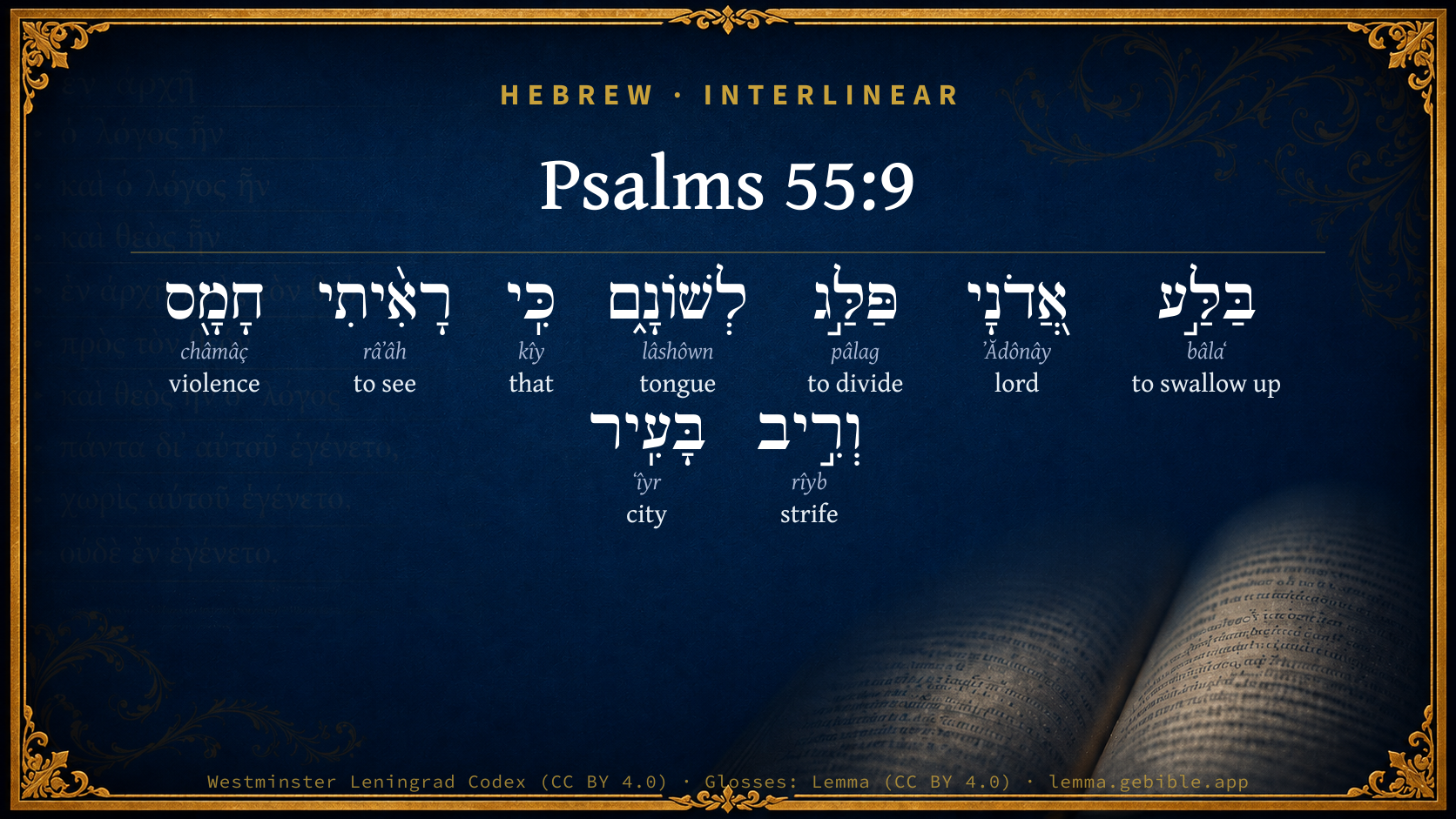
Hebrew (Westminster Leningrad Codex) Psalms 55:9 appears in the Hebrew Old Testament. The text above is from the Westminster Leningrad Codex. Each word links to its Strong’s number, a concise gloss, and parsing drawn from the Open Scriptures Hebrew Bible morphology. Click any word for its full Brown-Driver-Briggs (BDB) entry.
Download image
Cite this verse

Psalms 55:9 (World English Bible). Public Domain. Lemma interlinear Bible study tool, https://lemma.gebible.app/v/psalms/55/9.

Show BibTeX & RIS
BibTeX
RIS
English Translation
Confuse them, Lord, and confound their language, For I have seen violence and strife in the city.
World English Bible · Public Domain
Download a study sheet

One document with this verse’s original text, its word-by-word gloss line, the meaning frame, cross-references with their text, attributed commentary, and full source and license credits — printable, and it pastes into notes with its structure intact.

This verse Autodidact and up

Study sheet (.html) Plain text (.txt)

A passage Seminary Student

Up to 50 verses in one chapter. A passage sheet keeps up to 6 commentary sources and 12 cross-references per verse, in the order this page ranks them, and says so on the sheet whenever that leaves anything out. Ask for a single verse and you get the Autodidact verse sheet above.

Everything on this page stays free to read, with no account — the sheet is a download of what is already on screen, not access to it.

Want to remove ads? Support Godless Engineer
Compare translations 3

The same verse in 3 English versions, stacked beneath the original-language interlinear above. Click any original word for its lexicon entry.

Each is an independent rendering of the whole verse — the interlinear is not word-aligned to these translations.

Highlighted words mark where these versions differ — a whole-verse word diff, not a word-by-word alignment.

  • World English Bible Public Domain
    Confuse them, Lord, and confound their language, For I have seen violence and strife in the city.
  • King James Version Public Domain
    Destroy, O Lord, and divide their tongues: for I have seen violence and strife in the city.
  • unfoldingWord Literal Text CC BY-SA 4.0
    Swallow, Lord, divide their tongue! For I have seen violence and strife in the city.

unfoldingWord Literal Text — © unfoldingWord, licensed CC BY-SA 4.0. Word-aligned USFM3 via Door43 (git.door43.org/unfoldingWord/en_ult).

Versions to compare (up to 4)

3 of 4 selected

Show all 18 translations

Every available English version of this verse, each an independent rendering of the whole verse.

  • World English Bible Public Domain
    Confuse them, Lord, and confound their language, For I have seen violence and strife in the city.
  • Berean Standard Bible Public Domain
    O Lord, confuse and confound their speech, for I see violence and strife in the city.
  • Majority Standard Bible Public Domain
    O Lord, confuse and confound their speech, for I see violence and strife in the city.
  • King James Version Public Domain
    Destroy, O Lord, and divide their tongues: for I have seen violence and strife in the city.
  • American Standard Version (1901) Public Domain
    Destroy, O Lord, `and' divide their tongue; For I have seen violence and strife in the city.
  • Revised Version (1885) Public Domain
    Destroy, O Lord, and divide their tongue: for I have seen violence and strife in the city.
  • Geneva Bible (1599) Public Domain
    Destroy, O Lord, and deuide their tongues: for I haue seene crueltie and strife in the citie.
  • Douay-Rheims (1899) Public Domain
    And I said: Who will give me wings like a dove, and I will fly and be at rest?
  • Young's Literal Translation Public Domain
    Swallow up, O Lord, divide their tongue, For I saw violence and strife in a city.
  • Literal Standard Version CC BY-SA 4.0
    Swallow up, O Lord, divide their tongue, || For I saw violence and strife in a city.
  • Unlocked Literal Bible CC BY-SA 4.0
    Devour them, Lord, confuse their language! For I have seen violence and strife in the city.
  • unfoldingWord Literal Text CC BY-SA 4.0
    Swallow, Lord, divide their tongue! For I have seen violence and strife in the city.
  • Darby Bible Public Domain
    Swallow [them] up, Lord; divide their tongue: for I have seen violence and strife in the city.
  • World Messianic Bible Public Domain
    Confuse them, Lord, and confound their language, for I have seen violence and strife in the city.
  • Webster's Bible Public Domain
    \\55:8\\I would hasten my escape from the windy storm and tempest.
  • Free Bible Version CC BY-SA 4.0
    Confuse them, Lord! Muddle what they're saying, for I see violence and conflict in the city.
  • Bible in Basic English Public Domain
    Send destruction on them, O Lord, make a division of tongues among them: for I have seen fighting and violent acts in the town.
  • JPS Tanakh (1917) Public Domain
    (55-10) Destroy, O Lord, and divide their tongue; for I have seen violence and strife in the city.

Literal Standard Version (2020), Covenant Press — licensed CC BY-SA 4.0. Text via the HelloAO Bible API (eBible.org). Unlocked Literal Bible (unfoldingWord) — licensed CC BY-SA 4.0. Text via the HelloAO Bible API (eBible.org). unfoldingWord Literal Text — © unfoldingWord, licensed CC BY-SA 4.0. Word-aligned USFM3 via Door43 (git.door43.org/unfoldingWord/en_ult). Free Bible Version, Dr. Jonathan Gallagher — licensed CC BY-SA 4.0. Text via the HelloAO Bible API (eBible.org).

Word by word

More ways to search: Search by grammar → Find every occurrence → Compare this word →

Practice this passage: Drill this verse → Learn its vocabulary →

פַּלַּ֣ג
pâlag
H6385
“divide”
Verb, Piel, Imperative, 2nd Person, Masculine, Singular
Part of Speech
Verb
Stem
Piel
Form
Imperative
Person
2nd Person
Gender
Masculine
Number
Singular
Full BDB Definition

Origin: a primitive root

TWOT: 1769

to divide, split - (Niphal) to be split, be divided - (Piel) - to split, cleave - to divide
  1. בַּלַּ֣ע bâlaʻ H1104 “swallow up” Verb, Piel, Imperative, 2nd Person, Masculine, Singular
  2. אֲ֭דֹנָי ʼĂdônây H136 “Lord · my” Noun, Common, Masculine, Plural, Construct + Suffix, Personal, 1st Person, Common, Singular
  3. לְשׁוֹנָ֑ם lâshôwn H3956 “tongue · their” Noun, Common, Both, Singular, Construct + Suffix, Personal, 3rd Person, Masculine, Plural
  4. כִּֽי kîy H3588 “that” Conjunction
  5. רָאִ֨יתִי râʼâh H7200 “to see” Verb, Qal, Perfect, 1st Person, Common, Singular
  6. חָמָ֖ס châmâç H2555 “violence” Noun, Common, Masculine, Singular, Absolute
  7. וְרִ֣יב rîyb H7379 “and · strife” Conjunction + Noun, Common, Both, Singular, Absolute
  8. בָּעִֽיר ʻîyr H5892 “in/at the · city” Preposition, Determined + Noun, Common, Feminine, Singular, Absolute

About this verse

These counts appear in no published source. They are computed here, from the morphology-tagged text and Lemma’s own curated glosses. What Lemma adds →

9
words
9
distinct lemmas
Wisdom
section

Notable vocabulary

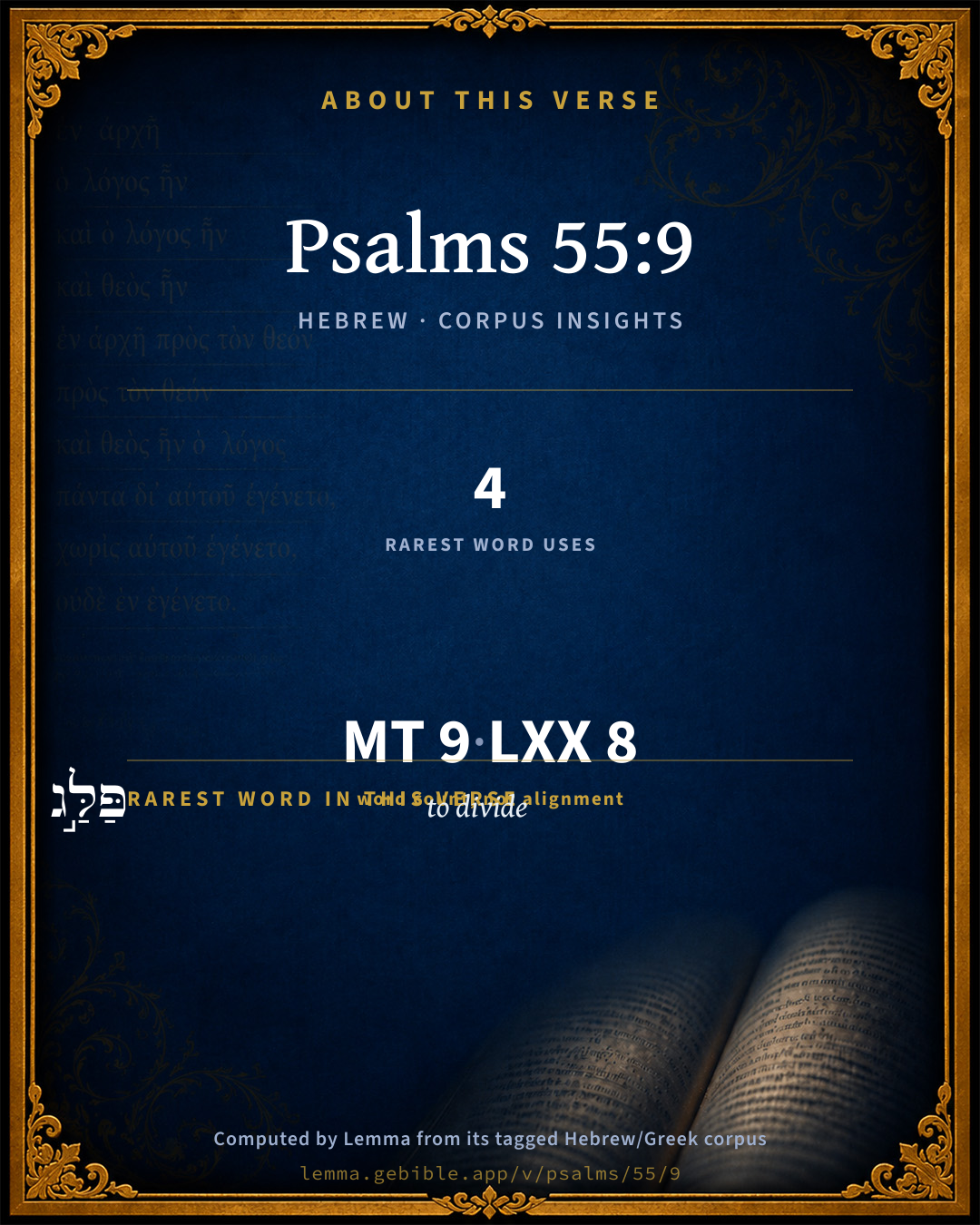
The rarest word here is פַּלַּ֣ג to divide H6385 — appearing just 4 times in the whole Hebrew Bible.

Shared distinctive vocabulary

פַּלַּ֣ג to divide H6385 occurs in 4 verses of the Hebrew Bible. Also found in:

Grammatical profile

  • 3 verbs
  • 5 nouns
  • 1 conjunction

Verb forms

  • בַּלַּ֣ע Piel · Imperative
  • פַּלַּ֣ג Piel · Imperative
  • רָאִ֨יתִי Qal · Perfect

Hebrew & Septuagint length

In English translation the verse runs 17 words from the Hebrew and 18 from the Septuagint (LXX English) — closely comparable.

A rough comparison of the two English renderings, which tokenize alike — not a word-level alignment.

Word counts can differ between the Hebrew and the Greek without any difference in meaning — e.g. the Hebrew direct-object marker אֵת has no separate Greek word, and Greek often adds the article ὁ.

In the original languages it is 9 Hebrew tokens and 8 Greek tokens — but the two are counted differently (Hebrew bundles its prefixes and suffixes into one token; the Greek is in lemma form), so that isn’t a like-for-like length.

Cross-references

8

Topical passages linked to Psalms 55:9 in the Treasury of Scripture Knowledge — connected by theme and wording, ordered by reader-vote popularity; previews shown in the World English Bible.

  • Jeremiah 6:7 As a well casts forth its waters, so she casts forth her wickedness: violence and destruction is heard in her; before me continually is sickness and wounds.
  • Genesis 11:7–9 Come, let's go down, and there confuse their language, that they may not understand one another's speech."
  • 2 Samuel 15:31 One told David, saying, Ahithophel is among the conspirators with Absalom. David said, Yahweh, please turn the counsel of Ahithophel into foolishness.
  • Jeremiah 23:14 In the prophets of Jerusalem also I have seen a horrible thing: they commit adultery, and walk in lies; and they strengthen the hands of evil-doers, so that none does return from his wickedness: they are all of them become to me as Sodom, and the inhabitants of it as Gomorrah.
  • Matthew 23:37–38 "Jerusalem, Jerusalem, who kills the prophets, and stones those who are sent to her! How often would I have gathered your children together, even as a hen gathers her chickens under her wings, and you would not!
  • John 7:45–53 The officers therefore came to the chief priests and Pharisees, and they said to them, "Why didn't you bring him?"
  • Acts 23:6–10 But when Paul perceived that the one part were Sadducees and the other Pharisees, he cried out in the council, "Men and brothers, I am a Pharisee, a son of Pharisees. Concerning the hope and resurrection of the dead I am being judged!"
  • 2 Samuel 17:1–14 Moreover Ahithophel said to Absalom, Let me now choose out twelve thousand men, and I will arise and pursue after David this night:

Cross-references courtesy of OpenBible.info (CC BY 4.0).

Hebrew and Greek witnesses Masoretic Hebrew ↔ Greek Septuagint

The same verse in the two great witnesses to the Old Testament, shown verse-for-verse.

You’re reading Greek Psalm 54 (Hebrew Psalm 55). The Septuagint counts the superscription, so verse numbers can differ from the Hebrew — chapter-level alignment, not verse-by-verse. Numbering follows Rahlfs.

These are two independent witnesses, not word-aligned to each other, and the Septuagint is shown in lemma (dictionary) form.

Hebrew Psalms 55:9 Masoretic · Westminster Leningrad Codex

בַּלַּ֣ע אֲ֭דֹנָי פַּלַּ֣ג לְשׁוֹנָ֑ם כִּֽי רָאִ֨יתִי חָמָ֖ס וְרִ֣יב בָּעִֽיר

Confuse them, Lord, and confound their language, For I have seen violence and strife in the city.

World English Bible · Public Domain

Greek LXX Greek Psalm 54:9 Septuagint · lemma form

προςδέχομαι ὁ σώζω ἐγώ ἀπό ὀλιγοψυχία καί καταιγίς

Destroy, O Lord, and divide their tongues: for I have seen iniquity and gain saying in the city.

LXX2012 (modern English Septuagint) · Public Domain

On this verse, Ellicott's Commentary for English Readers discusses the Septuagint’s reading. Read the note in Commentary ↓

Hebrew: Westminster Leningrad Codex (CC BY 4.0). Greek: Septuagint (public domain); English from LXX2012 (modern English Septuagint) (Public Domain). How the Septuagint differs from the Hebrew →

Commentary

Notes on Psalms 55:9 from classic Christian and Jewish commentators (each source and its license shown beneath its notes). The classic Christian expositions comment on the surrounding passage and are grouped to its opening verse, so a note may address several verses; the Jewish commentaries on the Tanakh (Rashi and others) are per-verse, so they appear only where the commentator wrote on this verse.

Lemma curates 59 commentaries, every one of them public domain or Creative Commons licensed, each selected and text-cleaned for this edition rather than reprinted as found. About our sources →

Matthew Henry's Commentary

David here complains of his enemies, whose wicked plots had brought him, though not to his faith's end, yet to his wits' end, and prays against them by the spirit of prophecy. Observe here,

I. The character he gives of the enemies he feared. They were of the worst sort of men, and his description of them agrees very well with Absalom and his accomplices. 1. He complains of the city of Jerusalem, which strangely fell in with Absalom and fell off from David, so that he had none there but how own guards and servants that he could repose any confidence in: How has that faithful city become a harlot! David did not take the representation of it from others; but with his own eyes, and with a sad heart, did himself see nothing but violence and strife in the city (Psa 55:9); for, when they grew disaffected and disloyal to David, they grew mischievous one to another. If he walked the rounds upon the walls of the city, he saw that violence and strife went about it day and night, and mounted its guards, Psa 55:10. All the arts and methods which the rebels used for the fortifying of the city were made up on violence and strife, and there were no remains of honesty or love among them. If he looked into the heart of the city, mischief and injury, mutual wrong and vexation, were in the midst of it: Wickedness, all manner of wickedness, is in the midst thereof. Jusque datum sceleri - Wickedness was legalized. Deceit and guile, and all manner of treacherous dealing, departed not from her streets, Psa 55:11. It may be meant of their base and barbarous usage of David's friends and such as they knew were firm and faithful to him; they did them all the mischief they could, by fraud or force. Is this the character of Jerusalem, the royal city, and, which is more, the holy city, and in David's time too, so soon after the thrones of judgment and the testimony of Israel were both placed there? Is this the city that men call the perfection of beauty? Lam 2:15. Is Jerusalem, the head-quarters of God's priests, so ill taught? Can Jerusalem be ungrateful to David himself, its own illustrious founder, and be made too hot for him, so that he cannot reside in it? Let us not be surprised at the corruptions and disorders of this church on earth, but long to see the New Jerusalem, where there is no violence nor strife, no mischief nor guilt, and into which no unclean thing shall enter, nor any thing that disquiets. 2. He complains of one of the ringleaders of the conspiracy, that had been very industrious to foment jealousies, to misrepresent him and his government, and to incense the city against him. It was one that reproached him, as if he either abused his power or neglected the use of it, for that was Absalom's malicious suggestion: There is no man deputed of the king to hear thee, Sa2 15:3. That and similar accusations were industriously spread among the people; and who was most active in it? "Not a sworn enemy, not Shimei, nor any of the nonjurors; then I could have borne it, for I should not have expected better from them" (and we find how patiently he did bear Shimei's curses); "not one that professed to hate me, then I would have stood upon my guard against him, would have hidden myself and counsels from him, so that it would not have been in his power to betray me. But it was thou, a man, my equal," Psa 55:13. The Chaldee-paraphrase names Ahithophel as the person here meant, and nothing in that plot seems to have discouraged David so much as to hear that Ahithophel was among the conspirators with Absalom (Sa2 15:31), for he was the king's counsellor, Ch1 27:33. "It was thou, a man, my equal, one whom I esteemed as myself, a friend as my own soul, whom I had laid in my bosom and made equal with myself, to whom I had communicated all my secrets and who knew my mind as well as I myself did, - my guide, with whom I advised and by whom I was directed in all my affairs, whom I made president of the council and prime-minister of state, - my intimate acquaintance and familiar friend; this is the man that now abuses me. I have been kind to him, but I find him thus basely ungrateful. I have put a trust in him, but I find him thus basely treacherous; nay, and he could not have done me the one-half of the mischief he does if I had not shown him so much respect." All this must needs be very grievous to an ingenuous mind, and yet this was not all; this traitor had seemed a saint, else he had never been David's bosom-friend (Psa 55:14): "We took counsel together, spent many an hour together, with a great deal of pleasure, in religious discourse," or, as Dr. Hammond reads it, "We joined ourselves together to the assembly; I gave him the right hand of fellowship in holy ordinances, and then we walked to the house of God in company, to attend the public service." Note, (1.) There always has been, and always will be, a mixture of good and bad, sound and unsound, in the visible church, between whom, perhaps for a long time, we can discern no difference; but the searcher of hearts does. David, who went to the house of God in his sincerity, had Ahithophel in company with him, who went in his hypocrisy. The Pharisee and the publican went together to the temple to pray; but, sooner or later, those that are perfect and those that are not will be made manifest. (2.) Carnal policy may carry men on very far and very long in a profession of religion while it is in fashion, and will serve a turn. In the court of pious David none was more devout than Ahithophel, and yet his heart was not right in the sight of God. (3.) We must not wonder if we be sadly deceived in some that have made great pretensions to those two sacred things, religion and friendship; David himself, though a very wise man, was thus imposed upon, which may make similar disappointments the more tolerable to us.

II. His prayers against them, which we are both to stand in awe of and to comfort ourselves in, as prophecies, but not to copy into our prayers against any particular enemies of our own. He prays, 1. That God would disperse them, as he did the Babel-builders (Psa 55:9): "Destroy, O Lord! and divide their tongues; that is, blast their counsels, by making them to disagree among themselves, and clash with one another. Send an evil spirit among them, that they may not understand one another, but be envious and jealous one of another." This prayer was answered in the turning of Ahithophel's counsel into foolishness, by setting up the counsel of Hushai against it. God often destroys the church's enemies by dividing them; nor is there a surer way to the destruction of any people than their division. A kingdom, an interest, divided against itself, cannot long stand. 2. That God would destroy them, as he did Dathan and Abiram, and their associates, who were confederate against Moses, whose throat being an open sepulchre, the earth therefore opened and swallowed them up. This was then a new thing which God executed, Num 16:30. But David prays that it might now be repeated, or something equivalent (Psa 55:15): "Let death seize upon them by divine warrant, and let them go down quickly into hell; let them be dead, and buried, and so utterly destroyed, in a moment; for wickedness is wherever they are; it is in the midst of them." The souls of impenitent sinners go down quick, or alive, into hell, for they have a perfect sense of their miseries, and shall therefore live still, that they may be still miserable. This prayer is a prophecy of the utter, the final, the everlasting ruin of all those who, whether secretly or openly, oppose and rebel against the Lord's Messiah.

Matthew Henry's Commentary on the Whole Bible (1708–1710) — public domain (CC PDM 1.0). Text via the HelloAO Bible API.

Trapp's Complete Commentary

John Trapp

Psa 55:9 Destroy, O Lord, [and] divide their tongues: for I have seen violence and strife in the city.

Ver. 9. Destroy, O Lord, and divide their tongues] Heb. Swallow them up, O Lord, and divide their tongues; by an allusion, as some conceive, to those two famous judgments of God upon Dathan and Abiram, first, Num 16:31-33, and then, secondly, upon the Babel builders, Gen 11:6-9, both which were thrown out for examples to all succeeding ages (as St Jude saith of the Sodomites, Jdg 1:7), and are to be considered by the saints, as here, in their prayers against their enemies. How God answered this prayer to David, see 2Sa 17:1-14, &c.

For I have seen violence and strife in the city] i.e. In Jerusalem, something I have seen, but more outrages I have heard of, since Absalom with his army came into it. The rude soldiers plunder the poor citizens at pleasure, and cannot agree among themselves in dividing the spoil.

John Trapp, A Commentary or Exposition upon All the Books of the Old and New Testament (1647–1656) — public domain. Text from a community e-Sword module.

Joseph Benson's Commentary

Psa 55:9. Destroy, O Lord, and divide — Destroy them by dividing their tongues — Their speech, as thou didst at Babel, (Genesis 11.,) their votes, and opinions, and counsels. Which was eminently done among Absalom’s followers, 2 Samuel 17. I have seen violence and strife — Injustice and fraud, oppression and contention rule there, instead of that public justice and peace which I established. In the city — In Jerusalem, which in Absalom’s time was a sink of all sins. And this circumstance is mentioned as an aggravation of their wickedness, that it was committed in that city where the throne and seat of public justice were settled; and where God was in a special manner present, and worshipped, and where they had great opportunities both for the knowledge and practice of their several duties.

Joseph Benson's Commentary on the Old and New Testaments (1811–1818) — public domain. Text from a community e-Sword module.

J. A. Alexander on Psalms

Joseph Addison Alexander

10. (Psa 55:9). Destroy, O Lord, divide their tongue; for I have seen violence and strife in the city. The first word properly means swallow up. See above, on Psa 21:9. The object to be supplied is not their tongue but themselves. Divide their tongue, i. e. confound their speech or make it uninteligible, and as a necessary consequence confound their counsels. There is obvious reference to the confusion of tongues at Babel (Gen 11:7-9), as a great historical example of the way in which God is accustomed and determined to defeat the purposes of wicked men and execute his own. The word translated cruelty denotes violent injustice, or injustice accompanied by violence. See above, on Psa 7:16. In the city is supposed by some to mean nothing more than among men, in human society; but the words could hardly fail to suggest to any Hebrew reader the idea of the holy city, as the place directly meant, although the words themselves may be applied to any other place where the same state of things exist.

Joseph Addison Alexander, The Psalms Translated and Explained (1850) — public domain. Text from a community e-Sword module.

Geneva Bible (1599)

Geneva Bible translators

As in the confusion of Babylon when the wicked conspired against God.

Geneva Bible (1599) marginal notes — public domain. Text via Bolls.life.

Jamieson, Fausset & Brown

Robert Jamieson, A. R. Fausset & David Brown

Destroy--literally, "swallow" (Psa 21:9).

divide their tongues--or, "confound their speech," and hence their counsels (Gen 11:7).

the city--perhaps Jerusalem, the scene of anarchy.

Jamieson, Fausset & Brown — Commentary Critical and Explanatory on the Whole Bible (1871) — public domain (CC PDM 1.0). Text via the HelloAO Bible API.

Adam Clarke's Commentary

Verse 9. Destroy, O lord] Swallow them up-confound them.

Divide their tongues] Let his counsellors give opposite advice. Let them never agree, and let their devices be confounded. And the prayer was heard. Hushai and Ahithophel gave opposite counsel. Absalom followed that of Hushai; and Ahithophel, knowing that the steps advised by Hushai would bring Absalom's affairs to ruin, went and hanged himself. See 2Sa 15:1-17.

Violence and strife in the city.] They have been concerting violent measures; and thus are full of contention.

Adam Clarke's Commentary on the Bible (1810–1826) — public domain. Text from a community e-Sword/MySword module.

John Calvin's Commentaries

9. Destroy, O Lord; and divide their tongue Having now composed, as it were, his mind, he resumes the exercise of prayer. Had he indulged longer in the strain of complaint, he might have given his sanction to the folly of those who do themselves more harm than good by the excessive use of this barren species of comfort. There will occasionally escape from the lips of a saint, when he prays, some complaining exclamations which cannot be altogether justified, but he soon recalls himself to the exercise of believing supplication. In the expression, divide their tongue, there seems an allusion to the judgment which fell upon the builders of Babel, (Genesis 31:7.) He means in general to pray that God would break their criminal confederacies, and distract their impious counsels, but evidently with an indirect reference to that memorable proof which God gave of his power to thwart the designs of the wicked by confounding their communication. It is thus that to this day he weakens the enemies of the Church, and splits them into factions, through the force of mutual animosities, rivalries, and disagreements in opinion. For his own encouragement in prayer, the Psalmist proceeds to insist upon the wickedness and malignity of his adversaries, this being a truth never to be lost sight of, that just in proportion as men grow rampant in sin, may it be anticipated that the divine judgments are about to descend upon them. From the unbridled license prevailing amongst them, he comforts himself with the reflection that the deliverance of God cannot be far distant; for he visits the proud, but gives more grace to the humble. Before proceeding to pray for divine judgments against them, he would intimate that he had full knowledge of their evil and injurious character. Interpreters have spent an unnecessary degree of labor in determining whether the city here spoken of was that of Jerusalem or of Keilah, for David by this term would appear merely to denote the open and public prevalence of crime in the country. The city stands opposed to places more hidden and obscure, and he insinuates that strife was practiced with unblushing publicity. Granting that the city meant was the metropolis of the kingdom, this is no reason why we should not suppose that the Psalmist had in his view the general state of the country; but the term is, in my opinion, evidently employed in an indefinite sense, to intimate that such wickedness as is generally committed in secret was at that time openly and publicly perpetrated. It is with the same view of marking the aggravated character of the wickedness then reigning in the nation, that he describes their crimes as going about the walls, keeping sentry or watch, so to speak, upon them. Walls are supposed to protect a city from rapine and incursion, but he complains that this order of things was inverted — that the city, instead of being surrounded with fortifications, was beset with strife and oppression, or that these had possession of the walls, and went about them. I have already commented elsewhere upon the words און, aven, and עמל, amal. In announcing that wickedness was in the midst of the city, and deceit and guile in her streets, he points to the true source of the prevailing crimes; even as it was to be expected that those who were inwardly corrupt, and given to such mischievous devices, would indulge in violence, and in persecuting the poor and defenseless. In general, he is to be considered as adverting in this passage to the deplorable confusions which marked the government of Saul, when justice and order were in a manner banished from the realm. And whether his description were intended to apply to one city or to many, matters had surely reached a portentous crisis in a nation professing the true religion, when any of their cities had thus become a den of robbers. It may be observed, too, that David, in denouncing a curse, as he does in the psalm before us, upon cities of this description, was obviously borne out by what must have been the judgment of the Holy Spirit against them.

John Calvin's Commentaries (1540-1563) — public domain. Text from the Calvin Translation Society English edition (1840s-50s) via the Christian Classics Ethereal Library (ccel.org). Calvin's coverage is partial (roughly two-thirds of the Bible); uncommented books and verses are honest gaps, never fabricated. The 19th-century editor's footnotes and remarks are omitted so the notes are faithfully Calvin's own voice.

Ellicott's Commentary for English Readers

(9) Destroy.—Literally, swallow up. So the LXX., forcibly, “drown in the sea.” The object them must be supplied.

This sudden change from plaintive sadness to violent invective is one of the marked features of this poem. Some think there has been a transposition of verses, but in lyric poetry these abrupt transitions of tone are not uncommon nor unpleasing.

Divide their tongues—i.e., cause division in their councils. “Divide their voices” would be almost English, being exactly the opposite of Shakespeare’s “a joint and corporate voice.”

For I have seen.—With the sense, and see still.

A Bible Commentary for English Readers, edited by Charles John Ellicott (1878–1897) — public domain. Text from a community e-Sword module.

The Cambridge Bible for Schools and Colleges

gen. ed. J. J. S. Perowne

9. Destroy] Lit., swallow up these malicious plotters, as the earth swallowed up Korah and his crew (Num_16:32). From several passages however it has been inferred that this verb also means to confound; and if so, their tongue may be the object of both verbs, and there may be a reminiscence of two passages in Genesis:—“The Lord did there confound the language of all the earth” (Gen_11:9): and “In his days was the earth divided” (Gen_10:25). May confusion and division such as overtook the builders of Babel overtake them, and break up their confederacy!

9–11. He prays for the confusion of his enemies’ counsels, and describes the miserable condition of the city.

9–15. The plaintive pleading of the opening verses suddenly gives way to a fierce outburst of indignation.

The Cambridge Bible for Schools and Colleges (gen. ed. J. J. S. Perowne; Cambridge University Press, 1878–1918) — public domain. Text from a community e-Sword module.

John Gill's Exposition

Day and night they go about it, upon the walls thereof,.... That is, "violence" and "strife" go about the walls of it continually; men of violence and contention are the only watchmen of it: a city must be sadly guarded that has no better watch than this;

mischief also and sorrow are in the midst of it; it was full of wickedness within and without; the city, as Aben Ezra observes, was like a circle; violence and strife were as a line round about it, and mischief and sorrow the centre of it: and these two commonly go together; where mischief is, sorrow follows.

John Gill's Exposition of the Whole Bible (1746–1763) — public domain (CC PDM 1.0). Text via the HelloAO Bible API.

Albert Barnes' Notes on the Bible

Destroy, O Lord - The word rendered “destroy,” properly means to “swallow up;” to “devour” with the idea of greediness. Isa 28:4; Exo 7:12; Jon 1:17; Jer 51:34. Then it is used in the sense of “destroy,” Job 20:18; Pro 1:12. The reference here is to the persons who had conspired against David. It is a prayer that they, and their counsels, might be destroyed: such a prayer as people always offer who pray for victory in battle. It is a prayer that the may be successful in what they regard as a righteous cause; but this implies a prayer that their enemies may be defeated and overcome. That is, they pray for success in what they have undertaken; and if it is right for them to attempt to do the thing, it is not wrong to pray that they may be succesful.

And divide their tongues - There is evident allusion here to the confusion of tongues at Babel Gen 11:1-9; and as the language of those who undertook to build that tower was confounded so that they could not understand each other, so the psalmist prays that the counsels of those engaged against him might be confounded, or that they might be divided and distracted in their plans, so that they could not act in harmony. It is very probable that there is an allusion here to the prayer which David offered when he learned that Ahithophel was among the conspirators 2Sa 15:31; “And David said, O Lord, I pray thee, turn the counsel of Ahithophel into foolishness.” This would tend to divide and distract; the purposes of Absalom, and secure his defeat.

For I have seen violence and strife in the city - In Jerusalem. Perhaps he had learned that among the conspirators there was not entire harmony, but that there were elements of “strife” and discord which led him to hope that their counsels would be confounded. There was little homogeneoushess of aim and purpose among the followers of Absalom; and perhaps David knew enough of Ahithophel to see that his views, though he might be enlisted in the cause of the rebellion, would not be likely to harmonize with the views of the masses of those who were engaged in the revolt.

Albert Barnes' Notes on the Bible (1834–1885) — public domain. Text from a community e-Sword/MySword module.

Matthew Poole's English Annotations

Divide their tongues, i.e. destroy them by dividing.

Their tongues, i.e. their speech, as thou didst at Babel, Ge 11; their votes, and opinions, and counsels; which was eminently done among Absalom’s followers, 2Sa 17.

I have seen; or, I do see or perceive, by certain and general report. Violence and strife in the city; that injustice, and fraud, and oppression, and contention bear rule there, instead of that public justice and peace which I established and maintained in it. In the city; either,

1. In Keilah, where David thought to abide, 1Sa 23, Or,

2. In Gibeah, where Saul had his abode. Or rather,

3. In Jerusalem; which is called the city by way of eminency; and which in Absalom’s time was the chief seat of rebellion, and a mere sink of all sins. And this circumstance is noted as an aggravation of their wickedness, that it was committed in that city, where the throne and seat of public justice was settled; and where God was in a special manner present and worshipped; and where they had great opportunities, both for the knowledge and practice of their several duties.

Matthew Poole's English Annotations on the Holy Bible (1683–1685) — public domain. Text from a community e-Sword/MySword module.

The Treasury of David

Charles H. Spurgeon

Ver. 9. Destroy, O Lord. Put mine enemies to the rout. Let them be devoured by the sword, since they have unsheathed it against me. How could we expect the exiled monarch to offer any other prayer than this against the rebellious bands of Absalom, and the crafty devices of Ahithophel?

Divide their tongues. Make another Babel in their debates and councils of war. Set them at cross purposes. Divide the pack that the hunted one may escape. The divisions of error are the hope of truth.

For I have seen violence and strife in the city. The rabble and their leaders were plotting and planning, raging and contending against their king, running wild with a thousand mad projects: anarchy had fermented among them, and the king hoped that now it might come to pass that the very lawlessness which had exiled him would create weakness among his foes. Revolution devours its own children. They who are strong through violence, will sooner or later find that their strength is their death. Absalom and Ahithophel may raise the mob, but they cannot so easily rule it, nor so readily settle their own policy as to remain firm friends. The prayer of David was heard, the rebels were soon divided in their councils; Ahithophel went his way to be hanged with a rope, and Absalom to be hanged without one.

Ver. 9. Destroy, O Lord, and divide their tongues. In the first place, their tongues were truly destroyed and they themselves divided, when the testimony of the two false witnesses agreed not so together. Then secondly, by the contradictory account of the soldiers that kept watch at the sepulchre. Michael Ayguan (1416) in J. M. Neal's Commentary, 1860.

Ver. 9. Divide their tongues: i.e., cause them to give conflicting opinions. French and Skinner, 1842

Ver. 9. (first clause). The Babel of heresies. Essential, for truth is one. Inevitable, for the motives of heretics clash. Providential, for so they weaken each other. Judicial, for so they torment each other.

Psalms 55:10*

Charles H. Spurgeon's The Treasury of David (1869–1885) — public domain. Psalms only. Text from a community e-Sword/MySword module.

Whedon's Commentary on the Bible

Daniel D. Whedon

9. Destroy—Literally, swallow them up. Let their destruction be sudden and at a single blow, as Psa_106:17.

Divide their tongues—An allusion to Gen_11:7; compare Isa_19:3. This was done when the conspirators were divided in counsel, the first and fatal step in Absalom’s downfall. Compare 2Sa_15:31, “And David said, O Lord, I pray thee, turn the counsel of Ahithophel into foolishness.” Accomplished, 2Sa_17:1-14.

Violence and strife in the city— “All kinds of party passions have broken loose.”—Delitzsch.

Daniel D. Whedon (gen. ed.), Commentary on the Old and New Testaments (1874–1909) — public domain. Text from a community e-Sword module.

The Pulpit Commentary

Vers. 9-15. With a sudden transition, the writer passes from his own suffering, fears, and longings, to imprecations on his enemies, and a description of their wicked proceedings. In the course of his description he singles out one individual for special remark one who had been his own guide, companion, and friend but who had turned against him, and joined the company of his adversaries (vers. 12-14).

Destroy, O Lord, and divide their tongues. The second clause contains a reference to the confusion of tongues at Babel. (Gen_11:7) "Introduce confusion into their counsels, and disperse them, as thou didst with the wicked ones who were forced to leave off to build the Tower." For I have seen violence and strife in the city. Such quarrels and broils, i.e., as usually precede revolutionary disturbance.

Vers. 9-15. A picture of corrupt city life and private life, and a denunciation of God"s judgments upon them.

I CORRUPT CITY LIFE. (Vers. 10, 11)

1. Corrupt in every part, on the walls and in the interior. Violence and strife reign unchecked universally.

2. Falsehood and deceit ruled in the market-place. (Ver. 11) In the square, or market-place, near the gates, where was the general place of concourse, men cheated and deceived each other in their ordinary intercourse.

II PICTURE OF CORRUPT PRIVATE LIFE. The sanctities of friendship were openly violated and renounced. The offence was aggravated by two things.

1. That he who had become the psalmists enemy had been a closely intimate friend. Love had turned to hate, because of the triumph of evil designs or passions, or of "the whispering tongues that can poison truth.

2. Their friendship had been consecrated by religious associations. (Ver. 14) A depraved life can sweep out of the mind the tenderest memories and the most holy associations, human and Divine.

III THE PSALMIST PRAYS FOR GOD"S JUDGMENTS UPON THIS CORRUPT LIFE. The two forms of judgment which he imprecates are:

1. The judgment that fell upon the builders of Babel. (Ver. 9) Discord among themselves and their counsels, so that they might destroy one another.

2. That they might go down to the grave alive. (Ver. 15) Like Korah and his company, let them be carried away by death in the fulness of life and strength. The psalmist knew of none but violent means and temporal judgments by which such wickedness could be removed. S.

The Pulpit Commentary (1880–1919), ed. H.D.M. Spence-Jones & Joseph S. Exell — public domain. Text from a community e-Sword module.

John Wesley's Explanatory Notes

Destroy - Destroy them by dividing. Tongues - Their speech, as thou didst at Babel, Gen. xi, 9, their votes, and opinions, and counsels. Which was eminently done among Absalom's followers, 2 Sam. xvii, 23. Strife - Injustice and fraud, oppression and contention rule here, instead of that public justice and peace which I established. City - In Jerusalem; which in Absalom's time was a sink of all sins.

John Wesley, Explanatory Notes Upon the Whole Bible (1754–1765) — public domain. Text via the GEBible commentary corpus.

Keil & Delitzsch

C. F. Keil & F. Delitzsch

In the second group anger is the prevailing feeling. In the city all kinds of party passions have broken loose; even his bosom friend has taken a part in this hostile rising. The retrospective reference to the confusion of tongues at Babel which is contained in the word פּלּג (cf. Gen 10:25), also in remembrance of בּלל (Gen 11:1-9), involves the choice of the word בּלּע, which here, after Isa 19:3, denotes a swallowing up, i.e., annihilation by means of confounding and rendering utterly futile. לשׁונם is the object to both imperatives, the second of which is פּלּג (like the pointing usual in connection with a final guttural) for the sake of similarity of sound. Instead of חמס וריב, the pointing is חמס וריב, which is perfectly regular, because the וריב with a conjunctive accent logically hurries on to בּעיר as its supplement.

(Note: Certain exceptions, however, exist, inasmuch as ו sometimes remains even in connection with a disjunctive accent, Isa 49:4; Jer 40:10; Jer 41:16; and it is pointed ו in connection with a conjunctive in Gen 45:23; Gen 46:12; Lev 9:3; Mic 2:11; Job 4:16; Ecc 4:8.)

The subjects to Psa 55:11 are not violence and strife (Hengstenberg, Hitzig), for it is rather a comical idea to make these personified run round about upon the city walls; but (cf. Psa 59:7, Psa 59:15) the Absalomites, and in fact the spies who incessantly watch the movements of David and his followers, and who to this end roam about upon the heights of the city. The narrative in 2 Sam. 15 shows how passively David looked on at this movement, until he abandoned the palace of his own free will and quitted Jerusalem The espionage in the circuit of the city is contrasted with the movements going on within the city itself by the word בּקרב. We are acquainted with but few details of the affair; but we can easily fill in the details for ourselves in accordance with the ambitious, base, and craftily malicious character of Absalom. The assertion that deceit (מרמה) and the extremest madness had taken possession of the city is confirmed in Psa 55:13 by כּי. It is not open enemies who might have had cause for it that are opposed to him, but faithless friends, and among them that Ahithophel of Giloh, the scum of perfidious ingratitude. The futures ואשּׂא and ואסּתר are used as subjunctives, and ו is equivalent to alioqui, as in Psa 51:18, cf. Job 6:14. He tells him to his face, to his shame, the relationship in which he had stood to him whom he now betrays. Psa 55:14 is not to be rendered: and thou art, etc., but: and thou (who dost act thus) wast, etc.; for it is only because the principal clause has a retrospective meaning that the futures נמתּיק and נהלּך describe what was a custom in the past. The expression is designedly אנושׁ כּערכּי and not אישׁ כערכי; David does not make him feel his kingly eminence, but places himself in the relation to him of man to man, putting him on the same level with himself and treating him as his equal. The suffix of כערכי is in this instance not subjective as in the כערכך of the law respecting the asham or trespass-offering: according to my estimation, but objectively: equal to the worth at which I am estimated, that is to say, equally valued with myself. What heart-piercing significance this word obtains when found in the mouth of the second David, who, although the Son of God and peerless King, nevertheless entered into the most intimate human relationship as the Son of man to His disciples, and among them to that Iscariot! אלּוּף from אלף, Arabic alifa, to be accustomed to anything, assuescere, signifies one attached to or devoted to any one; and מידּא, according to the Hebrew meaning of the verb ידע, an intimate acquaintance. The first of the relative clauses in Psa 55:15 describes their confidential private intercourse; the second the unrestrained manifestation of it in public. סוד here, as in Job 19:19 (vid., supra on Psa 25:14). המתּיק סוד, to make friendly intercourse sweet, is equivalent to cherishing it. רגשׁ stands over against סוד, just like סוד, secret counsel, and רגשׁה, loud tumult, in Psa 64:3. Here רגשׁ is just the same as that which the Korahitic poet calls המון חוגג in Psa 42:5.

In the face of the faithless friends who has become the head of the Absalomite faction David now breaks out, in Psa 55:16, into fearful imprecations. The Chethb is ישׁימות, desolationes (super eos); but this word occurs only in the name of a place ("House of desolations"), and does not well suit such direct reference to persons. On the other hand, the Ker ישּׁיאמות, let death ensnare or impose upon them, gives a sense that is not to be objected to; it is a pregnant expression, equivalent to: let death come upon them unexpectedly. To this ישּׁיא corresponds the חיּים of the second imprecation: let them go down alive into Hades (שׁאול, perhaps originally שׁאולה, the ה of which may have been lost beside the ח that follows), i.e., like the company of Korah, while their life is yet vigorous, that is to say, let them die a sudden, violent death. The drawing together of the decipiat (opprimat) mors into one word is the result of the ancient scriptio continua and of the defective mode of writing, ישּׁי, like יני, Psa 141:5, אבי, Kg1 21:29. Bttcher renders it differently: let death crash in upon them; but the future form ישּׁי = ישׁאה from שׁאה = שׁאי is an imaginary one, which cannot be supported by Num 21:30. Hitzig renders it: let death benumb them (ישּׁים); but this gives an inconceivable figure, with the turgidity of which the trepidantes Manes in Virgil, Aenid viii. 246, do not admit of comparison. In the confirmation, Psa 55:16, בּמגוּרם, together with the בּקרבּם which follows, does not pretend to be any advance in the thought, whether מגור be rendered a settlement, dwelling, παροικία (lxx, Targum), or an assembly (Aquila, Symmachus, Jerome). Hence Hitzig's rendering: in their shrine, in their breast (= ἐν τῷ θησαυρῷ τῆς καρδίας αὐτῶν, Luk 6:45), מגוּרם being short for מגוּרתם in accordance with the love of contraction which prevails in poetry (on Psa 25:5). But had the poet intended to use this figure he would have written בּמגוּרת קרבם, and is not the assertion that wickedness is among them, that it is at home in them, really a climax? The change of the names of God in Psa 55:17 is significant. He calls upon Him who is exalted above the world, and He who mercifully interposes in the history of the world helps him.

Keil & Delitzsch — Biblical Commentary on the Old Testament (1861–1891) — public domain (CC PDM 1.0). Text via the HelloAO Bible API. (Old Testament only.)

Lesson kit

Teaching starters — assembled from the data on this page, not authored interpretation. Every prompt links to the verse data it draws on. Edit before teaching.

Psalms, in the Wisdom, opens this verse with 9 words (9 distinct Hebrew lemmas). Its most distinctive word is pâlag (“to divide”). A historical commentator’s framing appears above. Read the whole chapter for the surrounding context.

Discussion questions

  1. How does “to divide” (pâlag) shape what this verse is saying?
  2. How does Genesis 10:25, which shares the word «to divide», read alongside this verse?
  3. The translations on this page render this verse differently — a whole-verse word diff, not a word-by-word alignment. What might account for the different wordings?
  4. «בַּלַּ֣ע» is a Piel Imperative verb. How does that grammatical form shape the action described?
  5. Compare how Matthew Henry's Commentary and Trapp's Complete Commentary read this verse. Where do they agree or differ?

Things to notice

Reading settings

Reading text

Shown beneath each verse's original-language words.

Old Testament
Old Testament edition

Read the OT as the Masoretic Hebrew (MT) or the Greek Septuagint (LXX).

English shown for the Greek Septuagint (in the Hebrew ↔ Greek comparison).

Comparing translations? Open the Compare panel on any verse page to stack up to four side by side.