Psalms 54:3

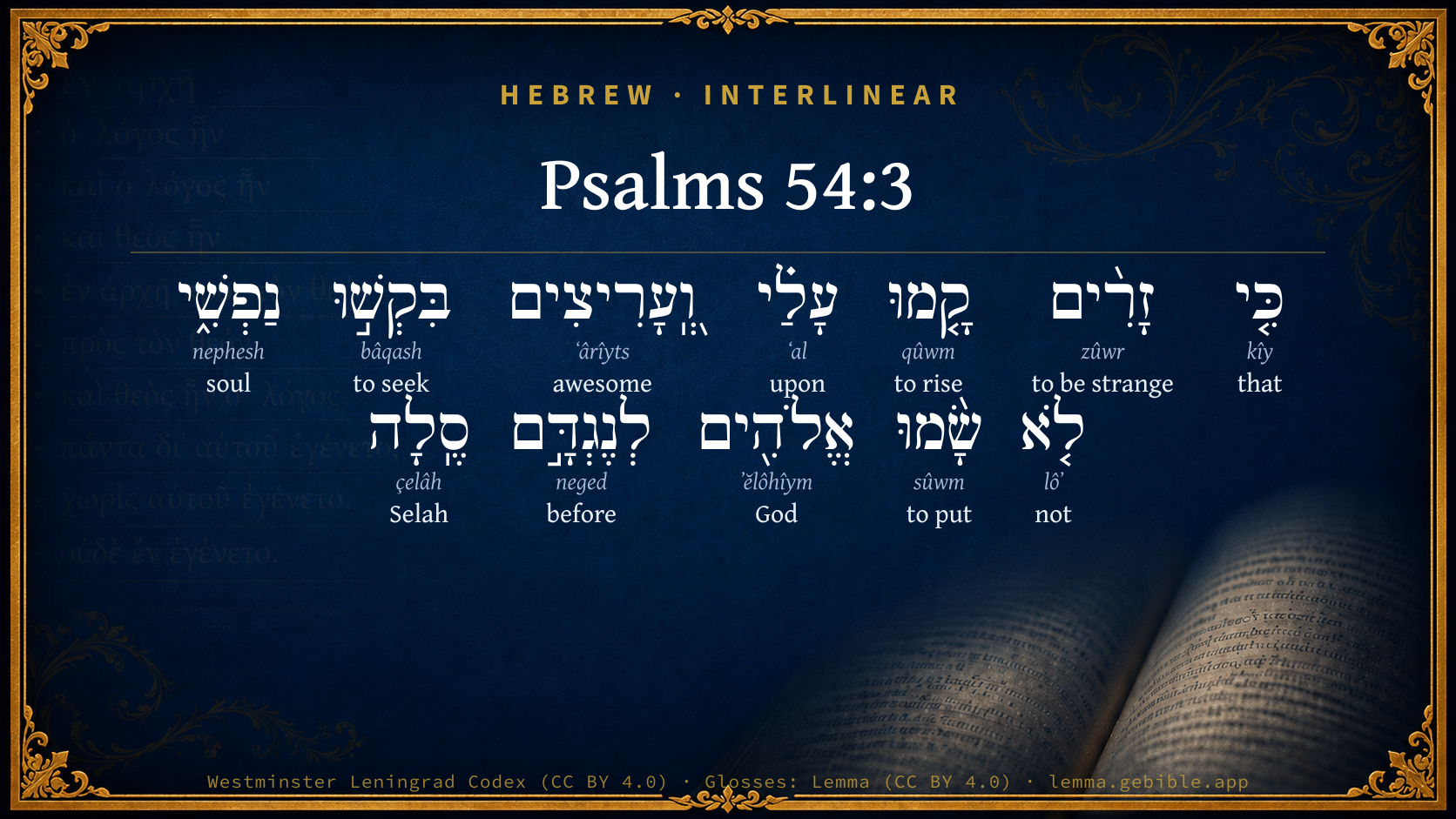
Hebrew (Westminster Leningrad Codex) Psalms 54:3 appears in the Hebrew Old Testament. The text above is from the Westminster Leningrad Codex. Each word links to its Strong’s number, a concise gloss, and parsing drawn from the Open Scriptures Hebrew Bible morphology. Click any word for its full Brown-Driver-Briggs (BDB) entry.
Download image
Cite this verse

Psalms 54:3 (World English Bible). Public Domain. Lemma interlinear Bible study tool, https://lemma.gebible.app/v/psalms/54/3.

Show BibTeX & RIS
BibTeX
RIS
English Translation
For strangers have risen up against me. Violent men have sought after my soul. They haven't set God before them. Selah.
World English Bible · Public Domain
Download a study sheet

One document with this verse’s original text, its word-by-word gloss line, the meaning frame, cross-references with their text, attributed commentary, and full source and license credits — printable, and it pastes into notes with its structure intact.

This verse Autodidact and up

Study sheet (.html) Plain text (.txt)

A passage Seminary Student

Up to 50 verses in one chapter. A passage sheet keeps up to 6 commentary sources and 12 cross-references per verse, in the order this page ranks them, and says so on the sheet whenever that leaves anything out. Ask for a single verse and you get the Autodidact verse sheet above.

Everything on this page stays free to read, with no account — the sheet is a download of what is already on screen, not access to it.

Want to remove ads? Support Godless Engineer
Compare translations 3

The same verse in 3 English versions, stacked beneath the original-language interlinear above. Click any original word for its lexicon entry.

Each is an independent rendering of the whole verse — the interlinear is not word-aligned to these translations.

Highlighted words mark where these versions differ — a whole-verse word diff, not a word-by-word alignment.

  • World English Bible Public Domain
    For strangers have risen up against me. Violent men have sought after my soul. They haven't set God before them. Selah.
  • King James Version Public Domain
    For strangers are risen up against me, and oppressors seek after my soul: they have not set God before them. Selah.
  • unfoldingWord Literal Text CC BY-SA 4.0
    For foreigners have arisen against me, and violent seek my life. They do not set God before them. Selah

unfoldingWord Literal Text — © unfoldingWord, licensed CC BY-SA 4.0. Word-aligned USFM3 via Door43 (git.door43.org/unfoldingWord/en_ult).

Versions to compare (up to 4)

3 of 4 selected

Show all 18 translations

Every available English version of this verse, each an independent rendering of the whole verse.

  • World English Bible Public Domain
    For strangers have risen up against me. Violent men have sought after my soul. They haven't set God before them. Selah.
  • Berean Standard Bible Public Domain
    For strangers rise up against me, and ruthless men seek my life—men with no regard for God. Selah
  • Majority Standard Bible Public Domain
    For strangers rise up against me, and ruthless men seek my life—men with no regard for God. Selah
  • King James Version Public Domain
    For strangers are risen up against me, and oppressors seek after my soul: they have not set God before them. Selah.
  • American Standard Version (1901) Public Domain
    For strangers are risen up against me, And violent men have sought after my soul: They have not set God before them. Selah
  • Revised Version (1885) Public Domain
    For strangers are risen up against me, and violent men have sought after my soul: they have not set God before them. Selah
  • Geneva Bible (1599) Public Domain
    For strangers are risen vp against me, and tyrants seeke my soule: they haue not set God before them. Selah.
  • Douay-Rheims (1899) Public Domain
    Save me, O God, by thy name, and judge me in thy strength.
  • Young's Literal Translation Public Domain
    For strangers have risen up against me And terrible ones have sought my soul, They have not set God before them. Selah.
  • Literal Standard Version CC BY-SA 4.0
    For strangers have risen up against me || And terrible ones have sought my soul, || They have not set God before them. Selah.
  • Unlocked Literal Bible CC BY-SA 4.0
    For strangers have risen up against me, and pitiless men have sought after my life; they have not set God before them. Selah
  • unfoldingWord Literal Text CC BY-SA 4.0
    For foreigners have arisen against me, and violent seek my life. They do not set God before them. Selah
  • Darby Bible Public Domain
    For strangers are risen up against me, and the violent seek after my life: they have not set God before them. Selah.
  • World Messianic Bible Public Domain
    For strangers have risen up against me. Violent men have sought after my soul. They haven’t set God before them. Selah.
  • Webster's Bible Public Domain
    \\54:1\\To the chief Musician on Neginoth, Maschil, A Psalm of David, when the Ziphims came and said to Saul, Doth not David hide himself with us? Save me, O God, by thy name, and judge me by thy strength.
  • Free Bible Version CC BY-SA 4.0
    For strangers are coming to attack me—violent men who don't care about God are trying to kill me. Selah.
  • Bible in Basic English Public Domain
    For men who are going after me have come out against me, violent men are purposing to take my soul; they have not put God before their eyes. (Selah.)
  • JPS Tanakh (1917) Public Domain
    (54-5) For strangers are risen up against me, and violent men have sought after my soul; they have not set God before them. Selah

Literal Standard Version (2020), Covenant Press — licensed CC BY-SA 4.0. Text via the HelloAO Bible API (eBible.org). Unlocked Literal Bible (unfoldingWord) — licensed CC BY-SA 4.0. Text via the HelloAO Bible API (eBible.org). unfoldingWord Literal Text — © unfoldingWord, licensed CC BY-SA 4.0. Word-aligned USFM3 via Door43 (git.door43.org/unfoldingWord/en_ult). Free Bible Version, Dr. Jonathan Gallagher — licensed CC BY-SA 4.0. Text via the HelloAO Bible API (eBible.org).

Word by word

More ways to search: Search by grammar → Find every occurrence → Compare this word →

Practice this passage: Drill this verse → Learn its vocabulary →

וְֽ֭עָרִיצִים
ʻârîyts
H6184
“and · awesome”
Conjunction + Adjective, Adjective, Masculine, Plural, Absolute
Part of Speech
Conjunction + Adjective
Type
Adjective
Gender
Masculine
Number
Plural
State
Absolute
Full BDB Definition

Origin: from H6206

TWOT: 1702b

awe-inspiring, terror-striking, awesome, terrifying, ruthless, mighty
  1. כִּ֤י kîy H3588 “that” Conjunction
  2. זָרִ֨ים zûwr H2114 “strange” Adjective, Adjective, Masculine, Plural, Absolute
  3. קָ֤מוּ qûwm H6965 “to rise” Verb, Qal, Perfect, 3rd Person, Common, Plural
  4. עָלַ֗י ʻal H5921 “upon · me” Preposition + Suffix, Personal, 1st Person, Common, Singular
  5. בִּקְשׁ֣וּ bâqash H1245 “to seek” Verb, Piel, Perfect, 3rd Person, Common, Plural
  6. נַפְשִׁ֑י nephesh H5315 “soul · my” Noun, Common, Both, Singular, Construct + Suffix, Personal, 1st Person, Common, Singular
  7. לֹ֤א lôʼ H3808 “not” Particle, Negative
  8. שָׂ֨מוּ sûwm H7760 “to put” Verb, Qal, Perfect, 3rd Person, Common, Plural
  9. אֱלֹהִ֖ים ʼĕlôhîym H430 “God(s)” Noun, Common, Masculine, Plural, Absolute
  10. לְנֶגְדָּ֣ם neged H5048 “to/for · before · them” Preposition + Preposition + Suffix, Personal, 3rd Person, Masculine, Plural
  11. סֶֽלָה çelâh H5542 “Selah” Particle, Interjection

About this verse

These counts appear in no published source. They are computed here, from the morphology-tagged text and Lemma’s own curated glosses. What Lemma adds →

12
words
12
distinct lemmas
Wisdom
section

Notable vocabulary

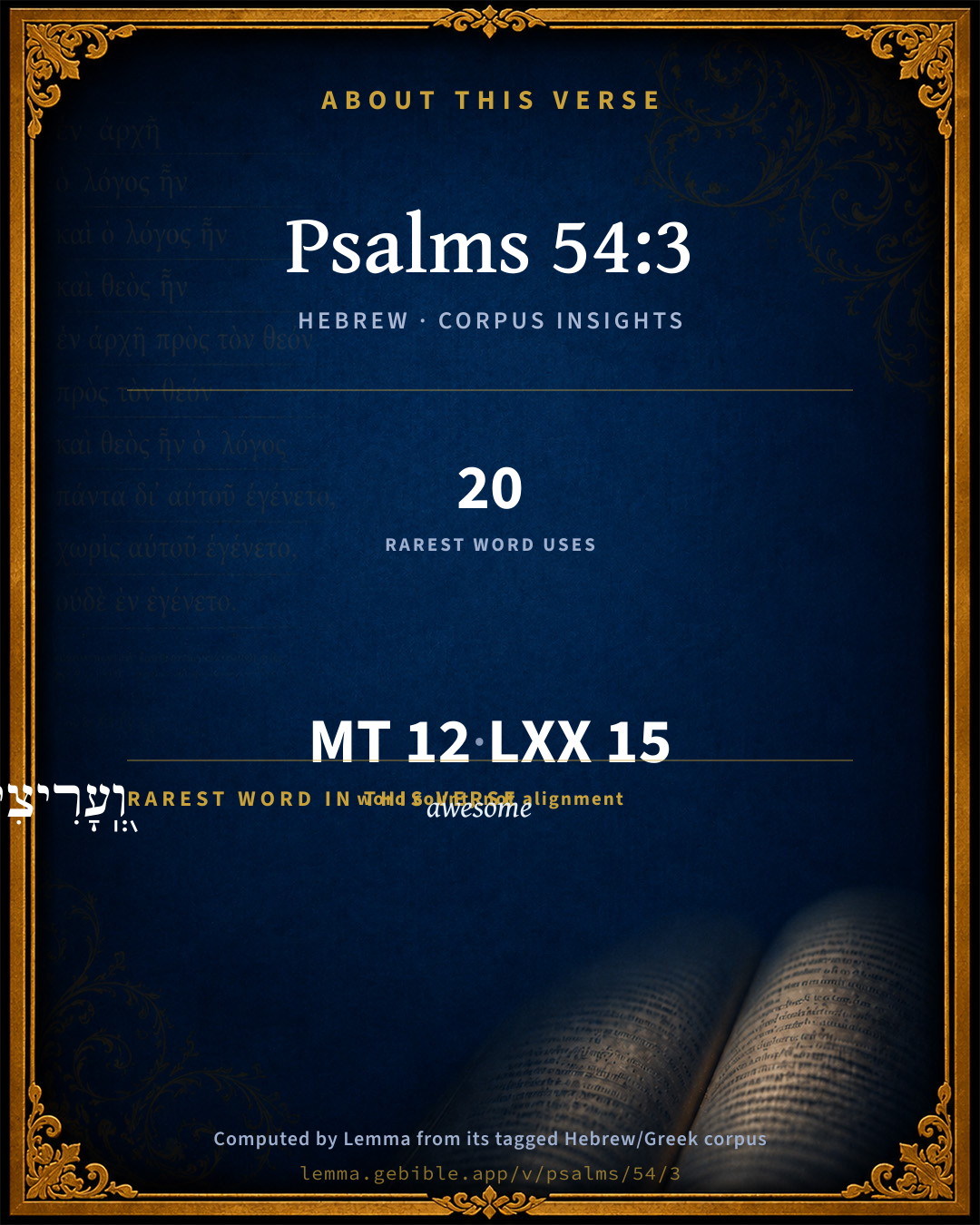
The rarest word here is וְֽ֭עָרִיצִים awesome H6184 — appearing just 20 times in the whole Hebrew Bible.

Shared distinctive vocabulary

וְֽ֭עָרִיצִים awesome H6184 occurs in 20 verses of the Hebrew Bible. Also found in:

Grammatical profile

  • 3 verbs
  • 2 nouns
  • 2 adjectives
  • 2 prepositions
  • 1 conjunction
  • 2 particles

Verb forms

  • קָ֤מוּ Qal · Perfect
  • בִּקְשׁ֣וּ Piel · Perfect
  • שָׂ֨מוּ Qal · Perfect

Hebrew & Septuagint length

In English translation the verse runs 21 words from the Hebrew and 22 from the Septuagint (LXX English) — closely comparable.

A rough comparison of the two English renderings, which tokenize alike — not a word-level alignment.

Word counts can differ between the Hebrew and the Greek without any difference in meaning — e.g. the Hebrew direct-object marker אֵת has no separate Greek word, and Greek often adds the article ὁ.

In the original languages it is 12 Hebrew tokens and 15 Greek tokens — but the two are counted differently (Hebrew bundles its prefixes and suffixes into one token; the Greek is in lemma form), so that isn’t a like-for-like length.

Cross-references

11

Topical passages linked to Psalms 54:3 in the Treasury of Scripture Knowledge — connected by theme and wording, ordered by reader-vote popularity; previews shown in the World English Bible.

  • Psalms 86:14 God, the proud have risen up against me. A company of violent men have sought after my soul, And they don't hold regard for you before them.
  • Psalms 36:1 An oracle is within my heart about the disobedience of the wicked: "There is no fear of God before his eyes."
  • John 16:3 They will do these things because they have not known the Father, nor me.
  • Psalms 53:4 Have the workers of iniquity no knowledge, Who eat up my people as they eat bread, And don't call on God?
  • Job 19:13–15 "He has put my brothers far from me. My acquaintances are wholly estranged from me.
  • Psalms 16:8 I have set Yahweh always before me. Because he is at my right hand, I shall not be moved.
  • Psalms 22:16 For dogs have surrounded me. A company of evil-doers have enclosed me. They pierced my hands and my feet.
  • Psalms 40:14 Let them be disappointed and confounded together who seek after my soul to destroy it. Let them be turned backward and brought to dishonor who delight in my hurt.
  • Psalms 59:3–5 For, behold, they lie in wait for my soul. The mighty gather themselves together against me, Not for my disobedience, nor for my sin, Yahweh.
  • Psalms 69:8 I have become a stranger to my brothers, An alien to my mother's children.
  • Matthew 27:20–23 Now the chief priests and the elders persuaded the multitudes to ask for Barabbas, and destroy Jesus.

Cross-references courtesy of OpenBible.info (CC BY 4.0).

Hebrew and Greek witnesses Masoretic Hebrew ↔ Greek Septuagint

The same verse in the two great witnesses to the Old Testament, shown verse-for-verse.

You’re reading Greek Psalm 53 (Hebrew Psalm 54). The Septuagint counts the superscription, so verse numbers can differ from the Hebrew — chapter-level alignment, not verse-by-verse. Numbering follows Rahlfs.

These are two independent witnesses, not word-aligned to each other, and the Septuagint is shown in lemma (dictionary) form.

Hebrew Psalms 54:3 Masoretic · Westminster Leningrad Codex

כִּ֤י זָרִ֨ים קָ֤מוּ עָלַ֗י וְֽ֭עָרִיצִים בִּקְשׁ֣וּ נַפְשִׁ֑י לֹ֤א שָׂ֨מוּ אֱלֹהִ֖ים לְנֶגְדָּ֣ם סֶֽלָה

For strangers have risen up against me. Violent men have sought after my soul. They haven't set God before them. Selah.

World English Bible · Public Domain

Greek LXX Greek Psalm 53:3 Septuagint · lemma form

ὁ θεός ἐν ὁ ὄνομα σύ σώζω ἐγώ καί ἐν ὁ δύναμις σύ κρίνω ἐγώ

For strangers have risen up against me, and mighty men have sought my life: they have not set God before them. Pause.

LXX2012 (modern English Septuagint) · Public Domain

Hebrew: Westminster Leningrad Codex (CC BY 4.0). Greek: Septuagint (public domain); English from LXX2012 (modern English Septuagint) (Public Domain). How the Septuagint differs from the Hebrew →

Commentary

Notes on Psalms 54:3 from classic Christian and Jewish commentators (each source and its license shown beneath its notes). The classic Christian expositions comment on the surrounding passage and are grouped to its opening verse, so a note may address several verses; the Jewish commentaries on the Tanakh (Rashi and others) are per-verse, so they appear only where the commentator wrote on this verse.

Lemma curates 59 commentaries, every one of them public domain or Creative Commons licensed, each selected and text-cleaned for this edition rather than reprinted as found. About our sources →

Trapp's Complete Commentary

John Trapp

Psa 54:3 For strangers are risen up against me, and oppressors seek after my soul: they have not set God before them. Selah.

Ver. 3. For strangers are risen up against me] He meaneth not foreigners, but home dwellers; Saul, Doeg, Ziphims, Nothi et spurii, strangers to religion, reason, common humanity; Jews outwardly, but not inwardly; heathens upon the matter, Psa 59:5 Amo 9:7 Rev 11:2. The pope showed himself no better in delivering up for money Zemes the Great Turk’s brother, who fled to him for safeguard of his life, wrongfully sought after.

Oppressors seek after my soul] i.e. My life at least; my soul also they would destroy, if it lay in their power, as the Papists delivered up John Huss to the devil when they burnt him; and would not allow Jerome of Prague a confessor, though he requested it. So the monster of Milan, that made his enemy first curse Christ in hope of life, and then stabbed him to death, saying, Now go soul and body to the devil (Bodin. de Rep.). So he that, for spite, procuring a man to be hanged, and seeing him penitent, said, I am afraid the rogue will go to heaven.

They have not set God before them] This was the root of all their outrages, they made no reckoning of God, prout est iudexet vindex mali, as he is a severe judge, and a sharp revenger of sin and wickedness.

John Trapp, A Commentary or Exposition upon All the Books of the Old and New Testament (1647–1656) — public domain. Text from a community e-Sword module.

J. A. Alexander on Psalms

Joseph Addison Alexander

5. (Psa 54:3). For strangers are risen up against me, and oppressors seek my soul (or life); they have not set God before them. Selah. To the earnest petitions in the two preceding verses he now adds a particular description of his danger. Strangers, not foreigners, but aliens in spirit, both to him and to Jehovah, with special reference to Saul. See below, on Psa 120:5. Oppressors, persecutors, tyrants. The original expression implies the possession of power, and its lawless exercise. See above, on Psa 37:35. Not to set God before them is to act as if they did not remember or believe in his existence and his presence. The Selah indicates a pause of indignation and abhorrence. See above, on Psa 52:5 (3).

Joseph Addison Alexander, The Psalms Translated and Explained (1850) — public domain. Text from a community e-Sword module.

Tyndale Open Study Notes

Tyndale Open Resources

54:3 The strangers were alienated from the covenant community (see 109:11; Prov 5:10). • Proud and violent people hold no regard for God or for other people (see Pss 35:11, 25; 86:14; Prov 11:16).

Tyndale Open Study Notes — © Tyndale Open Resources, licensed CC BY-SA 4.0. Text via the HelloAO Bible API.

Geneva Bible (1599)

Geneva Bible translators

To wit, the Ziphims.

Saul and his army, which were like cruel beasts, and could not be satisfied but by his death.

Geneva Bible (1599) marginal notes — public domain. Text via Bolls.life.

Jamieson, Fausset & Brown

Robert Jamieson, A. R. Fausset & David Brown

strangers--perhaps Ziphites.

oppressors--literally, "terrible ones" (Isa 13:11; Isa 25:3). Such were Saul and his army.

not set . . . them--acted as atheists, without God's fear (compare Psa 16:8).

Jamieson, Fausset & Brown — Commentary Critical and Explanatory on the Whole Bible (1871) — public domain (CC PDM 1.0). Text via the HelloAO Bible API.

Adam Clarke's Commentary

Verse 3. Strangers are risen up against me] The Ziphites.

And oppressors] Saul, his courtiers, and his army.

They have not set God before them.] It is on no religious account, nor is it to accomplish any end, on which they can ask the blessing of God.

Selah.] This is true.

Adam Clarke's Commentary on the Bible (1810–1826) — public domain. Text from a community e-Sword/MySword module.

Ellicott's Commentary for English Readers

(3) For strangers.—This verse, with some variations, occurs again (Psa_86:14); some MSS. even reading here “proud,” instead of “strangers.” With the received reading we must understand by the word “foreign oppressors”—though, doubtless, the inscription of the Psalm may be defended by taking the word in a derived sense of those Israelites who have degenerated, and so deserve the name “aliens.”

A Bible Commentary for English Readers, edited by Charles John Ellicott (1878–1897) — public domain. Text from a community e-Sword module.

The Cambridge Bible for Schools and Colleges

gen. ed. J. J. S. Perowne

3. This verse is repeated almost verbatim in Psa_86:14 (a mosaic constructed of fragments of other Psalms), with the change, accidental or intentional, of strangers into proud. The consonants of the Heb. words zârîm, strangers, and zçdîm, proud, are almost identical, and some Heb. MSS. and the Targ. read zçdîm here; but the rest of the versions support the Massoretic Text.

and oppressors &c.] Render, and violent men have sought my life, as in 1Sa_23:15, “David saw that Saul was come out to seek his life.” It has been argued that the terms ‘strangers’ and ‘violent men’ are inapplicable to Israelites, and prove that the title is erroneous. No doubt they are often used of foreign invaders or oppressors (Isa_25:2 ff; Isa_29:5; Eze_31:12; cp. Isa_1:7; Eze_7:21); but ‘violent men’ or ‘terrible ones’ is not exclusively so used (Job_6:23; Jer_15:21), and might well be applied to Saul and his followers; while the Ziphites might be designated ‘strangers,’ in view of their unneighbourly behaviour. It is however possible that ‘strangers’ refers to the men of Keilah, whom there is some ground for regarding as Canaanites. The peculiar term ‘lords’ or ‘owners’ applied to the men of Keilah (1Sa_23:11-12) seems to have been specially (though not exclusively) used of Canaanites. See Jos_24:11; Jdg_9:2 ff; and J. S. Black’s note on the latter passage in the Smaller Cambridge Bible for Schools.

they have not set God before them] They have no regard for God’s will, and no fear of His judgements. Cp. Psa_10:4-5; Psa_36:1; and contrast Psa_16:8; Psa_18:22. Under other circumstances loyalty to Saul might have required the Ziphites to surrender David: as it was, they were simply fighting against God in making themselves the tools of Saul’s blind rage, for it must have been well known that God intended David to be Saul’s successor.

The Cambridge Bible for Schools and Colleges (gen. ed. J. J. S. Perowne; Cambridge University Press, 1878–1918) — public domain. Text from a community e-Sword module.

John Gill's Exposition

For strangers are risen up against me,.... Meaning such as Doeg the Edomite, or Heathen soldiers, that Saul had hired and took into his army, who were aliens from the commonwealth of Israel; and such as these rose up against David's antitype, the Messiah, Psa 2:1, Act 4:27. Or rather the Ziphims, who were of his own nation, yea, of his own tribe, yet used him as barbarously as the very Heathens would have done, or worse; and who, though notwithstanding they were of Israel, might not be Israelites indeed, but strangers to an inward experience of divine and spiritual things: for men may be professors of religion, and yet be strangers to God in Christ, to Christ himself, and the way of salvation by him, and communion with him; to the Spirit of God, and the operations of his grace on the heart; to themselves, their own hearts, and their state and condition by nature; to the Gospel of Christ, and to the people of God; and these are sometimes the most violent persecutors of good and spiritual men;

and oppressors seek after my soul; or "life" (i), to take it away; as did Saul and his army; who are "the mighty" or "strong ones" (k), as the word here used signifies; see Sa1 24:11; and as the Jewish sanhedrim, Scribes and Pharisees, sought after the soul or life of Christ, to take that away, as they did;

they have not set God before them. They did not consider themselves as under the omniscient eye of God; they did not set his word before them, as the rule of their conduct, but cast it behind their backs; nor did they regard his providential mercies and layouts as a motive to engage them to obedience to him, but despised them; they had not the fear of God before their eyes, nor in their hearts, nor any concern for his glory; and therefore did the wicked things they did against his servant.

Selah; on this word; see Gill on Psa 3:2.

(i) "vitam meam", Junius & Tremellius, Michaelis. (k) "fortes", V. L. Pagninus, Musculus, Gejerus; "praepotentes", Vatablus.

John Gill's Exposition of the Whole Bible (1746–1763) — public domain (CC PDM 1.0). Text via the HelloAO Bible API.

Albert Barnes' Notes on the Bible

For strangers are risen up against me - That is, foreigners; those of another nation or land. Saul and his friends who sought the life of David were his own countrymen; these persons who sought go betray him were another people. They attempted to gain the favor of Saul, or to secure a reward from him, by betraying to him an innocent man whom he was persecuting.

And oppressors seek after my soul - Seek after my life. The word here rendered “oppressors” means people of violence; the proud; the haughty; persecutors; tyrants. The word properly denotes those who exert their power in an arbitrary manner, or not under the sanction of law.

They have not set God before them - They do not act as in the presence of God. They do not regard his authority. See the notes at Psa 36:1. The word “Selah” here merely marks a musical pause. It indicates nothing in regard to the sense.

Albert Barnes' Notes on the Bible (1834–1885) — public domain. Text from a community e-Sword/MySword module.

Matthew Poole's English Annotations

Strangers; the Ziphites, whom, though Israelites, he calls strangers, in regard of their barbarous and perfidious disposition and carriage towards him, by which they showed themselves to be estranged from God, as the wicked are said to be, Psa 58:3, and from the commonwealth of Israel, and from all the laws of piety and humanity; for which causes he calls such persons heathens, Psa 59:5, and elsewhere.

They have not set God before them; they cast off all regard to thy presence and authority, and all fear of thy judgments.

Matthew Poole's English Annotations on the Holy Bible (1683–1685) — public domain. Text from a community e-Sword/MySword module.

The Treasury of David

Charles H. Spurgeon

Ver. 3. For strangers are risen up against me. Those who had no cause for ill will had gone against him; persons to whom he could have given no offence, for they were strangers to him. They were aliens to his God also, and should these be allowed to worry and destroy him. A child may well complain to his father when strangers come in to molest him. What right have they to interfere? Let them leave off meddling and mind their own concerns.

And oppressors seek after my soul. Saul, that persecuting tyrant, had stamped his own image on many more. Kings generally coin their own likeness. He led the way, and others followed seeking David's soul, his blood, his life, his very existence. Cruel and intense were they in their malice, they would utterly crush the good man; no half measure would content them.

They have not set God before them. They had no more regard for right and justice than if they knew no God, or cared for none. Had they regarded God they would not have betrayed the innocent to be hunted down like a poor harmless stag. David felt that atheism lay at the bottom of the enmity which pursued him. Good men are hated for God's sake, and this is a good plea for them to urge in prayer.

Selah. As if he said, "Enough of this, let us pause." He is out of breath with indignation. A sense of wrong bids him suspend the music awhile. It may also be observed, that more pauses would, as a rule, improve our devotions: we are usually too much in a hurry: a little more holy meditation would make our words more suitable and our emotions more fervent.

Ver. 3. Strangers: aliens to his truth, men who from unbelief have estranged themselves from all lot and portion in his covenants --oppress and persecute. William Hill Tucker.

Ver. 3. (first clause). The Chaldee interpreter reads, proud men, instead of strangers, a reading which also is found in eight of Kennicott's Codices. So also Ps 86:14. William Walford, in "The Book of Psalms. A New Translation, " etc., 1837.

Ver. 3. (first clause). There is a great mistake made by rendering the word oyrz (zarim) strangers. The Ziphites surely were Israelites, and not strangers. The fact is this, that word is taken from hrz (zarah) the primary meaning of which is "to scatter, "to "disperse, "also "to sift, "as grain. Hence it signifies, likewise figuratively, to sift a matter, to investigate, to search out, to trace out. So here, David complains of the new and dangerous enemies he had got in the Ziphites, who became Saul's spies. When he pleads, therefore, for deliverance, saying, "Save me, O God, " etc., he describes the danger he was in: For spies have risen against me. Benjamin Weiss, in "New Translation, Exposition, and Chronological Arrangement of the Psalms, "1858.

Ver. 3. Oppressors seek after my soul; i.e., my life at least; my soul also they would destroy, if it lay in their power, as the Papists delivered up John Huss to the devil. John Trapp, 1611-1662.

Ver. 3. Selah. See "Treasury of David", Vol. 1, pp. 25,29,346,382; and Vol. 2, pp. 249-252.

Ver. 3. Strange trials.

I. They are not altogether strange.

1. Not so to God.

2. Not so in the history of the church.

3. Not so to the provisions of grace wherein they are anticipated. II. Wherein they are strange.

1. They reveal God anew.

2. Endear forgotten promises.

3. Train unused graces.

4. Being new praises, etc.

Ver. 3. (last clause). The root of sin: if they remembered his authority they dared not, if they tasted his love they would not, if they were conformed to his nature they could not.

Psalms 54:4*

Charles H. Spurgeon's The Treasury of David (1869–1885) — public domain. Psalms only. Text from a community e-Sword/MySword module.

Whedon's Commentary on the Bible

Daniel D. Whedon

3. Strangers—The word denotes foreigners, heathen, those who are not of the seed of Israel. If the reference is to the Ziphites, such they were to David in spirit, and in this moral sense the word often occurs. Compare Jer_23:14; Mat_18:17. But it may refer to Doeg the Edomite, and the political intrigues of his nation through him, to destroy the Hebrew monarchy.

Oppressors seek after my soul—Fierce men search after my life. They were Saul’s spies, and the allusion seems to be to the king’s order, (1Sa_23:23,) “See therefore, and take knowledge of all the lurking places where he hideth himself, and come ye again to me… and I will go with you.”

Daniel D. Whedon (gen. ed.), Commentary on the Old and New Testaments (1874–1909) — public domain. Text from a community e-Sword module.

The Pulpit Commentary

For strangers are risen up against me. David"s designation of his foes as "strangers" has been made an argument against the trustworthiness of the "title," since the Ziphites were Israelites of the tribe of Judah. (Jos_15:55) But he might well call those "strangers" who were treating him as an alien. Comp. Psa_120:5, where "the psalmist, heavily oppressed by his countrymen, complains that he dwelt in Mesheeh and Kedar" (Hengstenberg). And oppressors seek after my soul; or, my life. The phrase is exactly that used in 1Sa_23:15, when David was in the wilderness of Ziph, in a wood, and "saw that Saul was come out to seek his life. " They have not set God before them. (comp. Psa_86:14) David, on the contrary, "set the Lord always before him". (Psa_16:8)

The Pulpit Commentary (1880–1919), ed. H.D.M. Spence-Jones & Joseph S. Exell — public domain. Text from a community e-Sword module.

John Wesley's Explanatory Notes

Strangers - The Zephites, whom, though Israelites, he calls strangers in regard of their barbarous and perfidious carriage.

John Wesley, Explanatory Notes Upon the Whole Bible (1754–1765) — public domain. Text via the GEBible commentary corpus.

Rashi

Rabbi Shlomo Yitzchaki (Rashi)

and with Your might, avenge me Heb. תדינני, Wreak my vengeance, as (Deut. 32:36): “When the Lord will avenge (ידין) His people.”

Rashi on the Tanakh — English translations: “The Judaica Press complete Tanach with Rashi, translated by A. J. Rosenberg” (CC BY 4.0); “Pentateuch with Rashi's commentary by M. Rosenbaum and A.M. Silbermann, 1929-1934” (public domain); “The Metsudah Tanach series, Lakewood, N.J” (CC BY 4.0); and “The Book of Joshua, Metsudah Publications, 1997” (CC BY 4.0). Text via Sefaria.

Lesson kit

Teaching starters — assembled from the data on this page, not authored interpretation. Every prompt links to the verse data it draws on. Edit before teaching.

Psalms, in the Wisdom, opens this verse with 12 words (12 distinct Hebrew lemmas). Its most distinctive word is ʻârîyts (“awesome”). A historical commentator’s framing appears above. Read the whole chapter for the surrounding context.

Discussion questions

  1. The word ʻârîyts carries the sense “awesome.” How does it shape the verse?
  2. Job 6:23 shares the word «awesome» with this verse. How do the two illuminate each other?
  3. The translations on this page render this verse differently — a whole-verse word diff, not a word-by-word alignment. What might account for the different wordings?
  4. The verb «קָ֤מוּ» is Qal Perfect. How does its form color the action?
  5. Reading how Trapp's Complete Commentary and J. A. Alexander on Psalms read this verse, where do the two commentators agree and where do they part?

Things to notice

Reading settings

Reading text

Shown beneath each verse's original-language words.

Old Testament
Old Testament edition

Read the OT as the Masoretic Hebrew (MT) or the Greek Septuagint (LXX).

English shown for the Greek Septuagint (in the Hebrew ↔ Greek comparison).

Comparing translations? Open the Compare panel on any verse page to stack up to four side by side.