Psalms 37:20

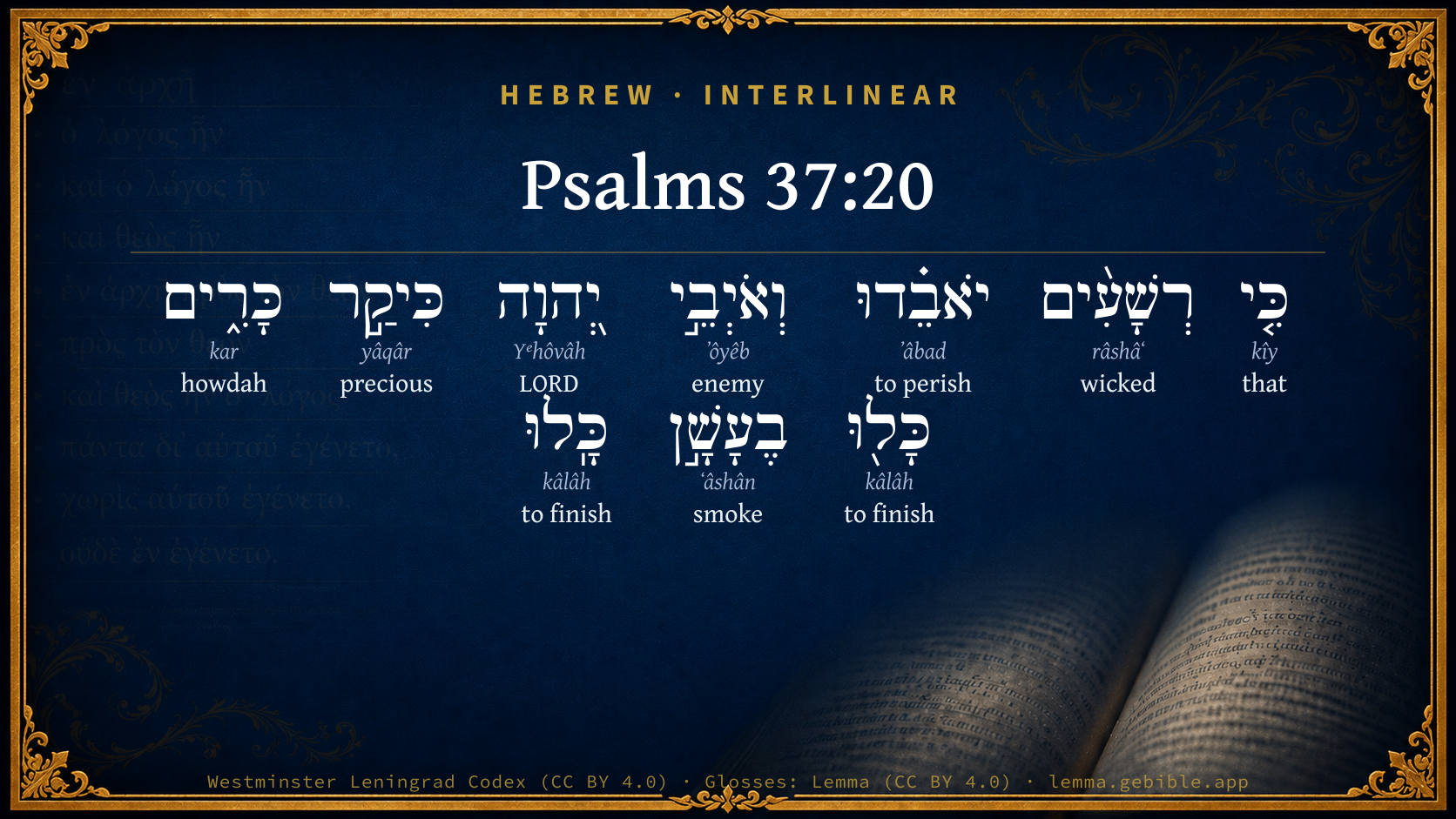
Hebrew (Westminster Leningrad Codex) Psalms 37:20 appears in the Hebrew Old Testament. The text above is from the Westminster Leningrad Codex. Each word links to its Strong’s number, a concise gloss, and parsing drawn from the Open Scriptures Hebrew Bible morphology. Click any word for its full Brown-Driver-Briggs (BDB) entry.
Download image
Cite this verse

Psalms 37:20 (World English Bible). Public Domain. Lemma interlinear Bible study tool, https://lemma.gebible.app/v/psalms/37/20.

Show BibTeX & RIS
BibTeX
RIS
English Translation
But the wicked shall perish. The enemies of Yahweh shall be like the beauty of the fields. They will vanish-- Vanish like smoke.
World English Bible · Public Domain
Download a study sheet

One document with this verse’s original text, its word-by-word gloss line, the meaning frame, cross-references with their text, attributed commentary, and full source and license credits — printable, and it pastes into notes with its structure intact.

This verse Autodidact and up

Study sheet (.html) Plain text (.txt)

A passage Seminary Student

Up to 50 verses in one chapter. A passage sheet keeps up to 6 commentary sources and 12 cross-references per verse, in the order this page ranks them, and says so on the sheet whenever that leaves anything out. Ask for a single verse and you get the Autodidact verse sheet above.

Everything on this page stays free to read, with no account — the sheet is a download of what is already on screen, not access to it.

Want to remove ads? Support Godless Engineer
Compare translations 3

The same verse in 3 English versions, stacked beneath the original-language interlinear above. Click any original word for its lexicon entry.

Each is an independent rendering of the whole verse — the interlinear is not word-aligned to these translations.

Highlighted words mark where these versions differ — a whole-verse word diff, not a word-by-word alignment.

  • World English Bible Public Domain
    But the wicked shall perish. The enemies of Yahweh shall be like the beauty of the fields. They will vanish-- Vanish like smoke.
  • King James Version Public Domain
    But the wicked shall perish, and the enemies of the LORD shall be as the fat of lambs: they shall consume; into smoke shall they consume away.
  • unfoldingWord Literal Text CC BY-SA 4.0
    For the wicked will perish, and the enemies of Yahweh like the precious of pastures; they vanish, in smoke they vanish.

unfoldingWord Literal Text — © unfoldingWord, licensed CC BY-SA 4.0. Word-aligned USFM3 via Door43 (git.door43.org/unfoldingWord/en_ult).

Versions to compare (up to 4)

3 of 4 selected

Show all 18 translations

Every available English version of this verse, each an independent rendering of the whole verse.

  • World English Bible Public Domain
    But the wicked shall perish. The enemies of Yahweh shall be like the beauty of the fields. They will vanish-- Vanish like smoke.
  • Berean Standard Bible Public Domain
    But the wicked and enemies of the LORD will perish like the glory of the fields. They will vanish; like smoke they will fade away.
  • Majority Standard Bible Public Domain
    But the wicked and enemies of the LORD will perish like the glory of the fields. They will vanish; like smoke they will fade away.
  • King James Version Public Domain
    But the wicked shall perish, and the enemies of the LORD shall be as the fat of lambs: they shall consume; into smoke shall they consume away.
  • American Standard Version (1901) Public Domain
    But the wicked shall perish, And the enemies of Jehovah shall be as the fat of lambs: They shall consume; In smoke shall they consume away.
  • Revised Version (1885) Public Domain
    But the wicked shall perish, and the enemies of the LORD shall be as the excellency of the pastures: they shall consume; in smoke shall they consume away.
  • Geneva Bible (1599) Public Domain
    But the wicked shall perish, and the enemies of the Lord shall be consumed as the fatte of lambes: euen with the smoke shall they consume away.
  • Douay-Rheims (1899) Public Domain
    because the wicked shall perish. And the enemies of the Lord, presently after they shall be honoured and exalted, shall come to nothing and vanish like smoke.
  • Young's Literal Translation Public Domain
    But the wicked perish, and the enemies of Jehovah, As the preciousness of lambs, Have been consumed, In smoke they have been consumed.
  • Literal Standard Version CC BY-SA 4.0
    But the wicked perish, and the enemies of YHWH, || Have been consumed as the preciousness of lambs, || They have been consumed in smoke.
  • Unlocked Literal Bible CC BY-SA 4.0
    But evil men will perish. Yahweh's enemies will be like the glory of the pastures; they will be consumed and disappear in the smoke.
  • unfoldingWord Literal Text CC BY-SA 4.0
    For the wicked will perish, and the enemies of Yahweh like the precious of pastures; they vanish, in smoke they vanish.
  • Darby Bible Public Domain
    For the wicked shall perish, and the enemies of Jehovah shall be as the fat of lambs: they shall consume, like smoke shall they consume away.
  • World Messianic Bible Public Domain
    But the wicked shall perish. The enemies of the LORD shall be like the beauty of the fields. They will vanish— vanish like smoke.
  • Webster's Bible Public Domain
    But the wicked shall perish, and the enemies of the LORD shall be as the fat of lambs: they shall consume; into smoke shall they consume away.
  • Free Bible Version CC BY-SA 4.0
    But the wicked will die. The enemies of the Lord are like the flowers of the field—they will vanish like smoke.
  • Bible in Basic English Public Domain
    But the wrongdoers will come to destruction, and the haters of the Lord will be like the fat of lambs, they will be burned up; they will go up in smoke, and never again be seen.
  • JPS Tanakh (1917) Public Domain
    For the wicked shall perish, and the enemies of the LORD shall be as the fat of lambs — they shall pass away in smoke, they shall pass away.

Literal Standard Version (2020), Covenant Press — licensed CC BY-SA 4.0. Text via the HelloAO Bible API (eBible.org). Unlocked Literal Bible (unfoldingWord) — licensed CC BY-SA 4.0. Text via the HelloAO Bible API (eBible.org). unfoldingWord Literal Text — © unfoldingWord, licensed CC BY-SA 4.0. Word-aligned USFM3 via Door43 (git.door43.org/unfoldingWord/en_ult). Free Bible Version, Dr. Jonathan Gallagher — licensed CC BY-SA 4.0. Text via the HelloAO Bible API (eBible.org).

Word by word

More ways to search: Search by grammar → Find every occurrence → Compare this word →

Practice this passage: Drill this verse → Learn its vocabulary →

כָּרִ֑ים
kar
H3733
“howdahs”
Noun, Common, Masculine, Plural, Absolute
Part of Speech
Noun
Type
Common
Gender
Masculine
Number
Plural
State
Absolute
Full BDB Definition

Origin: from H3769 in the sense of plumpness

TWOT: 1046a

howdah, palanquin, basket saddle - an enclosed riding space erected on a camel's saddle - pasture, meadow - ram, lamb, he-lamb - battering-ram
  1. כִּ֤י kîy H3588 “that” Conjunction
  2. רְשָׁעִ֨ים râshâʻ H7563 “wicked” Adjective, Adjective, Masculine, Plural, Absolute
  3. יֹאבֵ֗דוּ ʼâbad H6 “to perish” Verb, Qal, Imperfect, 3rd Person, Masculine, Plural
  4. וְאֹיְבֵ֣י ʼôyêb H341 “and · enemy” Conjunction + Verb, Qal, Participle Active, Masculine, Plural, Construct
  5. יְ֭הוָה Yᵉhôvâh H3068 “LORD” Noun, Proper
  6. כִּיקַ֣ר yâqâr H3368 “like/as · precious of” Preposition + Adjective, Adjective, Masculine, Singular, Construct
  7. כָּל֖וּ kâlâh H3615 “to finish” Verb, Qal, Perfect, 3rd Person, Common, Plural
  8. בֶעָשָׁ֣ן ʻâshân H6227 “in/at the · smoke” Preposition, Determined + Noun, Common, Masculine, Singular, Absolute
  9. כָּֽלוּ kâlâh H3615 “to finish” Verb, Qal, Perfect, 3rd Person, Common, Plural

About this verse

These counts appear in no published source. They are computed here, from the morphology-tagged text and Lemma’s own curated glosses. What Lemma adds →

10
words
9
distinct lemmas
Wisdom
section

Notable vocabulary

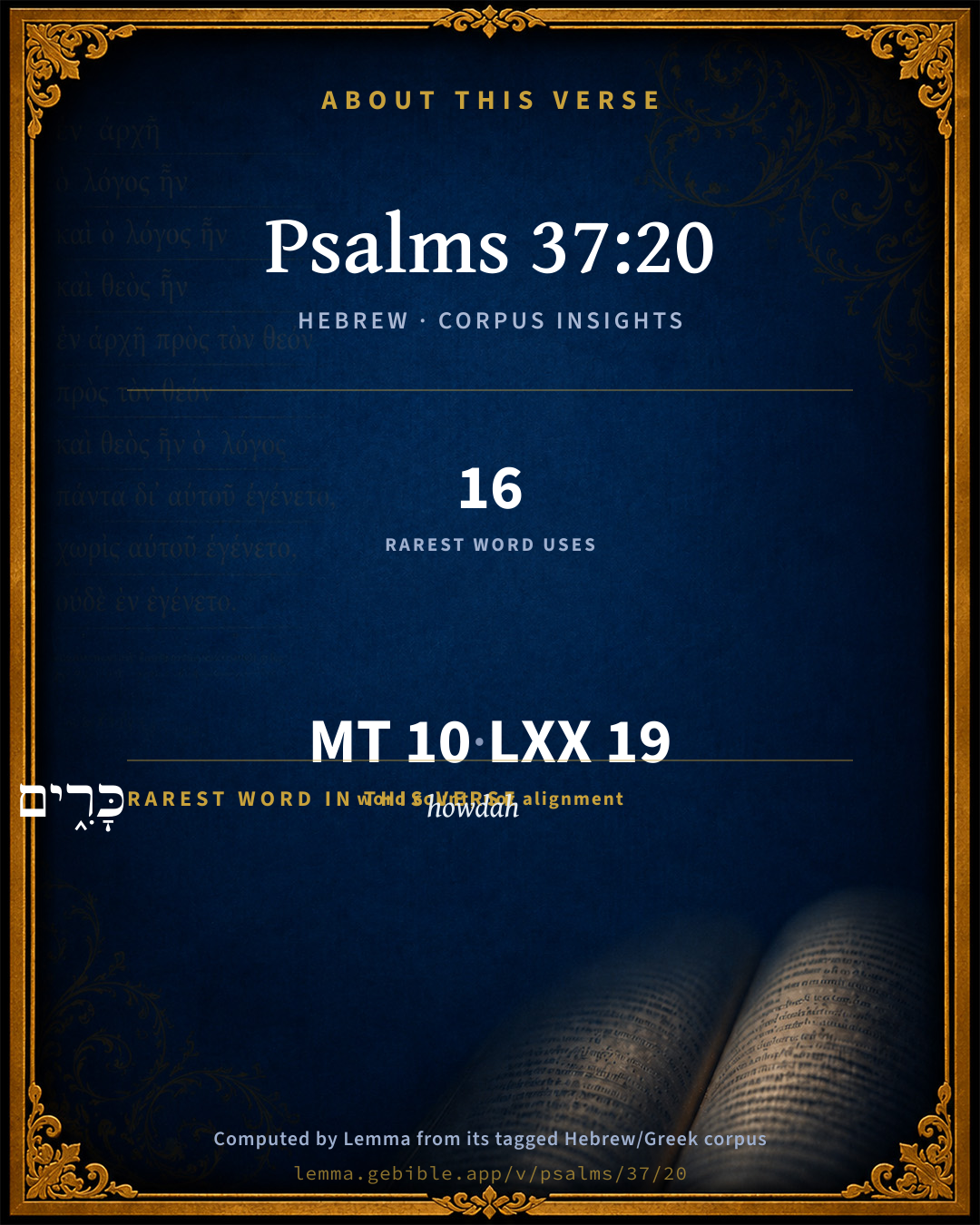
The rarest word here is כָּרִ֑ים howdah H3733 — appearing just 16 times in the whole Hebrew Bible.

Shared distinctive vocabulary

כָּרִ֑ים howdah H3733 occurs in 15 verses of the Hebrew Bible. Also found in:

Grammatical profile

  • 4 verbs
  • 3 nouns
  • 2 adjectives
  • 1 conjunction

Verb forms

  • יֹאבֵ֗דוּ Qal · Imperfect
  • וְאֹיְבֵ֣י Qal · Participle Active
  • כָּל֖וּ Qal · Perfect
  • כָּֽלוּ Qal · Perfect

Repetition

A word recurs within this verse — often emphatic in Hebrew:

  • כָּל֖וּ to finish H3615 ×2

Hebrew & Septuagint length

In English translation the verse runs 23 words from the Hebrew and 25 from the Septuagint (LXX English) — closely comparable.

A rough comparison of the two English renderings, which tokenize alike — not a word-level alignment.

Word counts can differ between the Hebrew and the Greek without any difference in meaning — e.g. the Hebrew direct-object marker אֵת has no separate Greek word, and Greek often adds the article ὁ.

In the original languages it is 10 Hebrew tokens and 19 Greek tokens — but the two are counted differently (Hebrew bundles its prefixes and suffixes into one token; the Greek is in lemma form), so that isn’t a like-for-like length.

Cross-references

13

Topical passages linked to Psalms 37:20 in the Treasury of Scripture Knowledge — connected by theme and wording, ordered by reader-vote popularity; previews shown in the World English Bible.

  • Psalms 68:2 As smoke is driven away, So drive them away. As wax melts before the fire, So let the wicked perish at the presence of God.
  • Psalms 102:3 For my days consume away like smoke. My bones are burned as a firebrand.
  • Luke 13:3 I tell you, no, but, unless you repent, you will all perish in the same way.
  • Deuteronomy 33:14–16 For the precious things of the fruits of the sun, For the precious things of the growth of the moons,
  • Judges 5:31 So let all your enemies perish, Yahweh: But let those who love him be as the sun when he goes forth in his might. The land had rest forty years.
  • Genesis 19:28 He looked toward Sodom and Gomorrah, and toward all the land of the plain, and looked, and saw that the smoke of the land went up as the smoke of a furnace.
  • Leviticus 3:3–11 He shall offer of the sacrifice of peace offerings an offering made by fire to Yahweh; the fat that covers the innards, and all the fat that is on the innards,
  • Psalms 92:9 For, behold, your enemies, Yahweh, For, behold, your enemies shall perish. All the evil-doers will be scattered.
  • 2 Peter 2:12 But these, as unreasoning creatures, born natural animals to be taken and destroyed, speaking evil in matters about which they are ignorant, will in their destroying surely be destroyed,
  • Leviticus 3:16 The priest shall burn them on the altar: it is the food of the offering made by fire, for a sweet savor; all the fat is Yahweh's.
  • Luke 13:5 I tell you, no, but, unless you repent, you will all perish in the same way."
  • Hebrews 12:29 for our God is a consuming fire.
  • Deuteronomy 29:20 Yahweh will not pardon him, but then the anger of Yahweh and his jealousy will smoke against that man, and all the curse that is written in this book shall lie on him, and Yahweh will blot out his name from under the sky.

Cross-references courtesy of OpenBible.info (CC BY 4.0).

Hebrew and Greek witnesses Masoretic Hebrew ↔ Greek Septuagint

The same verse in the two great witnesses to the Old Testament, shown verse-for-verse.

You’re reading Greek Psalm 36 (Hebrew Psalm 37). The Septuagint counts the superscription, so verse numbers can differ from the Hebrew — chapter-level alignment, not verse-by-verse. Numbering follows Rahlfs.

These are two independent witnesses, not word-aligned to each other, and the Septuagint is shown in lemma (dictionary) form.

Hebrew Psalms 37:20 Masoretic · Westminster Leningrad Codex

כִּ֤י רְשָׁעִ֨ים יֹאבֵ֗דוּ וְאֹיְבֵ֣י יְ֭הוָה כִּיקַ֣ר כָּרִ֑ים כָּל֖וּ בֶעָשָׁ֣ן כָּֽלוּ

But the wicked shall perish. The enemies of Yahweh shall be like the beauty of the fields. They will vanish-- Vanish like smoke.

World English Bible · Public Domain

Greek LXX Greek Psalm 36:20 Septuagint · lemma form

ὅτι ὁ ἁμαρτωλός ἀποὀλλύω ὁ δέ ἐχθρός ὁ κύριος ἅμα ὁ δοξάζω αὐτός καί ὑψόω ἐκλείπω ὡσεί καπνός ἐκλείπω

For the sinners shall perish; and the enemies of the Lord at the moment of their being honored and exalted have utterly vanished like smoke.

LXX2012 (modern English Septuagint) · Public Domain

On this verse, Albert Barnes' Notes on the Bible discusses the Septuagint’s reading. Read the note in Commentary ↓

Hebrew: Westminster Leningrad Codex (CC BY 4.0). Greek: Septuagint (public domain); English from LXX2012 (modern English Septuagint) (Public Domain). How the Septuagint differs from the Hebrew →

Commentary

Notes on Psalms 37:20 from classic Christian and Jewish commentators (each source and its license shown beneath its notes). The classic Christian expositions comment on the surrounding passage and are grouped to its opening verse, so a note may address several verses; the Jewish commentaries on the Tanakh (Rashi and others) are per-verse, so they appear only where the commentator wrote on this verse.

Lemma curates 59 commentaries, every one of them public domain or Creative Commons licensed, each selected and text-cleaned for this edition rather than reprinted as found. About our sources →

Trapp's Complete Commentary

John Trapp

Psa 37:20 But the wicked shall perish, and the enemies of the LORD [shall be] as the fat of lambs: they shall consume; into smoke shall they consume away.

Ver. 20. But the wicked shall perish] In tbe midst of their wealth and greatest abundance; their money shall perish with them.

And the enemies of the Lord] These are worse than those wicked aforementioned, said Theodoret; they are such as go on still in their trespasses, Psa 68:21.

Shall be as the fat of lambs] Which in sacrifices was wholly to be burnt and consumed, Lev 3:15-17.

Into smoke shall they consume away] Smoke the higher it ascendeth the sooner it vanisheth. Quanto fuerit globus ille grandior, tanto vanter, saith Austin. They shall be consumed in the smoke of Gehenna, or hell, saith the Chaldee here.

John Trapp, A Commentary or Exposition upon All the Books of the Old and New Testament (1647–1656) — public domain. Text from a community e-Sword module.

J. A. Alexander on Psalms

Joseph Addison Alexander

20. (Psa 37:20) This verse shews how the truth of the foregoing promises can be consistent with the actual prosperity of wicked men. Do not doubt the truth of these assurances because the wicked now seem happy, or because they now prevent your being so, by their oppressions and hostilities. For all this is soon to cease. The wicked shall perish, are to perish, and the enemies of Jehovah, another description of the same class, shewing that these judgments awaited them, not merely as the foes of the Psalmist, or of righteous men in general, but of God himself. See above, on Psa 5:5 (4). —Like the precious (part) of lambs, i.e. the sacrificial fat, which was burnt upon the altar, they have consumed; in smoke, or into smoke, they have consumed (or vanished). The preterite form of the verb represents the predicted consummation as already past in the perceptions of the writer. Some understand to be "the delight of lambs," i.e. their pasture, and suppose an allusion to the short-lived verdure of the fields, a common figure for the brevity of human life, which occurs near the beginning of this very psalm (ver. 2). Others obtain the same sense by explaining itself to mean pastures, as it seems to do in Isa 30:23, and perhaps in Psalms 65. It is best, however, to retain the usual and certain sense of ambs, whether the reference be to their pasture or their fat, which last is recommended by the mention of smoke in the same connection. This may indeed be an independent figure, but it is much more natural to connect it with the lambs, and understand it to denote the smoke ascending from the altar upon which they were consumed in sacrifice. In either case, however, and on any exegetical hypothesis whatever, the essential meaning of the figures is the same, to wit, that the prosperity of sinners is but short-lived, and that they themselves will vanish speedily and wholly, and are therefore in the mean time not a proper object of envious dissatisfaction or a legitimate occasion of sceptical misgiving to the righteous.

Joseph Addison Alexander, The Psalms Translated and Explained (1850) — public domain. Text from a community e-Sword module.

Tyndale Open Study Notes

Tyndale Open Resources

37:20 Smoke depicts the temporary nature of life (68:2; 102:3).

Tyndale Open Study Notes — © Tyndale Open Resources, licensed CC BY-SA 4.0. Text via the HelloAO Bible API.

Geneva Bible (1599)

Geneva Bible translators

They shall vanish away suddenly, for they are fed for the day of slaughter.

Geneva Bible (1599) marginal notes — public domain. Text via Bolls.life.

Jamieson, Fausset & Brown

Robert Jamieson, A. R. Fausset & David Brown

While the wicked, however mighty, are destroyed, and that utterly, as smoke which vanishes and leaves no trace.

Jamieson, Fausset & Brown — Commentary Critical and Explanatory on the Whole Bible (1871) — public domain (CC PDM 1.0). Text via the HelloAO Bible API.

Adam Clarke's Commentary

Verse 20. The enemies of the Lord shall be as the fat of lambs] This verse has given the critics some trouble. Several of the Versions read thus: "But the enemies of the Lord, as soon as they are exalted to honour, shall vanish; like smoke they vanish." If we follow the Hebrew, it intimates that they shall consume as the fat of lambs. That is, as the fat is wholly consumed in sacrifices by the fire on the altar, so shall they consume away in the fire of God's wrath.

Adam Clarke's Commentary on the Bible (1810–1826) — public domain. Text from a community e-Sword/MySword module.

John Calvin's Commentaries

20 For the wicked shall perish. The causal particle כי, ki, which is here translated for, might also be rendered as if used adversatively by but or although, unless, perhaps, some would prefer to expound the sentence as of much higher import. But the preferable interpretation is, that there is here a contrast between the subjects spoken of, namely, that the righteous are satisfied in the time of famine, whereas the ungodly shall perish in the midst of their affluence; for, while they trust in their abundance, God brings them to nought by the use of means that are secret and hidden. In calling them the enemies of Jehovah, he teaches us, that they are justly overwhelmed by his vengeance, which they bring upon themselves by their own wickedness. When he says, that they shall be consumed as the excellency of lambs, this is understood by some to refer to the fat of them. But as יכר, yakar, signifies excellency, as I have said elsewhere, I have no doubt that this expression denotes the very best of lambs, and such as are of extraordinary fatness: and this is very suitable to the contrast here stated. We learn from this what another prophet likewise teaches, that the ungodly are fattened for the day of slaughter; so that the more sumptuously they shall have lived, the more suddenly shall their destruction come upon them. To be consumed into smoke is of the same import as to vanish away quickly; as if it had been said, There is no stability or substance in them. Those who understand the term יקר, yakar, to mean fat, explain this latter clause in this sense: that the wicked are consumed into smoke as fat melts or wastes away. But the reader will see that the first interpretation is better.

John Calvin's Commentaries (1540-1563) — public domain. Text from the Calvin Translation Society English edition (1840s-50s) via the Christian Classics Ethereal Library (ccel.org). Calvin's coverage is partial (roughly two-thirds of the Bible); uncommented books and verses are honest gaps, never fabricated. The 19th-century editor's footnotes and remarks are omitted so the notes are faithfully Calvin's own voice.

Ellicott's Commentary for English Readers

(20) As the fat of lambs.—It is now generally allowed that this should be rendered as the glory of the meadows, recurring to the image of Psa_37:2. The next clause may then be either, they are consumed, with smoke they are consumed; or, they pass away, like smoke they pass away.

A Bible Commentary for English Readers, edited by Charles John Ellicott (1878–1897) — public domain. Text from a community e-Sword module.

The Cambridge Bible for Schools and Colleges

gen. ed. J. J. S. Perowne

20. Stanza of Kaph. The end of the wicked.

the enemies of the Lord] For His people’s enemies are His enemies. Cp. Psa_92:9.

as the fat of lambs] A rendering derived from the Targum. But the consumption of the fat of the sacrifice upon the altar would be a strange simile for the evanescence of the wicked: and we must render as the excellency of the pastures, or, (R.V.) as the splendour of the meadows. The gay show of flowers, so quickly vanishing, is an apt emblem for the short-lived pomp of the wicked.

The force of the comparison is hardly realised in our moist northern climate, where verdure is perpetual. “But let a traveller ride over the downs of Bethlehem in February, one spangled carpet of brilliant flowers, and again in May, when all traces of verdure are gone; or let him push his horse through the deep solid growth of clovers and grasses in the valley of the Jordan in the early spring, and then return and gallop across a brown, hard-baked, gaping plain in June, … and the Scriptural imagery will come home to him with tenfold power.” Tristram’s Natural History of the Bible, p. 455. Cp. Psa_37:2; Mat_6:29-30; Jas_1:10-11.

they shall consume &c. Lit. they are consumed; in smoke (or, like smoke) are they consumed away. Smoke is in itself a natural figure of speedy and complete disappearance (Hos_13:3): possibly, however, the idea of the preceding line is continued, and we are to think of “the grass of the field, which to-day is, and to-morrow is cast into the oven” (Mat_6:30). The perfect tense, as in Psa_36:12, forcibly expresses the realising certainty of faith.

The Cambridge Bible for Schools and Colleges (gen. ed. J. J. S. Perowne; Cambridge University Press, 1878–1918) — public domain. Text from a community e-Sword module.

John Gill's Exposition

The wicked borroweth, and payeth not again,.... While the wicked live, they are scandalous; they live by borrowing, which was always reckoned mean; see Deu 28:12; and what is worse, as they borrow, they do not design to repay; they take no care nor thought about that, but live upon what they borrow: for this either expresses their incapacity that they cannot pay; or the evil disposition of their mind, which rather seems to be the sense, that they will not pay;

but the righteous showeth mercy, and giveth; which not only argues capacity and ability, but a kind, merciful, and tender spirit to persons in distress, and is expressive of a generous action.

John Gill's Exposition of the Whole Bible (1746–1763) — public domain (CC PDM 1.0). Text via the HelloAO Bible API.

Albert Barnes' Notes on the Bible

But the wicked shall perish - The general sentiment here is the same as in Psa 1:1-6, that the righteous shall be prospered and saved, and that the wicked shall perish. See the notes at Psa 1:4-5. The word “perish” here would be applicable to any form of destruction - death here, or death hereafter - for it is equivalent to the idea that they shall be “destroyed.” Whether the psalmist means here to refer to the fact that they will be cut off from the earth, or will be punished hereafter in the world of woe, cannot be determined from the word itself. It is most probable, as appears from other parts of the psalm, that he refers particularly to the fact that they will be cut down in their sins; that their lives will be shortened by their crimes; that they will by their conduct expose themselves to the displeasure of God, and thus be cut off. The “word” used, however, would also express the idea of destruction in the future world in any form, and may have a significance beyond anything that can befall men in this life. Compare 2Th 1:8; Mat 25:46.

And the enemies of the Lord - All the enemies of God; all who can properly be regarded as his foes.

Shall be as the fat of lambs - Margin, “the preciousness of lambs.” Gesenius renders this, “like the beauty of the pastures.” Prof. Alexander, “like the precious” (part) “of lambs;” that is, the sacrificial parts, or the parts that were consumed in sacrifice. De Wette, “as the splendor of the pasture.” The Vulgate and the Septuagint render it: “the enemies of the Lord, as soon as they are honored and exalted, shall fail as if they were smoke.” Rosenmuller renders it as it is in our common version. It is not easy to determine the meaning. The word rendered “fat” - יקר yâqâr - means properly that which is precious, costly, weighty, as precious gems; then, anything dear, beloved, or valuable; then, that which is honored, splendid, beautiful, rare. It is in no other instance rendered “fat;” and it cannot be so rendered here, except as “fat” was considered valuable or precious. But this is a forced idea. The word כר kar, properly and commonly means a “lamb;” but it also may the “pasture” or “meadow” where lambs feed. Psa 65:13 : “the “pastures” - כרים kariym - are clothed with flocks.” Isa 30:23, “in that day shall thy cattle feed in large “pastures” - where the same word occurs. It seems to me, therefore, that the interpretation of Gesenius, DeWette, and others, is the correct interpretation, and that the idea is, that the wicked in their pride, beauty, and wealth, shall be like the meadow covered with grass and flowers, soon to be cut down by the scythe of the mower, or by the frosts of winter. This image often occurs: Mat 6:30; Psa 90:5-6; Isa 40:6-8; Jam 1:10; 1Pe 1:24.

They shall consume - The word used here means to be completed or finished; to be consumed or spent, as by fire, or in any other manner; to pine away by weeping, Lam 2:11; to vanish as a cloud or smoke, Job 7:9.

Into smoke - The meaning here is not that they will vanish as the fat of lambs does in sacrifice, but simply that they will pass away as smoke entirely disappears. All that there was of them - their wealth, their splendor, their power - shall utterly vanish away. This is spoken in contrast with what would be the condition of the righteous.

Albert Barnes' Notes on the Bible (1834–1885) — public domain. Text from a community e-Sword/MySword module.

Matthew Poole's English Annotations

Fat of lambs, which in an instant melteth before the fire. Consume into smoke, i.e. utterly and irrecoverably,

Matthew Poole's English Annotations on the Holy Bible (1683–1685) — public domain. Text from a community e-Sword/MySword module.

The Treasury of David

Charles H. Spurgeon

Ver. 20. But the wicked shall perish. Whatever phantom light may mock their present, their future is black with dark, substantial night. Judgment has been given against them, they are but reserved for execution. Let them flaunt their scarlet and fine linen, and fare sumptuously every day; the sword of Damocles is above their heads, and if their wits were a little more awake, their mirth would turn to misery. The enemies of the Lord shall be as the fat of lambs. As the sacrificial fat was all consumed upon the altar, so shall the ungodly utterly vanish from the place of their honour and pride. How can it be otherwise? If the stubble dares to contend with the flame, to what end can it hope to come? They shall consume. As dry wood, as heaps of leaves, as burning coals, they shall soon be gone, and gone altogether, for into smoke shall they consume away. Sic transit gloria mundi. A puff is the end of all their puffing. Their fuming ends in smoke. They made themselves fat, and perished in their own grease. Consumers of the good they tried to be, and consumed they shall be.

Ver. 20. As the fat of lambs. As the glory of fat sheep, which are at length slain. Targum.

Ver. 20. Fat of lambs. As the fat of the sacrifices was consumed on the altar by the fire (which was a type of God's righteous vengeance upon sinners), till it vanished into smoke; so the wicked will be the sacrifices to God's justice, and be destroyed by the fire of his indignation. Thomas Scott.

Ver. 20. Into smoke shall they consume. "What hath pride profited us? or what hath our boasting of riches given us?" Such are the things, they shall speak who are in hell and who have sinned. For, the hope of the ungodly is like a dry thistle down, by the wind carried away, or the thin foam spread upon the billows, or as a smoke floated hither and thither by the wind, or as the remembrance of a wayfaring man for a day. Wouter of Stoelwyk, 1541.

None.

Psalms 37:21*

Charles H. Spurgeon's The Treasury of David (1869–1885) — public domain. Psalms only. Text from a community e-Sword/MySword module.

Whedon's Commentary on the Bible

Daniel D. Whedon

20. The fat of lambs—The fat pieces of the lamb which were offered upon the altar in sacrifice, and which, being oily, were the more quickly consumed by the fire; herein lies the point of the comparison.

Daniel D. Whedon (gen. ed.), Commentary on the Old and New Testaments (1874–1909) — public domain. Text from a community e-Sword module.

The Pulpit Commentary

But the wicked shall perish (comp. vers. 2, 9, 10, 15, 36); literally, for the wicked shall perish. The happiness of the righteous cannot be complete until the wicked are removed out of their way; since, so long as they continue in the world, they will be ever vexing the righteous and troubling them. (Psa_56:1) And the enemies of the Lord shall be as the fat of lambs. So, many of the old commentators, as Aquila, Kimchi, and others; and among moderns, Rosenmuller, and Professor Alexander. But the bulk of recent critics translate, as the excellency of the pastures (Hupfeld, Kay, Hengstenberg, Canon Cook, Cheyne, Revised Version); i.e. the rich herbage which is burnt up by the heat of summer (comp. ver. 2). Both translations seem to be tenable; but the latter is perhaps preferable, since the consumption of the fat of lambs upon the altar is connected with the idea, not of rejection, but of acceptance. Into smoke shall they consume away. (comp. Psa_102:3)

The Pulpit Commentary (1880–1919), ed. H.D.M. Spence-Jones & Joseph S. Exell — public domain. Text from a community e-Sword module.

John Wesley's Explanatory Notes

Fat - Which in an instant melts before the fire.

John Wesley, Explanatory Notes Upon the Whole Bible (1754–1765) — public domain. Text via the GEBible commentary corpus.

Keil & Delitzsch

C. F. Keil & F. Delitzsch

With כּי the preceding assertion is confirmed by its opposite (cf. Psa 130:4). כּיקר בּרים forms a fine play in sound; יקר is a substantivized adjective like גּדל ekil evitcejda, Exo 15:16. Instead of בעשׁן, it is not to be read כּעשׁן, Hos 13:3; the ב is secured by Psa 102:4; Psa 78:33. The idea is, that they vanish into smoke, i.e., are resolved into it, or also, that they vanish in the manner of smoke, which is first thick, but then becomes thinner and thinner till it disappears (Rosenm׬ller, Hupfeld, Hitzig); both expressions are admissible as to fact and as to the language, and the latter is commended by בּהבל, Psa 78:33, cf. בּצלם, Psa 39:7. בעשׁן belongs to the first, regularly accented כּלוּ; for the Munach by בעשׂן is the substitute for Mugrash, which never can be used where at least two syllables do not precede the Silluk tone (vid., Psalter ii. 503). The second כּלוּ has the accent on the penult. for a change (Ew. 194, c), i.e., variation of the rhythm (cf. למה למה, Psa 42:10; Psa 43:2; עורי עורי, Jdg 5:12, and on Psa 137:7), and in particular here on account of its pausal position (cf. ערוּ, Psa 137:7).

Keil & Delitzsch — Biblical Commentary on the Old Testament (1861–1891) — public domain (CC PDM 1.0). Text via the HelloAO Bible API. (Old Testament only.)

unfoldingWord translationNotes

Door43 World Missions Community

Yahweh's enemies will be like the glory of the pastures

The writer compares Yahweh's enemies to the flowers blooming in the fields. (See: Simile)

be consumed and disappear in the smoke

The writer speaks of the destruction of the wicked as if they were weeds or wilted flowers in the field that are burned off after the harvest. This can be stated in active form. AT: "Yahweh will destroy them as fire turns the weeds of the field into smoke" (See: Metaphor and Active or Passive)

is generous and gives

These mean the same thing and emphasize the generosity of the righteous. (See: Doublet)

translationWords

evil

perish

adversary

glory

consume

unfoldingWord translationNotes — © Distant Shores Media and the Door43 World Missions Community, licensed CC BY-SA 4.0. Source: git.door43.org/Door43/en_tn.

Rashi

Rabbi Shlomo Yitzchaki (Rashi)

like disappearing light on the plains Heb. כיקר כרים, like the light of the morning cloud, which appears at dawn and glistens on the broad plains, which does not last. כרים means a plain, as (in Isa. 30:23): “a wide plain (כר נרחב).”

כיקר is an expression of “disappearing light (אור יקרות)” (as in Zech. 14:6). Others interpret כיקר כרים: like the glory of lambs that are fattened for the slaughter.

Rashi on the Tanakh — English translations: “The Judaica Press complete Tanach with Rashi, translated by A. J. Rosenberg” (CC BY 4.0); “Pentateuch with Rashi's commentary by M. Rosenbaum and A.M. Silbermann, 1929-1934” (public domain); “The Metsudah Tanach series, Lakewood, N.J” (CC BY 4.0); and “The Book of Joshua, Metsudah Publications, 1997” (CC BY 4.0). Text via Sefaria.

Lesson kit

Teaching starters — assembled from the data on this page, not authored interpretation. Every prompt links to the verse data it draws on. Edit before teaching.

Psalms, in the Wisdom, opens this verse with 10 words (9 distinct Hebrew lemmas). Its most distinctive word is kar (“howdah”). A historical commentator’s framing appears above. Read the whole chapter for the surrounding context.

Discussion questions

  1. How does “howdah” (kar) shape what this verse is saying?
  2. Genesis 31:34 shares the word «howdah» with this verse. How do the two illuminate each other?
  3. “to finish” occurs 2× in this one verse. What is the effect of the repetition?
  4. These translations render this verse differently; the difference is in the English rendering, not the original. What questions does that raise?
  5. The verb «יֹאבֵ֗דוּ» is Qal Imperfect. How does its form color the action?
  6. Reading how Trapp's Complete Commentary and J. A. Alexander on Psalms read this verse, where do the two commentators agree and where do they part?

Things to notice

Reading settings

Reading text

Shown beneath each verse's original-language words.

Old Testament
Old Testament edition

Read the OT as the Masoretic Hebrew (MT) or the Greek Septuagint (LXX).

English shown for the Greek Septuagint (in the Hebrew ↔ Greek comparison).

Comparing translations? Open the Compare panel on any verse page to stack up to four side by side.