
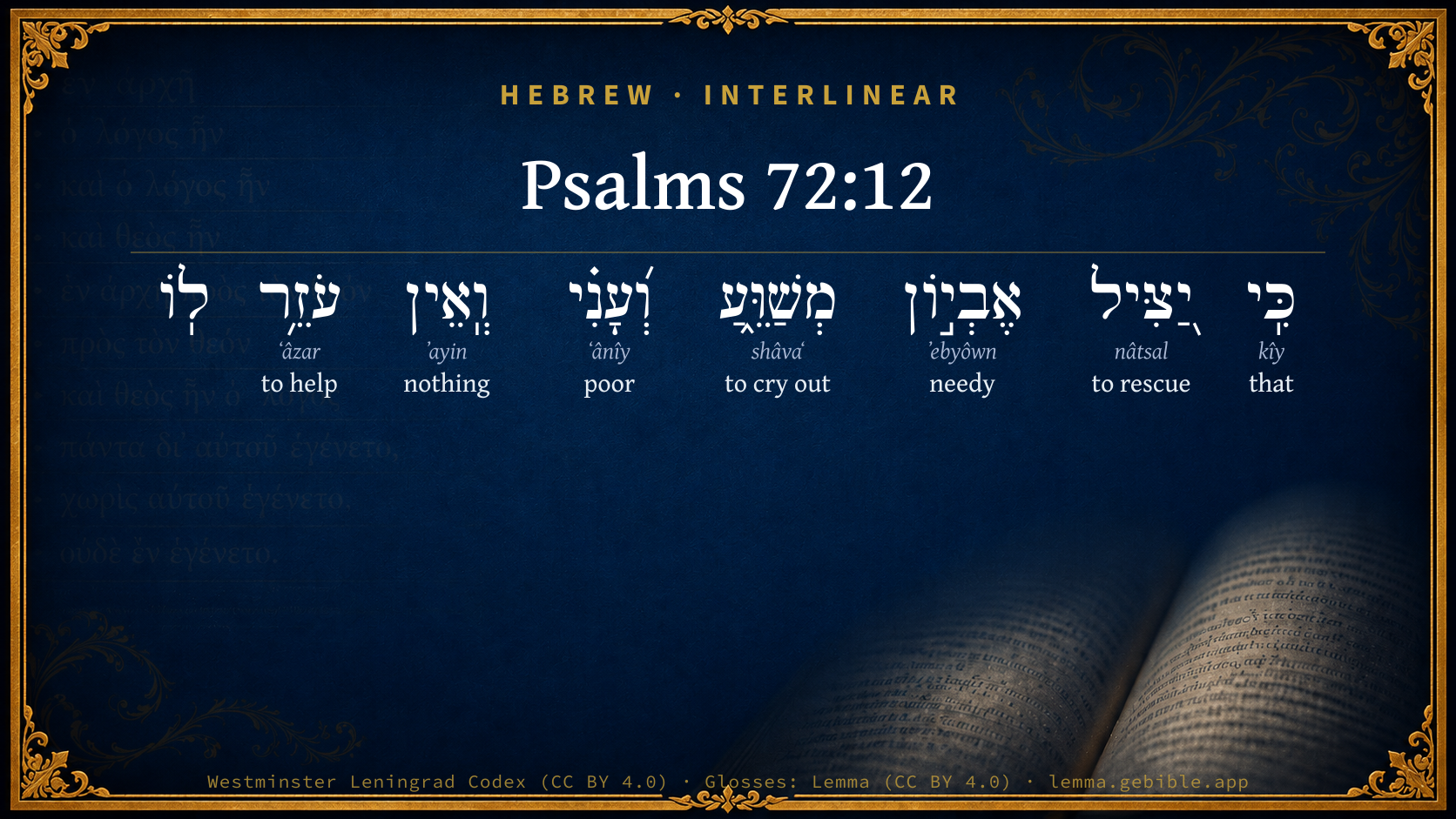
Psalms 72:12

Hebrew (Westminster Leningrad Codex) Psalms 72:12 appears in the Hebrew Old Testament. The text above is from the Westminster Leningrad Codex. Each word links to its Strong’s number, a concise gloss, and parsing drawn from the Open Scriptures Hebrew Bible morphology. Click any word for its full Brown-Driver-Briggs (BDB) entry.
Download image
Cite this verse

Psalms 72:12 (World English Bible). Public Domain. Lemma interlinear Bible study tool, https://lemma.gebible.app/v/psalms/72/12.

Show BibTeX & RIS
BibTeX
RIS
English Translation
For he will deliver the needy when he cries; The poor, who has no helper.
World English Bible · Public Domain
Download a study sheet

One document with this verse’s original text, its word-by-word gloss line, the meaning frame, cross-references with their text, attributed commentary, and full source and license credits — printable, and it pastes into notes with its structure intact.

This verse Autodidact and up

Study sheet (.html) Plain text (.txt)

A passage Seminary Student

Up to 50 verses in one chapter. A passage sheet keeps up to 6 commentary sources and 12 cross-references per verse, in the order this page ranks them, and says so on the sheet whenever that leaves anything out. Ask for a single verse and you get the Autodidact verse sheet above.

Everything on this page stays free to read, with no account — the sheet is a download of what is already on screen, not access to it.

Want to remove ads? Support Godless Engineer
Compare translations 3

The same verse in 3 English versions, stacked beneath the original-language interlinear above. Click any original word for its lexicon entry.

Each is an independent rendering of the whole verse — the interlinear is not word-aligned to these translations.

Highlighted words mark where these versions differ — a whole-verse word diff, not a word-by-word alignment.

  • World English Bible Public Domain
    For he will deliver the needy when he cries; The poor, who has no helper.
  • King James Version Public Domain
    For he shall deliver the needy when he crieth; the poor also, and him that hath no helper.
  • unfoldingWord Literal Text CC BY-SA 4.0
    For may he deliver the needy crying out and the poor when no helper to him.

unfoldingWord Literal Text — © unfoldingWord, licensed CC BY-SA 4.0. Word-aligned USFM3 via Door43 (git.door43.org/unfoldingWord/en_ult).

Versions to compare (up to 4)

3 of 4 selected

Show all 18 translations

Every available English version of this verse, each an independent rendering of the whole verse.

  • World English Bible Public Domain
    For he will deliver the needy when he cries; The poor, who has no helper.
  • Berean Standard Bible Public Domain
    For he will deliver the needy who cry out and the afflicted who have no helper.
  • Majority Standard Bible Public Domain
    For he will deliver the needy who cry out and the afflicted who have no helper.
  • King James Version Public Domain
    For he shall deliver the needy when he crieth; the poor also, and him that hath no helper.
  • American Standard Version (1901) Public Domain
    For he will deliver the needy when he crieth, And the poor, that hath no helper.
  • Revised Version (1885) Public Domain
    For he shall deliver the needy when he crieth; and the poor, that hath no helper.
  • Geneva Bible (1599) Public Domain
    For he shall deliuer the poore when he cryeth: the needie also, and him that hath no helper.
  • Douay-Rheims (1899) Public Domain
    For he shall deliver the poor from the mighty: and the needy that had no helper.
  • Young's Literal Translation Public Domain
    For he delivereth the needy who crieth, And the poor when he hath no helper,
  • Literal Standard Version CC BY-SA 4.0
    For He delivers the needy who cries, || And the poor when he has no helper,
  • Unlocked Literal Bible CC BY-SA 4.0
    For he helps the needy person who cries out and the poor person who has no other helper.
  • unfoldingWord Literal Text CC BY-SA 4.0
    For may he deliver the needy crying out and the poor when no helper to him.
  • Darby Bible Public Domain
    For he will deliver the needy who crieth, and the afflicted, who hath no helper;
  • World Messianic Bible Public Domain
    For he will deliver the needy when he cries; the poor, who has no helper.
  • Webster's Bible Public Domain
    For he shall deliver the needy when he crieth; the poor also, and him that hath no helper.
  • Free Bible Version CC BY-SA 4.0
    He will help the poor when they cry out to him, and help those who are suffering that have no one to support them.
  • Bible in Basic English Public Domain
    For he will be a saviour to the poor in answer to his cry; and to him who is in need, without a helper.
  • JPS Tanakh (1917) Public Domain
    For he will deliver the needy when he crieth; the poor also, and him that hath no helper.

Literal Standard Version (2020), Covenant Press — licensed CC BY-SA 4.0. Text via the HelloAO Bible API (eBible.org). Unlocked Literal Bible (unfoldingWord) — licensed CC BY-SA 4.0. Text via the HelloAO Bible API (eBible.org). unfoldingWord Literal Text — © unfoldingWord, licensed CC BY-SA 4.0. Word-aligned USFM3 via Door43 (git.door43.org/unfoldingWord/en_ult). Free Bible Version, Dr. Jonathan Gallagher — licensed CC BY-SA 4.0. Text via the HelloAO Bible API (eBible.org).

Word by word

More ways to search: Search by grammar → Find every occurrence → Compare this word →

Practice this passage: Drill this verse → Learn its vocabulary →

About this verse

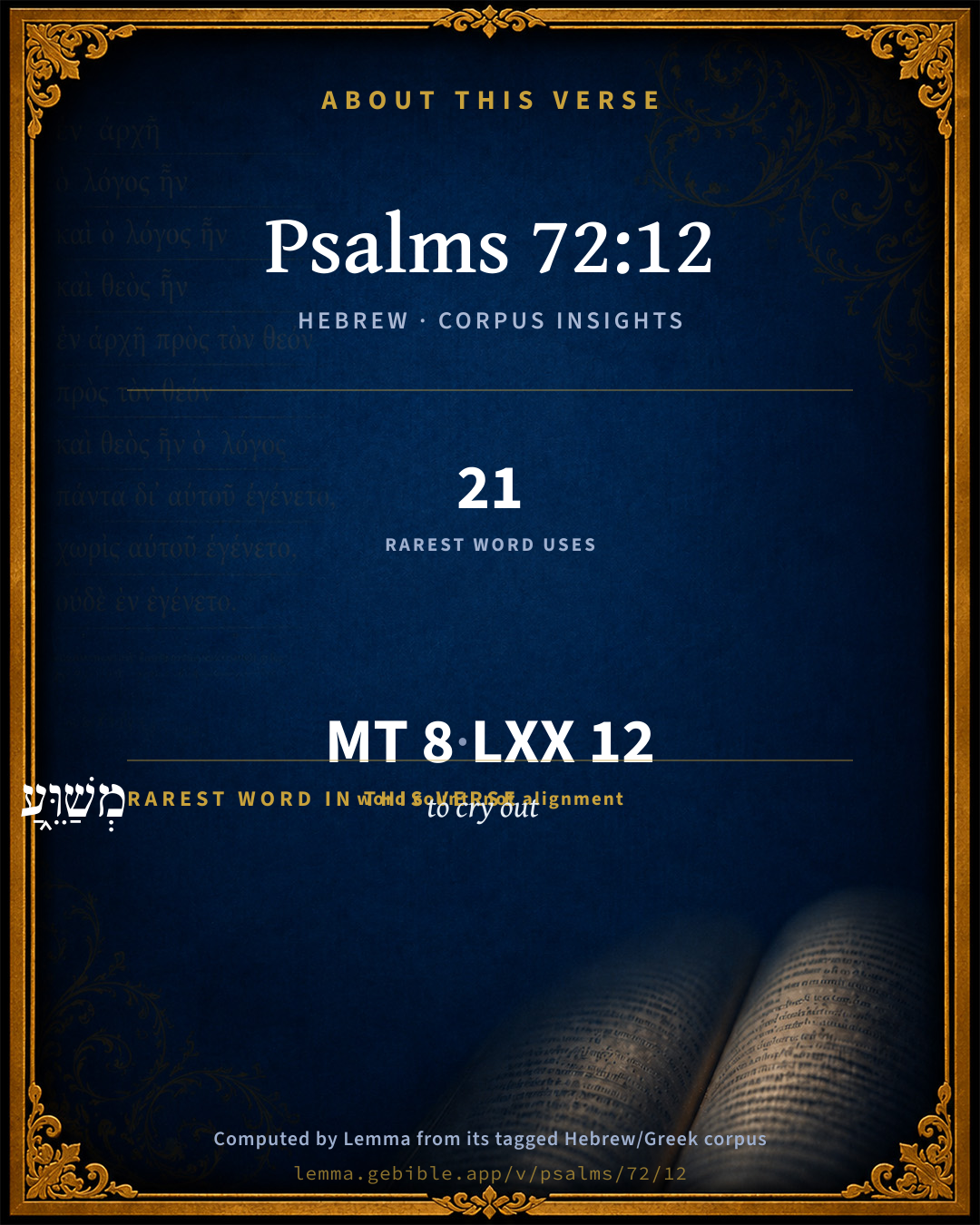
These counts appear in no published source. They are computed here, from the morphology-tagged text and Lemma’s own curated glosses. What Lemma adds →

8
words
7
distinct lemmas
Wisdom
section

Notable vocabulary

The rarest word here is מְשַׁוֵּ֑עַ to cry out H7768 — appearing just 21 times in the whole Hebrew Bible.

Shared distinctive vocabulary

מְשַׁוֵּ֑עַ to cry out H7768 occurs in 21 verses of the Hebrew Bible. Also found in:

Grammatical profile

  • 3 verbs
  • 2 adjectives
  • 1 preposition
  • 1 conjunction
  • 1 particle

Verb forms

  • יַ֭צִּיל Hiphil · Imperfect
  • מְשַׁוֵּ֑עַ Piel · Participle Active
  • עֹזֵ֥ר Qal · Participle Active

Hebrew & Septuagint length

In English translation the verse runs 15 words from the Hebrew and 16 from the Septuagint (LXX English) — closely comparable.

A rough comparison of the two English renderings, which tokenize alike — not a word-level alignment.

Word counts can differ between the Hebrew and the Greek without any difference in meaning — e.g. the Hebrew direct-object marker אֵת has no separate Greek word, and Greek often adds the article ὁ.

In the original languages it is 8 Hebrew tokens and 12 Greek tokens — but the two are counted differently (Hebrew bundles its prefixes and suffixes into one token; the Greek is in lemma form), so that isn’t a like-for-like length.

Cross-references

14

Topical passages linked to Psalms 72:12 in the Treasury of Scripture Knowledge — connected by theme and wording, ordered by reader-vote popularity; previews shown in the World English Bible.

  • Job 29:12 Because I delivered the poor who cried, And the fatherless also, who had none to help him.
  • Psalms 102:17 He has responded to the prayer of the destitute, And has not despised their prayer.
  • Revelation 3:17–18 Because you say, 'I am rich, and have gotten riches, and have need of nothing;' and don't know that you are the wretched one, miserable, poor, blind, and naked;
  • Ecclesiastes 4:1 Then I returned and saw all the oppressions that are done under the sun: and, behold, the tears of those who were oppressed, and they had no comforter; and on the side of their oppressors there was power; but they had no comforter.
  • Hebrews 7:25 Therefore he is also able to save to the uttermost those who draw near to God through him, seeing he ever lives to make intercession for them.
  • Psalms 10:17 Yahweh, you have heard the desire of the humble. You will prepare their heart. You will cause your ear to hear,
  • Psalms 82:3–4 "Defend the weak, the poor, and the fatherless. Maintain the rights of the poor and oppressed.
  • Psalms 72:4 He will judge the poor of the people. He will save the children of the needy, And will break the oppressor in pieces.
  • Isaiah 41:17 The poor and needy seek water, and there is none, and their tongue fails for thirst; I, Yahweh, will answer them, I, the God of Israel, will not forsake them.
  • Luke 4:18 "The Spirit of the Lord is on me, Because he has anointed me to preach good news to the poor. He has sent me to heal the brokenhearted, To proclaim release to the captives, Recovering of sight to the blind, To deliver those who are crushed,
  • 2 Corinthians 8:9 For you know the grace of our Lord Jesus Christ, that, though he was rich, yet for your sakes he became poor, that you through his poverty might become rich.
  • Psalms 102:20 To hear the groans of the prisoner; To free those who are condemned to death;
  • Luke 7:22 Jesus answered them, "Go and tell John the things which you have seen and heard: that the blind receive their sight, the lame walk, the lepers are cleansed, the deaf hear, the dead are raised up, and the poor have good news preached to them.
  • Isaiah 63:4–5 For the day of vengeance was in my heart, and the year of my redeemed is come.

Cross-references courtesy of OpenBible.info (CC BY 4.0).

Hebrew and Greek witnesses Masoretic Hebrew ↔ Greek Septuagint

The same verse in the two great witnesses to the Old Testament, shown verse-for-verse.

You’re reading Greek Psalm 71 (Hebrew Psalm 72). The Septuagint counts the superscription, so verse numbers can differ from the Hebrew — chapter-level alignment, not verse-by-verse. Numbering follows Rahlfs.

These are two independent witnesses, not word-aligned to each other, and the Septuagint is shown in lemma (dictionary) form.

Hebrew Psalms 72:12 Masoretic · Westminster Leningrad Codex

כִּֽי יַ֭צִּיל אֶבְי֣וֹן מְשַׁוֵּ֑עַ וְ֝עָנִ֗י וְֽאֵין עֹזֵ֥ר לֽוֹ

For he will deliver the needy when he cries; The poor, who has no helper.

World English Bible · Public Domain

Greek LXX Greek Psalm 71:12 Septuagint · lemma form

ὅτι ῥύομαι πτωχός ἐκ χείρ δυνάστης καί πένης ὅς οὐ ὑποἄρχω βοηθός

For he has delivered the poor from the oppressor; and the needy who had no helper.

LXX2012 (modern English Septuagint) · Public Domain

Hebrew: Westminster Leningrad Codex (CC BY 4.0). Greek: Septuagint (public domain); English from LXX2012 (modern English Septuagint) (Public Domain). How the Septuagint differs from the Hebrew →

Commentary

Notes on Psalms 72:12 from classic Christian and Jewish commentators (each source and its license shown beneath its notes). The classic Christian expositions comment on the surrounding passage and are grouped to its opening verse, so a note may address several verses; the Jewish commentaries on the Tanakh (Rashi and others) are per-verse, so they appear only where the commentator wrote on this verse.

Lemma curates 59 commentaries, every one of them public domain or Creative Commons licensed, each selected and text-cleaned for this edition rather than reprinted as found. About our sources →

Trapp's Complete Commentary

John Trapp

Psa 72:12 For he shall deliver the needy when he crieth; the poor also, and [him] that hath no helper.

Ver. 12. For he shall deliver the needy] See on Psa 72:4. If the people complained of Solomon’s government, and cried out to his son Rehoboam, Alleva iugum, Ease our yoke laid upon us by thy father, it was out of a sinful discontent; αει γαρ το παρον Bαρυ, saith Thucydides, people seldom know when they are well, but are ever quarrelling at and complaining of the present govermnent; yea, even of Christ’s easy yoke and light burden, as if importable.

John Trapp, A Commentary or Exposition upon All the Books of the Old and New Testament (1647–1656) — public domain. Text from a community e-Sword module.

The Biblical Illustrator

Joseph S. Exell

Psa_72:12

For He shall deliver the needy when he crieth; the poor also and him that hath no helper.

The poor mans friend

I. The special objects of grace.

1. They are needy. This we all are, all our life long, for body and for soul. But Gods peculiar people feel their spiritual need as others do not. They are full of needs. Once they thought they had need of nothing, but they do not think so now.

2. They are poor: the poor also. A man might be needy, and yet be able to supply his own need, so far as temporal things are concerned. But in things spiritual we are not only needy, but poor also.

3. They have no helper. Now, until God enlightens us, we seem to have a great many helpers. Priests, ministers, parents, preachers and many earthly things. But we have done with all such help now; we have found them all broken reeds. We felt this at our conversion, and we feel it now when we would advance in grace; and we feel it also when Satan tempts us, and in our trials and sorrows. But the Lord has not cast us off, for He shall deliver the needy, etc. Now, why does God select these for His favour? Partly because He is a Sovereign, and chooseth whom He will; then, they are the most willing to accept it; and they will never set themselves up in rivalry with Christ; they are glad to be saved in Gods way; the Lord finds in them warm friends. If the Lord were to save the Pharisees, they would hardly say, Thank you, they are so good themselves. But these poor and needy ones, they feel like that good old woman who said, that if ever the Lord saved her, He should never hear the last of it. They will praise and bless God with their whole soul.

II. The special blessing which the Great King has stored up for these people.

1. They shall be judged with judgment--they are often judged now with harshness. The Lord will right them.

2. Saved from oppression.

3. Deliverance shall be theirs, and--

4. He shall redeem their souls.

III. The special season when all this shall be true. When he crieth, when the needy cry unto Him. A cry is more than an ordinary prayer. We cry unto God when it gets so with us that we must have His grace, and our heart breaks for it when we will not let Him go unless He blesses, then deliverance is not far off. Oh, to feel our need, to know our utter poverty and helplessness, then shall we cry unto God, and He will save us. (C. H. Spurgeon.)

The cry of the needy heard and answered

A French tourist relates that some time ago he set out to cross St. Bernards Pass by himself, and got caught in the fog near the top. He sat on a rock and waited for one of the dogs to come and attend to him, but in vain, and when the fog cleared away he managed to reach the Hospice. On arrival he observed that he thought the dog a rather overrated animal. There I was, he said, for at least six hours, and not one came near me. But why, exclaimed one of the monks, did you not ring us up on the telephone? To the astonished tourist it was explained that the whole of the pass is provided with shelters at short distances from each other, all in direct telephonic communication with the Hospice. When the bell rings the monks send off a hound loaded with bread and wine and other comforts. The dog on duty is told what number has rung, and he goes straight to that shelter. This system saves the hounds their old duty of patrolling the pass on the chance of a stray traveller being found, and as the pass is for about eight months of the year under snow, this entailed very hard and often fruitless labour. There are many people in need of spiritual help who have not yet realized that there is One who will hear and answer directly the troubled soul cries to Him for aid.

The Biblical Illustrator, edited by Joseph S. Exell (c. 1880s–1900s) — public domain. Text from a community e-Sword module.

Joseph Benson's Commentary

Psa 72:12-14. For he shall deliver the needy, &c. — The fame of his just and merciful government shall induce multitudes either to put themselves under his rule and protection, or to show great respect and reverence for him. He shall spare the poor and needy — He shall take pity on them, and add no heavier burden unto that of their lamentable poverty. And shall save the souls — That is, the lives, of the needy. He shall not be prodigal of their lives, but as tenderly careful to spare and preserve them as those of his greatest subjects. If applied to Christ it means, that he shall save their souls, properly so called, namely, from the guilt and power of sin, into the favour and image of God, and a state of communion with him here, and the everlasting enjoyment of him hereafter, it being Christ’s proper work to save men’s souls. He shall redeem their soul from deceit and violence — The two ways whereby the lives and souls of men are usually destroyed. And precious shall their blood be in his sight — He shall set so high a value upon their lives, and love them so dearly, as never to expose them to imminent danger, much less to cast them away, merely to gratify his own revenge, covetousness, or insatiable desire of enlarging his empire, as earthly kings commonly do; but, like a true father of his people, will tenderly preserve them, and severely avenge their blood upon those that shall shed it.

Joseph Benson's Commentary on the Old and New Testaments (1811–1818) — public domain. Text from a community e-Sword module.

Keil & Delitzsch

C. F. Keil & F. Delitzsch

The confirmation of these prospects is now given. Voluntative forms are intermingled because the prospect extending into the future is nevertheless more lyrical than prophetic in its character. The elevation of the king to the dominion of the world is the reward of his condescension; he shows himself to be the helper and protecting lord of the poor and the oppressed, who are the especial object upon which God's eye is set. He looks upon it as his task to deal most sympathizingly and most considerately (יחס) just with those of reduced circumstances and with the poor, and their blood is precious in his eyes. Psa 72:12 is re-echoed in Job 29:12. The meaning of Psa 72:14 is the same as Psa 116:15. Instead of יקר, by a retention of the Jod of the stem it is written ייקר. Just as in Psa 49:10, ייקר here also is followed by ויחי. The assertion is individualized: and he (who was threatened with death) shall live (voluntative, having reference to the will of the king). But who is now the subject to ויתּן-? Not the rescued one (Hitzig), for after the foregoing designations (Psa 72:11.) we cannot expect to find "the gold of Sheba" (gold from Jeman or Aethiopia) in his possession. Therefore it is the king, and in fact Solomon, of whom the disposal of the gold of Sheba (Saba) is characteristic. The king's thought and endeavour are directed to this, that the poor man who has almost fallen a victim shall live or revive, and not only will he maintain his cause, he will also bestow gifts upon him with a liberal hand, and he (the poor one who has been rescued and endowed from the riches of the king) shall pray unceasingly for him (the king) and bless him at all times. The poor one is he who is restored to life and endowed with gifts, and who intercedes and blesses; the king, however, is the beneficent giver. It is left for the reader to supply the right subjects in thought to the separate verbs. That clearly marked precision which we require in rhetorical recital is alien to the Oriental style (vid., my Geschichte der jdischen Poesie, S. 189). Maurer and Hofmann also give the same interpretation as we have done.

Keil & Delitzsch — Biblical Commentary on the Old Testament (1861–1891) — public domain (CC PDM 1.0). Text via the HelloAO Bible API. (Old Testament only.)

J. A. Alexander on Psalms

Joseph Addison Alexander

Psa 72:12. For he will deliver the needy crying (to him for help), and the sufferer, and him that hath no helper. The literal translation of the last clause is, and there is no one helping him, or, and there is no helper to him. By referring the pronoun to the sufferer mentioned just before, we may take this, not as the description of a. third class, but as a further description of the second, the sufferer to whom there is no helper. The whole verse represents the king in question as the protector, not the oppressor, of his subjects, and assigns a reason for their tribute being represented as a requital of benefits received. See above, on Psa 72:10.

Joseph Addison Alexander, The Psalms Translated and Explained (1850) — public domain. Text from a community e-Sword module.

Tyndale Open Study Notes

Tyndale Open Resources

72:12-14 The anointed king will rescue the needy. He is not only the judge but also a father to the poor (10:14, 17; 68:5).

72:12 To rescue the poor means to bring an end to the rule of their oppressors.

Tyndale Open Study Notes — © Tyndale Open Resources, licensed CC BY-SA 4.0. Text via the HelloAO Bible API.

Adam Clarke's Commentary

Verse 12. He shall deliver the needy when he crieth] The poor and the rich shall, in the administration of justice, be equally respected; and the strong shall not be permitted to oppress the weak.

Adam Clarke's Commentary on the Bible (1810–1826) — public domain. Text from a community e-Sword/MySword module.

John Calvin's Commentaries

12. For he will deliver the poor when he crieth to him. The Psalmist again affirms that the kingdom which he magnifies so greatly will not be tyrannical or cruel. The majority of kings, neglecting the well-being of the community, have their minds wholly engrossed with their own private interests. The consequence is, that they unmercifully oppress their miserable subjects; and it even happens that the more formidable any of them is, and the more absorbing his rapacity, he is accounted so much the more eminent and illustrious. But it is far different with the king here described. It has been held as a proverb by all mankind, “That there is nothing in which men approach nearer to God than by their beneficence;” and it would be very inconsistent did not this virtue shine forth in those kings whom God has more nearly linked to himself. Accordingly, David, to render the king beloved who was chosen of God, justly declares, not only that he will be the guardian of justice and equity, but also that he will be so humane and merciful, as to be ready to afford succor to the most despised; qualities too seldom to be found in sovereigns, who, dazzled with their own splendor, withdraw themselves to a distance from the poor and the afflicted, as if it were unworthy of, and far beneath, their royal dignity to make them the objects of their care. David avows that the blood of the common people, which is usually accounted vile and as a thing of nought, will be very precious in the estimation of this heavenly king. Constancy and magnanimity are denoted by the words he will redeem; for it would be far short of the duty of a king merely to hate fraud and extortion, did he not resolutely come forward to punish these crimes and set himself to defend those who are oppressed. Under the terms fraud and violence is comprehended all kind of wrong-doing; for a man in working mischief is either a lion or a fox. Some rage with open violence, and others proceed to wrong-doing insidiously and by secret arts. Moreover, we know that supreme sovereignty, both in heaven and earth, has been given to Christ, (Matthew 28:18,) that he may defend his people not only from all temporal dangers, but especially from all the harassing annoyances of Satan, until having delivered them at length from all trouble, he gather them into the everlasting rest of his heavenly kingdom.

John Calvin's Commentaries (1540-1563) — public domain. Text from the Calvin Translation Society English edition (1840s-50s) via the Christian Classics Ethereal Library (ccel.org). Calvin's coverage is partial (roughly two-thirds of the Bible); uncommented books and verses are honest gaps, never fabricated. The 19th-century editor's footnotes and remarks are omitted so the notes are faithfully Calvin's own voice.

Ellicott's Commentary for English Readers

(12) For he shall deliver.—Here the verb must be present, “for he delivereth” giving the reason of the wide sway asked for this monarch. The prayer is based on the justice and beneficence of his reign (“to him that hath shall be given”), in which the weak and poor find their lives safe from violence, and their property protected against fraud. The verse is almost word for word the same as Job_29:12.

Poor.—Rather, afflicted.

A Bible Commentary for English Readers, edited by Charles John Ellicott (1878–1897) — public domain. Text from a community e-Sword module.

The Cambridge Bible for Schools and Colleges

gen. ed. J. J. S. Perowne

12. For he shall deliver] His claim to this universal homage rests not on the strength of his armies but on the justice and mercifulness of his rule. Cp. Isa_16:4-5. The true victory of the kingdom of God is a moral victory, Psa_72:9, it is true, refers to the forced submission of his enemies; but the same inconsistency is found in Zec_9:9 ff.: it was only by slow degrees that the triumph of the kingdom of God came to be completely dissociated from the idea of material conquest, and was realised to be entirely a moral triumph.

the poor also &c.] And the afflicted, when he hath no helper. The verse closely resembles Job_29:12.

The Cambridge Bible for Schools and Colleges (gen. ed. J. J. S. Perowne; Cambridge University Press, 1878–1918) — public domain. Text from a community e-Sword module.

John Gill's Exposition

For he shall deliver the needy when he crieth,.... Such as are not only in want, but are sensible of it, see their need of Christ and his righteousness, and salvation by him, and cry to him for the same, under a sense of their misery and danger; these he delivers out of all their troubles, and out of the hands of all their enemies, and supplies all their need;

the poor also; the poor in spirit; who acknowledge their spiritual poverty, and apply to him for the true riches; to these he gives gold tried in the fire, that they may be rich; he gives them grace here, and glory hereafter;

and him that hath no helper; that is in an helpless condition; can neither help himself, nor can any creature, angel or man, give him any help: but this being laid on Christ, and found in him, is given to him, whereby he is delivered out of a miserable state into a very comfortable and happy one; and such humane, kind, and tender regard to the needy, poor, and helpless, in this great King spoken of, is what engages to a cheerful subjection to him, and worship and reverence of him; more of which is expressed in the following verses, as the reason of the great esteem he should be had in.

John Gill's Exposition of the Whole Bible (1746–1763) — public domain (CC PDM 1.0). Text via the HelloAO Bible API.

Albert Barnes' Notes on the Bible

For he shall deliver the needy when he crieth - The sufferer; the down-trodden; the oppressed. See the notes at Psa 72:4. Compare the notes at Isa 61:1.

The poor also ... - All who have no protector; all who are exposed to injustice and wrong from others. This is everywhere declared to be the characteristic of the reign of the Messiah. See the notes at Isa 11:4.

Albert Barnes' Notes on the Bible (1834–1885) — public domain. Text from a community e-Sword/MySword module.

Matthew Poole's English Annotations

The fame of his just and merciful government shall induce multitudes either to put themselves under him, or to show great respect and reverence to him.

Matthew Poole's English Annotations on the Holy Bible (1683–1685) — public domain. Text from a community e-Sword/MySword module.

The Treasury of David

Charles H. Spurgeon

Ver. 12. For he shall deliver the needy. Here is an excellent reason for man's submission to the Lord Christ; it is not because they dread his overwhelming power, but because they are won over by his just and condescending rule. Who would not fear so good a Prince, who makes the needy his peculiar care, and pledges himself to be their deliverer in times of need?

When he crieth. He permits them to be so needy as to be driven to cry bitterly for help, but then he hears them, and comes to their aid. A child's cry touches a father's heart, and our King is the Father of his people. If we can do no more than cry it will bring omnipotence to our aid. A cry is the native language of a spiritually needy soul; it has done with fine phrases and long orations, and it takes to sobs and moans; and so, indeed, it grasps the most potent of all weapons, for heaven always yields to such artillery.

The poor also, and him that hath no helper. The proverb says, "God helps those that help themselves; "but it is yet more true that Jesus helps those who cannot help themselves, nor find help in others. All helpless ones are under the especial care of Zion's compassionate King; let them hasten to put themselves in fellowship with him. Let them look to him, for he is looking for them.

Ver. 12. He shall deliver the needy when he crieth. There needeth no mediator between him and his subjects; he heareth the needy when they cry. The man that hath nothing within him or without him to commend him to Christ, to assist, help, relieve, or comfort him in heaven or earth, is not despised by Christ, but delivered from that which he feareth. David Dickson.

Ver. 12. Christ's peculiar care of the poor.

Ver. 12.

I. Pitiable characters.

II. Abject conditions: "cry; ""no helper."

III. Natural resort: "crieth."

IV. Glorious interposition. G. Rogers.

Psalms 72:13*

Charles H. Spurgeon's The Treasury of David (1869–1885) — public domain. Psalms only. Text from a community e-Sword/MySword module.

Whedon's Commentary on the Bible

Daniel D. Whedon

12. For—Again in this and the two following verses the reasons are assigned for this majesty and dominion. (See Psa_72:2-4.) “He has merited such submission by the exercise of every royal virtue, by the justice and the mercy of his sway. The majesty of righteousness enthroned in his person compels all to bow before him.”—Perowne.

And him that hath no helper—Phillips reads, “When he has no helper,” giving vauv (ו) the adverbial sense.

Daniel D. Whedon (gen. ed.), Commentary on the Old and New Testaments (1874–1909) — public domain. Text from a community e-Sword module.

The Pulpit Commentary

For he shall deliver the needy when he crieth; the poor also, and him that hath no helper (comp. ver. 4); rather, and the poor who has no helper. Two classes of persons are spoken of, not three. (comp. Job_29:12)

The Pulpit Commentary (1880–1919), ed. H.D.M. Spence-Jones & Joseph S. Exell — public domain. Text from a community e-Sword module.

Lesson kit

Teaching starters — assembled from the data on this page, not authored interpretation. Every prompt links to the verse data it draws on. Edit before teaching.

Psalms, in the Wisdom, opens this verse with 8 words (7 distinct Hebrew lemmas). Its most distinctive word is shâvaʻ (“to cry out”). A historical commentator’s framing appears above. Read the whole chapter for the surrounding context.

Discussion questions

  1. How does “to cry out” (shâvaʻ) shape what this verse is saying?
  2. Job 19:7 shares the word «to cry out» with this verse. How do the two illuminate each other?
  3. These translations render this verse differently; the difference is in the English rendering, not the original. What questions does that raise?
  4. The verb «יַ֭צִּיל» is Hiphil Imperfect. How does its form color the action?
  5. Reading how Trapp's Complete Commentary and The Biblical Illustrator read this verse, where do the two commentators agree and where do they part?

Things to notice

Reading settings

Reading text

Shown beneath each verse's original-language words.

Old Testament
Old Testament edition

Read the OT as the Masoretic Hebrew (MT) or the Greek Septuagint (LXX).

English shown for the Greek Septuagint (in the Hebrew ↔ Greek comparison).

Comparing translations? Open the Compare panel on any verse page to stack up to four side by side.