Psalms 18:7

Hebrew (Westminster Leningrad Codex) Psalms 18:7 appears in the Hebrew Old Testament. The text above is from the Westminster Leningrad Codex. Each word links to its Strong’s number, a concise gloss, and parsing drawn from the Open Scriptures Hebrew Bible morphology. Click any word for its full Brown-Driver-Briggs (BDB) entry.
Download image
Cite this verse

Psalms 18:7 (World English Bible). Public Domain. Lemma interlinear Bible study tool, https://lemma.gebible.app/v/psalms/18/7.

Show BibTeX & RIS
BibTeX
RIS
English Translation
Then the earth shook and trembled. The foundations also of the mountains quaked and were shaken, Because he was angry.
World English Bible · Public Domain
Download a study sheet

One document with this verse’s original text, its word-by-word gloss line, the meaning frame, cross-references with their text, attributed commentary, and full source and license credits — printable, and it pastes into notes with its structure intact.

This verse Autodidact and up

Study sheet (.html) Plain text (.txt)

A passage Seminary Student

Up to 50 verses in one chapter. A passage sheet keeps up to 6 commentary sources and 12 cross-references per verse, in the order this page ranks them, and says so on the sheet whenever that leaves anything out. Ask for a single verse and you get the Autodidact verse sheet above.

Everything on this page stays free to read, with no account — the sheet is a download of what is already on screen, not access to it.

Want to remove ads? Support Godless Engineer
Compare translations 3

The same verse in 3 English versions, stacked beneath the original-language interlinear above. Click any original word for its lexicon entry.

Each is an independent rendering of the whole verse — the interlinear is not word-aligned to these translations.

Highlighted words mark where these versions differ — a whole-verse word diff, not a word-by-word alignment.

  • World English Bible Public Domain
    Then the earth shook and trembled. The foundations also of the mountains quaked and were shaken, Because he was angry.
  • King James Version Public Domain
    Then the earth shook and trembled; the foundations also of the hills moved and were shaken, because he was wroth.
  • unfoldingWord Literal Text CC BY-SA 4.0
    Then the earth shook and trembled, and the foundations of the mountains quaked and shook themselves because it burned to him.

unfoldingWord Literal Text — © unfoldingWord, licensed CC BY-SA 4.0. Word-aligned USFM3 via Door43 (git.door43.org/unfoldingWord/en_ult).

Versions to compare (up to 4)

3 of 4 selected

Show all 18 translations

Every available English version of this verse, each an independent rendering of the whole verse.

  • World English Bible Public Domain
    Then the earth shook and trembled. The foundations also of the mountains quaked and were shaken, Because he was angry.
  • Berean Standard Bible Public Domain
    Then the earth shook and quaked, and the foundations of the mountains trembled; they were shaken because He burned with anger.
  • Majority Standard Bible Public Domain
    Then the earth shook and quaked, and the foundations of the mountains trembled; they were shaken because He burned with anger.
  • King James Version Public Domain
    Then the earth shook and trembled; the foundations also of the hills moved and were shaken, because he was wroth.
  • American Standard Version (1901) Public Domain
    Then the earth shook and trembled; The foundations also of the mountains quaked And were shaken, because he was wroth.
  • Revised Version (1885) Public Domain
    Then the earth shook and trembled, me foundations also of the mountains moved and were shaken, because he was wroth.
  • Geneva Bible (1599) Public Domain
    Then the earth trembled, and quaked: the foundations also of the mountaines mooued and shooke, because he was angrie.
  • Douay-Rheims (1899) Public Domain
    In my affliction I called upon the Lord, and I cried to my God: And he heard my voice from his holy temple: and my cry before him came into his ears.
  • Young's Literal Translation Public Domain
    And shake and tremble doth the earth, And foundations of hills are troubled, And they shake -- because He hath wrath.
  • Literal Standard Version CC BY-SA 4.0
    And the earth shakes and trembles, || And foundations of hills are troubled, || And they shake—because He has wrath.
  • Unlocked Literal Bible CC BY-SA 4.0
    Then the earth shook and trembled; the foundations of the mountains also trembled and were shaken because God was angry.
  • unfoldingWord Literal Text CC BY-SA 4.0
    Then the earth shook and trembled, and the foundations of the mountains quaked and shook themselves because it burned to him.
  • Darby Bible Public Domain
    Then the earth shook and quaked, and the foundations of the mountains trembled and shook, because he was wroth.
  • World Messianic Bible Public Domain
    Then the earth shook and trembled. The foundations also of the mountains quaked and were shaken, because he was angry.
  • Webster's Bible Public Domain
    \\18:6\\In my distress I called upon the LORD, and cried to my God: he heard my voice out of his temple, and my cry came before him, even into his ears.
  • Free Bible Version CC BY-SA 4.0
    The earth shook to and fro; the foundations of the mountains trembled, shaking because of his anger.
  • Bible in Basic English Public Domain
    Then trouble and shock came on the earth; and the bases of the mountains were moved and shaking, because he was angry.
  • JPS Tanakh (1917) Public Domain
    (18-8) Then the earth did shake and quake, the foundations also of the mountains did tremble; they were shaken, because He was wroth.

Literal Standard Version (2020), Covenant Press — licensed CC BY-SA 4.0. Text via the HelloAO Bible API (eBible.org). Unlocked Literal Bible (unfoldingWord) — licensed CC BY-SA 4.0. Text via the HelloAO Bible API (eBible.org). unfoldingWord Literal Text — © unfoldingWord, licensed CC BY-SA 4.0. Word-aligned USFM3 via Door43 (git.door43.org/unfoldingWord/en_ult). Free Bible Version, Dr. Jonathan Gallagher — licensed CC BY-SA 4.0. Text via the HelloAO Bible API (eBible.org).

Word by word

More ways to search: Search by grammar → Find every occurrence → Compare this word →

Practice this passage: Drill this verse → Learn its vocabulary →

וַתִּגְעַ֬שׁ
gâʻash
H1607
“and · to shake”
Conjunction + Verb, Qal, Sequential Imperfect, 3rd Person, Feminine, Singular
Part of Speech
Conjunction + Verb
Stem
Qal
Form
Sequential Imperfect
Person
3rd Person
Gender
Feminine
Number
Singular
Full BDB Definition

Origin: a primitive root

TWOT: 371

to shake, quake - (Qal) to shake - (Pual) to be shaken up, convulsed - (Hithpael) to shake back and forth, toss or reel to and fro - (Hithpoel) to reel to and fro
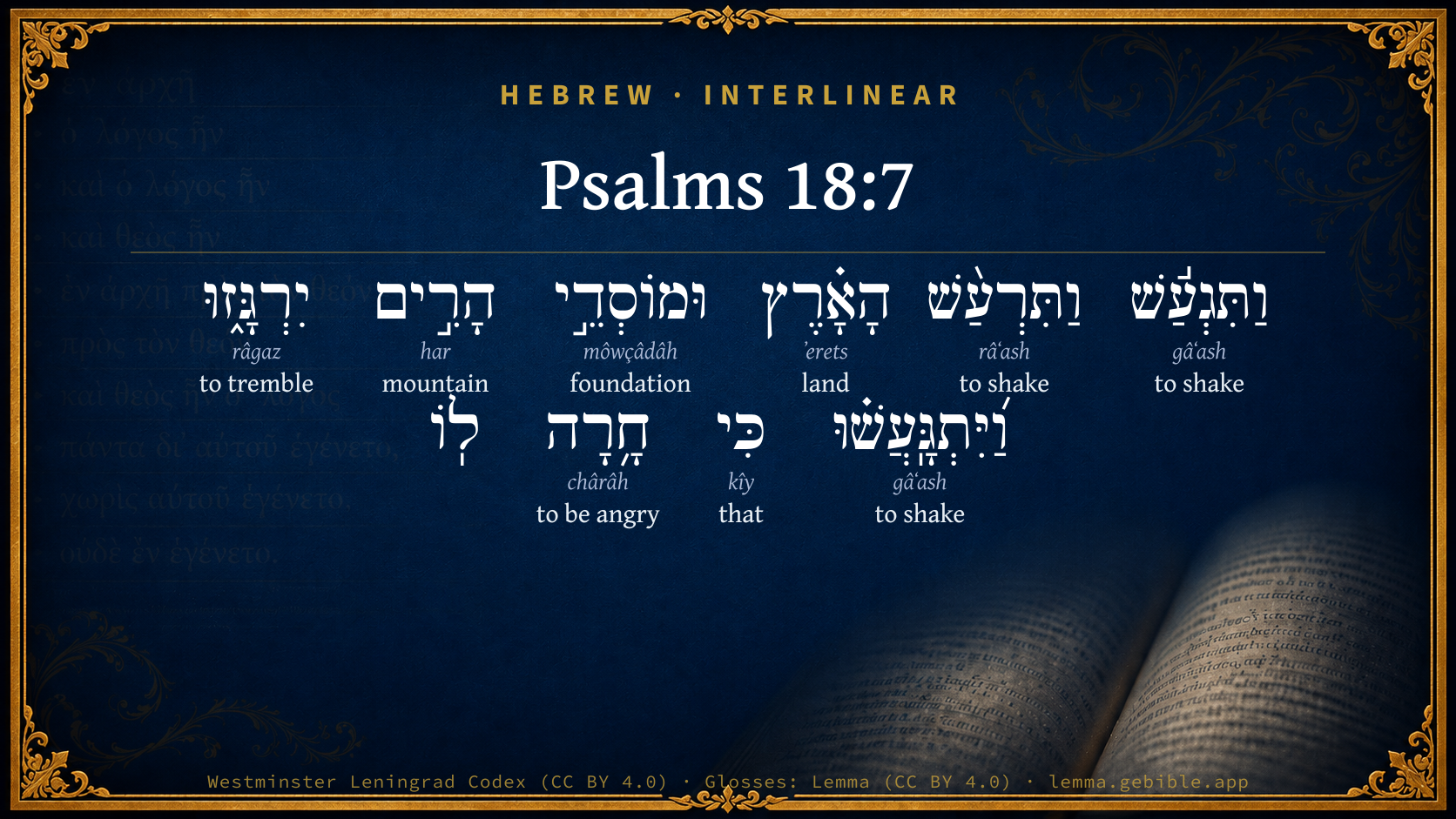
  1. וַתִּרְעַ֨שׁ râʻash H7493 “and · to shake” Conjunction + Verb, Qal, Sequential Imperfect, 3rd Person, Feminine, Singular
  2. הָאָ֗רֶץ ʼerets H776 “the · land” Particle, Definite Article + Noun, Common, Both, Singular, Absolute
  3. וּמוֹסְדֵ֣י môwçâdâh H4146 “and · foundations of” Conjunction + Noun, Common, Both, Plural, Construct
  4. הָרִ֣ים har H2022 “mountains” Noun, Common, Masculine, Plural, Absolute
  5. יִרְגָּ֑זוּ râgaz H7264 “to tremble” Verb, Qal, Imperfect, 3rd Person, Masculine, Plural
  6. וַ֝יִּתְגָּֽעֲשׁ֗וּ gâʻash H1607 “and · to shake” Conjunction + Verb, Hithpael, Sequential Imperfect, 3rd Person, Masculine, Plural
  7. כִּי kîy H3588 “that” Conjunction
  8. חָ֥רָה chârâh H2734 “to be angry” Verb, Qal, Perfect, 3rd Person, Masculine, Singular

About this verse

These counts appear in no published source. They are computed here, from the morphology-tagged text and Lemma’s own curated glosses. What Lemma adds →

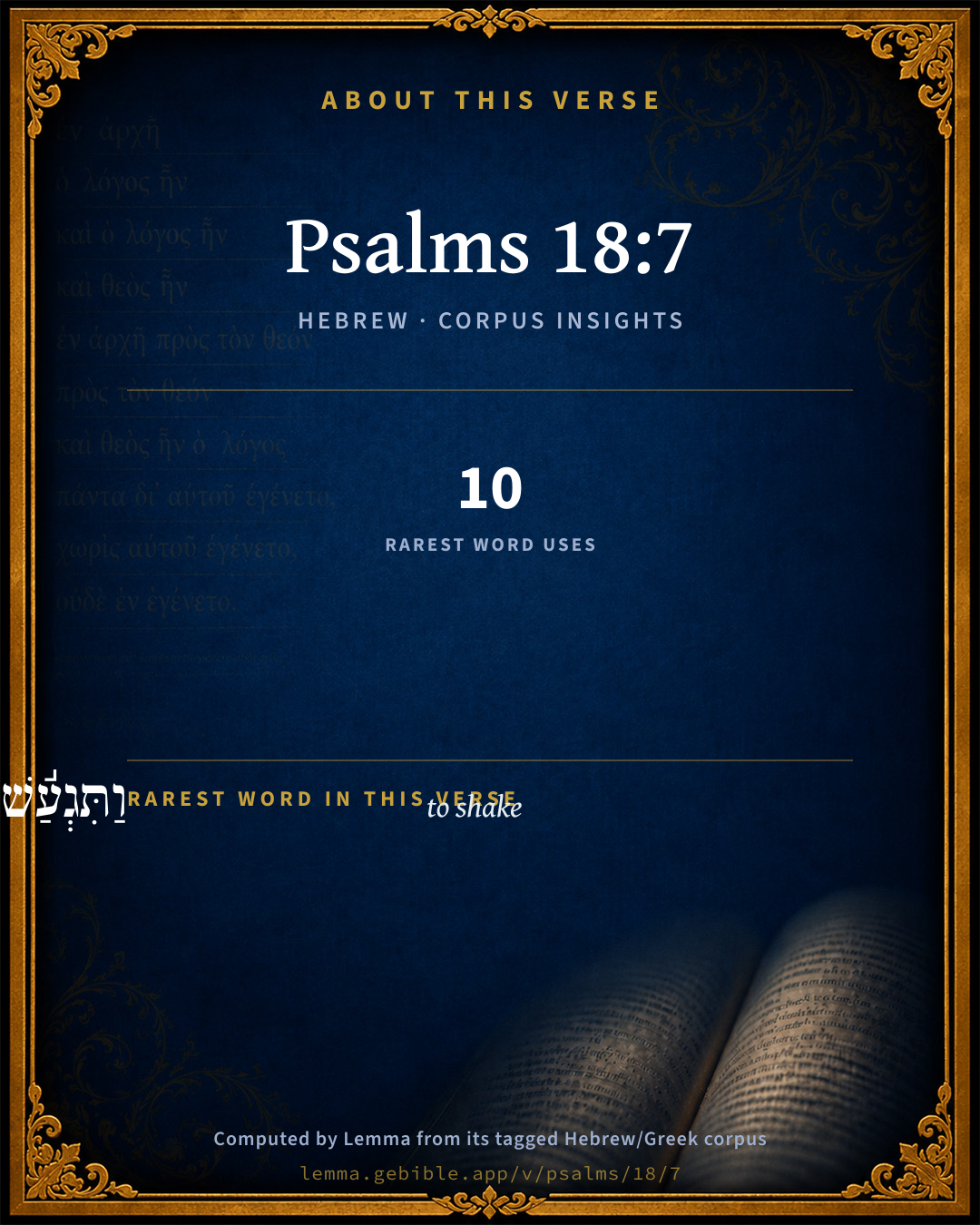
10
words
8
distinct lemmas
Wisdom
section

Notable vocabulary

The rarest word here is וַתִּגְעַ֬שׁ to shake H1607 — appearing just 10 times in the whole Hebrew Bible.

Shared distinctive vocabulary

וַתִּגְעַ֬שׁ to shake H1607 occurs in 7 verses of the Hebrew Bible. Also found in:

Grammatical profile

  • 5 verbs
  • 3 nouns
  • 1 preposition
  • 1 conjunction

Verb forms

  • וַתִּגְעַ֬שׁ Qal · Sequential Imperfect
  • וַתִּרְעַ֨שׁ Qal · Sequential Imperfect
  • יִרְגָּ֑זוּ Qal · Imperfect
  • וַ֝יִּתְגָּֽעֲשׁ֗וּ Hithpael · Sequential Imperfect
  • חָ֥רָה Qal · Perfect

Repetition

A word recurs within this verse — often emphatic in Hebrew:

  • וַתִּגְעַ֬שׁ to shake H1607 ×2

Hebrew & Septuagint length

In English translation the verse runs 20 words from the Hebrew and 23 from the Septuagint (LXX English) — closely comparable.

A rough comparison of the two English renderings, which tokenize alike — not a word-level alignment.

Word counts can differ between the Hebrew and the Greek without any difference in meaning — e.g. the Hebrew direct-object marker אֵת has no separate Greek word, and Greek often adds the article ὁ.

Cross-references

14

Topical passages linked to Psalms 18:7 in the Treasury of Scripture Knowledge — connected by theme and wording, ordered by reader-vote popularity; previews shown in the World English Bible.

  • Acts 4:31 When they had prayed, the place was shaken where they were gathered together. They were all filled with the Holy Spirit, and they spoke the word of God with boldness.
  • Psalms 68:7–8 God, when you went forth before your people, When you marched through the wilderness... Selah.
  • Ezekiel 38:19–20 For in my jealousy and in the fire of my wrath have I spoken, Surely in that day there shall be a great shaking in the land of Israel;
  • Deuteronomy 32:22 For a fire is kindled in my anger, Burns to the lowest Sheol, Devours the earth with its increase, Sets on fire the foundations of the mountains.
  • Judges 5:4 Yahweh, when you went forth out of Seir, When you marched out of the field of Edom, The earth trembled, the sky also dropped, Yes, the clouds dropped water.
  • Jeremiah 4:24 I saw the mountains, and, behold, they trembled, and all the hills moved back and forth.
  • Acts 16:25–26 But about midnight Paul and Silas were praying and singing hymns to God, and the prisoners were listening to them.
  • Psalms 114:4–7 The mountains skipped like rams, The little hills like lambs.
  • Habakkuk 3:6 He stood, and shook the earth. He looked, and made the nations tremble. The ancient mountains were crumbled. The age-old hills collapsed. His ways are eternal.
  • Habakkuk 3:10 The mountains saw you, and were afraid. The tempest of waters passed by. The deep roared and lifted up its hands on high.
  • Zechariah 14:4 His feet will stand in that day on the Mount of Olives, which is before Jerusalem on the east; and the Mount of Olives will be split in two, from east to west, making a very great valley. Half of the mountain will move toward the north, and half of it toward the south.
  • Matthew 28:2 Behold, there was a great earthquake, for an angel of the Lord descended from the sky, and came and rolled away the stone from the door, and sat on it.
  • 1 Corinthians 13:2 If I have the gift of prophecy, and know all mysteries and all knowledge; and if I have all faith, so as to remove mountains, but don't have love, I am nothing.
  • Psalms 46:2 Therefore we won't be afraid, though the earth changes, Though the mountains are shaken into the heart of the seas;

Cross-references courtesy of OpenBible.info (CC BY 4.0).

Hebrew and Greek witnesses Masoretic Hebrew ↔ Greek Septuagint

The same verse in the two great witnesses to the Old Testament, shown verse-for-verse.

You’re reading Greek Psalm 17 (Hebrew Psalm 18). The Septuagint counts the superscription, so verse numbers can differ from the Hebrew — chapter-level alignment, not verse-by-verse. Numbering follows Rahlfs.

These are two independent witnesses, not word-aligned to each other, and the Septuagint is shown in lemma (dictionary) form.

Hebrew Psalms 18:7 Masoretic · Westminster Leningrad Codex

וַתִּגְעַ֬שׁ וַתִּרְעַ֨שׁ הָאָ֗רֶץ וּמוֹסְדֵ֣י הָרִ֣ים יִרְגָּ֑זוּ וַ֝יִּתְגָּֽעֲשׁ֗וּ כִּי חָ֥רָה לֽוֹ

Then the earth shook and trembled. The foundations also of the mountains quaked and were shaken, Because he was angry.

World English Bible · Public Domain

Greek LXX Greek Psalm 17:7 Septuagint · lemma form

καί ἐν ὁ θλίβω ἐγώ ἐπικαλέω ὁ κύριος καί πρός ὁ θεός ἐγώ κράζω ἀκούω ἐκ ναός ἅγιος αὐτός φωνή ἐγώ καί ὁ κραυγή ἐγώ ἐνώπιον αὐτός εἰςἔρχομαι εἰς ὁ οὖς αὐτός

Then the earth shook and quaked, and the foundations of the mountains were disturbed, and were shaken, because God was angry with them.

LXX2012 (modern English Septuagint) · Public Domain

Hebrew: Westminster Leningrad Codex (CC BY 4.0). Greek: Septuagint (public domain); English from LXX2012 (modern English Septuagint) (Public Domain). How the Septuagint differs from the Hebrew →

Commentary

Notes on Psalms 18:7 from classic Christian and Jewish commentators (each source and its license shown beneath its notes). The classic Christian expositions comment on the surrounding passage and are grouped to its opening verse, so a note may address several verses; the Jewish commentaries on the Tanakh (Rashi and others) are per-verse, so they appear only where the commentator wrote on this verse.

Lemma curates 59 commentaries, every one of them public domain or Creative Commons licensed, each selected and text-cleaned for this edition rather than reprinted as found. About our sources →

The Cambridge Bible for Schools and Colleges

gen. ed. J. J. S. Perowne

7. The paronomasia of the original in the first line might be preserved by rendering, Then the earth did shake and quake.

the foundations &c.] Render: And the foundations of the mountains trembled. The strong mountains were shaken to their very bases. Cp. Isa_24:18; Hab_3:6. The text in 2 Sam. has “the foundations of heaven;” heaven as well as earth trembled. Its ‘foundations’ may be the mountains on which the vault of heaven seems to rest: cp. “the pillars of heaven” (Job_26:11): or more probably the universe is spoken of as a vast building, without any idea of applying the details of the metaphor precisely.

because he was wroth] The coming of Jehovah for the deliverance of His servant is necessarily a coming for the judgment of His enemies; and ‘wrath’ is that attribute of God’s character which moves Him to judgment. Cp. Rev_6:16-17.

7–15. Forthwith David’s prayer is answered by the Advent of Jehovah for the discomfiture of his enemies. He manifests Himself in earthquake and storm. The majestic though terrible phenomena of nature are the expression of His presence. Nature in its stern and awful aspect is a revelation of His judicial wrath. We may call this an ‘ideal’ description of a Theophany; for though it is possible that David refers to some occasion when his enemies were scattered by the breaking of a terrible storm (cp. Jos_10:11; Jdg_5:20 f.; 1Sa_7:10), we have no record of such an event having actually happened in his life; and in any case the picture is intended to serve as a description of God’s providential interposition for his deliverance in general, and not upon any single occasion. His power was exerted as really and truly as if all these extraordinary natural phenomena had visibly attested His Advent. Compare the accounts of the Exodus and the Giving of the Law. See Exo_19:16-18; Jdg_5:4-5; Psa_68:7-8; Psa_77:16-18 : and cp. Psa_50:2 ff., Psa_97:2 ff., Psalms 114; Isa_29:6; Isa_30:27 ff; Isa_64:1 ff; Hab_3:3 ff.

Psalms 29 should be compared as illustrating David’s sense of the grandeur and significance of natural phenomena.

The earthquake (Psa_18:7); the distant lightnings (Psa_18:8); the gathering darkness of the storm (Psa_18:9-11); the final outburst of its full fury (Psa_18:12-15); are pictured in regular succession.

The Cambridge Bible for Schools and Colleges (gen. ed. J. J. S. Perowne; Cambridge University Press, 1878–1918) — public domain. Text from a community e-Sword module.

Trapp's Complete Commentary

John Trapp

Psa 18:7 Then the earth shook and trembled; the foundations also of the hills moved and were shaken, because he was wroth.

Ver. 7. Then the earth shook and trembled, &c.] Upon David’s prayer all this befell; like as, Act 4:31, the house shook wherein they were praying; and the thundering legion procured thunder and rain; and so did Samuel by his prayers, 1Sa 12:17-18. But this terrible tempest here described is to be taken rather allegorically than historically. The prophet, in most lofty and lively terms and expressions (far above the strain of the most sublime either poets or orators), describeth God’s powerful presence and concurrence in David’s conquests.

The foundations also of the hills] That is, so vehement was the earthquake, that it shook, as it were, the roots of the mountains, which lie deep within the ground, 2Sa 22:8. These hills are called the foundation of heaven, as Job 26:11, the pillars of heaven; because the tops of high mountains seem to touch the clouds, and the heavens seem to lean upon them; and because the earth is in the centre of the world, about the which the heavens do continually turn.

Because he was wroth] Or, burn did his nose. So

John Trapp, A Commentary or Exposition upon All the Books of the Old and New Testament (1647–1656) — public domain. Text from a community e-Sword module.

The Biblical Illustrator

Joseph S. Exell

Psa_18:7

Then the earth shook and trembled.

Earthquakes, their moral suggestions

It is not for us to speculate concerning the physical causes of earthquakes. With the Bible in our hands we are privileged to regard the mightiest and the most destructive forces of nature as the ministers of His will who is wise in counsel, benevolent in purpose, and almighty in power.

I. The perilous condition of our earthly existence. Deep is the sense of insecurity which the earthquake strikes to our inward souls. But this is only one out of many perils that every moment threaten our destruction. This insecurity shows--

1. The absurdity of setting our affections on material good. Set your affection on things above.

2. The folly of postponing the preparation for eternity. How absurd to presume one minute upon the future, when every minute is uncertain.

II. The probability of a coming crisis in the history of our planet. Geology teaches that the subterraneous forces of the earth have effected wonderful crises in its history. It is only natural to suppose that the forces which swept away races that preceded them will one day sweep man from its sphere, and make the earth the habitation of other races of existences yet to be created. Science gives a testimony concerning a coming crisis that is positive and satisfactory. The Bible assures us that a crisis awaits the world (2Pe_3:1-18).

III. The element of severity in the Divine government. Storms, pestilences, famines, and earthquakes attest severity in the government of God.

1. The sinner deserves the severity.

2. The sinner requires the severity.

IV. The wisdom of seeking the Divine protection.

1. That protection can be obtained through a practical reliance on the mediation of Christ for acceptance.

2. The protection has been obtained. The ancient believers enjoyed it.

3. The protection secures from all danger. Then is God your protector? (Homilist.)

The Biblical Illustrator, edited by Joseph S. Exell (c. 1880s–1900s) — public domain. Text from a community e-Sword module.

The Treasury of David

Charles H. Spurgeon

Ver. 7. There was no great space between the cry and its answer. The Lord is not slack concerning his promise, but is swift to rescue his afflicted. David has in his mind's eye the glorious manifestations of God in Egypt, at Sinai, and on different occasions to Joshua and the judges; and he considers that his own case exhibits the same glory of power and goodness, and that, therefore, he may accommodate the descriptions of former displays of the divine majesty into his hymn of praise.

Then the earth shook and trembled. Observe how the most solid and immovable things feel the force of supplication. Prayer has shaken houses, opened prison doors, and made stout hearts to quail. Prayer rings the alarm bell, and the Master of the house arises to the rescue, shaking all things beneath his tread.

The foundations also of the hills moved and were shaken, because of his wrath. He who fixed the world's pillars can make them rock in their sockets, and can upheave the cornerstones of creation. The huge roots of the towering mountains are torn up when the Lord bestirs himself in anger to smite the enemies of his people. How shall puny man be able to face it out with God when the very mountains quake with fear? Let not the boaster dream that his present false confidence will support him in the dread day of wrath.

Ver. 7. Then the earth shook and trembled. The word (veg) signifies, to move or shake violently: it is employed, also, to denote the reeling and staggering of a drunken man. Jer 25:16. John Morison, in loc.

Ver. 7. Let no appearing impossibilities make you question God's accomplishment of any of his gracious words. Though you cannot see how the thing can be done, it is enough if God hath said that he will do it. There can be no obstructions to promised salvation which we need to fear. He who is the God of this salvation and the Author of the promise will prepare his own way for the doing of his own work, so that "every valley shall be filled, and every mountain and hill shall be brought low." Lu 3:5. Though the valleys be so deep that we cannot see the bottom, and the mountains so high that we cannot see the tops of them, yet God knows how to raise the one and level the other. Isa 63:1. "I that speak in righteousness (or faithfulness) am mighty to save." If anything would keep back the kingdom of Christ, it would be our infidelity; but he will come though he should find no faith on the earth. See Ro 3:3. Cast not away your confidence because he defers his performances. Though providences run cross, though they move backwards and forwards, you have a sure and faithful word to rely upon. Promises, though they be for a time seemingly delayed, cannot be finally frustrated. Dare not to harbour such a thought within yourselves as Ps 77:8; "Doth his promise fail for evermore?" The being of God may as well fail as the promise of God. That which does not come in your time, will be hastened in his time, which is always the more convenient season. Accuse him not of slowness who hath said, "I come quickly, "that is, he comes as soon as all things are ready and ripe for his appearance. It is as true that "the Lord is not slack concerning his promise" (2Pe 3:9), as that he is never guilty of breaking his promise. Wait, therefore, how long soever he tarry; do not give over expecting: the heart of God is not turned though his face be hid; and prayers are not flung back, though they be not instantly answered. Timothy Cruso.

Ver. 7-8. The volcanic phenomena of Palestine open a question of which the data are, in a scientific point of view, too imperfect to be discussed; but there is enough in the history and literature of the people to show that there was an agency of this kind at work. The valley of the Jordan, both in its desolation and vegetation, was one continued portent; and from its crevices ramified even into the interior of Judea the startling appearances, if not of the volcano, at least of the earthquake. Their historical effect in the special theatres of their operation will appear as we proceed; but their traces on the permanent feeling of the nation must be noticed here. The writings of the psalmists and prophets abound with indications which escape the eye of a superficial reader. Like the soil of their country, they actually heave and labour with the fiery convulsions which glow beneath their surface. Arthur Penrhyn Stanley.

Ver. 7-9. While Jesus hung on the cross, a preternatural "darkness covered all the land; "and no sooner had he yielded up his spirit, than "the vail of the temple was rent in twain from the top even to the bottom, and the earth did quake, and the rocks rent, and the graves were opened; and many bodies of the saints that slept arose, and came out of the graves, after his resurrection, and went into the holy city, and appeared unto many." John Brown.

Ver. 7-9. In the night in which the Idumaeans lay before Jerusalem, there arose a prodigious tempest and fierce winds, with most vehement rains, frequent lightnings, and terrible thunderings, and great roarings of the shaken earth; and it was manifest that the state of the universe was disordered at the slaughter of men; so one might guess that these were signs of no small calamity... At the day of Pentecost, when the priests, by night, went into the inner temple, according to their custom, to execute their office, they said they perceived, first of all, a shake and a noise, and after that a sudden voice, "Let us go hence."... A few days after the feast of unleavened bread, a strange and almost incredible sight was seen which would, I suppose, be taken for a mere fable, were it not related by such as saw it, and did not the miseries which followed appear answerable to the signs; for, before the sun set, were seen on high, in the air, all over the country, chariots and armed regiments moving swiftly in the clouds, and encompassing the city. Flavius Josephus, 37-103.

Ver. 7. The quaking of all things in the presence of an angry God.

Psalms 18:8*

Ver. 7-8. See Psalms on "Ps 19:7" for further information.

Ver. 7-9. See Psalms on "Ps 19:7" for further information.

Ver. 7-9. See Psalms on "Ps 19:7" for further information.

Ver. 7-9. See Psalms on "Ps 18:7" for further information.

Ver. 7-9. See Psalms on "Ps 18:7" for further information.

Charles H. Spurgeon's The Treasury of David (1869–1885) — public domain. Psalms only. Text from a community e-Sword/MySword module.

J. A. Alexander on Psalms

Joseph Addison Alexander

8. (Psa 18:7 ). Then did the earth shake and quake, and the foundations of the mountains trembled and were shaken because he was angry. The idea of succession expressed by the English then is conveyed in Hebrew by the form of the verb. The resemblance, in form and sound, of shake and quake, corresponds to that of the original verbs, where a reflexive or emphatic passive form of the first verb appears in the second clause. The closing words of this clause strictly mean because it was inflamed (or enkindled) to him with an ellipsis of the noun (Jxa) anger. The full construction may be found in Deu 6:15, and Psa 124:3. The phrase foundations of the mountains is copied from Deu 32:22.

Joseph Addison Alexander, The Psalms Translated and Explained (1850) — public domain. Text from a community e-Sword module.

Tyndale Open Study Notes

Tyndale Open Resources

18:7-15 The psalmist depicts the Lord’s descent from heaven to earth with phenomena such as earthquakes, flames, smoke, darkness, and rain. Creation shudders at God’s marvelous coming as the Divine Warrior (see 97:2-5) and Judge (see 50:1-6).

18:7 The destabilization of the whole earth will be a means of God’s judgment (77:17-18; 96:9; 97:4; 99:1; 104:32; Isa 29:6; Mic 1:3-4; Nah 1:2-6; Hag 2:7, 21).

Tyndale Open Study Notes — © Tyndale Open Resources, licensed CC BY-SA 4.0. Text via the HelloAO Bible API.

Geneva Bible (1599)

Geneva Bible translators

A description of the wrath of God against his enemies, after he had heard his prayers.

Geneva Bible (1599) marginal notes — public domain. Text via Bolls.life.

Jamieson, Fausset & Brown

Robert Jamieson, A. R. Fausset & David Brown

God's coming described in figures drawn from His appearance on Sinai (compare Deu 32:22).

Jamieson, Fausset & Brown — Commentary Critical and Explanatory on the Whole Bible (1871) — public domain (CC PDM 1.0). Text via the HelloAO Bible API.

Adam Clarke's Commentary

Verse 7. Then the earth shook and trembled] "In this and the following verses David describes, by the sublimest expressions and grandest terms, the majesty of God, and the awful manner in which he came to his assistance. The representation of the storm in these verses must be allowed by all skilful and impartial judges to be truly sublime and noble, and in the genuine spirit of poetry. The majesty of God, and the manner in which he is represented as coming to the aid of his favourite king, surrounded with all the powers of nature as his attendants and ministers, and arming (as it were) heaven and earth to fight his battles, and execute his vengeance, is described in the loftiest and most striking terms. The shaking of the earth; the trembling of the mountains and pillars of heaven; the smoke that drove out of his nostrils; the flames of devouring fire that flashed from his mouth; the heavens bending down to convey him to the battle; his riding upon a cherub, and rapidly flying on the wings of a whirlwind; his concealing his majesty in the thick clouds of heaven; the bursting of the lightnings from the horrid darkness; the uttering of his voice in peals of thunder; the storm of fiery hail; the melting of the heavens, and their dissolving into floods of tempestuous rain; the cleaving of the earth, and disclosing of the bottom of the hills, and the subterraneous channels or torrents of water, by the very breath of the nostrils of the Almighty; are all of them circumstances which create admiration, excite a kind of horror, and exceed every thing of this nature that is to be found in any of the remains of heathen antiquity. See Longinus on the Sublime, sec. 9, and Hesiod's description of Jupiter fighting against the Titans, which is one of the grandest things in all pagan antiquity; though upon comparison it will be found infinitely short of this description of the psalmist's; throughout the whole of which God is represented as a mighty warrior going forth to fight the battles of David, and highly incensed at the opposition his enemies made to his power and authority.

"When he descended to the engagement the very heavens bowed down to render his descent more awful, his military tent was substantial darkness; the voice of his thunder was the warlike alarm which sounded to the battle; the chariot in which he rode was the thick clouds of heaven, conducted by cherubs, and carried on by the irresistible force and rapid wings of an impetuous tempest; and the darts and weapons he employed were thunderbolts, lightnings, fiery hail, deluging rains, and stormy winds!

"No wonder that when God thus arose, all his enemies should be scattered, and those who hated him should flee before him.

"It does not appear from any part of David's history that there was any such storm as is here described, which proved destructive to his enemies, and salutary to himself. There might, indeed, have been such a one, though there is no particular mention of it: unless it may be thought that something of this nature is intimated in the account given of David's second battle with the Philistines, 2Sa 5:23-24. It is undoubted, however, that the storm is represented as real; though David, in describing it, has heightened and embellished it with all the ornaments of poetry. See Chandler, Delaney, and Lowth's ninth Prelection.

Adam Clarke's Commentary on the Bible (1810–1826) — public domain. Text from a community e-Sword/MySword module.

John Calvin's Commentaries

7. Then the earth shook. David, convinced that the aid of God, which he had experienced, was of such a character, that it was impossible for him to extol it sufficiently and as it deserved, sets forth an image of it in the sky and the earth, as if he had said, It has been as visible as the changes which give different appearances to the sky and the earth. If natural things always flowed in an even and uniform course, the power of God would not be so perceptible. But when he changes the face of the sky by sudden rain, or by loud thunder, or by dreadful tempests, those who before were, as it were, asleep and insensible, must necessarily be awakened, and be tremblingly conscious of the existence of a presiding God. “Il faut necessa ement que les gens qui auparavant estoyent comme endormis et stupides se resueillent et apprehendent qu’il y a un Dieu.” — Fr.

In the first place, he says, The earth shook, and nothing is more dreadful than an earthquake. Instead of the words, the foundations of the mountains, it is in the song, as recorded in 2nd Samuel, the foundations of the heavens; but the meaning is the same, namely, that there was nothing in the world so settled and steadfast which did not tremble, and which was not removed out of its place. David, however, as I have already observed in the beginning, does not relate this as a piece of history, or as what had actually taken place, but he employs these similitudes for the purpose of removing all doubt, and for the greater confirmation of faith as to the power and providence of God; because men, from their slowness of understanding, cannot apprehend God except by means of external signs. Some think that these miracles were actually wrought, and performed exactly as they are here related; but it is not easy to believe this, since the Holy Spirit, in the narrative given of David’s life, makes no mention whatever of such wonderful displays of divine power in his behalf. We cannot, however, justly censure or find fault with this hyperbolic manner of speaking, when we consider our slowness of apprehension, and also our depravity, to which I have just now called your attention. David, who was much more penetrating and quick of understanding than ordinary men, finding he could not sufficiently succeed in impressing and profiting people of sluggish and weak understandings by a simple manner of speaking, describes under outward figures the power of God, which he had discovered by means of faith, and the revelation of the Holy Spirit. He doubtless hereby apprehended and knew more distinctly the omnipresent majesty of God, than the dull sort of common people perceive the hand of God in earthquakes, tempests, thunders, the gloomy lowerings of the heavens, and the boisterous winds. At the same time, it is proper to consider, that although God had, in a wonderful manner, displayed his grace in defending and maintaining David, many, nevertheless, thought that it was by his own skill, or by chance, or by other natural means, that all his affairs had come to a prosperous issue; and it was such stupidity or depravity as this which he saw in the men of his own time, that constrained him to mention and to summon together all parts of creation as witnesses for God. Some also justly and judiciously consider that, in the whole of this description, David has an allusion to the common deliverance of God’s chosen people from Egypt. As God then designed and established that event to be a perpetual memorial, from which the faithful might learn that he was the guardian and protector of their welfare, so all the benefits which, from that period, he bestowed upon his people, either as a public body or as private individuals, were, so to speak, appendages of that first deliverance. Accordingly David, in other places as well as here, with the view of exalting the succor which God had granted to his people, sets forth that most memorable instance of the goodness of God towards the children of Israel, as if it were the archtype or original copy of the grace of God. And surely, while many, seeing him an exile from his country, held him in derision as a man expelled from the family of God, and many murmured that he had violently and unrighteously usurped the kingdom, he had good ground to include, under the deliverance which had been common to all the people, the protection and safety which God had afforded to himself; as if he had said, I have been wrongfully cast off as an alien or stranger, seeing God has sufficiently shown, in the deliverance which he has wrought for me, that by him I am owned and acknowledged to be a distinguished and valuable member of the Church. We see how the prophets, whenever they would inspire the people with the hope of salvation, call their thoughts back to the contemplation of that first covenant which had been confirmed by those miracles which were wrought in Egypt, in the passage through the Red Sea and in Mount Sinai. When he says, The earth trembled, because he was wroth, it is to be understood as referring to the ungodly. It is a form of speech which God often employs, to say, that, being inflamed with indignation, he arms himself to maintain the safety of his people against their persecutors.

John Calvin's Commentaries (1540-1563) — public domain. Text from the Calvin Translation Society English edition (1840s-50s) via the Christian Classics Ethereal Library (ccel.org). Calvin's coverage is partial (roughly two-thirds of the Bible); uncommented books and verses are honest gaps, never fabricated. The 19th-century editor's footnotes and remarks are omitted so the notes are faithfully Calvin's own voice.

Ellicott's Commentary for English Readers

(7) The earth shook.—The sudden burst of the storm is the Divine answer to the sufferer’s prayer. For similar manifestations comp. Psa_68:7-8; Psa_77:14-20; Amo_9:5; Mic_1:3; Hab_3:4; but here the colours are more vivid, and the language more intense. In fact, the whole realm of poetry cannot show a finer feeling for nature in her wrath. We first hear the rumbling of the earth, probably earthquake preceding the storm (for volcanic phenomena of Palestine see Stanley’s Sinai and Palestine, 124), or possibly only its distant threatening. Comp.

“Earth groans as if beneath a heavy load.”

BYRON.

Foundations also of the hills.—In Sam., “of the heavens”—i.e., the hills, called also “the pillars of heaven” (Job_26:11).

A Bible Commentary for English Readers, edited by Charles John Ellicott (1878–1897) — public domain. Text from a community e-Sword module.

John Gill's Exposition

There went up a smoke out of his nostrils,.... This, with what follows, describes a storm of thunder; the "smoke" designs thick black clouds, gathered together; "fire" intends lightning; and "coals of fire", hot thunderbolts; and the whole is borrowed from, and is an allusion to what was at the giving of the law on Mount Sinai, Exo 19:16; The majesty of God is here set forth in much such language as is the leviathan in Job 41:19; the "smoke of his nostrils" seems to intend the indignation of God against the enemies of David, of Christ, and of his people, and the punishment be will inflict upon them, Isa 65:5. The Targum interprets it of the pride and insolence of Pharaoh;

and fire out of his mouth devoured; God is a wall of fire round about his people, and a consuming one to his and their enemies. This expresses the wrath of God upon the Jewish nation, and his sending the Roman armies to burn their city, Mat 22:7;

coals were kindled by it; the Jews being as dry trees, were fit fuel for the fire of divine wrath, and so presently became as coals of fire; so the antichristian party, upon the pouring out of the fourth vial, will be scorched with heat, and blaspheme the name of God, Rev 16:8.

John Gill's Exposition of the Whole Bible (1746–1763) — public domain (CC PDM 1.0). Text via the HelloAO Bible API.

Albert Barnes' Notes on the Bible

Then the earth shook and trembled - The description which follows here is one of the most sublime that is to be found in any language. It is taken from the fury of the storm and tempest, when all the elements are in commotion; when God seems to go forth in the greatness of his majesty and the terror of his power, to prostrate everything before him. We are not to regard this as descriptive of anything which literally occurred, but rather as expressive of the fact of the divine interposition, as if he thus came forth in the greatness of his power. There is no improbability indeed in supposing that in some of the dangerous periods of David’s life, when surrounded by enemies, or even when in the midst of a battle, a furious tempest may have occurred that seemed to be a special divine interposition in his behalf, but we have no distinct record of such an event, and it is not necessary to suppose that such an event occurred in order to a correct understanding of the passage. All that is needful is to regard this as a representation of the mighty interposition of God; to suppose that his intervention was as direct, as manifest, and as sublime, as if he had thus interposed. There are frequent references in the Scriptures to such storms and tempests as illustrative of the majesty, the power, and the glory of God, and of the manner in which he interposes on behalf of his people. See Psa 144:5-7; Psa 46:6-8; Psa 29:1-11; Job 37:21-24; Job 38:1; Nah 1:3; and particularly Hab 3:3-16. The description in Habakkuk strongly resembles the passage before us, and both were drawn doubtless from an actual observation of the fury of a tempest.

The foundations also of the hills moved - The mountains seemed to rock on their foundations. In the corresponding place in 2Sa 22:8 the expression is, “The foundations of heaven moved and shook;” that is, that on which the heavens seem to rest was agitated. Many suppose that the expression refers to the mountains as if they bore up the heavens; but DeWette more properly supposes that the reference is to the heavens as a building or an edifice resting on foundations. Why the change was made in revising the psalm from the “foundations of the heavens” to the “foundations of the hills,” it is impossible now to determine.

Because he was wroth - literally,” Because it was inflamed (or enkindled) to him;” that is, because he was angry. Anger is often compared to a raging flame, because it seems to consume everything before it. Hence, we speak of it as “heated,” as “burning.” So we say of one that he is “inflamed by passion.” The expression here is sublime in the highest degree. God seemed to be angry, and hence, he came forth in this awful manner, and the very earth trembled before him.

Albert Barnes' Notes on the Bible (1834–1885) — public domain. Text from a community e-Sword/MySword module.

Matthew Poole's English Annotations

Then God appeared on my behalf in a miraculous and glorious manner, and with the great terror and confusion of all mine enemies, which is here compared to an earthquake. The earthquake was so deep and violent, that it overthrew whole mountains by the roots; whereby he designs his lofty and potent enemies; such being oft compared to mountains, as Psa 46:2,3; 144:5; Isa 41:15, &c.

Matthew Poole's English Annotations on the Holy Bible (1683–1685) — public domain. Text from a community e-Sword/MySword module.

Whedon's Commentary on the Bible

Daniel D. Whedon

7. Here begins the lofty description of David’s deliverances, continuing to Psa_18:20. The sublimity of his strain cannot be exceeded. The long years of his sufferings, his war’s, and his triumphs, come under one comprehensive glance. A traceable line of personal history is seen throughout, but the fulness of his descriptions are realized only by the Church in her struggles and victories. In this view, the psalm allies itself to the symbolism of the apocalypse.

Then—When God answered his prayer and arose to judgment.

The earth shook and trembled—The allusion here seems to be to Gen_19:25 : “And he overthrew those cities, and all the plain:” an earthquake attended by an eruption, as modern geological observation attests.

Daniel D. Whedon (gen. ed.), Commentary on the Old and New Testaments (1874–1909) — public domain. Text from a community e-Sword module.

The Pulpit Commentary

Then the earth shook and trembled; or, quailed and quaked (Kay, who thus expresses the assonance of the Hebrew vat-tig"ash vat-tir" ash). The psalmist must not be understood literally. He does not mean that the deliverance came by earthquake, storm, and thunder, but describes the discomfiture and dismay of his opponents by a series of highly poetical images. In these he, no doubt, follows nature closely, and probably describes what he had seen, heard, and felt. The foundations also of the hills moved and were shaken. In violent earthquakes, the earth seems to rock to its foundations; mountain ranges are sometimes actually elevated to a height of several feet; rocks topple down; and occasionally there are earth-slips of enormous dimensions. Because he was wroth. God"s anger against the psalmist"s enemies produced the entire disturbance which he is describing.

The Pulpit Commentary (1880–1919), ed. H.D.M. Spence-Jones & Joseph S. Exell — public domain. Text from a community e-Sword module.

John Wesley's Explanatory Notes

Then - Then God appeared on my behalf in a glorious manner, to the terror and confusion of all mine enemies, which is here compared to an earthquake.

John Wesley, Explanatory Notes Upon the Whole Bible (1754–1765) — public domain. Text via the GEBible commentary corpus.

Keil & Delitzsch

C. F. Keil & F. Delitzsch

(Heb.: 18:8-10) As these verses go on to describe, the being heard became manifest in the form of deliverance. All nature stands to man in a sympathetic relationship, sharing his curse and blessing, his destruction and glory, and to God is a (so to speak) synergetic relationship, furnishing the harbingers and instruments of His mighty deeds. Accordingly in this instance Jahve's interposition on behalf of David is accompanied by terrible manifestations in nature. Like the deliverance of Israel out of Egypt, Ps 68; Ps 77, and the giving of the Law on Sinai, Ex 19, and like the final appearing of Jahve and of Jesus Christ according to the words of prophet and apostle (Hab 3; Th2 1:7.), the appearing of Jahve for the help of David has also extraordinary natural phenomena in its train. It is true we find no express record of any incident in David's life of the kind recorded in Sa1 7:10, but it must be come real experience which David here idealises (i.e., seizes at its very roots, and generalises and works up into a grand majestic picture of his miraculous deliverance). Amidst earthquake, a black thunderstorm gathers, the charging of which is heralded by the lightning's flash, and its thick clouds descend nearer and nearer to the earth. The aorists in Psa 18:8 introduce the event, for the introduction of which, from Psa 18:4 onwards, the way has been prepared and towards which all is directed. The inward excitement of the Judge, who appears to His servant for his deliverance, sets the earth in violent oscillation. The foundations of the mountains (Isa 24:18) are that upon which they are supported beneath and within, as it were, the pillars which support the vast mass. געשׁ (rhyming with רעשׁ) is followed by the Hithpa. of the same verb: the first impulse having been given they, viz., the earth and the pillars of the mountains, continue to shake of themselves. These convulsions occur, because "it is kindled with respect to God;" it is unnecessary to supply אפּו, חרה לו is a synonym of חם לו. When God is wrath, according to Old Testament conception, the power of wrath which is present in Him is kindled and blazes up and breaks forth. The panting of rage may accordingly also be called the smoke of the fire of wrath (Psa 74:1; Psa 80:5). The smoking is as the breathing out of the fire, and the vehement hot breath which is inhaled and exhaled through the nose of one who is angry (cf. Job 41:12), is like smoke rising from the internal fire of anger. The fire of anger itself "devours out of the mouth," i.e., flames forth out of the mouth, consuming whatever it lays hold of-in men in the form of angry words, with God in the fiery forces of nature, which are of a like kind with, and subservient to, His anger, and more especially in the lightning's flash. It is the lightning chiefly, that is compared here to the blazing up of burning coals. The power of wrath in God, becoming manifest in action, breaks forth into a glow, and before it entirely discharges its fire, it gives warning of action like the lightning's flash heralding the outburst of the storm. Thus enraged and breathing forth His wrath, Jahve bowed the heavens, i.e., caused them to bend towards the earth, and came down, and darkness of clouds (ערפל similar in meaning to ὄρφνη, cf. ἔρεβος) was under His feet: black, low-hanging clouds announced the coming of Him who in His wrath was already on His way downwards towards the earth.

Keil & Delitzsch — Biblical Commentary on the Old Testament (1861–1891) — public domain (CC PDM 1.0). Text via the HelloAO Bible API. (Old Testament only.)

unfoldingWord translationNotes

Door43 World Missions Community

Then the earth ... shaken because God was angry

God's being angry is spoken of as if the there was a terrible earthquake. AT: "God was so angry that it was as if the earth ... shaken" (See: Metaphor)

the earth shook and trembled

The words "shook" and "trembled" mean basically the same thing and emphasize how greatly the earth shook. AT: "the land moved back and forth" or "the ground moved up and down" or "there was a violent earthquake" (See: Doublet)

the foundations of the mountains also trembled and were shaken

This can be stated in active form. AT: "the foundations of the mountains also trembled and shook" (See: Active or Passive)

Smoke went up from out of his nostrils ... Coals were ignited by it

David speaks of Yahweh as if he were breathing fire. This is a picture of how angry God was. (See: Metaphor)

blazing fire came out of his mouth. Coals were ignited by it

This can be stated in active form. AT: "blazing fire came out of his mouth and ignited coals" (See: Active or Passive)

translationWords

earth

found

anger

fire

unfoldingWord translationNotes — © Distant Shores Media and the Door43 World Missions Community, licensed CC BY-SA 4.0. Source: git.door43.org/Door43/en_tn.

Rashi

Rabbi Shlomo Yitzchaki (Rashi)

When I am in distress, I call I would always call upon the Lord.

Rashi on the Tanakh — English translations: “The Judaica Press complete Tanach with Rashi, translated by A. J. Rosenberg” (CC BY 4.0); “Pentateuch with Rashi's commentary by M. Rosenbaum and A.M. Silbermann, 1929-1934” (public domain); “The Metsudah Tanach series, Lakewood, N.J” (CC BY 4.0); and “The Book of Joshua, Metsudah Publications, 1997” (CC BY 4.0). Text via Sefaria.

Lesson kit

Teaching starters — assembled from the data on this page, not authored interpretation. Every prompt links to the verse data it draws on. Edit before teaching.

Psalms, in the Wisdom, opens this verse with 10 words (8 distinct Hebrew lemmas). Its most distinctive word is gâʻash (“to shake”). A historical commentator’s framing appears above. Read the whole chapter for the surrounding context.

Discussion questions

  1. The word gâʻash carries the sense “to shake.” How does it shape the verse?
  2. 2 Samuel 22:8 shares the word «to shake» with this verse. How do the two illuminate each other?
  3. “to shake” occurs 2× in this one verse. What is the effect of the repetition?
  4. These translations render this verse differently; the difference is in the English rendering, not the original. What questions does that raise?
  5. The verb «וַתִּגְעַ֬שׁ» is Qal Sequential Imperfect. How does its form color the action?
  6. Reading how The Cambridge Bible for Schools and Colleges and Trapp's Complete Commentary read this verse, where do the two commentators agree and where do they part?

Things to notice

  • These translations choose different wording for 11 words in this verse.
  • “to shake” occurs 2× in this single verse.
  • 8 distinct Hebrew lemmas span 10 words in this verse.

Reading settings

Reading text

Shown beneath each verse's original-language words.

Old Testament
Old Testament edition

Read the OT as the Masoretic Hebrew (MT) or the Greek Septuagint (LXX).

English shown for the Greek Septuagint (in the Hebrew ↔ Greek comparison).

Comparing translations? Open the Compare panel on any verse page to stack up to four side by side.