Genesis 2:3

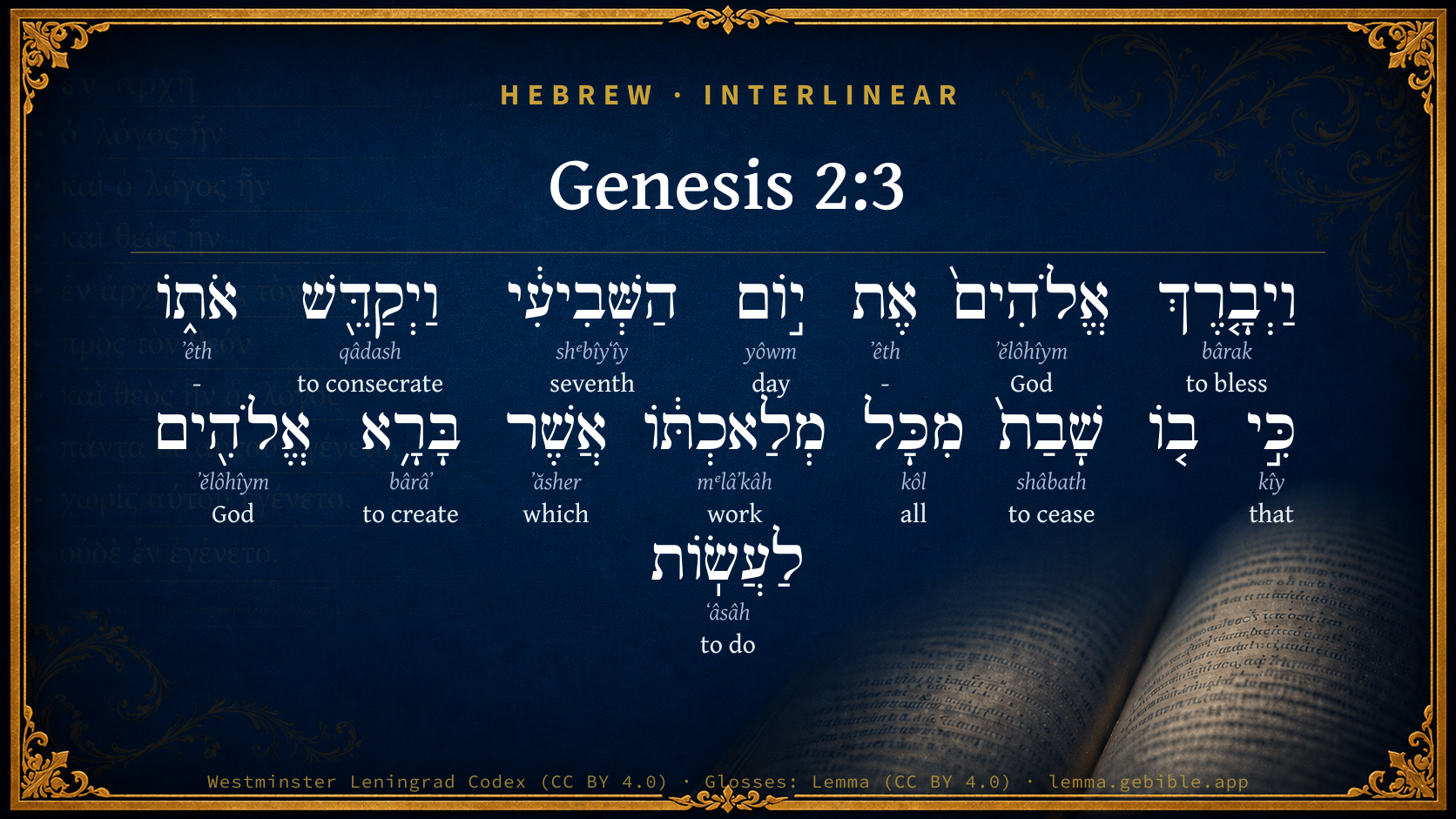
Hebrew (Westminster Leningrad Codex) Genesis 2:3 appears in the Hebrew Old Testament. The text above is from the Westminster Leningrad Codex. Each word links to its Strong’s number, a concise gloss, and parsing drawn from the Open Scriptures Hebrew Bible morphology. Click any word for its full Brown-Driver-Briggs (BDB) entry.
Download image
Cite this verse

Genesis 2:3 (World English Bible). Public Domain. Lemma interlinear Bible study tool, https://lemma.gebible.app/v/genesis/2/3.

Show BibTeX & RIS
BibTeX
RIS
English Translation
God blessed the seventh day, and made it holy, because he rested in it from all his work which he had created and made.
World English Bible · Public Domain
Highlights
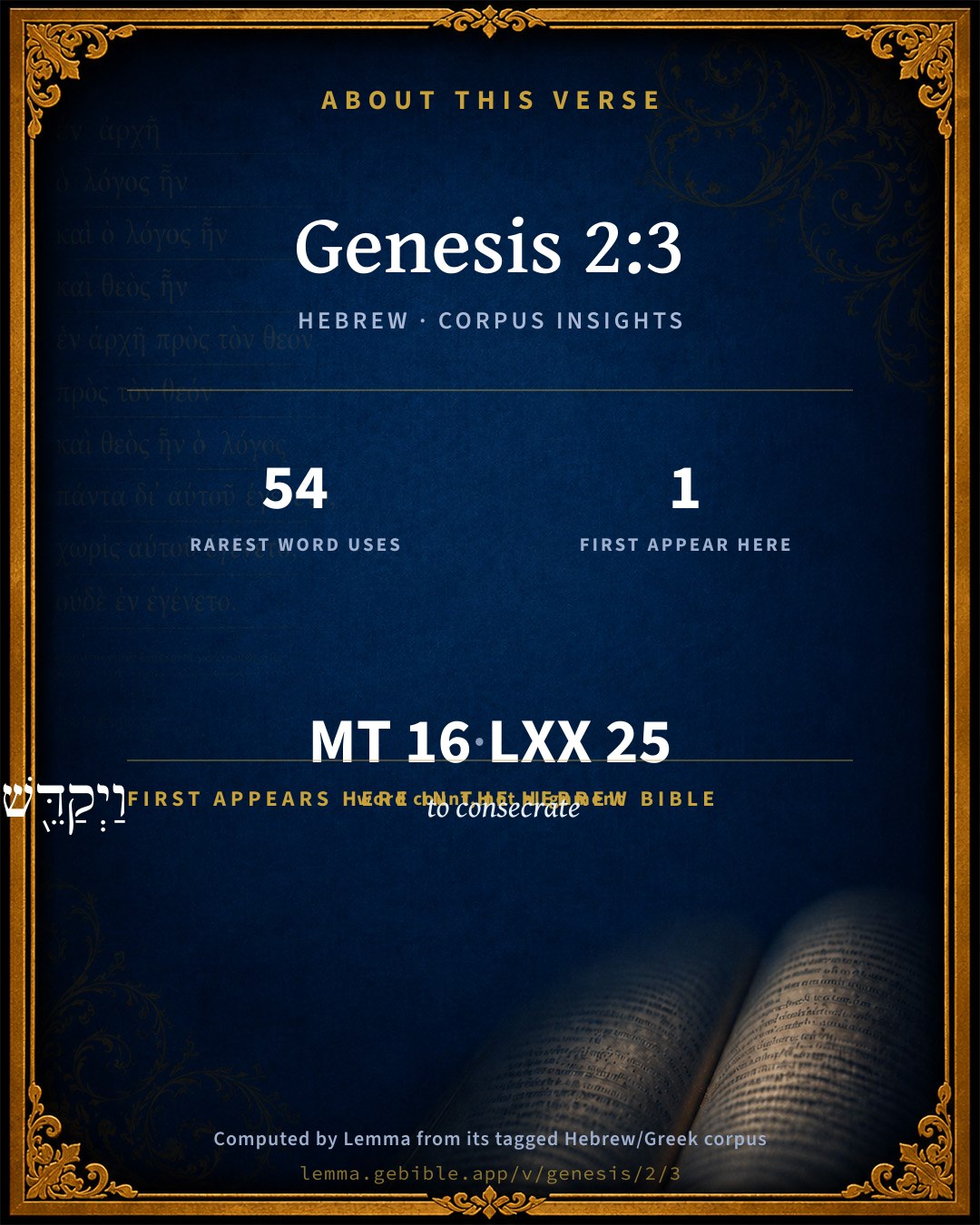
  • 1 first appearance in the Hebrew Bible
Full analysis ↓
Download a study sheet

One document with this verse’s original text, its word-by-word gloss line, the meaning frame, cross-references with their text, attributed commentary, and full source and license credits — printable, and it pastes into notes with its structure intact.

This verse Autodidact and up

Study sheet (.html) Plain text (.txt)

A passage Seminary Student

Up to 50 verses in one chapter. A passage sheet keeps up to 6 commentary sources and 12 cross-references per verse, in the order this page ranks them, and says so on the sheet whenever that leaves anything out. Ask for a single verse and you get the Autodidact verse sheet above.

Everything on this page stays free to read, with no account — the sheet is a download of what is already on screen, not access to it.

Want to remove ads? Support Godless Engineer
Compare translations 3

The same verse in 3 English versions, stacked beneath the original-language interlinear above. Click any original word for its lexicon entry.

Each is an independent rendering of the whole verse — the interlinear is not word-aligned to these translations.

Highlighted words mark where these versions differ — a whole-verse word diff, not a word-by-word alignment.

  • World English Bible Public Domain
    God blessed the seventh day, and made it holy, because he rested in it from all his work which he had created and made.
  • King James Version Public Domain
    And God blessed the seventh day, and sanctified it: because that in it he had rested from all his work which God created and made.
  • unfoldingWord Literal Text CC BY-SA 4.0
    And God blessed the seventh day and sanctified it, because on it he rested from all his work of creating that God had done. Adam and Eve and the Garden of Eden 2:4-25

unfoldingWord Literal Text — © unfoldingWord, licensed CC BY-SA 4.0. Word-aligned USFM3 via Door43 (git.door43.org/unfoldingWord/en_ult).

Versions to compare (up to 4)

3 of 4 selected

Show all 18 translations

Every available English version of this verse, each an independent rendering of the whole verse.

  • World English Bible Public Domain
    God blessed the seventh day, and made it holy, because he rested in it from all his work which he had created and made.
  • Berean Standard Bible Public Domain
    Then God blessed the seventh day and sanctified it, because on that day He rested from all the work of creation that He had accomplished.
  • Majority Standard Bible Public Domain
    Then God blessed the seventh day and sanctified it, because on that day He rested from all the work of creation that He had accomplished.
  • King James Version Public Domain
    And God blessed the seventh day, and sanctified it: because that in it he had rested from all his work which God created and made.
  • American Standard Version (1901) Public Domain
    And God blessed the seventh day, and hallowed it; because that in it he rested from all his work which God had created and made.
  • Revised Version (1885) Public Domain
    And God blessed the seventh day, and hallowed it: because that in it he rested from all his work which God had created and made.
  • Geneva Bible (1599) Public Domain
    So God blessed the seuenth day, and sanctified it, because that in it he had rested from all his worke, which God had created and made.
  • Douay-Rheims (1899) Public Domain
    And he blessed the seventh day, and sanctified it: because in it he had rested from all his work which God created and made.
  • Young's Literal Translation Public Domain
    And God blesseth the seventh day, and sanctifieth it, for in it He hath ceased from all His work which God had prepared for making.
  • Literal Standard Version CC BY-SA 4.0
    And God blesses the seventh day, and sanctifies it, for in it He has ceased from all His work which God had created for making.
  • Unlocked Literal Bible CC BY-SA 4.0
    God blessed the seventh day and sanctified it, because in it he rested from all his work which he had done in his creation.
  • unfoldingWord Literal Text CC BY-SA 4.0
    And God blessed the seventh day and sanctified it, because on it he rested from all his work of creating that God had done. Adam and Eve and the Garden of Eden 2:4-25
  • Darby Bible Public Domain
    And God blessed the seventh day, and hallowed it, because that on it he rested from all his work which God had created in making it.
  • World Messianic Bible Public Domain
    God blessed the seventh day, and made it holy, because he rested in it from all his work of creation which he had done.
  • Webster's Bible Public Domain
    And God blessed the seventh day, and sanctified it: because that in it he had rested from all his work which God created and made.
  • Free Bible Version CC BY-SA 4.0
    God blessed the seventh day, and set it apart as holy, because he rested from all the work he'd done in creation.
  • Bible in Basic English Public Domain
    And God gave his blessing to the seventh day and made it holy: because on that day he took his rest from all the work which he had made and done.
  • JPS Tanakh (1917) Public Domain
    And God blessed the seventh day, and hallowed it; because that in it He rested from all His work which God in creating had made.

Literal Standard Version (2020), Covenant Press — licensed CC BY-SA 4.0. Text via the HelloAO Bible API (eBible.org). Unlocked Literal Bible (unfoldingWord) — licensed CC BY-SA 4.0. Text via the HelloAO Bible API (eBible.org). unfoldingWord Literal Text — © unfoldingWord, licensed CC BY-SA 4.0. Word-aligned USFM3 via Door43 (git.door43.org/unfoldingWord/en_ult). Free Bible Version, Dr. Jonathan Gallagher — licensed CC BY-SA 4.0. Text via the HelloAO Bible API (eBible.org).

Word by word

More ways to search: Search by grammar → Find every occurrence → Compare this word →

Practice this passage: Drill this verse → Learn its vocabulary →

בָּרָ֥א
bârâʼ
H1254
“to create”
Verb, Qal, Perfect, 3rd Person, Masculine, Singular
Part of Speech
Verb
Stem
Qal
Form
Perfect
Person
3rd Person
Gender
Masculine
Number
Singular
Full BDB Definition

Origin: a primitive root

TWOT: 278

to create, shape, form - (Qal) to shape, fashion, create (always with God as subject) - of heaven and earth - of individual man - of new conditions and circumstances - of transformations - (Niphal) to be created - of heaven and earth - of birth - of something new - of miracles - (Piel) - to cut down - to cut out - to be fat - (Hiphil) to make yourselves fat
  1. וַיְבָ֤רֶךְ bârak H1288 “and · to bless” Conjunction + Verb, Piel, Sequential Imperfect, 3rd Person, Masculine, Singular
  2. אֱלֹהִים֙ ʼĕlôhîym H430 “God(s)” Noun, Common, Masculine, Plural, Absolute
  3. אֶת ʼêth H853 “-” Particle, Direct Object
  4. י֣וֹם yôwm H3117 “day of” Noun, Common, Masculine, Singular, Construct
  5. הַשְּׁבִיעִ֔י shᵉbîyʻîy H7637 “the · seventh” Particle, Definite Article + Adjective, Ordinal number, Masculine, Singular, Absolute
  6. וַיְקַדֵּ֖שׁ qâdash H6942 “and · to consecrate” Conjunction + Verb, Piel, Sequential Imperfect, 3rd Person, Masculine, Singular
  7. אֹת֑וֹ ʼêth H853 “- · him” Particle, Direct Object + Suffix, Personal, 3rd Person, Masculine, Singular
  8. כִּ֣י kîy H3588 “that” Conjunction
  9. שָׁבַת֙ shâbath H7673 “to cease” Verb, Qal, Perfect, 3rd Person, Masculine, Singular
  10. מִכָּל kôl H3605 “from · all of” Preposition + Noun, Common, Masculine, Singular, Construct
  11. מְלַאכְתּ֔וֹ mᵉlâʼkâh H4399 “work · his” Noun, Common, Feminine, Singular, Construct + Suffix, Personal, 3rd Person, Masculine, Singular
  12. אֲשֶׁר ʼăsher H834 “which” Particle, Relative
  13. אֱלֹהִ֖ים ʼĕlôhîym H430 “God(s)” Noun, Common, Masculine, Plural, Absolute
  14. לַעֲשֽׂוֹת ʻâsâh H6213 “to do” Preposition + Verb, Qal, Infinitive Construct

About this verse

These counts appear in no published source. They are computed here, from the morphology-tagged text and Lemma’s own curated glosses. What Lemma adds →

16
words
13
distinct lemmas
Pentateuch
section

First appearance in Scripture

This word makes its first canonical appearance in the Hebrew Bible here:

  • וַיְקַדֵּ֖שׁ to consecrate H6942

Shared distinctive vocabulary

בָּרָ֥א to create H1254 occurs in 46 verses of the Hebrew Bible. Also found in:

Grammatical profile

  • 5 verbs
  • 5 nouns
  • 1 adjective
  • 1 preposition
  • 1 conjunction
  • 3 particles

Verb forms

  • וַיְבָ֤רֶךְ Piel · Sequential Imperfect
  • וַיְקַדֵּ֖שׁ Piel · Sequential Imperfect
  • שָׁבַת֙ Qal · Perfect
  • בָּרָ֥א Qal · Perfect
  • לַעֲשֽׂוֹת Qal · Infinitive Construct

Repetition

A word recurs within this verse — often emphatic in Hebrew:

  • אֱלֹהִים֙ God H430 ×2

Hebrew & Septuagint length

In English translation the verse runs 24 words from the Hebrew and 23 from the Septuagint (LXX English) — closely comparable.

A rough comparison of the two English renderings, which tokenize alike — not a word-level alignment.

Word counts can differ between the Hebrew and the Greek without any difference in meaning — e.g. the Hebrew direct-object marker אֵת has no separate Greek word, and Greek often adds the article ὁ.

In the original languages it is 16 Hebrew tokens and 25 Greek tokens — but the two are counted differently (Hebrew bundles its prefixes and suffixes into one token; the Greek is in lemma form), so that isn’t a like-for-like length.

Cross-references

19

Topical passages linked to Genesis 2:3 in the Treasury of Scripture Knowledge — connected by theme and wording, ordered by reader-vote popularity; previews shown in the World English Bible.

  • Leviticus 23:3 "'Six days shall work be done: but on the seventh day is a Sabbath of solemn rest, a holy convocation; you shall do no manner of work. It is a Sabbath to Yahweh in all your dwellings.
  • Ezekiel 20:12 Moreover also I gave them my Sabbaths, to be a sign between me and them, that they might know that I am Yahweh who sanctifies them.
  • Mark 2:27 He said to them, "The Sabbath was made for man, not man for the Sabbath.
  • Exodus 31:13–17 "Speak also to the children of Israel, saying, 'Most assuredly you shall keep my Sabbaths: for it is a sign between me and you throughout your generations; that you may know that I am Yahweh who sanctifies you.
  • Luke 23:56 They returned, and prepared spices and ointments. On the Sabbath they rested according to the commandment.
  • Exodus 34:21 Six days you shall work, but on the seventh day you shall rest: in plowing time and in harvest you shall rest.
  • Exodus 35:2–3 'Six days shall work be done, but on the seventh day there shall be a holy day for you, a Sabbath of solemn rest to Yahweh: whoever does any work in it shall be put to death.
  • Leviticus 25:2–3 "Speak to the children of Israel, and tell them, 'When you come into the land which I give you, then the land shall keep a Sabbath to Yahweh.
  • Isaiah 58:13–14 If you turn away your foot from the Sabbath, from doing your pleasure on my holy day; and call the Sabbath a delight, [and] the holy of Yahweh honorable; and shall honor it, not doing your own ways, nor finding your own pleasure, nor speaking [your own] words:
  • Jeremiah 17:21–27 Thus says Yahweh, Take heed to yourselves, and bear no burden on the Sabbath day, nor bring it in by the gates of Jerusalem;
  • Exodus 20:8–11 "Remember the Sabbath day, to keep it holy.
  • Exodus 23:12 "Six days you shall do your work, and on the seventh day you shall rest, that your ox and your donkey may have rest, and the son of your handmaid, and the alien may be refreshed.
  • Deuteronomy 5:12–14 "Observe the Sabbath day, to keep it holy, as Yahweh your God commanded you.
  • Nehemiah 9:14 and made known to them your holy Sabbath, and commanded them commandments, and statutes, and a law, by Moses your servant,
  • Isaiah 56:2–7 Blessed is the man who does this, and the son of man who holds it fast; who keeps the Sabbath from profaning it, and keeps his hand from doing any evil.
  • Exodus 16:22–30 It happened that on the sixth day they gathered twice as much bread, two omers for each one, and all the rulers of the congregation came and told Moses.
  • Hebrews 4:4–10 For he has said this somewhere about the seventh day, "God rested on the seventh day from all his works;"
  • Nehemiah 13:15–22 In those days saw I in Judah some men treading wine-presses on the Sabbath, and bringing in sheaves, and lading donkeys [therewith]; as also wine, grapes, and figs, and all manner of burdens, which they brought into Jerusalem on the Sabbath day: and I testified [against them] in the day in which they sold food.
  • Proverbs 10:22 Yahweh's blessing brings wealth, And he adds no trouble to it.

Cross-references courtesy of OpenBible.info (CC BY 4.0).

Hebrew and Greek witnesses Masoretic Hebrew ↔ Greek Septuagint

The same verse in the two great witnesses to the Old Testament, shown verse-for-verse.

These are two independent witnesses, not word-aligned to each other, and the Septuagint is shown in lemma (dictionary) form.

Hebrew Genesis 2:3 Masoretic · Westminster Leningrad Codex

וַיְבָ֤רֶךְ אֱלֹהִים֙ אֶת י֣וֹם הַשְּׁבִיעִ֔י וַיְקַדֵּ֖שׁ אֹת֑וֹ כִּ֣י ב֤וֹ שָׁבַת֙ מִכָּל מְלַאכְתּ֔וֹ אֲשֶׁר בָּרָ֥א אֱלֹהִ֖ים לַעֲשֽׂוֹת

God blessed the seventh day, and made it holy, because he rested in it from all his work which he had created and made.

World English Bible · Public Domain

Greek LXX Genesis 2:3 Septuagint · lemma form

καί εὐλογέω ὁ θεός ὁ ἡμέρα ὁ ἕβδομος καί ἁγιάζω αὐτός ὅτι ἐν αὐτός καταπαύω ἀπό πᾶς ὁ ἔργον αὐτός ὅς ἄρχω ὁ θεός ποιέω

And God blessed the seventh day and sanctified it, because in it he ceased from all his works which God began to do.

LXX2012 (modern English Septuagint) · Public Domain

On this verse, The Cambridge Bible for Schools and Colleges discusses the Septuagint’s reading. Read the note in Commentary ↓

Hebrew: Westminster Leningrad Codex (CC BY 4.0). Greek: Septuagint (public domain); English from LXX2012 (modern English Septuagint) (Public Domain). How the Septuagint differs from the Hebrew →

Targum (Aramaic paraphrase)

2

The Targum is the ancient Jewish Aramaic paraphrase of the Hebrew Scriptures — an interpretive translation, not the Hebrew text itself. Onkelos (literal) and Pseudo-Jonathan (expansive) render the Torah, and Jonathan the Prophets. Coverage is partial: where no permissively-licensed English translation exists for a verse, only the Aramaic is shown. This is verse-level text, not a word-by-word alignment to the Hebrew.

  1. Targum Onkelos Torah (Genesis–Deuteronomy)
    וּבָרִיךְ יְיָ יָת יוֹמָא שְׁבִיעָאָה וְקַדִּישׁ יָתֵהּ אֲרֵי בֵהּ נַח מִכָּל עֲבִדְתֵּהּ דִּי בְרָא יְיָ לְמֶעְבַּד

    (no public-domain English translation for this verse)

    Targum Onkelos — Aramaic: “Onkelos Genesis” (public domain); “Onkelos Exodus” (public domain); “Onkelos Leviticus” (public domain); “Onkelos Numbers” (public domain); “Onkelos Deuteronomy” (public domain). English: “Sefaria Community Translation” (CC0 1.0 (public-domain dedication)); “J.W. Etheridge. The Targums of Onkelos and Jonathan Ben Uzziel on the Pentateuch. London: Longmans, Green, 1862” (public domain). Text via Sefaria.

  2. Targum Pseudo-Jonathan Torah (Genesis–Deuteronomy)
    וּבְרִיךְ יְיָ יַת יוֹמָא שְׁבִיעָאָה מִן כּוּלְהוֹן יוֹמֵי שְׁבִיעָתָא וְקַדִישׁ יָתֵיהּ אֲרוּם בֵּיהּ נחַ מִכָּל עֲבִידְתֵּיהּ דִבְרָא יְיָ וְעָתִיד לְמֶעֱבָד

    And the Lord blessed the Seventh Day more than all the days of the week, and sanctified it, because in it He rested from all His works which the Lord had created and had willed to make.

    Targum Pseudo-Jonathan — Aramaic: “Targum Jonathan on Genesis” (public domain); “Targum Jonathan on Exodus” (public domain); “Targum Jonathan on Leviticus” (public domain); “Targum Jonathan on Numbers” (public domain); “Targum Jonathan on Deuteronomy” (public domain). English: “The Targum of Jonathan ben Uzziel, trans. J. W. Etheridge, London, 1862” (public domain). Text via Sefaria.

Commentary

Notes on Genesis 2:3 from classic Christian and Jewish commentators (each source and its license shown beneath its notes). The classic Christian expositions comment on the surrounding passage and are grouped to its opening verse, so a note may address several verses; the Jewish commentaries on the Tanakh (Rashi and others) are per-verse, so they appear only where the commentator wrote on this verse.

Lemma curates 59 commentaries, every one of them public domain or Creative Commons licensed, each selected and text-cleaned for this edition rather than reprinted as found. About our sources →

The Cambridge Bible for Schools and Colleges

gen. ed. J. J. S. Perowne

3. And God blessed the seventh day) It was the belief of the devout Israelite that in some mysterious way God at the beginning conferred His special favour upon the seventh day. The writer does not in this passage mention the name “Sabbath,” but the reference to the Israelite Sabbath is indisputable. A play on the word “Sabbath “is evidently intended by the use of the word shâbath. The Hebrew cosmogony traced back the observance of the Sabbath to the Divine example on the seventh day of the creative week. Whether its observance was followed by the Israelites before the time of Moses, has been much disputed. No reference to it occurs in the Patriarchal narratives: but the intervals of seven days occurring in the story of the Flood (Gen_7:10, Gen_8:10; Gen_8:12 J) may indicate the belief in the primitive recognition of the “week” as a sacred division of time. The reference to the Sabbath in Exo_16:23 ff. has led many commentators to suppose that the opening word (“Remember”) of the Fourth Commandment assumes the primitive recognition of the institution. See Special Note on Gen_2:1-3.

hallowed) viz. separated from common and profane usage. LXX ἡγίασεν: Lat. sanctificavit. This is the first mention of the idea of holiness, which in Holy Scripture occupies such an important place in the description of religious worship and godly life.

We may be unable fully to discern what was intended by the writer, when he spoke of God “hallowing” or “making separate” the seventh day. But it conveys to us the thought that God from the first, set His seal upon “time” as well as His blessing upon matter; and this consecration of the seventh day should serve as the continual reminder that as “the earth is the Lord’s and the fulness thereof,” so time is of the Lord and the opportunities thereof. The Sabbath is the sacrament of time: its rest is the symbol of the consecration of work. The worship of the Creator made a demand for the consecration of time as well as of place. Notice the absence of the formula, “There was evening and there was morning, the seventh day.” This omission led some to suppose that the seventh, or rest, day of God is not yet ended; and that, when the work of Creation was finished, there began on the seventh day the different task of the maintenance of the universe. But it seems more probable that by the reference to the seventh day in Gen_2:2, and by the blessing of the seventh day in Gen_2:3, the writer intended that the seven days should be regarded as completed, and as presenting the Divine type for every week of seven days. After the seventh day came another phase of Divine activity, the unceasing operation of Divine laws. The Immanence of Creative Love and Wisdom needs to be acknowledged no less than their Transcendence; cf., especially, Joh_5:17, “My Father worketh even until now, and I work.” In that conception of Divine work, there is no room for the thought of cessation.

The Cambridge Bible for Schools and Colleges (gen. ed. J. J. S. Perowne; Cambridge University Press, 1878–1918) — public domain. Text from a community e-Sword module.

Trapp's Complete Commentary

John Trapp

Gen 2:3 And God blessed the seventh day, and sanctified it: because that in it he had rested from all his work which God created and made.

Ver. 3. God blessed the seventh day,] i.e., made it an effectual means of blessing to him that sanctifieth it, as a rest from bodily labour and spiritual idleness, as Ignatius {a} exhorts.

And sanctified it,] i.e., consecrated and set it apart for holy use; as they sanctified, that is, appointed Kedesh for a city of refuge {Jos 20:7, margin.}

{a} Eκαστος ημων σαββατιξετω πνευατικως μελετη νομου χαιρων ου σωματος ανσει Ignat. Eph 3:1-21, Ad Magnesios. Spac. Europae

John Trapp, A Commentary or Exposition upon All the Books of the Old and New Testament (1647–1656) — public domain. Text from a community e-Sword module.

Joseph Benson's Commentary

Gen 2:3. God blessed the seventh day — He conferred on it peculiar honour, and annexed to it special privileges above those granted to any other day; and sanctified it — That is, separated it from common use, and dedicated it to his own sacred service, that it should be accounted holy, and spent in his worship, and in other religious and holy duties. It appears evidently by this, that the observation of the sabbath was not first enjoined when the law was given, but that it was an ordinance of God from the creation of the world, and, of course, is obligatory on all the posterity of Adam, and the indispensable duty of every one to whom this divine appointment is made known.

Joseph Benson's Commentary on the Old and New Testaments (1811–1818) — public domain. Text from a community e-Sword module.

The Pulpit Commentary

And God blessed the seventh day. The blessing (cf. Gen_1:22, Gen_1:28) of the seventh day implied

1. That it was thereby declared to be the special object of the Divine favor.

2. That it was thenceforth to be a day or epoch of blessing for his creation. And

3. That it was to be invested with a permanence which did not belong to the other six days every one of which passed away and gave place to a successor. And sanctified it. Literally, declared it holy, or set it apart for holy purposes. As afterwards Mount Sinai was sanctified, (Exo_19:23) or, for the time being, invested with a sacred character as the residence of God; and Aaron and his sons were sanctified, or consecrated to the priestly office; (Exo_29:44) and the year of Jubilee was sanctified, or devoted to the purposes of religion, (Lev_25:10) so here was the seventh day sanctified, or instituted in the interests of holiness, and as such proclaimed to be a holy day. Because that in it he had rested from all his work which God had created and made. Literally, created to make, the exact import of which has been variously explained. The "w+n hrxato oJ qeov poihsai" of the LXX is obviously incorrect. Calvin, Ainsworth, Bush, et alii take the second verb emphatice, as intensifying the action of the first, and conveying the idea of a perfect creation. Kalisch, Alford, and others explain the second as epexegetic of the first, as in the similar phrases, "spoke, saying, literally, spoke to speak" (Exo_6:10) and labored to do". (Ecc_2:11) Onkelos, the Vulgate (quod Dens creavit ut faceret), Calvin, Tayler Lewis, &c. understand the infinitive in a ;relic sense, as expressive of the purpose for which the heavens and the earth were at first created, viz., that by the six days" work they might be fashioned into a cosmos. It has been observed that the usual concluding formula is not appended to the record of the seventh day, and the reason has perhaps been declared by Augustine: "Dies autem septimus sine vespera eat, nee habet occasum, quia sanctificasti eum ad permansionem sempiternam" ("Confess.," 13:36). But now what was this seventh day which received Elohim"s benediction? On the principle of interpretation applied to the creative days, this must be regarded as a period of indefinite duration, compounding to the human era of both Scripture and geology. But other Scriptures (Exo_20:8 Exo_23:12; Deu_5:12, &c.); show that the Hebrews were enjoined by God to observe a seventh day rest in imitation of himself. There are also indications that sabbatic observance was not unknown to the patriarchs, (Gen_29:27, Gen_29:28) to the antediluvians, (Gen_8:6-12) and to Cain and Abel. (Gen_4:3) Profane history likewise vouches for the veracity of the statement of Josephus, that "there is not any city of the Grecians, nor any of the barbarians, nor any nation whatsoever, whither our custom of resting on the seventh day hath not come" ("Contra Apionem," 2:40). The ancient Persians, Indians, and Germans esteemed the number seven as sacred. By the Greeks and Phoenicians a sacred character was ascribed to the seventh day. The Assyrians, Babylonians, Egyptians, and other nations of antiquity were acquainted with the hebdomadal division of time. Travelers have detected traces of it among the African and American aborigines. To account for its existence among nations so widely apart, both chronologically and geographically, recourse has been had to some violent hypotheses; as, e.g., to the number of the primary planets known to the ancients (Humboldt), the division of a lunar month into four nearly equal periods of seven days (Ideler, Baden Powell, &c.), Jewish example (Josephus). Its true genesis, however, must be sought for in the primitive observance of a seventh day rest in accordance with Divine appointment. Precisely as we reason that the early and widespread prevalence of sacrifice can only be explained by an authoritative revelation to the first parents of the human family of such a mode of worship, so do we conclude that a seventh day sabbath must have been prescribed to man in Eden. The question then arises, Is this sabbath also referred to in the Mosaic record of the seventh day? The popular Belief is that the institution of the weekly sabbath alone is the subject spoken of in the opening verses of the present chapter; and the language of Exo_20:11 may at first sight appear to warrant this conclusion. A more careful consideration of the phraseology employed by Moses, how ever, shows that in the mind of the Hebrew lawgiver there existed a distinction between God"s seventh day and man"s sabbath, and that, instead of identifying the two, he meant to teach that the first was the reason of the second; as thus six days God made.... and rested on the seventh day; where fore God blessed the (weekly) sabbath day, and hallowed it." Here it is commonly assumed that the words are exactly parallel to those in Gen_2:3, and that the sabbath in Exodus corresponds to the seventh day of Genesis. But this is open to debate. The seventh day which God blessed in Eden was the first day of human life, and not the seventh day; and it is certain that God did not rest from his labors on man"s seventh day, but on man"s first. We feel inclined then to hold with Luther that in Gen_2:3 Moses says nothing about man"s day, and that the seventh day which received the Divine benediction was God"s own great aeonian period of sabbatic rest. At the same time, for the reasons above specified, believing that a weekly sabbath was pre scribed to man from the beginning, we have no difficulty in assenting to the words of Tayler Lewis: God blessed the seventh day." Which seventh day, the greater or the less, the Divine or the human, the aeonian or the astronomical? Both, is the easy answer; both, as commencing at the same time, so far as the one connects with astronomical time; both, as the greater including the less; both, as being (the one as represented, the other as typically representing) the same essence and idea." It does not appear necessary to refute the idea that the weekly sabbath had no existence till the giving of the law, and that it is only here proleptically referred to by Moses. In addition to the above-mentioned historical testimonies to the antiquity of the Sabbath, the Fifth Tablet in the Chaldean Creation Series, after referring to the fourth day"s work, proceeds:

On the seventh day he appointed a holy day, And to cease from all business he commanded. Then arose the sun in the horizon of heaven in (glory).

thus apparently affirming that, in the opinion of the early Babylonians, the institution of the sabbath was coeval with the creation. (Vid. "Records of the Past," vol. 9. p. 117.)

HOMILETICS.

The two sabbaths: the Divine and the human.

I THE SABBATH OF GOD. A period of

1. Cessation from toil, or discontinuance of those world-making operations which had occupied the six preceding days. (Heb_4:4) Never since the close of the creative week has God interfered to fundamentally rearrange the material structure of the globe. The Deluge produced no alteration on the constitution of nature. Nor is there evidence that any new species have been added to its living creatures.

2. Holy delight. On the seventh day Elohim rested and was" refreshed"; (Exo_31:17) which refreshment consisted partly in the satisfaction he experienced in beholding the cosmos a satisfaction prefigured and anticipated by the solemn pauses intervening at the end of each creative day, accompanied by the "good," "lo! very good," of Divine approbation; and partly in the pleasure with which he contemplated the peculiar work of blessing his creation which lay before him, a work which also had its foreshadowings in the benedictions pronounced on the living creatures of the fifth day, and on man on the sixth.

3. Beneficent activity. Even man, unless where his intellectual and moral faculties are dormant, finds it difficult to rest in indolence and inactivity. Absence of motion, with complete negation of effort, may constitute the refreshment of the physical system. The mind seeks its rest in change of occupation. Still less can the supreme Intelligence, who is pure Spirit, rest in absolute inaction; only the Divine energy is now directed towards the happiness of his creatures. (Psa_145:9) Having finished his creative labors, what else could Elohim do but outpour his own blessedness upon his creatures, in proportion to their capacities to receive it? His nature as God necessitated such communication of good to his creatures. (Jam_1:5, Jam_1:17) The capacities of his creatures for such blessing required it. Hence God"s rest may be said to have been man"s birthright. He was created in that rest, as the sphere of his existence.

4. Continuous duration. That which secures its perpetuity is the Divine resolution to bless it, i.e. constitute it an era of blessing for man, and in particular to sanctify it, or devote it to the interests of holiness. And in this Divine determination lies the pledge of mans salvation. Without it God"s rest might have been broken into by man s sin, and the era of blessing ended. But, because of it, man"s sin could not change the character of God"s seventh day, so as to prevent it from dropping down gifts and exercising holy influences on the creature for whose sake it was appointed. The security of the world as a cosmos may also be said to be involved in the permanence of God"s sabbath. So long as it continues nothing shall occur to resolve the present goodly framework of this globe into another lightless, formless, lifeless chaos, at least until the Divine purpose with the human race has been fulfilled.

II THE SABBATH OF MAN.

1. Of Divine institution (Exo_20:8; Lev_19:30; Psa_118:24) That God had a right to enact a weekly sabbath for man is implied in his relation to man as Creator and Lawgiver. For man, therefore, to withhold the seventh portion of his time is to be guilty of disobedience against God as a moral Governor, ingratitude towards God as Creator and Preserver, robbery of God as the original Proprietor of both man"s powers and time"s days. As an institution of God"s appointing, the sabbath deserves our honor and esteem. To neglect to render this God counts a sin. (Isa_58:13)

2. Of sacred character. Among the Israelites its sanctity was to be recognized by abstinence from bodily labor (Exo_20:10 Exo_34:21, &c.); and holy convocations. (Lev_23:3) That this was the manner of its observance prior to the giving of the law may be judged from the regulations concerning the manna. (Exo_16:22) That from the beginning it was a day of rest and religious worship may be reasonably inferred. That it was so used by Christ and his apostles the Gospels attest. (Luk_4:16) That the same character was held to attach to the first day of the week after Christ"s resurrection may be deduced from the practice of the apostolic Church. (Act_20:7) The sanctity of the sabbath may be profaned, positively, by prosecuting one"s ordinary labors in its hours (Isa_58:13; Jer_17:24) negatively, by neglecting to devote them to Divine worship and spiritual improvement. (Eze_44:24) Christianity has not obliterated the distinction between the sabbath and the other days of the week; not even by elevating them to the position of holy days. An attempt to equalize the seven days always results in the degradation of the seventh, never in the elevation of the other six.

1. Of beneficent design. (Mar_2:27) The sabbath is adapted to the wants of man physically, intellectually, socially, politically. Innumerable

2. facts and testimonies establish the beneficial influence of a seventh day"s rest from toil upon the manual laborer, the professional thinker, the social fabric, the body politic, in respect of health, wealth, strength, happiness. It is, however, chiefly man"s elevation as a religious being at which it aims. In the paradisiacal state it was designed to hedge him round and, if possible, prevent his fall; since the tragedy in Eden it has been seeking his reinstatement in that purity from which he fell.

3. Of permanent obligation. Implied in the terms of its institution, its permanence would not be affected by the abolition of the Decalogue. The Decalogue presupposed its previous appointment. Christianity takes it up, just as Judaism took it up, as one of God"s existing ordinances for the good of man, and seeks through it to bring its higher influences to bear on man, just as Judaism sought, through it, to operate with its inferior agency. Till it merges in the rest of which it is a shadow by the accomplishment of its grand design, it must abide.

III THE CONNECTION OF THE TWO. God"s rest is

1. The reason of man"s sabbath. The Almighty could have no higher reason for enjoining a seventh day"s rest upon his creature than that by so resting that creature would be like himself.

2. The pattern of man"s sabbath. As God worked through six of his days and rested on the seventh, so should man toil through six of his days and rest on the seventh. As God did all his work in the six creative days, so should all man"s labor be performed in the six days of the week. As God employs his rest in contemplation of his finished work and in blessing his creature man, so should man devote his sabbath to pious meditation on his past life and to a believing reception of God"s gifts of grace and salvation.

3. The life of man"s sabbath. Whatever blessing comes to man on his weekly day of rest has its primal fountain in the rest of God. As man himself is God"s image, so is man"s sabbath the image of God"s rest; and as man lives and moves and has his being in God, so does man"s sabbath live and move and have its being in God"s rest.

4. The end of man"s sabbath. The reinstatement of man in God"s rest is the purpose at which man"s sabbath aims, the goal towards which it is tending. God"s rest remains on high, (Heb_4:9) drawing men towards it. Man"s weekly sabbath will ultimately lose itself m God s eternal rest.

The Pulpit Commentary (1880–1919), ed. H.D.M. Spence-Jones & Joseph S. Exell — public domain. Text from a community e-Sword module.

Scofield Reference Notes

C. I. Scofield

sanctified

In the O.T. the same Hebrew word (qodesh) is translated sanctify, consecrate, dedicate, and holy. It means, set apart for the service of God. See refs. following "Sanctify," (See Scofield "Gen 2:3").

The Scofield Reference Bible (1917 edition), notes by C. I. Scofield — public domain. Text from a community e-Sword module.

Tyndale Open Study Notes

Tyndale Open Resources

2:3 The first six days of creation involved separation (light from darkness, day from night, water from dry land). The last act of creation separated what is ordinary from what is holy, thus laying the foundation for Israel’s worship. It also anticipated a coming age of rest (Heb 4:1-11; 12:2; 13:14). • The absence of the usual “morning and evening” reflects the Creator’s willingness to enter into unending fellowship with humankind.

Tyndale Open Study Notes — © Tyndale Open Resources, licensed CC BY-SA 4.0. Text via the HelloAO Bible API.

Geneva Bible (1599)

Geneva Bible translators

Appointed it to be kept holy, that man might therein consider the excellency of his works and God’s goodness toward him.

Geneva Bible (1599) marginal notes — public domain. Text via Bolls.life.

Jamieson, Fausset & Brown

Robert Jamieson, A. R. Fausset & David Brown

blessed and sanctified the seventh day--a peculiar distinction put upon it above the other six days, and showing it was devoted to sacred purposes. The institution of the Sabbath is as old as creation, giving rise to that weekly division of time which prevailed in the earliest ages. It is a wise and beneficent law, affording that regular interval of rest which the physical nature of man and the animals employed in his service requires, and the neglect of which brings both to premature decay. Moreover, it secures an appointed season for religious worship, and if it was necessary in a state of primeval innocence, how much more so now, when mankind has a strong tendency to forget God and His claims?

Jamieson, Fausset & Brown — Commentary Critical and Explanatory on the Whole Bible (1871) — public domain (CC PDM 1.0). Text via the HelloAO Bible API.

Adam Clarke's Commentary

Verse 3. And God blessed the seventh day] The original word ברך barach, which is generally rendered to bless, has a very extensive meaning. It is frequently used in Scripture in the sense of speaking good of or to a person; and hence literally and properly rendered by the Septuagint ευλογησεν, from ευ, good or well, and λεγω, I speak. So God has spoken well of the Sabbath, and good to them who conscientiously observe it. Blessing is applied both to God and man: when God is said to bless, we generally understand by the expression that he communicates some good; but when man is said to bless God, we surely cannot imagine that he bestows any gifts or confers any benefit on his Maker. When God is said to bless, either in the Old or New Testament, it signifies his speaking good TO man; and this comprises the whole of his exceeding great and precious promises. And when man is said to bless God, it ever implies that he speaks good OF him, for the giving and fulfilment of his promises. This observation will be of general use in considering the various places where the word occurs in the sacred writings. Reader, God blesses thee when by his promises he speaks good TO thee; and thou dost bless him when, from a consciousness of his kindness to thy body and soul, thou art thankful to him, and speakest good OF his name.

Because that in it he had rested] שבת shabath, he rested; hence Sabbath, the name of the seventh day, signifying a day of rest - rest to the body from labour and toil, and rest to the soul from all worldly care and anxieties. He who labours with his mind by worldly schemes and plans on the Sabbath day is as culpable as he who labours with his hands in his accustomed calling. It is by the authority of God that the Sabbath is set apart for rest and religious purposes, as the six days of the week are appointed for labour. How wise is this provision! It is essentially necessary, not only to the body of man, but to all the animals employed in his service: take this away and the labour is too great, both man and beast would fail under it. Without this consecrated day religion itself would fail, and the human mind, becoming sensualized, would soon forget its origin and end. Even as a political regulation, it is one of the wisest and most beneficent in its effects of any ever instituted. Those who habitually disregard its moral obligation are, to a man, not only good for nothing, but are wretched in themselves, a curse to society, and often end their lives miserably. See Clarke on Ex 20:8; "Ex 23:12"; "Ex 24:16"; and See Clarke on Ex 31:13; to which the reader is particularly desired to refer.

As God formed both the mind and body of man on principles of activity, so he assigned him proper employment; and it is his decree that the mind shall improve by exercise, and the body find increase of vigour and health in honest labour. He who idles away his time in the six days is equally culpable in the sight of God as he who works on the seventh. The idle person is ordinarily clothed with rags, and the Sabbath-breakers frequently come to an ignominions death. Reader, beware.

Adam Clarke's Commentary on the Bible (1810–1826) — public domain. Text from a community e-Sword/MySword module.

John Calvin's Commentaries

3. And God blessed the seventh day It appears that God is here said to bless according to the manner of men, because they bless him whom they highly extol. Nevertheless, even in this sense, it would not be unsuitable to the character of God; because his blessing sometimes means the favor which he bestows upon his people, as the Hebrews call that man the blessed of God, who, by a certain special favor, has power with God. (See Genesis 24:31.) Enter thou blessed of God. Thus we may be allowed to describe the day as blessed by him which he has embraced with love, to the end that the excellence and dignity of his works may therein be celebrated. Yet I have no doubt that Moses, by adding the word sanctified, wished immediately to explain what he had said, and thus all ambiguity is removed, because the second word is exegetical of the former. For קדש (kadesh,) with the Hebrews, is to separate from the common number. God therefore sanctifies the seventh day, when he renders it illustrious, that by a special law it may be distinguished from the rest. Whence it also appears, that God always had respect to the welfare of men. I have said above, that six days were employed in the formation of the world; not that God, to whom one moment is as a thousand years, had need of this succession of time, but that he might engage us in the consideration of his works. He had the same end in view in the appointment of his own rest, for he set apart a day selected out of the remainder for this special use. Wherefore, that benediction is nothing else than a solemn consecration, by which God claims for himself the meditations and employments of men on the seventh day. This is, indeed, the proper business of the whole life, in which men should daily exercise themselves, to consider the infinite goodness, justice, power, and wisdom of God, in this magnificent theater of heaven and earth. But, lest men should prove less sedulously attentive to it than they ought, every seventh day has been especially selected for the purpose of supplying what was wanting in daily meditation. First, therefore, God rested; then he blessed this rest, that in all ages it might be held sacred among men: or he dedicated every seventh day to rest, that his own example might be a perpetual rule. The design of the institution must be always kept in memory: for God did not command men simply to keep holiday every seventh day, as if he delighted in their indolence; but rather that they, being released from all other business, might the more readily apply their minds to the Creator of the world. Lastly, that is a sacred rest, which withdraws men from the impediments of the world, that it may dedicate them entirely to God. But now, since men are so backward to celebrate the justice, wisdom, and power of God, and to consider his benefits, that even when they are most faithfully admonished they still remain torpid, no slight stimulus is given by God’s own example, and the very precept itself is thereby rendered amiable. For God cannot either more gently allure, or more effectually incite us to obedience, than by inviting and exhorting us to the imitation of himself. Besides, we must know, that this is to be the common employment not of one age or people only, but of the whole human race. Afterwards, in the Law, a new precept concerning the Sabbath was given, which should be peculiar to the Jews, and but for a season; because it was a legal ceremony shadowing forth a spiritual rest, the truth of which was manifested in Christ. Therefore the Lord the more frequently testifies that he had given, in the Sabbath, a symbol of sanctification to his ancient people. Therefore when we hear that the Sabbath was abrogated by the coming of Christ, we must distinguish between what belongs to the perpetual government of human life, and what properly belongs to ancient figures, the use of which was abolished when the truth was fulfilled. Spiritual rest is the mortification of the flesh; so that the sons of God should no longer live unto themselves, or indulge their own inclination. So far as the Sabbath was a figure of this rest, I say, it was but for a season; but inasmuch as it was commanded to men from the beginning that they might employ themselves in the worship of God, it is right that it should continue to the end of the world.

Which God created and made Here the Jews, in their usual method, foolishly trifle, saying, that God being anticipated in his work by the last evening, left certain animals imperfect, of which kind are fauns and satyrs, as though he had been one of the ordinary class of artifices who have need of time. Ravings so monstrous prove the authors of them to have been delivered over to a reprobate mind, as a dreadful example of the wrath of God. As to the meaning of Moses, some take it thus: that God created his Works in order to make them, inasmuch as from the time he gave them being, he did not withdraw his hand from their preservation. But this exposition is harsh. Nor do I more willingly subscribe to the opinion of those who refer the word make to man, whom God placed over his works, that he might apply them to use, and in a certain sense perfect them by his industry. I rather think that the perfect form of God’s works is here noted; as if he had said God so created his works that nothing should be wanting to their perfection; or the creation has proceeded to sucks a point, that the work is in all respects perfect.

John Calvin's Commentaries (1540-1563) — public domain. Text from the Calvin Translation Society English edition (1840s-50s) via the Christian Classics Ethereal Library (ccel.org). Calvin's coverage is partial (roughly two-thirds of the Bible); uncommented books and verses are honest gaps, never fabricated. The 19th-century editor's footnotes and remarks are omitted so the notes are faithfully Calvin's own voice.

Ellicott's Commentary for English Readers

(3) Sanctified it.—That is, separated it from ordinary uses, and hallowed it. Legal observance of the Sabbath did not begin till the days of Moses (Exo_31:13; Exo_35:2); but this blessing and sanctification were given prior to any covenant with man, and by Elohim, the God of nature, and not Jehovah, the God of grace. The weekly rest, therefore, is universal, permanent, and independent of the Mosaic law.

Which God created and made.—Literally, created to make. God created the world in order to make and form and fashion it. There is a work of completion which follows upon creation, and this may still be going on, and be perfected only when there is a new heaven and a new earth.

THE GENERATIONS OF THE HEAVENS AND OF THE EARTH (Gen_2:4 to Gen_4:26).

After the hymn of creation the rest of the Book of Genesis is divided into ten sections of very unequal length, called tôldôth, translated by the LXX. the Book of Genesis, or generation, whence the title given by St. Matthew to his Gospel. (See note on Gen_5:1.) This title, however, does not mean a genealogical list of a person’s ancestors, but the register of his posterity. As applied to the heavens and the earth, it signifies the history of what followed upon their creation.

A Bible Commentary for English Readers, edited by Charles John Ellicott (1878–1897) — public domain. Text from a community e-Sword module.

John Gill's Exposition

And God blessed the seventh day, and sanctified it,.... A day in which he took delight and pleasure, having finished all his works, and resting from them, and looking over them as very good; and so he pronounced this day a good and happy day, and "sanctified" or appointed it in his mind to be a day separated from others, for holy service and worship; as it was with the Jews when they became a body of people, both civil and ecclesiastical: or this is all said by way of prolepsis or anticipation, as many things in this chapter are, many names of countries and rivers, by which being called in the times of Moses, are here given them, though they were not called by them so early, nor till many ages after: and according to Jarchi this passage respects future time, when God "blessed" this day with the manna, which descended on all the days of the week, an omer for a man, and on the sixth day double food; and he "sanctified" it with the manna which did not descend at all on that day: besides, these words may be read in a parenthesis, as containing an account of a fact that was done, not at the beginning of the world, and on the first seventh day of it; but of what had been done in the times of Moses, who wrote this, after the giving of the law of the sabbath; and this being given through his hands to the people of Israel, he takes this opportunity here to insert it, and very pertinently, seeing the reason why God then, in the times of Moses, blessed the sabbath day, and hallowed it, was, because he had rested on that day from all his works, Exo 20:11 and the same reason is given here, taken plainly out of that law which he had delivered to them:

because that in it he had rested from all his work, which God created and made; which shows, that this refers not to the same time when God blessed and hallowed the seventh day, which was done in the times of Moses, but to what had been long before, and was then given as a reason enforcing it; for it is not here said, as in the preceding verse, "he rested", but "had rested", even from the foundation of the world, when his works were finished, as in Heb 4:3 even what "he created to make" (e), as the words may be here rendered; which he created out of nothing, as he did the first matter, in order to make all things out of it, and put them in that order, and bring them to that perfection he did.

(e) "creavit ut faceret", V. L. "creaverat ut faceret", Pagninus, Montanus.

John Gill's Exposition of the Whole Bible (1746–1763) — public domain (CC PDM 1.0). Text via the HelloAO Bible API.

Matthew Poole's English Annotations

God blessed the seventh day, by conferring special honours and privileges upon it above all other days, that it should be a day of solemn rest and rejoicing and celebration of God and his works, and a day of God’s bestowing singular and the best blessings upon his servants and worshippers. He separated it from common use and worldly employments, and consecrated it to the worship of God, that it should be accounted a holy day, and spent in holy works and solemn exercises of religion. Some conceive that the sabbath was not actually blessed and sanctified at and from this time, but only in the days of Moses, which they pretend to be here related by way of anticipation. But this opinion hath no foundation in the text or context, but rather is confuted from them; for as soon as the sacred penman had said that God had

ended his work and rested, & c., he adds immediately in words of the same tense, that God blessed the seventh day, and sanctified it. And if we compare this place with Exo 20:8-11, we shall find that Moses there speaks of God’s blessing and sanctifying of the sabbath, not as an action then first done, but as that which God had done formerly upon the creation of the world, to the end that men might celebrate the praises of God for that glorious work, which as it was agreeable to the state of innocency, so was it no less proper and necessary a duty for the first ages of the world after the fall, than it was for the days of Moses, and for the succeeding generations. Because he would have the memory of that glorious work of creation, from which he then rested, preserved through all generations.

Which God created and made; either,

1. Created in making, i.e. made by way of creation; or rather,

2. Created out of nothing, and afterwards out of that created matter

made or formed divers things, as the beasts out of the earth, the fishes out of the water. He useth these two words possibly to show that God’s wisdom, power, and goodness was manifest, not only in that which he brought out of mere nothing, but also in those things which he wrought out of matter altogether unfit for so great works.

Matthew Poole's English Annotations on the Holy Bible (1683–1685) — public domain. Text from a community e-Sword/MySword module.

Whedon's Commentary on the Bible

Daniel D. Whedon

3. Created and made — Hebrews, created to make. That is, created for the purpose of moulding into such forms and putting to such uses as are here described.

Daniel D. Whedon (gen. ed.), Commentary on the Old and New Testaments (1874–1909) — public domain. Text from a community e-Sword module.

Rashi

Rabbi Shlomo Yitzchaki (Rashi)

ויברך … ויקדש AND GOD BLESSED … AND HE SANCTIFIED — He blessed it through the Manna, that on all other days of the week there should fall for them (the Israelites) an Omer for each person, whereas on the sixth day there should fall twice as much of that bread. So, too, He sanctified it through the Manna, that it should not fall at all on the Sabbath (Genesis Rabbah 11:2). This verse is written here with reference to what would happen in the future.

אשר ברא אלהים לעשות WHICH GOD IN CREATING HAD MADE — The work which should have been done on the Sabbath He did in the double work which He executed on the sixth day, as it is explained in Genesis Rabbah 11:9.

Rashi on the Tanakh — English translations: “The Judaica Press complete Tanach with Rashi, translated by A. J. Rosenberg” (CC BY 4.0); “Pentateuch with Rashi's commentary by M. Rosenbaum and A.M. Silbermann, 1929-1934” (public domain); “The Metsudah Tanach series, Lakewood, N.J” (CC BY 4.0); and “The Book of Joshua, Metsudah Publications, 1997” (CC BY 4.0). Text via Sefaria.

Ramban (Nachmanides)

Rabbi Moshe ben Nachman (Ramban / Nachmanides)

AND G-D BLESSED THE SEVENTH DAY AND HE SANCTIFIED IT. He blessed it through the Manna. [On all other days of the week there fell one portion per person, whereas on the sixth day — the eve of the Sabbath — a double portion fell.] And He sanctified it through the Manna [by not having it fall on the Sabbath]. And the verse is written here with reference to the future. Thus are the words of Rabbeinu Shlomo [Rashi] as quoted from Bereshith Rabbah. In the name of the Gaon Rav Saadia they have said that the blessing and sanctification refer to those who observe the Sabbath, meaning that they will be blessed and sanctified. However, from the intimation of the verse it does not appear that it refers to something which will happen in the future.And Rabbi Abraham ibn Ezra said that the blessing signifies additional well-being, that on the seventh day there is a renewal of procreative strength in the body, and in the soul, a greater capacity in the functioning of the reasoning power. And He sanctified it by not working on it as He did on the other days. Now Ibn Ezra’s interpretation is correct to those who believe in it for this additional well-being he speaks of is not perceptible to human senses.The truth is that the blessing on the Sabbath day is the fountain of blessings and constitutes the foundation of the world. And He sanctified it that it draw its sanctity from the Sanctuary on high. If you will understand this comment of mine you will grasp what the Rabbis have said in Bereshith Rabbah concerning the Sabbath: [“Why did He bless the Sabbath? It is] because it has no partner,” ) is a direct quote from the Midrash there. (See Theodore’s ed. of Bereshith Rabbah, p. 95, variants.) In the printed edition of the Midrash, the word l’phi (because) is missing. and that which they have further related [that G-d said to the Sabbath]: “The congregation of Israel will be thy partner.” And then you will comprehend that on the Sabbath there is truly an extra soul.

WHICH G-D IN CREATING HAD MADE. The work which should have been done on the Sabbath, He did in the double work which He executed on the sixth day, as it is explained in Bereshith Rabbah. So says Rashi.Rabbi Abraham ibn Ezra, however, explained simply that His work refers to the roots of all species to which He gave the power to make [i.e., to produce] after their own kind. [Thus the verse would translate: which G-d had created in order to make it.]To me, the explanation appears to be that He rested from all His work which He created out of nothing; to make from it all the works mentioned on the six days. Thus the verse is stating that G-d rested from creating and forming — from the creation He created on the first day, and from the formation He formed on the rest of the days. And it is possible that the word la’asoth (to make) is connected with the expression above in the verse, that in it He rested from all His work which He created from making, [thus making the word la’asoth to be understood as mila’asoth (from making)]. So also are the verses: Until he ceased ‘lispor’ (to count), which means milispor (until he left off counting); And they ceased ‘livnoth’ (to build) the city, 11:8. which means milivnoth; Take heed to yourselves, that ye go not up into the mount; (going up) should be understood as me’aloth (from going up). And they departed not ‘mitzvath’ (the commandment of the king, which should be understood as mimitzvath (from the commandment); and thus in many other cases.Know that in the word la’asoth (to make, to do) is also included a hint that the six days of creation represent all the days of the world, i.e., that its existence will be six thousand years. For this reason the Rabbis have said: “A day of the Holy One, blessed be He, is a thousand years.” Thus on the first two days the world was all water, and nothing was perfected during them. They allude to the first two thousand years when there was no one to call on the name of the Eternal. And so the Rabbis said: “The first two thousand years there was desolation.” However, there was the creation of light on the first day corresponding to the thousand years of Adam who was the light of the world and who recognized his Creator. Perhaps Enosh did not worship idols until the death of the first man.On the second day G-d said, ‘Let there be a firmament… and let it divide,’ for on that “day” [i.e., the second thousand-year period] Noah and his sons — the righteous ones — were separated from the wicked, who were punished in water.On the third day, the dry land appeared; plants and trees began growing, and fruits ripened. This corresponds to the third thousand-year period which begins when Abraham was forty-eight years old, for then he began to call the name of the Eternal. A righteous shoot did then spring forth in the world for he attracted many people to know the Eternal, just as the Rabbis interpreted the verse: And the souls that they had gotten in Haran — and he commanded his household and his children after him, and they shall keep the way of the Eternal, to do righteousness and judgment., 18:19. This course continued until his descendants received the Torah on Sinai and the House of G-d was also built on that “day,” and then all commandments — which are “the fruits” of the world — were affirmed.Know that from the time twilight falls it is already considered as the following day. Therefore, the subject of every “day” begins somewhat before it, just as Abraham was born at the end of the second thousand years. And you will see similar examples for each and every day.On the fourth day the luminaries — the large and the small and the stars — were created. Its “day,” in the fourth thousand-year period, began seventy-two years after the First Sanctuary was built and continued until one hundred seventy-two years after the destruction of the Second Sanctuary. Now on this “day,” the children of Israel had light, for the glory of the Eternal filled the house of the Eternal, and the light of Israel became the fire upon the altar in the Sanctuary, resting there like a lion and the dog, that the first Sanctuary was built by King Solomon who was of the tribe of Judah, likened to a lion (see Genesis 49:9), while the second Sanctuary was built by the government of the Persians, symbolized by the dog (see Rosh Hashanah 4 a). consuming the offerings. Afterwards their light diminished and they were exiled to Babylon just as the light of the moon disappears before the birth of the new moon. Then the moon shone for them all the days of the Second Sanctuary, and the fire upon the altar rested on it like a dog. and the dog, that the first Sanctuary was built by King Solomon who was of the tribe of Judah, likened to a lion (see Genesis 49:9), while the second Sanctuary was built by the government of the Persians, symbolized by the dog (see Rosh Hashanah 4 a). And then the two luminaries disappeared towards eventide and the Sanctuary was destroyed.On the fifth day the waters swarmed with living creatures and fowl flying above the earth. This was a reference to the fifth thousand-year period which began one hundred seventy-two years after the destruction of the Second Sanctuary since, during this millennium, the nations will have dominion, and man will be made as the fishes of the sea, as the creeping things, that have no ruler over them; they take up all of them with the angle, catch them in their net and gather in their drag, and no one seeks the Eternal.On the sixth day in the morning, G-d said: ‘Let the earth bring forth the living creature after its kind, cattle and creeping thing, and beast of the earth after its kind.’ Their creation took place before sunrise, even as it is written, The sun ariseth, they withdraw, and crouch in their dens. Then man was created in the image of G-d, and this is the time of his dominion, as it is written, Man goeth forth unto his work and to his labor until the evening., Verse 23. All this is an indication of the sixth thousand-year period in the beginning of which the “beasts,” symbolizing the kingdoms that knew not the Eternal, will rule, but after a tenth thereof — in the proportion of the time from the first sparklings of the sun to the beginning of the day — the redeemer will come, as it is said concerning him, And his throne is as the sun before Me. This is the son of David, who was formed in the image of G-d, as it is written, And behold, there came with the clouds of heaven, one like unto a son of man, and he came even to the Ancient One of days, and he was brought near before Him. And there was given him dominion, and glory, and a kingdom. This will take place one hundred eighteen years after the completion of five thousand years, that the word of the Eternal by the mouth of Daniel might be accomplished: And from the time that the continual burnt-offering shall be taken away, and the detestable thing that causeth appalment set up, there shall be a thousand two hundred and ninety days. here means “years.” Thus 172 years after the destruction of the Second Temple, the fifth millennium began. Add this to the 118 years after the beginning of the sixth millennium, and you have 1290 years, as mentioned in the verse.It would appear from the change of days — from the swarms of the waters and the fowl created on the fifth day to the beasts of the earth created on the sixth day — that in the beginning of the sixth thousand-year period a new ruling kingdom will arise, dreadful and terrible, and strong exceedingly, 7:7. Ramban refers here to rise of Islam. and approaching the truth more than the preceding ones.The seventh day which is the Sabbath alludes to the World to Come, “which will be wholly a Sabbath and will bring rest for life everlasting.” And may G-d guard us during all the days and set our portion with His servants, the blameless ones.

Ramban (Nachmanides) on the Tanakh — English translation: “Commentary on the Torah by Ramban (Nachmanides). Translated and annotated by Charles B. Chavel. New York, Shilo Pub. House, 1971-1976” (CC BY 4.0). Text via Sefaria.

Radak

Rabbi David Kimhi (Radak)

ויברך, this refers to the addition of something beneficial. The seventh day is distinguished by the fact that it enjoys additional good, i.e. additional Divine blessings. These consist of the fact that the Jew is afforded an opportunity to study Torah in a quiet unhurried setting, allowing him to derive the maximum benefit from such study. G’d extended this blessing at the time when He commanded the Jewish people to observe this day as a day of “rest” by sanctifying that day.

ויקדש אותו, the day was to be sacred in the sense that it is set apart from other days precisely because the Jewish people treat it as such. In other words, its sanctity is due to the way the Jewish people relate to it. This day constitutes a visible sign linking G’d and His people, i.e. that they, just as He, are holy through observing the Sabbath which by itself is testimony to the fact that G’d created the universe. It is a statement aimed at all of mankind announcing that the existence of the universe did not precede the existence of G’d. A researcher has stated that there is a fish in the ocean which does not swim on the Sabbath, spending the entire day resting near the beach or near a rock. Our sages (Sanhedrin 65) describe the river Sambatyon as carrying huge stone down from the mountain every day of the week except on the Sabbath. This is why it is called Sabbatyon. They report further (Bereshit Rabbah Albeck edition pages 92-93) that the hostile Roman governor Turnusrufus asked Rabbi Akiva (in a sarcastic manner) how the Sabbath was different from the other days of the week. He answered: “what makes one warrior greater than another warrior?” Thereupon he told him that G’d had made it such. Turnusrufus enquired how Rabbi Akiva could prove this. Rabbi Akiva then told him about the strange phenomenon of the river Sambatyon resting on that day and not hurling stones down from the mountain. This simply proves that G’d, the Creator, has equipped His creatures with a sign indicating to them that the universe is the product of His creative activity, and had not preceded His existence. Our sages (Bereshit Rabbah 11,1) also explain the sequence of ויברך...ויקדש in our verse in this fashion when they say ברכו וקדשו במן, “He blessed it and sanctified it by means of the manna,” i.e. by the fact that on that day the manna did not descend from the celestial regions, seeing that G’d already provided a double portion on the previous day.

אשר ברא אלוקים לעשות, He had created them, whereas it was now up to the plants, animals, etc., to continue the process G’d had begun and to perfect the earth as well as themselves, each species according to its potential.

Radak on the Tanakh — English translations: “Sefaria Community Translation” (CC0 1.0 (public-domain dedication)); “Eliyahu Munk, HaChut Hameshulash” (CC BY 4.0); “Rabbi Mike Feuer, Jerusalem Anthology” (CC BY 4.0); and “R. David Kimhi on the first book of Psalms, Translated by R.G. Finch, London, 1919” (public domain). Text via Sefaria.

Lesson kit

Teaching starters — assembled from the data on this page, not authored interpretation. Every prompt links to the verse data it draws on. Edit before teaching.

Genesis, in the Pentateuch, opens this verse with 16 words (13 distinct Hebrew lemmas). Its most distinctive word is bârâʼ (“to create”). A historical commentator’s framing appears above. Read the whole chapter for the surrounding context.

Discussion questions

  1. What does “to create” (bârâʼ) contribute to the verse as a whole?
  2. This is the first place “to consecrate” appears in Scripture (first appears here). What does its debut here establish?
  3. How does Genesis 1:1, which shares the word «to create», read alongside this verse?
  4. What does the repetition of “God” (2× in this one verse) do in this verse?
  5. These translations render this verse differently; the difference is in the English rendering, not the original. What questions does that raise?
  6. «וַיְבָ֤רֶךְ» is a Piel Sequential Imperfect verb. How does that grammatical form shape the action described?
  7. Compare how The Cambridge Bible for Schools and Colleges and Trapp's Complete Commentary read this verse. Where do they agree or differ?

Things to notice

Reading settings

Reading text

Shown beneath each verse's original-language words.

Old Testament
Old Testament edition

Read the OT as the Masoretic Hebrew (MT) or the Greek Septuagint (LXX).

English shown for the Greek Septuagint (in the Hebrew ↔ Greek comparison).

Comparing translations? Open the Compare panel on any verse page to stack up to four side by side.