
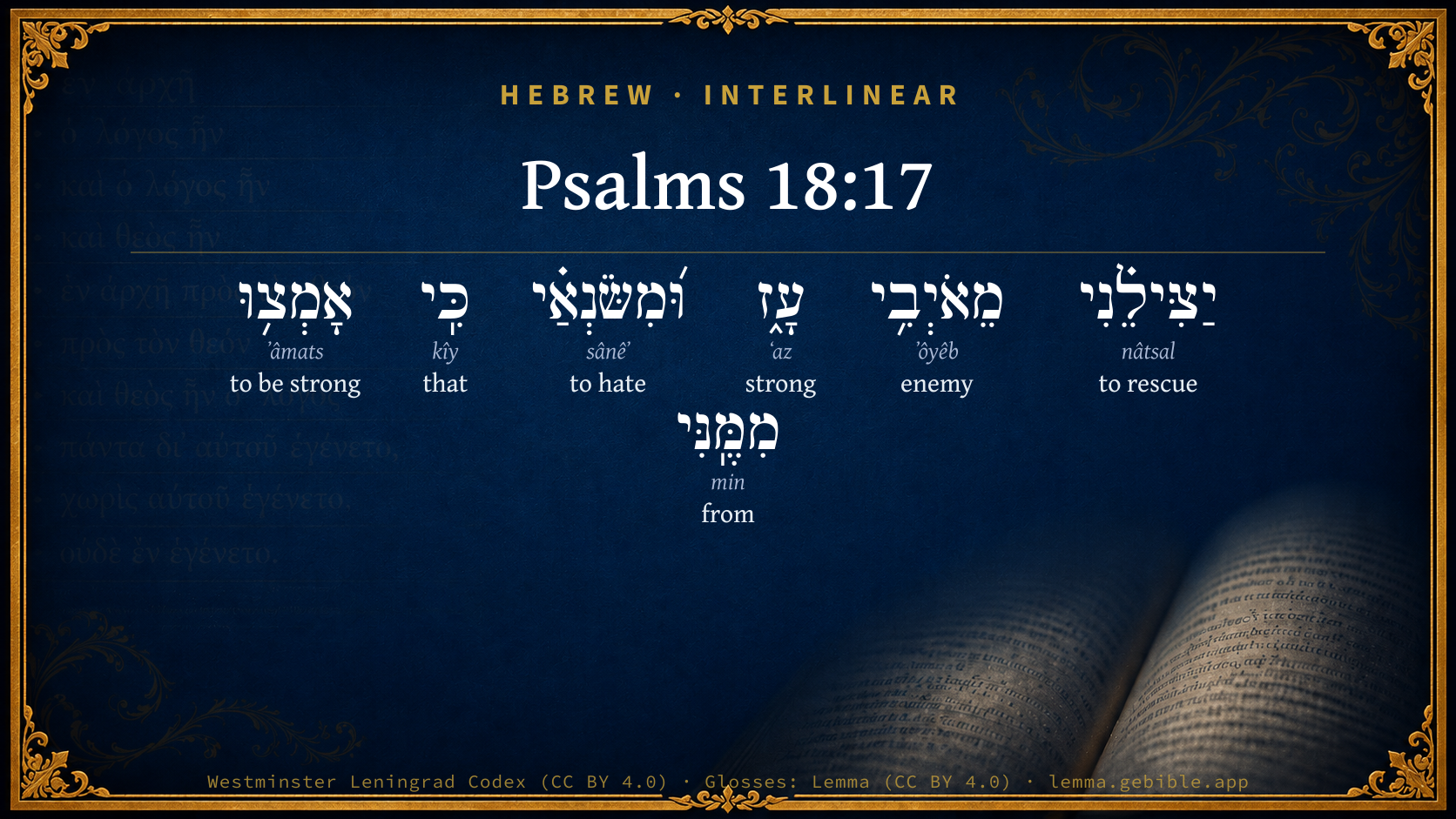
Psalms 18:17

Hebrew (Westminster Leningrad Codex) Psalms 18:17 appears in the Hebrew Old Testament. The text above is from the Westminster Leningrad Codex. Each word links to its Strong’s number, a concise gloss, and parsing drawn from the Open Scriptures Hebrew Bible morphology. Click any word for its full Brown-Driver-Briggs (BDB) entry.
Download image
Cite this verse

Psalms 18:17 (World English Bible). Public Domain. Lemma interlinear Bible study tool, https://lemma.gebible.app/v/psalms/18/17.

Show BibTeX & RIS
BibTeX
RIS
English Translation
He delivered me from my strong enemy, From those who hated me; for they were too mighty for me.
World English Bible · Public Domain
Download a study sheet

One document with this verse’s original text, its word-by-word gloss line, the meaning frame, cross-references with their text, attributed commentary, and full source and license credits — printable, and it pastes into notes with its structure intact.

This verse Autodidact and up

Study sheet (.html) Plain text (.txt)

A passage Seminary Student

Up to 50 verses in one chapter. A passage sheet keeps up to 6 commentary sources and 12 cross-references per verse, in the order this page ranks them, and says so on the sheet whenever that leaves anything out. Ask for a single verse and you get the Autodidact verse sheet above.

Everything on this page stays free to read, with no account — the sheet is a download of what is already on screen, not access to it.

Want to remove ads? Support Godless Engineer
Compare translations 3

The same verse in 3 English versions, stacked beneath the original-language interlinear above. Click any original word for its lexicon entry.

Each is an independent rendering of the whole verse — the interlinear is not word-aligned to these translations.

Highlighted words mark where these versions differ — a whole-verse word diff, not a word-by-word alignment.

  • World English Bible Public Domain
    He delivered me from my strong enemy, From those who hated me; for they were too mighty for me.
  • King James Version Public Domain
    He delivered me from my strong enemy, and from them which hated me: for they were too strong for me.
  • unfoldingWord Literal Text CC BY-SA 4.0
    He delivered me from my strong enemy, from the ones hating me, for they were stronger than me.

unfoldingWord Literal Text — © unfoldingWord, licensed CC BY-SA 4.0. Word-aligned USFM3 via Door43 (git.door43.org/unfoldingWord/en_ult).

Versions to compare (up to 4)

3 of 4 selected

Show all 18 translations

Every available English version of this verse, each an independent rendering of the whole verse.

  • World English Bible Public Domain
    He delivered me from my strong enemy, From those who hated me; for they were too mighty for me.
  • Berean Standard Bible Public Domain
    He rescued me from my powerful enemy, from foes too mighty for me.
  • Majority Standard Bible Public Domain
    He rescued me from my powerful enemy, from foes too mighty for me.
  • King James Version Public Domain
    He delivered me from my strong enemy, and from them which hated me: for they were too strong for me.
  • American Standard Version (1901) Public Domain
    He delivered me from my strong enemy, And from them that hated me; for they were too mighty for me.
  • Revised Version (1885) Public Domain
    He delivered me from my strong enemy, and from them that hated me, for they were too mighty for me.
  • Geneva Bible (1599) Public Domain
    He hath deliuered mee from my strong enemie, and from them which hate me: for they were too strong for me.
  • Douay-Rheims (1899) Public Domain
    He sent from on high, and took me: and received me out of many waters.
  • Young's Literal Translation Public Domain
    He delivereth me from my strong enemy, And from those hating me, For they have been stronger than I.
  • Literal Standard Version CC BY-SA 4.0
    He delivers me from my strong enemy, || And from those hating me, || For they have been stronger than I.
  • Unlocked Literal Bible CC BY-SA 4.0
    He rescued me from my strong enemy, from those who hated me, for they were too strong for me.
  • unfoldingWord Literal Text CC BY-SA 4.0
    He delivered me from my strong enemy, from the ones hating me, for they were stronger than me.
  • Darby Bible Public Domain
    He delivered me from my strong enemy, and from them that hated me; for they were mightier than I.
  • World Messianic Bible Public Domain
    He delivered me from my strong enemy, from those who hated me; for they were too mighty for me.
  • Webster's Bible Public Domain
    \\18:16\\He sent from above, he took me, he drew me out of many waters.
  • Free Bible Version CC BY-SA 4.0
    He rescued me from my powerful enemies, from those who hated me and who were much stronger than me.
  • Bible in Basic English Public Domain
    He made me free from my strong hater, and from those who were against me, because they were stronger than I.
  • JPS Tanakh (1917) Public Domain
    (18-18) He delivered me from mine enemy most strong, and from them that hated me, for they were too mighty for me.

Literal Standard Version (2020), Covenant Press — licensed CC BY-SA 4.0. Text via the HelloAO Bible API (eBible.org). Unlocked Literal Bible (unfoldingWord) — licensed CC BY-SA 4.0. Text via the HelloAO Bible API (eBible.org). unfoldingWord Literal Text — © unfoldingWord, licensed CC BY-SA 4.0. Word-aligned USFM3 via Door43 (git.door43.org/unfoldingWord/en_ult). Free Bible Version, Dr. Jonathan Gallagher — licensed CC BY-SA 4.0. Text via the HelloAO Bible API (eBible.org).

Word by word

More ways to search: Search by grammar → Find every occurrence → Compare this word →

Practice this passage: Drill this verse → Learn its vocabulary →

About this verse

These counts appear in no published source. They are computed here, from the morphology-tagged text and Lemma’s own curated glosses. What Lemma adds →

7
words
7
distinct lemmas
Wisdom
section

Notable vocabulary

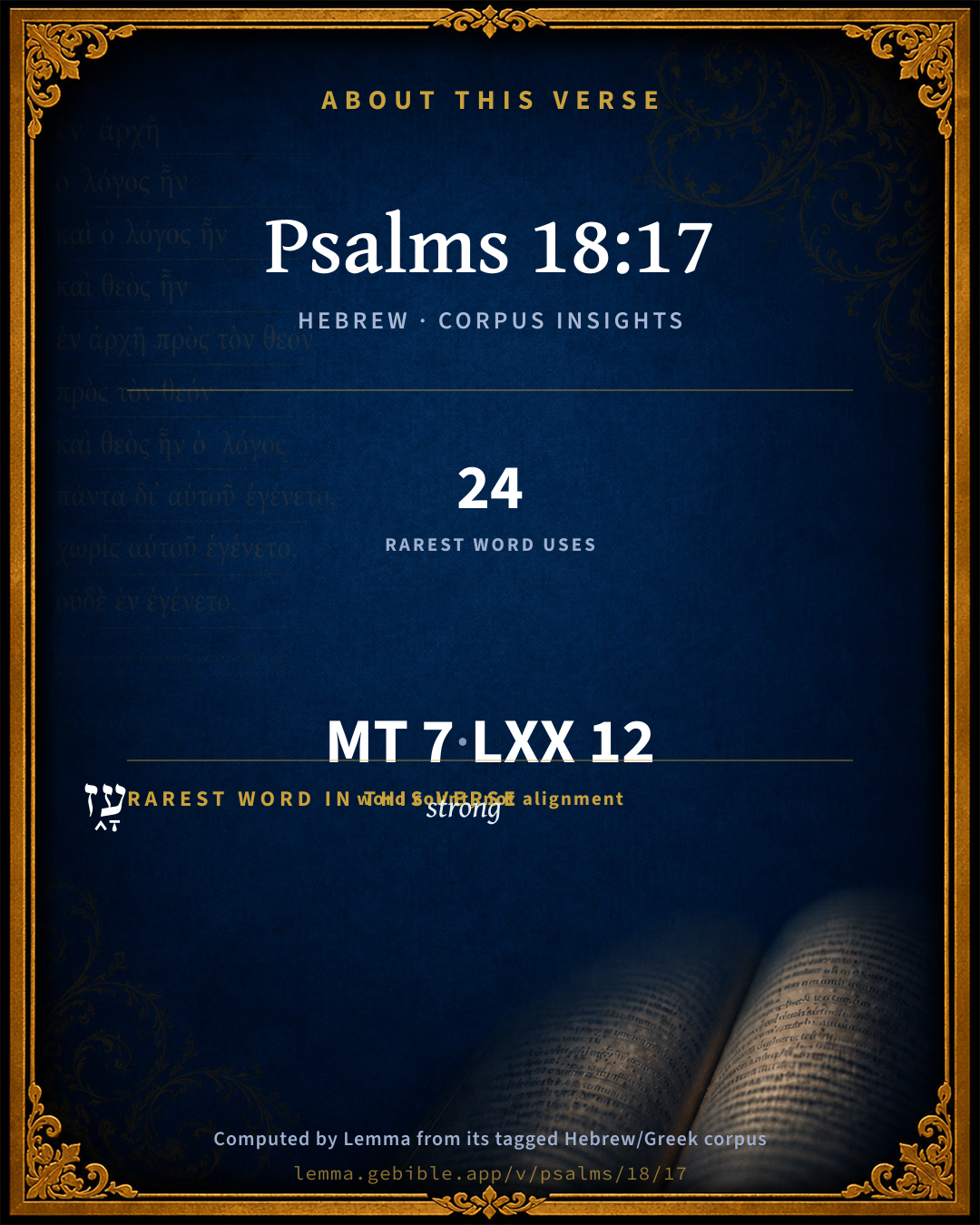
The rarest word here is עָ֑ז strong H5794 — appearing just 24 times in the whole Hebrew Bible.

Shared distinctive vocabulary

עָ֑ז strong H5794 occurs in 24 verses of the Hebrew Bible. Also found in:

Grammatical profile

  • 4 verbs
  • 1 adjective
  • 1 preposition
  • 1 conjunction

Verb forms

  • יַצִּילֵ֗נִי Hiphil · Imperfect
  • מֵאֹיְבִ֥י Qal · Participle Active
  • וּ֝מִשֹּׂנְאַ֗י Qal · Participle Active
  • אָמְצ֥וּ Qal · Perfect

Hebrew & Septuagint length

In English translation the verse runs 19 words from the Hebrew and 20 from the Septuagint (LXX English) — closely comparable.

A rough comparison of the two English renderings, which tokenize alike — not a word-level alignment.

Word counts can differ between the Hebrew and the Greek without any difference in meaning — e.g. the Hebrew direct-object marker אֵת has no separate Greek word, and Greek often adds the article ὁ.

In the original languages it is 7 Hebrew tokens and 12 Greek tokens — but the two are counted differently (Hebrew bundles its prefixes and suffixes into one token; the Greek is in lemma form), so that isn’t a like-for-like length.

Cross-references

13

Topical passages linked to Psalms 18:17 in the Treasury of Scripture Knowledge — connected by theme and wording, ordered by reader-vote popularity; previews shown in the World English Bible.

  • Hebrews 2:14–15 Since then the children have shared in flesh and blood, he also himself in like manner partook of the same, that through death he might bring to nothing him who had the power of death, that is, the devil,
  • Job 16:9 He has torn me in his wrath, and persecuted me; He has gnashed on me with his teeth: My adversary sharpens his eyes on me.
  • Psalms 35:10 All my bones shall say, "Yahweh, who is like you, Who delivers the poor from him who is too strong for him, Yes, the poor and the needy from him who robs him?"
  • Psalms 142:6 Listen to my cry, For I am in desperate need. Deliver me from my persecutors, For they are stronger than me.
  • Psalms 69:4–14 Those who hate me without a cause are more than the hairs of my head. Those who want to cut me off, being my enemies wrongfully, are mighty. I have to restore what I didn't take away.
  • Ephesians 6:10–12 Finally, be strong in the Lord, and in the strength of his might.
  • Psalms 118:7 Yahweh is on my side among those who help me. Therefore I will look in triumph at those who hate me.
  • 2 Samuel 22:1 David spoke to Yahweh the words of this song in the day that Yahweh delivered him out of the hand of all his enemies, and out of the hand of Saul:
  • 2 Samuel 22:18 He delivered me from my strong enemy, From those who hated me; for they were too mighty for me.
  • Psalms 9:13 Have mercy on me, Yahweh. See my affliction by those who hate me, And lift me up from the gates of death;
  • Psalms 18:40–41 You have also made my enemies turn their backs to me, That I might cut off those who hate me.
  • Psalms 38:19 But my enemies are vigorous and many. Those who hate me without reason are numerous.
  • Psalms 25:19 Consider my enemies, for they are many. They hate me with cruel hatred.

Cross-references courtesy of OpenBible.info (CC BY 4.0).

Hebrew and Greek witnesses Masoretic Hebrew ↔ Greek Septuagint

The same verse in the two great witnesses to the Old Testament, shown verse-for-verse.

You’re reading Greek Psalm 17 (Hebrew Psalm 18). The Septuagint counts the superscription, so verse numbers can differ from the Hebrew — chapter-level alignment, not verse-by-verse. Numbering follows Rahlfs.

These are two independent witnesses, not word-aligned to each other, and the Septuagint is shown in lemma (dictionary) form.

Hebrew Psalms 18:17 Masoretic · Westminster Leningrad Codex

יַצִּילֵ֗נִי מֵאֹיְבִ֥י עָ֑ז וּ֝מִשֹּׂנְאַ֗י כִּֽי אָמְצ֥וּ מִמֶּֽנִּי

He delivered me from my strong enemy, From those who hated me; for they were too mighty for me.

World English Bible · Public Domain

Greek LXX Greek Psalm 17:17 Septuagint · lemma form

ἐκ ἀποστέλλω ἐκ ὕψος καί λαμβάνω ἐγώ προςλαμβάνω ἐγώ ἐκ ὕδωρ πολύς

He will deliver me from my mighty enemies, and from them that hate me; for they are stronger than I.

LXX2012 (modern English Septuagint) · Public Domain

Hebrew: Westminster Leningrad Codex (CC BY 4.0). Greek: Septuagint (public domain); English from LXX2012 (modern English Septuagint) (Public Domain). How the Septuagint differs from the Hebrew →

Commentary

Notes on Psalms 18:17 from classic Christian and Jewish commentators (each source and its license shown beneath its notes). The classic Christian expositions comment on the surrounding passage and are grouped to its opening verse, so a note may address several verses; the Jewish commentaries on the Tanakh (Rashi and others) are per-verse, so they appear only where the commentator wrote on this verse.

Lemma curates 59 commentaries, every one of them public domain or Creative Commons licensed, each selected and text-cleaned for this edition rather than reprinted as found. About our sources →

Trapp's Complete Commentary

John Trapp

Psa 18:17 He delivered me from my strong enemy, and from them which hated me: for they were too strong for me.

Ver. 17. He delivered me from my strong enemy] Saul; this he oft instanceth, rolling it as sugar under his tongue, and turning aside often to look upon it, as Samson did to see his dead lion fetching honey out of it.

For they were too strong for me] And then God’s help was most seasonable when David found himself outmatched.

John Trapp, A Commentary or Exposition upon All the Books of the Old and New Testament (1647–1656) — public domain. Text from a community e-Sword module.

J. A. Alexander on Psalms

Joseph Addison Alexander

18. (Psa 18:17). He will free me from my enemy (because he is) strong, and from my haters, because they are mightier than I. The futures are to be explained as in the verse preceding. The enemy here mentioned is an ideal person, representing a whole class, of whom Saul was the chief representative. The idiomatic phrase, my enemy strong, may be understood as simply meaning my strong enemy; but the true construction seems to be indicated by the parallelism. His own weakness and the power of his enemies is given as a reason for the divine interposition.

Joseph Addison Alexander, The Psalms Translated and Explained (1850) — public domain. Text from a community e-Sword module.

Geneva Bible (1599)

Geneva Bible translators

Therefore God sent me succor.

To wit, Saul.

Geneva Bible (1599) marginal notes — public domain. Text via Bolls.life.

Adam Clarke's Commentary

Verse 17. He delivered me from my strong enemy] Does not this refer to his conflict with Ishbi-benob? "And Ishbi-benob, which was of the sons of the giant-thought to have slain David. But Abishai the son of Zeruiah succoured him, and smote the Philistine, and killed him. Then the men of David sware unto him, saying, Thou shalt go no more out with us to battle, that thou quench not the light of Israel;" 2Sa 21:16-17. It appears that at this time he was in the most imminent danger of his life, and that he must have fallen by the hands of the giant, if God had not sent Abishai to his assistance. They were too strong for me. He was nearly overpowered by the Philistines; and his escape was such as evidently to show it to be supernatural.

Adam Clarke's Commentary on the Bible (1810–1826) — public domain. Text from a community e-Sword/MySword module.

The Cambridge Bible for Schools and Colleges

gen. ed. J. J. S. Perowne

17. Figures are dropped, and David refers explicitly to his deliverance from his ‘strong’ or ‘fierce’ enemy Saul, and Saul’s partisans who hated him, from whom but for this Divine intervention he could not have escaped, for they were too mighty for him.

The Cambridge Bible for Schools and Colleges (gen. ed. J. J. S. Perowne; Cambridge University Press, 1878–1918) — public domain. Text from a community e-Sword module.

John Gill's Exposition

They prevented me in the day of my calamity,.... Referring to the times of his distress in the garden and upon the cross; the time of his sufferings and death, which was a dark and cloudy day, as the word (x) used suggests, both in a literal and in a spiritual sense; and when the day and hour was come, fixed and determined by the will of God, then his enemies, though not before, met him, laid hold on him, were too mighty for him, condemned, crucified, and insulted him;

but the Lord was my stay; or staff, on whom he leaned, relied, and depended, believing he would help him; and by whom he was supported and upheld, Isa 42:1. The Targum is,

"the Word of the Lord was my stay.''

(x) "in the day of my cloudy calamity", Ainsworth; "nomen" "proprie signifient vaporem vel nubem, ut Gen. vii. 6. hinc per metaphoram transfertur ad obscuras ac terrificas calamitatum nebulas, Prov. i. 26.", Gejerus.

John Gill's Exposition of the Whole Bible (1746–1763) — public domain (CC PDM 1.0). Text via the HelloAO Bible API.

Albert Barnes' Notes on the Bible

He delivered me from my strong enemy - The enemy that had more power than I had, and that was likely to overcome me. It is probable that the allusion here in the mind of the psalmist would be particularly to Saul.

And from them which hated me - From all who hated and persecuted me, in the time of Saul, and ever onward during my life.

For they were too strong for me - I had no power to resist them, and when I was about to sink under their opposition and malice, God interposed and rescued me. David, valiant and bold as he was as a warrior, was not ashamed, in the review of his life, to admit that he owed his preservation not to his own courage and skill in war, but to God; that his enemies were superior to himself in power; and that if God had not interposed he would have been crushed and destroyed. No man dishonors himself by acknowledging that he owes his success in the world to the divine interposition.

Albert Barnes' Notes on the Bible (1834–1885) — public domain. Text from a community e-Sword/MySword module.

Matthew Poole's English Annotations

From them that wanted neither malice nor power.

Matthew Poole's English Annotations on the Holy Bible (1683–1685) — public domain. Text from a community e-Sword/MySword module.

The Treasury of David

Charles H. Spurgeon

Ver. 17. When we have been rescued, we must take care to ascribe all the glory to God by confessing our own weakness, and remembering the power of the conquered enemy. God's power derives honour from all the incidents of the conflict. Our great spiritual adversary is a "strong enemy" indeed, much too strong for poor, weak creatures like ourselves, but we have been delivered hitherto and shall be even to the end. Our weakness is a reason for divine help; mark the force of the for in the text.

Ver. 17. The saint's paean of victory over Satan, and all other foes.

Ver. 17. (last clause). Singular but sound reason for expecting divine help.

Psalms 18:18*

Charles H. Spurgeon's The Treasury of David (1869–1885) — public domain. Psalms only. Text from a community e-Sword/MySword module.

Whedon's Commentary on the Bible

Daniel D. Whedon

17. My strong enemy—The singular may be taken collectively for all his enemies; or, more probably, as pointing to Saul, who in the title of the psalm holds this distinction.

Daniel D. Whedon (gen. ed.), Commentary on the Old and New Testaments (1874–1909) — public domain. Text from a community e-Sword module.

The Pulpit Commentary

He delivered me from my strong enemy. This is generally understood of Saul. By the defeat of Gilboa, and its consequences, (1Sa_31:1-4) God delivered David from the peril of death which hung over him so long as Saul lived. And from them which hated me. David"s enemies among the courtiers of Saul were powerless without their master. Many, probably, fell in the battle; the rest sank into obscurity. For they were too strong for me. I must have succumbed to them had not God helped me.

The Pulpit Commentary (1880–1919), ed. H.D.M. Spence-Jones & Joseph S. Exell — public domain. Text from a community e-Sword module.

Rashi

Rabbi Shlomo Yitzchaki (Rashi)

He sent forth from on high His angels to save Israel from the sea and from the Egyptians.

He drew me out Heb. ימשני, an expression of drawing out, as (in Exod. 2:10), “I drew him out (משיתהו) of the water.”

Rashi on the Tanakh — English translations: “The Judaica Press complete Tanach with Rashi, translated by A. J. Rosenberg” (CC BY 4.0); “Pentateuch with Rashi's commentary by M. Rosenbaum and A.M. Silbermann, 1929-1934” (public domain); “The Metsudah Tanach series, Lakewood, N.J” (CC BY 4.0); and “The Book of Joshua, Metsudah Publications, 1997” (CC BY 4.0). Text via Sefaria.

Lesson kit

Teaching starters — assembled from the data on this page, not authored interpretation. Every prompt links to the verse data it draws on. Edit before teaching.

Psalms, in the Wisdom, opens this verse with 7 words (7 distinct Hebrew lemmas). Its most distinctive word is ʻaz (“strong”). A historical commentator’s framing appears above. Read the whole chapter for the surrounding context.

Discussion questions

  1. The word ʻaz carries the sense “strong.” How does it shape the verse?
  2. How does Genesis 49:3, which shares the word «strong», read alongside this verse?
  3. These translations render this verse differently; the difference is in the English rendering, not the original. What questions does that raise?
  4. «יַצִּילֵ֗נִי» is a Hiphil Imperfect verb. How does that grammatical form shape the action described?
  5. Compare how Trapp's Complete Commentary and J. A. Alexander on Psalms read this verse. Where do they agree or differ?

Things to notice

Reading settings

Reading text

Shown beneath each verse's original-language words.

Old Testament
Old Testament edition

Read the OT as the Masoretic Hebrew (MT) or the Greek Septuagint (LXX).

English shown for the Greek Septuagint (in the Hebrew ↔ Greek comparison).

Comparing translations? Open the Compare panel on any verse page to stack up to four side by side.