
Psalms 51:3

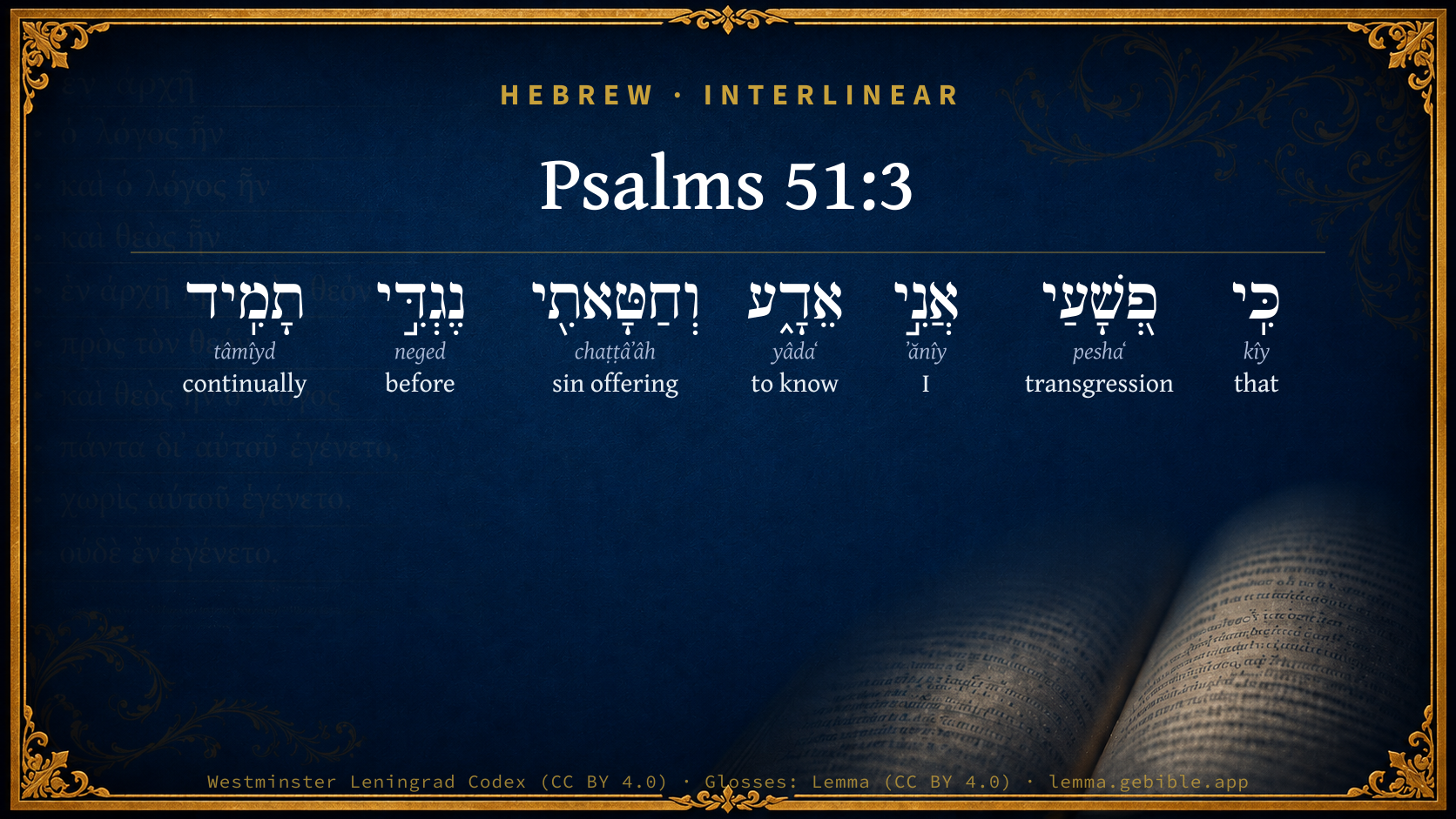
Hebrew (Westminster Leningrad Codex) Psalms 51:3 appears in the Hebrew Old Testament. The text above is from the Westminster Leningrad Codex. Each word links to its Strong’s number, a concise gloss, and parsing drawn from the Open Scriptures Hebrew Bible morphology. Click any word for its full Brown-Driver-Briggs (BDB) entry.
Download image
Cite this verse

Psalms 51:3 (World English Bible). Public Domain. Lemma interlinear Bible study tool, https://lemma.gebible.app/v/psalms/51/3.

Show BibTeX & RIS
BibTeX
RIS
English Translation
For I know my transgressions. My sin is constantly before me.
World English Bible · Public Domain
Download a study sheet

One document with this verse’s original text, its word-by-word gloss line, the meaning frame, cross-references with their text, attributed commentary, and full source and license credits — printable, and it pastes into notes with its structure intact.

This verse Autodidact and up

Study sheet (.html) Plain text (.txt)

A passage Seminary Student

Up to 50 verses in one chapter. A passage sheet keeps up to 6 commentary sources and 12 cross-references per verse, in the order this page ranks them, and says so on the sheet whenever that leaves anything out. Ask for a single verse and you get the Autodidact verse sheet above.

Everything on this page stays free to read, with no account — the sheet is a download of what is already on screen, not access to it.

Want to remove ads? Support Godless Engineer
Compare translations 3

The same verse in 3 English versions, stacked beneath the original-language interlinear above. Click any original word for its lexicon entry.

Each is an independent rendering of the whole verse — the interlinear is not word-aligned to these translations.

Highlighted words mark where these versions differ — a whole-verse word diff, not a word-by-word alignment.

  • World English Bible Public Domain
    For I know my transgressions. My sin is constantly before me.
  • King James Version Public Domain
    For I acknowledge my transgressions: and my sin is ever before me.
  • unfoldingWord Literal Text CC BY-SA 4.0
    For I, I know my transgressions, and my sin always before me.

unfoldingWord Literal Text — © unfoldingWord, licensed CC BY-SA 4.0. Word-aligned USFM3 via Door43 (git.door43.org/unfoldingWord/en_ult).

Versions to compare (up to 4)

3 of 4 selected

Show all 18 translations

Every available English version of this verse, each an independent rendering of the whole verse.

  • World English Bible Public Domain
    For I know my transgressions. My sin is constantly before me.
  • Berean Standard Bible Public Domain
    For I know my transgressions, and my sin is always before me.
  • Majority Standard Bible Public Domain
    For I know my transgressions, and my sin is always before me.
  • King James Version Public Domain
    For I acknowledge my transgressions: and my sin is ever before me.
  • American Standard Version (1901) Public Domain
    For I know my transgressions; And my sin is ever before me.
  • Revised Version (1885) Public Domain
    For I acknowledge my transgressions: and my sin is ever before me.
  • Geneva Bible (1599) Public Domain
    For I know mine iniquities, and my sinne is euer before me.
  • Douay-Rheims (1899) Public Domain
    Have mercy on me, O God, according to thy great mercy. And according to the multitude of thy tender mercies blot out my iniquity.
  • Young's Literal Translation Public Domain
    For my transgressions I do know, And my sin `is' before me continually.
  • Literal Standard Version CC BY-SA 4.0
    For I know my transgressions, || And my sin [is] continually before me.
  • Unlocked Literal Bible CC BY-SA 4.0
    For I know my transgressions, and my sin is always before me.
  • unfoldingWord Literal Text CC BY-SA 4.0
    For I, I know my transgressions, and my sin always before me.
  • Darby Bible Public Domain
    For I acknowledge my transgressions, and my sin is continually before me.
  • World Messianic Bible Public Domain
    For I know my transgressions. My sin is constantly before me.
  • Webster's Bible Public Domain
    \\51:1\\To the chief Musician, A Psalm of David, when Nathan the prophet came to him, after he had gone in to Bath-sheba. Have mercy upon me, O God, according to thy loving-kindness: according to the multitude of thy tender mercies, blot out my transgressions.
  • Free Bible Version CC BY-SA 4.0
    I admit my rebellion; my sin always stares me in my face.
  • Bible in Basic English Public Domain
    For I am conscious of my error; my sin is ever before me.
  • JPS Tanakh (1917) Public Domain
    (51-5) For I know my transgressions; and my sin is ever before me.

Literal Standard Version (2020), Covenant Press — licensed CC BY-SA 4.0. Text via the HelloAO Bible API (eBible.org). Unlocked Literal Bible (unfoldingWord) — licensed CC BY-SA 4.0. Text via the HelloAO Bible API (eBible.org). unfoldingWord Literal Text — © unfoldingWord, licensed CC BY-SA 4.0. Word-aligned USFM3 via Door43 (git.door43.org/unfoldingWord/en_ult). Free Bible Version, Dr. Jonathan Gallagher — licensed CC BY-SA 4.0. Text via the HelloAO Bible API (eBible.org).

Word by word

More ways to search: Search by grammar → Find every occurrence → Compare this word →

Practice this passage: Drill this verse → Learn its vocabulary →

פְ֭שָׁעַי
peshaʻ
H6588
“transgressions · my”
Noun, Common, Masculine, Plural, Construct + Suffix, Personal, 1st Person, Common, Singular
Part of Speech
Noun
Type
Common
Gender
Masculine
Number
Plural
State
Construct
Full BDB Definition

Origin: from H6586

TWOT: 1846a

transgression, rebellion - transgression (against individuals) - transgression (nation against nation) - transgression (against God) - in general - as recognised by sinner - as God deals with it - as God forgives - guilt of transgression - punishment for transgression - offering for transgression
  1. כִּֽי kîy H3588 “that” Conjunction
  2. אֲנִ֣י ʼănîy H589 “I” Pronoun, Personal, 1st Person, Common, Singular
  3. אֵדָ֑ע yâdaʻ H3045 “to know” Verb, Qal, Imperfect, 1st Person, Common, Singular
  4. וְחַטָּאתִ֖י chaṭṭâʼâh H2403 “and · sin offering · my” Conjunction + Noun, Common, Feminine, Singular, Construct + Suffix, Personal, 1st Person, Common, Singular
  5. נֶגְדִּ֣י neged H5048 “before · me” Preposition + Suffix, Personal, 1st Person, Common, Singular
  6. תָמִֽיד tâmîyd H8548 “continually” Noun, Common, Masculine, Singular, Absolute

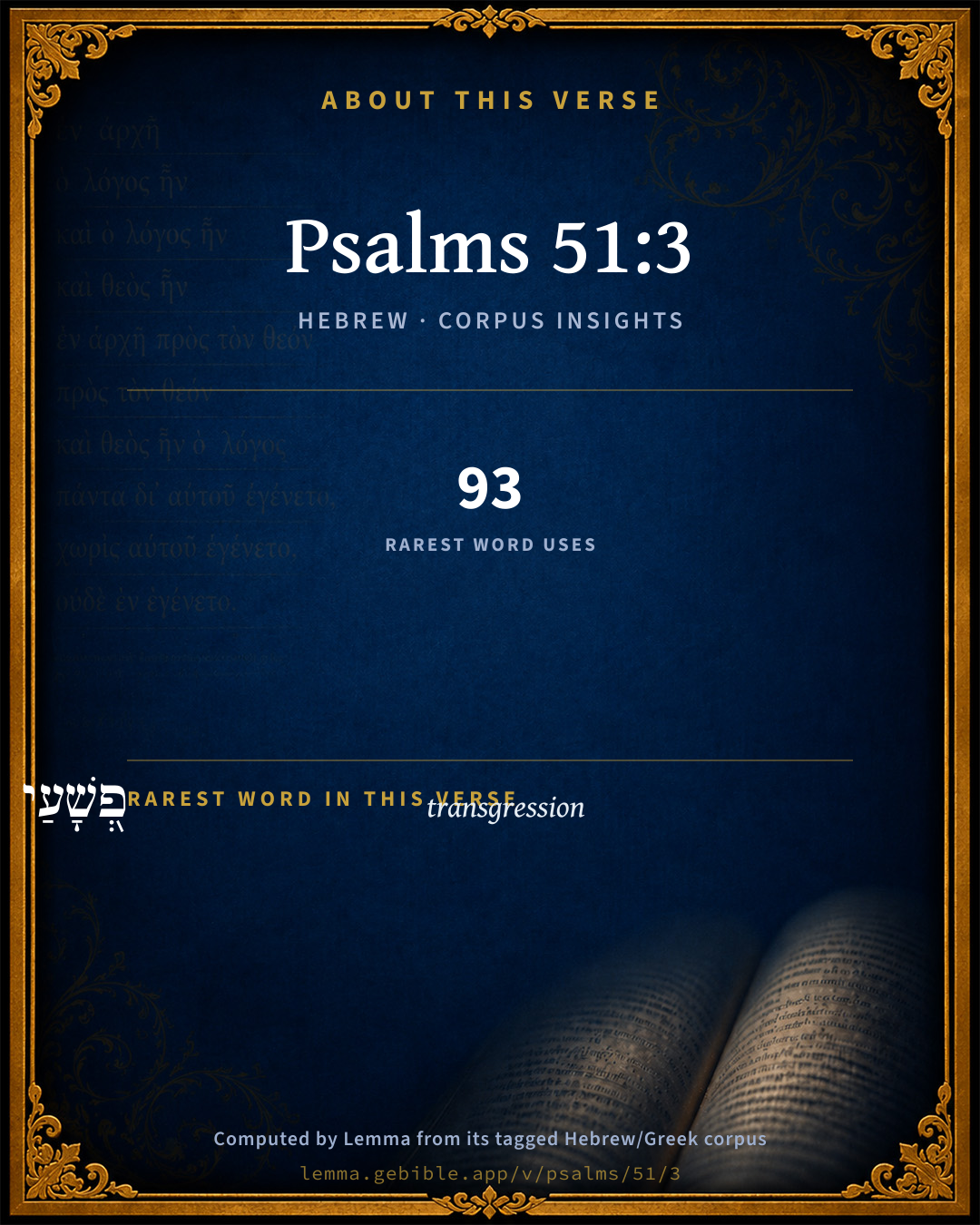
About this verse

These counts appear in no published source. They are computed here, from the morphology-tagged text and Lemma’s own curated glosses. What Lemma adds →

7
words
7
distinct lemmas
Wisdom
section

Grammatical profile

  • 1 verb
  • 3 nouns
  • 1 pronoun
  • 1 preposition
  • 1 conjunction

Verb forms

  • אֵדָ֑ע Qal · Imperfect

Hebrew & Septuagint length

In English translation the verse runs 11 words from the Hebrew and 14 from the Septuagint (LXX English) — closely comparable.

A rough comparison of the two English renderings, which tokenize alike — not a word-level alignment.

Word counts can differ between the Hebrew and the Greek without any difference in meaning — e.g. the Hebrew direct-object marker אֵת has no separate Greek word, and Greek often adds the article ὁ.

Cross-references

10

Topical passages linked to Psalms 51:3 in the Treasury of Scripture Knowledge — connected by theme and wording, ordered by reader-vote popularity; previews shown in the World English Bible.

  • Proverbs 28:13 He who conceals his sins doesn't prosper, But whoever confesses and renounces them finds mercy.
  • Isaiah 59:12 For our transgressions are multiplied before you, and our sins testify against us; for our transgressions are with us, and as for our iniquities, we know them:
  • Psalms 38:18 For I will declare my iniquity. I will be sorry for my sin.
  • Psalms 32:5 I acknowledged my sin to you. I didn't hide my iniquity. I said, I will confess my transgressions to Yahweh, And you forgave the iniquity of my sin. Selah.
  • Leviticus 26:40–41 "'If they confess their iniquity, and the iniquity of their fathers, in their trespass which they trespassed against me, and also that, because they walked contrary to me,
  • Luke 15:18–21 I will get up and go to my father, and will tell him, "Father, I have sinned against heaven, and in your sight.
  • Jeremiah 3:25 Let us lie down in our shame, and let our confusion cover us; for we have sinned against Yahweh our God, we and our fathers, from our youth even to this day; and we have not obeyed the voice of Yahweh our God.
  • Job 33:27 He sings before men, and says, 'I have sinned, and perverted that which was right, And it didn't profit me.
  • Psalms 40:12 For innumerable evils have surrounded me. My iniquities have overtaken me, so that I am not able to look up. They are more than the hairs of my head. My heart has failed me.
  • Nehemiah 9:2 The seed of Israel separated themselves from all foreigners, and stood and confessed their sins, and the iniquities of their fathers.

Cross-references courtesy of OpenBible.info (CC BY 4.0).

Hebrew and Greek witnesses Masoretic Hebrew ↔ Greek Septuagint

The same verse in the two great witnesses to the Old Testament, shown verse-for-verse.

You’re reading Greek Psalm 50 (Hebrew Psalm 51). The Septuagint counts the superscription, so verse numbers can differ from the Hebrew — chapter-level alignment, not verse-by-verse. Numbering follows Rahlfs.

These are two independent witnesses, not word-aligned to each other, and the Septuagint is shown in lemma (dictionary) form.

Hebrew Psalms 51:3 Masoretic · Westminster Leningrad Codex

כִּֽי פְ֭שָׁעַי אֲנִ֣י אֵדָ֑ע וְחַטָּאתִ֖י נֶגְדִּ֣י תָמִֽיד

For I know my transgressions. My sin is constantly before me.

World English Bible · Public Domain

Greek LXX Greek Psalm 50:3 Septuagint · lemma form

ἐλεέω ἐγώ ὁ θεός κατά ὁ μέγας ἔλεος σύ καί κατά ὁ πλῆθος ὁ οἰκτιρμός σύ ἐκἀλείφω ὁ ἀνόμημα ἐγώ

For I am conscious of my iniquity; and my sin is continually before me.

LXX2012 (modern English Septuagint) · Public Domain

On this verse, Keil & Delitzsch discusses the Septuagint’s reading. Read the note in Commentary ↓

Hebrew: Westminster Leningrad Codex (CC BY 4.0). Greek: Septuagint (public domain); English from LXX2012 (modern English Septuagint) (Public Domain). How the Septuagint differs from the Hebrew →

Commentary

Notes on Psalms 51:3 from classic Christian and Jewish commentators (each source and its license shown beneath its notes). The classic Christian expositions comment on the surrounding passage and are grouped to its opening verse, so a note may address several verses; the Jewish commentaries on the Tanakh (Rashi and others) are per-verse, so they appear only where the commentator wrote on this verse.

Lemma curates 59 commentaries, every one of them public domain or Creative Commons licensed, each selected and text-cleaned for this edition rather than reprinted as found. About our sources →

Trapp's Complete Commentary

John Trapp

Psa 51:3 For I acknowledge my transgressions: and my sin [is] ever before me.

Ver. 3. For I acknowledge my transgressions] And therefore look for pardon, according to thy promise. Homo agnoseit, Deus ignoscit.

And my sin] My twisted sin and sadly accented; mine accumulative sin, voluminous wickedness, that hath so many sins bound up in it, as Cicero saith of parricide.

Is ever before me] To my great grief and regret, my conscience twitteth me with it, and the devil layeth it in my dish. This maketh him follow God so close, resolved to give him no rest till he hath registered and enrolled the remission of his sins in the book of life, with the bloody lines of Christ’s soul saving sufferings, and golden characters of his own eternal love.

John Trapp, A Commentary or Exposition upon All the Books of the Old and New Testament (1647–1656) — public domain. Text from a community e-Sword module.

Joseph Benson's Commentary

Psa 51:3. For I acknowledge my transgressions — With grief, and shame, and abhorrence of myself and of my sins, which hitherto I have dissembled and covered. And, being thus truly penitent, I hope and beg that I may find mercy with thee. This David had formerly found to be the only way of obtaining forgiveness and peace of conscience, Psa 32:4-5, and he now hoped to find the same blessings in the same way. And my sin is ever before me — That sin, which I had cast behind my back, is now constantly in my view, to humble and mortify, and make me continually to blush and tremble. We see here David’s contrition for his sin was not a slight, sudden passion, but all abiding grief. He was put in mind of his crimes on all occasions; they were continually in his thoughts: and he was willing they should be so for his further abasement. Let us learn from hence, that our acts of repentance, for the same sin, ought to be often repeated, and that it is very expedient, and will be of great use for us, to have our sins ever before us, that by the remembrance of those that are past, we may be armed against temptations for the future, and may be kept humble, quickened to duty, and made patient under the cross.

Joseph Benson's Commentary on the Old and New Testaments (1811–1818) — public domain. Text from a community e-Sword module.

Whedon's Commentary on the Bible

Daniel D. Whedon

3. In Psa_51:3-5 are brought out more distinctly the psalmist’s clear sense of guilt, and his free confessions.

I acknowledge—Literally, I will know. The word is expressive of clear internal perception of sin. The willingness to know sin is the first step towards repentance, and the open expression of this knowledge is the exact idea of acknowledge, confess.

Transgressions—He uses the plural here as in Psa_51:1. He had caused the death of Uriah, used deceit, covered his sin, hardened his heart, dishonoured his family, and weakened his kingdom, added to the breach of the seventh commandment. Thus one sin never stands alone, but, as Perowne says, “each single transgression is the mother of many.” Each sin has a malignant and multiform embryonic vitality.

Daniel D. Whedon (gen. ed.), Commentary on the Old and New Testaments (1874–1909) — public domain. Text from a community e-Sword module.

J. A. Alexander on Psalms

Joseph Addison Alexander

5. (Psa 51:3). For my transgressions I know, and my sin (is) before me always. His consciousness of guilt is urged, not only as a reason why he should ask forgiveness, but as a reason why God should grant it. As no one is forgiven unless convinced of sin, so this conviction constitutes a kind of claim to pardon, not as being meritorious or intrinsically efficacious, but as an indication of God's merciful intentions, since conviction and forgiveness are alike his gift. The same mutual connection of the two things is uniformly recognised in Scripture. See above, on Psa 32:5, and compare 2Sa 12:13, Pro 28:13, 1Jn 1:9. The future in the first clause is significant. I know it and shall know it; I can never henceforth lose the sense or knowledge of it.

Joseph Addison Alexander, The Psalms Translated and Explained (1850) — public domain. Text from a community e-Sword module.

Tyndale Open Study Notes

Tyndale Open Resources

51:3-6 The psalmist accepts the consequences of his sin against God. He knows that there is nothing good in him unless God renews his life.

Tyndale Open Study Notes — © Tyndale Open Resources, licensed CC BY-SA 4.0. Text via the HelloAO Bible API.

Geneva Bible (1599)

Geneva Bible translators

My conscience accuseth me so, that I can have no rest till I be reconciled.

Geneva Bible (1599) marginal notes — public domain. Text via Bolls.life.

Jamieson, Fausset & Brown

Robert Jamieson, A. R. Fausset & David Brown

For . . . before me--Conviction precedes forgiveness; and, as a gift of God, is a plea for it (Sa2 12:13; Psa 32:5; Jo1 1:9).

Jamieson, Fausset & Brown — Commentary Critical and Explanatory on the Whole Bible (1871) — public domain (CC PDM 1.0). Text via the HelloAO Bible API.

Adam Clarke's Commentary

Verse 3. For I acknowledge my transgressions] I know, I feel, I confess that I have sinned.

My sin is ever before me.] A true, deep, and unsophisticated mark of a genuine penitent. Wherever he turns his face, he sees his sin, and through it the eye of an angry God.

Adam Clarke's Commentary on the Bible (1810–1826) — public domain. Text from a community e-Sword/MySword module.

John Calvin's Commentaries

3. For I know my sins He now discovers his reason for imploring pardon with so much vehemency, and this was the painful disquietude which his sins caused him, and which could only be relieved by his obtaining reconciliation with God. This proves that his prayer did not proceed from dissimulation, as many will be found commending the grace of God in high terms, although, in reality, they care little about it, having never felt the bitterness of being exposed to his displeasure. David, on the contrary, declares that he is subjected by his sin to constant anguish of mind, and that it is this which imparts such an earnestness to his supplications. From his example we may learn who they are that can alone be said to seek reconciliation with God in a proper manner. They are such as have had their consciences wounded with a sense of sin, and who can find no rest until they have obtained assurance of his mercy. We will never seriously apply to God for pardon, until we have obtained such a view of our sins as inspires us with fear. The more easily satisfied we are under our sins, the more do we provoke God to punish them with severity, and if we really desire absolution from his hand, we must do more than confess our guilt in words; we must institute a rigid and formidable scrutiny into the character of our transgressions. David does not simply say that he will confess his sins to man, but declares that he has a deep inward feeling of them, such a feeling of them as filled him with the keenest anguish. His was a very different spirit from that of the hypocrite, who displays a complete indifference upon this subject, or when it intrudes upon him, endeavors to bury the recollection of it. He speaks of his sins in the plural number. His transgression, although it sprung from one root, was complicated, including, besides adultery, treachery and cruelty; nor was it one man only whom he had betrayed, but the whole army which had been summoned to the field in defense of the Church of God. He accordingly recognises many particular sins as wrapt up in it.

John Calvin's Commentaries (1540-1563) — public domain. Text from the Calvin Translation Society English edition (1840s-50s) via the Christian Classics Ethereal Library (ccel.org). Calvin's coverage is partial (roughly two-thirds of the Bible); uncommented books and verses are honest gaps, never fabricated. The 19th-century editor's footnotes and remarks are omitted so the notes are faithfully Calvin's own voice.

Ellicott's Commentary for English Readers

(3) For I.—There is an emphatic pronoun in the first clause which we may preserve, at the same time noticing the difference between the violation of the covenant generally in the term transgressions in the first clause, and the offence which made the breach in the second. (See Note Psa_51:1.) Because I am one who is conscious of my transgressions, and (or, possibly, even) my offence is ever before me.

The thought that he had been unfaithful to the covenant was an accusing conscience to him, keeping his sin always before his eyes, and until, according to his prayer in Psa_51:1-2, he was received back into conscious relationship again, his offence must weigh upon his mind. This explanation holds, whether an individual or the community speaks.

A Bible Commentary for English Readers, edited by Charles John Ellicott (1878–1897) — public domain. Text from a community e-Sword module.

The Cambridge Bible for Schools and Colleges

gen. ed. J. J. S. Perowne

3. For I acknowledge] Lit., I know. The pronoun is emphatic. His sins have all along been known to God. They are before His eyes (Psa_90:8). But now he has come to know them himself; they are unceasingly present to his conscience. Such consciousness of sin is the first step towards the repentance and confession which are the indispensable conditions of forgiveness. David refused to acknowledge his sin to himself and to God—yet not, apparently, without sharp pangs of remorse, see Psa_32:3-4—until Nathan’s message awoke his conscience. Cp. the confession of the nation in Isa_59:12.

The Cambridge Bible for Schools and Colleges (gen. ed. J. J. S. Perowne; Cambridge University Press, 1878–1918) — public domain. Text from a community e-Sword module.

John Gill's Exposition

For I acknowledge my transgressions,.... Before God and man. Acknowledgment of sin is what the Lord requires, and promises forgiveness upon, and therefore is used here as a plea for it; and moreover the psalmist had done so before, and had succeeded in this way, which must encourage him to take the same course again; see Psa 32:5;

and my sin is ever before me; staring him in the face; gnawing upon his conscience, and filling him with remorse and distress; so that his life was a burden to him: for though God had put away sin out of his own sight, so that he would not condemn him for it, and he should not die; notwithstanding as yet it was not caused to pass from David, or the guilt of it removed from his conscience.

John Gill's Exposition of the Whole Bible (1746–1763) — public domain (CC PDM 1.0). Text via the HelloAO Bible API.

Albert Barnes' Notes on the Bible

For I acknowledge my transgressions - literally, I know, or make known. That is, he knew that he was a sinner, and he did not seek to cloak or conceal that fact. He came with the knowledge of it himself; he was willing to make acknowledgment of it before God. There was no attempt to conceal it; to excuse it. Compare the notes at Psa 32:5. The word ““for”” does not imply that he referred to his willingness to confess his sins as an act of merit, but it indicates a state of mind which was necessary to forgiveness, and without which he could not hope for pardon.

And my sin is ever before me - That is, It is now constantly before my mind. It had not been so until Nathan brought it vividly to his recollection (2Sa 12:1 ff); but after that it was continually in his view. He could not turn his mind from it. The memory of his guilt followed him; it pressed upon him; it haunted him. It was no wonder that this was so. The only ground of wonder in the case is that it did not occur “before” Nathan made that solemn appeal to him, or that he could have been for a moment insensible to the greatness of his crime. The whole transaction, however, shows that people “may” be guilty of enormous sins, and have for a long time no sense of their criminality; but that “when” the consciousness of guilt is made to come home to the soul, nothing will calm it down. Everything reminds the soul of it; and nothing will drive away its recollection. In such a state the sinner has no refuge - no hope of permanent peace - but in the mercy of God.

Albert Barnes' Notes on the Bible (1834–1885) — public domain. Text from a community e-Sword/MySword module.

Matthew Poole's English Annotations

I acknowledge, with grief and shame, and abhorrency of myself and of my sins; which hitherto I have dissembled and covered. And being thus truly penitent, I hope and beg that I may find mercy with thee.

My transgressions; for it was not a single, but a complicated wickedness, adultery, murder, injustice, perfidiousness; and frequent repetition of and long and stupid continuance in abominable filthiness, and that with public scandal.

My sin is ever before me; that which I had cast behind my back is now constantly in my view, and fixed in my thoughts and memory.

Matthew Poole's English Annotations on the Holy Bible (1683–1685) — public domain. Text from a community e-Sword/MySword module.

The Treasury of David

Charles H. Spurgeon

Ver. 3. For I acknowledge my transgressions. Here he sees the plurality and immense number of his sins, and makes open declaration of them. He seems to say, I make a full confession of them. Not that this is my plea in seeking forgiveness, but it is a clear evidence that I need mercy, and am utterly unable to look to any other quarter for help. My pleading guilty has barred me from any appeal against the sentence of justice: O Lord, I must cast myself on thy mercy, refuse me not, I pray thee. Thou hast made me willing to confess. O follow up this work of grace with a full and free remission! And my sin is ever before me. My sin as a whole is never out of my mind; it continually oppresses my spirit. I lay it before thee because it is ever before me: Lord, put it away both from thee and me. To an awakened conscience, pain on account of sin is not transient and occasional, but intense and permanent, and this is no sign of divine wrath, but rather a sure preface of abounding favour.

Ver. 3. For I acknowledge my transgressions, etc. To acknowledge our transgressions, there's confession; and to have our sin ever before us, there's conviction and contrition. To acknowledge our transgressions, I say, is to confess our sins; to call them to mind, to bring them back to our remembrance what we can; to own them with shame, and to declare them with sorrow; to reckon them up one by one, to give in a particular account of them, as far as our memory will serve, and to spread them before the Lord, as Hezekiah did Rabshakah's letter, and in a humble sense of our own vileness to implore his goodness, that he would multiply his mercies over us, as we have multiplied our transgressions against him, in their free and full forgiveness of them all. To have our sin ever before us, is throughly to be convinced of it, to be continually troubled in mind about it, to be truly humbled under the sense of it, and to be possessed of those dreads and terrors of conscience which may never let us rest or enjoy any quiet within our own breast till we have reconciled ourselves to a gracious God for it. Adam Littleton.

Ver. 3. I acknowledge my transgressions: and my sin is ever before me. There cannot be agnitio if there be not cognitio peccati, and acknowledging, unless there precede a knowledge of sin. David puts them together. If our sins be not before us, how can we set them before God? And therefore, to the right exercise of this duty, there is required a previous examination of our hearts, inspection into our lives, that we may be enabled to see our sins. He that hath not yet asked himself that question, Quid feci? What have I done? can never make the confession, si feci, thus and thus have I done; and in this respect I would, thought not require, yet advise it as a pious and prudent practice, and that which I doubt not but many Christians have found benefit by, to keep a constant daily catalogue, as of mercies received, so of sins committed. Nathaneal Hardy.

Ver. 3. I, my, my. David did not think it sufficient to acknowledge that the whole human race were sinners; but as if he stood alone in the world, and was the only offender in it, he says, "I acknowledge my transgressions; and my sin is ever before me." Charles de Coetlogon.

Ver. 3. MY sin. David owneth his sin, and confesseth it his own. Here is our natural wealth: what can we call our own but sin? Our food and raiment, the necessaries of life, are borrowings. We came hungry and naked into the world, we brought none of these with us, and we deserved none of them here. Our sin came with us, as David after confesseth. We have right of inheritance in sin, taking it by traduction and transmission from our parents: we have right of possession. So Job: "Thou makest me to possess the sins of my youth." Samuel Page.

Ver. 3. My SIN. It is sin, as sin, not its punishment here, not hereafter, not simply any of its evil consequences; but sin, the sin against God, the daring impiety of my breaking the good and holy law of this living, loving God. Thomas Alexander, D.D., in "The Penitent's Prayer, "1861.

Ver. 3. Ever before me. Sorrow for sin exceeds sorrow for suffering, in the continuance and durableness thereof: the other, like a landlord, quickly come, quickly gone; this is a continual dropping or running river, keeping a constant stream. My sins, saith David, are ever before me; so also is the sorrow for sin in the soul of a child of God, morning, evening, day, night, when sick, when sound, fasting, at home, abroad, ever within him. This grief begins at his conversion, continues all his life, ends only at his death. Thomas Fuller.

Ver. 3. Before me. Coram populo, before the people; shame to him: coram ecclesia, before the church; grief to them: coram inimicis, before the enemies; joy to them: coram Deo, before God; anger against him: coram Nathane, before Nathan; a chiding. But if any hope of repentance and amendment, it is peccatum meum coram me, my sin before me. Here is the distress of a sinner, he never discerneth how unhappy he is, till his sin is before him. Samuel Page.

Ver. 3.

1. Confession. "I acknowledge, "etc.

2. Humiliation, not a mere confession with the lips, but ever before me--in its guilt--defilement-- consequences in this life and hereafter.

Ver. 3-4,11-12,17.

1. Scripture estimate of sin.

1. Personal accountability--My sin.

2. Estimated as hateful to God--Against thee, etc.

3. Sin estimated as separation from God.

2. Spiritual restoration. First step--Sacrifice of a broken spirit. Last step--Spirit of liberty. Thy free spirit. F. W. Robertson.

Psalms 51:4*

Ver. 3-4,11-12,17.

1. Scripture estimate of sin.

1. Personal accountability--My sin.

2. Estimated as hateful to God--Against thee, etc.

3. Sin estimated as separation from God.

2. Spiritual restoration. First step--Sacrifice of a broken spirit. Last step--Spirit of liberty. Thy free spirit. F. W. Robertson.

Charles H. Spurgeon's The Treasury of David (1869–1885) — public domain. Psalms only. Text from a community e-Sword/MySword module.

The Pulpit Commentary

For I acknowledge my transgressions. (comp. Psa_32:5, "I said, I will confess my transgressions unto the Lord; and thou forgavest the iniquity of my sin The first step in repentance is contrition; the second, confession; the third, amendment of life. And my sin is ever before me. I bear it in mind; I do not hide it from myself. I keep it continually before my mental vision. This, too, is characteristic of true penitence. Mock penitents confess their sins, and straightway forget them. Real genuine ones find it impossible to forget.

A portrait.

Lord Macaulay tells us that the Earl of Breadalbane, who was the chief hand in the Massacre of Glencoe, never had rest afterwards. "He did his best to assume an air of unconcern. He made his appearance in the most fashionable coffee-house in Edinburgh, and talked loudly and self-complacently about the important service in which he had been engaged in the mountains. Some of his soldiers, however, who observed him closely, whispered that all this bravery was put on. He was not the man that he had been before that night. The form of his countenance was changed. In all places, at all hours, whether he waked or slept, Glencoe was for ever before him" (vol. 3. p. 216). So it was also with David. As Chrysostom has said, "He carried in his bosom a painted picture of adultery and murder." Let us consider this.

I THE SUBJECT OF THE PAINTING. Sin is everywhere. It is in the world, in society, in our friends, but worst of all it is in our own hearts. "My sin!" What is "before" us is not the sins of others, but our own sins, or perhaps some particular sin that stands out in all its hideousness and enormity.

II THE MEANS BY WINCH THE PAINTING IS WROUGHT OUT. It is not said before the world or the Church, but "before me." Everything is individualized. "Awakened conscience acts the artist, Uses the sun of heaven"s law To photograph the sinner"s life; Then holds it up, a hideous monster, To the affrighted eye!

But conscience has its allies. There is memory. All that we have thought and felt and done, all the varied events and experiences of our life, are recorded by memory, Much may seem to be forgotten, but nothing is really lost. Go where you willYet doth remembrance, like a sovereign prince, For you a stately gallery maintain of gay and tragic pictures?

"My sin!" It is there, in memory, to be brought out at the call of conscience. "The austere remembrance of that deed Will hang upon thy spirit like a cloud, And tinge its world of happy images with hues of horror.

There is also association. One of its chief uses is to add force to conscience. We are strangely linked with the past. A book will recall the giver. A letter will start various trains of thought, according to its contents and the circumstances in which it is received. A portrait will bring up memories of the departed. Remember how Cowper"s heart was moved by the portrait of his mother remembrancer of one so dear." So it is as to our sin. The place, the surroundings, the circumstances, or some link of association, may bring all the past before us fresh as a yesterday event. Remember Pharaoh"s butler, (Gen_41:9) the widow of Zarephath, (1Ki_17:18) Peter the apostle. (Mar_14:72) And what is presented to conscience by memory and association, the imagination works out with powerful effect, brining in not only the past, but the future, the terrible result. But besides all this, we are to take into account the hand of God, working by conscience through providence and Holy Scripture. David"s eyes were opened by the ministry of Nathan. He presented his sin to him in a parable, and then brought it home to himself in demonstration of the Spirit. "Thou art the man!" And so it is still. "By the Law is the knowledge of sin;" "When the commandment came, sin revived, and I died." We have a striking illustration of this in Augustine ("Confessions," bk. 8. ch. 7): "Thou, O Lord, whilst he was speaking, didst turn me round towards myself, taking me from behind my back, where I had placed me, unwilling to observe myself, and setting me before my face, that I might see how foul I was, how crooked and defiled, be spotted and ulcerous." Sooner or later, this vision will come to us all. "My sin is ever before me." This may be the cry in the torments of hell, and then there is no hope. It may be said under the power of a guilty conscience, and then the answer is, "Behold the Lamb of God, which taketh away the sin of the world!

III THE FEELINGS WITH WHICH THIS PAINTING SHOULD BE CONTEMPLATED, The sight is painful, but salutary. If it humbles us, it leads us to exalt God. If it embitters sin to us, it endears Christ to us, and binds us for ever to him in love and devotion.

1. Sense of personal guilt. "My sin." We may have been tempted; but in the deepest sense the guilt is ours, surely and inalienably. Our sins are more our own than anything else we possess. With this conviction we cry, "What shall we do?

2. Grief and self-abasement. Others may speak of "my place," "my merits," "my services;" but for me it is "my sin." The more we study this picture looking at it in the light of the cross the more vile and wicked do we become in our own eyes. We see ourselves as God sees us, and are filled with amazement and horror. Besides, we come to understand that our sin is not a casual thing, but the product of the sinful heart within. True grief will lead to sincere and full confession, and confession to forgiveness. When we justify God, God will justify us.

3. Simple and unfeigned faith. Despairing of ourselves, we cease from our own works, and cast ourselves upon the mercy of God. We accept the testimony which God has given of his Son, and, trusting in him, we find peace.

4. Adoring gratitude and love. To whom much is forgiven, the same loveth much. We owe everything to Christ, and the love of Christ constraineth us. (2Co_5:14, 2Co_5:15) The thought of the sins of the past, which we carry with us, will not only make us humble and watchful, but stimulate us to increasing love and zeal in the service of him who hath redeemed us by his precious blood. W.F.

The Pulpit Commentary (1880–1919), ed. H.D.M. Spence-Jones & Joseph S. Exell — public domain. Text from a community e-Sword module.

Keil & Delitzsch

C. F. Keil & F. Delitzsch

Substantiation of the prayer by the consideration, that his sense of sin is more than superficial, and that he is ready to make a penitential confession. True penitence is not a dead knowledge of sin committed, but a living sensitive consciousness of it (Isa 59:12), to which it is ever present as a matter and ground of unrest and pain. This penitential sorrow, which pervades the whole man, is, it is true, no merit that wins mercy or favour, but it is the condition, without which it is impossible for any manifestation of favour to take place. Such true consciousness of sin contemplates sin, of whatever kind it may be, directly as sin against God, and in its ultimate ground as sin against Him alone (חטא with ל of the person sinned against, Isa 42:24; Mic 7:9); for every relation in which man stands to his fellow-men, and to created things in general, is but the manifest form of his fundamental relationship to God; and sin is "that which is evil in the eyes of God" (Isa 65:12; Isa 66:4), it is contradiction to the will of God, the sole and highest Lawgiver and Judge. Thus it is, as David confesses, with regard to his sin, in order that... This למען must not be weakened by understanding it to refer to the result instead of to the aim or purpose. If, however, it is intended to express intention, it follows close upon the moral relationship of man to God expressed in לך לבדּך and הרע בּעיניך, - a relationship, the aim of which is, that God, when He now condemns the sinner, may appear as the just and holy One, who, as the sinner is obliged himself to acknowledge, cannot do otherwise than pronounce a condemnatory decision concerning him. When sin becomes manifest to a man as such, he must himself say Amen to the divine sentence, just as David does to that passed upon him by Nathan. And it is just the nature of penitence so to confess one's self to be in the wrong in order that God may be in the right and gain His cause. If, however, the sinner's self-accusation justifies the divine righteousness or justice, just as, on the other hand, all self-justification on the part of the sinner (which, however, sooner or later will be undeceived) accuses God of unrighteousness or injustice (Job 40:8): then all human sin must in the end tend towards the glorifying of God. In this sense Psa 51:6 is applied by Paul (Rom 3:4), inasmuch as he regards what is here written in the Psalter - ὅπως ἂν δικαιωθῇς ἐν τοῖς λόγοις σου, καὶ νικῃσεες ἐν τῷ κρίνεσθαί σε (lxx) - as the goal towards which the whole history of Israel tends. Instead of בּדברך (infin. like שׁלחך, Gen 38:17, in this instance for the sake of similarity of sound

(Note: Cf. the following forms, chosen on account of their accord: - נשׂוּי, Psa 32:1; הנדּף, Psa 68:3; צאינה, Sol 3:11; שׁתות, Isa 22:13; ממחים, ib. Psa 25:6; הלּוט, ib. Psa 25:7.)

instead of the otherwise usual form דּבּר), in Thy speaking, the lxx renders ἐν τοῖς λόγοις σου = בּדבריך; instead of בּשׁפטך, ἐν τῷ κρίνεσθαί σε = בּהשּׁפטך (infin. Niph.), provided κρίνεσθαι is intended as passive and not (as in Jer 2:9 lxx, cf. Mat 5:40) as middle. The thought remains essentially unchanged by the side of these deviations; and even the taking of the verb זכה, to be clean, pure, in the Syriac signification νικᾶν, does not alter it. That God may be justified in His decisive speaking and judging; that He, the Judge, may gain His cause in opposition to all human judgment, towards this tends David's confession of sin, towards this tends all human history, and more especially the history of Israel.

Keil & Delitzsch — Biblical Commentary on the Old Testament (1861–1891) — public domain (CC PDM 1.0). Text via the HelloAO Bible API. (Old Testament only.)

unfoldingWord translationNotes

Door43 World Missions Community

my sin is always before me

Not being able to forget his sins is spoken of as if they were always in front of him where he can see them. AT: "I am always aware of my sins" or "I cannot forget my sins" (See: Metaphor)

what is evil in your sight

The word "sight" here represents judgment. Yahweh saw and did not approve of David's actions. AT: "what you judge to be evil" or "what you consider to be evil" (See: Metaphor)

translationWords

transgress

sin

evil

judge

unfoldingWord translationNotes — © Distant Shores Media and the Door43 World Missions Community, licensed CC BY-SA 4.0. Source: git.door43.org/Door43/en_tn.

Lesson kit

Teaching starters — assembled from the data on this page, not authored interpretation. Every prompt links to the verse data it draws on. Edit before teaching.

Psalms, in the Wisdom, opens this verse with 7 words (7 distinct Hebrew lemmas). Its most distinctive word is peshaʻ (“transgression”). A historical commentator’s framing appears above. Read the whole chapter for the surrounding context.

Discussion questions

  1. The word peshaʻ carries the sense “transgression.” How does it shape the verse?
  2. How does Proverbs 28:13, which shares this passage’s theme, read alongside this verse?
  3. These translations render this verse differently; the difference is in the English rendering, not the original. What questions does that raise?
  4. «אֵדָ֑ע» is a Qal Imperfect verb. How does that grammatical form shape the action described?
  5. Compare how Trapp's Complete Commentary and Joseph Benson's Commentary read this verse. Where do they agree or differ?

Things to notice

Reading settings

Reading text

Shown beneath each verse's original-language words.

Old Testament
Old Testament edition

Read the OT as the Masoretic Hebrew (MT) or the Greek Septuagint (LXX).

English shown for the Greek Septuagint (in the Hebrew ↔ Greek comparison).

Comparing translations? Open the Compare panel on any verse page to stack up to four side by side.