Psalms 22:24

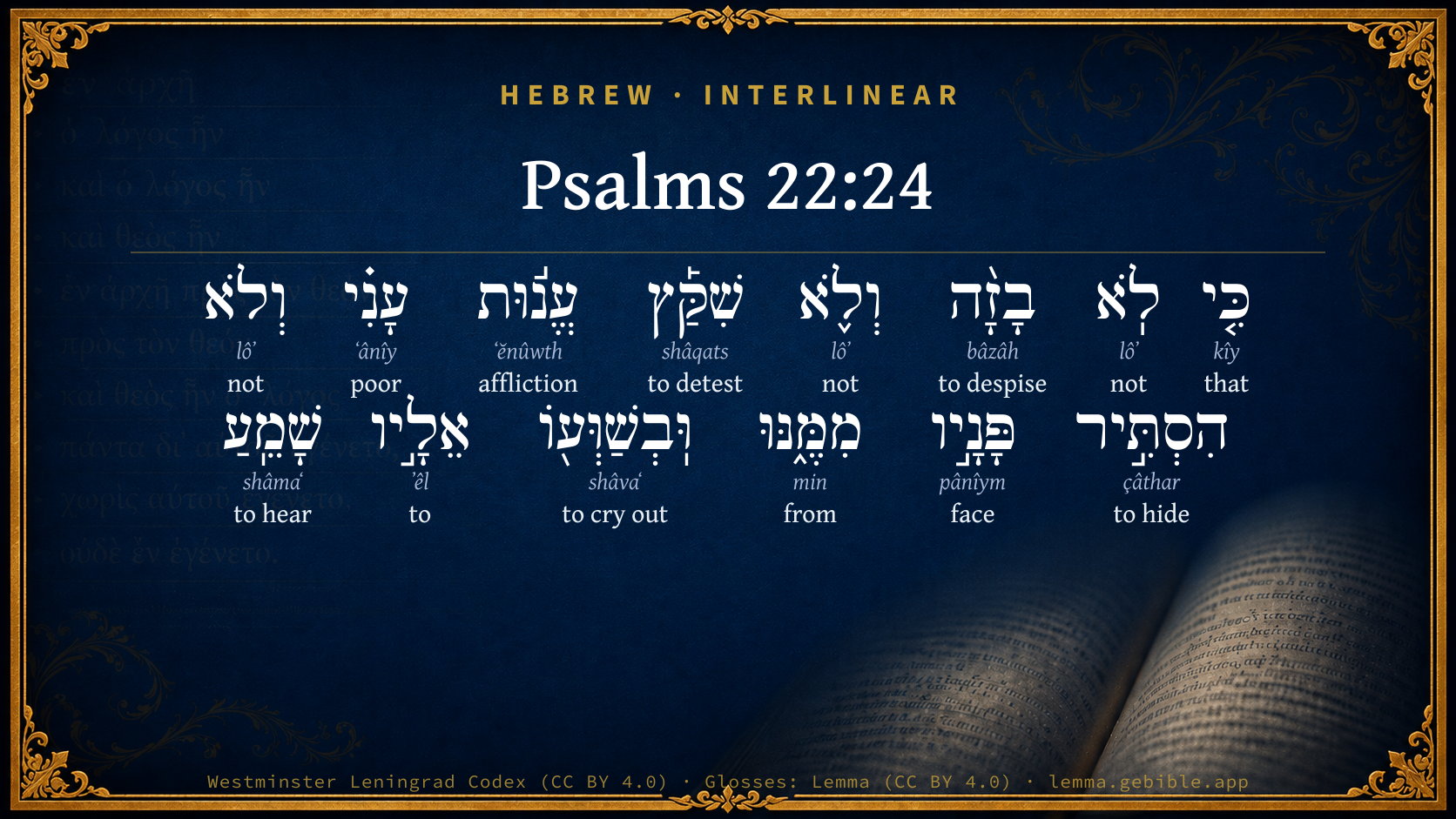
Hebrew (Westminster Leningrad Codex) Psalms 22:24 appears in the Hebrew Old Testament. The text above is from the Westminster Leningrad Codex. Each word links to its Strong’s number, a concise gloss, and parsing drawn from the Open Scriptures Hebrew Bible morphology. Click any word for its full Brown-Driver-Briggs (BDB) entry.
Download image
Cite this verse

Psalms 22:24 (World English Bible). Public Domain. Lemma interlinear Bible study tool, https://lemma.gebible.app/v/psalms/22/24.

Show BibTeX & RIS
BibTeX
RIS
English Translation
For he has not despised nor abhorred the affliction of the afflicted, Neither has he hidden his face from him; But when he cried to him, he heard.
World English Bible · Public Domain
Highlights
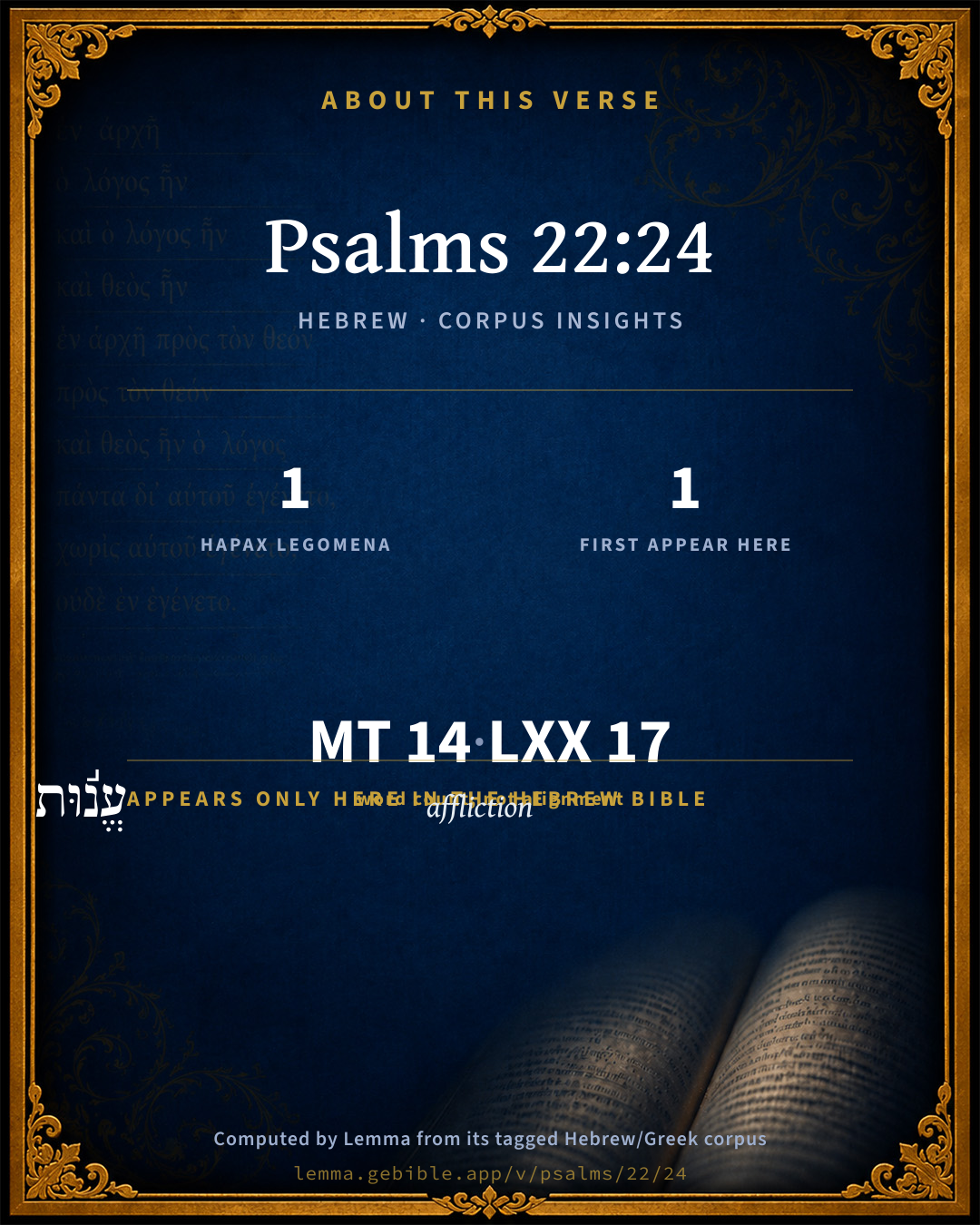
  • 1 hapax legomenon — only here in the Hebrew Bible
  • 1 first appearance in the Hebrew Bible
Full analysis ↓
Download a study sheet

One document with this verse’s original text, its word-by-word gloss line, the meaning frame, cross-references with their text, attributed commentary, and full source and license credits — printable, and it pastes into notes with its structure intact.

This verse Autodidact and up

Study sheet (.html) Plain text (.txt)

A passage Seminary Student

Up to 50 verses in one chapter. A passage sheet keeps up to 6 commentary sources and 12 cross-references per verse, in the order this page ranks them, and says so on the sheet whenever that leaves anything out. Ask for a single verse and you get the Autodidact verse sheet above.

Everything on this page stays free to read, with no account — the sheet is a download of what is already on screen, not access to it.

Want to remove ads? Support Godless Engineer
Compare translations 3

The same verse in 3 English versions, stacked beneath the original-language interlinear above. Click any original word for its lexicon entry.

Each is an independent rendering of the whole verse — the interlinear is not word-aligned to these translations.

Highlighted words mark where these versions differ — a whole-verse word diff, not a word-by-word alignment.

  • World English Bible Public Domain
    For he has not despised nor abhorred the affliction of the afflicted, Neither has he hidden his face from him; But when he cried to him, he heard.
  • King James Version Public Domain
    For he hath not despised nor abhorred the affliction of the afflicted; neither hath he hid his face from him; but when he cried unto him, he heard.
  • unfoldingWord Literal Text CC BY-SA 4.0
    For he has not despised nor abhorred the affliction of the afflicted, and he has not hidden his face from him, but when he cried to him, he heard.

unfoldingWord Literal Text — © unfoldingWord, licensed CC BY-SA 4.0. Word-aligned USFM3 via Door43 (git.door43.org/unfoldingWord/en_ult).

Versions to compare (up to 4)

3 of 4 selected

Show all 18 translations

Every available English version of this verse, each an independent rendering of the whole verse.

  • World English Bible Public Domain
    For he has not despised nor abhorred the affliction of the afflicted, Neither has he hidden his face from him; But when he cried to him, he heard.
  • Berean Standard Bible Public Domain
    For He has not despised or detested the torment of the afflicted. He has not hidden His face from him, but has attended to his cry for help.
  • Majority Standard Bible Public Domain
    For He has not despised or detested the torment of the afflicted. He has not hidden His face from him, but has attended to his cry for help.
  • King James Version Public Domain
    For he hath not despised nor abhorred the affliction of the afflicted; neither hath he hid his face from him; but when he cried unto him, he heard.
  • American Standard Version (1901) Public Domain
    For he hath not despised nor abhorred the affliction of the afflicted; Neither hath he hid his face from him; But when he cried unto him, he heard.
  • Revised Version (1885) Public Domain
    For he hath not despised nor abhorred the affliction of the afflicted; neither hath he hid his face from him; but when he cried unto him, he heard.
  • Geneva Bible (1599) Public Domain
    For he hath not despised nor abhorred ye affliction of the poore: neither hath he hid his face from him, but when he called vnto him, he heard.
  • Douay-Rheims (1899) Public Domain
    Ye that fear the Lord, praise him: all ye the seed of Jacob, glorify him.
  • Young's Literal Translation Public Domain
    For He hath not despised, nor abominated, The affliction of the afflicted, Nor hath He hidden His face from him, And in his crying unto Him He heareth.
  • Literal Standard Version CC BY-SA 4.0
    For He has not despised, nor detested, || The affliction of the afflicted, || Nor has He hidden His face from Him, || And in His crying to Him He hears.
  • Unlocked Literal Bible CC BY-SA 4.0
    For he has not despised or abhorred the suffering of the afflicted one; Yahweh has not hidden his face from him; when the afflicted one cried to him, he heard.
  • unfoldingWord Literal Text CC BY-SA 4.0
    For he has not despised nor abhorred the affliction of the afflicted, and he has not hidden his face from him, but when he cried to him, he heard.
  • Darby Bible Public Domain
    For he hath not despised nor abhorred the affliction of the afflicted; neither hath he hid his face from him: but when he cried unto him, he heard.
  • World Messianic Bible Public Domain
    For he has not despised nor abhorred the affliction of the afflicted, neither has he hidden his face from him; but when he cried to him, he heard.
  • Webster's Bible Public Domain
    \\22:23\\Ye that fear the LORD, praise him; all ye the seed of Jacob, glorify him; and fear him, all ye the seed of Israel.
  • Free Bible Version CC BY-SA 4.0
    For he has not ridiculed or scorned the suffering of the poor; he has not turned away from them, he has listened to their cries for help.
  • Bible in Basic English Public Domain
    For he has not been unmoved by the pain of him who is troubled; or kept his face covered from him; but he has given an answer to his cry.
  • JPS Tanakh (1917) Public Domain
    (22-25) For He hath not despised nor abhorred the lowliness of the poor; neither hath He hid His face from him; but when he cried unto Him, He heard.'

Literal Standard Version (2020), Covenant Press — licensed CC BY-SA 4.0. Text via the HelloAO Bible API (eBible.org). Unlocked Literal Bible (unfoldingWord) — licensed CC BY-SA 4.0. Text via the HelloAO Bible API (eBible.org). unfoldingWord Literal Text — © unfoldingWord, licensed CC BY-SA 4.0. Word-aligned USFM3 via Door43 (git.door43.org/unfoldingWord/en_ult). Free Bible Version, Dr. Jonathan Gallagher — licensed CC BY-SA 4.0. Text via the HelloAO Bible API (eBible.org).

Word by word

More ways to search: Search by grammar → Find every occurrence → Compare this word →

Practice this passage: Drill this verse → Learn its vocabulary →

עֱנ֬וּת
ʻĕnûwth
H6039
“affliction of”
Noun, Common, Feminine, Singular, Construct
Part of Speech
Noun
Type
Common
Gender
Feminine
Number
Singular
State
Construct
Full BDB Definition

Origin: from H6031

TWOT: 1652c

affliction
  1. כִּ֤י kîy H3588 “that” Conjunction
  2. לֹֽא lôʼ H3808 “not” Particle, Negative
  3. בָזָ֨ה bâzâh H959 “to despise” Verb, Qal, Perfect, 3rd Person, Masculine, Singular
  4. וְלֹ֪א lôʼ H3808 “and · not” Conjunction + Particle, Negative
  5. שִׁקַּ֡ץ shâqats H8262 “to detest” Verb, Piel, Perfect, 3rd Person, Masculine, Singular
  6. עָנִ֗י ʻânîy H6041 “poor” Adjective, Adjective, Masculine, Singular, Absolute
  7. וְלֹא lôʼ H3808 “and · not” Conjunction + Particle, Negative
  8. הִסְתִּ֣יר çâthar H5641 “to hide” Verb, Hiphil, Perfect, 3rd Person, Masculine, Singular
  9. פָּנָ֣יו pânîym H6440 “face(s) · his” Noun, Common, Both, Plural, Construct + Suffix, Personal, 3rd Person, Masculine, Singular
  10. מִמֶּ֑נּוּ min H4480 “from · us” Preposition + Suffix, Personal, 1st Person, Common, Plural
  11. וּֽבְשַׁוְּע֖וֹ shâvaʻ H7768 “and · in/at · to cry out · him” Conjunction + Preposition + Verb, Piel, Infinitive Construct + Suffix, Personal, 3rd Person, Masculine, Singular
  12. אֵלָ֣יו ʼêl H413 “to · him” Preposition + Suffix, Personal, 3rd Person, Masculine, Singular
  13. שָׁמֵֽעַ shâmaʻ H8085 “to hear” Verb, Qal, Perfect, 3rd Person, Masculine, Singular

About this verse

These counts appear in no published source. They are computed here, from the morphology-tagged text and Lemma’s own curated glosses. What Lemma adds →

14
words
12
distinct lemmas
Wisdom
section

Notable vocabulary

1 hapax legomenon — a word that appears only here in the entire Hebrew Bible:

  • עֱנ֬וּת affliction H6039

First appearance in Scripture

This word makes its first canonical appearance in the Hebrew Bible here:

  • עֱנ֬וּת affliction H6039

Shared distinctive vocabulary

שִׁקַּ֡ץ to detest H8262 occurs in 6 verses of the Hebrew Bible. Also found in:

Grammatical profile

  • 5 verbs
  • 2 nouns
  • 1 adjective
  • 2 prepositions
  • 1 conjunction
  • 3 particles

Verb forms

  • בָזָ֨ה Qal · Perfect
  • שִׁקַּ֡ץ Piel · Perfect
  • הִסְתִּ֣יר Hiphil · Perfect
  • וּֽבְשַׁוְּע֖וֹ Piel · Infinitive Construct
  • שָׁמֵֽעַ Qal · Perfect

Repetition

A word recurs within this verse — often emphatic in Hebrew:

Hebrew & Septuagint length

In English translation the verse runs 28 words from the Hebrew and 30 from the Septuagint (LXX English) — closely comparable.

A rough comparison of the two English renderings, which tokenize alike — not a word-level alignment.

Word counts can differ between the Hebrew and the Greek without any difference in meaning — e.g. the Hebrew direct-object marker אֵת has no separate Greek word, and Greek often adds the article ὁ.

In the original languages it is 14 Hebrew tokens and 17 Greek tokens — but the two are counted differently (Hebrew bundles its prefixes and suffixes into one token; the Greek is in lemma form), so that isn’t a like-for-like length.

Cross-references

11

Topical passages linked to Psalms 22:24 in the Treasury of Scripture Knowledge — connected by theme and wording, ordered by reader-vote popularity; previews shown in the World English Bible.

  • Hebrews 5:7 He, in the days of his flesh, having offered up prayers and petitions with strong crying and tears to him who was able to save him from death, and having been heard for his godly fear,
  • Isaiah 50:6–9 I gave my back to the strikers, and my cheeks to those who plucked off the hair; I didn't hide my face from shame and spitting.
  • Psalms 116:3–6 The cords of death surrounded me, The pains of Sheol got a hold of me. I found trouble and sorrow.
  • Psalms 118:5 Out of my distress, I called on Yah. Yah answered me with freedom.
  • Psalms 34:6 This poor man cried, and Yahweh heard him, And saved him out of all his troubles.
  • Psalms 69:29–34 But I am in pain and distress. Let your salvation, God, protect me.
  • Luke 23:46 Jesus, crying with a loud voice, said, "Father, into your hands I commit my spirit!" Having said this, he breathed his last.
  • Psalms 22:6 But I am a worm, and no man; A reproach of men, and despised by the people.
  • Psalms 22:2 My God, I cry in the daytime, but you don't answer; In the night season, and am not silent.
  • Psalms 69:17 Don't hide your face from your servant, For I am in distress. Answer me speedily!
  • Psalms 35:10 All my bones shall say, "Yahweh, who is like you, Who delivers the poor from him who is too strong for him, Yes, the poor and the needy from him who robs him?"

Cross-references courtesy of OpenBible.info (CC BY 4.0).

Hebrew and Greek witnesses Masoretic Hebrew ↔ Greek Septuagint

The same verse in the two great witnesses to the Old Testament, shown verse-for-verse.

You’re reading Greek Psalm 21 (Hebrew Psalm 22). The Septuagint counts the superscription, so verse numbers can differ from the Hebrew — chapter-level alignment, not verse-by-verse. Numbering follows Rahlfs.

These are two independent witnesses, not word-aligned to each other, and the Septuagint is shown in lemma (dictionary) form.

Hebrew Psalms 22:24 Masoretic · Westminster Leningrad Codex

כִּ֤י לֹֽא בָזָ֨ה וְלֹ֪א שִׁקַּ֡ץ עֱנ֬וּת עָנִ֗י וְלֹא הִסְתִּ֣יר פָּנָ֣יו מִמֶּ֑נּוּ וּֽבְשַׁוְּע֖וֹ אֵלָ֣יו שָׁמֵֽעַ

For he has not despised nor abhorred the affliction of the afflicted, Neither has he hidden his face from him; But when he cried to him, he heard.

World English Bible · Public Domain

Greek LXX Greek Psalm 21:24 Septuagint · lemma form

ὁ φοβέω κύριος αἰνέω αὐτός ἅπας ὁ σπέρμα ἰακώβ δοξάζω αὐτός φοβέω αὐτός ἅπας ὁ σπέρμα ἰσραήλ

For he has not despised nor been angry at the supplication of the poor; nor turned away his face from me; but when I cried to him, he heard me.

LXX2012 (modern English Septuagint) · Public Domain

On this verse, John Gill's Exposition discusses the Septuagint’s reading. Read the note in Commentary ↓

Hebrew: Westminster Leningrad Codex (CC BY 4.0). Greek: Septuagint (public domain); English from LXX2012 (modern English Septuagint) (Public Domain). How the Septuagint differs from the Hebrew →

Commentary

Notes on Psalms 22:24 from classic Christian and Jewish commentators (each source and its license shown beneath its notes). The classic Christian expositions comment on the surrounding passage and are grouped to its opening verse, so a note may address several verses; the Jewish commentaries on the Tanakh (Rashi and others) are per-verse, so they appear only where the commentator wrote on this verse.

Lemma curates 59 commentaries, every one of them public domain or Creative Commons licensed, each selected and text-cleaned for this edition rather than reprinted as found. About our sources →

Trapp's Complete Commentary

John Trapp

Psa 22:24 For he hath not despised nor abhorred the affliction of the afflicted; neither hath he hid his face from him; but when he cried unto him, he heard.

Ver. 24. For he hath not despised nor abhorred the affliction] Vel responsionem, id est orationem, quae est responsio linguae, Pro 16:1. With men a poor man’s tale cannot be heard; and the answer given to such cuts off half the petition, as the echo doth the voice; but here it is otherwise. "I know thy poverty," saith Christ to one of the seven Churches; "but" (that is nothing) "thou art rich." God thinks not the worse of his suppliants for their meanness, but the better rather.

John Trapp, A Commentary or Exposition upon All the Books of the Old and New Testament (1647–1656) — public domain. Text from a community e-Sword module.

J. A. Alexander on Psalms

Joseph Addison Alexander

25. (Psa 22:24). For he has not despised and not abhorred the suffering of the sufferer, and has not hid his face from him, and, in his crying to him, heard. This is the ground on which the fearers of the Lord are called upon to praise him, namely, the faithful execution of his promise to the sufferer in this case, and the pledge thereby afforded of like faithfulness in every other.

Joseph Addison Alexander, The Psalms Translated and Explained (1850) — public domain. Text from a community e-Sword module.

Tyndale Open Study Notes

Tyndale Open Resources

22:24 Unlike his response to the wicked (see 21:8-12), God cares about the needy and hears their prayers (51:17; 69:33; 102:17).

Tyndale Open Study Notes — © Tyndale Open Resources, licensed CC BY-SA 4.0. Text via the HelloAO Bible API.

Geneva Bible (1599)

Geneva Bible translators

The poor afflicted are comforted by this example of David, or Christ.

Geneva Bible (1599) marginal notes — public domain. Text via Bolls.life.

Adam Clarke's Commentary

Verse 24. For he hath not despised] It is his property to help and save the poor and the humble; and he rejects not the sighings of a contrite heart. Perhaps it may mean, Though ye have despised me in my humiliation, yet God has graciously received me in the character of a sufferer on account of sin; as by that humiliation unto death the great atonement was made for the sin of the world.

Adam Clarke's Commentary on the Bible (1810–1826) — public domain. Text from a community e-Sword/MySword module.

John Calvin's Commentaries

24. For he hath not despised. To rejoice in one another’s good, and to give thanks in common for each other’s welfare, is a branch of that communion which ought to exist among the people of God, as Paul also teaches,

“That for the gift bestowed upon us by the means of many persons, thanks may be given by many on our behalf.” (2 Corinthians 1:11,)

But this statement of David serves another important purpose — it serves to encourage every man to hope that God will exercise the same mercy towards himself. By the way, we are taught from these words that the people of God ought to endure their afflictions patiently, however long it shall please the Lord to keep them in a state of distress, that he may at length succor them, and lend them his aid when they are so severely tried.

John Calvin's Commentaries (1540-1563) — public domain. Text from the Calvin Translation Society English edition (1840s-50s) via the Christian Classics Ethereal Library (ccel.org). Calvin's coverage is partial (roughly two-thirds of the Bible); uncommented books and verses are honest gaps, never fabricated. The 19th-century editor's footnotes and remarks are omitted so the notes are faithfully Calvin's own voice.

The Cambridge Bible for Schools and Colleges

gen. ed. J. J. S. Perowne

24. For he hath not despised as men do (Psa_22:6) nor abhorred as something loathsome and abominable (Isa_49:7, though the word here is even stronger) the affliction of the afflicted. Cp. Psa_69:33. The ‘servant of Jehovah’ (Isa_53:4; Isa_53:7) and Zion’s future king (Zec_9:9) are both described as ‘afflicted.’ See note on Psa_9:12.

hid his face] In anger (Psa_10:11, Psa_13:1); or abhorrence (Isa_53:3, R.V.).

The Cambridge Bible for Schools and Colleges (gen. ed. J. J. S. Perowne; Cambridge University Press, 1878–1918) — public domain. Text from a community e-Sword module.

John Gill's Exposition

For he hath not despised nor abhorred the affliction of the afflicted,.... That is, Christ, who was afflicted by men, both by their tongues, and by their hands; by devils, by the temptations of Satan for Christ suffered being tempted, though he was not overcome; and by his attacks upon him, both in the garden and on the cross; and by the Lord himself, Jehovah his Father, who laid on him the iniquity and chastisement of his people, bruised him, and put him to grief; awoke the sword of justice against him, and spared him not: his afflictions were many, both in body and soul; in body, being scourged, buffeted, bruised, pierced, racked, and tortured on the cross; in soul, being made exceeding sorrowful, and an offering for sin; sustaining his Father's wrath, and seeking and enduring affliction by the rod of it; see Isa 53:4; now, though his afflictions and sufferings were despised by men, and he was despised and abhorred on account of them; yet not by his Father, he took pleasure in them, and in him as suffering for his people; not simply considered, as if he delighted in his sufferings as such, but as they were agreeable to his counsel and covenant, and brought about the salvation of his chosen ones: he accepted them in the room and stead of his people; the sacrifice of Christ was of a sweet smelling savour to him; he was well pleased with his righteousness, his law being magnified and made honourable by it; and his death was precious in his sight, being the propitiation for the sins of his people; so far was he from despising and abhorring the afflictions of his son. And this is mentioned as a reason or argument for praise and thanksgiving in them that fear the Lord; since God has looked upon the redemption price his Son has paid for them sufficient; has not despised, but accepted of it as the ransom of their souls: some render the words, "the prayer of the afflicted"; so the Targum, and the Septuagint version, and the versions that follow that; which agrees with the next words:

neither hath he hid his face from him; when men did, as ashamed of him, Isa 53:3; for though he forsook him for a while, and in a little wrath hid his face from him for a moment, that he might bear the whole curse of the law for us; yet he returned again, and did not hide his face from him for even;

but when he cried unto him, he heard; cried not only on account of his crucifiers, that God would forgive them; but on account of himself, that he would not be afar off from him; that he would take his spirit or soul into his hands, into which he committed it; that he would deliver him from the power of death and the grave, and loose their bands; in all which he was heard, Heb 5:7.

John Gill's Exposition of the Whole Bible (1746–1763) — public domain (CC PDM 1.0). Text via the HelloAO Bible API.

Albert Barnes' Notes on the Bible

For he hath not despised nor abhorred the affliction of the afflicted - This expresses the belief that his prayer had been heard. The fact that he had been thus heard is here assigned to be the ground or reason for the exhortation in the previous verse, addressed to all the pious. The Lord had heard his prayer, and this was a reason why others should also confide in the Lord, and feel assured that he would likewise hear their prayers.

Neither hath he hid his face from him - That is, “permanently, constantly, finally, completely.” He has not wholly abandoned me, but though he seemed to forsake me, it was for a time only; and his friendship has not been ultimately and forever withdrawn. It was indeed the foundation of all the petitions in this psalm that the Lord had hid his face from the sufferer Psa 22:1; but, from this verse, it seems that it was only for a time. That which he passed through was a temporary darkness, succeeded by the clear manifestations of the divine favor. The Lord heard his prayer; the Lord showed that he had not utterly forsaken him.

But when he cried unto him, he heard - Showing that now he had the evidence and the assurance that his prayer had been heard. As applicable to the Redeemer on the cross, this means that though the darkness seemed to continue until death, yet it was not an utter forsaking. His prayer was heard; his work was accepted; the great object for which he came into the world would be accomplished; he himself would rise triumphantly from his sufferings; and the cause which he came to establish, and for which he died, would finally prevail in the world. Compare Heb 5:7-8; Joh 11:42; Isa 53:11-12.

Albert Barnes' Notes on the Bible (1834–1885) — public domain. Text from a community e-Sword/MySword module.

Matthew Poole's English Annotations

He hath not despised: I was despised by the people, Psa 22:6, but not by God.

Nor abhorred, i.e. he did not turn away his face from it, as men do from things which they abhor, but looked upon it with compassion.

Neither hath he hid his face from him, to wit, for ever; for he did so for a time; but now, saith he, he hath lift up upon me the light of his countenance.

Matthew Poole's English Annotations on the Holy Bible (1683–1685) — public domain. Text from a community e-Sword/MySword module.

The Treasury of David

Charles H. Spurgeon

Ver. 24. For he hath not despised nor abhorred the affliction of the afflicted. Here is good matter and motive for praise. The experience of our covenant Head and Representative should encourage all of us to bless the God of grace. Never was man so afflicted as our Saviour in body and soul from friends and foes, by heaven and hell, in life and death; he was the foremost in the ranks of the afflicted, but all those afflictions were sent in love, and not because his Father despised and abhorred him. It is true that justice demanded that Christ should bear the burden which as a substitute he undertook to carry, but Jehovah always loved him, and in love laid that load upon him with a view to his ultimate glory and to the accomplishment of the dearest wish of his heart. Under all his woes our Lord was honourable in the Father's sight, the matchless jewel of Jehovah's heart.

Neither hath he hid his face from him. That is to say, the hiding was but temporary, and was soon removed; it was not final and eternal.

But when he cried unto him, he heard. Jesus was heard in that he feared. He cried in extremis and de profundis, and was speedily answered; he therefore bids his people join him in singing a Gloria in excelsis.

Every child of God should seek refreshment for his faith in this testimony of the Man of Sorrows. What Jesus here witnesses is as true today as when it was first written. It shall never be said that any man's affliction or poverty prevented his being an accepted suppliant at Jehovah's throne of grace. The meanest applicant is welcome at mercy's door:

"None that approach his throne shall find A God unfaithful or unkind."

Ver. 24. For he hath not despised nor abhorred the prayer of the poor, neither hath he hid his face from me; but when I cried unto him, he heard me. Let him, therefore, that desires to be of the seed of Israel, and to rejoice in the grace of the gospel, become poor, for this is a fixed truth, our God is one that has respect unto the poor! And observe the fulness and diligence of the prophet. He was not content with having said "will not despise", but adds, "and will not abhor; "and, again, "will not turn away his face; "and again, "will hear." And then he adds himself as an example, saying, "When I cried", as our translation has it. As if he had said, "Behold ye, and learn by my example, who have been made the most vile of all men, and numbered among the wicked; when I was despised, cast out, rejected, behold! I was held in the highest esteem, and taken up, and heard. Let not this state of things, therefore, after this, my encouraging example, frighten you; the gospel requires a man to be such a character before it will save him. These things, I say, because our weakness requires so much exhortation, that it might not dread being humbled, nor despair when humbled, and thus might, after the bearing of the cross, receive the salvation." Martin Luther.

Ver. 24. A consoling fact in history attested by universal experience.

Ver. 24. (first clause). A common fear dispelled.

Psalms 22:25*

Charles H. Spurgeon's The Treasury of David (1869–1885) — public domain. Psalms only. Text from a community e-Sword/MySword module.

Whedon's Commentary on the Bible

Daniel D. Whedon

24. For he hath not despised—Because “he hath not despised.” The answer of prayer, even of the afflicted poor, is the theme and occasion of this public praise.

Daniel D. Whedon (gen. ed.), Commentary on the Old and New Testaments (1874–1909) — public domain. Text from a community e-Sword module.

The Pulpit Commentary

For he hath not despised nor abhorred the affliction of the afflicted. The Father might seem by his passivity to disregard his Son"s affliction; but it was not really so. Every pang was marked, every suffering sympathized with. And the reward received from the Father was proportionate. (see Isa_53:12, "Therefore will I divide him a portion with the great, and he shall divide the spoil with the strong; because he hath poured out his soul unto death;" and Php_2:8-11, "He became obedient unto death, even the death of the cross; wherefore God also hath highly exalted him, and given him a Name which is above every name: that at the Name of Jesus every knee should bow, of things in heaven, and things in earth, and things under the earth; and that every tongue should confess that Jesus Christ is Lord, to the glory of God the Father Neither hath he hid his face from him; but when he cried unto him, he heard. There was no real turning away, no real forsaking. Every cry was heard, and the cries were answered at the fitting moment.

The Pulpit Commentary (1880–1919), ed. H.D.M. Spence-Jones & Joseph S. Exell — public domain. Text from a community e-Sword module.

John Wesley's Explanatory Notes

Abhorred - He did not turn away his face from it, as men do from things which they abhor. From him - For ever: tho' he did so for a time.

John Wesley, Explanatory Notes Upon the Whole Bible (1754–1765) — public domain. Text via the GEBible commentary corpus.

Keil & Delitzsch

C. F. Keil & F. Delitzsch

(Heb.: 22:25) This tristich is the evangel itself. The materia laudis is introduced by כּי. ענוּת (principal form ענוּת) bending, bowing down, affliction, from ענה, the proper word to denote the Passion. For in Isaiah, Isa 53:4, Isa 53:7, the Servant of God is also said to be מענּה and נענה, and Zechariah, Zac 9:9, also introduces Him as עני and נושׁע. The lxx, Vulgate, and Targum erroneously render it "cry." ענה does not mean to cry, but to answer, ἀμείβεσθαι; here, however, as the stem-word of ענות, it means to be bent. From the שׁקּץ (to regard as an abhorrence), which alternates with בּזה, we see that the sufferer felt the wrath of God, but this has changed into a love that sends help; God did not long keep His countenance hidden, He hearkened to him, for his prayer was well-pleasing to Him. שׁמע is not the verbal adjective, but, since we have the definite fact of the rescue before us, it is a pausal form for שׁמע, as in Psa 34:7, Psa 34:18; Jer 36:13.

Keil & Delitzsch — Biblical Commentary on the Old Testament (1861–1891) — public domain (CC PDM 1.0). Text via the HelloAO Bible API. (Old Testament only.)

unfoldingWord translationNotes

Door43 World Missions Community

he has not despised or abhorred the suffering of the afflicted one

Possible meanings are 1) he has not despised the afflicted one because he is suffering or 2) he has not belittled the suffering of the afflicted one

despised or abhorred

These two words mean basically the same thing and emphasize that God has not forgotten the one who is afflicted and suffering. (See: Doublet)

despised

strongly disliked or hated

he has not ... abhorred the suffering of the afflicted one

Here, suffering is a metonym for the person who suffers. To abhor something is to think of it as horrible. AT: "he has not ... thought of the afflicted one who suffers as horrible"

the suffering of the afflicted one ... from him ... the afflicted one cried

Possible meanings are 1) the author was speaking about how God treats people who are suffering. AT: "those who suffer ... from them ... those who are suffering cried" or 2) the author was speaking specifically about how God treated him. AT: "my suffering because of my affliction ... from me ... I cried" (See: Generic Noun Phrases and First, Second, or Third Person)

has not hidden his face from him

Hiding one's face from someone represents ignoring him. AT: "has not turned his attention away from him" or "has not ignored him" (See: Metaphor)

he heard

"he listened." It is implied that he responded when he heard their cry. AT: "he answered" or "he helped" (See: Assumed Knowledge and Implicit Information)

because of you

Here "you" refers to Yahweh. (See: Forms of You)

I will fulfill my vows

This refers to sacrifices the writer promised to offer to God. (See: Assumed Knowledge and Implicit Information)

before those who fear him

Here "him" refers to Yahweh. It can be stated as "you." AT: "in the presence of those who fear you" (See: First, Second, or Third Person)

translationWords

suffer

afflicted

Yahweh

face

cry

praise

assembly

fulfill

vow

fear

unfoldingWord translationNotes — © Distant Shores Media and the Door43 World Missions Community, licensed CC BY-SA 4.0. Source: git.door43.org/Door43/en_tn.

Rashi

Rabbi Shlomo Yitzchaki (Rashi)

and fear Heb. וגורו, an expression of fear.

Rashi on the Tanakh — English translations: “The Judaica Press complete Tanach with Rashi, translated by A. J. Rosenberg” (CC BY 4.0); “Pentateuch with Rashi's commentary by M. Rosenbaum and A.M. Silbermann, 1929-1934” (public domain); “The Metsudah Tanach series, Lakewood, N.J” (CC BY 4.0); and “The Book of Joshua, Metsudah Publications, 1997” (CC BY 4.0). Text via Sefaria.

Radak

Rabbi David Kimhi (Radak)

Ye that fear the Lord, praise Him; All ye of the seed of Jacob, glorify Him: – So shall they say in the time of their deliverance. The interpretation of ye that fear the Lord is “ye of Israel,” and this division is like “Ye that fear the Lord, bless ye the Lord” (Ps. 135:20); “house of Levi” (ibid.); “house of Aaron” (ibid. 19); “house of Israel” (ibid.). The reason is that each separate one is mentioned according to its gradation and significance, and according to its relative nearness to God. Notice also that in this verse he mentions love and fear, for “glory” is equivalent to love, and those that fear the Lord from fear will attain to love.

And stand in awe of Him, all ye seed of Israel: – i.e. those who have not yet attained to love. In the Haggadic interpretation (Shoher Tod, with a slight verbal alteration) (it is said): “Rabbi Joshua ben Levi says: Ye that fear the Lord – these are the fearers of Heaven; Rabbi Samuel bar Nahmani says: These are proselytes of righteousness in the age to come. Our Rabbis say: The fearers of the Lord are the priests, all the seed of Jacob are the Levites, and all the seed of Israel is to be understood literally.”

Radak on the Tanakh — English translations: “Sefaria Community Translation” (CC0 1.0 (public-domain dedication)); “Eliyahu Munk, HaChut Hameshulash” (CC BY 4.0); “Rabbi Mike Feuer, Jerusalem Anthology” (CC BY 4.0); and “R. David Kimhi on the first book of Psalms, Translated by R.G. Finch, London, 1919” (public domain). Text via Sefaria.

Lesson kit

Teaching starters — assembled from the data on this page, not authored interpretation. Every prompt links to the verse data it draws on. Edit before teaching.

Psalms, in the Wisdom, opens this verse with 14 words (12 distinct Hebrew lemmas). Its most distinctive word is ʻĕnûwth (“affliction”). A historical commentator’s framing appears above. Read the whole chapter for the surrounding context.

Discussion questions

  1. What does “affliction” (ʻĕnûwth) contribute to the verse as a whole?
  2. This verse holds 1 word here found nowhere else in the Hebrew Bible. What might the rare word draw attention to?
  3. The word “affliction” first appears here in Scripture. What is being introduced at this debut?
  4. Leviticus 11:11 shares the word «to detest» with this verse. How do the two illuminate each other?
  5. “not” occurs 3× in this one verse. What is the effect of the repetition?
  6. These translations render this verse differently. What is at stake in choosing one wording over another?
  7. The verb «בָזָ֨ה» is Qal Perfect. How does its form color the action?
  8. Reading how Trapp's Complete Commentary and J. A. Alexander on Psalms read this verse, where do the two commentators agree and where do they part?

Things to notice

  • 1 word in this verse appears nowhere else in the Hebrew Bible.
  • 1 word makes its first canonical appearance in Scripture here.
  • This verse counts 14 Hebrew ↔ 17 Greek words.
  • These translations choose different wording for 4 words in this verse.
  • “not” occurs 3× in this single verse.

Reading settings

Reading text

Shown beneath each verse's original-language words.

Old Testament
Old Testament edition

Read the OT as the Masoretic Hebrew (MT) or the Greek Septuagint (LXX).

English shown for the Greek Septuagint (in the Hebrew ↔ Greek comparison).

Comparing translations? Open the Compare panel on any verse page to stack up to four side by side.