
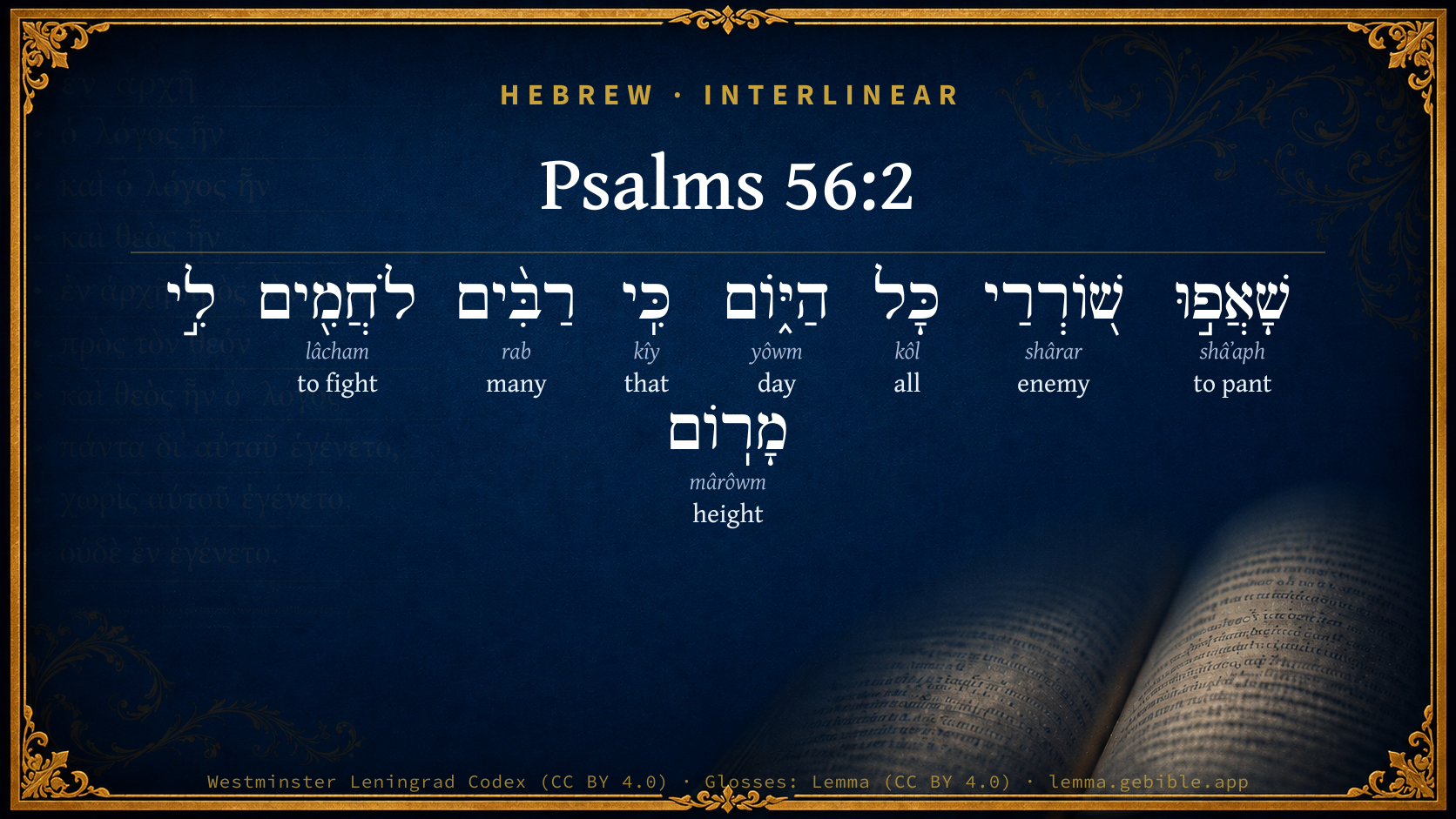
Psalms 56:2

Hebrew (Westminster Leningrad Codex) Psalms 56:2 appears in the Hebrew Old Testament. The text above is from the Westminster Leningrad Codex. Each word links to its Strong’s number, a concise gloss, and parsing drawn from the Open Scriptures Hebrew Bible morphology. Click any word for its full Brown-Driver-Briggs (BDB) entry.
Download image
Cite this verse

Psalms 56:2 (World English Bible). Public Domain. Lemma interlinear Bible study tool, https://lemma.gebible.app/v/psalms/56/2.

Show BibTeX & RIS
BibTeX
RIS
English Translation
My enemies want to swallow me up all day long, For they are many who fight proudly against me.
World English Bible · Public Domain
Download a study sheet

One document with this verse’s original text, its word-by-word gloss line, the meaning frame, cross-references with their text, attributed commentary, and full source and license credits — printable, and it pastes into notes with its structure intact.

This verse Autodidact and up

Study sheet (.html) Plain text (.txt)

A passage Seminary Student

Up to 50 verses in one chapter. A passage sheet keeps up to 6 commentary sources and 12 cross-references per verse, in the order this page ranks them, and says so on the sheet whenever that leaves anything out. Ask for a single verse and you get the Autodidact verse sheet above.

Everything on this page stays free to read, with no account — the sheet is a download of what is already on screen, not access to it.

Want to remove ads? Support Godless Engineer
Compare translations 3

The same verse in 3 English versions, stacked beneath the original-language interlinear above. Click any original word for its lexicon entry.

Each is an independent rendering of the whole verse — the interlinear is not word-aligned to these translations.

Highlighted words mark where these versions differ — a whole-verse word diff, not a word-by-word alignment.

  • World English Bible Public Domain
    My enemies want to swallow me up all day long, For they are many who fight proudly against me.
  • King James Version Public Domain
    Mine enemies would daily swallow me up: for they be many that fight against me, O thou most High.
  • unfoldingWord Literal Text CC BY-SA 4.0
    My enemies trample me all of the day, for many are fighting against me arrogantly.

unfoldingWord Literal Text — © unfoldingWord, licensed CC BY-SA 4.0. Word-aligned USFM3 via Door43 (git.door43.org/unfoldingWord/en_ult).

Versions to compare (up to 4)

3 of 4 selected

Show all 18 translations

Every available English version of this verse, each an independent rendering of the whole verse.

  • World English Bible Public Domain
    My enemies want to swallow me up all day long, For they are many who fight proudly against me.
  • Berean Standard Bible Public Domain
    My enemies pursue me all day long, for many proudly assail me.
  • Majority Standard Bible Public Domain
    My enemies pursue me all day long, for many proudly assail me.
  • King James Version Public Domain
    Mine enemies would daily swallow me up: for they be many that fight against me, O thou most High.
  • American Standard Version (1901) Public Domain
    Mine enemies would swallow me up all the day long; For they are many that fight proudly against me.
  • Revised Version (1885) Public Domain
    Mine enemies would swallow me up all the day long: for they be many that fight proudly against me.
  • Geneva Bible (1599) Public Domain
    Mine enemies would dayly swallowe mee vp: for many fight against me, O thou most High.
  • Douay-Rheims (1899) Public Domain
    Have mercy on me, O God, for man hath trodden me under foot; all the day long he hath afflicted me fighting against me.
  • Young's Literal Translation Public Domain
    Mine enemies have swallowed up all the day, For many `are' fighting against me, O most High,
  • Literal Standard Version CC BY-SA 4.0
    My enemies have swallowed up all the day, || For many [are] fighting against me, O Most High,
  • Unlocked Literal Bible CC BY-SA 4.0
    My enemies trample me all day long; for there are many who arrogantly fight against me.
  • unfoldingWord Literal Text CC BY-SA 4.0
    My enemies trample me all of the day, for many are fighting against me arrogantly.
  • Darby Bible Public Domain
    Mine enemies would swallow [me] up all the day long; for they are many that fight against me haughtily.
  • World Messianic Bible Public Domain
    My enemies want to swallow me up all day long, for they are many who fight proudly against me.
  • Webster's Bible Public Domain
    \\56:1\\To the chief Musician upon Jonathelem-rechokim, Michtam of David, when the Philistines took him in Gath. Be merciful to me, O God: for man would swallow me up; he fighting daily oppresseth me.
  • Free Bible Version CC BY-SA 4.0
    My enemies chase me down all the time—there are many of them, attacking me in their arrogance.
  • Bible in Basic English Public Domain
    My haters are ever ready to put an end to me; great numbers are lifting themselves up against me.
  • JPS Tanakh (1917) Public Domain
    (56-3) They that lie in wait for me would swallow me up all the day; for they are many that fight against me, O Most High,

Literal Standard Version (2020), Covenant Press — licensed CC BY-SA 4.0. Text via the HelloAO Bible API (eBible.org). Unlocked Literal Bible (unfoldingWord) — licensed CC BY-SA 4.0. Text via the HelloAO Bible API (eBible.org). unfoldingWord Literal Text — © unfoldingWord, licensed CC BY-SA 4.0. Word-aligned USFM3 via Door43 (git.door43.org/unfoldingWord/en_ult). Free Bible Version, Dr. Jonathan Gallagher — licensed CC BY-SA 4.0. Text via the HelloAO Bible API (eBible.org).

Word by word

More ways to search: Search by grammar → Find every occurrence → Compare this word →

Practice this passage: Drill this verse → Learn its vocabulary →

About this verse

These counts appear in no published source. They are computed here, from the morphology-tagged text and Lemma’s own curated glosses. What Lemma adds →

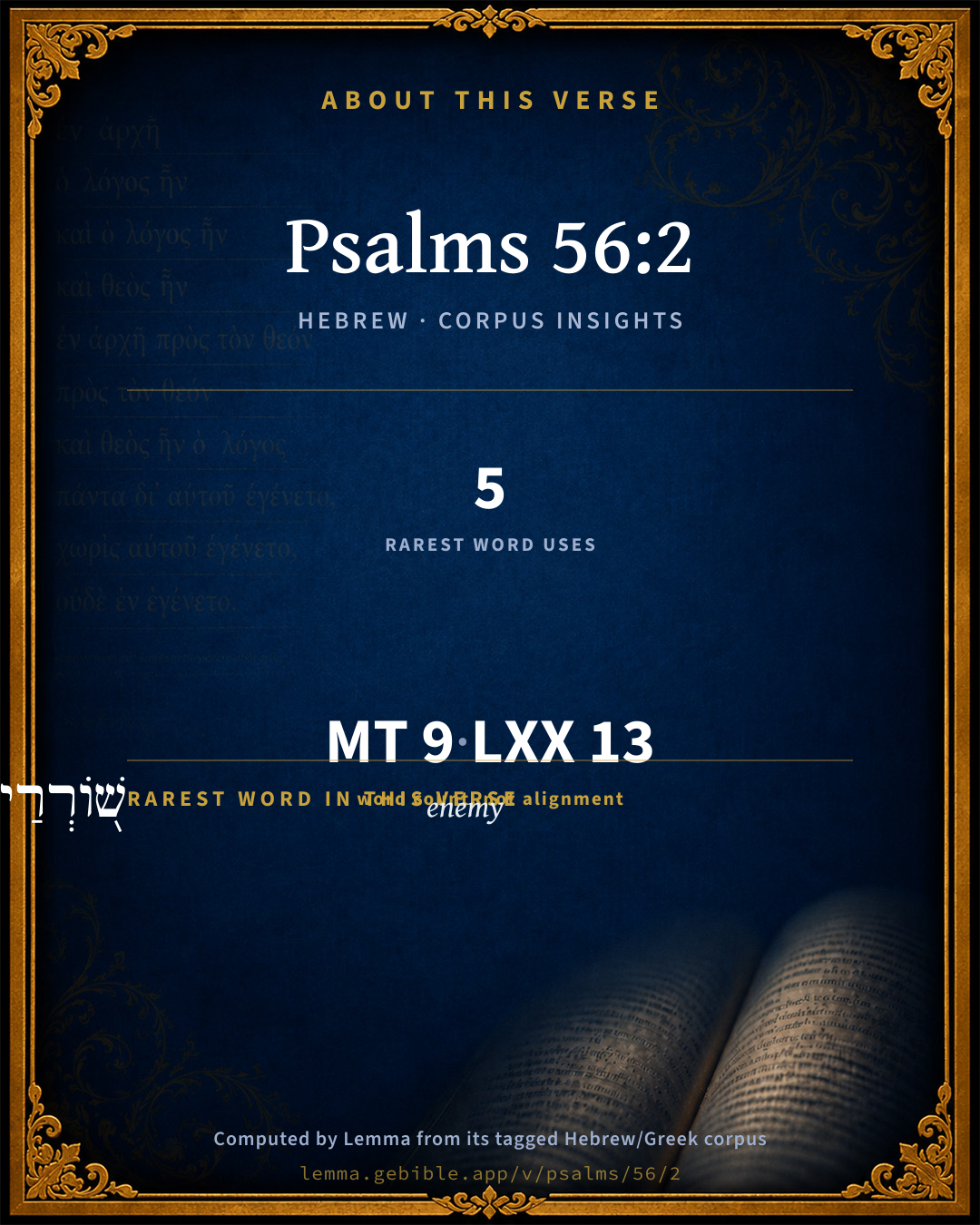
9
words
8
distinct lemmas
Wisdom
section

Notable vocabulary

The rarest word here is שׁ֭וֹרְרַי enemy H8324 — appearing just 5 times in the whole Hebrew Bible.

Shared distinctive vocabulary

שׁ֭וֹרְרַי enemy H8324 occurs in 5 verses of the Hebrew Bible. Also found in:

Grammatical profile

  • 2 verbs
  • 4 nouns
  • 1 adjective
  • 1 preposition
  • 1 conjunction

Verb forms

  • שָׁאֲפ֣וּ Qal · Perfect
  • לֹחֲמִ֖ים Qal · Participle Active

Hebrew & Septuagint length

In English translation the verse runs 19 words from the Hebrew and 22 from the Septuagint (LXX English) — closely comparable.

A rough comparison of the two English renderings, which tokenize alike — not a word-level alignment.

Word counts can differ between the Hebrew and the Greek without any difference in meaning — e.g. the Hebrew direct-object marker אֵת has no separate Greek word, and Greek often adds the article ὁ.

In the original languages it is 9 Hebrew tokens and 13 Greek tokens — but the two are counted differently (Hebrew bundles its prefixes and suffixes into one token; the Greek is in lemma form), so that isn’t a like-for-like length.

Cross-references

15

Topical passages linked to Psalms 56:2 in the Treasury of Scripture Knowledge — connected by theme and wording, ordered by reader-vote popularity; previews shown in the World English Bible.

  • Psalms 118:10–12 All the nations surrounded me, But in the name of Yahweh, I cut them off.
  • Psalms 57:3 He will send from heaven, and save me, He rebukes the one who is pursuing me. Selah. God will send out his loving kindness and his truth.
  • Psalms 3:1 Yahweh, how my adversaries have increased! Many are those who rise up against me.
  • Psalms 9:2 I will be glad and rejoice in you. I will sing praise to your name, O Most High.
  • Psalms 35:1 Contend, Yahweh, with those who contend with me. Fight against those who fight against me.
  • Psalms 54:5 He will repay the evil to my enemies. Destroy them in your truth.
  • Psalms 91:1 He who dwells in the secret place of the Most High Will rest in the shadow of the Almighty.
  • Psalms 92:1 It is a good thing to give thanks to Yahweh, To sing praises to your name, Most High;
  • Psalms 92:8 But you, Yahweh, are on high forevermore.
  • Psalms 93:4 Above the voices of many waters, The mighty breakers of the sea, Yahweh on high is mighty.
  • Isaiah 57:15 For thus says the high and lofty One who inhabits eternity, whose name is Holy: I dwell in the high and holy place, with him also who is of a contrite and humble spirit, to revive the spirit of the humble, and to revive the heart of the contrite.
  • Daniel 5:18 You king, the Most High God gave Nebuchadnezzar your father the kingdom, and greatness, and glory, and majesty:
  • Micah 6:6 How shall I come before Yahweh, And bow myself before the exalted God? Shall I come before him with burnt offerings, With calves a year old?
  • Acts 4:25–27 who by the mouth of your servant, David, said, 'Why do the nations rage, And the peoples plot a vain thing?
  • Revelation 16:14 for they are spirits of demons, performing signs; which go forth to the kings of the whole inhabited earth, to gather them together for the war of that great day of God, the Almighty.

Cross-references courtesy of OpenBible.info (CC BY 4.0).

Hebrew and Greek witnesses Masoretic Hebrew ↔ Greek Septuagint

The same verse in the two great witnesses to the Old Testament, shown verse-for-verse.

You’re reading Greek Psalm 55 (Hebrew Psalm 56). The Septuagint counts the superscription, so verse numbers can differ from the Hebrew — chapter-level alignment, not verse-by-verse. Numbering follows Rahlfs.

These are two independent witnesses, not word-aligned to each other, and the Septuagint is shown in lemma (dictionary) form.

Hebrew Psalms 56:2 Masoretic · Westminster Leningrad Codex

שָׁאֲפ֣וּ שׁ֭וֹרְרַי כָּל הַיּ֑וֹם כִּֽי רַבִּ֨ים לֹחֲמִ֖ים לִ֣י מָרֽוֹם

My enemies want to swallow me up all day long, For they are many who fight proudly against me.

World English Bible · Public Domain

Greek LXX Greek Psalm 55:2 Septuagint · lemma form

ἐλεέω ἐγώ κύριος ὅτι καταπατέω ἐγώ ἄνθρωπος ὅλος ὁ ἡμέρα πολεμέω θλίβω ἐγώ

Mine enemies have trodden me down all the day from the dawning of the day; for there are many warring against me.

LXX2012 (modern English Septuagint) · Public Domain

On this verse, Ellicott's Commentary for English Readers discusses the Septuagint’s reading. Read the note in Commentary ↓

Hebrew: Westminster Leningrad Codex (CC BY 4.0). Greek: Septuagint (public domain); English from LXX2012 (modern English Septuagint) (Public Domain). How the Septuagint differs from the Hebrew →

Commentary

Notes on Psalms 56:2 from classic Christian and Jewish commentators (each source and its license shown beneath its notes). The classic Christian expositions comment on the surrounding passage and are grouped to its opening verse, so a note may address several verses; the Jewish commentaries on the Tanakh (Rashi and others) are per-verse, so they appear only where the commentator wrote on this verse.

Lemma curates 59 commentaries, every one of them public domain or Creative Commons licensed, each selected and text-cleaned for this edition rather than reprinted as found. About our sources →

Trapp's Complete Commentary

John Trapp

Psa 56:2 Mine enemies would daily swallow [me] up: for [they be] many that fight against me, O thou most High.

Ver. 2. Mine enemies (or observers) would daily swallow me up] Anhelant observatores mei. To set forth the indignity of the thing, he repeateth the same sentence again in the plural number; noting that there were not a few of them bitterly bent by might and main to mischief him, a poor forlorn, friendless man.

For they be many that fight against me, O thou most High] Or, though there be many that fight for me from on high, that is, the angels, as Aben Ezra rendereth and senseth the text.

John Trapp, A Commentary or Exposition upon All the Books of the Old and New Testament (1647–1656) — public domain. Text from a community e-Sword module.

J. A. Alexander on Psalms

Joseph Addison Alexander

3. (Psa 56:2). My enemies have gaped upon me all the day; for (there are) many devourers to me, O most High. The word translated enemies is that supposed by some to mean spies or watchers. See above, on Psa 27:11; Psa 54:5. Having first spoken of his enemy in the singular number, he now substitutes the plural, to explain which seems to be the object of the last clause. "I say enemies, because my devourers are many." The last word in the verse strictly means a high place, and particularly heaven, but is sometimes applied to God himself. See below, on Psa 92:8. Some interpreters, however, understand it as an abstract noun meaning loftiness or pride, and then used as an adverb in the sense of arrogantly, proudly. Compare Psa 73:8.

Joseph Addison Alexander, The Psalms Translated and Explained (1850) — public domain. Text from a community e-Sword module.

Jamieson, Fausset & Brown

Robert Jamieson, A. R. Fausset & David Brown

enemies--watchers (Psa 54:5).

most High--As it is not elsewhere used absolutely for God, some render the word here, arrogantly, or proudly, as qualifying "those who fight," &c.

Jamieson, Fausset & Brown — Commentary Critical and Explanatory on the Whole Bible (1871) — public domain (CC PDM 1.0). Text via the HelloAO Bible API.

Adam Clarke's Commentary

Verse 2. O thou Most High.] מרום marom. I do not think that this word expresses any attribute of God, or indeed is at all addressed to him. It signifies, literally, from on high, or from a high or elevated place: "For the multitudes fight against me from the high or elevated place;" the place of authority - the court and cabinet of Saul.

Most of the Versions begin the next verse with this word: "From the light of the day, though I fear, yet will I trust in thee." From the time that persecution waxes hot against me, though I often am seized with fear, yet I am enabled to maintain my trust in thee. Dr. Kennicott thinks there is a corruption here, and proposes to read: "I look upwards all the day long."

Adam Clarke's Commentary on the Bible (1810–1826) — public domain. Text from a community e-Sword/MySword module.

Ellicott's Commentary for English Readers

(2) Swallow me up.—The root idea of the Hebrew word so rendered is by no means clear. In many passages where it is used the meaning given here by the LXX., “trample on,” will suit the context quite as well as, or even better than, the meaning, “pant after,” given in the Lexicons. (See Job_5:5; Isa_42:14; Ecc_1:5; Amo_2:7; Amo_8:4.) And this sense of bruising by trampling also suits the cognate verb, shûph, used only three times (Gen_3:15; Job_9:17; Psa_139:11). Symmachus also here has “bruise,” or “grind.” On the other hand in Psa_119:131; Job_7:2, &c, we want the idea of “haste” or “desire.” Possibly the original meaning of “trample” may have passed through the sense of physical haste to that of passion. Or we may even get the sense of “greedily devouring” by the exactly similar process by which we come to talk of devouring the road with speed. The same verb is used in the next verse with an object.

Fighting.—Better, devouring. (Comp. Psa_35:1.)

O thou most High.—Heb., marôm, which is here not a vocative, but an adverbial accusative, “proudly,” in pride.

A Bible Commentary for English Readers, edited by Charles John Ellicott (1878–1897) — public domain. Text from a community e-Sword module.

The Cambridge Bible for Schools and Colleges

gen. ed. J. J. S. Perowne

2. They that lie in wait for me would swallow me up [or, crush me] all the day long:

For many are they that fight against me haughtily.

For they that lie in wait for me see note on Psa_54:5. The word rendered O thou most High in A.V. is not Elyôn, the word usually so rendered (e.g. Psa_57:2), but mârôm. This word is applied to God, as in Mic_6:6, “the high God,” Psa_92:8, “Thou, O Lord, art on high for evermore:” but it can hardly stand by itself as a vocative, and probably means ‘with a high hand,’ ‘haughtily.’ Cp. Psa_73:8. ‘Be thou exalted’ in Psa_57:5; Psa_57:11 is derived from the same root. The Psalmist prays that God will prove His own supreme exaltation against these self-exalted braggarts. P.B.V. are in hand = are busying themselves.

The Cambridge Bible for Schools and Colleges (gen. ed. J. J. S. Perowne; Cambridge University Press, 1878–1918) — public domain. Text from a community e-Sword module.

John Gill's Exposition

Mine enemies would daily swallow me up,.... For not one man only, but many, were his enemies; who observed and watched him, and were eagerly desirous of his ruin. The believer has many enemies, sin, Satan, and the world, seeking to devour and destroy him, though they cannot;

for they be many that fight against me, O thou most High; he appeals to God, who dwells on high, and sees all things, for the truth of this, that he had many enemies both at Gath and in Israel; as well as applies to him for help, he being higher than they. Some render the words, "for they be many that fight against me from on high" (q), or "highly" (r), proudly and haughtily. Aben Ezra gives a very different sense,

"I have many angels on high that fight for me.''

But "marom", is an epithet of God, as in Psa 92:8; and so it is interpreted by Jarchi and Kimchi; and also by the Targum, which renders it, O God most High; and adds,

"whose throne is on high;''

which is approved by Gussetius (s).

(q) "a sublimi", Junius & Tremellius; "ex alto", Cocceius; so Arab vers. and Michaelis. (r) "Elato animo", Musculus; so some in Vatablus; "superbe", Gejerus. (s) Ebr. Comment. p. 783.

John Gill's Exposition of the Whole Bible (1746–1763) — public domain (CC PDM 1.0). Text via the HelloAO Bible API.

Albert Barnes' Notes on the Bible

Mine enemies - Margin, “mine observers.” The Hebrew word here used means properly to twist, to twist totogether; then, to be firm, hard, tough; then, “to press together,” as a rope that is twisted - and hence, the idea of oppressing, or pressing hard on one, as an enemy. See Psa 27:11; Psa 54:5. In the former verse the psalmist spoke of an enemy, or of “one” that would swallow him up (in the singular number), or of “man” as an enemy to him anywhere. Here he uses the plural number, implying that there were “many” who were enlisted against him. He was surrounded by enemies. He met them wherever he went. He had an enemy in Saul; he had enemies in the followers of Saul; he had enemies among the Philistines, and now when he had fled to Achish, king of Gath, and had hoped to find a refuge and a friend there, he found only bitter foes.

Would daily swallow me up - Constantly; their efforts to do it are unceasing. A new day brings no relief to me, but every day I am called to meet some new form of opposition.

For they be many that fight against me - His own followers and friends were few; his foes were many. Saul had numerous followers, and David encountered foes wherever he went. “O thou Most High.” The word used here - מרום mârôm - means properly height, altitude, elevation; then, a high place, especially heaven, Psa 18:16; Isa 24:18, Isa 24:21; then it is applied to anything high or inaccessible, as a fortress, Isa 26:5. It is supposed by Gesenius (Lexicon), and some others, to mean here “elation of mind, pride,” - implying that his enemies fought against him with elated minds, or proudly. So the Septuagint, the Vulgate, and Luther render it; and so DeWette understands it. Yet it seems most probable that our translators have given the correct rendering, and that the passage is a solemn appeal to God as more exalted than his foes, and as one, therefore, in whom he could put entire confidence. Compare Psa 92:8; Psa 93:4,; Mic 6:6.

Albert Barnes' Notes on the Bible (1834–1885) — public domain. Text from a community e-Sword/MySword module.

Matthew Poole's English Annotations

Mine enemies, Heb. my observers, that narrowly look to all my paths, and watch for my haltings, and for an opportunity to destroy me.

Many that fight against me: they trust to their great numbers, wherein they know themselves to be much superior to me.

O thou Most High; who from thine high place beholdest all their plots, and canst most easily disturb and blast them.

Matthew Poole's English Annotations on the Holy Bible (1683–1685) — public domain. Text from a community e-Sword/MySword module.

The Treasury of David

Charles H. Spurgeon

Ver. 2. Mine enemies would daily swallow me up. Their appetite for blood never fails them. With them there is no truce or armistice. They are many, but one mind animates them. Nothing I can do can make them relent. Unless they can quite devour me they will never be content. The ogres of nursery tales exist in reality in the enemies of the church, who would crush the bones of the godly, and make a mouthful of them if they could.

For they be many that fight against me. Sinners are gregarious creatures. Persecutors hunt in packs. These wolves of the church seldom come down upon us singly. The number of our foes is a powerful plea for the interposition of the one Defender of the faithful, who is mightier than all their bands. These foes of the gracious are also keen eyed, and ever on the watch, hence the margin calls them "observers."

O thou most High. Thus he invokes against the lofty ones of the earth the aid of one who is higher than the highest. Some translate the words differently, and think that the writer means that his foes assailed him from the high places in which pride and power had placed them. Saul, his great foe, attacked him from his throne with all the force which his high position placed at his disposal: our comfort in such a case is near to hand, for God will help us from a higher place than our proudest foes can occupy. The greatness of God as the Most High is a fertile source of consolation to weak saints oppressed by mighty enemies.

Ver. 2. O thou most High. The Hebrew is not that rendered Most High in Ps 7:17; nor in our version is it ever rendered Most High in any other place, although found in the Hebrew Bible more than fifty times. There are but two other places where it is applied, as an epithet, to God; Ps 92:8; Mic 6:6. It is commonly rendered, from above, on high, high places, high; once loftily, Ps 73:8... The probable meaning is, they "fight against me from the high places of authority, both in Jerusalem and in Gath, "q.d., mine enemies are in power. William S. Plumer's "Studies in the Book of Psalms, "1867.

Ver. 2-3.

I. Fears are common to all men, at one time or

another.

II. Improper and inefficacious means of removing fear

are often resorted to.

III. There is here suggested a true and effectual

method of removing fear. Robert Morrison (1782-1834), in "A Parting Memorial."

Psalms 56:3*

Ver. 2-3.

I. Fears are common to all men, at one time or

another.

II. Improper and inefficacious means of removing

fear are often resorted to.

III. There is here suggested a true and effectual

method of removing fear.

Robert Morrison (1782-1834), in "A Parting Memorial."

Charles H. Spurgeon's The Treasury of David (1869–1885) — public domain. Psalms only. Text from a community e-Sword/MySword module.

Whedon's Commentary on the Bible

Daniel D. Whedon

2. Mine enemies—Literally, my watchers, namely, the conspirators.

Swallow me up—Have panted for me, as a ravenous beast; same word as in Psa_56:1.

They be many—It would seem from the sequel of the history, (1 Samuel 27, 29,) that Achish, the king, favoured David, but was overpowered by the number and influence of his enemies.

O thou Most High—מרום, (maroom,) is nowhere else in Scripture translated as a title of Deity, and should not be here. The word means a high place, as Isa_22:16, and figuratively a high office or dignity, and adverbially, in a bad sense, loftily, proudly; my enemies fight against me from a high place, or, they fight loftily, stately, as Psa_73:8. In the Hebrew territory David had Saul and the government against him; here, in Philistia, the nobility and lords of the nation. Gath was the city of the giants, David’s mortal enemies, of whom he, as already mentioned, had killed Goliath, and of the four surviving, one was Goliath’s brother, 2Sa_21:19. They all subsequently fell by the hands of David and his officers. 1 Chronicles 20. He might well complain that those who sought his life were numerous and in high places, or of a lofty spirit.

Daniel D. Whedon (gen. ed.), Commentary on the Old and New Testaments (1874–1909) — public domain. Text from a community e-Sword module.

The Pulpit Commentary

Mine enemies; literally, my watchers those who keep a continual guard over me. If David had been seized and made a prisoner by the Philistine lords, this expression would be very appropriate. Would daily swallow me up; rather, pant after me all day. For they be many that fight against me. The "lords of the Philistines" were, doubtless, "many;" they seem to have, all of them, opposed themselves to David. (1Sa_29:2-9) O thou Most High. This rendering is now generally abandoned, since marom ( "height," is nowhere else used in this sense. Dr. Kay, Hengstenberg, and the Revised Version render "proudly;" Professor Cheyne, "with high looks."

The Pulpit Commentary (1880–1919), ed. H.D.M. Spence-Jones & Joseph S. Exell — public domain. Text from a community e-Sword module.

Rashi

Rabbi Shlomo Yitzchaki (Rashi)

yearn Heb. שאפנו, yearn to swallow me up, goloseir or goloser, to long, to be impatient. (Cf. Rashi to Amos 2:7.) As (Jer. 2:24): “that snuffs up (שאפה) the wind.”

the warrior Heb. לחם, an expression of war (מלחמה).

Rashi on the Tanakh — English translations: “The Judaica Press complete Tanach with Rashi, translated by A. J. Rosenberg” (CC BY 4.0); “Pentateuch with Rashi's commentary by M. Rosenbaum and A.M. Silbermann, 1929-1934” (public domain); “The Metsudah Tanach series, Lakewood, N.J” (CC BY 4.0); and “The Book of Joshua, Metsudah Publications, 1997” (CC BY 4.0). Text via Sefaria.

Lesson kit

Teaching starters — assembled from the data on this page, not authored interpretation. Every prompt links to the verse data it draws on. Edit before teaching.

Psalms, in the Wisdom, opens this verse with 9 words (8 distinct Hebrew lemmas). Its most distinctive word is shârar (“enemy”). A historical commentator’s framing appears above. Read the whole chapter for the surrounding context.

Discussion questions

  1. What does “enemy” (shârar) contribute to the verse as a whole?
  2. How does Psalms 5:8, which shares the word «enemy», read alongside this verse?
  3. These translations render this verse differently; the difference is in the English rendering, not the original. What questions does that raise?
  4. «שָׁאֲפ֣וּ» is a Qal Perfect verb. How does that grammatical form shape the action described?
  5. Compare how Trapp's Complete Commentary and J. A. Alexander on Psalms read this verse. Where do they agree or differ?

Things to notice

Reading settings

Reading text

Shown beneath each verse's original-language words.

Old Testament
Old Testament edition

Read the OT as the Masoretic Hebrew (MT) or the Greek Septuagint (LXX).

English shown for the Greek Septuagint (in the Hebrew ↔ Greek comparison).

Comparing translations? Open the Compare panel on any verse page to stack up to four side by side.