Psalms 49:10

Hebrew (Westminster Leningrad Codex) Psalms 49:10 appears in the Hebrew Old Testament. The text above is from the Westminster Leningrad Codex. Each word links to its Strong’s number, a concise gloss, and parsing drawn from the Open Scriptures Hebrew Bible morphology. Click any word for its full Brown-Driver-Briggs (BDB) entry.
Download image
Cite this verse

Psalms 49:10 (World English Bible). Public Domain. Lemma interlinear Bible study tool, https://lemma.gebible.app/v/psalms/49/10.

Show BibTeX & RIS
BibTeX
RIS
English Translation
For he sees that wise men die; Likewise the fool and the senseless perish, And leave their wealth to others.
World English Bible · Public Domain
Highlights
  • 2 first appearances in the Hebrew Bible
Full analysis ↓
Download a study sheet

One document with this verse’s original text, its word-by-word gloss line, the meaning frame, cross-references with their text, attributed commentary, and full source and license credits — printable, and it pastes into notes with its structure intact.

This verse Autodidact and up

Study sheet (.html) Plain text (.txt)

A passage Seminary Student

Up to 50 verses in one chapter. A passage sheet keeps up to 6 commentary sources and 12 cross-references per verse, in the order this page ranks them, and says so on the sheet whenever that leaves anything out. Ask for a single verse and you get the Autodidact verse sheet above.

Everything on this page stays free to read, with no account — the sheet is a download of what is already on screen, not access to it.

Want to remove ads? Support Godless Engineer
Compare translations 3

The same verse in 3 English versions, stacked beneath the original-language interlinear above. Click any original word for its lexicon entry.

Each is an independent rendering of the whole verse — the interlinear is not word-aligned to these translations.

Highlighted words mark where these versions differ — a whole-verse word diff, not a word-by-word alignment.

  • World English Bible Public Domain
    For he sees that wise men die; Likewise the fool and the senseless perish, And leave their wealth to others.
  • King James Version Public Domain
    For he seeth that wise men die, likewise the fool and the brutish person perish, and leave their wealth to others.
  • unfoldingWord Literal Text CC BY-SA 4.0
    For one will see. The wise die, likewise the fool and the brute perish, and they leave their wealth to others.

unfoldingWord Literal Text — © unfoldingWord, licensed CC BY-SA 4.0. Word-aligned USFM3 via Door43 (git.door43.org/unfoldingWord/en_ult).

Versions to compare (up to 4)

3 of 4 selected

Show all 18 translations

Every available English version of this verse, each an independent rendering of the whole verse.

  • World English Bible Public Domain
    For he sees that wise men die; Likewise the fool and the senseless perish, And leave their wealth to others.
  • Berean Standard Bible Public Domain
    For it is clear that wise men die, and the foolish and the senseless both perish and leave their wealth to others.
  • Majority Standard Bible Public Domain
    For it is clear that wise men die, and the foolish and the senseless both perish and leave their wealth to others.
  • King James Version Public Domain
    For he seeth that wise men die, likewise the fool and the brutish person perish, and leave their wealth to others.
  • American Standard Version (1901) Public Domain
    For he shall see it. Wise men die; The fool and the brutish alike perish, And leave their wealth to others.
  • Revised Version (1885) Public Domain
    For he seeth that wise men die, the fool and the brutish together perish, and leave their wealth to others.
  • Geneva Bible (1599) Public Domain
    For he seeth that wise men die, and also that the ignorant and foolish perish, and leaue their riches for others.
  • Douay-Rheims (1899) Public Domain
    and shall still live unto the end.
  • Young's Literal Translation Public Domain
    For he seeth wise men die, Together the foolish and brutish perish, And have left to others their wealth.
  • Literal Standard Version CC BY-SA 4.0
    For he sees wise men die, || Together the foolish and brutish perish, || And have left their wealth to others.
  • Unlocked Literal Bible CC BY-SA 4.0
    For he will see decay. Wise men die; the fool and the brute alike perish and leave their wealth to others.
  • unfoldingWord Literal Text CC BY-SA 4.0
    For one will see. The wise die, likewise the fool and the brute perish, and they leave their wealth to others.
  • Darby Bible Public Domain
    For he seeth that wise men die; all alike, the fool and the brutish perish, and they leave their wealth to others.
  • World Messianic Bible Public Domain
    For he sees that wise men die; likewise the fool and the senseless perish, and leave their wealth to others.
  • Webster's Bible Public Domain
    \\49:9\\That he should still live for ever, and not see corruption.
  • Free Bible Version CC BY-SA 4.0
    Everyone knows that the wise die, those who are foolish and stupid too, leaving what they have to the next generation.
  • Bible in Basic English Public Domain
    For he sees that wise men come to their end, and foolish persons of low behaviour come to destruction together, letting their wealth go to others.
  • JPS Tanakh (1917) Public Domain
    (49-11) For he seeth that wise men die, the fool and the brutish together perish, and leave their wealth to others.

Literal Standard Version (2020), Covenant Press — licensed CC BY-SA 4.0. Text via the HelloAO Bible API (eBible.org). Unlocked Literal Bible (unfoldingWord) — licensed CC BY-SA 4.0. Text via the HelloAO Bible API (eBible.org). unfoldingWord Literal Text — © unfoldingWord, licensed CC BY-SA 4.0. Word-aligned USFM3 via Door43 (git.door43.org/unfoldingWord/en_ult). Free Bible Version, Dr. Jonathan Gallagher — licensed CC BY-SA 4.0. Text via the HelloAO Bible API (eBible.org).

Word by word

More ways to search: Search by grammar → Find every occurrence → Compare this word →

Practice this passage: Drill this verse → Learn its vocabulary →

וָבַ֣עַר
baʻar
H1198
“and · brutishness”
Conjunction + Adjective, Adjective, Masculine, Singular, Absolute
Part of Speech
Conjunction + Adjective
Type
Adjective
Gender
Masculine
Number
Singular
State
Absolute
Full BDB Definition

Origin: from H1197

TWOT: 264b

brutishness, stupidity, brutish (person)
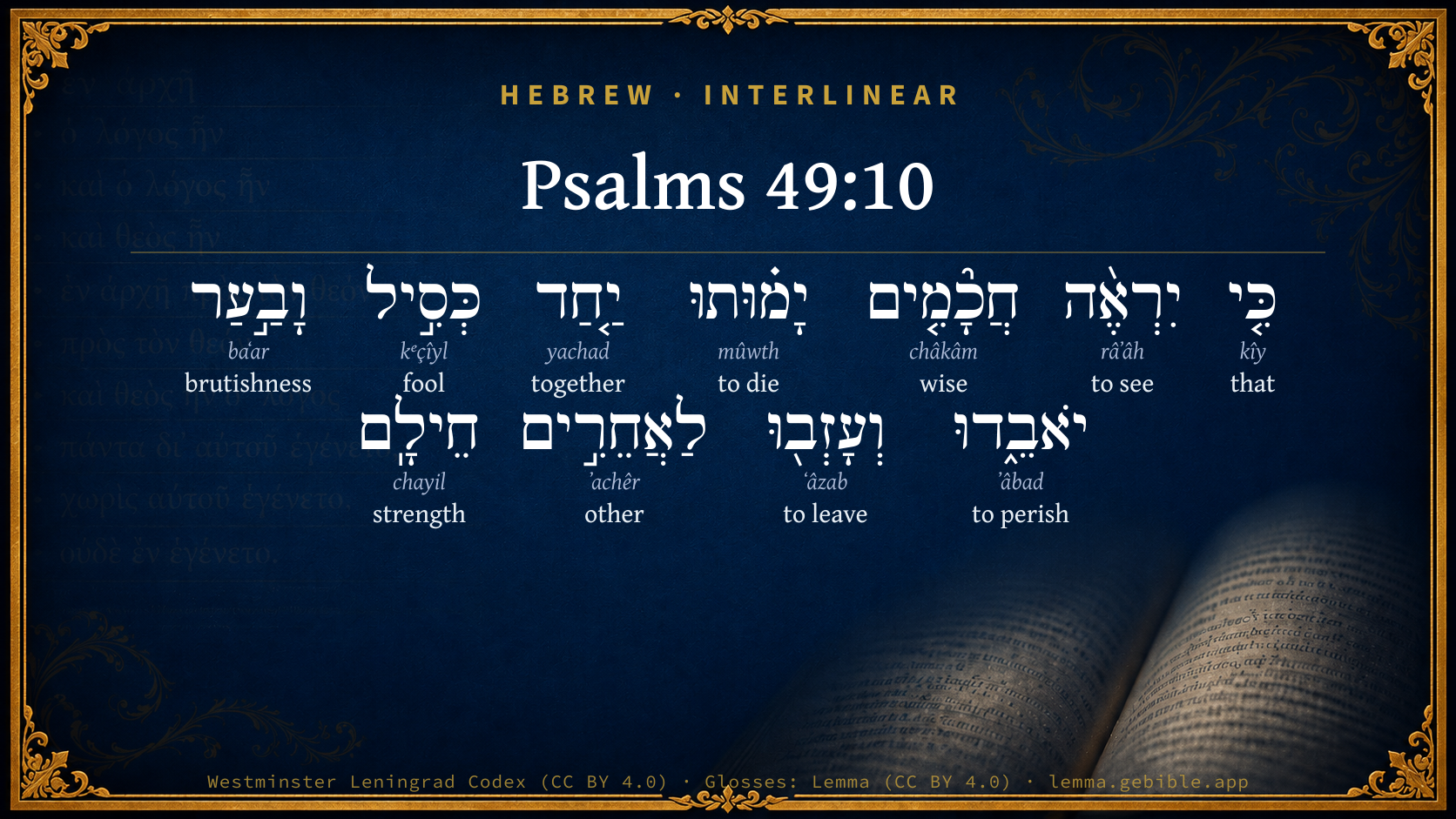
  1. כִּ֤י kîy H3588 “that” Conjunction
  2. יִרְאֶ֨ה râʼâh H7200 “to see” Verb, Qal, Imperfect, 3rd Person, Masculine, Singular
  3. חֲכָ֘מִ֤ים châkâm H2450 “wise” Adjective, Adjective, Masculine, Plural, Absolute
  4. יָמ֗וּתוּ mûwth H4191 “to die” Verb, Qal, Imperfect, 3rd Person, Masculine, Plural
  5. יַ֤חַד yachad H3162 “together” Adverb
  6. כְּסִ֣יל kᵉçîyl H3684 “fool” Adjective, Adjective, Masculine, Singular, Absolute
  7. יֹאבֵ֑דוּ ʼâbad H6 “to perish” Verb, Qal, Imperfect, 3rd Person, Masculine, Plural
  8. וְעָזְב֖וּ ʻâzab H5800 “and · to leave” Conjunction + Verb, Qal, Sequential Perfect, 3rd Person, Common, Plural
  9. לַאֲחֵרִ֣ים ʼachêr H312 “to/for · other” Preposition + Adjective, Adjective, Masculine, Plural, Absolute
  10. חֵילָֽם chayil H2428 “strength · their” Noun, Common, Masculine, Singular, Construct + Suffix, Personal, 3rd Person, Masculine, Plural

About this verse

These counts appear in no published source. They are computed here, from the morphology-tagged text and Lemma’s own curated glosses. What Lemma adds →

11
words
11
distinct lemmas
Wisdom
section

Notable vocabulary

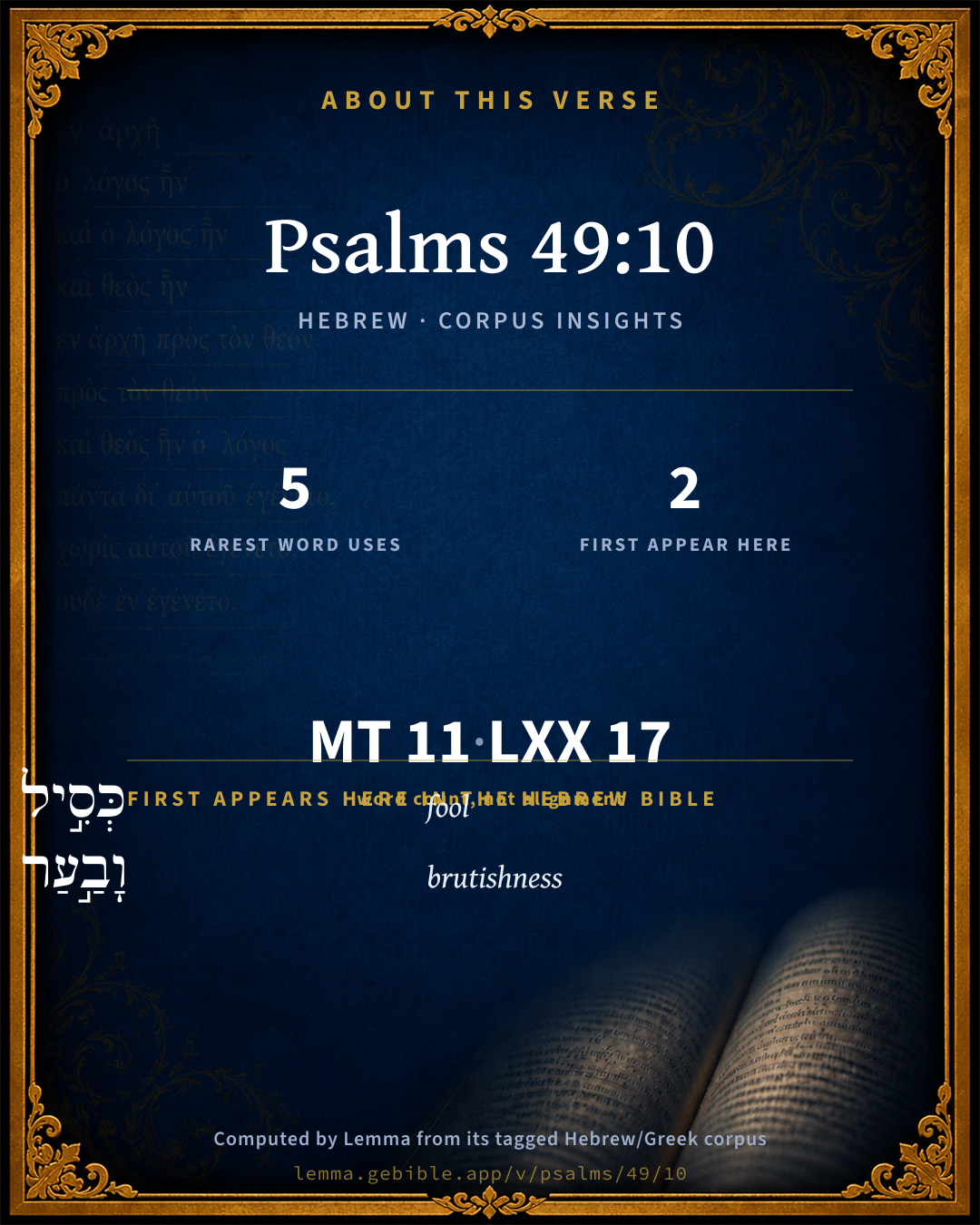
The rarest word here is וָבַ֣עַר brutishness H1198 — appearing just 5 times in the whole Hebrew Bible.

First appearance in Scripture

These words make their first canonical appearance in the Hebrew Bible here:

  • כְּסִ֣יל fool H3684
  • וָבַ֣עַר brutishness H1198

Shared distinctive vocabulary

וָבַ֣עַר brutishness H1198 occurs in 5 verses of the Hebrew Bible. Also found in:

Grammatical profile

  • 4 verbs
  • 1 noun
  • 4 adjectives
  • 1 conjunction
  • 1 adverb

Verb forms

  • יִרְאֶ֨ה Qal · Imperfect
  • יָמ֗וּתוּ Qal · Imperfect
  • יֹאבֵ֑דוּ Qal · Imperfect
  • וְעָזְב֖וּ Qal · Sequential Perfect

Hebrew & Septuagint length

In English translation the verse runs 20 words from the Hebrew and 24 from the Septuagint (LXX English) — closely comparable.

A rough comparison of the two English renderings, which tokenize alike — not a word-level alignment.

Word counts can differ between the Hebrew and the Greek without any difference in meaning — e.g. the Hebrew direct-object marker אֵת has no separate Greek word, and Greek often adds the article ὁ.

In the original languages it is 11 Hebrew tokens and 17 Greek tokens — but the two are counted differently (Hebrew bundles its prefixes and suffixes into one token; the Greek is in lemma form), so that isn’t a like-for-like length.

Cross-references

19

Topical passages linked to Psalms 49:10 in the Treasury of Scripture Knowledge — connected by theme and wording, ordered by reader-vote popularity; previews shown in the World English Bible.

  • Psalms 39:6 "Surely every man walks like a shadow. Surely they busy themselves in vain. He heaps up, and doesn't know who shall gather.
  • Luke 12:20 "But God said to him, 'You foolish one, tonight your soul is required of you. The things which you have prepared--whose will they be?'
  • Ecclesiastes 5:13–16 There is a grievous evil which I have seen under the sun: wealth kept by its owner to his harm.
  • 1 Timothy 6:6–10 But godliness with contentment is great gain.
  • Hebrews 9:27 Inasmuch as it is appointed for men to die once, and after this, judgment,
  • Proverbs 30:2 "Surely I am the most ignorant man, And don't have a man's understanding.
  • Jeremiah 10:8 But they are together brutish and foolish: the instruction of idols! it is but a stock.
  • Psalms 49:17 For when he dies he shall carry nothing away. His glory shall not descend after him.
  • Psalms 73:22 I was so senseless and ignorant. I was a brute beast before you.
  • Psalms 94:8 Consider, you senseless among the people; You fools, when will you be wise?
  • Proverbs 11:4 Riches don't profit in the day of wrath, But righteousness delivers from death.
  • Ecclesiastes 2:26 For to the man who pleases him, God gives wisdom, knowledge, and joy; but to the sinner he gives travail, to gather and to heap up, that he may give to him who pleases God. This also is vanity and a chasing after wind.
  • Psalms 17:14 From men by your hand, Yahweh, From men of the world, whose portion is in this life. You fill the belly of your cherished ones. Your sons have plenty, And they store up wealth for their children.
  • Psalms 92:6–7 A senseless man doesn't know, Neither does a fool understand this:
  • Proverbs 12:1 Whoever loves correction loves knowledge, But he who hates reproof is stupid.
  • Ecclesiastes 2:16–21 For of the wise man, even as of the fool, there is no memory for ever, seeing that in the days to come all will have been long forgotten. Indeed, the wise man must die just like the fool!
  • Ecclesiastes 9:1–2 For all this I laid to my heart, even to explore all this: that the righteous, and the wise, and their works, are in the hand of God; whether it is love or hatred, man doesn't know it; all is before them.
  • Jeremiah 17:11 As the partridge that sits on [eggs] which she has not laid, so is he who gets riches, and not by right; in the midst of his days they shall leave him, and at his end he shall be a fool.
  • Romans 5:12–14 Therefore, as sin entered into the world through one man, and death through sin; and so death passed to all men, because all sinned.

Cross-references courtesy of OpenBible.info (CC BY 4.0).

Hebrew and Greek witnesses Masoretic Hebrew ↔ Greek Septuagint

The same verse in the two great witnesses to the Old Testament, shown verse-for-verse.

You’re reading Greek Psalm 48 (Hebrew Psalm 49). The Septuagint counts the superscription, so verse numbers can differ from the Hebrew — chapter-level alignment, not verse-by-verse. Numbering follows Rahlfs.

These are two independent witnesses, not word-aligned to each other, and the Septuagint is shown in lemma (dictionary) form.

Hebrew Psalms 49:10 Masoretic · Westminster Leningrad Codex

כִּ֤י יִרְאֶ֨ה חֲכָ֘מִ֤ים יָמ֗וּתוּ יַ֤חַד כְּסִ֣יל וָבַ֣עַר יֹאבֵ֑דוּ וְעָזְב֖וּ לַאֲחֵרִ֣ים חֵילָֽם

For he sees that wise men die; Likewise the fool and the senseless perish, And leave their wealth to others.

World English Bible · Public Domain

Greek LXX Greek Psalm 48:10 Septuagint · lemma form

καί κοπάζω εἰς ὁ αἰών καί ζάω εἰς τέλος ὅτι οὐ ὁράω καταφθορά ὅταν ὁράω σοφός ἀποθνήσκω

When he shall see wise men dying, the fool and the senseless one shall perish together; and they shall leave their wealth to strangers.

LXX2012 (modern English Septuagint) · Public Domain

Hebrew: Westminster Leningrad Codex (CC BY 4.0). Greek: Septuagint (public domain); English from LXX2012 (modern English Septuagint) (Public Domain). How the Septuagint differs from the Hebrew →

Commentary

Notes on Psalms 49:10 from classic Christian and Jewish commentators (each source and its license shown beneath its notes). The classic Christian expositions comment on the surrounding passage and are grouped to its opening verse, so a note may address several verses; the Jewish commentaries on the Tanakh (Rashi and others) are per-verse, so they appear only where the commentator wrote on this verse.

Lemma curates 59 commentaries, every one of them public domain or Creative Commons licensed, each selected and text-cleaned for this edition rather than reprinted as found. About our sources →

Trapp's Complete Commentary

John Trapp

Psa 49:10 For he seeth [that] wise men die, likewise the fool and the brutish person perish, and leave their wealth to others.

Ver. 10. For he seeth that wise men die, likewise the fool] This to be a truth, etiam muta clamant cadavera, the dead corpses of both do preach and proclaim, by a dumb kind of eloquence. Death maketh no difference; Pallida mors aequo, &c. It is appointed for all men once to die. It lieth as a man’s lot, as the word αποκειται signifieth, Heb 9:27, and all men can say, We are all mortal; but, alas, we say it for most part, magis usu quam sensu, more of custom than feeling; for we live as if our lives were riveted upon eternity, and we should never come to a reckoning.

Heu vivunt heroines tanquam mors nulla sequatur,

Aut velut infernus fabula vana foret.

And the brutish person perish] His life and his hopes ending together. But it would be considered, that wise men die as well as fools, good men die as well as bad, yea, good men oft before the bad, Isa 57:1. Jeroboam’s best son died before the rest, because there was some good found in him (ωκυμοροι οι θεοριλεις).

And leave their wealth to others] Nec aliis solum, sed et alienis, to mere strangers; this Solomon sets forth as a great vanity. It was therefore a good speech of a holy man once to a great lord, who had showed him his stately house and pleasant gardens: You had need make sure of heaven, or else when you die you will be a very great loser.

John Trapp, A Commentary or Exposition upon All the Books of the Old and New Testament (1647–1656) — public domain. Text from a community e-Sword module.

Joseph Benson's Commentary

Psa 49:10. For he seeth — Every man sees and knows it; it is visible and evident, both from reason and from universal experience; wise men die, &c. — All men die, the wise and good, as well as the foolish and wicked; and leave their wealth to others — He saith not to sons or kindred, but indefinitely to others, because it is wholly uncertain to whom they shall leave it, to friends, or strangers, or enemies; which he mentions as a great vanity in riches. They neither can save him from death, nor will accompany him in and after death; and after his death will be disposed of, he knows not how, nor to whom.

Joseph Benson's Commentary on the Old and New Testaments (1811–1818) — public domain. Text from a community e-Sword module.

J. A. Alexander on Psalms

Joseph Addison Alexander

11. (Psa 49:10). For he shall see (it); wise (men) must die; likewise the fool and brute must perish, and leave to others their substance. The usual construction of the first words—when he sees (or for he sees) that wise men die—is neither so simple in itself, nor so well suited to the context, as that which gives the verb the same sense, and the same object, as in the preceding verse. Wealth cannot ransom its possessor, so that he shall live for ever and not see corruption, for he shall see it, as all others do. Even the wisest men must die, much more the fool and brutish person. These are the terms so frequently used in the Book of Proverbs to describe the sinner as irrational. See above, on Psa 14:1, and compare Pro 1:32; Pro 10:1; Pro 12:1; Pro 30:2, Ecc 2:16. In the use of the verbs die and perish, there may be an intentional allusion to the different destiny of the wise and foolish. Likewise, or more literally together, at the same time. See above, Psa 4:8 (7), and compare Isa 1:28. Substance, strength, pecuniary strength, the same word that is used in Psa 49:7 (6) above.

Joseph Addison Alexander, The Psalms Translated and Explained (1850) — public domain. Text from a community e-Sword module.

Geneva Bible (1599)

Geneva Bible translators

In that that death maketh no difference between the persons.

That is, not to their children, but to strangers. Yet the wicked profit not by these examples, but still dream an immortality in earth.

Geneva Bible (1599) marginal notes — public domain. Text via Bolls.life.

Jamieson, Fausset & Brown

Robert Jamieson, A. R. Fausset & David Brown

For he seeth--that is, corruption; then follows the illustration.

wise . . . fool-- (Psa 14:1; Pro 1:32; Pro 10:1).

likewise--alike altogether-- (Psa 4:8) --die--all meet the same fate.

Jamieson, Fausset & Brown — Commentary Critical and Explanatory on the Whole Bible (1871) — public domain (CC PDM 1.0). Text via the HelloAO Bible API.

Adam Clarke's Commentary

Verse 10. For he seeth that wise men die] Though they may be rich, and their wisdom teach them the best method of managing their riches so as to derive all the good from them they can possibly produce, yet they die as well as the fool and the poor ignorant man; and their wealth is left to others who will be equally disappointed in their expectation from it.

Adam Clarke's Commentary on the Bible (1810–1826) — public domain. Text from a community e-Sword/MySword module.

John Calvin's Commentaries

10 For he shall see that wise men die. I consider the ninth and tenth verses to be connected, and that it is the intention of the Psalmist to censure the folly of those who dream of spending an eternity in this world, and set themselves seriously to establish a permanent settlement in it, though they cannot but see their fellow-creatures cut down daily before their eyes by the stroke of death. It is a common proverb, that experience teaches fools, and they may be looked upon as something worse who will not lay to heart their mortality, when surrounded by so many convincing illustrations of it. This seems obviously to be the connection. These infatuated enemies of God, as if he had said, cannot fail to perceive that death is the universal lot of mankind, that the wise are equally liable to it with the foolish; and yet they persist in the imagination that they will remain here always, and will live as if they were never to quit with this world! They see what happens to others, that all, without exception or discrimination, are involved in the common mortality; and they must observe how often it happens that wealth passes into the hands of strangers The word אחרים, acherim, I translate strangers, rather than others; for although it may be extended to successors of any kind, yet I think that the Psalmist here supposes the case of wealth passing into the hands of those who are not our natural and lawful heirs, and cannot be considered in any sense as representing us. Many not only die, but die childless, and their name becomes extinct, which is an additional ingredient of bitterness in the cup of the worldling. And yet all these affecting lessons of experience are entirely lost upon them, and they still in their secret thoughts fondly cherish the idea of living here for ever. The Hebrew word קרב, kereb, means the middle of anything; but it is taken metaphorically to signify the heart, or inward parts of the man. Here it denotes that their secret thoughts are occupied with an imaginary eternity which they hope to enjoy upon earth. Another and more ingenious interpretation has been suggested by some, that as the word occasionally means a tomb, the Psalmist may here be satirising those who think to perpetuate their memory after death by rearing expensive mausoleums. This view of the words is strained and unnatural; and what immediately follows proves that the other is the most correct, when it is added, that worldly men call out their names upon the earth; that is, make every exertion in their power to win reputation amongst their fellow-creatures. Their desire should be to have their names written in the book of life, and to be blessed before God and his holy angels; but their ambition is of another kind — to be renowned and extolled upon earth. By the expression, calling out, it is insinuated that the fame of ungodly men is but an empty sound. Some interpreters prefer reading, They have called their lands by their own names, that they might leave some monument of themselves to posterity. But what the Psalmist seems chiefly to insist upon is, that they are wholly bent upon earthly renown.

John Calvin's Commentaries (1540-1563) — public domain. Text from the Calvin Translation Society English edition (1840s-50s) via the Christian Classics Ethereal Library (ccel.org). Calvin's coverage is partial (roughly two-thirds of the Bible); uncommented books and verses are honest gaps, never fabricated. The 19th-century editor's footnotes and remarks are omitted so the notes are faithfully Calvin's own voice.

Ellicott's Commentary for English Readers

(10) For he seeth.—The clauses are wrongly divided in the Authorised Version. Translate—

“On the contrary he must see it (the grave),

Wise men must die . . .

Likewise the fool and the stupid must perish.”

The wealth of the prudent will not avail any more for indefinite prolongation of life, than that of fools.

A Bible Commentary for English Readers, edited by Charles John Ellicott (1878–1897) — public domain. Text from a community e-Sword module.

The Cambridge Bible for Schools and Colleges

gen. ed. J. J. S. Perowne

10. For he seeth that wise men die] Experience shews the rich man that all alike come to the grave. Even wisdom cannot deliver its possessor. This rendering is on the whole preferable to that of R.V. marg., Yea, he (the brother or the rich man) shall see it (the pit): wise men die &c. ‘Wise’ and ‘fool’ are words characteristic of the Wisdom literature. The former occurs but once again in the Psalter, and 46 times in Proverbs: the latter but twice in the Psalter, and 49 times in Proverbs.

likewise &c.] Fool and brutish perish together. Perhaps the use of different verbs is intended to distinguish between the end of the wise man and the end of the fool and the brutish, the self-confident braggart and the mere stupid animal.

and leave &c.] Or, abandon. The point of course is not that they can pass on their property to their heirs, but that they must themselves surrender it. Wealth can neither prolong life, nor be retained by its owner at death. Cp. Luk_12:10.

The Cambridge Bible for Schools and Colleges (gen. ed. J. J. S. Perowne; Cambridge University Press, 1878–1918) — public domain. Text from a community e-Sword module.

John Gill's Exposition

For he seeth that wise men die,.... This is a reason convincing the rich man, that with all his riches he cannot redeem his brother from death; since he must see, by daily and constant experience, that none are exempted from dying, no, not even the wise man; and therefore, not the rich, since wisdom is better than riches, and is said to give life, Ecc 7:12; and yet wise men die, yea, Solomon, the wisest of men, died. Worldly wise men, such who are wiser in their generation than the children of light, know how, to get money and estates, and to provide for futurity, and yet cannot secure themselves from death: men that are wise in natural things, know the secrets of nature, the constitution of human bodies, what is proper to preserve health and life, as philosophers and physicians, and yet cannot deliver themselves from death: wise politicians, prudent magistrates, instructors of mankind in all the branches of useful knowledge, who are profitable to themselves and others, and are the most deserving to live because of usefulness, yet these die as well as others: such as are spiritually wise, wise unto salvation, who know themselves, and know Christ, whom to know is life eternal; and the wisest among them, such as are capable of teaching others the hidden and mysterious wisdom of God; even these wise men and prophets do not live for ever. The Targum interprets this of wicked wise men, condemned to hell; or as it is in the king's Bible,

"the wicked wise men, who die the second death;''

see Rev 2:11; and are condemned to hell;

likewise the fool and the brutish person perish; the worldly fool, who trusts in his riches, and boasts of them; his soul is at once required of him. The atheistical fool, who says there is no God, no judgment, no future state; has made a covenant with death, and with hell is at an agreement; this covenant does not stand, he dies, and finds himself dreadfully mistaken: the fool that is so immorally, who makes a mock at sin, a jest of religion, and puts away the evil day far from him; his great wickedness, to which he is given, shall not deliver him from death. Every man is become brutish in his knowledge; but there are some among the people more brutish than others, who are as natural brute beasts, and shall utterly perish in their own corruptions. The wise good man dies, but perishes not; he inherits eternal life; but the wicked fool and brute not only perish by death, but are punished with everlasting destruction in soul and body;

and leave their wealth to others; they cannot carry it with them, so that it will be of no service to them after death any more than at it: if the Judge could be bribed by gold, as he cannot, they will not have it with them to do it; they came into the world naked, and so they will go out, and carry nothing with them, but leave all behind them; either to their babes, their children, and heirs, Psa 17:14; or to strangers, they know not who; and if they do, they do not know whether they will be wise men or fools, or what use they will make of it, Psa 39:6, Ecc 2:18.

John Gill's Exposition of the Whole Bible (1746–1763) — public domain (CC PDM 1.0). Text via the HelloAO Bible API.

Albert Barnes' Notes on the Bible

For he seeth that wise men die - He must see this; he does see it. He perceives that no one can be saved from death. It comes on all alike - the wise and the unwise. Nothing saves from it. The allusion is here especially to the “rich,” whether “they” are wise or whether they are fools and “brutish.” The simple fact, as stated, is that no matter what may be the character of the man of wealth, whether wise or foolish, he must certainly die His wealth cannot save him from the grave. The possessor of wealth himself “sees” this. It cannot be concealed from him.

Likewise the fool - The rich man who is a fool, or who is destitute of wisdom. He who is rich and who is wise - wise in the things of this life and wise unto salvation - (or who is gifted with a high degree of intelligence and who evinces wisdom in respect to the higher matters of existence) - and the rich man who is a fool - (who is regardless of his highest interests, and who evinces no special intelligence, though possessed of wealth) - all, all die alike.

And the brutish person - The rich man who is stupid and dull; who lives like a brute; who lives to eat and drink; who lives for gross sensuality - “he” dies as well as he who is wise. Wealth cannot in either case save from death. Whether connected with wisdom or folly - whether carefully husbanded or lavishly spent - whether a man employs it in the highest and noblest manner in which it can be devoted, or in the indulgence of the most low and debasing enjoyments - it is alike powerless in saving people from the grave.

And leave their wealth to others - It all passes into other hands. It “must” be so left. It cannot be carried away by its possessor when he goes into the eternal world. It not only cannot save him from the grave, but he cannot even take it with him. All his houses, his lands, his title-deeds, his silver, his gold, his parks, gardens, horses, hounds - all that he had accumulated with so much care, and worshipped with so idolatrous an affection, is not even his own in the sense that he can take it with him. The title passes absolutely into other hands, and even if he could come back to earth again, he could no longer claim it, for when he dies it ceases to be his forever. How powerless, then, is wealth in reference to the great purposes of human existence!

Albert Barnes' Notes on the Bible (1834–1885) — public domain. Text from a community e-Sword/MySword module.

Matthew Poole's English Annotations

He seeth; an impersonal expression. Every man sees and knows it; it is visible and evident, both from reason and from universal experience, that all men die, without any difference between wise and fools, good and bad. To others; he saith not, to sons or kindred; but indefinitely, to others because he is wholly uncertain to whom he shall leave him, to friends, or strangers, or enemies; which he mentions as a great vanity in riches. They neither can save him from death, nor will accompany him in and after death, and after his death will be disposed he knows not how nor to whom.

Matthew Poole's English Annotations on the Holy Bible (1683–1685) — public domain. Text from a community e-Sword/MySword module.

The Treasury of David

Charles H. Spurgeon

Ver. 10. For he seeth that wise men die. Every one sees this. The proud persecuting rich man cannot help seeing it. He cannot shut his eyes to the fact that wiser men than he are dying, and that he also, with all his craft, must die. Likewise the fool and the brutish person perish. Folly has no immunity from death. Off goes the jester's cap, as well as the student's gown. Jollity cannot laugh off the dying hour; death who visits the university, does not spare the tavern. Thoughtlessness and brutishness meet their end as surely as much care and wasting study. In fact, while the truly wise, so far as this world is concerned, die, the fool has a worse lot, for he perishes, is blotted out of remembrance, bewailed by none, remembered no more. And leave their wealth to others. Not a farthing can they carry with them. Whether heirs male of their own body, lawfully begotten, inherit their estates, or they remain unclaimed, it matters not, their hoardings are no longer theirs; friends may quarrel over their property, or strangers divide it as spoil, they cannot interfere. Ye boasters, hold ye your own, before ye dream of despoiling the sons of the living God. Keep shoes to your own feet in death's dark pilgrimage, ere ye seek to bite our heels.

Charles H. Spurgeon's The Treasury of David (1869–1885) — public domain. Psalms only. Text from a community e-Sword/MySword module.

Whedon's Commentary on the Bible

Daniel D. Whedon

10. Wise men—A designation not only of men of learning and mental endowments, but of prudence, virtue, and piety.

Fool… brutish person— The first is one who is dull, sluggish, of obdurate will, and averse to discipline, and always classed with impious persons; the second, “brutish,” are men who are distinguished for living for appetite, being of strong passions, and savage temper and stupid minds.

Die… perish—The wise men “die,” but the “fool” and “brutish” perish. There is a wreck of their plans and hopes. They are not annihilated; the word will not bear this sense, and the whole argument contradicts it; for the subject of discourse is moral rewards, not immortality of being. No language could define more diverse characters or rewards.

Leave their wealth to others—So that herein they have only a momentary advantage, and that in things of inferior worth.

Daniel D. Whedon (gen. ed.), Commentary on the Old and New Testaments (1874–1909) — public domain. Text from a community e-Sword module.

The Pulpit Commentary

For he seeth that wise men die, likewise the fool and the brutish person perish. The rich man must see that any hope of ransoming himself by means of his wealth, and so escaping death and the grave, is vain, since the law of mortality, which is in operation all around him, is universal. No one is redeemed from death, in the sense of escaping "the first death." Not only do "the fool and the brutish person" perish, but the fate of "the wise" is the same. All die; all quit the earth; all leave behind them everything that they possessed on earth; no one can take with him the gold in which he has trusted (ver. 6); all leave their wealth to others.

The Pulpit Commentary (1880–1919), ed. H.D.M. Spence-Jones & Joseph S. Exell — public domain. Text from a community e-Sword module.

John Wesley's Explanatory Notes

He seeth - Every man sees that all men die, the wise and the foolish; the evil and the good. To others - He saith not to sons or kindred; but to others, because he is wholly uncertain to whom he shall leave them, to friends, or strangers, or enemies; which he mentions as a great vanity in riches. They neither can save them from death, nor will accompany him in and after death; and after his death will be disposed, he knows not how, nor to whom.

John Wesley, Explanatory Notes Upon the Whole Bible (1754–1765) — public domain. Text via the GEBible commentary corpus.

Ibn Ezra

Rabbi Abraham ibn Ezra

"And he shall live" - that is how he who works to gain treasure thinks

Ibn Ezra on the Tanakh — English translations: “Sefaria Community Translation” (CC0 1.0 (public-domain dedication)); “Yalkut, Sifsei Chachomim Chumash, Metsudah Publications, 2009” (CC BY 4.0); and “Commentary of Ibn Ezra on Isaiah - trans. by M. Friedlander, 1873” (public domain). Text via Sefaria.

Lesson kit

Teaching starters — assembled from the data on this page, not authored interpretation. Every prompt links to the verse data it draws on. Edit before teaching.

Psalms, in the Wisdom, opens this verse with 11 words (11 distinct Hebrew lemmas). Its most distinctive word is baʻar (“brutishness”). A historical commentator’s framing appears above. Read the whole chapter for the surrounding context.

Discussion questions

  1. How does “brutishness” (baʻar) shape what this verse is saying?
  2. 2 words here appear for the first time in Scripture. What is being introduced at this debut?
  3. Psalms 73:22 shares the word «brutishness» with this verse. How do the two illuminate each other?
  4. These translations render this verse differently. What is at stake in choosing one wording over another?
  5. The verb «יִרְאֶ֨ה» is Qal Imperfect. How does its form color the action?
  6. Reading how Trapp's Complete Commentary and Joseph Benson's Commentary read this verse, where do the two commentators agree and where do they part?

Things to notice

Reading settings

Reading text

Shown beneath each verse's original-language words.

Old Testament
Old Testament edition

Read the OT as the Masoretic Hebrew (MT) or the Greek Septuagint (LXX).

English shown for the Greek Septuagint (in the Hebrew ↔ Greek comparison).

Comparing translations? Open the Compare panel on any verse page to stack up to four side by side.