Psalms 37:40

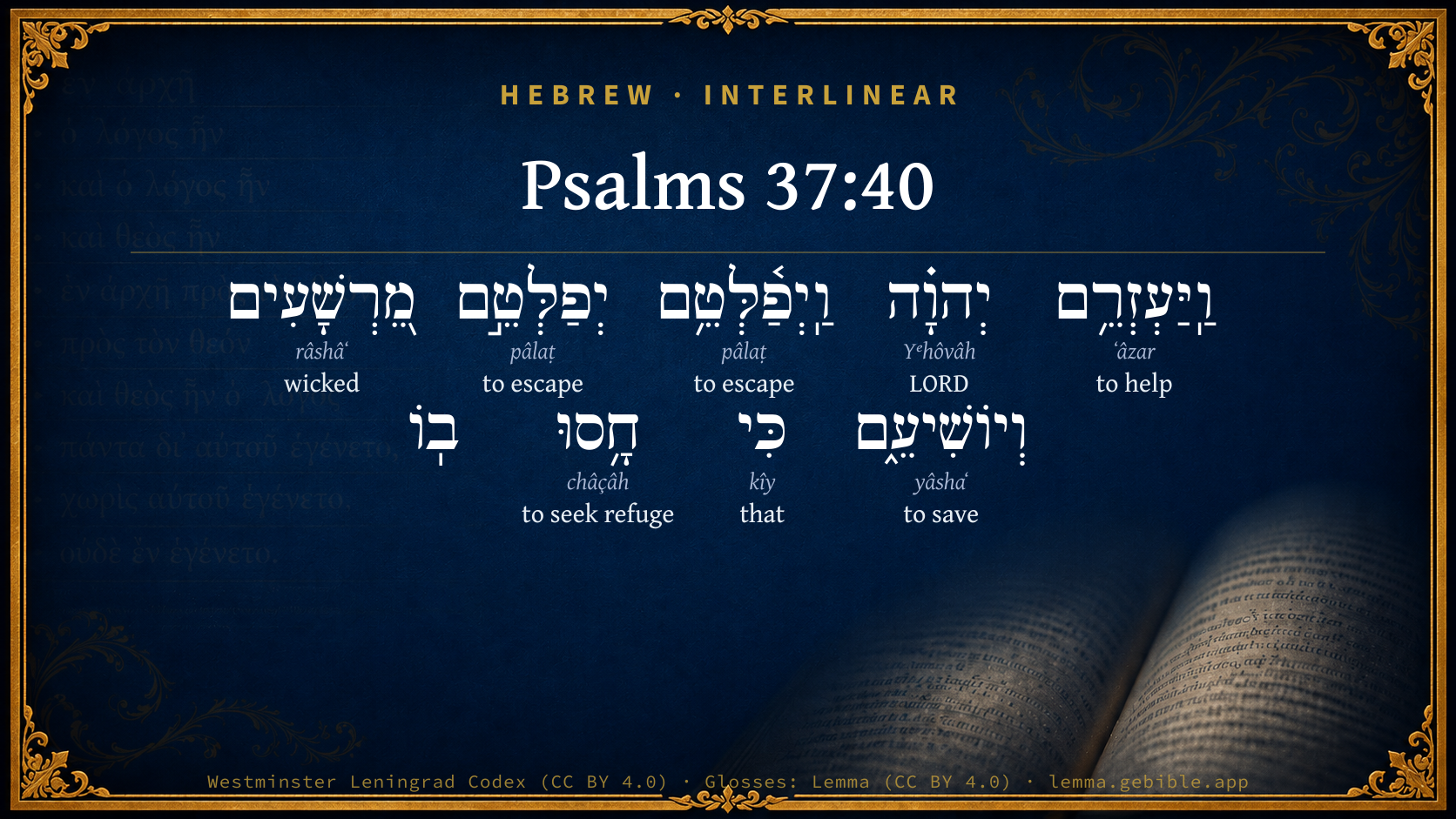
Hebrew (Westminster Leningrad Codex) Psalms 37:40 appears in the Hebrew Old Testament. The text above is from the Westminster Leningrad Codex. Each word links to its Strong’s number, a concise gloss, and parsing drawn from the Open Scriptures Hebrew Bible morphology. Click any word for its full Brown-Driver-Briggs (BDB) entry.
Download image
Cite this verse

Psalms 37:40 (World English Bible). Public Domain. Lemma interlinear Bible study tool, https://lemma.gebible.app/v/psalms/37/40.

Show BibTeX & RIS
BibTeX
RIS
English Translation
Yahweh helps them, and rescues them. He rescues them from the wicked, and saves them, Because they have taken refuge in him.
World English Bible · Public Domain
Download a study sheet

One document with this verse’s original text, its word-by-word gloss line, the meaning frame, cross-references with their text, attributed commentary, and full source and license credits — printable, and it pastes into notes with its structure intact.

This verse Autodidact and up

Study sheet (.html) Plain text (.txt)

A passage Seminary Student

Up to 50 verses in one chapter. A passage sheet keeps up to 6 commentary sources and 12 cross-references per verse, in the order this page ranks them, and says so on the sheet whenever that leaves anything out. Ask for a single verse and you get the Autodidact verse sheet above.

Everything on this page stays free to read, with no account — the sheet is a download of what is already on screen, not access to it.

Want to remove ads? Support Godless Engineer
Compare translations 3

The same verse in 3 English versions, stacked beneath the original-language interlinear above. Click any original word for its lexicon entry.

Each is an independent rendering of the whole verse — the interlinear is not word-aligned to these translations.

Highlighted words mark where these versions differ — a whole-verse word diff, not a word-by-word alignment.

  • World English Bible Public Domain
    Yahweh helps them, and rescues them. He rescues them from the wicked, and saves them, Because they have taken refuge in him.
  • King James Version Public Domain
    And the LORD shall help them, and deliver them: he shall deliver them from the wicked, and save them, because they trust in him.
  • unfoldingWord Literal Text CC BY-SA 4.0
    And Yahweh helps them and delivers them; he delivers them from the wicked and saves them, because they have taken refuge in him.

unfoldingWord Literal Text — © unfoldingWord, licensed CC BY-SA 4.0. Word-aligned USFM3 via Door43 (git.door43.org/unfoldingWord/en_ult).

Versions to compare (up to 4)

3 of 4 selected

Show all 18 translations

Every available English version of this verse, each an independent rendering of the whole verse.

  • World English Bible Public Domain
    Yahweh helps them, and rescues them. He rescues them from the wicked, and saves them, Because they have taken refuge in him.
  • Berean Standard Bible Public Domain
    The LORD helps and delivers them; He rescues and saves them from the wicked, because they take refuge in Him.
  • Majority Standard Bible Public Domain
    The LORD helps and delivers them; He rescues and saves them from the wicked, because they take refuge in Him.
  • King James Version Public Domain
    And the LORD shall help them, and deliver them: he shall deliver them from the wicked, and save them, because they trust in him.
  • American Standard Version (1901) Public Domain
    And Jehovah helpeth them, and rescueth them; He rescueth them from the wicked, and saveth them, Because they have taken refuge in him. Psalm 38 A Psalm of David, to bring to remembrance.
  • Revised Version (1885) Public Domain
    And the LORD helpeth them, and rescueth them: he rescueth them from the wicked, and saveth them, because they have taken refuge in him.
  • Geneva Bible (1599) Public Domain
    For the Lord shall helpe them, and deliuer them: he shall deliuer them from the wicked, and shall saue them, because they trust in him.
  • Douay-Rheims (1899) Public Domain
    And the Lord will help them and deliver them: and he will rescue them from the wicked, and save them, because they have hoped in him.
  • Young's Literal Translation Public Domain
    And Jehovah doth help them and deliver them, He delivereth them from the wicked, And saveth them, Because they trusted in Him!
  • Literal Standard Version CC BY-SA 4.0
    And YHWH helps them and delivers them, || He delivers them from the wicked, || And saves them, || Because they trusted in Him!
  • Unlocked Literal Bible CC BY-SA 4.0
    Yahweh helps them and rescues them. He rescues them from evil men and saves them because they have taken refuge in him.
  • unfoldingWord Literal Text CC BY-SA 4.0
    And Yahweh helps them and delivers them; he delivers them from the wicked and saves them, because they have taken refuge in him.
  • Darby Bible Public Domain
    And Jehovah will help them and deliver them: he will deliver them from the wicked, and save them; for they trust in him.
  • World Messianic Bible Public Domain
    The LORD helps them and rescues them. He rescues them from the wicked and saves them, because they have taken refuge in him.
  • Webster's Bible Public Domain
    And the LORD will help them, and deliver them: he will deliver them from the wicked, and save them, because they trust in him.
  • Free Bible Version CC BY-SA 4.0
    The Lord helps them and rescues them from the wicked. He saves them because they go to him for protection.
  • Bible in Basic English Public Domain
    And the Lord will be their help, and keep them safe: he will take them out of the hands of the evil-doers, and be their saviour, because they had faith in him.
  • JPS Tanakh (1917) Public Domain
    And the LORD helpeth them, and delivereth them; He delivereth them from the wicked, and saveth them, because they have taken refuge in Him.

Literal Standard Version (2020), Covenant Press — licensed CC BY-SA 4.0. Text via the HelloAO Bible API (eBible.org). Unlocked Literal Bible (unfoldingWord) — licensed CC BY-SA 4.0. Text via the HelloAO Bible API (eBible.org). unfoldingWord Literal Text — © unfoldingWord, licensed CC BY-SA 4.0. Word-aligned USFM3 via Door43 (git.door43.org/unfoldingWord/en_ult). Free Bible Version, Dr. Jonathan Gallagher — licensed CC BY-SA 4.0. Text via the HelloAO Bible API (eBible.org).

Word by word

More ways to search: Search by grammar → Find every occurrence → Compare this word →

Practice this passage: Drill this verse → Learn its vocabulary →

וַֽיְפַ֫לְּטֵ֥ם
pâlaṭ
H6403
“and · to escape · them”
Conjunction + Verb, Piel, Sequential Imperfect, 3rd Person, Masculine, Singular + Suffix, Personal, 3rd Person, Masculine, Plural
Part of Speech
Conjunction + Verb
Stem
Piel
Form
Sequential Imperfect
Person
3rd Person
Gender
Masculine
Number
Singular
Full BDB Definition

Origin: a primitive root

TWOT: 1774

to escape, save, deliver, slip away - (Qal) to escape - (Piel) - to bring into security, deliver - to cause to escape, cast forth - to be delivered - to slip away - (Hiphil) to bring into security, bring to safety
  1. וַֽיַּעְזְרֵ֥ם ʻâzar H5826 “and · to help · them” Conjunction + Verb, Qal, Sequential Imperfect, 3rd Person, Masculine, Singular + Suffix, Personal, 3rd Person, Masculine, Plural
  2. יְהוָ֗ה Yᵉhôvâh H3068 “LORD” Noun, Proper
  3. יְפַלְּטֵ֣ם pâlaṭ H6403 “to escape · them” Verb, Piel, Imperfect, 3rd Person, Masculine, Singular + Suffix, Personal, 3rd Person, Masculine, Plural
  4. מֵ֭רְשָׁעִים râshâʻ H7563 “from · wicked” Preposition + Adjective, Adjective, Masculine, Plural, Absolute
  5. וְיוֹשִׁיעֵ֑ם yâshaʻ H3467 “and · to save · them” Conjunction + Verb, Hiphil, Imperfect, 3rd Person, Masculine, Singular + Suffix, Personal, 3rd Person, Masculine, Plural
  6. כִּי kîy H3588 “that” Conjunction
  7. חָ֥סוּ châçâh H2620 “to seek refuge” Verb, Qal, Perfect, 3rd Person, Common, Plural

About this verse

These counts appear in no published source. They are computed here, from the morphology-tagged text and Lemma’s own curated glosses. What Lemma adds →

9
words
7
distinct lemmas
Wisdom
section

Notable vocabulary

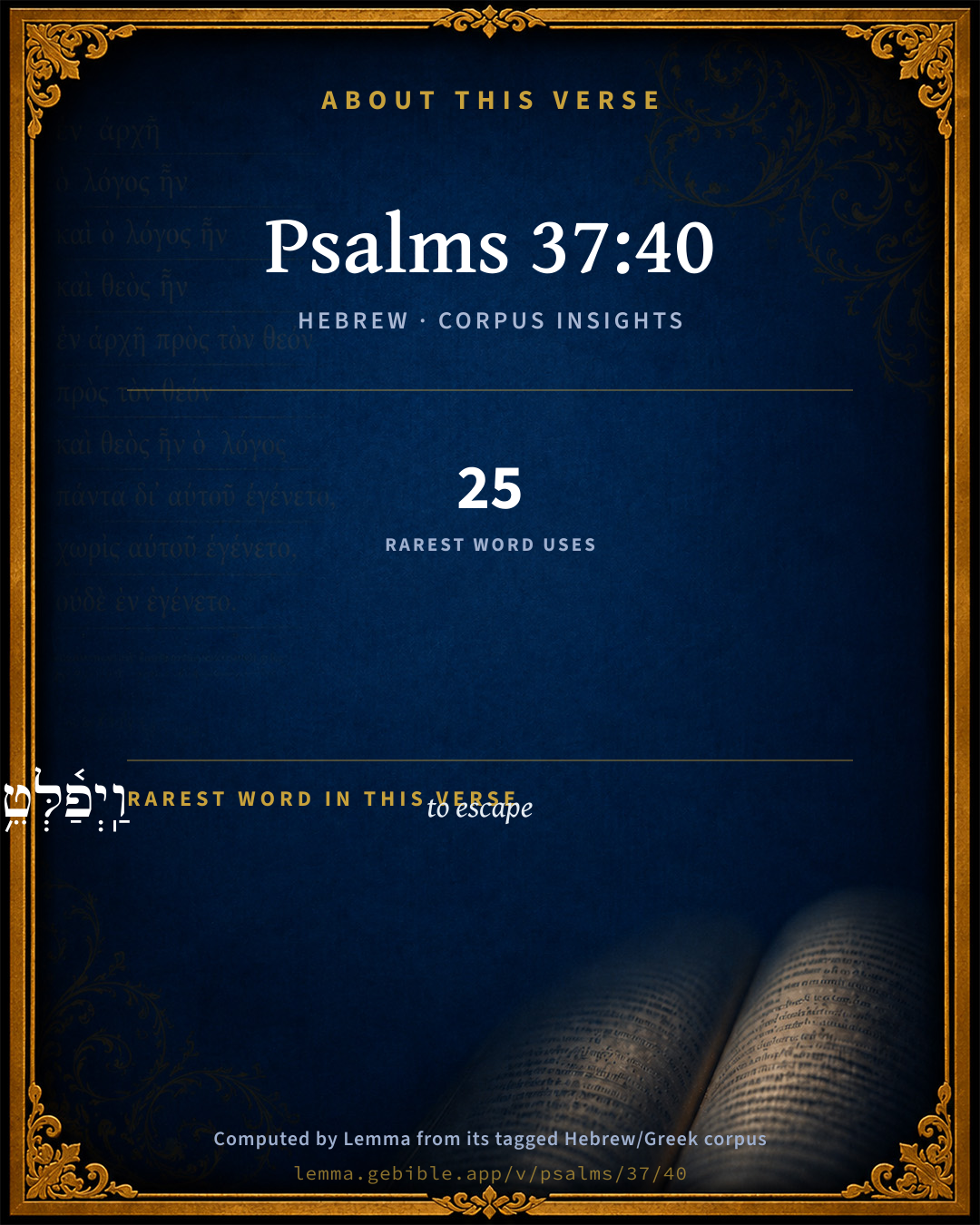
The rarest word here is וַֽיְפַ֫לְּטֵ֥ם to escape H6403 — appearing just 25 times in the whole Hebrew Bible.

Shared distinctive vocabulary

וַֽיְפַ֫לְּטֵ֥ם to escape H6403 occurs in 23 verses of the Hebrew Bible. Also found in:

Grammatical profile

  • 5 verbs
  • 1 noun
  • 1 adjective
  • 1 preposition
  • 1 conjunction

Verb forms

  • וַֽיַּעְזְרֵ֥ם Qal · Sequential Imperfect
  • וַֽיְפַ֫לְּטֵ֥ם Piel · Sequential Imperfect
  • יְפַלְּטֵ֣ם Piel · Imperfect
  • וְיוֹשִׁיעֵ֑ם Hiphil · Imperfect
  • חָ֥סוּ Qal · Perfect

Repetition

A word recurs within this verse — often emphatic in Hebrew:

  • וַֽיְפַ֫לְּטֵ֥ם to escape H6403 ×2

Hebrew & Septuagint length

In English translation the verse runs 22 words from the Hebrew and 25 from the Septuagint (LXX English) — closely comparable.

A rough comparison of the two English renderings, which tokenize alike — not a word-level alignment.

Word counts can differ between the Hebrew and the Greek without any difference in meaning — e.g. the Hebrew direct-object marker אֵת has no separate Greek word, and Greek often adds the article ὁ.

Cross-references

11

Topical passages linked to Psalms 37:40 in the Treasury of Scripture Knowledge — connected by theme and wording, ordered by reader-vote popularity; previews shown in the World English Bible.

  • Isaiah 31:5 As birds hovering, so will Yahweh of Hosts protect Jerusalem; he will protect and deliver [it], he will pass over and preserve [it].
  • 1 Chronicles 5:20 They were helped against them, and the Hagrites were delivered into their hand, and all who were with them; for they cried to God in the battle, and he was entreated of them, because they put their trust in him.
  • Daniel 3:17 If it be [so], our God whom we serve is able to deliver us from the burning fiery furnace; and he will deliver us out of your hand, O king.
  • Isaiah 46:4 and even to old age I am he, and even to gray hairs will I carry you. I have made, and I will bear; yes, I will carry, and will deliver.
  • Daniel 6:23 Then was the king exceeding glad, and commanded that they should take Daniel up out of the den. So Daniel was taken up out of the den, and no manner of hurt was found on him, because he had trusted in his God.
  • Daniel 3:28 Nebuchadnezzar spoke and said, Blessed be the God of Shadrach, Meshach, and Abednego, who has sent his angel, and delivered his servants who trusted in him, and have changed the king's word, and have yielded their bodies, that they might not serve nor worship any god, except their own God.
  • Psalms 22:4–5 Our fathers trusted in you. They trusted, and you delivered them.
  • 1 John 5:18 We know that whoever is born of God doesn't sin, but he who was born of God keeps himself, and the evil one doesn't touch him.
  • Psalms 17:13 Arise, Yahweh, Confront him, cast him down. Deliver my soul from the wicked by your sword;
  • Psalms 27:2 When evil-doers came at me to eat up my flesh, Even my adversaries and my foes, they stumbled and fell.
  • 1 John 2:13–14 I write to you, fathers, because you know him who is from the beginning. I write to you, young men, because you have overcome the evil one. I write to you, little children, because you know the Father.

Cross-references courtesy of OpenBible.info (CC BY 4.0).

Hebrew and Greek witnesses Masoretic Hebrew ↔ Greek Septuagint

The same verse in the two great witnesses to the Old Testament, shown verse-for-verse.

You’re reading Greek Psalm 36 (Hebrew Psalm 37). The Septuagint counts the superscription, so verse numbers can differ from the Hebrew — chapter-level alignment, not verse-by-verse. Numbering follows Rahlfs.

These are two independent witnesses, not word-aligned to each other, and the Septuagint is shown in lemma (dictionary) form.

Hebrew Psalms 37:40 Masoretic · Westminster Leningrad Codex

וַֽיַּעְזְרֵ֥ם יְהוָ֗ה וַֽיְפַ֫לְּטֵ֥ם יְפַלְּטֵ֣ם מֵ֭רְשָׁעִים וְיוֹשִׁיעֵ֑ם כִּי חָ֥סוּ בֽוֹ

Yahweh helps them, and rescues them. He rescues them from the wicked, and saves them, Because they have taken refuge in him.

World English Bible · Public Domain

Greek LXX Greek Psalm 36:40 Septuagint · lemma form

καί βοηθέω αὐτός κύριος καί ῥύομαι αὐτός καί ἐκαἱρέω αὐτός ἐκ ἁμαρτωλός καί σώζω αὐτός ὅτι ἐλπίζω ἐπί αὐτός

And the Lord shall help them, and deliver them: and he shall rescue them from sinners, and save them, because they have hoped in him.

LXX2012 (modern English Septuagint) · Public Domain

Hebrew: Westminster Leningrad Codex (CC BY 4.0). Greek: Septuagint (public domain); English from LXX2012 (modern English Septuagint) (Public Domain). How the Septuagint differs from the Hebrew →

Commentary

Notes on Psalms 37:40 from classic Christian and Jewish commentators (each source and its license shown beneath its notes). The classic Christian expositions comment on the surrounding passage and are grouped to its opening verse, so a note may address several verses; the Jewish commentaries on the Tanakh (Rashi and others) are per-verse, so they appear only where the commentator wrote on this verse.

Lemma curates 59 commentaries, every one of them public domain or Creative Commons licensed, each selected and text-cleaned for this edition rather than reprinted as found. About our sources →

Trapp's Complete Commentary

John Trapp

Psa 37:40 And the LORD shall help them, and deliver them: he shall deliver them from the wicked, and save them, because they trust in him.

Ver. 40. And the Lord shall help them, &c.] He shall, he shall, he shall. Oh the rhetoric of God! the safety of the saints! the certainty of the promises!

John Trapp, A Commentary or Exposition upon All the Books of the Old and New Testament (1647–1656) — public domain. Text from a community e-Sword module.

J. A. Alexander on Psalms

Joseph Addison Alexander

40. (Psa 37:40) And Jehovah has helped them. It is not in name or in profession merely that he is their stronghold and protector. Jehovah has helped them and delivered them. And what he has done he will still do. He will deliver them from the wicked. The mention of this specific evil brings us back to the point from which we started, the temptation to repine at the prosperity of sinners and resent their evil treatment. But the true wisdom of the righteous is to wait, to wait for God. He will deliver them from the wicked, and will save them from all evil, as this verb when absolutely used imports, not because of any merit upon their part, but because they have trusted, taken refuge, sought for shelter, in him, not only under his protection, but in intimate union and Communion with him. See above, on Psa 2:12; Psa 5:12 (11), Psa 7:2 (1), Psa 25:20; Psa 31:2 (1).

Joseph Addison Alexander, The Psalms Translated and Explained (1850) — public domain. Text from a community e-Sword module.

Adam Clarke's Commentary

Verse 40. The Lord - shall deliver them] For they are always exposed to trials, and liable to fall.

Because they trust in him.] They keep faith, prayer, love, and obedience in continual exercise. They continue to believe in, love, and obey God; and he continues to save them.

ANALYSIS OF THE THIRTY-SEVENTH PSALM

What is here delivered may be reduced to these two general heads: -

I. He sets down the duty of a good man, which is to be patient, and put his confidence in God when he sees the wicked prosper and flourish.

II. He gives many reasons to prove the propriety of such conduct.

I. He begins with an interdict, and then descends to give some directions.

1. His interdict is, "Fret not thyself," c. Be not angry nor envious to which he adds this reason, that their prosperity is but short: "For they shall be cut down," c.

2. Then he sets down some directions and rules to prevent fretting and anger.

1. The first is a perpetual rule for our whole life: "Trust in the Lord." Rely not on human helps, friends, riches, c.

2. "Be good." Increase not thy state by evil arts or means.

3. "Dwell in the land." Desert not thy station.

4. "And verily thou shalt be fed." Enjoy quietly what thou hast at present.

5. "Delight thyself in the Lord." Be pleased with his way.

6. "Commit thy way unto the Lord." Labour in an honest vocation, and leave the rest to him for "he will work for thee."

7. "Rest in the Lord." Acquiesce in his will and the dispensations of his providence wait patiently for him; his time is the best. And then he repeats his interdict: "Fret not thyself."

II. Then he resumes his former reason, mentioned Ps 37:2, and amplifies it by an antithesis, viz., that it shall be well with the good, ill with the wicked, Ps 37:9-11; and so it falls out for the most part, but not always; which is enough for temporal blessings.

1. "Evil doers shall be cut off, but those who wait on the Lord shall inherit the land."

2. "Yet a little while, and the wicked shall not be," c.

To this he adds a second reason, taken from the providence of God: -

1. In protecting the righteous, and confounding their enemies.

2. In blessing the little they have in which he seems to remove a double objection: the first, about the tyranny of the wicked over the righteous; the second, that they are commonly in want and poverty.

The first temptation, by which many pious souls are troubled, is the power, the cruelty and the implacable hatred of wicked men: "The wicked plotteth against the just, and gnasheth upon him." To which the psalmist answers, "The Lord shall laugh at him; for he seeth that his day of punishment is coming." Yea, "but the wicked have drawn out their sword and bent their bow," which is beyond plotting and derision, "to cast down the poor, and slay such as are of an upright conversation." To which he answers, Be it so: "Their sword shall enter into their own heart, and their bow shall be broken."

The other temptation is beggary and poverty, than which nothing is more afflictive, The ungodly swim in wealth; but the godly are commonly poor, and therefore exposed to contempt; for poverty reckons up no reputable genealogy. To this he answers: "A little that the righteous hath is better than the riches of many wicked." Better, because used better; better, because possessed with contentment; better, because it has God's blessing upon it. And this he proves by many reasons: -

1. "For the arms of the wicked (their riches) shall be broken; but the Lord upholdeth the righteous. "

2. "The Lord knoweth the days (good or bad) of the upright." He loves them, and they are his care; and "their inheritance shall be for ever," firm and stable.

3. "They shall not be ashamed in the evil time," nor destitute, nor forsaken of necessaries; for "in the days of famine they shall be satisfied."

But with rich wicked men it is not so. Though they abound in wealth, yet they shall insensibly consume and perish, "as the fat of lambs," burnt upon the altar, "vanisheth into smoke and passeth away."

4. And yet there is another blessing on the good man's little: he has often over and above, and something to spare to give, whereas the wicked is a borrower, with this bad quality, that he payeth not again. "But the righteous showeth mercy, and giveth."

Of which he gives this reason: for "such as God blesseth shall possess the earth;" and "they that be cursed of him shall be cut off." They may have, but not enjoy, the goods of this life.

And thus much the psalmist proved by his own experience: "I have been young, and now am old; yet have I not seen the righteous forsaken, nor his seed begging their bread." His liberality was the cause of it; "He is ever merciful, and lendeth; and his seed is blessed."

A third reason of God's protection is, that God upholds him: "The steps of a good man are ordered of the Lord;" and should he by infirmity fall into error, or get into trouble or affliction, "he shall not be utterly cast down, for the Lord upholdeth him with his hand." He shall have his judgment corrected by God's teaching, and no disease shall be able to remove him till God's work be done in him, and by him.

In the rest of the Psalm he makes a repetition of all that went before: he repeats his chief rule, his promises, his comforts, and his threatenings.

He begins with this rule, Ps 37:3: "Depart from evil and do good, and dwell for evermore." In which he exhorts to obedience, and in both parts brings instances of repentance, mortification, and vivification, which he fortifies with a double reason, as before.

1. A promise to the godly: "For the Lord loveth righteousness; he forsaketh not his saints; they are preserved for ever."

2. A threatening to the wicked: "But the seed Of the wicked shall be cut off." These two reasons he resumes, amplifies, and illustrates.

First, That of the righteous: "The righteous shall inherit the land," c. and that you may know whom he means by the righteous, he sets down his character.

1. He is one whose mouth speaks wisdom. He speaks reverently of God's justice and providence.

2. One whose mouth talks of judgment; i.e., of that only which is just and right.

3. "The law of God is in his heart;" not in his tongue alone, or in his brain.

4. "None of his steps shall slide." He keeps on his right way, and will not be seduced. Yet this righteous man has his enemies, Ps 37:13-15: "For the wicked watcheth the righteous, and seeketh to slay him."

But although he has his enemies, yet has he also his protector: "The Lord will not leave him in his hand," c. therefore "wait on the Lord, and keep his way, and he shall exalt thee. When the wicked are cut off, thou shalt see it."

Secondly, For they shall be cut off, as was said before, Ps 37:28; and this he knew from his own experience: "I have seen the wicked in great power, and flourishing like a green bay-tree; yet I passed by, and lo, he was gone; I sought him, but he could not be found."

And what he observed, others, if attentive and diligent, may observe also, both in respect of the righteous and the wicked. 1. For "mark the perfect man, and behold the upright; for the end of that man is peace." 2. "But the transgressors shall be destroyed together; the end of the wicked shall be cut off."

Should the cause be inquired why God does these things, it is added, that this sums up all the doctrine of the Psalm: -

1. "The salvation of the righteous is of the Lord; he will save them because they trust in him."

2. On the contrary, "the wicked shall be cut off and perish, because they trust not in him."

Adam Clarke's Commentary on the Bible (1810–1826) — public domain. Text from a community e-Sword/MySword module.

The Cambridge Bible for Schools and Colleges

gen. ed. J. J. S. Perowne

40. And the Lord helpeth them, and rescueth them:

He rescueth them from the wicked, and saveth them,

Because they have taken refuge in him (R.V.).

The Cambridge Bible for Schools and Colleges (gen. ed. J. J. S. Perowne; Cambridge University Press, 1878–1918) — public domain. Text from a community e-Sword module.

Albert Barnes' Notes on the Bible

And the Lord shall help them - He will interpose to defend them when they are in danger and in trouble.

And deliver them - Rescue them from their dangers, and from the power of the wicked.

He shall deliver them from the wicked - From all the attempts of the wicked to destroy them.

And save them - Or, preserve them. He will keep them to everlasting life.

Because they trust in him - They rely on him, and not on themselves. This verse is a summing up of the sentiments of the psalm, and is designed to confirm the main thought which runs through it, to wit, that we should not fret, or complain, or repine at the prosperity of wicked men, Psa 37:1. The reason ultimately assigned for this is, that whatever may be the danger of the righteous from the designs of wicked men, they will in the end be safe. It will go well with them, for the Lord will keep them. The general course of thought in the psalm is, that, whatever prosperity the wicked now have, it is temporary, for they will soon be cut off; and that whatever troubles now come upon the righteous, they too are temporary, and that their “hereafter” - “their futurity” - will be blessedness and peace. There is a moral government: God is the friend of the righteous; along the path of the present life there are proofs that he is so, and beyond the present life he will show himself to be so in their eternal peace.

He is the enemy of the wicked; there are evidences in the present life that he is so, and this will be fully and finally manifested in their destruction in the future world. The argument in the psalm, indeed, is mainly drawn from the “present life,” from what there is to encourage virtue and goodness in the blessings which religion scatters on earth, and by the peaceful termination of the course - as well as from what there is to discourage wickedness and vice, in the fact that the wicked will be cut down and pass away. The argument is, that if this life were all, there are encouragements here to virtue and goodness. In Ps. 73, which in some respects resembles this psalm, the argument which satisfied the mind of the troubled psalmist - troubled at the prosperity of the wicked - is drawn mainly from the future world. Here it is drawn chiefly from the present life; and the main thought here - the practical lesson from the psalm - is, that even with reference to the life that now is - to its security, to its peace, to its blessedness, and to its happy close - it is an advantage to be righteous. It is better to have God for our friend in life, and our support in death, than to have all the external prosperity of wicked men.

Albert Barnes' Notes on the Bible (1834–1885) — public domain. Text from a community e-Sword/MySword module.

The Treasury of David

Charles H. Spurgeon

Ver. 40. And the Lord shall help them. In all future time Jehovah will stand up for his chosen. Our Great Ally will bring up his forces in the heat of the battle. He shall deliver them from the wicked. As he rescued Daniel from the lions, so will he preserve his beloved from their enemies; they need not therefore fret, nor be discouraged. And save them, because they trust in him. Faith shall ensure they safety of the elect. It is the mark of the sheep by which they shall be separated from the goats. Not their merit, but their believing, shall distinguish them. Who would not try the walk of faith? Whoever truly believes in God will be no longer fretful against the apparent irregularities of this present life, but will rest assured that what is mysterious is nevertheless just, and what seems hard, is, beyond a doubt, ordered in mercy. So the Psalm ends with a note which is the death knell of the unhallowed disquietude with which the Psalm commenced. Happy they who can thus sing themselves out of ill frames into gracious conditions.

Ver. 40. And the Lord shall help them. He shall, he shall, he shall. Oh, the rhetoric of God! the safety of the saints! the certainty of the promises! John Trapp.

Luther closes his Exposition of the Psalm with the words, Oh, shame on our faithlessness, mistrust, and vile unbelief, that we do not believe such rich, powerful, consolatory, declarations of God, and take up so readily with little grounds of offence, whenever we but hear the wicked speeches of the ungodly. Help. O God, that we may once attain to right faith. Amen.

Charles H. Spurgeon's The Treasury of David (1869–1885) — public domain. Psalms only. Text from a community e-Sword/MySword module.

The Pulpit Commentary

And the Lord shall help them, and deliver them; he shall deliver them from the wicked, and save them, because they trust in him. The ground of God"s favour towards the righteous, and the ground moreover of their righteousness itself (ver. 3), is their trust in him. Trusting in him, they have taken his Law for their rule of life, and made it their constant endeavour to serve and please him.

The Pulpit Commentary (1880–1919), ed. H.D.M. Spence-Jones & Joseph S. Exell — public domain. Text from a community e-Sword module.

Scofield Reference Notes

C. I. Scofield

trust

(See Scofield "Psa 2:12").

The Scofield Reference Bible (1917 edition), notes by C. I. Scofield — public domain. Text from a community e-Sword module.

Lesson kit

Teaching starters — assembled from the data on this page, not authored interpretation. Every prompt links to the verse data it draws on. Edit before teaching.

Psalms, in the Wisdom, opens this verse with 9 words (7 distinct Hebrew lemmas). Its most distinctive word is pâlaṭ (“to escape”). A historical commentator’s framing appears above. Read the whole chapter for the surrounding context.

Discussion questions

  1. How does “to escape” (pâlaṭ) shape what this verse is saying?
  2. 2 Samuel 22:2 shares the word «to escape» with this verse. How do the two illuminate each other?
  3. “to escape” occurs 2× in this one verse. What is the effect of the repetition?
  4. These translations render this verse differently; the difference is in the English rendering, not the original. What questions does that raise?
  5. The verb «וַֽיַּעְזְרֵ֥ם» is Qal Sequential Imperfect. How does its form color the action?
  6. Reading how Trapp's Complete Commentary and J. A. Alexander on Psalms read this verse, where do the two commentators agree and where do they part?

Things to notice

  • These translations choose different wording for 14 words in this verse.
  • “to escape” occurs 2× in this single verse.
  • 7 distinct Hebrew lemmas span 9 words in this verse.

Reading settings

Reading text

Shown beneath each verse's original-language words.

Old Testament
Old Testament edition

Read the OT as the Masoretic Hebrew (MT) or the Greek Septuagint (LXX).

English shown for the Greek Septuagint (in the Hebrew ↔ Greek comparison).

Comparing translations? Open the Compare panel on any verse page to stack up to four side by side.