
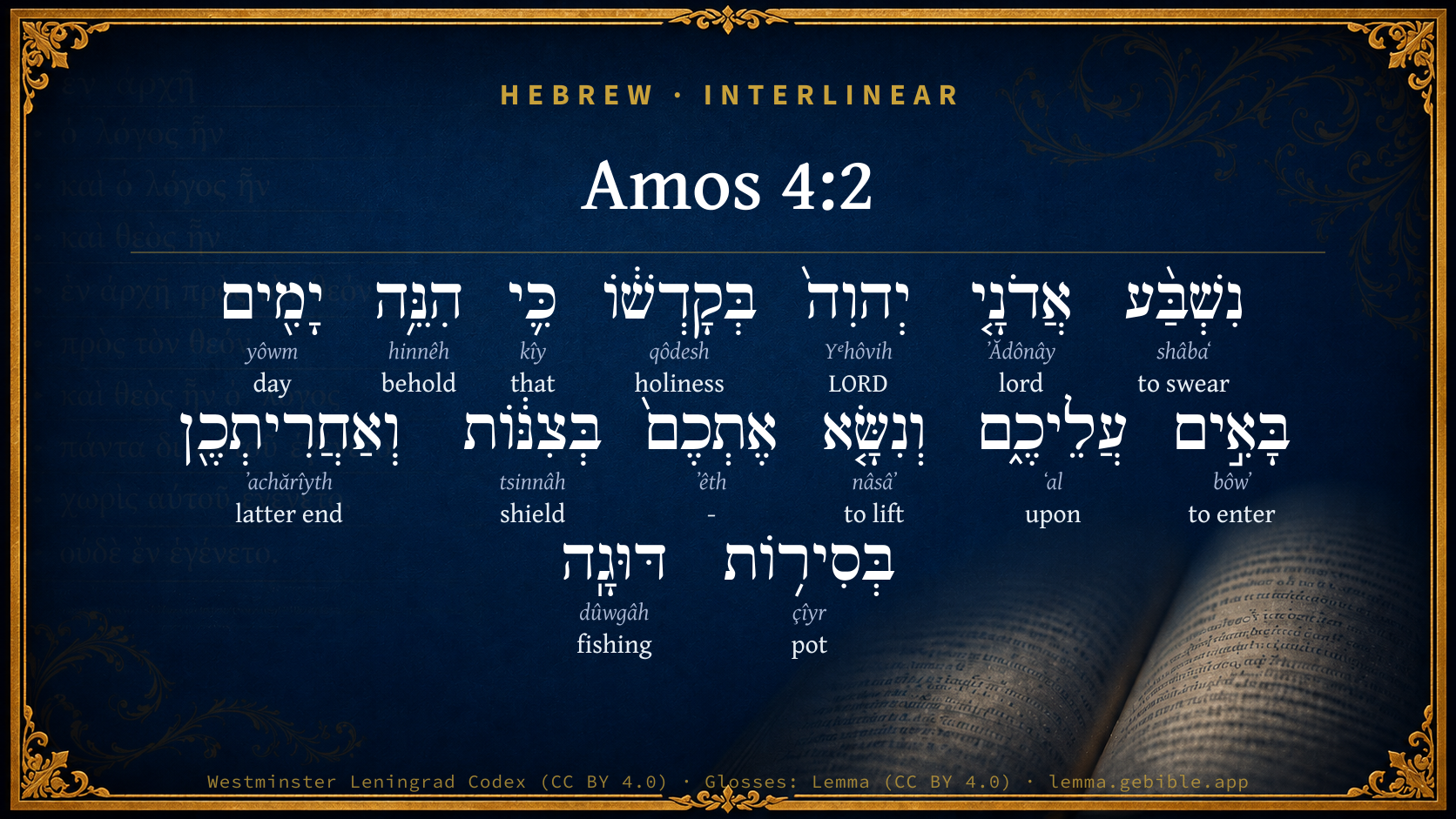
Amos 4:2

Hebrew (Westminster Leningrad Codex) Amos 4:2 appears in the Hebrew Old Testament. The text above is from the Westminster Leningrad Codex. Each word links to its Strong’s number, a concise gloss, and parsing drawn from the Open Scriptures Hebrew Bible morphology. Click any word for its full Brown-Driver-Briggs (BDB) entry.
Download image
Cite this verse

Amos 4:2 (World English Bible). Public Domain. Lemma interlinear Bible study tool, https://lemma.gebible.app/v/amos/4/2.

Show BibTeX & RIS
BibTeX
RIS
English Translation
The Lord Yahweh has sworn by his holiness that behold, "The days shall come on you that they will take you away with hooks, And the last of you with fish hooks.
World English Bible · Public Domain
Highlights
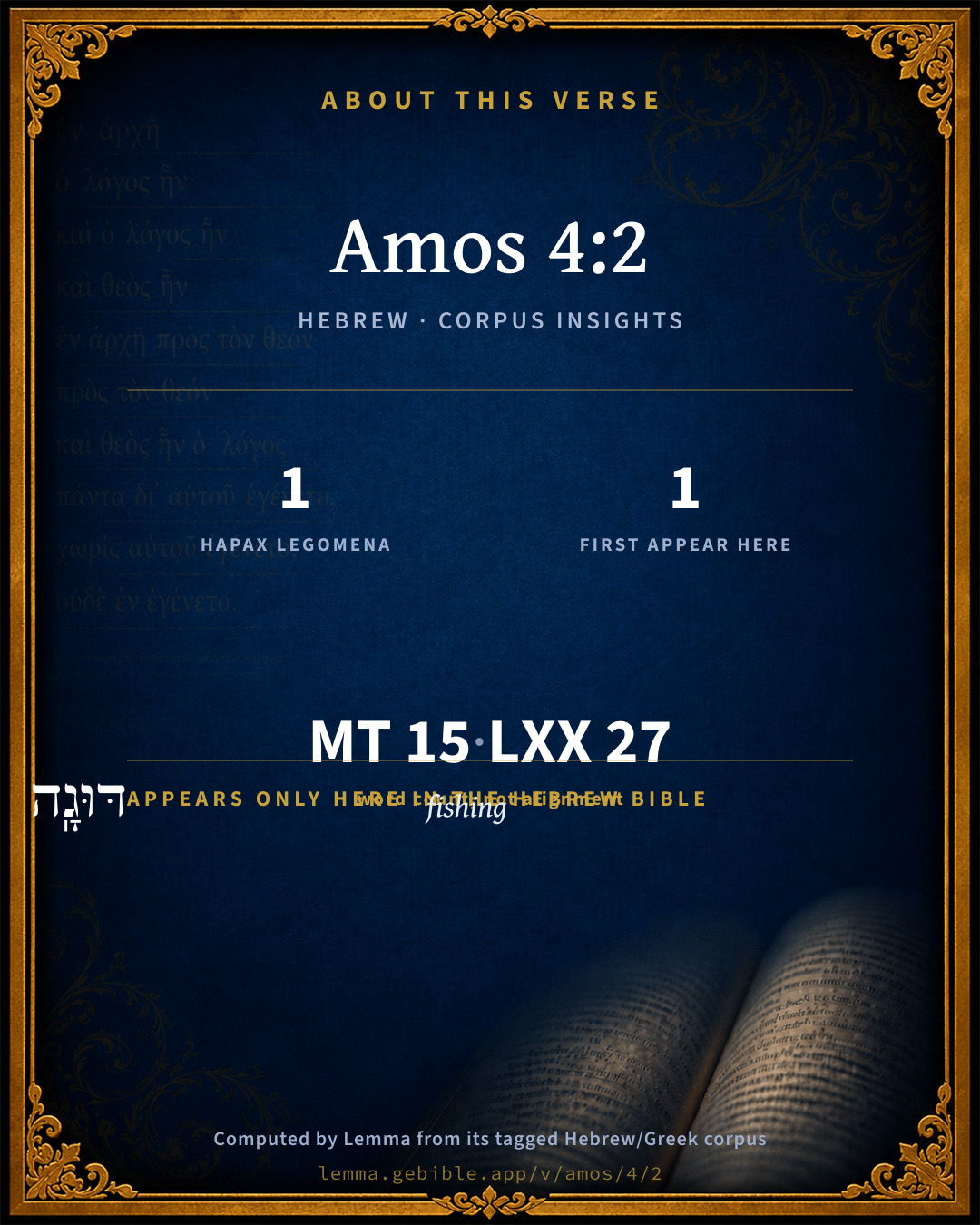
  • 1 hapax legomenon — only here in the Hebrew Bible
  • 1 first appearance in the Hebrew Bible
Full analysis ↓
Download a study sheet

One document with this verse’s original text, its word-by-word gloss line, the meaning frame, cross-references with their text, attributed commentary, and full source and license credits — printable, and it pastes into notes with its structure intact.

This verse Autodidact and up

Study sheet (.html) Plain text (.txt)

A passage Seminary Student

Up to 50 verses in one chapter. A passage sheet keeps up to 6 commentary sources and 12 cross-references per verse, in the order this page ranks them, and says so on the sheet whenever that leaves anything out. Ask for a single verse and you get the Autodidact verse sheet above.

Everything on this page stays free to read, with no account — the sheet is a download of what is already on screen, not access to it.

Want to remove ads? Support Godless Engineer
Compare translations 3

The same verse in 3 English versions, stacked beneath the original-language interlinear above. Click any original word for its lexicon entry.

Each is an independent rendering of the whole verse — the interlinear is not word-aligned to these translations.

Highlighted words mark where these versions differ — a whole-verse word diff, not a word-by-word alignment.

  • World English Bible Public Domain
    The Lord Yahweh has sworn by his holiness that behold, "The days shall come on you that they will take you away with hooks, And the last of you with fish hooks.
  • King James Version Public Domain
    The Lord GOD hath sworn by his holiness, that, lo, the days shall come upon you, that he will take you away with hooks, and your posterity with fishhooks.
  • unfoldingWord Literal Text CC BY-SA 4.0
    The Lord Yahweh has sworn by his holiness saying, “Behold, the days will come on you when they will take you away with hooks, the last of you with fishhooks.

unfoldingWord Literal Text — © unfoldingWord, licensed CC BY-SA 4.0. Word-aligned USFM3 via Door43 (git.door43.org/unfoldingWord/en_ult).

Versions to compare (up to 4)

3 of 4 selected

Show all 18 translations

Every available English version of this verse, each an independent rendering of the whole verse.

  • World English Bible Public Domain
    The Lord Yahweh has sworn by his holiness that behold, "The days shall come on you that they will take you away with hooks, And the last of you with fish hooks.
  • Berean Standard Bible Public Domain
    The Lord GOD has sworn by His holiness: “Behold, the days are coming when you will be taken away with hooks, and your posterity with fishhooks.
  • Majority Standard Bible Public Domain
    The Lord GOD has sworn by His holiness: “Behold, the days are coming when you will be taken away with hooks, and your posterity with fishhooks.
  • King James Version Public Domain
    The Lord GOD hath sworn by his holiness, that, lo, the days shall come upon you, that he will take you away with hooks, and your posterity with fishhooks.
  • American Standard Version (1901) Public Domain
    The Lord Jehovah hath sworn by his holiness, that, lo, the days shall come upon you, that they shall take you away with hooks, and your residue with fish-hooks.
  • Revised Version (1885) Public Domain
    The Lord GOD hath sworn by his holiness, that, lo, the days shall come upon you, that they shall take you away with hooks, and your residue with fish hooks.
  • Geneva Bible (1599) Public Domain
    The Lord God hath sworne by his holines, that loe, the dayes shall come vpon you, that hee wil take you away with thornes, and your posteritie with fish hookes.
  • Douay-Rheims (1899) Public Domain
    The Lord God hath sworn by his holiness, that lo, the days shall come upon you, when they shall lift you up on pikes, and what shall remain of you in boiling pots.
  • Young's Literal Translation Public Domain
    Sworn hath the Lord Jehovah by His holiness, That lo, days are coming upon you, And he hath taken you away with hooks, And your posterity with fish-hooks.
  • Literal Standard Version CC BY-SA 4.0
    Lord YHWH has sworn by His holiness, || “Behold, days are coming on you, || And He has taken you away with hooks, || And your posterity with fish-hooks.
  • Unlocked Literal Bible CC BY-SA 4.0
    The Lord Yahweh has sworn by his holiness, “Look, the days will come on you when they will take you away with hooks, the last of you with fishhooks.
  • unfoldingWord Literal Text CC BY-SA 4.0
    The Lord Yahweh has sworn by his holiness saying, “Behold, the days will come on you when they will take you away with hooks, the last of you with fishhooks.
  • Darby Bible Public Domain
    the Lord Jehovah hath sworn by his holiness, that behold, days shall come upon you, when he will take you away with hooks, and your posterity with fish-hooks;
  • World Messianic Bible Public Domain
    The Lord GOD has sworn by his holiness, “Behold, the days shall come on you that they will take you away with hooks, and the last of you with fish hooks.
  • Webster's Bible Public Domain
    The Lord GOD hath sworn by his holiness, that lo, the days shall come upon you, that he will take you away with hooks, and your posterity with fish-hooks,
  • Free Bible Version CC BY-SA 4.0
    The Lord God has sworn by his holiness: Watch out! For the time is coming when they will drag you away with hooks, each one of you will be like a fish on a hook.
  • Bible in Basic English Public Domain
    The Lord God has taken an oath by his holy name, that the days are coming when they will take you away with hooks, and the rest of you with fish-hooks.
  • JPS Tanakh (1917) Public Domain
    The Lord GOD hath sworn by His holiness: Lo, surely the days shall come upon you, that ye shall be taken away with hooks, and your residue with fish-hooks.

Literal Standard Version (2020), Covenant Press — licensed CC BY-SA 4.0. Text via the HelloAO Bible API (eBible.org). Unlocked Literal Bible (unfoldingWord) — licensed CC BY-SA 4.0. Text via the HelloAO Bible API (eBible.org). unfoldingWord Literal Text — © unfoldingWord, licensed CC BY-SA 4.0. Word-aligned USFM3 via Door43 (git.door43.org/unfoldingWord/en_ult). Free Bible Version, Dr. Jonathan Gallagher — licensed CC BY-SA 4.0. Text via the HelloAO Bible API (eBible.org).

Word by word

More ways to search: Search by grammar → Find every occurrence → Compare this word →

Practice this passage: Drill this verse → Learn its vocabulary →

דּוּגָֽה
dûwgâh
H1729
“fishing”
Noun, Common, Feminine, Singular, Absolute
Part of Speech
Noun
Type
Common
Gender
Feminine
Number
Singular
State
Absolute
Full BDB Definition

Origin: from the same as H1728

TWOT: 401e

fishing, fishery
  1. נִשְׁבַּ֨ע shâbaʻ H7650 “to swear” Verb, Niphal, Perfect, 3rd Person, Masculine, Singular
  2. אֲדֹנָ֤י ʼĂdônây H136 “Lord · my” Noun, Common, Masculine, Plural, Construct + Suffix, Personal, 1st Person, Common, Singular
  3. יְהוִה֙ Yᵉhôvih H3069 “LORD” Noun, Proper
  4. בְּקָדְשׁ֔וֹ qôdesh H6944 “in/at · holiness · his” Preposition + Noun, Common, Masculine, Singular, Construct + Suffix, Personal, 3rd Person, Masculine, Singular
  5. כִּ֛י kîy H3588 “that” Conjunction
  6. הִנֵּ֥ה hinnêh H2009 “behold” Particle, Demonstrative
  7. יָמִ֖ים yôwm H3117 “days” Noun, Common, Masculine, Plural, Absolute
  8. בָּאִ֣ים bôwʼ H935 “entering” Verb, Qal, Participle Active, Masculine, Plural, Absolute
  9. עֲלֵיכֶ֑ם ʻal H5921 “upon · you” Preposition + Suffix, Personal, 2nd Person, Masculine, Plural
  10. וְנִשָּׂ֤א nâsâʼ H5375 “and · to lift” Conjunction + Verb, Piel, Sequential Perfect, 3rd Person, Masculine, Singular
  11. אֶתְכֶם֙ ʼêth H853 “- · you” Particle, Direct Object + Suffix, Personal, 2nd Person, Masculine, Plural
  12. בְּצִנּ֔וֹת tsinnâh H6793 “in/at · shields” Preposition + Noun, Common, Masculine, Plural, Absolute
  13. וְאַחֲרִיתְכֶ֖ן ʼachărîyth H319 “and · latter end · your” Conjunction + Noun, Common, Feminine, Singular, Construct + Suffix, Personal, 2nd Person, Feminine, Plural
  14. בְּסִיר֥וֹת çîyr H5518 “in/at · pots of” Preposition + Noun, Common, Feminine, Plural, Construct

About this verse

These counts appear in no published source. They are computed here, from the morphology-tagged text and Lemma’s own curated glosses. What Lemma adds →

15
words
15
distinct lemmas
Prophets
section

Notable vocabulary

1 hapax legomenon — a word that appears only here in the entire Hebrew Bible:

  • דּוּגָֽה fishing H1729

First appearance in Scripture

This word makes its first canonical appearance in the Hebrew Bible here:

  • דּוּגָֽה fishing H1729

Shared distinctive vocabulary

בְּצִנּ֔וֹת shield H6793 occurs in 20 verses of the Hebrew Bible. Also found in:

Grammatical profile

  • 3 verbs
  • 8 nouns
  • 1 preposition
  • 1 conjunction
  • 2 particles

Verb forms

  • נִשְׁבַּ֨ע Niphal · Perfect
  • בָּאִ֣ים Qal · Participle Active
  • וְנִשָּׂ֤א Piel · Sequential Perfect

Hebrew & Septuagint length

In English translation the verse runs 32 words from the Hebrew and 31 from the Septuagint (LXX English) — closely comparable.

A rough comparison of the two English renderings, which tokenize alike — not a word-level alignment.

Word counts can differ between the Hebrew and the Greek without any difference in meaning — e.g. the Hebrew direct-object marker אֵת has no separate Greek word, and Greek often adds the article ὁ.

In the original languages it is 15 Hebrew tokens and 27 Greek tokens — but the two are counted differently (Hebrew bundles its prefixes and suffixes into one token; the Greek is in lemma form), so that isn’t a like-for-like length.

Cross-references

6

Topical passages linked to Amos 4:2 in the Treasury of Scripture Knowledge — connected by theme and wording, ordered by reader-vote popularity; previews shown in the World English Bible.

  • Jeremiah 16:16 Behold, I will send for many fishermen, says Yahweh, and they shall fish them up; and afterward I will send for many hunters, and they shall hunt them from every mountain, and from every hill, and out of the clefts of the rocks.
  • Psalms 89:35 Once have I sworn by my holiness, I will not lie to David.
  • Habakkuk 1:15–16 He takes up all of them with the hook. He catches them in his net, and gathers them in his dragnet. Therefore he rejoices and is glad.
  • Isaiah 37:29 Because of your raging against me, and because your arrogance is come up into my ears, therefore will I put my hook in your nose, and my bridle in your lips, and I will turn you back by the way by which you came.
  • Amos 6:8 "The Lord Yahweh has sworn by himself," says Yahweh, the God of hosts: "I abhor the pride of Jacob, And detest his fortresses. Therefore I will deliver up the city with all that is in it.
  • Ezekiel 39:4–5 You shall fall on the mountains of Israel, you, and all your hordes, and the peoples who are with you: I will give you to the ravenous birds of every sort, and to the animals of the field to be devoured.

Cross-references courtesy of OpenBible.info (CC BY 4.0).

Hebrew and Greek witnesses Masoretic Hebrew ↔ Greek Septuagint

The same verse in the two great witnesses to the Old Testament, shown verse-for-verse.

These are two independent witnesses, not word-aligned to each other, and the Septuagint is shown in lemma (dictionary) form.

Hebrew Amos 4:2 Masoretic · Westminster Leningrad Codex

נִשְׁבַּ֨ע אֲדֹנָ֤י יְהוִה֙ בְּקָדְשׁ֔וֹ כִּ֛י הִנֵּ֥ה יָמִ֖ים בָּאִ֣ים עֲלֵיכֶ֑ם וְנִשָּׂ֤א אֶתְכֶם֙ בְּצִנּ֔וֹת וְאַחֲרִיתְכֶ֖ן בְּסִיר֥וֹת דּוּגָֽה

The Lord Yahweh has sworn by his holiness that behold, "The days shall come on you that they will take you away with hooks, And the last of you with fish hooks.

World English Bible · Public Domain

Greek LXX Amos 4:2 Septuagint · lemma form

ὄμνυμι κύριος κατά ὁ ἅγιος αὐτός διότι ἰδού ἡμέρα ἔρχομαι ἐπί σύ καί λαμβάνω σύ ἐν ὅπλον καί ὁ μετά σύ εἰς λέβης ὑποκαίω ἐνβάλλω ἔμπυρος λοιμός

The Lord swears by his holiness, that, behold, the days come upon you, when they shall take you with weapons, and fiery destroyers shall cast those with you into boiling caldrons.

LXX2012 (modern English Septuagint) · Public Domain

On this verse, The Pulpit Commentary discusses the Septuagint’s reading. Read the note in Commentary ↓

Hebrew: Westminster Leningrad Codex (CC BY 4.0). Greek: Septuagint (public domain); English from LXX2012 (modern English Septuagint) (Public Domain). How the Septuagint differs from the Hebrew →

Targum (Aramaic paraphrase)

1

The Targum is the ancient Jewish Aramaic paraphrase of the Hebrew Scriptures — an interpretive translation, not the Hebrew text itself. Onkelos (literal) and Pseudo-Jonathan (expansive) render the Torah, and Jonathan the Prophets. Coverage is partial: where no permissively-licensed English translation exists for a verse, only the Aramaic is shown. This is verse-level text, not a word-by-word alignment to the Hebrew.

  1. Targum Jonathan Prophets (Joshua–Malachi)
    קַיָם יְיָ אֱלֹהִים בְּמֵימְרֵיהּ בְּקוּדְשֵׁיה אֲרֵי הָא יוֹמַיָא אֶתָן עֲלֵיכוֹן וְיִטְלוּן יַתְכוֹן עַמְמַיָא עַל תְּרֵיסְהוּן וּבְנַתְכוֹן בְּדוּגִית צָיְדִין:

    (no public-domain English translation for this verse)

    Targum Jonathan — Aramaic: “Mikraot Gedolot” (public domain). English: “Sefaria Community Translation” (CC0 1.0 (public-domain dedication)); “London "Chaldee Paraphrase," 1871” (public domain). Text via Sefaria.

Commentary

Notes on Amos 4:2 from classic Christian and Jewish commentators (each source and its license shown beneath its notes). The classic Christian expositions comment on the surrounding passage and are grouped to its opening verse, so a note may address several verses; the Jewish commentaries on the Tanakh (Rashi and others) are per-verse, so they appear only where the commentator wrote on this verse.

Lemma curates 59 commentaries, every one of them public domain or Creative Commons licensed, each selected and text-cleaned for this edition rather than reprinted as found. About our sources →

Trapp's Complete Commentary

John Trapp

Amo 4:2 The Lord GOD hath sworn by his holiness, that, lo, the days shall come upon you, that he will take you away with hooks, and your posterity with fishhooks.

Ver. 2. The Lord God hath sworn by his holiness] He hath sworn for more assurance, Heb 6:16-18, it being hard to persuade secure sinners of the certainty and infallibility of the threatenings; which yet will as surely befall them without repentance, as the coat is on their back, or the heart in their bodies. And, "by his holiness," he hath sworn; that is, by himself (as having none greater to swear by); confer Gen 22:16 Jer 51:14 Isa 45:23; Isa 62:8, where God swears by his right hand, and by the arm of his strength. Exo 17:16, he is brought in laying his hand upon his throne, and swearing to root out Amalek. And so some in this place think, that by God’s holiness is meant heaven, the habitation of his holiness, and of his glory, Isa 63:15. But Drusius dislikes that, because swearing by heaven is condemned by Christ, Mat 5:34. If God be holiness itself, let him be sanctified in righteousness, Isa 5:16, and let men swear (when called to it, and not till then; the Hebrew word Neshbang here used is passive, and signifieth to be sworn, rather than to swear) "in truth, in judgment, and in righteousness," Jer 4:2.

Behold, the days come] Certo et cito, surely and suddenly: even those dismal days of blackness and darkness, of greatest calamities; see Amo 5:18; Amo 5:20. And let this prediction be to you as the knuckles of a man’s hand, to write you your destiny; or as a prophet, to read it unto you.

That he will take you away] i.e. Ye shall be taken away, and hurried into another country; like as Isa 8:4, He shall take away the spoil of Samaria, i.e. It shall be surely taken away; so Luk 12:20, They do require thy soul (απαιτουσι), that is, it shall be required of thee.

With hooks] Heb. with thorns, which were wont to be used in fishing, till iron hooks were more frequent. See Job 40:24 Eze 29:4; Eze 19:4, They brought him with hooks, that is, with chains, into the land of Egypt. Those that were overcome were wont to be linked and langold together; and so led captive by their conquerors.

And your posterity with fishhooks] Heb. that which is last of you; your children, and nephews, as Dan 11:4. It is foretold of Alexander the Great that none of his race shall succeed him, but strangers. See enemies compared to fishers, Jer 16:16 Hab 1:16; and note, that hereby is intimated, that these insolent dames shall be no more like fat kine, that abide in their pastures; but as fishes hanging on the hook, that are easily pulled up, and quickly carried away with little labour, but much delight to the fisher. See a like comparison from swimming, Isa 25:11, the motion wherein is easy and not strong; to show, that God can subdue his stoutest adversaries with greatest ease.

John Trapp, A Commentary or Exposition upon All the Books of the Old and New Testament (1647–1656) — public domain. Text from a community e-Sword module.

Joseph Benson's Commentary

Amo 4:2. The Lord hath sworn by his holiness — As sure as God is holy and true, so certainly will he bring the threatened judgment upon you; that he will take you away with hooks — “The original word in the masculine is used for thorns; but in the feminine it signifies shields. So that, perhaps, a fishing instrument may be denoted, which, like some now in our use, resembled a shield, or a basket, in its form. Our translators render the word hooks, from their analogy to thorns.” — Newcome. And your posterity — Or remainder; with fish-hooks — Invaders and spoilers are often compared to fishers. The sense here seems to be, that the several invaders of Israel, coming after one another, should make an entire riddance of the whole nation, so that their posterity, or remainder, which had escaped the first invaders, should certainly fall into the hands of those that came after.

Joseph Benson's Commentary on the Old and New Testaments (1811–1818) — public domain. Text from a community e-Sword module.

Whedon's Commentary on the Bible

Daniel D. Whedon

2. This shameful conduct has aroused the anger of Jehovah.

Hath sworn — An anthropomorphism. As a man affirms a statement by an oath and thus makes certain its fulfillment, so Jehovah is represented as having affirmed the sentence of doom by an oath (Amo_6:8; Amo_8:7; compare Gen_15:9-18).

By his holiness — Mitchell renders, “by his sacred, awe-inspiring personality.” Jehovah has pledged his holiness that he will fulfill his threat. The expression is practically equivalent to “by himself” (Amo_6:8). A.B. Davidson says, “The two phrases have virtually the same sense.” “Holy as applied to Jehovah is an expression that in some way describes him as God, either generally or on any particular side of his nature, the manifestation or thought of which impresses men with the sense of his Godhead.” For a discussion of holiness see on Hos_11:9.

That, lo, the days shall come — Better, Lo, the days are about to come (see on Amo_2:13). The conjunction translated “that” serves here to introduce the direct address (G.-K., 157b). He will [“they shall”] — Literally, one shall take you — you shall be taken (G.-K., 144d). The prophet expects the punishment to take the form of an exile (Amo_5:27; Amo_6:7; Amo_7:17).

With hooks — Both words so translated mean primarily thorns; probably the latter served as fishhooks to primitive man. The figure apparently changes in Amo_4:2 to that of catching fish. As fish are taken by fishermen with hooks, so the women are to be carried away by the foreign invader (Hab_1:14). The picture may be based upon the Assyrian custom alluded to also in Isa_37:29; Eze_29:4 (compare Rawlinson, Seven Great Monarchies, i, plate 35). Some, to retain the figure of Amo_4:1, understand it to allude to the putting of hooks into the nostrils of unruly cattle, “but so many should the cattle of Samaria be, that for the last of them fishhooks must be used.” Marti understands both words to designate hooks in general, and he thinks that the prophet has in mind the removal of the carcasses of the fat cattle with hooks put in the nose and the hinder part. Whatever the basis of the picture, the figure is one of absolute helplessness.

Posterity — R.V., “residue.” Posterity cannot be correct, since the prophet looks for the judgment in the immediate future (Amo_7:17); the thought is “every last one of you”; not one shall escape.

In Amo_4:3 the figurative language is abandoned.

Ye shall go out — As captives.

At the breaches — Made by the besiegers.

Every cow at that which is before her — Better, R.V., “every one straight before her,” which some interpret to mean that there will be no need of looking for a gate, since the breaches are so numerous (Jos_6:5; Jos_6:20); others, without turning to the right or to the left; hurriedly they will be driven away “as a herd of cows go one after another through a gap in a fence.”

Ye shall cast them — The context fails to indicate who is addressed. This difficulty was felt by the Revisers, who translate, without warrant in the Hebrew, “ye shall cast yourselves,” and state in the margin, “The text (including the next two words) is obscure.” The difficulty vanishes if one vowel point is altered; then it may be translated “ye shall be cast,” that is, by your captors.

Into the palace — R.V., “into Harmon.” A.V. is incorrect. The word is the name of the city or district to which the women are to be exiled. Concerning the identification of the locality there exists disagreement both among the ancient versions and among modern commentators. A few of the latter consider the case hopeless; many attempt emendations, but none are quite satisfactory. In all probability the text is corrupt. If it is the name of a city or district it must lie “beyond Damascus” (Amo_5:27). The district suggested by three of the ancient versions (Peshitto, Targum, Symmachus), and by Jerome in a note, namely, Armenia, would meet this condition, and this translation might be defended on linguistic grounds without serious difficulties.

Daniel D. Whedon (gen. ed.), Commentary on the Old and New Testaments (1874–1909) — public domain. Text from a community e-Sword module.

Tyndale Open Study Notes

Tyndale Open Resources

4:2 has sworn this by his holiness: Holiness speaks of God as existing outside of and independent of creation; his nature is wholly other than what he has created. The oath is similar to 6:8; 8:7. • hooks: The Assyrians were known for their inhumane treatment of war captives (see 2 Chr 33:11; cp. 2 Kgs 19:28). A stela (stone pillar with an inscription) discovered in northern Syria shows the Assyrian king Esarhaddon holding cords that pass through the lips of two war captives. A recent scholar has suggested that hooks referred to the rings inserted into the noses of cattle to manage them.

Tyndale Open Study Notes — © Tyndale Open Resources, licensed CC BY-SA 4.0. Text via the HelloAO Bible API.

Geneva Bible (1599)

Geneva Bible translators

He alludeth to fishers, which catch fish by hooks and thorns.

Geneva Bible (1599) marginal notes — public domain. Text via Bolls.life.

Jamieson, Fausset & Brown

Robert Jamieson, A. R. Fausset & David Brown

The Lord--the same Hebrew as "masters" (Amo 4:1). Israel's nobles say to their master or lord, Bring us drink: but "the Lord" of him and them "hath sworn," &c.

by his holiness--which binds Him to punish the guilty (Psa 89:35).

he will take yon away--that is God by the instrumentality of the enemy.

with hooks--literally, "thorns" (compare Ch2 33:11). As fish are taken out of the water by hooks, so the Israelites are to be taken out of their cities by the enemy (Eze 29:4; compare Job 41:1-2; Jer 16:16; Hab 1:15). The image is the more appropriate, as anciently captives were led by their conquerors by a hook made to pass through the nose (Kg2 19:28), as is to be seen in the Assyrian remains.

Jamieson, Fausset & Brown — Commentary Critical and Explanatory on the Whole Bible (1871) — public domain (CC PDM 1.0). Text via the HelloAO Bible API.

Adam Clarke's Commentary

Verse 2. He will take you away with hooks] Two modes of fishing are here alluded to:

1. Angling with rod, line, and baited hook.

2. That with the gaff, eel-spear, harpoon, or such like; the first used in catching small fish, by which the common people may be here represented; the second, for catching large fish, such as leave the sea, and come up the rivers to deposit their spawn; or such as are caught in the sea, as sharks, whales, dolphins, and even the hippopotamus, to which the more powerful and opulent inhabitants may be likened.

But as the words in the text are generally feminine, it has been supposed that the prophecy is against the proud, powerful, voluptuous women. I rather think that the prophet speaks catachrestically; and means men of effeminate manners and idle lives. They are not the bulls of Bashan, but the cows; having little of the manly character remaining. Some understand the latter word as meaning a sort of basket or wicker fish-nets.

Adam Clarke's Commentary on the Bible (1810–1826) — public domain. Text from a community e-Sword/MySword module.

John Calvin's Commentaries

Here Amos declares what sort of punishment awaited those fat cattle, who being well fed despised God, and were torpid in their fatness. He therefore says, that the days were nigh, when they should be taken away together with all that they had, and all their posterity, as by a hook of a fisher.

But to give more effect to his combination, he says that God had sworn by his sanctuary. The simple word of God ought indeed to have been sufficient: but as we do not easily embrace the promises of God, so also hypocrites and the reprobate are not easily terrified by his threatening; but they laugh to scorn, or at least regard as empty, what God’s servants declare. It was then necessary that God should interpose this oath, that secure men might be more effectually aroused.

“The Lord then has sworn by his sanctuary”. It is singular that God should swear by his temple rather than by himself: and this seems strange; for the Lord is wont to swear by himself for this reason, — because there is none greater by whom he can swear, as the Apostle says, (Hebrews 6:13.) God then seems to transfer the honor due to himself to stones and wood; which appears by no means consistent. But the name of the temple amounts to the same thing as the name of God. God then says that he had sworn by the sanctuary, because he himself is invisible, and the temple was his ostensible image, by which he exhibited himself as visible: it was also a sign and symbol of religion, where the face of God shone forth. God did not then divest himself of his own glory, that he might adorn with it the temple; but he rather accommodated himself here to the rude state of men; for he could not in himself be known, but in a certain way appeared to them in the temple. Hence he swore by the temple.

But the special reason, which interpreters have not pointed out, ought to be noticed, and that is, that God, by swearing by his sanctuary, repudiated all the fictitious forms of worship in which the Israelites gloried, as we have already seen. The meaning is this, — “God, who is rightly worshipped on mount Zion, and who seeks to be invoked there only, swears by himself; and though holiness dwells in himself alone, he yet sets before you the symbol of his holiness, the sanctuary at Jerusalem: he therefore repudiates all your forms of worship, and regards your temples as stews or brothels.” We hence see that there is included in this expression a contrast between the sanctuary, where the Jews rightly and legitimately worshipped God, and the spurious temples which Jeroboam built, and also the high places where the Israelites imagined that they worshipped him. We now then understand what is meant by the words, that God sware by his sanctuary

And he sware by his sanctuary, that the days would come, yea, were nigh, in which they should be taken away with hooks, or with shields. צנה, tsane, means in Hebrew to be cold: but צנות, tsanut denotes shields in that language, and sometimes fishing-hooks. Some yet think that the instrument by which the flesh is pulled off is intended, as though the Prophet still alluded to his former comparison. But another thing, which is wholly different, seems to be meant here, and that is, that these fat cows would be drawn out as a little fish by a hook; for afterwards he mentions a thorn or a hook again. It is the same as though he had said, “Ye are indeed of great weight, and ye are very heavy through your fatness; but this your grossness will not prevent God from quickly taking you away, as when one draws out a fish by a hook.” We see how well these two different similitudes harmonize: “Ye are now trusting in your own fatness, but God will draw you forth as if ye were of no weight at all: ye shall therefore be dragged away by your enemies, not as fat cows but as small fishes, and a hook will be sufficient, which will draw you away into remote lands.” This change ought to have seriously affected the Israelites, when they understood that they would be stripped of their fatness and wealth, and then taken away as though they were small fishes, that a hook was enough, and that there would be no need of large wagons. It follows —

John Calvin's Commentaries (1540-1563) — public domain. Text from the Calvin Translation Society English edition (1840s-50s) via the Christian Classics Ethereal Library (ccel.org). Calvin's coverage is partial (roughly two-thirds of the Bible); uncommented books and verses are honest gaps, never fabricated. The 19th-century editor's footnotes and remarks are omitted so the notes are faithfully Calvin's own voice.

Ellicott's Commentary for English Readers

(2) Fishhooks.—Descriptive of the suddenness and irresistible character of the seizure, whereby, as a punishment for their wanton selfishness, the nobles were to be carried away as captives from their condition of fancied security. The strangeness of the imagery has led to a variety of interpretations. Döderlein translates “ye shall be driven into thorny districts, and among thorn bushes.”

A Bible Commentary for English Readers, edited by Charles John Ellicott (1878–1897) — public domain. Text from a community e-Sword module.

The Cambridge Bible for Schools and Colleges

gen. ed. J. J. S. Perowne

2. Jehovah’s indignation is aroused; and He swears (cf. Amo_6:8, Amo_8:7), that retribution will overtake them for such selfishness and cruelty.

hath sworn by his holiness] God’s holiness is made the pledge of the validity of the oath: so Psa_89:35; cf. Jer_44:26.

behold, days are coming &c.] The expression implies a sudden and unexpected reversal of what at present prevails: it occurs besides, Amo_8:11, Amo_9:13; 1Sa_2:31; 2Ki_20:17 (= Isa_39:6), and fifteen times in Jeremiah (Jer_7:32; Jer_9:24; Jer_16:14; Jer_19:6; Jer_23:5; Jer_23:7; Jer_30:3, &c.).

he will take you away with hooks &c.] rather, ye shall be taken &c. The image is one partly of ignominy, partly of helplessness. The women of Samaria are no longer like fat cattle, proudly disdainful of all who may approach them: they are dragged violently by the foe out of the ease and luxury of their palaces, like fishes out of their native element, the water.

your posterity] your residue (R.V.),—any of you who happen to escape the ‘hooks’ of the preceding clause. It is a total destruction which the prophet contemplates.

The Cambridge Bible for Schools and Colleges (gen. ed. J. J. S. Perowne; Cambridge University Press, 1878–1918) — public domain. Text from a community e-Sword module.

John Gill's Exposition

The Lord God hath sworn by his holiness,.... That is, by himself, holiness being his nature, and an essential attribute of his; this is done to ascertain the truth of what is after said, and that men may be assured of the certain performance of it. Some render it, "by his holy place"; and interpret it of heaven; so Aben Ezra and Kimchi; which is not likely; see Mat 5:34. The Targum is,

"the Lord God hath sworn by his word in his holiness;''

that, lo, the days shall come upon you; speedily, swiftly, and at an unawares:

that he will take you away with hooks, and your posterity with fish hooks; the enemy, the king of Assyria, or God by him, would take them out of their own land, as fish out of water, out of their own element, and carry them captive into a strange land, both them and their posterity; and which should be as easily done as fish are taken with the hook, even though they were as the kine of Bashan. The word for fish hooks signifies "thorns" (p), and is by some so rendered; these perhaps being used in angling, before iron hooks were invented. The Targum is,

"that people shall take you away on their shields, and your daughters in fishermen's (q) boats;''

see Jer 16:16.

(p) "spinis", Mercerus, Liveleus, Drusius, Grotius. (q) So it is interpreted by R. Sol Urbin Ohel Moed, fol. 65. 2. likewise Elias says the word signifies a small ship, or a boat that is in a large ship, Tishbi, p. 59. So Vatablus interprets it, "scaphas piscatorias, sive cymbas"; and some in Munster.

John Gill's Exposition of the Whole Bible (1746–1763) — public domain (CC PDM 1.0). Text via the HelloAO Bible API.

Albert Barnes' Notes on the Bible

The Lord God hath sworn by His holiness - They had sinned to profane His “Holy Name” (see the note at Amo 2:7). God swears by that holiness which they had profaned in themselves on whom it was called, and which they had caused to be profaned by others. He pledges His own holiness, that He will avenge their unholiness. : “In swearing “by His holiness,” God sware by Himself. For He is the supreme uncreated justice and Holiness. This justice each, in his degree, should imitate and maintain on earth, and these had sacrilegiously violated and overthrown.”

Days shall come (literally, are among) upon you - God’s Day and eternity are ever coming. He reminds them of their continual approach. He says not only that they will certainly come, but they are ever coming. They are holding on their steady course. Each day which passes, they advance a day closer upon the sinner. People put out of their minds what “will come;” they “put far the evil day.” Therefore, God so often in His notices of woe to come, (1Sa 2:31; Isa 39:6; Jer 7:32; Jer 9:25; Jer 17:14; Jer 19:6; Jer 23:5, Jer 23:7; Jer 30:3; Jer 31:27-31, Jer 31:38; Jer 33:14; Jer 48:12; Jer 49:2; Jer 51:47, Jer 51:52. (Ges.); Amo 8:11), brings to mind, that those “days are” ever “coming” ; they are not a thing which shall be only; in God’s purpose, they already “are;” and with one uniform steady noiseless tread “are coming upon” the sinner. Those “days shall come upon you,” heavily charged with the displeasure of God, crushing you, as ye have crushed the poor. They come doubtless, too, unexpectedly upon them, as our Lords says, “and so that day come upon you unwares.”

He (that is one) will take you away - In the midst of their security, they should on a sudden be taken away violently from the abode of their luxury, as the fish, when hooked, is lifted out of the water. The image pictures (see Hab 1:15; Eze 29:4-5,) their utter helplessness, the contempt in which they would be had, the ease with which they would be lifted out of the flood of pleasures in which they had immersed themselves. People can be reckless, at last, about themselves, so that their posterity escape, and they themselves survive in their offspring. Amos foretells, then, that these also should be swept away.

Albert Barnes' Notes on the Bible (1834–1885) — public domain. Text from a community e-Sword/MySword module.

Haydock's Catholic Bible Commentary

Holiness. He has none but himself to swear by, Hebrews vi. 13. His word is infallible; but he condescends to use an oath to make a deeper impression on man. --- Pikes; spits, or large shields. Hebrew also, "They will lead you away with hooks, (in the nose, Isaias xxxvii. 29.) and your children with fish-hooks," or pots. You shall be treated like victims, being either roasted or boiled. No part shall be left.

George Leo Haydock (1774–1849), Haydock's Catholic Family Bible and Commentary, 1859 edition — public domain. Excludes Psalms (Douay-Rheims chapter numbering differs from Protestant) and Deuterocanonical books (Catholic canon only).

Matthew Poole's English Annotations

I have often told you that God had spoken, now I assure you that the mighty and eternal God hath sworn the thing, and you must therefore needs conclude it sure and certain.

He hath sworn by his holiness, by himself, as he is the holy God, and cannot lie: see Psa 89:35.

The days of darkness, slaughter, famine, desolation, and captivity, threatened against you, shall come upon you, oppressors that crush the poor.

He will take; God by the Assyrian army under Shalmaneser, nay, before that time you shall be taken, as fish are taken with the hook, during the intestine wars that are coming upon you.

You, who now live, and hear the word of Amos and Hoses, but notwithstanding do continue to act the same violence still.

With hooks, or thorns, as the Hebrew, with which they did pierce the greater fish, before they had the skill of making iron darts, as some observe.

Your posterity; the children of these oppressors.

With fish-hooks; shall be taken as silly fish, and as easily carried away; the enemy shall with delight insnare and destroy them.

Matthew Poole's English Annotations on the Holy Bible (1683–1685) — public domain. Text from a community e-Sword/MySword module.

The Pulpit Commentary

By his holiness. God swears by his holiness, which cannot tolerate iniquity, and which they had profaned. (Amo_2:7; comp. Amo_6:8) That he will take you away. "That one, or they, shall take you away;" the enemy, the instrument of God"s vengeance, is meant. With hooks; tsinnoth; Septuagint, ejn oploiv: Vulgate, in contis. The translation, "with hooks," is correct, the idea being that the people shall be utterly helpless and taken for destruction, like fish caught with hooks (Jer_16:16; Hab_1:15) Your posterity; acharith; (Amo_9:1) better, your residue, those who have not been destroyed previously. The Septuagint and the Vulgate give quite a different notion to the passage. The former (according to the Vatican manuscript) has, Kai toubhtav uJpokaiomenouv ejmbalousin empuroi loimoi, "And fiery destroyers shall cast those with you into boiling caldrons;" the latter, Et levabunt vos in contis, et reliquias vestras in ollis ferventibus. (For the explanation of these versions, which arise from mistakes in the meanings of ambiguous words, see Schegg and Kuabenbauer.)

The Pulpit Commentary (1880–1919), ed. H.D.M. Spence-Jones & Joseph S. Exell — public domain. Text from a community e-Sword module.

John Wesley's Explanatory Notes

By his holiness - By himself as he is the holy God. The days - Of famine, desolation and captivity. He - God by the Assyrian army will take you, as fish are taken with the hook. Your posterity - The children of these oppressors.

John Wesley, Explanatory Notes Upon the Whole Bible (1754–1765) — public domain. Text via the GEBible commentary corpus.

Rashi

Rabbi Shlomo Yitzchaki (Rashi)

and you shall be borne on shields Heb. בְּצִנּוֹת. And the nations shall bear you on their shields.

and your posterity in fishing boats Heb. בְּסִירוֹת דּוּגָה. [Jonathan renders:] And your daughters in fishermen’s boats. That is a small boat used by fishermen, and, since it is small, he calls it סִיר, a pot, and in Mishnaic Hebrew, it is called דּוּגִית in Baba Bathra 73a. your posterity Heb. וְאַחֲרִיתְכֶן, lit., your end. Dunash ben Livrat (Teshuvoth p. 50): We find a person’s descendants called ‘his end.’ Cf. (Daniel 11:4) “And when he stands up, his kingdom shall be broken, and it shall be divided to the four winds of the heaven, and not to his posterity (לְאַחֲרִיתוֹ).” I.e, he will not leave over his kingdom to his son.

Rashi on the Tanakh — English translations: “The Judaica Press complete Tanach with Rashi, translated by A. J. Rosenberg” (CC BY 4.0); “Pentateuch with Rashi's commentary by M. Rosenbaum and A.M. Silbermann, 1929-1934” (public domain); “The Metsudah Tanach series, Lakewood, N.J” (CC BY 4.0); and “The Book of Joshua, Metsudah Publications, 1997” (CC BY 4.0). Text via Sefaria.

Lesson kit

Teaching starters — assembled from the data on this page, not authored interpretation. Every prompt links to the verse data it draws on. Edit before teaching.

Amos, in the Prophets, opens this verse with 15 words (15 distinct Hebrew lemmas). Its most distinctive word is dûwgâh (“fishing”). A historical commentator’s framing appears above. Read the whole chapter for the surrounding context.

Discussion questions

  1. How does “fishing” (dûwgâh) shape what this verse is saying?
  2. This verse holds 1 word here found nowhere else in the Hebrew Bible. What might the rare word draw attention to?
  3. The word “fishing” first appears here in Scripture. What is being introduced at this debut?
  4. 1 Samuel 17:7 shares the word «shield» with this verse. How do the two illuminate each other?
  5. These translations render this verse differently. What is at stake in choosing one wording over another?
  6. The verb «נִשְׁבַּ֨ע» is Niphal Perfect. How does its form color the action?
  7. Reading how Trapp's Complete Commentary and Joseph Benson's Commentary read this verse, where do the two commentators agree and where do they part?

Things to notice

Reading settings

Reading text

Shown beneath each verse's original-language words.

Old Testament
Old Testament edition

Read the OT as the Masoretic Hebrew (MT) or the Greek Septuagint (LXX).

English shown for the Greek Septuagint (in the Hebrew ↔ Greek comparison).

Comparing translations? Open the Compare panel on any verse page to stack up to four side by side.