
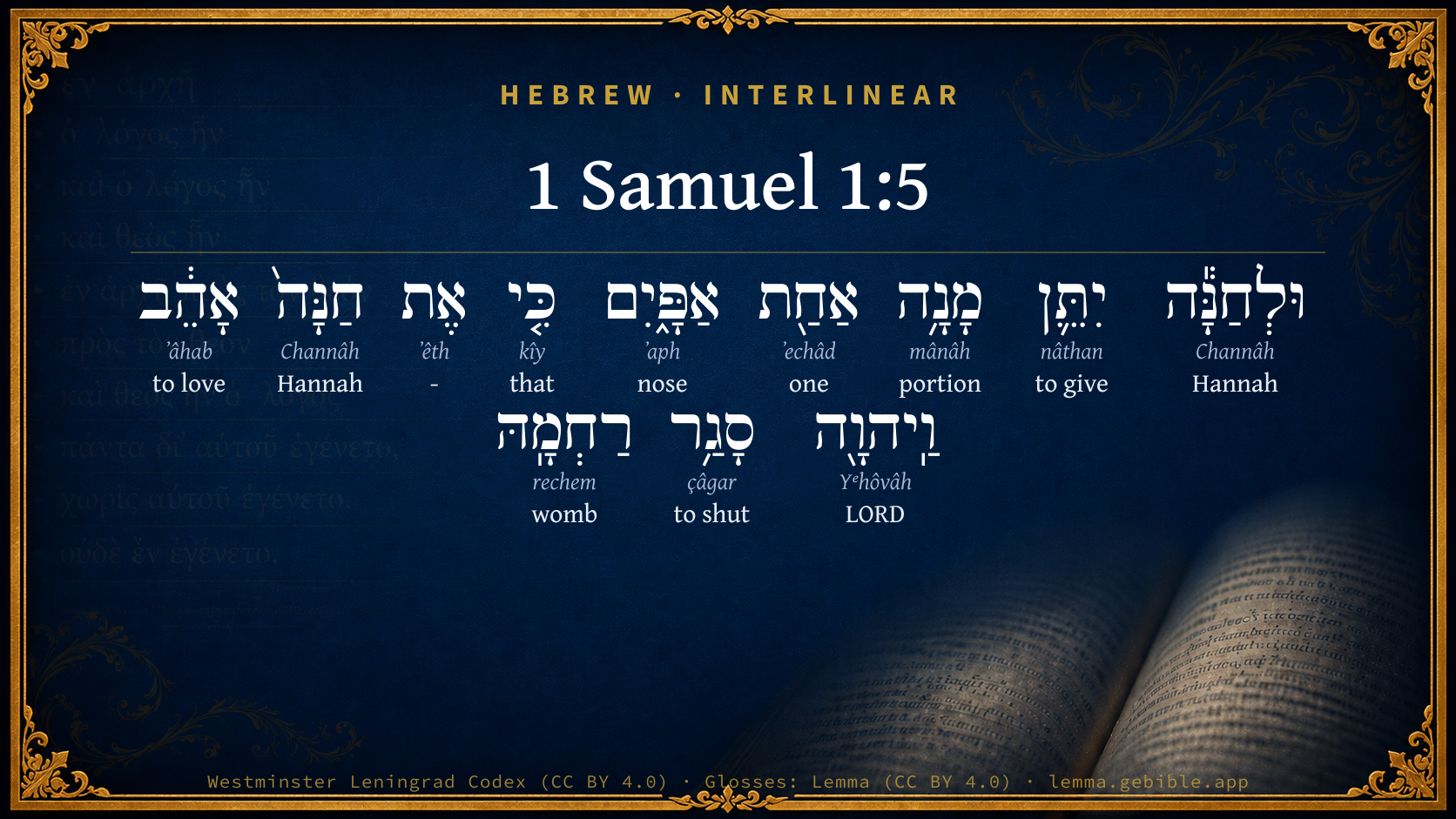
1 Samuel 1:5

Hebrew (Westminster Leningrad Codex) 1 Samuel 1:5 appears in the Hebrew Old Testament. The text above is from the Westminster Leningrad Codex. Each word links to its Strong’s number, a concise gloss, and parsing drawn from the Open Scriptures Hebrew Bible morphology. Click any word for its full Brown-Driver-Briggs (BDB) entry.
Download image
Cite this verse

1 Samuel 1:5 (World English Bible). Public Domain. Lemma interlinear Bible study tool, https://lemma.gebible.app/v/1-samuel/1/5.

Show BibTeX & RIS
BibTeX
RIS
English Translation
but to Hannah he gave a double portion; for he loved Hannah, but Yahweh had shut up her womb.
World English Bible · Public Domain
Download a study sheet

One document with this verse’s original text, its word-by-word gloss line, the meaning frame, cross-references with their text, attributed commentary, and full source and license credits — printable, and it pastes into notes with its structure intact.

This verse Autodidact and up

Study sheet (.html) Plain text (.txt)

A passage Seminary Student

Up to 50 verses in one chapter. A passage sheet keeps up to 6 commentary sources and 12 cross-references per verse, in the order this page ranks them, and says so on the sheet whenever that leaves anything out. Ask for a single verse and you get the Autodidact verse sheet above.

Everything on this page stays free to read, with no account — the sheet is a download of what is already on screen, not access to it.

Want to remove ads? Support Godless Engineer
Compare translations 3

The same verse in 3 English versions, stacked beneath the original-language interlinear above. Click any original word for its lexicon entry.

Each is an independent rendering of the whole verse — the interlinear is not word-aligned to these translations.

Highlighted words mark where these versions differ — a whole-verse word diff, not a word-by-word alignment.

  • World English Bible Public Domain
    but to Hannah he gave a double portion; for he loved Hannah, but Yahweh had shut up her womb.
  • King James Version Public Domain
    But unto Hannah he gave a worthy portion; for he loved Hannah: but the LORD had shut up her womb.
  • unfoldingWord Literal Text CC BY-SA 4.0
    But to Hannah he gave one portion two faces, for he loved Hannah but Yahweh had shut her womb,

unfoldingWord Literal Text — © unfoldingWord, licensed CC BY-SA 4.0. Word-aligned USFM3 via Door43 (git.door43.org/unfoldingWord/en_ult).

Versions to compare (up to 4)

3 of 4 selected

Show all 18 translations

Every available English version of this verse, each an independent rendering of the whole verse.

  • World English Bible Public Domain
    but to Hannah he gave a double portion; for he loved Hannah, but Yahweh had shut up her womb.
  • Berean Standard Bible Public Domain
    But to Hannah he would give a double portion, for he loved her even though the LORD had closed her womb.
  • Majority Standard Bible Public Domain
    But to Hannah he would give a double portion, for he loved her even though the LORD had closed her womb.
  • King James Version Public Domain
    But unto Hannah he gave a worthy portion; for he loved Hannah: but the LORD had shut up her womb.
  • American Standard Version (1901) Public Domain
    but unto Hannah he gave a double portion; for he loved Hannah, but Jehovah had shut up her womb.
  • Revised Version (1885) Public Domain
    but unto Hannah he gave a double portion: for he loved Hannah, but the LORD had shut up her womb.
  • Geneva Bible (1599) Public Domain
    But vnto Hannah he gaue a worthy portion: for he loued Hannah, and the Lord had made her barren.
  • Douay-Rheims (1899) Public Domain
    But to Anna he gave one portion with sorrow, because he loved Anna. And the Lord had shut up her womb.
  • Young's Literal Translation Public Domain
    and to Hannah he giveth a certain portion -- double, for he hath loved Hannah, and Jehovah hath shut her womb;
  • Literal Standard Version CC BY-SA 4.0
    and he gives a certain portion to Hannah—double, for he has loved Hannah, and YHWH has shut her womb;
  • Unlocked Literal Bible CC BY-SA 4.0
    But to Hannah he always gave a double portion, for he loved Hannah, although Yahweh had closed her womb.
  • unfoldingWord Literal Text CC BY-SA 4.0
    But to Hannah he gave one portion two faces, for he loved Hannah but Yahweh had shut her womb,
  • Darby Bible Public Domain
    but to Hannah he used to give a double portion, for he loved Hannah; but Jehovah had shut up her womb.
  • World Messianic Bible Public Domain
    but he gave a double portion to Hannah, for he loved Hannah, but the LORD had shut up her womb.
  • Webster's Bible Public Domain
    But to Hannah he gave a worthy portion; for he loved Hannah; but the LORD had rendered her barren.
  • Free Bible Version CC BY-SA 4.0
    He would give an extra portion to Hannah, to show his love for her even though the Lord hadn't given her any children.
  • Bible in Basic English Public Domain
    But to Hannah he gave one part, though Hannah was very dear to him, but the Lord had not let her have children.
  • JPS Tanakh (1917) Public Domain
    but unto Hannah he gave a double portion; for he loved Hannah, but the LORD had shut up her womb.

Literal Standard Version (2020), Covenant Press — licensed CC BY-SA 4.0. Text via the HelloAO Bible API (eBible.org). Unlocked Literal Bible (unfoldingWord) — licensed CC BY-SA 4.0. Text via the HelloAO Bible API (eBible.org). unfoldingWord Literal Text — © unfoldingWord, licensed CC BY-SA 4.0. Word-aligned USFM3 via Door43 (git.door43.org/unfoldingWord/en_ult). Free Bible Version, Dr. Jonathan Gallagher — licensed CC BY-SA 4.0. Text via the HelloAO Bible API (eBible.org).

Word by word

More ways to search: Search by grammar → Find every occurrence → Compare this word →

Practice this passage: Drill this verse → Learn its vocabulary →

וּלְחַנָּ֕ה
Channâh
H2584
“and · to/for · Hannah”
Conjunction + Preposition + Noun, Proper
Part of Speech
Conjunction + Preposition + Noun
Type
Proper
Full BDB Definition

Origin: from H2603

TWOT: None

Hannah = "grace" - the mother of Samuel, one of the wives of Elkanah
  1. יִתֵּ֛ן nâthan H5414 “to give” Verb, Qal, Imperfect, 3rd Person, Masculine, Singular
  2. מָנָ֥ה mânâh H4490 “portion” Noun, Common, Feminine, Singular, Absolute
  3. אַחַ֖ת ʼechâd H259 “one” Adjective, Cardinal number, Feminine, Singular, Absolute
  4. אַפָּ֑יִם ʼaph H639 “nostrils” Noun, Common, Masculine, Dual, Absolute
  5. כִּ֤י kîy H3588 “that” Conjunction
  6. אֶת ʼêth H853 “-” Particle, Direct Object
  7. חַנָּה֙ Channâh H2584 “Hannah” Noun, Proper
  8. אָהֵ֔ב ʼâhab H157 “to love” Verb, Qal, Perfect, 3rd Person, Masculine, Singular
  9. וַֽיהוָ֖ה Yᵉhôvâh H3068 “and · LORD” Conjunction + Noun, Proper
  10. סָגַ֥ר çâgar H5462 “to shut” Verb, Qal, Perfect, 3rd Person, Masculine, Singular
  11. רַחְמָֽהּ rechem H7358 “womb · her” Noun, Common, Masculine, Singular, Construct + Suffix, Personal, 3rd Person, Feminine, Singular

About this verse

These counts appear in no published source. They are computed here, from the morphology-tagged text and Lemma’s own curated glosses. What Lemma adds →

12
words
11
distinct lemmas
Historical
section

Notable vocabulary

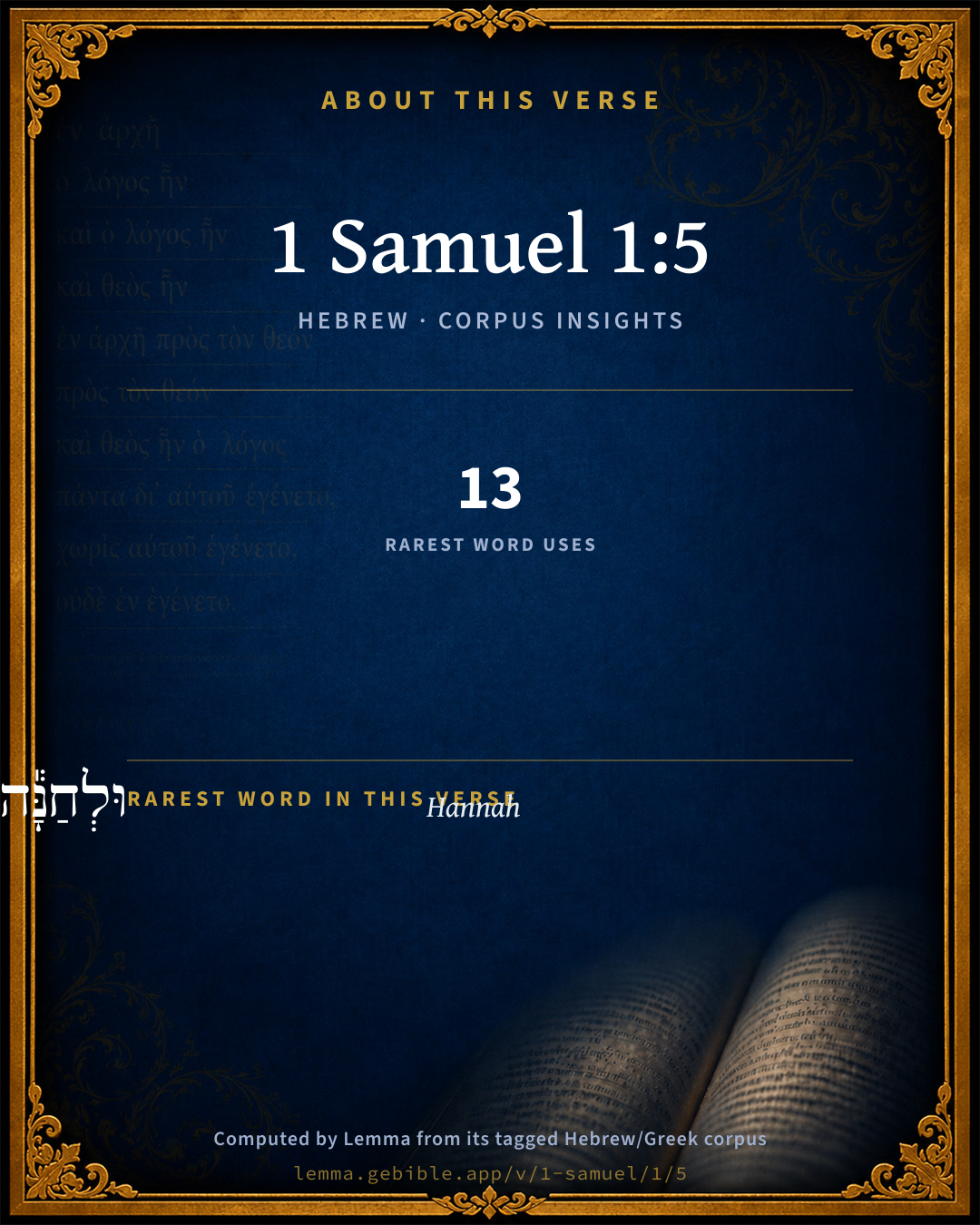
The rarest word here is וּלְחַנָּ֕ה Hannah H2584 — appearing just 13 times in the whole Hebrew Bible.

Shared distinctive vocabulary

וּלְחַנָּ֕ה Hannah H2584 occurs in 11 verses of the Hebrew Bible. Also found in:

Grammatical profile

  • 3 verbs
  • 6 nouns
  • 1 adjective
  • 1 conjunction
  • 1 particle

Verb forms

  • יִתֵּ֛ן Qal · Imperfect
  • אָהֵ֔ב Qal · Perfect
  • סָגַ֥ר Qal · Perfect

Repetition

A word recurs within this verse — often emphatic in Hebrew:

  • וּלְחַנָּ֕ה Hannah H2584 ×2

Hebrew & Septuagint length

In English translation the verse runs 19 words from the Hebrew and 28 from the Septuagint (LXX English) — the Septuagint runs noticeably longer here. See the side-by-side →

A rough comparison of the two English renderings, which tokenize alike — not a word-level alignment.

Word counts can differ between the Hebrew and the Greek without any difference in meaning — e.g. the Hebrew direct-object marker אֵת has no separate Greek word, and Greek often adds the article ὁ.

Cross-references

6

Topical passages linked to 1 Samuel 1:5 in the Treasury of Scripture Knowledge — connected by theme and wording, ordered by reader-vote popularity; previews shown in the World English Bible.

  • Genesis 30:2 Jacob's anger was kindled against Rachel, and he said, "Am I in God's place, who has withheld from you the fruit of the womb?"
  • Genesis 29:30–31 He went in also to Rachel, and he loved also Rachel more than Leah, and served with him yet seven other years.
  • Genesis 16:1 Now Sarai, Abram's wife, bore him no children. She had a handmaid, an Egyptian, whose name was Hagar.
  • Genesis 20:18 For Yahweh had closed up tight all the wombs of the house of Abimelech, because of Sarah, Abraham's wife.
  • Genesis 45:22 To all of them he gave each man changes of clothing, but to Benjamin he gave three hundred pieces of silver and five changes of clothing.
  • Genesis 43:34 He sent portions to them from before him, but Benjamin's portion was five times as much as any of theirs. They drank, and were merry with him.

Cross-references courtesy of OpenBible.info (CC BY 4.0).

Hebrew and Greek witnesses Masoretic Hebrew ↔ Greek Septuagint

The same verse in the two great witnesses to the Old Testament, shown verse-for-verse.

Here the Septuagint runs noticeably longer than the Hebrew — LXX2012 (modern English Septuagint) 28 words vs World English Bible 19. A rough length comparison of the two English translations, not a word-level alignment — read both below.

These are two independent witnesses, not word-aligned to each other, and the Septuagint is shown in lemma (dictionary) form.

Hebrew 1 Samuel 1:5 Masoretic · Westminster Leningrad Codex

וּלְחַנָּ֕ה יִתֵּ֛ן מָנָ֥ה אַחַ֖ת אַפָּ֑יִם כִּ֤י אֶת חַנָּה֙ אָהֵ֔ב וַֽיהוָ֖ה סָגַ֥ר רַחְמָֽהּ

but to Hannah he gave a double portion; for he loved Hannah, but Yahweh had shut up her womb.

World English Bible · Public Domain

Greek LXX 1 Samuel 1:5 Septuagint · lemma form

καί ὁ αννα δίδωμι μερίς εἷς ὅτι οὐ εἰμί αὐτός παιδίον πλήν ὅτι ὁ ανναν ἀγαπάω ελκανα ὑπέρ οὗτος καί κύριος ἀποκλείω ὁ περί ὁ μήτρα αὐτός

And to Anna he gave a prime portion, because she had no child, only Helkana loved Anna more than the other; but the Lord had closed her womb.

LXX2012 (modern English Septuagint) · Public Domain

On this verse, The Pulpit Commentary discusses the Septuagint’s reading. Read the note in Commentary ↓

Hebrew: Westminster Leningrad Codex (CC BY 4.0). Greek: Septuagint (public domain); English from LXX2012 (modern English Septuagint) (Public Domain). How the Septuagint differs from the Hebrew →

Targum (Aramaic paraphrase)

1

The Targum is the ancient Jewish Aramaic paraphrase of the Hebrew Scriptures — an interpretive translation, not the Hebrew text itself. Onkelos (literal) and Pseudo-Jonathan (expansive) render the Torah, and Jonathan the Prophets. Coverage is partial: where no permissively-licensed English translation exists for a verse, only the Aramaic is shown. This is verse-level text, not a word-by-word alignment to the Hebrew.

  1. Targum Jonathan Prophets (Joshua–Malachi)
    וּלְחַנָה יְהַב חוּלַק חָד בְּחִיר אֲרֵי יַת חַנָה רְחִים וּמִן קֳדָם יְיָ אִתְמְנַע מִנָהּ וְלָד:

    (no public-domain English translation for this verse)

    Targum Jonathan — Aramaic: “Mikraot Gedolot” (public domain). English: “Sefaria Community Translation” (CC0 1.0 (public-domain dedication)); “London "Chaldee Paraphrase," 1871” (public domain). Text via Sefaria.

Commentary

Notes on 1 Samuel 1:5 from classic Christian and Jewish commentators (each source and its license shown beneath its notes). The classic Christian expositions comment on the surrounding passage and are grouped to its opening verse, so a note may address several verses; the Jewish commentaries on the Tanakh (Rashi and others) are per-verse, so they appear only where the commentator wrote on this verse.

Lemma curates 59 commentaries, every one of them public domain or Creative Commons licensed, each selected and text-cleaned for this edition rather than reprinted as found. About our sources →

Trapp's Complete Commentary

John Trapp

1Sa 1:5 But unto Hannah he gave a worthy portion; for he loved Hannah: but the LORD had shut up her womb.

Ver. 5. But unto Hannah he gave a worthy portion.] Heb., A gift of the face; partem spectabilem; a choice dainty piece, such as a man might well set before his best guests, as looking better than any of the rest.

For he loved Hannah: but the Lord had shut up her womb.] For an allay to his love: God is wise and jealous. Piscator rendereth it, "He loved Hannah, although the Lord had shut up her womb": that was no stop to his love.

John Trapp, A Commentary or Exposition upon All the Books of the Old and New Testament (1647–1656) — public domain. Text from a community e-Sword module.

Joseph Benson's Commentary

1Sa 1:5-6. Unto Hannah he gave a worthy portion — Or, a double portion; in token of his extraordinary respect and kindness to her. For he loved Hannah: but the Lord — Or, though the Lord, had shut her womb — Her barrenness did not cause him to love her less, but rather more; because he would comfort her under her affliction. To abate our just love to any relations for the sake of any infirmity which they cannot help, is to add affliction to the afflicted. Her adversary also provoked her sore — Peninnah, through envy or jealousy, set herself against her, though so nearly related to her, and strove to vex her by upbraiding her with her barrenness.

Joseph Benson's Commentary on the Old and New Testaments (1811–1818) — public domain. Text from a community e-Sword module.

Geneva Bible (1599)

Geneva Bible translators

Some read, a portion with an hearty cheer.

Geneva Bible (1599) marginal notes — public domain. Text via Bolls.life.

Adam Clarke's Commentary

Verse 5. Unto Hannah he gave a worthy portion] The Hebrew here is very obscure, יתן מנה אחת אפים yitten manah achath appayim; he gave her one portion of two faces; which the Syriac renders, he gave her one DOUBLE PART; and the Chaldee, he gave her one CHOSEN part; the Arabic is nearly the same; the Vulgate Annae autem dedit unam partem tristis, but to Anna he being sorrowful gave one part. As the shew-bread that was presented to the Lord was called לחם פנים lechem panim, the bread of faces, because it was placed before the face or appearances of the Lord; probably this was called מנה אפים manah appayim, because it was the portion that belonged to, or was placed before, the person who had offered the sacrifice. On this ground it might be said that Elkanah gave Hannah his own portion or a part of that which was placed before himself. Whatever it was, it was intended as a proof of his especial love to her; for, it is added, he loved Hannah.

Adam Clarke's Commentary on the Bible (1810–1826) — public domain. Text from a community e-Sword/MySword module.

Ellicott's Commentary for English Readers

(5) A worthy portion.—Literally, one portion for two persons: i.e., a double portion. It was an expression of his deep love for her. As Von Gerlach puts it, “Thou art as dear to me as if thou hadst borne me a child.” Some scholars would translate the difficult Hebrew expression here by, “But to Hannah he gave a portion of anger or sadness,” thus intensifying the natural sorrow of Hannah by representing her husband as unkind. The Vulgate, Luther, and Abarbanel favour this singular interpretation; but the one adopted by the English Version, and explained above, is in all respects grammatically and exegetically to be preferred.

A Bible Commentary for English Readers, edited by Charles John Ellicott (1878–1897) — public domain. Text from a community e-Sword module.

The Cambridge Bible for Schools and Colleges

gen. ed. J. J. S. Perowne

5. a worthy portion] Lit., one portion for two persons: a double portion. If the text is sound, this seems to be the best explanation of an obscure expression. Elkanah marked his love for Hannah by giving her a double portion. Similarly Joseph distinguished Benjamin by sending him a fivefold portion (Gen_43:34). But the Sept. points to a different reading which would give the following sense: “And to Hannah he gave a single portion, because she had no child: nevertheless Elkanah loved Hannah most: but the Lord had shut up her womb.”

had shut up her womb] Hannah’s faith might have been strengthened by the recollection that Sarah (Gen_16:1), Rachel (Gen_30:1), Manoah’s wife (Jdg_13:2), all had to bear the reproach of childlessness for a time, and all eventually bore illustrious sons.

The Cambridge Bible for Schools and Colleges (gen. ed. J. J. S. Perowne; Cambridge University Press, 1878–1918) — public domain. Text from a community e-Sword module.

John Gill's Exposition

But unto Hannah he gave a worthy portion,.... Or, one choice portion, as the Targum; the best part or portion in the peace offering, of what the priest had not; he had the breast and the right shoulder, the next best piece he gave to Hannah; and the word being of the dual number, some render it a double portion; others, "one part of two faces" (h); which Jerom interprets, which might be received with a cheerful countenance, it was so good and excellent in its kind; others interpret it that he gave it with a sorrowful (i) and displeased countenance, because of the reason following, that she had no children; but Ben Gersom understands it of a part or portion of meat that had two faces or appearances; that he gave her one of the pieces, one part of which was very fat, and the other had no fat on it, so that she might choose what she liked best:

for he loved Hannah; loved her best, and therefore did everything to please her, and make her comfortable under her affliction for want of children, and to express his tender affection for her:

but the Lord had shut up her womb; restrained her from conception, and bearing children; see Gen 20:18 or "though the Lord had shut up her womb" (k); this did not abate his love to her.

(h) "unam portionem duarum facicrum", Sanctius Belgae. (i) Sic Stockins, p. 79. (k) "quanquam Jehovah", Piscator.

John Gill's Exposition of the Whole Bible (1746–1763) — public domain (CC PDM 1.0). Text via the HelloAO Bible API.

Albert Barnes' Notes on the Bible

A worthy portion - Probably as in the margin. Naturally she would have had a single portion of the sacrifice (compare 1Sa 9:23), but because of his love to her he gave her a double portion, enough for two people (compare Gen 43:34).

Albert Barnes' Notes on the Bible (1834–1885) — public domain. Text from a community e-Sword/MySword module.

Haydock's Catholic Bible Commentary

With sorrow. Hebrew apayim, "of faces, indignation, (Calmet) sorrow;" (Menochius) or that was presented before him. Chaldean and many others translate, "a chosen:" (Calmet) Protestants, "a worthy portion." (Haydock) --- The shew-bread is called, "the bread of the face," because it stood before the Lord. Joseph sent to each of his brethren, "a portion of his faces," as the Hebrew expresses it; (Genesis xliii. 33.) or of such meat as was placed upon his table. In the East, the master of a family has all set before him, and he sends to each his portion, to the place where he is sitting. (Chardin, Perse.) --- Thus Elcana sent some more excellent, or "double," part to his beloved Anna, (Calmet) grieving inwardly that she had no children, to whom he might also send. (Haydock) --- By this distinction, he wished to alleviate the sorrow of his wife. (Menochius) --- Womb. Sterility was deemed a curse, and a mark of God’s displeasure, with which women were often reproached. Hence Anna prays so earnestly that God would be mindful of her, ver. 11-19. The power of the Almighty, in giving children to the barren, is frequently mentioned, Genesis xxviii. 13., and Psalm cxii. 9. (Calmet) --- Luke i. 25., &c. (Haydock)

George Leo Haydock (1774–1849), Haydock's Catholic Family Bible and Commentary, 1859 edition — public domain. Excludes Psalms (Douay-Rheims chapter numbering differs from Protestant) and Deuterocanonical books (Catholic canon only).

Matthew Poole's English Annotations

A worthy portion, or, an honourable or select part, such as the master of the feast usually gave to the person most respected or beloved. See Gen 43:34; 1Sa 9:23,24.

He loved Hannah, with a singular and eminent love. Compare Gen 29:30.

Matthew Poole's English Annotations on the Holy Bible (1683–1685) — public domain. Text from a community e-Sword/MySword module.

Whedon's Commentary on the Bible

Daniel D. Whedon

5. A worthy portion — Margin, a double portion. Hebrews, מנה אחת אפים, a portion one of two faces. It is difficult to decide the precise meaning. The Vulgate renders: But he, being sorrowful, gave to Hannah one portion; but though אפים sometimes has the sense of anger, it never means sorrow, and the context shows that Hannah was the sorrowful one, not Elkanah. Some have thought that Hannah’s portion was called a portion of faces because of some resemblance to the show-bread, which was called bread of presence, (לחם פנים;) and Clarke suggests that Elkanah gave Hannah his own portion, which might be called a portion of presence from its having been placed before himself as the person who had offered the sacrifice. But such resemblance is far-fetched and inappropriate here. Better, then, to take the word אפים, two faces, by synecdoche, for two persons — a portion one of two persons, that is, two persons’ portion, enough for two. Accordingly, the marginal reading cited above conveys the true sense. He set before Hannah a portion as large as was set before the faces of two other persons.

For he loved Hannah — Had a peculiar affection for her such as he had not for Peninnah, and he showed it as Joseph showed his special affection for Benjamin by sending him a mess five times as great as he set before the other brothers. Gen_43:34.

Daniel D. Whedon (gen. ed.), Commentary on the Old and New Testaments (1874–1909) — public domain. Text from a community e-Sword module.

The Pulpit Commentary

A worthy portion. This rendering is based upon the idea that the Hebrew, which is literally "one portion of two faces," may mean "one portion enough for two persons." But for this there is no sufficient authority, and though the word is a dual, it really signifies the two sides of the face, or more exactly "the two nostrils," and so simply the countenance. The Syriac translation, "a double portion," is based upon an accidental resemblance between the words. As the term sometimes signifies anger from the swelling of the nostrils of an enraged person, the Vulgate translates, "And Elkanah was sad when he gave Hannah her portion; for" The Septuagint has a different reading, epes for apaim, and though the words look different in our writing, they are nearly identical in Hebrew. This is probably the true reading, and the translation would then be, "And to Hannah he gave one portion only (because she bad no child, while Peninnah had many portions, as each son and daughter had a share); for he loved Hannah (and did not leave her without this mark of affection), though Jehovah had shut up her womb. These portions were of course taken from those parts of the victim which formed a feast for the offerers, after Jehovah and the priests had had their dues. It is plain from this feast that Elkanah"s annual sacrifice was a peace offering, for the law of which Lev_7:11-21.

The Pulpit Commentary (1880–1919), ed. H.D.M. Spence-Jones & Joseph S. Exell — public domain. Text from a community e-Sword module.

John Wesley's Explanatory Notes

Shut up her womb - Yet Elkanah did not withdraw his love from her. To abate out just love to any relation, for the sake of any infirmity which they cannot help, is to add affliction to the afflicted.

John Wesley, Explanatory Notes Upon the Whole Bible (1754–1765) — public domain. Text via the GEBible commentary corpus.

unfoldingWord translationNotes

Door43 World Missions Community

Hannah

This is a woman's name. See how you translated this in 1 Samuel 1:2. (See: How to Translate Names)

closed her womb

"made her barren" or "prevented her from becoming pregnant"

Her rival provoked her severely

The other wife would often grieve and shame Hannah.

translationWords

love

womb

unfoldingWord translationNotes — © Distant Shores Media and the Door43 World Missions Community, licensed CC BY-SA 4.0. Source: git.door43.org/Door43/en_tn.

Rashi

Rabbi Shlomo Yitzchaki (Rashi)

One choice portion. One choice portion which is fit to be accepted with a friendly countenance.

Rashi on the Tanakh — English translations: “The Judaica Press complete Tanach with Rashi, translated by A. J. Rosenberg” (CC BY 4.0); “Pentateuch with Rashi's commentary by M. Rosenbaum and A.M. Silbermann, 1929-1934” (public domain); “The Metsudah Tanach series, Lakewood, N.J” (CC BY 4.0); and “The Book of Joshua, Metsudah Publications, 1997” (CC BY 4.0). Text via Sefaria.

Radak

Rabbi David Kimhi (Radak)

But to Hannah he would give (lit., he will give): It is like, he gave - like (other examples of the future tense indicating the past), "Then Yehoshua will build" (Joshua 8:30); "Then Moshe will separate" (Deuteronomy 4:41).

One portion, apayim (face)": One distinguished portion to assuage her rage and her anger. And likewise, "long of face (arekh apayim)," is long to anger. And Yonatan translated it [in the Targum] as, "a choice portion" - meaning to say, a portion fitting to be received with a joyful face. And in the homiletical teachings: What is "face?" For the falling of the face, with a pleasant face. Face corresponding to Peninah and her children. But my master, my father, may his memory be blessed, explained apayim as anger. That is to say, he would give her only one portion in anger, because God, may He be blessed, sealed her womb, and she did not have children for him to give portions to her, like with the children of Peninah. He was angry and sad about this, since he loved Channah and desired to have children from her.

But the Lord had closed her womb: Yonatan translated it [in the Targum] as, "She was prevented from having a child before God. "

Radak on the Tanakh — English translations: “Sefaria Community Translation” (CC0 1.0 (public-domain dedication)); “Eliyahu Munk, HaChut Hameshulash” (CC BY 4.0); “Rabbi Mike Feuer, Jerusalem Anthology” (CC BY 4.0); and “R. David Kimhi on the first book of Psalms, Translated by R.G. Finch, London, 1919” (public domain). Text via Sefaria.

Lesson kit

Teaching starters — assembled from the data on this page, not authored interpretation. Every prompt links to the verse data it draws on. Edit before teaching.

1 Samuel, in the Historical, opens this verse with 12 words (11 distinct Hebrew lemmas). Its most distinctive word is Channâh (“Hannah”). The Greek Septuagint runs longer here. A historical commentator’s framing appears above. Read the whole chapter for the surrounding context.

Discussion questions

  1. How does “Hannah” (Channâh) shape what this verse is saying?
  2. 1 Samuel 1:2 shares the word «Hannah» with this verse. How do the two illuminate each other?
  3. “Hannah” occurs 2× in this one verse. What is the effect of the repetition?
  4. Compared with the Hebrew, the Septuagint runs longer here. What questions does that raise?
  5. These translations render this verse differently. What is at stake in choosing one wording over another?
  6. The verb «יִתֵּ֛ן» is Qal Imperfect. How does its form color the action?
  7. Reading how Trapp's Complete Commentary and Joseph Benson's Commentary read this verse, where do the two commentators agree and where do they part?

Things to notice

Reading settings

Reading text

Shown beneath each verse's original-language words.

Old Testament
Old Testament edition

Read the OT as the Masoretic Hebrew (MT) or the Greek Septuagint (LXX).

English shown for the Greek Septuagint (in the Hebrew ↔ Greek comparison).

Comparing translations? Open the Compare panel on any verse page to stack up to four side by side.