
Psalms 39:9

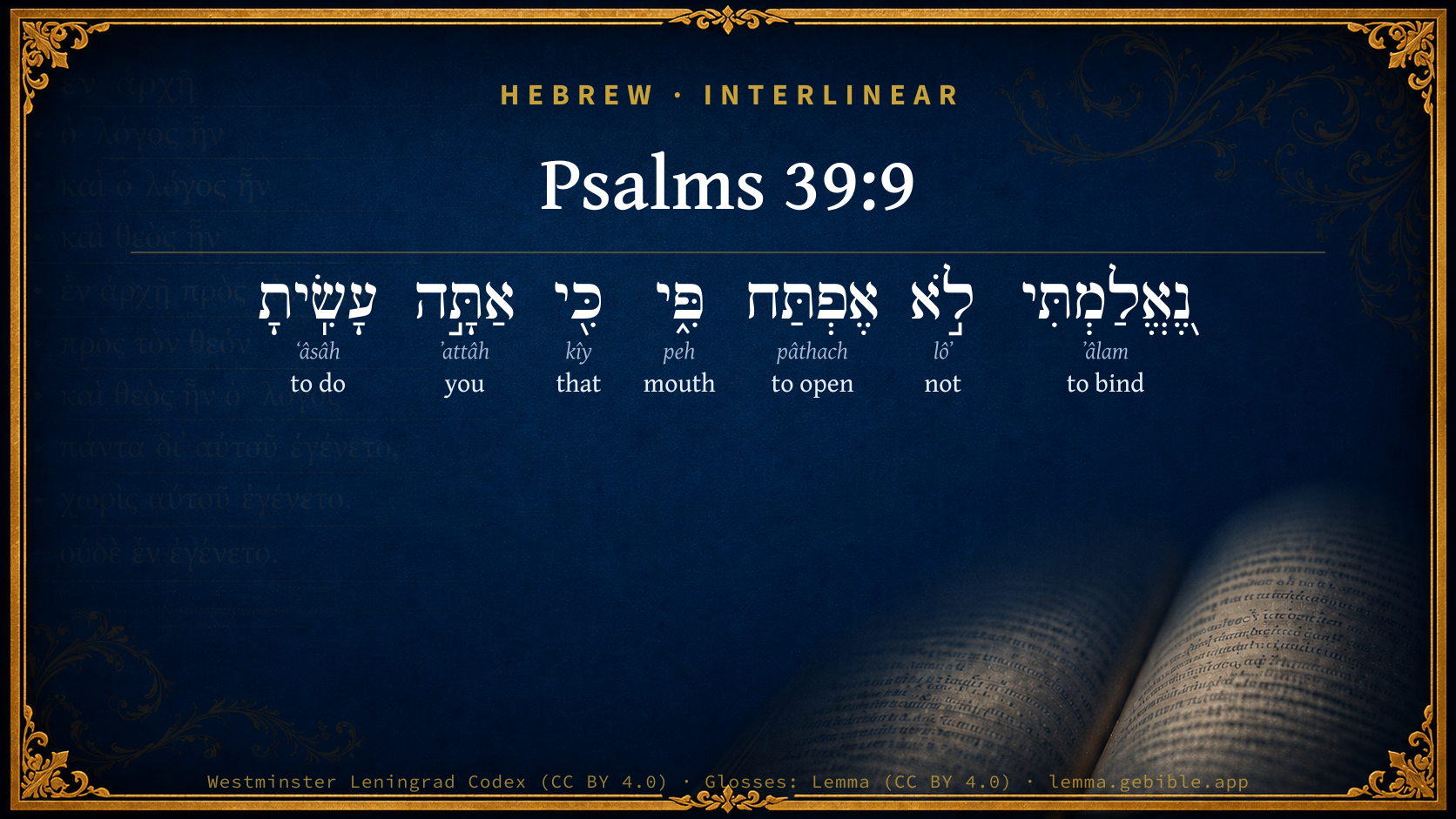
Hebrew (Westminster Leningrad Codex) Psalms 39:9 appears in the Hebrew Old Testament. The text above is from the Westminster Leningrad Codex. Each word links to its Strong’s number, a concise gloss, and parsing drawn from the Open Scriptures Hebrew Bible morphology. Click any word for its full Brown-Driver-Briggs (BDB) entry.
Download image
Cite this verse

Psalms 39:9 (World English Bible). Public Domain. Lemma interlinear Bible study tool, https://lemma.gebible.app/v/psalms/39/9.

Show BibTeX & RIS
BibTeX
RIS
English Translation
I was mute. I didn't open my mouth, Because you did it.
World English Bible · Public Domain
Download a study sheet

One document with this verse’s original text, its word-by-word gloss line, the meaning frame, cross-references with their text, attributed commentary, and full source and license credits — printable, and it pastes into notes with its structure intact.

This verse Autodidact and up

Study sheet (.html) Plain text (.txt)

A passage Seminary Student

Up to 50 verses in one chapter. A passage sheet keeps up to 6 commentary sources and 12 cross-references per verse, in the order this page ranks them, and says so on the sheet whenever that leaves anything out. Ask for a single verse and you get the Autodidact verse sheet above.

Everything on this page stays free to read, with no account — the sheet is a download of what is already on screen, not access to it.

Want to remove ads? Support Godless Engineer
Compare translations 3

The same verse in 3 English versions, stacked beneath the original-language interlinear above. Click any original word for its lexicon entry.

Each is an independent rendering of the whole verse — the interlinear is not word-aligned to these translations.

Highlighted words mark where these versions differ — a whole-verse word diff, not a word-by-word alignment.

  • World English Bible Public Domain
    I was mute. I didn't open my mouth, Because you did it.
  • King James Version Public Domain
    I was dumb, I opened not my mouth; because thou didst it.
  • unfoldingWord Literal Text CC BY-SA 4.0
    I am mute; I do not open my mouth, for you, you have done.

unfoldingWord Literal Text — © unfoldingWord, licensed CC BY-SA 4.0. Word-aligned USFM3 via Door43 (git.door43.org/unfoldingWord/en_ult).

Versions to compare (up to 4)

3 of 4 selected

Show all 18 translations

Every available English version of this verse, each an independent rendering of the whole verse.

  • World English Bible Public Domain
    I was mute. I didn't open my mouth, Because you did it.
  • Berean Standard Bible Public Domain
    I have become mute; I do not open my mouth because of what You have done.
  • Majority Standard Bible Public Domain
    I have become mute; I do not open my mouth because of what You have done.
  • King James Version Public Domain
    I was dumb, I opened not my mouth; because thou didst it.
  • American Standard Version (1901) Public Domain
    I was dumb, I opened not my mouth; Because thou didst it.
  • Revised Version (1885) Public Domain
    I was dumb, I opened not my mouth; because thou didst it.
  • Geneva Bible (1599) Public Domain
    I should haue bene dumme, and not haue opened my mouth, because thou didest it.
  • Douay-Rheims (1899) Public Domain
    Deliver thou me from all my iniquities: thou hast made me a reproach to the fool.
  • Young's Literal Translation Public Domain
    I have been dumb, I open not my mouth, Because Thou -- Thou hast done `it'.
  • Literal Standard Version CC BY-SA 4.0
    I have been mute, I do not open my mouth, || Because You have done [it].
  • Unlocked Literal Bible CC BY-SA 4.0
    I am silent and cannot open my mouth, because it is you who has done it.
  • unfoldingWord Literal Text CC BY-SA 4.0
    I am mute; I do not open my mouth, for you, you have done.
  • Darby Bible Public Domain
    I was dumb, I opened not my mouth; for *thou* hast done [it].
  • World Messianic Bible Public Domain
    I was mute. I didn’t open my mouth, because you did it.
  • Webster's Bible Public Domain
    \\39:8\\Deliver me from all my transgressions: make me not the reproach of the foolish.
  • Free Bible Version CC BY-SA 4.0
    I will stay quiet, I won't say a word, for it's you who has done this to me.
  • Bible in Basic English Public Domain
    I was quiet, and kept my mouth shut; because you had done it.
  • JPS Tanakh (1917) Public Domain
    (39-10) I am dumb, I open not my mouth; because Thou hast done it.

Literal Standard Version (2020), Covenant Press — licensed CC BY-SA 4.0. Text via the HelloAO Bible API (eBible.org). Unlocked Literal Bible (unfoldingWord) — licensed CC BY-SA 4.0. Text via the HelloAO Bible API (eBible.org). unfoldingWord Literal Text — © unfoldingWord, licensed CC BY-SA 4.0. Word-aligned USFM3 via Door43 (git.door43.org/unfoldingWord/en_ult). Free Bible Version, Dr. Jonathan Gallagher — licensed CC BY-SA 4.0. Text via the HelloAO Bible API (eBible.org).

Word by word

More ways to search: Search by grammar → Find every occurrence → Compare this word →

Practice this passage: Drill this verse → Learn its vocabulary →

About this verse

These counts appear in no published source. They are computed here, from the morphology-tagged text and Lemma’s own curated glosses. What Lemma adds →

7
words
7
distinct lemmas
Wisdom
section

Notable vocabulary

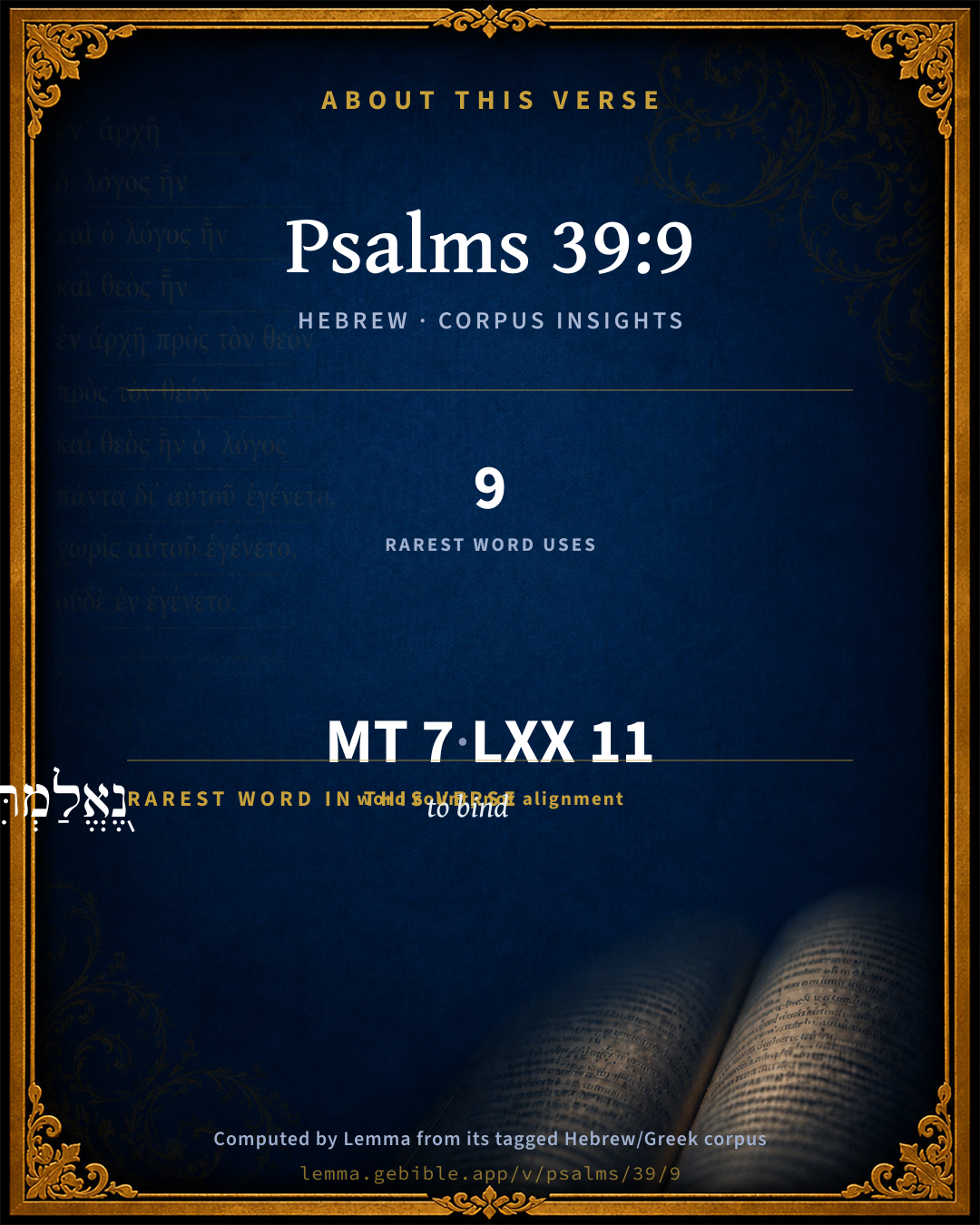
The rarest word here is נֶ֭אֱלַמְתִּי to bind H481 — appearing just 9 times in the whole Hebrew Bible.

Shared distinctive vocabulary

נֶ֭אֱלַמְתִּי to bind H481 occurs in 9 verses of the Hebrew Bible. Also found in:

Grammatical profile

  • 3 verbs
  • 1 noun
  • 1 pronoun
  • 1 conjunction
  • 1 particle

Verb forms

  • נֶ֭אֱלַמְתִּי Niphal · Perfect
  • אֶפְתַּח Qal · Imperfect
  • עָשִֽׂיתָ Qal · Perfect

Hebrew & Septuagint length

In English translation the verse runs 12 words from the Hebrew and 15 from the Septuagint (LXX English) — closely comparable.

A rough comparison of the two English renderings, which tokenize alike — not a word-level alignment.

Word counts can differ between the Hebrew and the Greek without any difference in meaning — e.g. the Hebrew direct-object marker אֵת has no separate Greek word, and Greek often adds the article ὁ.

In the original languages it is 7 Hebrew tokens and 11 Greek tokens — but the two are counted differently (Hebrew bundles its prefixes and suffixes into one token; the Greek is in lemma form), so that isn’t a like-for-like length.

Cross-references

8

Topical passages linked to Psalms 39:9 in the Treasury of Scripture Knowledge — connected by theme and wording, ordered by reader-vote popularity; previews shown in the World English Bible.

  • Job 2:10 But he said to her, "You speak as one of the foolish women would speak. What? Shall we receive good at the hand of God, and shall we not receive evil?" In all this Job didn't sin with his lips.
  • 1 Samuel 3:18 Samuel told him every whit, and hid nothing from him. He said, It is Yahweh: let him do what seems him good.
  • 2 Samuel 16:10 The king said, What have I to do with you, you sons of Zeruiah? Because he curses, and because Yahweh has said to him, Curse David; who then shall say, Why have you done so?
  • Job 1:21 He said, "Naked I came out of my mother's womb, and naked shall I return there. Yahweh gave, and Yahweh has taken away. Blessed be the name of Yahweh."
  • Job 40:4–5 "Behold, I am of small account. What shall I answer you? I lay my hand on my mouth.
  • Daniel 4:35 All the inhabitants of the earth are reputed as nothing; and he does according to his will in the army of heaven, and among the inhabitants of the earth; and none can stay his hand, or tell him, What do you?
  • Leviticus 10:3 Then Moses said to Aaron, "This is what Yahweh spoke of, saying, "'I will show myself holy to those who come near me, And before all the people I will be glorified.'" Aaron held his peace.
  • Psalms 38:13 But I, as a deaf man, don't hear. I am as a mute man who doesn't open his mouth.

Cross-references courtesy of OpenBible.info (CC BY 4.0).

Hebrew and Greek witnesses Masoretic Hebrew ↔ Greek Septuagint

The same verse in the two great witnesses to the Old Testament, shown verse-for-verse.

You’re reading Greek Psalm 38 (Hebrew Psalm 39). The Septuagint counts the superscription, so verse numbers can differ from the Hebrew — chapter-level alignment, not verse-by-verse. Numbering follows Rahlfs.

These are two independent witnesses, not word-aligned to each other, and the Septuagint is shown in lemma (dictionary) form.

Hebrew Psalms 39:9 Masoretic · Westminster Leningrad Codex

נֶ֭אֱלַמְתִּי לֹ֣א אֶפְתַּח פִּ֑י כִּ֖י אַתָּ֣ה עָשִֽׂיתָ

I was mute. I didn't open my mouth, Because you did it.

World English Bible · Public Domain

Greek LXX Greek Psalm 38:9 Septuagint · lemma form

ἀπό πᾶς ὁ ἀνομία ἐγώ ῥύομαι ἐγώ ὄνειδος ἄφρων δίδωμι ἐγώ

I was dumb, and opened not my mouth; for you are he that made me.

LXX2012 (modern English Septuagint) · Public Domain

Hebrew: Westminster Leningrad Codex (CC BY 4.0). Greek: Septuagint (public domain); English from LXX2012 (modern English Septuagint) (Public Domain). How the Septuagint differs from the Hebrew →

Commentary

Notes on Psalms 39:9 from classic Christian and Jewish commentators (each source and its license shown beneath its notes). The classic Christian expositions comment on the surrounding passage and are grouped to its opening verse, so a note may address several verses; the Jewish commentaries on the Tanakh (Rashi and others) are per-verse, so they appear only where the commentator wrote on this verse.

Lemma curates 59 commentaries, every one of them public domain or Creative Commons licensed, each selected and text-cleaned for this edition rather than reprinted as found. About our sources →

Trapp's Complete Commentary

John Trapp

Psa 39:9 I was dumb, I opened not my mouth; because thou didst [it].

Ver. 9. I was dumb, I opened not my mouth] Or better thus, I should have been dumb, and not have opened my mouth, according to my first resolution. I should not have reasoned, or rather wrangled, with thee, as Psa 39:4, but have kissed thy rod in a humble submission, and have known that the rod of Aaron and pot of manna must go together. Macrobius writeth that the image of Angeronia among the old Romans was placed on the altar of Volupia with the mouth closed and sealed up; to signify, that such as patiently and silently bear their griefs do thereby attain to greatest pleasures.

Because thou didst it] This is indeed a quieting consideration, and will notably quell and kill unruly passions. Set but God before them when they are tumultuating, and all will be soon hushed. This made Jacob so patient in the rape of his daughter Dinah; Job, in the loss of his goods by the Sabaean spoilers; David, in the barkings of that dead dog Shimei; that noble lord of Plessis, in the loss of his only son, a gentleman of marvellous great hopes, slain in the wars of the Low Countries. His mother, more impatient, died of the grief of it; but his father laid his hand on his mouth when God’s hand was on his back; and used these very words, "I was dumb, and opened not my mouth, because thou didst it."

John Trapp, A Commentary or Exposition upon All the Books of the Old and New Testament (1647–1656) — public domain. Text from a community e-Sword module.

The Biblical Illustrator

Joseph S. Exell

Psa_39:9

I was dumb, I opened not my mouth, because Thou didst it.

Silent before God

This psalm is the utterance of a man in trouble. It thrills with a strong but repressed feeling. In a thoughtful man, trouble always doubles itself. Added to the smart of the immediate affliction is the moral problem which it raises, of the reason and the justice of Gods administration in the world, of the permission of evil, of the tendency and destiny of this vain show called life. Every special sorrow or disaster is a stream, setting towards this unfathomable ocean of thought, with a swift and resistless current. The psalm represents a familiar experience. So many feel, if they do not think, deeply. But there is strong repression here as well as strong feeling. The writer is on his guard against hasty speech. I said, I will take heed, etc. But in our text we get down to a deeper reason for silence. The man is so overcome by the grandeur and the mystery of Gods dealing with him that he is forced to be silent. There are some mysteries that we can--so we think--solve, but there are others concerning which we can only say, Thou didst it--that is all. We stand like a belated traveller before the closed gate of an Egyptian temple, rising, low-brewed and grim, under the stars, and no sound answers our knock. This, then, is the simple, stern picture of our text--a man in silence before the truth, God did it! The text assumes God to be a fact, and further assumes faith in God. God and His providence are both taken for granted. What, then? Well it is something to have got firm hold of a fact. A great deal is gained when the sorrow, however severe, or the mystery, however dark, has been traced up to God. When we can say, not something, but some one, did it, the matter is greatly simplified. We have no longer to count chances. Whatever we may think of the dispensation we know its source. God did it. A teacher sets for a boy a hard problem in algebra. The boy goes resolutely to work. The day passes, and he cannot solve it. He takes it home with him, and works at it there. He comes back next day to the teacher, and says, I cannot do it; and then he begins to talk passionately, to tell what methods he has tried, to hint that the teacher may have made a mistake in his statement, to complain that this or that in his algebra is not clearly defined. The teacher sees the difficulty; and, as the first step toward clearing it up, he quietly says, Be still! Do not talk any morel I set the problem, and I know it is right. And if he says no more, and the boy goes back to his seat, he has gained something in that interview. There is power in the thought which the lad turns over in his mind, This problem was set by somebody that knows. My teacher, whom [ have always found wise and truthful, did it. The thought that there may have been a mistake in the statement of the sum goes out of his mind, and the matter is thus far relieved, at any rate; and, under the impulse of that relief, he may attack the question again, and successfully; or, if not, he will gain by silence, by restraint. The teacher wisely silences him, not to check his inquiry, but to bring his mind into the right condition to receive explanation. And this is just how God often deals with us. Well, it may be said, all that may do very well for a child; but a reasoning man cannot be disposed of in that way. All I can say is, many a reasoning man has to accept that or nothing. And after all, it may be that the childs satisfaction has something rational at bottom, Reason cannot compel God to answer; and suppose it could, would man be the better? Take a simple illustration. There are certain reasons connected with your childs education or inheritance which constrain you to live for some years in an uncongenial and unpleasant place. Neither climate, scenery, nor society is what you could desire. The child asks, We are not poor, are we, father?--No.--Could we not live somewhere else?--Yes.--Then, why do we stay here when there are so many pleasant places elsewhere? You cannot tell him; he could not understand the reasons; but, for all that, the lesson that child learns through your silence, through being obliged to be content with the simple fact, father does it, is more valuable than the knowledge of the reasons. Even if he should make a shrewd guess at your reasons, that would not please you half so much as his cheerful, unquestioning acceptance of the truth that you love him, and will do what is best for him. Now, in such dependence upon God lies the very foundation of all true character, and this is why God lays so much stress on this lesson, and so often brings us face to face with His I did it. That kind of teaching may not make philosophers--when it does, it makes them of large mould--but it makes Pauls and Luthers. But as we look at this, Thou didst it, we find it has some treasures of knowledge for us. Faith is not ignorance. We begin to make discoveries--this one, that if God did it, then infinite wisdom did it, and infinite power did it. Ah! you say, we know that but too well. The stroke is on our hearts and homes. It is written on fresh graves, and in the scar of dreary partings. All true. But has power no other aspect than this terrible one? Shall we symbolize it only by a hand hurling thunderbolts? or may we not picture a hand, strong indeed, but open, and pouring forth blessings? All power is given unto me, says Jesus. Yet He laid His hand on blind eyes, and they saw; on the paralytic, and he leaped and ran. God did it, and therefore I know that infinite love did it. That is a piece of knowledge worth having indeed. Surely, when we reach that, we find the rock yielding water. Ah! we have to creep back for rest into the shadow of love after all. And how this truth gathers power when we go to this text, taking Christ with us! How it kindles under His touch! God did it; and I look up into that face of unspeakable love, with its thorn-marked brow, and say, Thou didst it. He that hath seen Thee hath seen the Father. I am in sorrow; the sorrow is driven home by a pierced hand: Thou didst it. The pierced hand tells me of the loving heart behind the hand; and, if love hath done it, let me be silent and content. (M. R. Vincent, D. D.)

Silent submission to the Divine will

I. What we out not to do.

1. We ought not to divert our attention from a higher object, by too anxiously inquiring into second causes; much less aggravate our distress, by vainly lamenting the circumstances of a case, of which the event sufficiently proves its entire consonance with the will of God; whilst these circumstances are to be regarded only as the sword or the staff, which served to inflict a necessary wound.

2. Neither let us be tempted too deeply to speculate upon the secret intentions of our heavenly Father in such a visitation; or too solicitously to ask whether it be an infliction in mercy or in wrath.

3. Much less should we adopt the language, or harbour a sentiment of impatience or discontent.

4. Neither ought we to despair. What though the stream be dried up, which once flowed down with blessings on our lot, the Fountain whence it was supplied still remains; and though the friend be gone, Omnipotence is left.

II. What we ought to do.

1. Let us begin with acknowledging the imperfection of our own blind and fallible judgment, which had led us to build our hopes so high upon a passing shadow.

2. Painful, however, as we doubtless feel this severe act of the Divine sovereignty, let us next consider that as our sins have most clearly deserved all there is of chastisement in it, so our repentance alone, and deep contrition for sin, can avert its worst consequences as a national curse.

3. A duty most unquestionably it is, even in the utmost extremity, and in the absence of every human resource, still to assure ourselves that the Lord reigneth; and that in His supreme dominion are involved the operations and the results of infinite power, and wisdom, and goodness, and mercy. To Christians the same assurance beams with a superior brightness through the medium of that purer revelation made known to us by the coming of our Lord Jesus Christ, and sealed to us by His blood. (C. J. Hoare, M. A.)

Submission under Divine chastisements

I. What it is not.

1. It is not a silence arising from an unfeeling disregard to affliction. We are not told to do violence to our nature.

2. It is not a sullen silence, like the sulky humour of an ill-managed child, who stubbornly refuses to speak when any of his wishes are not gratified.

3. Neither is it a silence which springs from natural constitution, or from good sense, as it is called, either natural or acquired. Such silence, such submission cannot be acceptable to God, inasmuch as God is not at all regarded in it.

4. Again, men may be silent under their afflictions, lest by murmurings they should bring down upon themselves yet worse. Such submission however has respect to self rather than to God.

5. It is not a despairing silence.

II. What it is. Because Thou didst it.

1. The Christian in his afflictions considers who God is. He sees in them the hand of one who is Almighty, the High and Mighty One, perfectly holy, and just, and good. And looking at himself, who is but sinful dust and ashes, he says, How shall I dare to murmur against God?

2. But while the Christian silently submits himself to God, from a deep sense of His power and majesty, his fear is mixed with love, for he views God not only as an almighty Sovereign, but as a kind parent.

3. The Christian calls to mind the gracious and valuable purposes for which God afflicts His children, and in them he finds fresh motives for silent resignation.

4. The pious sufferer quiets himself under affliction with the reflection that God will not always be chiding; weeping may endure for a night, but joy cometh in the morning.

5. The Christian, when he is under Gods afflicting hand, gives himself up entirely to His disposal; in firm confidence that he suffers according to the will of God, infinite power did it. Ah! you say, we know that but too well. The stroke is on our hearts and homes. It is written on fresh graves, and in the scar of dreary partings. All true. But has power no other aspect than this terrible one? Shall we symbolize it only by a hand hurling thunderbolts? or may we not picture a band, strong indeed, but open, and pouring forth blessings? All power is given unto me, says Jesus. Yet He laid His hand on blind eyes, and they saw; on the paralytic, and he leaped and ran. God did it, and therefore I know that infinite love did it. That is a piece of knowledge worth having indeed. Surely, when we reach that, we find the rock yielding water. Ah! we have to creep back for rest into the shadow of love after all. And how this truth gathers power when we go to this text, taking Christ with us! How it kindles under His touch! God did it; and I look up into that face of unspeakable love, with its thorn-marked brow, and say, Thou didst it. He that hath seen Thee hath seen the Father. I am in sorrow; the sorrow is driven home by a pierced hand: Thou didst it. The pierced hand tells me of the loving heart behind the hand; and, if love hath done it, let me be silent and content. (M. R. Vincent, D. D.)

Silent submission to the Divine will

I. What we ought not to do.

1. We ought not to divert our attention from a higher object, by too anxiously inquiring into second causes; much less aggravate our distress, by vainly lamenting the circumstances of a case, of which the event sufficiently proves its entire consonance with the will of God; whilst these circumstances are to be regarded only as the sword or the staff, which served to inflict a necessary wound.

2. Neither let us be tempted too deeply to speculate upon the secret intentions of our heavenly Father in such a visitation; or too solicitously to ask whether it be an infliction in mercy or in wrath.

3. Much less should we adopt the language, or harbour a sentiment of impatience or discontent.

4. Neither ought we to despair. What though the stream be dried up, which once flowed down with blessings on our lot, the Fountain whence it was supplied still remains; and though the friend be gone, Omnipotence is left.

II. What we ought to do.

1. Let us begin with acknowledging the imperfection of our own blind and fallible judgment, which had led us to build our hopes so high upon a passing shadow.

2. Painful, however, as we doubtless feel this severe act of the Divine sovereignty, let us next consider that as our sins have most clearly deserved all there is of chastisement in it, so our repentance alone, and deep contrition for sin, can avert its worst consequences as a national curse.

3. A duty most unquestionably it is, even in the utmost extremity, and in the absence of every human resource, still to assure ourselves that the Lord reigneth; and that in His supreme dominion are involved the operations and the results of infinite power, and wisdom, and goodness, and mercy. To Christians the same assurance beams with a superior brightness through the medium of that purer revelation made known to us by the coming of our Lord Jesus Christ, and sealed to us by His blood. (C. J. Hoare, M. A.)

Submission under Divine chastisements

I. What it is not.

1. It is not a silence arising from an unfeeling disregard to affliction. We are not told to do violence to our nature.

2. It is not a sullen silence, like the sulky humour of an ill-managed child, who stubbornly refuses to speak when any of his wishes are not gratified.

3. Neither is it a silence which springs from natural constitution, or from good sense, as it is called, either natural or acquired. Such silence, such submission cannot be acceptable to God, inasmuch as God is not at all regarded in it.

4. Again, men may be silent under their afflictions, lest by murmurings they should bring down upon themselves yet worse. Such submission however has respect to self rather than to God.

5. It is not a despairing silence.

II. What it is. Because Thou didst it.

1. The Christian in his afflictions considers who God is. He sees in them the hand of one who is Almighty, the High and Mighty One, perfectly holy, and just, and good. And looking at himself, who is but sinful dust and ashes, he says, How shall I dare to murmur against God?

2. But while the Christian silently submits himself to God, from a deep sense of His power and majesty, his fear is mixed with love, for he views God not only as an almighty Sovereign, but as a kind parent.

3. The Christian calls to mind the gracious and valuable purposes for which God afflicts His children, and in them he finds fresh motives for silent resignation.

4. The pious sufferer quiets himself under affliction with the reflection that God will not always be chiding; weeping may endure for a night, but joy cometh in the morning.

5. The Christian, when he is under Gods afflicting hand, gives himself up entirely to His disposal; in firm confidence that he suffers according to the will of God, who is infinite in mercy and goodness, and who of very faithfulness causeth His people to be troubled.

6. A view of the God-man Christ Jesus suffering for the sins of the whole world affords another most powerful motive to the Christian to bear his sufferings with silence and submission.

7. It is not, however, inconsistent with that submission to express a sense of pain and distress; to desire and pray for deliverance; or to use any lawful means by which we may be delivered. (J. T. Sangar, M. A.)

The duty of resignation

Faith, obedience and patience are the three duties incumbent upon a Christian. Faith being a submission of our understanding; obedience, of our will; and patience, of the whole man to the will of God. The consideration of such a duty as patience is ever seasonable, to those in adversity, as a cordial to support them; to those in prosperity, as an amulet to guard them. We have in the text Davids submissive deportment, and the reason for it.

I. The nature and measure of submission.

1. Negatively. It is not insensibility to suffering. Nor abstaining from prayer for relief of it; nor from endeavour to remove it.

2. Positively, it is the submission of the understanding so that it shall approve Gods procedure. Of the will, our chief faculty. Of the passions and affections, commonly so turbulent, and of the tongue, so as to refrain from hard and bitter speech, and of the Spirit, so that we abstain from all rage and revenge against the instruments of our affliction (2Sa_16:10). We are not called upon to account enemies as friends, but we are not to take revenge.

3. All this is very difficult. Therefore, consider the worth of such submissive spirit, how excellent it is (Rom_1:10). See it in Moses and especially in Christ. It was suffering which redeemed the world. But it is difficult, because of the opposition to it which we find in ourselves, and from the mean though mistaken opinion of it which the generality of men entertain. Therefore, there is needed an early and long endeavour after such an excellent frame of mind.

II. The reasons and arguments for it because of our relation to God. Think--

1. Of Gods irresistible power. How useless resistance is (1Co_10:22; Psa_135:6). Then--

2. Of Gods absolute sovereignty and dominion over all things, founded, as it is, upon the greatest and most undeniable title, which is that of creation and providence (Job_9:12; Rev_4:11).

3. His infinite and unfailing wisdom, which is never at fault (Job_4:18). Would it be better for us to have our own way? Passengers in a ship always submit to their pilots discretion.

4. His great goodness, benignity and mercy which is over all His works. God does not willingly afflict (Lam_3:38; Isa_28:21). Consider also--

5. Gods exact and inviolable justice. He could not do us wrong.

6. And how He rewards the submissive soul. Ye have heard of the patience of Job, and have seen the end of the Lord. Could we but trust God to do our business for us, to assert our cause and vindicate our innocence, we should find that He would not only answer, but outdo our hopes.

III. Conclusion. Learn--

1. The necessity of submission.

2. Its prudence. There are few things in the world so entirely bad but some advantage may be had of them by dexterous management. Like Isaac let us take the wood upon our shoulders, though we be designed for sacrifice, and who knows but that, as in his case, deliverance may come? (2Co_4:17). Inward if not outward relief will come to us if we submit.

3. Think also of the decency and comeliness of such submission (Dan_5:28; Luk_21:19). Thus may we make ourselves happy in the most afflicted, abject and forlorn condition of life. Therefore, let us take up our cross, looking unto Jesus as our great example and who, because He endured, is now set down at the right hand of God. (R. South, D. D.)

Christian resignation

Such resignation is all too rare. The words of resignation may be on the lips, but impatience may be in the heart. To provide against, such evil we must study to be real disciples of Christ; and we must have our minds turned to those doctrines and habituated to those exercises of religion, which help us to submit amid the calamities of life. Without such aid we are overcome when calamity falls upon us. Let us consider some of these aids to resignation.

I. The remembering that when god visits us with bereavements, he only takes away what is his own. Now, if we will take this view, if we not only speculatively assent to it as an abstract truth, but have it as a part of our practical creed, it will lead us to surrender any comfort whatever, and to make the surrender with patience and readiness into the hands of God, from whom we at first received it.

II. That God accompanies our bereavements with consolation and support. How much is still left to us of good. All is not lost. Has it not often happened in the case of the afflicted that their latter end, like that of Job, has been much more than their beginning? In all this there is something that is well fitted to inspire us with patience and contentment. Whatever we suffer is much less, and whatever we enjoy is much more, than we deserve. But He gives us consolation and support of a spiritual kind, far more precious and far more efficacious still. The Bible, prayer, ere.

III. In the third place, we should be resigned to the will of God when He afflicts us, because affliction is for our good. To mere worldly persons there is nothing good but that which gives them much pleasure. But to true Christians that, and that alone, is good, whatever it may be, which promotes their spiritual and immortal interests; which tends to make them wiser and better. There is still another consideration by which we ought to be influenced when involved in affliction.

IV. God who sends it is entitled to our patient acquiescence, our cheerful submission, because at the very time that we are suffering under his hand, he has in reserve, and is preparing for us, the happiness of heaven and immortality. (A. Thompson, D. D.)

The Biblical Illustrator, edited by Joseph S. Exell (c. 1880s–1900s) — public domain. Text from a community e-Sword module.

Joseph Benson's Commentary

Psa 39:9. I opened not my mouth — In the way of murmuring or repining against thee or thy providence, as I promised I would not, Psa 39:1. For though, when I looked only to instruments, I was discomposed, and did at last speak foolishly; yet when I recollected myself, and looked up to thee, the first cause and sovereign disposer of this afflictive dispensation, I returned to my former silence. Because thou didst it — Didst send this chastisement: meaning, probably, either, 1st, The rebellion and untimely death of Absalom; in which he acknowledged the just hand of God, punishing his sins: or, 2d, Some other affliction.

Joseph Benson's Commentary on the Old and New Testaments (1811–1818) — public domain. Text from a community e-Sword module.

J. A. Alexander on Psalms

Joseph Addison Alexander

10. (Psa 39:9). I am silenced, I will not open my mouth, because thou hast done (it). This is far from being a reiteration of the sttement in Psa 39:3 (2) above. The common version of the second verb (I opened not) is altogether arbitrary, and even the first, although a preterite, does not mean I was dumb, i. e. at some former time, but I have been silenced or am dumb, at present. There is obvious allusion to the similar expressions of Psa 39:3 (2), but rather in the way of contrast than of repetition. As before he was kept silent by an obstinate suppression of the rebellious feelings which he really experienced, so now he is kept silent by a filial submission to his father's chastisements. I will not open my mouth, to murmur or give utterance to undutiful complaints. Thou hast done the very thing at which I was tempted to repine. See above, on Ps. 22:32 (31). The pronoun is emphatic: (it is) thou (who) hast done (it), and no other. See above, on Psa 30:7 (6), Psa 33:9.

Joseph Addison Alexander, The Psalms Translated and Explained (1850) — public domain. Text from a community e-Sword module.

Tyndale Open Study Notes

Tyndale Open Resources

39:9-11 The psalmist links suffering with God’s discipline, assuming that it is punishment for his sin.

Tyndale Open Study Notes — © Tyndale Open Resources, licensed CC BY-SA 4.0. Text via the HelloAO Bible API.

Geneva Bible (1599)

Geneva Bible translators

Seeing my troubles came of thy providence, I ought to have endured them patiently.

Geneva Bible (1599) marginal notes — public domain. Text via Bolls.life.

John Calvin's Commentaries

9. I was dumb Here David blames himself, because he had not preserved that silence which, as we have already seen, the violence of his grief forced him to break. When he says then that he was dumb, he does not mean this as a commendation of the uniform and persevering restraint which he had exercised over himself. It is rather a correction of his error, as if reproving his own impatience, he had spoken within himself in this way: What doest thou? thou hadst enjoined upon thyself silence, and now thou murmurest proudly against God; what wilt thou gain by this presumption? We have here a very profitable and instructive lesson; for nothing is better fitted to restrain the violent paroxysms of grief, than the recollection that we have to do, not with a mortal man, but with God, who will always maintain his own righteousness in opposition to all that men may say against it in their murmuring complaints, and even in their outrageous accusations. What is the reason why the great majority of men run to such excess in their impatience, but because they forget that, in doing so, they dare to plead a controversy with God? Thus, while some impute all their miseries to fortune, and others to men, and others account for them from a variety of causes which their own fancy suggests, while scarcely one in a hundred recognises in them the hand of God, they allow themselves to indulge in bitter complaint, without ever thinking that in so doing they offend God. David, on the contrary, in order to subdue every unholy desire and sinful excess, returns to God, and resolves to keep silence, because the affliction which he is now suffering proceeded from God. As David, who was thus afflicted with the severest trials, resolved nevertheless to keep silence, let us learn from this, that it is one of the chief exercises of our faith to humble ourselves under the mighty hand of God, and to submit to his judgments without murmuring or complaint. It is to be observed, that men humbly and calmly submit themselves to God only when they are persuaded, not only that he does by his almighty power whatever he pleases, but that he is also a righteous Judge; for although the wicked feel that the hand of God is upon them, yet as they charge him with cruelty and tyranny, they cease not to pour forth horrible blasphemies against him. In the meantime, David regards the secret judgments of God with such reverence and wonder, that, satisfied with his will alone, he considers it sinful to open his mouth to utter a single word against him.

John Calvin's Commentaries (1540-1563) — public domain. Text from the Calvin Translation Society English edition (1840s-50s) via the Christian Classics Ethereal Library (ccel.org). Calvin's coverage is partial (roughly two-thirds of the Bible); uncommented books and verses are honest gaps, never fabricated. The 19th-century editor's footnotes and remarks are omitted so the notes are faithfully Calvin's own voice.

Ellicott's Commentary for English Readers

(9) Thou is emphatic. Kimchi well explains: “I could not complain of man, for it was God’s doing; I could not complain of God, for I was conscious of my own sin.”

A Bible Commentary for English Readers, edited by Charles John Ellicott (1878–1897) — public domain. Text from a community e-Sword module.

The Cambridge Bible for Schools and Colleges

gen. ed. J. J. S. Perowne

9. This verse may refer to the silence with which he bore the taunts of his enemies (Psa_39:2; Psa_38:13-14); or it may be the expression of perfect resignation to the will of God: I am dumb, I will not open my mouth, for Thou hast done it. Cp. Lam_1:21. “He has risen out of the moody silence of impatience to the contrite silence of evangelical faith, recognising at once his sin and God’s holy love.” Kay.

The Cambridge Bible for Schools and Colleges (gen. ed. J. J. S. Perowne; Cambridge University Press, 1878–1918) — public domain. Text from a community e-Sword module.

John Gill's Exposition

I was dumb, I opened not my mouth,.... This refers either to his former silence, before he broke it, Psa 39:1, or to what he after that came into again, when he had seen the folly of his impatience, the frailty of his life, the vanity of man, and all human affairs, and had been directed to place his hope and confidence in the Lord, Psa 39:5; or to the present frame of his mind, and his future conduct, he had resolved upon; and may be rendered, "I am dumb"; or "will be dumb, and will not open my mouth" (e); that is, not in a complaining and murmuring way against the Lord, but be still, and know or own that he is God;

because thou didst it; not "because thou hast made me", as Austin reads the, words, and as the Arabic version renders them, "because thou hast created me"; though the consideration of God being a Creator lays his creatures under obligation as to serve him, so to be silent under his afflicting hand upon them; but the sense is, that the psalmist was determined to be patient and quiet under his affliction, because God was the author of it; for though he is not the author of the evil of sin, yet of the evil of affliction; see Amo 3:6; and it is a quieting consideration to a child of God under it, that it comes from God, who is a sovereign Being, and does what he pleases; and does all things well and wisely, in truth and faithfulness, and in mercy and loving kindness: this some refer to the rebellion of Absalom, and the cursing of Shimei, Sa2 12:11; or it may refer to the death of his child, Sa2 12:22; or rather to some sore affliction upon himself; since it follows,

(e) "non aperiam", Pagninus, Montanus, Piscator, Gejerus; so Ainsworth.

John Gill's Exposition of the Whole Bible (1746–1763) — public domain (CC PDM 1.0). Text via the HelloAO Bible API.

Albert Barnes' Notes on the Bible

I was dumb - See the notes at Psa 39:2. Compare Isa 53:7. The meaning here is, that he did not open his mouth to complain; he did not speak of God as if he had dealt unkindly or unjustly with him.

I opened not my mouth - I kept entire silence. This would be better rendered, “I am dumb; I will not open my mouth.” The meaning is, not that he had been formerly silent and uncomplaining, but that he was now silenced, or that his mind was now calm, and that he acquiesced in the dealings of Divine Providence. The state of mind here, if should be further observed, is not that which is described in Psa 39:2. There he represents himself as mute, or as restraining himself from uttering what was in his mind, because he felt that it would do harm, by encouraging the wicked in their views of God and of his government; here he says that he was now silenced - he acquiesced - he had no disposition to say anything against the government of God. He was mute, not by putting a restraint on himself, but because he had nothing to say.

Because thou didst it - thou hast done that which was so mysterious to me; that about which I was so much disposed to complain; that which has overwhelmed me with affliction and sorrow. It is now, to my mind, a sufficient reason for silencing all my complains, and producing entire acquiescence, that it has been done by thee. That fact is to me sufficient proof that it is right, and wise, and good; that fact makes my mind calm. “The best proof that anything is right and best is that it is done by God.” The most perfect calmness and peace in trouble is produced, not when we rely on our own reasonings, or when we attempt to comprehend and explain a mystery, but when we direct our thoughts simply to the fact that “God has done it.” This is the highest reason that can be presented to the human mind, that what is done is right; this raises the mind above the mysteriousness of what is done, and makes it plain that it should be done; this leaves the reasons why it is done, where they should be left, with God. This consideration will calm down the feelings when nothing else would do it, and dispose the mind, even under the deepest trials, to acquiescence and peace. I saw this verse engraved, with great appropriateness, on a beautiful marble monument that had been erected over a grave where lay three children that had been suddenly cut down by the scarlet fever. What could be more suitable in such a trial than such a text? What could more strikingly express the true feelings of Christian piety - the calm submission of redeemed souls - than the disposition of parents, thus bereaved, to record such a sentiment over the grave of their children?

Albert Barnes' Notes on the Bible (1834–1885) — public domain. Text from a community e-Sword/MySword module.

Matthew Poole's English Annotations

I opened not my mouth, to wit, in way of murmuring or repining against thee, or thy providence, as I promised I would be, Psa 39:1. For though when I looked only to instruments, I was discomposed, and did at last speak a foolish word; yet when I did recollect myself, and looked up to thee, the First Cause and Sovereign Disposer of this and all other things, I returned to my former silence.

Thou didst it. What? Either,

1. and particularly, Absalom’s rebellion; wherein I acknowledge thy just hand in punishing my sins. Or,

2. and more generally, Whatsoever is done in these matters; all the events which befall all men, whether good or bad; the afflictions of the one, and the prosperity of the other; all which are the effects of thy counsel and providence, in which all men ought to acquiesce.

Matthew Poole's English Annotations on the Holy Bible (1683–1685) — public domain. Text from a community e-Sword/MySword module.

The Treasury of David

Charles H. Spurgeon

Ver. 9. I was dumb, I opened not my mouth; because thou didst it. This had been far clearer if it had been rendered, "I am silenced, I will not open my mouth." Here we have a nobler silence, purged of all sullenness, and sweetened with submission. Nature failed to muzzle the mouth, but grace achieved the work in the worthiest manner. How like in appearance may two very different things appear! silence is ever silence, but it may be sinful in one case and saintly in another. What a reason for hushing every murmuring thought is the reflection, "because thou didst it."! It is his right to do as he wills, and he always wills to do that which is wisest and kindest; why should I then arraign his dealings? Nay, if it be indeed the Lord, let him do what seemeth him good.

Ver. 9. I was dumb, I opened not my mouth; because thou didst it. See David's carriage here; it was a patience not constrained, but from satisfaction of spirit: he saw love in his affliction, and that sweetened his soul. Joseph Symonds.

Ver. 9. I was dumb, I opened not my mouth; because thou didst it. God is training up his children here. This is the true character of his dealings with them. The education of his saints is the object he has in view. It is training for the kingdom; it is education for eternity...It is the discipline of love. Every step of it is kindness. There is no wrath nor vengeance in any part of the process. The discipline of the school may be harsh and stern; but that of the family is love. We are sure of this; and the consolation which it affords is unutterable. Love will not wrong us. There will be no needless suffering. Were this but kept in mind there would be fewer hard thoughts of God amongst men, even when his strokes are most severe. I know not a better illustration of what the feelings of a saint should be, in the hour of bitterness, than the case of Richard Cameron's father. The aged saint was in prison "for the Word of God, and for the testimony of Jesus Christ." The bleeding head of his martyred son was brought to him by his unfeeling persecutors, and he was asked derisively if he knew it. "I know it, I know it, "said the father, as he kissed the mangled forehead of his fair haired son "it is my son's, my own dear son's! It is the Lord! good is the will of the Lord, who cannot wrong me or mine, but who hath made goodness and mercy to follow us all our days." Horatius Bonar, in "The Night of Weeping, "1847.

Ver. 9. Because thou didst it. This holy man had a breach made both at his body and spirit at this time; he was sick and sad; yet he remembers from whose hand the blow came. Thou, Lord, didst it; thou, whom I love dearly, and so can take it kindly; thou whom I have offended, and so take it patiently; yea, thou, who mightest have cast me into a bed of flames, instead of my bed of sickness, and therefore I accept thy correction thankfully. Thus he catches at the blow without retorting it back upon God by any quarrelling discontented language. William Gurnall.

Ver. 9. Because thou didst it. We digest not a blow from our equals, but a blow from our king we can well digest. If the King of kings lays his hand on our backs, let us, beloved, lay our hands on our mouths. I am sure this stopped David's mouth from venting fretful speeches. "I held my tongue and said nothing." Why didst thou so, David? Because thou, Lord, didst it; and God gives this testimony of such an one; that he is a prudent man that keeps silence at an evil time. Am 5:13. Nicholas Estwick, B.D., 1644.

Ver. 9. Perkins, in his "Salve for a Sick Man, "gives the "last words" of many holy men, among others of Calvin: "I held my tongue, because thou, Lord, hast done itI mourned as a dove Lord, you ground me to powder, but it suffices me because it is thy hand."

Ver. 9. I wondered once at providence, and called white providence black and unjust, that I should be smothered in a town where no soul will take Christ off my hand. But providence hath another lustre (shining; appearance) with God than with my bleared eyes. I proclaim myself a blind body, who knoweth not black and white, in the unco (strange) course of God's providence. Suppose that Christ should set hell where heaven is, and devils up in glory beside the elect angels (which yet cannot be), I would I had a heart to acquiesce in his way, without further dispute. I see that infinite wisdom is the mother of his judgments, and that his ways pass finding out. I cannot learn, but I desire to learn, to bring my thoughts, will, and lusts in under (close under) Christ's feet, that he may trample upon them. But, alas! I am still upon Christ's wrong side. Samuel Rutherford.

Ver. 9. A little girl, in the providence of God, was born deaf and dumb. She was received, and instructed, at an institution established for these afflicted ones. A visitor was one day requested to examine the children thus sadly laid aside from childhood's common joys. Several questions were asked, and quickly answered by means of a slate and pencil. At length the gentleman wrote, Why were you born deaf and dumb? A look of anguish clouded for the moment the expressive face of the little girl; but it quickly passed, as she took her slate, and wrote, "Even so, Father; for so it seemeth good in thy sight." Mrs. Rogers, in "The Shepherd King."

Ver. 9.

1. The occasion referred to. I was dumb, etc. We are not told what the particular trial was, that each one may apply it to his own affliction, and because all are to be viewed in the same light.

2. The conduct of the psalmist upon that particular occasion: I opened not my mouth.

1. Not in anger and rebellion against God in murmurs or complaints.

2. Not in impatience, or complaining, or angry feelings against men.

3. The reason he assigns for this conduct: Because thou didst it. G. Rogers.

Psalms 39:10*

Charles H. Spurgeon's The Treasury of David (1869–1885) — public domain. Psalms only. Text from a community e-Sword/MySword module.

Whedon's Commentary on the Bible

Daniel D. Whedon

9. Compare on Psa_39:1-2, and Psa_38:13-14.

Because thou didst it—Much as he had suffered from man, the point of his anguish lay inthe thought that it was a judgment from God for his own conscious ill-desert. Thus in Psa_39:10, thy stroke, the blow of thine hand—recognise the same truth.

Daniel D. Whedon (gen. ed.), Commentary on the Old and New Testaments (1874–1909) — public domain. Text from a community e-Sword module.

The Pulpit Commentary

I was dumb, I opened not my mouth (comp. vers. 1, 2). Because thou didst it. The knowledge that my afflictions came from thee, and were the just punishment of my transgressions, helped me to keep the silence which I observed while the ungodly was in my sight.

The Pulpit Commentary (1880–1919), ed. H.D.M. Spence-Jones & Joseph S. Exell — public domain. Text from a community e-Sword module.

Rashi

Rabbi Shlomo Yitzchaki (Rashi)

do not make me the reproach of the ignoble Esau. Bring afflictions and pains upon him too, so he will not be able to say to me, “You are suffering, and we are not suffering.” This prayer was instrumental in bringing about the pains of illnesses upon the nations.

Rashi on the Tanakh — English translations: “The Judaica Press complete Tanach with Rashi, translated by A. J. Rosenberg” (CC BY 4.0); “Pentateuch with Rashi's commentary by M. Rosenbaum and A.M. Silbermann, 1929-1934” (public domain); “The Metsudah Tanach series, Lakewood, N.J” (CC BY 4.0); and “The Book of Joshua, Metsudah Publications, 1997” (CC BY 4.0). Text via Sefaria.

Lesson kit

Teaching starters — assembled from the data on this page, not authored interpretation. Every prompt links to the verse data it draws on. Edit before teaching.

Psalms, in the Wisdom, opens this verse with 7 words (7 distinct Hebrew lemmas). Its most distinctive word is ʼâlam (“to bind”). A historical commentator’s framing appears above. Read the whole chapter for the surrounding context.

Discussion questions

  1. How does “to bind” (ʼâlam) shape what this verse is saying?
  2. How does Genesis 37:7, which shares the word «to bind», read alongside this verse?
  3. The translations on this page render this verse differently — a whole-verse word diff, not a word-by-word alignment. What might account for the different wordings?
  4. «נֶ֭אֱלַמְתִּי» is a Niphal Perfect verb. How does that grammatical form shape the action described?
  5. Compare how Trapp's Complete Commentary and The Biblical Illustrator read this verse. Where do they agree or differ?

Things to notice

Reading settings

Reading text

Shown beneath each verse's original-language words.

Old Testament
Old Testament edition

Read the OT as the Masoretic Hebrew (MT) or the Greek Septuagint (LXX).

English shown for the Greek Septuagint (in the Hebrew ↔ Greek comparison).

Comparing translations? Open the Compare panel on any verse page to stack up to four side by side.