
Genesis 27:36

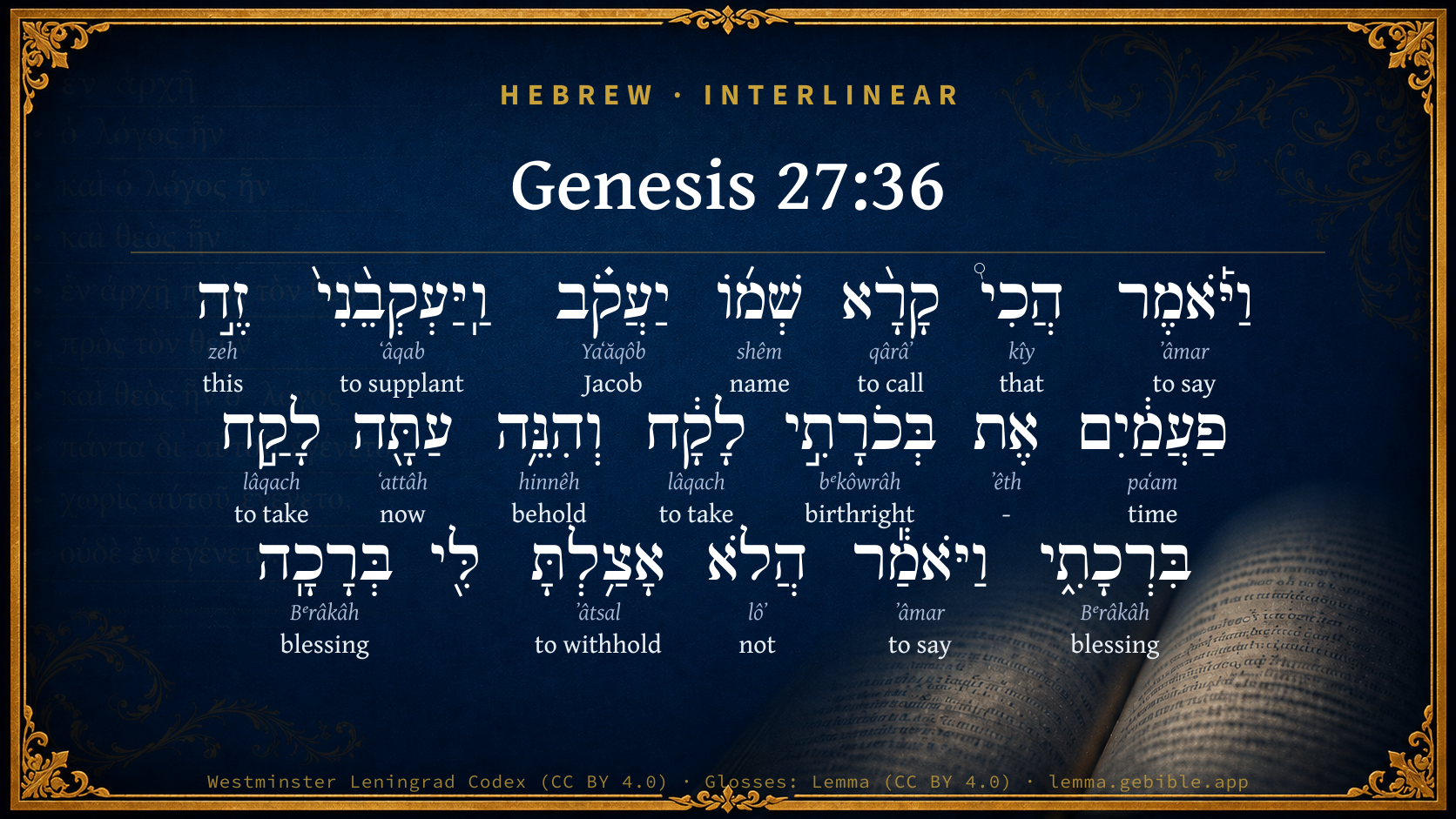
Hebrew (Westminster Leningrad Codex) Genesis 27:36 appears in the Hebrew Old Testament. The text above is from the Westminster Leningrad Codex. Each word links to its Strong’s number, a concise gloss, and parsing drawn from the Open Scriptures Hebrew Bible morphology. Click any word for its full Brown-Driver-Briggs (BDB) entry.
Download image
Cite this verse

Genesis 27:36 (World English Bible). Public Domain. Lemma interlinear Bible study tool, https://lemma.gebible.app/v/genesis/27/36.

Show BibTeX & RIS
BibTeX
RIS
English Translation
He said, "Isn't he rightly named Jacob? For he has supplanted me these two times. He took away my birthright. See, now he has taken away my blessing." He said, "Haven't you reserved a blessing for me?"
World English Bible · Public Domain
Highlights
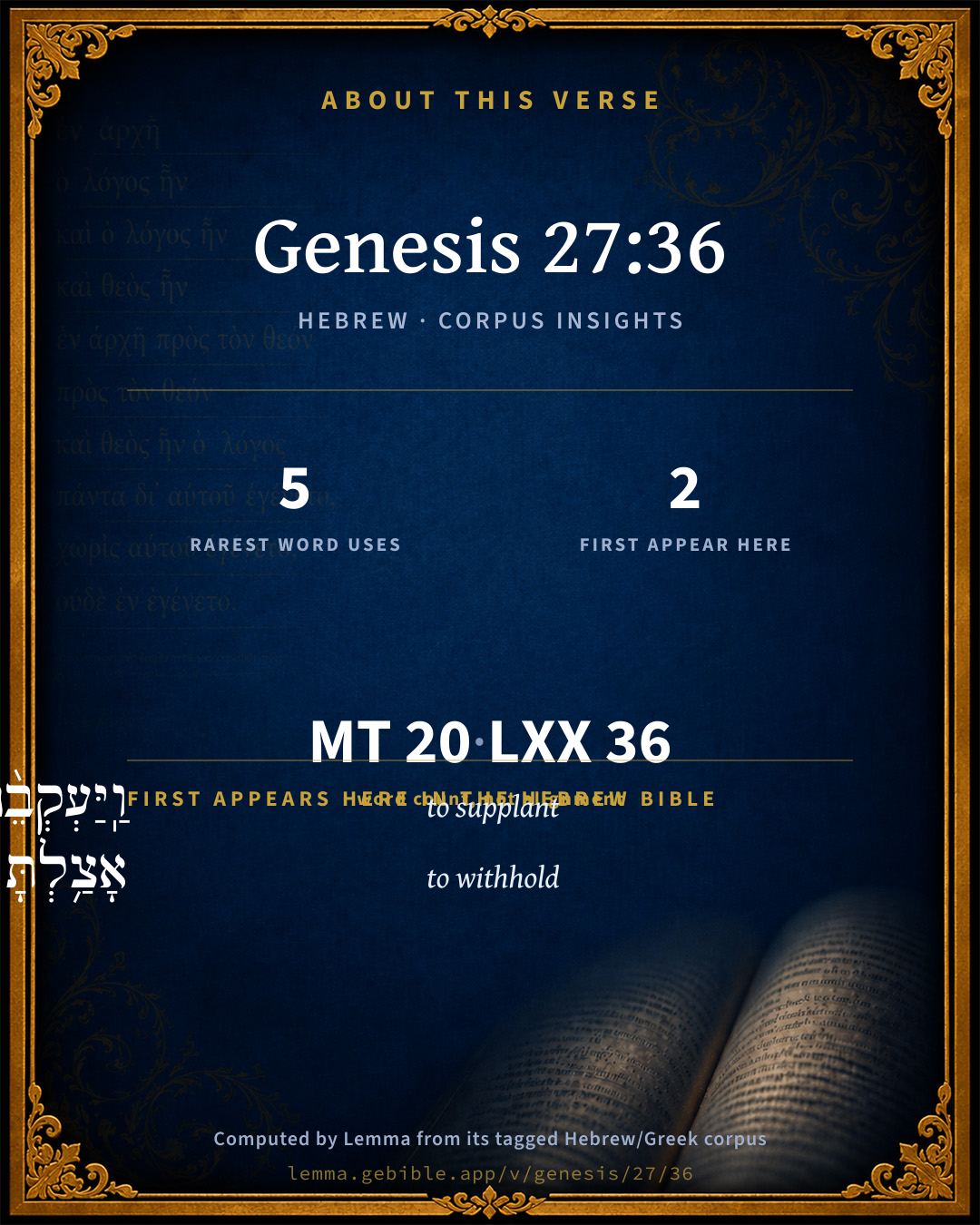
  • 2 first appearances in the Hebrew Bible
Full analysis ↓
Download a study sheet

One document with this verse’s original text, its word-by-word gloss line, the meaning frame, cross-references with their text, attributed commentary, and full source and license credits — printable, and it pastes into notes with its structure intact.

This verse Autodidact and up

Study sheet (.html) Plain text (.txt)

A passage Seminary Student

Up to 50 verses in one chapter. A passage sheet keeps up to 6 commentary sources and 12 cross-references per verse, in the order this page ranks them, and says so on the sheet whenever that leaves anything out. Ask for a single verse and you get the Autodidact verse sheet above.

Everything on this page stays free to read, with no account — the sheet is a download of what is already on screen, not access to it.

Want to remove ads? Support Godless Engineer
Compare translations 3

The same verse in 3 English versions, stacked beneath the original-language interlinear above. Click any original word for its lexicon entry.

Each is an independent rendering of the whole verse — the interlinear is not word-aligned to these translations.

Highlighted words mark where these versions differ — a whole-verse word diff, not a word-by-word alignment.

  • World English Bible Public Domain
    He said, "Isn't he rightly named Jacob? For he has supplanted me these two times. He took away my birthright. See, now he has taken away my blessing." He said, "Haven't you reserved a blessing for me?"
  • King James Version Public Domain
    And he said, Is not he rightly named Jacob? for he hath supplanted me these two times: he took away my birthright; and, behold, now he hath taken away my blessing. And he said, Hast thou not reserved a blessing for me?
  • unfoldingWord Literal Text CC BY-SA 4.0
    Then he said, “Is it because his name is called Jacob that he has defrauded me these two times? He took my birthright, and behold, now he has taken my blessing!” Then he said, “Have you not reserved a blessing for me?”

unfoldingWord Literal Text — © unfoldingWord, licensed CC BY-SA 4.0. Word-aligned USFM3 via Door43 (git.door43.org/unfoldingWord/en_ult).

Versions to compare (up to 4)

3 of 4 selected

Show all 18 translations

Every available English version of this verse, each an independent rendering of the whole verse.

  • World English Bible Public Domain
    He said, "Isn't he rightly named Jacob? For he has supplanted me these two times. He took away my birthright. See, now he has taken away my blessing." He said, "Haven't you reserved a blessing for me?"
  • Berean Standard Bible Public Domain
    So Esau declared, “Is he not rightly named Jacob? For he has cheated me twice. He took my birthright, and now he has taken my blessing.” Then he asked, “Haven’t you saved a blessing for me?”
  • Majority Standard Bible Public Domain
    So Esau declared, “Is he not rightly named Jacob? For he has cheated me twice. He took my birthright, and now he has taken my blessing.” Then he asked, “Haven’t you saved a blessing for me?”
  • King James Version Public Domain
    And he said, Is not he rightly named Jacob? for he hath supplanted me these two times: he took away my birthright; and, behold, now he hath taken away my blessing. And he said, Hast thou not reserved a blessing for me?
  • American Standard Version (1901) Public Domain
    And he said, Is not he rightly name Jacob? for he hath supplanted me these two time. He took away my birthright. And, behold, now he hath taken away my blessing. And he said, Hast thou not reserved a blessing for me?
  • Revised Version (1885) Public Domain
    And he said, Is not he rightly named Jacob? for he hath supplanted me these two times: he took away my birthright; and, behold, now he hath taken away my blessing. And he said, Hast thou not reserved a blessing for me?
  • Geneva Bible (1599) Public Domain
    Then he sayde, Was hee not iustly called Iaakob? for hee hath deceiued mee these two times: he tooke my birthright, and loe, nowe hath he taken my blessing. Also he sayd, Hast thou not reserued a blessing for me?
  • Douay-Rheims (1899) Public Domain
    But he said again: Rightly is his name called Jacob; for he hath supplanted me lo this second time: my first birthright he took away before, and now this second time he hath stolen away my blessing. And again he said to his father: Hast thou not reserved me also a blessing?
  • Young's Literal Translation Public Domain
    And he saith, `Is it because `one' called his name Jacob that he doth take me by the heel these two times? my birthright he hath taken; and lo, now, he hath taken my blessing;' he saith also, `Hast thou not kept back a blessing for me?'
  • Literal Standard Version CC BY-SA 4.0
    And he says, “Is it because he whose name is called Jacob takes me by the heel these two times? He has taken my birthright; and behold, now he has taken my blessing”; he also says, “Have you not kept back a blessing for me?”
  • Unlocked Literal Bible CC BY-SA 4.0
    Esau said, “Is he not rightly named Jacob? For he has cheated me these two times. He took away my birthright, and, see, now he has taken away my blessing.” Then he said, “Have you not reserved a blessing for me?”
  • unfoldingWord Literal Text CC BY-SA 4.0
    Then he said, “Is it because his name is called Jacob that he has defrauded me these two times? He took my birthright, and behold, now he has taken my blessing!” Then he said, “Have you not reserved a blessing for me?”
  • Darby Bible Public Domain
    And he said, Is it not therefore he was named Jacob, for he has supplanted me now twice? He took away my birthright, and behold, now he has taken away my blessing. And he said, Hast thou not reserved a blessing for me?
  • World Messianic Bible Public Domain
    He said, “Isn’t he rightly named Jacob? For he has supplanted me these two times. He took away my birthright. See, now he has taken away my blessing.” He said, “Haven’t you reserved a blessing for me?”
  • Webster's Bible Public Domain
    And he said, Is he not rightly named Jacob? for he hath supplanted me twice: he took away my birth-right; and behold, now he hath taken away my blessing. And he said, Hast thou not reserved a blessing for me?
  • Free Bible Version CC BY-SA 4.0
    “Isn't he well named—Jacob the deceiver!” said Esau. “He's deceived me twice. First he took my birthright, and now he's stolen my blessing! Haven't you kept a blessing for me?”
  • Bible in Basic English Public Domain
    And he said, Is it because he is named Jacob that he has twice taken my place? for he took away my birthright, and now he has taken away my blessing. And he said, Have you not kept a blessing for me?
  • JPS Tanakh (1917) Public Domain
    And he said: 'Is not he rightly named Jacob? for he hath supplanted me these two times: he took away my birthright; and, behold, now he hath taken away my blessing.' And he said: 'Hast thou not reserved a blessing for me?'

Literal Standard Version (2020), Covenant Press — licensed CC BY-SA 4.0. Text via the HelloAO Bible API (eBible.org). Unlocked Literal Bible (unfoldingWord) — licensed CC BY-SA 4.0. Text via the HelloAO Bible API (eBible.org). unfoldingWord Literal Text — © unfoldingWord, licensed CC BY-SA 4.0. Word-aligned USFM3 via Door43 (git.door43.org/unfoldingWord/en_ult). Free Bible Version, Dr. Jonathan Gallagher — licensed CC BY-SA 4.0. Text via the HelloAO Bible API (eBible.org).

Word by word

More ways to search: Search by grammar → Find every occurrence → Compare this word →

Practice this passage: Drill this verse → Learn its vocabulary →

וַֽיַּעְקְבֵ֨נִי֙
ʻâqab
H6117
“and · to supplant · me”
Conjunction + Verb, Qal, Sequential Imperfect, 3rd Person, Masculine, Singular + Suffix, Personal, 1st Person, Common, Singular
Part of Speech
Conjunction + Verb
Stem
Qal
Form
Sequential Imperfect
Person
3rd Person
Gender
Masculine
Number
Singular
Full BDB Definition

Origin: a primitive root

TWOT: 1676

to supplant, circumvent, take by the heel, follow at the heel, assail insidiously, overreach - (Qal) to supplant, overreach, attack at the heel - (Piel) to hold back
  1. וַיֹּ֡אמֶר ʼâmar H559 “and · to say” Conjunction + Verb, Qal, Sequential Imperfect, 3rd Person, Masculine, Singular
  2. הֲכִי֩ kîy H3588 “that” Particle, Interrogative + Conjunction
  3. קָרָ֨א qârâʼ H7121 “to call” Verb, Qal, Perfect, 3rd Person, Masculine, Singular
  4. שְׁמ֜וֹ shêm H8034 “name · his” Noun, Common, Masculine, Singular, Construct + Suffix, Personal, 3rd Person, Masculine, Singular
  5. יַעֲקֹ֗ב Yaʻăqôb H3290 “Jacob” Noun, Proper
  6. זֶ֣ה zeh H2088 “this” Pronoun, Demonstrative, Masculine, Singular
  7. פַעֲמַ֔יִם paʻam H6471 “times” Noun, Common, Feminine, Dual, Absolute
  8. אֶת ʼêth H853 “-” Particle, Direct Object
  9. בְּכֹרָתִ֣י bᵉkôwrâh H1062 “birthright · my” Noun, Common, Both, Singular, Construct + Suffix, Personal, 1st Person, Common, Singular
  10. לָקָ֔ח lâqach H3947 “to take” Verb, Qal, Perfect, 3rd Person, Masculine, Singular
  11. וְהִנֵּ֥ה hinnêh H2009 “and · behold” Conjunction + Particle, Demonstrative
  12. עַתָּ֖ה ʻattâh H6258 “now” Adverb
  13. לָקַ֣ח lâqach H3947 “to take” Verb, Qal, Perfect, 3rd Person, Masculine, Singular
  14. בִּרְכָתִ֑י Bᵉrâkâh H1293 “blessing · my” Noun, Common, Feminine, Singular, Construct + Suffix, Personal, 1st Person, Common, Singular
  15. וַיֹּאמַ֕ר ʼâmar H559 “and · to say” Conjunction + Verb, Qal, Sequential Imperfect, 3rd Person, Masculine, Singular
  16. הֲלֹא lôʼ H3808 “not” Particle, Interrogative + Particle, Negative
  17. אָצַ֥לְתָּ ʼâtsal H680 “to withhold” Verb, Qal, Perfect, 2nd Person, Masculine, Singular
  18. בְּרָכָֽה Bᵉrâkâh H1293 “blessing” Noun, Common, Feminine, Singular, Absolute

About this verse

These counts appear in no published source. They are computed here, from the morphology-tagged text and Lemma’s own curated glosses. What Lemma adds →

20
words
16
distinct lemmas
Pentateuch
section

Notable vocabulary

The rarest word here is וַֽיַּעְקְבֵ֨נִי֙ to supplant H6117 — appearing just 5 times in the whole Hebrew Bible.

First appearance in Scripture

These words make their first canonical appearance in the Hebrew Bible here:

  • וַֽיַּעְקְבֵ֨נִי֙ to supplant H6117
  • אָצַ֥לְתָּ to withhold H680

Shared distinctive vocabulary

וַֽיַּעְקְבֵ֨נִי֙ to supplant H6117 occurs in 4 verses of the Hebrew Bible. Also found in:

Grammatical profile

  • 7 verbs
  • 6 nouns
  • 1 pronoun
  • 1 preposition
  • 1 conjunction
  • 1 adverb
  • 3 particles

Verb forms

  • וַיֹּ֡אמֶר Qal · Sequential Imperfect
  • קָרָ֨א Qal · Perfect
  • וַֽיַּעְקְבֵ֨נִי֙ Qal · Sequential Imperfect
  • לָקָ֔ח Qal · Perfect
  • לָקַ֣ח Qal · Perfect
  • וַיֹּאמַ֕ר Qal · Sequential Imperfect
  • אָצַ֥לְתָּ Qal · Perfect

Repetition

Words recur within this verse — often emphatic in Hebrew:

  • וַיֹּ֡אמֶר to say H559 ×2
  • לָקָ֔ח to take H3947 ×2
  • בִּרְכָתִ֑י blessing H1293 ×2

Hebrew & Septuagint length

In English translation the verse runs 37 words from the Hebrew and 46 from the Septuagint (LXX English) — closely comparable.

A rough comparison of the two English renderings, which tokenize alike — not a word-level alignment.

Word counts can differ between the Hebrew and the Greek without any difference in meaning — e.g. the Hebrew direct-object marker אֵת has no separate Greek word, and Greek often adds the article ὁ.

In the original languages it is 20 Hebrew tokens and 36 Greek tokens — but the two are counted differently (Hebrew bundles its prefixes and suffixes into one token; the Greek is in lemma form), so that isn’t a like-for-like length.

Cross-references

4

Topical passages linked to Genesis 27:36 in the Treasury of Scripture Knowledge — connected by theme and wording, ordered by reader-vote popularity; previews shown in the World English Bible.

  • Genesis 25:26 After that, his brother came out, and his hand had hold on Esau's heel. He was named Jacob. Isaac was sixty years old when she bore them.
  • Genesis 25:31–34 Jacob said, "First, sell me your birthright."
  • Genesis 32:28 He said, "Your name will no longer be called 'Jacob,' but, 'Israel,' for you have fought with God and with men, and have prevailed."
  • John 1:47 Jesus saw Nathanael coming to him, and said about him, "Behold, an Israelite indeed, in whom is no deceit!"

Cross-references courtesy of OpenBible.info (CC BY 4.0).

Hebrew and Greek witnesses Masoretic Hebrew ↔ Greek Septuagint

The same verse in the two great witnesses to the Old Testament, shown verse-for-verse.

These are two independent witnesses, not word-aligned to each other, and the Septuagint is shown in lemma (dictionary) form.

Hebrew Genesis 27:36 Masoretic · Westminster Leningrad Codex

וַיֹּ֡אמֶר הֲכִי֩ קָרָ֨א שְׁמ֜וֹ יַעֲקֹ֗ב וַֽיַּעְקְבֵ֨נִי֙ זֶ֣ה פַעֲמַ֔יִם אֶת בְּכֹרָתִ֣י לָקָ֔ח וְהִנֵּ֥ה עַתָּ֖ה לָקַ֣ח בִּרְכָתִ֑י וַיֹּאמַ֕ר הֲלֹא אָצַ֥לְתָּ לִּ֖י בְּרָכָֽה

He said, "Isn't he rightly named Jacob? For he has supplanted me these two times. He took away my birthright. See, now he has taken away my blessing." He said, "Haven't you reserved a blessing for me?"

World English Bible · Public Domain

Greek LXX Genesis 27:36 Septuagint · lemma form

καί εἶπον δικαίως καλέω ὁ ὄνομα αὐτός ἰακώβ πτερνίζω γάρ ἐγώ ἤδη δεύτερος οὗτος ὁ τε πρωτοτόκιον ἐγώ λαμβάνω καί νῦν λαμβάνω ὁ εὐλογία ἐγώ καί εἶπον ησαυ ὁ πατήρ αὐτός οὐ ὑπολείπω ἐγώ εὐλογία πατήρ

And he said, Rightly was his name called Jacob, for behold! this second time has he supplanted me; he has both taken my birthright, and now he has taken my blessing; and Esau said to his father, Have you not left a blessing for me, father?

LXX2012 (modern English Septuagint) · Public Domain

On this verse, The Cambridge Bible for Schools and Colleges discusses the Septuagint’s reading. Read the note in Commentary ↓

Hebrew: Westminster Leningrad Codex (CC BY 4.0). Greek: Septuagint (public domain); English from LXX2012 (modern English Septuagint) (Public Domain). How the Septuagint differs from the Hebrew →

Targum (Aramaic paraphrase)

2

The Targum is the ancient Jewish Aramaic paraphrase of the Hebrew Scriptures — an interpretive translation, not the Hebrew text itself. Onkelos (literal) and Pseudo-Jonathan (expansive) render the Torah, and Jonathan the Prophets. Coverage is partial: where no permissively-licensed English translation exists for a verse, only the Aramaic is shown. This is verse-level text, not a word-by-word alignment to the Hebrew.

  1. Targum Onkelos Torah (Genesis–Deuteronomy)
    וַאֲמַר יָאוּת קְרָא שְׁמֵהּ יַעֲקֹב וְכָמַנִי דְּנָן תַּרְתֵּין זִמְנִין יָת בְּכֵירוּתִי נְסִיב וְהָא כְּעַן קַבִּיל בִּרְכְּתִי וַאֲמַר הֲלָא שְׁבַקְתָּ לִי בִּרְכְּתָא

    (no public-domain English translation for this verse)

    Targum Onkelos — Aramaic: “Onkelos Genesis” (public domain); “Onkelos Exodus” (public domain); “Onkelos Leviticus” (public domain); “Onkelos Numbers” (public domain); “Onkelos Deuteronomy” (public domain). English: “Sefaria Community Translation” (CC0 1.0 (public-domain dedication)); “J.W. Etheridge. The Targums of Onkelos and Jonathan Ben Uzziel on the Pentateuch. London: Longmans, Green, 1862” (public domain). Text via Sefaria.

  2. Targum Pseudo-Jonathan Torah (Genesis–Deuteronomy)
    וַאֲמַר בְּקוּשְׁטָא קְרָא שְׁמֵיהּ יַעֲקב וּשְׁקַר בִּי דְנַן תַּרְתֵּין זִמְנִין יַת בְּכֵירוּתִי נְסִיב וְהָא כְּדוֹן קַבֵּיל בִּרְכָתִי וַאֲמַר הֲלָא שְׁבַקְתָּא לִי בִּרְכָתָא

    And he said, His name is truly called Jakob; for he hath dealt treacherously with me these two times: my birthright he took, and, behold, now he hath received my blessing! And he said, Hast thou not reserved a blessing for me?

    Targum Pseudo-Jonathan — Aramaic: “Targum Jonathan on Genesis” (public domain); “Targum Jonathan on Exodus” (public domain); “Targum Jonathan on Leviticus” (public domain); “Targum Jonathan on Numbers” (public domain); “Targum Jonathan on Deuteronomy” (public domain). English: “The Targum of Jonathan ben Uzziel, trans. J. W. Etheridge, London, 1862” (public domain). Text via Sefaria.

Commentary

Notes on Genesis 27:36 from classic Christian and Jewish commentators (each source and its license shown beneath its notes). The classic Christian expositions comment on the surrounding passage and are grouped to its opening verse, so a note may address several verses; the Jewish commentaries on the Tanakh (Rashi and others) are per-verse, so they appear only where the commentator wrote on this verse.

Lemma curates 59 commentaries, every one of them public domain or Creative Commons licensed, each selected and text-cleaned for this edition rather than reprinted as found. About our sources →

Trapp's Complete Commentary

John Trapp

Gen 27:36 And he said, Is not he rightly named Jacob? for he hath supplanted me these two times: he took away my birthright; and, behold, now he hath taken away my blessing. And he said, Hast thou not reserved a blessing for me?

Ver. 36. Is he not rightly named Jacob?] He cavils and quarrels at his brother’s guile; at his father’s store, Hast thou but one blessing? &c.; but not a word we hear of his own profaneness. How apt are men to mistake the cause of their sufferings, and to blame anything sooner than their own untowardness!

John Trapp, A Commentary or Exposition upon All the Books of the Old and New Testament (1647–1656) — public domain. Text from a community e-Sword module.

Tyndale Open Study Notes

Tyndale Open Resources

27:36 Esau began to realize Jacob’s true nature, saying he has cheated me (or tripped me up, or deceived me) twice, by taking the birthright (the right of inheritance, Hebrew bekorah; 25:27-34) and by deceiving their father to receive the blessing (the spoken pronouncement of the inheritance, Hebrew berakah). • Esau’s assessment of Jacob was correct, but he failed to see his own ungodliness in these transactions (see study note on 27:5; Heb 12:16).

Tyndale Open Study Notes — © Tyndale Open Resources, licensed CC BY-SA 4.0. Text via the HelloAO Bible API.

Geneva Bible (1599)

Geneva Bible translators

In Gen. 25, he was so called because he held his brother by the heel, as though he would overthrow him: and therefore he is here called an overthrower, or deceiver.

Geneva Bible (1599) marginal notes — public domain. Text via Bolls.life.

Adam Clarke's Commentary

Verse 36. Is not he rightly named Jacob?] See Clarke on Ge 25:26.

He took away my birthright] So he might say with considerable propriety; for though he sold it to Jacob, yet as Jacob had taken advantage of his perishing situation, he considered the act as a species of robbery.

Adam Clarke's Commentary on the Bible (1810–1826) — public domain. Text from a community e-Sword/MySword module.

John Calvin's Commentaries

36. Is he not rightly named Jacob? That the mind of Esau was affected with no sense of penitence appears hence; he accused his brother and took no blame to himself. But the very beginning of repentance is grief felt on account of sin, together with self-condemnation. Esau ought to have descended into himself, and to have become his own judge. Having sold his birthright, he had darted, like a famished dog, upon the meat and the pottage; and now, as if he had done no wrong, he vents all his anger on his brother. Further, if the blessing is deemed of any value, why does he not consider that he had been repelled from it, not simply by the fraud of man, but by the providence of God? We see, therefore, that like a blind man feeling in the dark, he cannot find his way.

John Calvin's Commentaries (1540-1563) — public domain. Text from the Calvin Translation Society English edition (1840s-50s) via the Christian Classics Ethereal Library (ccel.org). Calvin's coverage is partial (roughly two-thirds of the Bible); uncommented books and verses are honest gaps, never fabricated. The 19th-century editor's footnotes and remarks are omitted so the notes are faithfully Calvin's own voice.

Ellicott's Commentary for English Readers

(36) Is not he rightly named Jacob?—In thus playing upon his brother’s name, Esau has had a lasting revenge; for the bad sense which he for the first time put upon the word Jacob has adhered to it, no doubt, because Jacob’s own conduct made it only too appropriate. Its right meaning is “one who follows close upon another’s heels.” (See Note on Gen_25:26.)

A Bible Commentary for English Readers, edited by Charles John Ellicott (1878–1897) — public domain. Text from a community e-Sword module.

The Cambridge Bible for Schools and Colleges

gen. ed. J. J. S. Perowne

36. rightly named Jacob] See note on Gen_25:26.

supplanted] i.e. “outwitted,” “overreached by guile.” The word in the original is of the same root as the word “Jacob.” It is as if Esau had said “he hath ‘Jacob-ed’ me these two times”; “he hath twice overreached me.” See Jer_9:4. LXX ἐπτέρνικε, Lat. supplantavit. Our word “supplant” is probably derived from this context.

he took away my birthright] See Gen_25:29-34. Esau now applies the words “took away” to the transaction in which he was foolish enough, not only to sell his birthright for a “mess of pottage,” but also to ratify his action with an oath. He tries to hide his own folly by denouncing his brother’s part in the affair.

my blessing] The word “my blessing” is spelt in the Heb. with the same consonants as “my birthright,” but with two letters transposed. The difference between the birthright or primogenita, and the blessing or benedictio, is that between a title of privilege and the patent which confers it.

The Cambridge Bible for Schools and Colleges (gen. ed. J. J. S. Perowne; Cambridge University Press, 1878–1918) — public domain. Text from a community e-Sword module.

John Gill's Exposition

And he said, is not he rightly named Jacob?.... As he was by his parents, and those that were at his birth, because he took his brother by the heel as he came out of his mother's womb; for Jacob signifies "heeler", a supplanter, and was given him to keep up the memory of what he had done, to which Esau here refers:

for he hath supplanted me these two times; to supplant another is to put his foot under the heel of another, in order to trip him up, to which Esau alludes; but uses the word in a figurative sense, for circumventing him, and dealing fraudulently and deceitfully with him, though he is not able to support his charge; for if he dealt fraudulently with any, it was with his father, and not with him, and the two times he refers to prove it not:

he took away my birthright; which is not true, he did not take it away from him either by force or fraud, Esau sold it to him for a mess of pottage, Gen 25:29; he had despised and made light of it himself, and had parted with it at so mean a price, and now falsely charges his brother with taking it away from him, and wrongly accuses him of being a supplanter on that account:

and behold, now he hath taken away my blessing; this also is not true, he had not taken it away; it was given him by his father; and though he had used some artful methods with him to get it, Gen 27:15, he had neither supplanted Esau, but if anyone, his father; nor had he done any injustice to Esau, since as he had bought of him the birthright, the blessing annexed to it went along with it, and of right belonged to Jacob:

and he said, hast thou not reserved a blessing for me? is the whole fund of blessings exhausted? are all bestowed upon Jacob? is there not one left for me? he hoped there was, and that as good a one as he had bestowed on his brother, and entreats he might have it.

John Gill's Exposition of the Whole Bible (1746–1763) — public domain (CC PDM 1.0). Text via the HelloAO Bible API.

Haydock's Catholic Bible Commentary

Jacob. That is, a supplanter. (Challoner) --- My blessing. Both Isaac and Esau speak of this blessing, according to the dictates of nature. But God had disposed of it otherwise. The profane and cruel manners of Esau rendered him unworthy of it; and he could not maintain his natural claim, after having freely resigned it even with an oath. He seems to distinguish the blessing from the birth-right, though one necessarily followed the other. (Haydock)

George Leo Haydock (1774–1849), Haydock's Catholic Family Bible and Commentary, 1859 edition — public domain. Excludes Psalms (Douay-Rheims chapter numbering differs from Protestant) and Deuterocanonical books (Catholic canon only).

Matthew Poole's English Annotations

He puts a perverse construction upon Jacob’s name, as if it belonged not to him so properly, because of the manner of his birth, as because of his falseness and deceitfulness, and his tripping up his brother’s heels.

He took away my birthright; a false accusation; Jacob did not take it deceitfully, but Esau sold it profanely.

Matthew Poole's English Annotations on the Holy Bible (1683–1685) — public domain. Text from a community e-Sword/MySword module.

Whedon's Commentary on the Bible

Daniel D. Whedon

36. Rightly named Jacob — Literally, Is it that his name is called Jacob? and he has jacobed me these two times. Thus Esau points to the significancy of Jacob’s name. Comp. Gen_25:26.

Daniel D. Whedon (gen. ed.), Commentary on the Old and New Testaments (1874–1909) — public domain. Text from a community e-Sword module.

The Pulpit Commentary

And he (Esau) said, Is he not rightly named Jacob? literally, is it that one has called ha name Jacob? ykih) being employed when the reason is unknown (vide Ewald, "Hebrews Syut., On the meaning of Jacob cf. Gen_25:26 for (literally, and) he hath supplanted me (a paronomasia on the word Jacob) these two times or, already twice; hz, being used adverbially in the sense of now (Gesenius, "Grammar," The precise import of Esau"s exclamation has been rendered, "Has he not been justly (dikaiwv, LXX; juste, Vulgate; rightly, A.V) named Supplanter from supplanting?" (Rosenm "Is it because he was named Jacob that he hath now twice supplanted me?" (Ainsworth, Bush). "Has he received the name Jacob from the fact that he has twice outwitted me?" (Keil). "Shall he get the advantage of me because he was rims inadvertently named Jacob?" (Lange). "Has in truth his name been called Jacob?" (Kalisch). All agree in bringing out that Esau designed to indicate a correspondence between Jacob"s name and Jacob"s practice. He took away my birthright; this was scarcely correct, since Esau voluntarily sold it (Gen_25:33) and, behold, now he hath taken away my blessing. Neither was this exactly accurate, since the blessing did not originally belong to Esau, however he may have imagined that it did. And he said, Hast thou not reserved a blessing for me? The question indicates that Esau had no proper conception of the spiritual character of the blessing which his brother had obtained.

HOMILIES BY J.F. MONTGOMERY

Ver. 36.

Unfaithfulness in believers.

not he rightly named Jacob?" Jacob, Israel how widely different the thoughts suggested by the two names. Both tell of success. But one is the man of craft, who takes by the heel to trip up. The other, as a prince of God, (cf. Luk_1:15) prevails through believing prayer. Yet Jacob became Israel, and Israel had once been Jacob. The plant of faith has often to struggle through a hard soil. To understand the lessons of his life, remember

1. In contrast to Esau, he was a man of faith. His desire was for a future and spiritual blessing. He believed that it was to be his, and that belief influenced his life. But

2. His faith was imperfect and partial in its operation, and this led to inconsistencies (cf. Mat_14:29, Mat_14:30; Gal_2:12) Naturally quiet, his life was passed chiefly at home. Godly influences undisturbed by outward life taught him to worship God, and to prize his promise. But he had not proved his armor; (cf. 1Co_10:12) and, as often happens, the object of his faith was the means of his trial. His father"s purpose in favor of Esau shook his faith (cf. 1Pe_4:18) He yielded to the suggestion to obtain by deceit what God had promised to give, (Isa_49:1) and earned his brother"s taunt, "Is not he rightly named Jacob?" Yet it does not appear that he was conscious of having failed in faith. Consider

I THE DANGER OF SELF-DECEIVING (cf. Eze_13:10) One brought up among godly influences may seem to possess faith. Ways of faith, hopes of faith, may be familiar to him. He may really embrace them, really desire a spiritual prize. But not without cause are we warned. (1Co_10:12) Some plan of worldly wisdom, some point of self-seeking or self-indulgence, attracts him; only a little way; not into anything distinctly wrong. Or he falls into indolent self-sufficiency. Then there is a shrinking from close walk with God. Formality takes the place of confidence. All may seem outwardly well; but other powers than God"s will are at work within. And if now some more searching trial is sent, some more distinct choice between God and the world, a self-satisfying plea is easily found. And the self-deceit which led to the fall makes it unfelt. And the path is lighted, but not from God. (Isa_1:11)

II THE HARM DONE TO OTHERS BY UNFAITHFULNESS OFCHRISTIANS (cf. Rom_2:24 Rom_14:16) The world is quick to mark inconsistencies of believers. They form an excuse for the careless, a plea for disbelieving the reality of holiness. And for weak Christians they throw the influence of example on the wrong side (cf. 1Co_8:9) Deeds have more power than words; and the course of a life may be turned by some thoughtless yielding. Nor can the harm be undone even by repentance. The failure is visible, the contrition and seeking pardon are secret. The sins of good men are eagerly retailed. The earnest supplication for pardon and restoration are known to few, and little cared for. The man himself may be forgiven, and rise stronger from his fall; but the poison in the soul of another is still doing its deadly work.

III THE WAY OF SAFETY. Realize the living Christ. (Eph_3:17) Rules of themselves can do little; but to know the love of Christ, to bear it in mind, is power. M.

The Pulpit Commentary (1880–1919), ed. H.D.M. Spence-Jones & Joseph S. Exell — public domain. Text from a community e-Sword module.

unfoldingWord translationNotes

Door43 World Missions Community

Is he not rightly named Jacob?

Esau uses a question to emphasize his anger at Jacob. AT: "Jacob is certainly the right name for my brother!" (See: Rhetorical Question)

Jacob

Translators may also add a footnote that says: "The name Jacob means 'he grasps the heel.' In the original language the name 'Jacob' also sounds like the word for 'he deceives.'"

He took away my birthright

This speaks about a birthright as if it were an object that a person could take away. AT: "What was once my birthright is now his because he tricked me" (See: Metaphor)

now he has taken away my blessing

This speaks about a blessing as if it were an object that person could take away. AT: "now he has tricked you into blessing him instead of me" (See: Metaphor)

Have you not reserved a blessing for me

Esau knows that his father cannot bless him with the same things that he blessed Jacob. Esau is asking if there is anything left to say to him that Isaac did not say while blessing Jacob.

What more can I do for you, my son?

Isaac uses a question to emphasize that there is nothing else he can do. AT: "There is nothing else I can do for you!" (See: Rhetorical Question)

translationWords

Esau

Jacob

birthright

bless

lord

servant

grain

wine

unfoldingWord translationNotes — © Distant Shores Media and the Door43 World Missions Community, licensed CC BY-SA 4.0. Source: git.door43.org/Door43/en_tn.

Rashi

Rabbi Shlomo Yitzchaki (Rashi)

הכי קרא שמו IS IT BECAUSE HE HAS BEEN CALLED [JACOB]—This is a question, like (29:15) “Is it because (הכי) thou art my brother?” Perhaps that is why they have given him the name Jacob — in reference to what was to happen in the future — that he would some time or other supplant me (יעקבני)? (Tanchuma). Why did Isaac tremble? He thought: Perhaps I have sinned in blessing the younger before the elder, thus changing the order of relationship between them. But when Esau began to cry out, “for he hath supplanted me these two times”, his father asked him, “What did he do to you?” He replied, “He took away my birth-right”. Isaac thereupon said, “It was on account of this that I was grieved and trembled: perhaps I had overstepped the line of strict justice. Now, however, I have really blessed the first-born — ‘And he shall indeed be blessed’”.

ויעקבני THAT HE HATH SUPPLANTED ME — Explain it as the Targum renders it, וחכמני, which means “and he lay in wait for me.” The word (Deuteronomy 19:11) וארב “and he lies in wait” is rendered by the Targum וכמי. There are some who read in the Targum not וכמני but וחכמני which means “he showed himself clever against me” (outwitted me).

אצלת HAST THOU NOT RESERVED — the word means “separating״, “setting aside״, like (Numbers 11:25) “And he separated.

Rashi on the Tanakh — English translations: “The Judaica Press complete Tanach with Rashi, translated by A. J. Rosenberg” (CC BY 4.0); “Pentateuch with Rashi's commentary by M. Rosenbaum and A.M. Silbermann, 1929-1934” (public domain); “The Metsudah Tanach series, Lakewood, N.J” (CC BY 4.0); and “The Book of Joshua, Metsudah Publications, 1997” (CC BY 4.0). Text via Sefaria.

Radak

Rabbi David Kimhi (Radak)

ויאמר, when Esau heard that his brother had used subterfuge to obtain the blessing by making his hands appear as if they were hairy, he said: הכי קרא שמו יעקב, “he was called the crooked one for good reason!” The letter ה at the beginning of the word הכי serves as confirmation of something, as if to say: “truly!” We find it used in a similar sense in Kings I 21,19 הרצחת וגם ירשת!, “ You not only murdered but meant to inherit!” Or, Numbers 20,10: המן הסלע הזה! “from this very rock!” Esau said that Yaakov had truly deserved the name they had given him at birth. Actually, the word יעקב has two connotations; one is connected to deviousness, deceit, as in Jeremiah 17,10 עקוב הלב, “the heart is full of deceit;” or, also from Jeremiah 9,3 כי כל אח עקוב יעקב, “every brother takes advantage.” On the other hand, the word also is derived from עקב, heel, not a negative connotation at all, but possibly a positive one, suggesting humility, modesty, the opposite of pushiness. Yaakov combined both qualities.

ויעקבני, he tricked me twice.

את בכורתי לקח, there is no greater type of craftiness than to exploit one’s brother’s hunger and fatigue and to buy his birthright for a dish of lentils. Now he has also taken my blessing by deceit.

הלא אצלת לי ברכה, “you have not even reserved a minor blessing for me!” You have given everything to him. How could that be?

Radak on the Tanakh — English translations: “Sefaria Community Translation” (CC0 1.0 (public-domain dedication)); “Eliyahu Munk, HaChut Hameshulash” (CC BY 4.0); “Rabbi Mike Feuer, Jerusalem Anthology” (CC BY 4.0); and “R. David Kimhi on the first book of Psalms, Translated by R.G. Finch, London, 1919” (public domain). Text via Sefaria.

Lesson kit

Teaching starters — assembled from the data on this page, not authored interpretation. Every prompt links to the verse data it draws on. Edit before teaching.

Genesis, in the Pentateuch, opens this verse with 20 words (16 distinct Hebrew lemmas). Its most distinctive word is ʻâqab (“to supplant”). A historical commentator’s framing appears above. Read the whole chapter for the surrounding context.

Discussion questions

  1. The word ʻâqab carries the sense “to supplant.” How does it shape the verse?
  2. 2 words here appear for the first time in Scripture. What is being introduced at this debut?
  3. Job 37:4 shares the word «to supplant» with this verse. How do the two illuminate each other?
  4. “to say” occurs 2× in this one verse. What is the effect of the repetition?
  5. The translations on this page render this verse differently — a whole-verse word diff, not a word-by-word alignment. What might account for the different wordings?
  6. The verb «וַיֹּ֡אמֶר» is Qal Sequential Imperfect. How does its form color the action?
  7. Reading how Trapp's Complete Commentary and Tyndale Open Study Notes read this verse, where do the two commentators agree and where do they part?

Things to notice

Reading settings

Reading text

Shown beneath each verse's original-language words.

Old Testament
Old Testament edition

Read the OT as the Masoretic Hebrew (MT) or the Greek Septuagint (LXX).

English shown for the Greek Septuagint (in the Hebrew ↔ Greek comparison).

Comparing translations? Open the Compare panel on any verse page to stack up to four side by side.