
Psalms 22:9

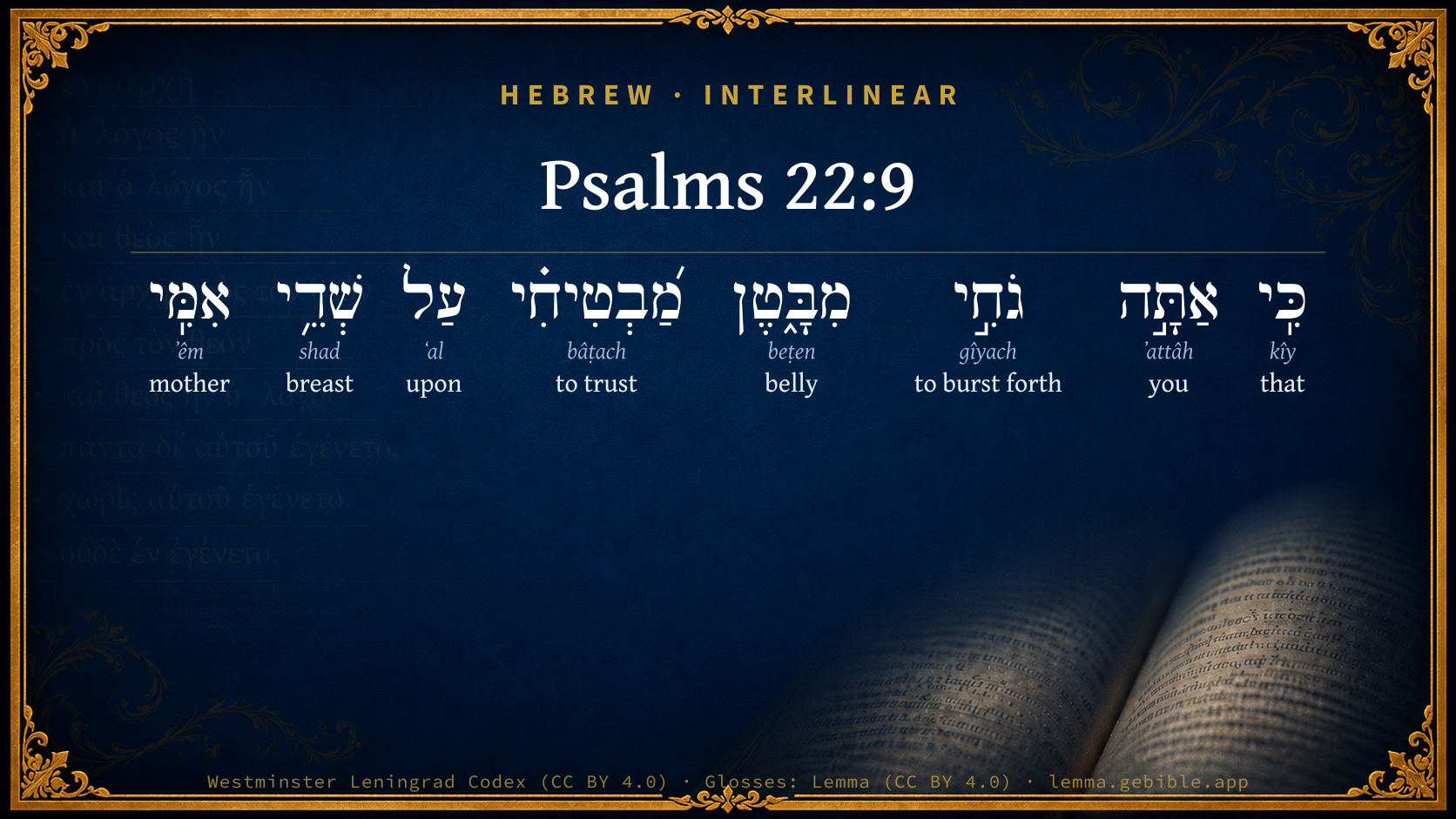
Hebrew (Westminster Leningrad Codex) Psalms 22:9 appears in the Hebrew Old Testament. The text above is from the Westminster Leningrad Codex. Each word links to its Strong’s number, a concise gloss, and parsing drawn from the Open Scriptures Hebrew Bible morphology. Click any word for its full Brown-Driver-Briggs (BDB) entry.
Download image
Cite this verse

Psalms 22:9 (World English Bible). Public Domain. Lemma interlinear Bible study tool, https://lemma.gebible.app/v/psalms/22/9.

Show BibTeX & RIS
BibTeX
RIS
English Translation
But you brought me out of the womb. You made me trust at my mother's breasts.
World English Bible · Public Domain
Download a study sheet

One document with this verse’s original text, its word-by-word gloss line, the meaning frame, cross-references with their text, attributed commentary, and full source and license credits — printable, and it pastes into notes with its structure intact.

This verse Autodidact and up

Study sheet (.html) Plain text (.txt)

A passage Seminary Student

Up to 50 verses in one chapter. A passage sheet keeps up to 6 commentary sources and 12 cross-references per verse, in the order this page ranks them, and says so on the sheet whenever that leaves anything out. Ask for a single verse and you get the Autodidact verse sheet above.

Everything on this page stays free to read, with no account — the sheet is a download of what is already on screen, not access to it.

Want to remove ads? Support Godless Engineer
Compare translations 3

The same verse in 3 English versions, stacked beneath the original-language interlinear above. Click any original word for its lexicon entry.

Each is an independent rendering of the whole verse — the interlinear is not word-aligned to these translations.

Highlighted words mark where these versions differ — a whole-verse word diff, not a word-by-word alignment.

  • World English Bible Public Domain
    But you brought me out of the womb. You made me trust at my mother's breasts.
  • King James Version Public Domain
    But thou art he that took me out of the womb: thou didst make me hope when I was upon my mother's breasts.
  • unfoldingWord Literal Text CC BY-SA 4.0
    Yet you are the one pulling me out from the womb, making me trust upon the breasts of my mother.

unfoldingWord Literal Text — © unfoldingWord, licensed CC BY-SA 4.0. Word-aligned USFM3 via Door43 (git.door43.org/unfoldingWord/en_ult).

Versions to compare (up to 4)

3 of 4 selected

Show all 18 translations

Every available English version of this verse, each an independent rendering of the whole verse.

  • World English Bible Public Domain
    But you brought me out of the womb. You made me trust at my mother's breasts.
  • Berean Standard Bible Public Domain
    Yet You brought me forth from the womb; You made me secure at my mother’s breast.
  • Majority Standard Bible Public Domain
    Yet You brought me forth from the womb; You made me secure at my mother’s breast.
  • King James Version Public Domain
    But thou art he that took me out of the womb: thou didst make me hope when I was upon my mother's breasts.
  • American Standard Version (1901) Public Domain
    But thou art he that took me out of the womb; Thou didst make me trust `when I was' upon my mother's breasts.
  • Revised Version (1885) Public Domain
    But thou art he that took me out the womb: thou didst make me trust when I was upon my mother’s breasts.
  • Geneva Bible (1599) Public Domain
    But thou didest draw me out of ye wombe: thou gauest me hope, euen at my mothers breasts.
  • Douay-Rheims (1899) Public Domain
    He hoped in the Lord, let him deliver him: let him save him, seeing he delighteth in him.
  • Young's Literal Translation Public Domain
    For thou `art' He bringing me forth from the womb, Causing me to trust, On the breasts of my mother.
  • Literal Standard Version CC BY-SA 4.0
    For You [are] He bringing Me forth from the womb, || Causing Me to trust, || On the breasts of My mother.
  • Unlocked Literal Bible CC BY-SA 4.0
    For you brought me from the womb; you made me trust you when I was on my mother's breasts.
  • unfoldingWord Literal Text CC BY-SA 4.0
    Yet you are the one pulling me out from the womb, making me trust upon the breasts of my mother.
  • Darby Bible Public Domain
    But thou art he that took me out of the womb; thou didst make me trust, upon my mother's breasts.
  • World Messianic Bible Public Domain
    But you brought me out of the womb. You made me trust while at my mother’s breasts.
  • Webster's Bible Public Domain
    \\22:8\\He trusted on the LORD that he would deliver him: let him deliver him, seeing he delighted in him.
  • Free Bible Version CC BY-SA 4.0
    However, you brought me safely through birth, and led me to trust in you at my mother's breasts.
  • Bible in Basic English Public Domain
    But it was you who took care of me from the day of my birth: you gave me faith even from my mother's breasts.
  • JPS Tanakh (1917) Public Domain
    (22-10) For Thou art He that took me out of the womb; Thou madest me trust when I was upon my mother's breasts.

Literal Standard Version (2020), Covenant Press — licensed CC BY-SA 4.0. Text via the HelloAO Bible API (eBible.org). Unlocked Literal Bible (unfoldingWord) — licensed CC BY-SA 4.0. Text via the HelloAO Bible API (eBible.org). unfoldingWord Literal Text — © unfoldingWord, licensed CC BY-SA 4.0. Word-aligned USFM3 via Door43 (git.door43.org/unfoldingWord/en_ult). Free Bible Version, Dr. Jonathan Gallagher — licensed CC BY-SA 4.0. Text via the HelloAO Bible API (eBible.org).

Word by word

More ways to search: Search by grammar → Find every occurrence → Compare this word →

Practice this passage: Drill this verse → Learn its vocabulary →

About this verse

These counts appear in no published source. They are computed here, from the morphology-tagged text and Lemma’s own curated glosses. What Lemma adds →

8
words
8
distinct lemmas
Wisdom
section

Notable vocabulary

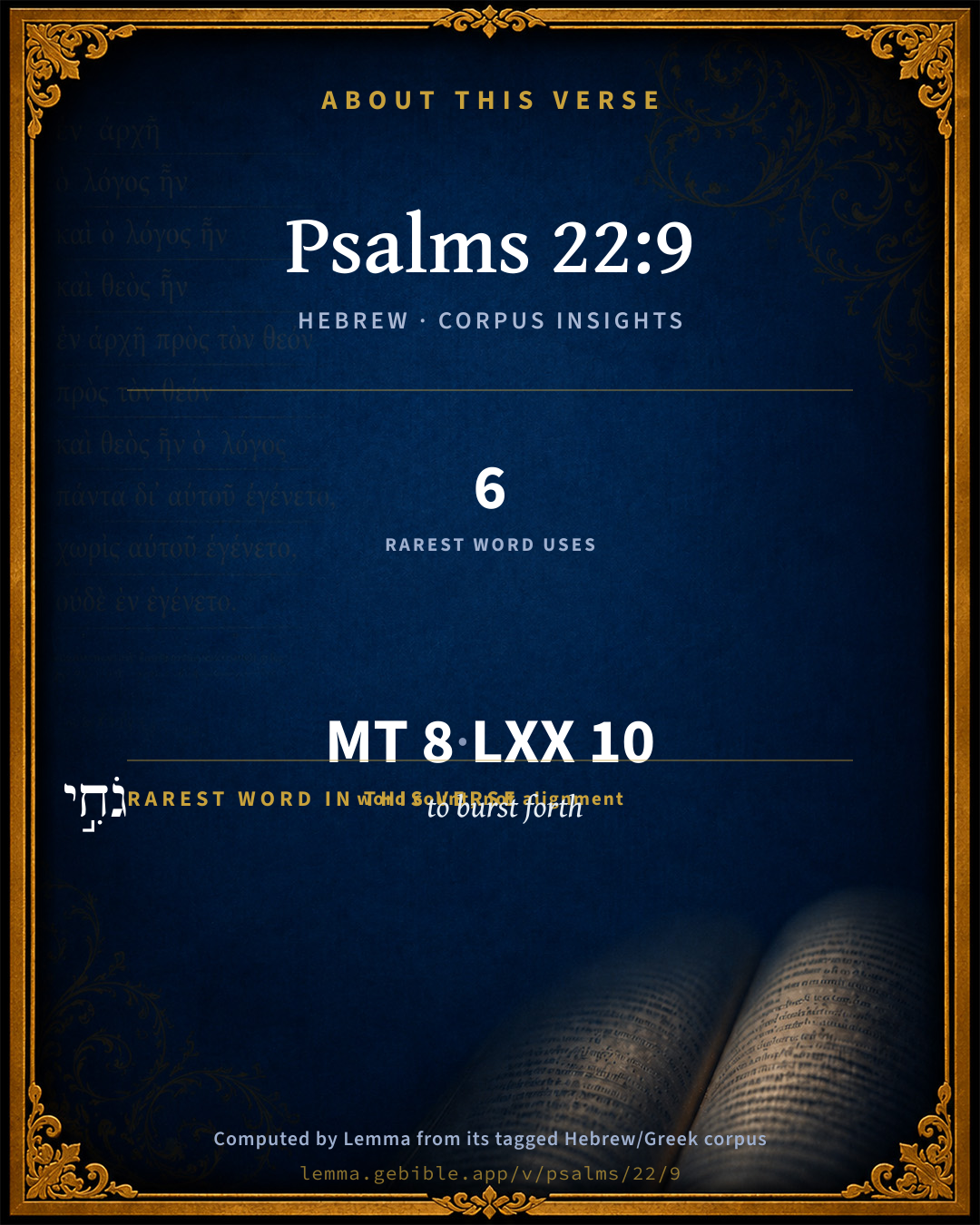
The rarest word here is גֹחִ֣י to burst forth H1518 — appearing just 6 times in the whole Hebrew Bible.

Shared distinctive vocabulary

גֹחִ֣י to burst forth H1518 occurs in 6 verses of the Hebrew Bible. Also found in:

Grammatical profile

  • 2 verbs
  • 3 nouns
  • 1 pronoun
  • 1 preposition
  • 1 conjunction

Verb forms

  • גֹחִ֣י Qal · Participle Active
  • מַ֝בְטִיחִ֗י Hiphil · Participle Active

Hebrew & Septuagint length

In English translation the verse runs 16 words from the Hebrew and 17 from the Septuagint (LXX English) — closely comparable.

A rough comparison of the two English renderings, which tokenize alike — not a word-level alignment.

Word counts can differ between the Hebrew and the Greek without any difference in meaning — e.g. the Hebrew direct-object marker אֵת has no separate Greek word, and Greek often adds the article ὁ.

In the original languages it is 8 Hebrew tokens and 10 Greek tokens — but the two are counted differently (Hebrew bundles its prefixes and suffixes into one token; the Greek is in lemma form), so that isn’t a like-for-like length.

Cross-references

8

Topical passages linked to Psalms 22:9 in the Treasury of Scripture Knowledge — connected by theme and wording, ordered by reader-vote popularity; previews shown in the World English Bible.

  • Psalms 71:6 I have relied on you from the womb. You are he who took me out of my mother's womb. I will always praise you.
  • Isaiah 49:1–2 Listen, isles, to me; and listen, you peoples, from far: Yahweh has called me from the womb; from the bowels of my mother has he made mention of my name:
  • Psalms 71:17 God, you have taught me from my youth. Until now, I have declared your wondrous works.
  • Psalms 139:15–16 My frame wasn't hidden from you, When I was made in secret, Woven together in the depths of the earth.
  • Matthew 2:13–15 Now when they had departed, behold, an angel of the Lord appeared to Joseph in a dream, saying, "Arise and take the young child and his mother, and flee into Egypt, and stay there until I tell you, for Herod will seek the young child to destroy him."
  • Isaiah 9:6 For to us a child is born, to us a son is given; and the government shall be on his shoulder: and his name shall be called Wonderful, Counselor, Mighty God, Everlasting Father, Prince of Peace.
  • Isaiah 7:14–15 Therefore the Lord himself will give you a sign. Behold, the virgin will conceive, and bear a son, and shall call his name Immanuel.
  • Revelation 12:4–5 His tail drew one third of the stars of the sky, and threw them to the earth. The dragon stood before the woman who was about to give birth, so that when she gave birth he might devour her child.

Cross-references courtesy of OpenBible.info (CC BY 4.0).

Hebrew and Greek witnesses Masoretic Hebrew ↔ Greek Septuagint

The same verse in the two great witnesses to the Old Testament, shown verse-for-verse.

You’re reading Greek Psalm 21 (Hebrew Psalm 22). The Septuagint counts the superscription, so verse numbers can differ from the Hebrew — chapter-level alignment, not verse-by-verse. Numbering follows Rahlfs.

These are two independent witnesses, not word-aligned to each other, and the Septuagint is shown in lemma (dictionary) form.

Hebrew Psalms 22:9 Masoretic · Westminster Leningrad Codex

כִּֽי אַתָּ֣ה גֹחִ֣י מִבָּ֑טֶן מַ֝בְטִיחִ֗י עַל שְׁדֵ֥י אִמִּֽי

But you brought me out of the womb. You made me trust at my mother's breasts.

World English Bible · Public Domain

Greek LXX Greek Psalm 21:9 Septuagint · lemma form

ἐλπίζω ἐπί κύριος ῥύομαι αὐτός σώζω αὐτός ὅτι θέλω αὐτός

For you are he that drew me out of the womb; my hope from my mother's breasts.

LXX2012 (modern English Septuagint) · Public Domain

On this verse, The Cambridge Bible for Schools and Colleges discusses the Septuagint’s reading. Read the note in Commentary ↓

Hebrew: Westminster Leningrad Codex (CC BY 4.0). Greek: Septuagint (public domain); English from LXX2012 (modern English Septuagint) (Public Domain). How the Septuagint differs from the Hebrew →

Commentary

Notes on Psalms 22:9 from classic Christian and Jewish commentators (each source and its license shown beneath its notes). The classic Christian expositions comment on the surrounding passage and are grouped to its opening verse, so a note may address several verses; the Jewish commentaries on the Tanakh (Rashi and others) are per-verse, so they appear only where the commentator wrote on this verse.

Lemma curates 59 commentaries, every one of them public domain or Creative Commons licensed, each selected and text-cleaned for this edition rather than reprinted as found. About our sources →

Trapp's Complete Commentary

John Trapp

Psa 22:9 But thou [art] he that took me out of the womb: thou didst make me hope [when I was] upon my mother’s breasts.

Ver. 9. But thou art he that took me out of the womb] When, but for thine almighty midwifery, I might have been strangled; or, as an untimely birth, never seen the sun. It is no less than a miracle that the child is kept alive in the womb, and perisheth not in the midst of those excrements, and that, in coming forth, it dieth not, &c. The very opening and shutting again of the body when the child is to be born is a thing so incomprehensible that some naturalists acknowledge the immediate hand and power of God in it. But because it is a common mercy little notice is taken or use made of it.

Thou didst make me hope] Or, keptest me in safety; for puerilitas est periculorum pelagus, a thousand deaths and dangers little ones are subject to; but God preserveth and provideth: et haec non sunt per accidens, saith Kimchi, these things are not by chance, but by Divine providence.

John Trapp, A Commentary or Exposition upon All the Books of the Old and New Testament (1647–1656) — public domain. Text from a community e-Sword module.

The Biblical Illustrator

Joseph S. Exell

Psa_22:9-10

Thou art He that took me out of the womb.

Davids acknowledgment of Gods goodness

1. He takes notice of common mercies. Such mercies as most men are partakers of. To come safe and sound into the world, and to be persuaded and sustained in it, they are such things as most men have allotted and vouchsafed unto them. But there are very few who are sensible of common mercies,--such is the corruption of our nature and our base ingratitude.

2. He acknowledges ancient mercies. He remembers those mercies which another would have forgotten. The mercies of his infancy and childhood and younger years. We should remember both temporal and spiritual mercies.

3. He remembers primitive or original mercies. Those mercies which he had at first, in the very entrance or beginning of his life when he first came into the world, and were likewise the ground and foundation of all the rest. It is with mercies as with judgments, one makes way for another, and the first is so much the more considerable as it induces and brings in the rest.

4. He takes notice of constant mercies. Those which were continued to him from the first moment of his being till now, through the whole course of his life to this present. He takes notice of the goodness of God to him in the full latitude and extent of it. See now the specification of the several particulars.

(1) The blessings of the womb, in his birth and first coming into the world.

(2) The blessings of the breast, in his nursery and first sustentation in the world.

(3) The blessing of the cradle, in the tutelary care of his orphanage and desolate condition.

(4) The blessings of the covenant, in the continued and mutual interest which he had in God and God in him. (T. Horton, D. D.)

Thou didst make me hope when I was upon my mothers breasts.--

On the nature and influence of hope

To a contemplative mind nothing will suggest more powerful inducements, perhaps, for adoring the wisdom and the goodness of God than a distinct consideration of the many faculties, passions, and propensities with which a human creature is furnished. Exposed to various evils; encompassed with manifold infirmities; subject to pain and labour, to poverty, disease, and death, we might soon feel life a burden unless there were some pervading principle which seems to connect us with futurity, and bids us forget our past calamities and our present sorrows in the bright prospects that are to come. Hence by the goodness of God we are all possessed of that lasting and universal passion, Hope. Now let us consider--

I. Its nature and influence. It enters largely into every mans system of happiness, whether they be prosperous or afflicted. It is the spring of mens conduct, the end of their life. It keeps his soul alive within him, invigorates his faculties, purifies his passions, and directs the exertions both of his mind and body to their proper objects.

II. By what principles to regulate it. A passion so general, and that has such an influence on the sum of life, cannot be too carefully regulated nor disciplined to its proper objects. In this, as in most other cases of moral and religious duty, the folly and the danger of extremes should be avoided. The happy medium, which we should all labour to attain on the present occasion, lies equally remote from silly and extravagant expectations,--from sluggish indifference and helpless despondency, or the dead calm of insensibility. The one is apt to lead to every kind of excess, and to end in misery and disappointment; the other disqualifies us for fulfilling the duties of life, and is, in fact, the destruction or subversion of every virtue.

III. The objects to which it should be directed. These are to be found in the blessed future world. (J. Hewlett, B. D.)

The meaning of hope as an instinct of the soul

The text is a strong figure intended to express the idea that hope is an inbred sentiment of the soul. The body, it is true, may exist without the eye, but in a very incomplete state. And there are emaciated souls, souls with deadened senses and broken faculties. But hope is yet an instinct keeping the face of the soul ever towards the future. Now, this instinct--

I. Implies the goodness of God in the constitution of our nature. For it is one of the chief blessings of humanity.

1. It is one of the most powerful impulses to action.

2. It is one of the chief elements of support under trial. Hope buoys us up beneath the load; gives us a steady anchorage amid the fiercest surgings of the storm.

3. It is a source of joy. The joys of memory and the pleasures of the passing hour are not to be compared with the joys of hope.

II. Suggests a future state of existence. It may not prove such existence, but it does much in that direction. For--

1. Analogy supports it. All our senses and appetites have provision made for them--light for the eye, sounds for the ear, etc. And so in our social relations.

2. The Divine goodness leads to belief in it.

III. Means that progress in blessedness is the law of our being. Hope points not only to the future, but to good in the future.

IV. Shows the fitness of Christianity to human nature. For--

1. It reveals eternal blessedness; and--

2. Supplies means of its attainment which are both soul pacifying and purifying.

V. Indicates the congruity of the religious life with our nature. Therefore, if we quench this hope midnight reigns; and sin tends to do this. (D. Thomas, D. D.)

The Biblical Illustrator, edited by Joseph S. Exell (c. 1880s–1900s) — public domain. Text from a community e-Sword module.

The Treasury of David

Charles H. Spurgeon

Ver. 9. But thou art he that took me out of the womb. Kindly providence attends with the surgery of tenderness at every human birth; but the Son of Man, who was marvellously begotten of the Holy Ghost, was in an especial manner watched over by the Lord when brought forth by Mary. The destitute state of Joseph and Mary, far away from friends and home, led them to see the cherishing hand of God in the safe delivery of the mother, and the happy birth of the child; that Child now fighting the great battle of his life, uses the mercy of his nativity as an argument with God. Faith finds weapons everywhere. He who wills to believe shall never lack reasons for believing.

Thou didst make me hope when I was upon my mother's breasts. Was our Lord so early a believer? Was he one of those babes and sucklings out of whose mouths strength is ordained? So it would seem; and if so, what a plea for help! Early piety gives peculiar comfort in our after trials, for surely he who loved us when we were children is too faithful to cast us off in our riper years. Some give the text the sense of "gave me cause to trust, by keeping me safely", and assuredly there was a special providence which preserved our Lord's infant days from the fury of Herod, the dangers of travelling, and the ills of poverty.

Ver. 9-10. Faith is much strengthened by constant evidences of God's favour. Herewith did he support his faith that said to God, Thou art he that took me out of the womb: thou didst make me hope when I was upon my mother's breasts. I was cast upon thee from the womb: thou art my God from my mother's belly. "Thou art my trust from my youth. By thee have I been holden up from the womb: thou art he that took me out of my mother's bowels." Ps 71:5-6. It was not only the disposition of Obadiah towards God, but also the evidence that thereby he had of God's affection towards him, that made him with confidence say to Elijah, "I fear the Lord from my youth." 1Ki 18:12. By long continuance of ancient favour, many demonstrations are given of a fast, fixed, and unremovable affection. So as if, by reason of temptations, one or more evidences should be questioned, yet others would remain to uphold faith, and to keep it from an utter languishing, and a total falling away. As when a house is supported by many pillars, though some be taken away, yet by the support of them which remain, the house will stand. William Gouge.

Ver. 9-10. David acknowledges ancient mercies, those mercies which had been cast upon him long ago, these were still fresh and new in his memory, and this is one affection and disposition of a thankful heartto remember those mercies which another would have quite forgotten, or never thought of. Thus does David here; the mercies of his infancy, and his childhood, and his younger years, which one would have imagined, that now in his age had been quite out of his mind; yet these does he here stir up himself to remember and bring to his thoughts. Took me out of the womb: when was that? It may have been threescore years ago when David penned the Psalms. He thinks of those mercies which God vouchsafed him when he was not capable of thinking, nor considering what was bestowed upon him; and so are we taught hence to do, in an imitation of this holy example which is here set before us: those mercies which God hast bestowed in our minority, we are to call to mind and acknowledge in our riper years. Thomas Horton.

Ver. 9-10. Here the tribulation begins to grow lighter, and hope inclines towards victory; a support, though small, and sought out with deep anxiety, is now found. For after he had felt that he had suffered without any parallel or example, so that the wonderful works of God as displayed toward the fathers afforded him no help, he comes to the wonderful works of God toward himself, and in these he finds the goodwill of God towards him, and which was displayed towards him alone in so singular a way. Martin Luther.

Ver. 9-10. The bitter severity of the several taunts with which his enemies assailed our Lord, had no other effect than to lead the Saviour to make a direct appeal to his Father... That appeal is set before us in these two verses. It is of an unusual and remarkable nature. The argument on which it is founded is most forcible and conclusive. At the same time, it is the most seasonable and appropriate that can be urged. We may thus paraphrase it, "I am now brought as a man to my last extremity. It is said that God disowns me; but it cannot be so. My first moment of existence he tenderly cared for. When I could not even ask for, or think of his kindness, he bestowed it upon me. If, of his mere good pleasure he brought me into life at first, he will surely not forsake me when I am departing out of it. In opposition, therefore, to all their taunts, I can and I will appeal to himself. Mine enemies declare, O God, that thou hast cast me offbut thou art he that took me out of the womb. They affirm that I do not, and need not trust in thee; but thou didst make me hope (or, kept me in safety, margin) when I was upon my mother's breasts. They insinuate that thou wilt not acknowledge me as thy Son; but I was cast upon thee from the womb; thou art my God from my mother's belly." John Stevenson.

Ver. 9-10. See Psalms on "Ps 22:9" for further information.

Ver. 9-10. See Psalms on "Ps 22:9" for further information.

Ver. 9-10. See Psalms on "Ps 22:9" for further information.

Ver. 9-10. See Psalms on "Ps 22:9" for further information.

Charles H. Spurgeon's The Treasury of David (1869–1885) — public domain. Psalms only. Text from a community e-Sword/MySword module.

Joseph Benson's Commentary

Psa 22:9-10. Thou art he, &c. — This seems to refer to the miraculous conception of Christ, who was the Son of God, in a sense in which no other man ever was, being formed, as to his human nature, by the power of God, in the womb of a pure virgin. Therefore he said, at his entrance into the world, Sacrifice and offering thou wouldest not, but a body hast thou prepared me. Thou didst make me hope — Or, trust, that is, Thou didst give me sufficient ground for hope and trust, if I had been capable of it, because of thy wonderful and watchful care over me in that weak and helpless state; when I was upon my mother’s breasts — When I was a sucking child. This was eminently true of Christ, whom God so miraculously preserved and provided for in his infancy, giving, in a supernatural way, an order to Joseph and Mary to carry him into Egypt, as we read Mat 2:20-21. I was cast upon thee from the womb — Thou didst take me at my birth, and in a particular manner didst charge thyself with the care of me.

Joseph Benson's Commentary on the Old and New Testaments (1811–1818) — public domain. Text from a community e-Sword module.

J. A. Alexander on Psalms

Joseph Addison Alexander

10. (Psa 22:9). For thou didst draw me from the womb, making me trust upon the breasts of my mother. The argument from past time is here pushed still further. God had not only shewn himself to be the God of the sufferer's forefathers, but of the sufferer himself in early life. The for connects this verse with the last clause of the one preceding. What his enemies ironically said was seriously true. God had indeed delighted in him once, for it was he that brought him into life, and through the perils of infancy. Thou didst draw me, literally; thou (art or wast) my breaking forth, i.e. the cause of it, as God is said to be the light, joy, strength of the believer, i.e. the source or the dispenser of these blessings.—Made me trust, does not refer to the literal exercise of confidence in God, which could not be asserted of a suckling, but means gave me cause to trust or feel secure, in other words, secured me, kept me safe. The original construction is, making me trust, but the Hebrew infinitive and participle used in these two clauses may be here represented by the past tense of the English verb.—As applied to the whole church or chosen people, this verse may be considered as descriptive of God's dealings with them at the exodus from Egypt, which is elsewhere metaphorically represented as a birth. The direct and obvious reference, however, is to individual birth and infancy.

Joseph Addison Alexander, The Psalms Translated and Explained (1850) — public domain. Text from a community e-Sword module.

Tyndale Open Study Notes

Tyndale Open Resources

22:9-11 The psalmist reflects on his past relationship with God (see 22:3-5). The Lord has been his very life.

22:9 The Lord took care of the psalmist before he could do anything for himself (see 71:6; 139:13).

Tyndale Open Study Notes — © Tyndale Open Resources, licensed CC BY-SA 4.0. Text via the HelloAO Bible API.

Geneva Bible (1599)

Geneva Bible translators

Even from my birth thou hast given me occasion to trust in thee.

Geneva Bible (1599) marginal notes — public domain. Text via Bolls.life.

Jamieson, Fausset & Brown

Robert Jamieson, A. R. Fausset & David Brown

Though ironically spoken, the exhortation to trust was well founded on his previous experience of divine aid, the special illustration of which is drawn from the period of helpless infancy.

didst make me hope--literally, "made me secure."

Jamieson, Fausset & Brown — Commentary Critical and Explanatory on the Whole Bible (1871) — public domain (CC PDM 1.0). Text via the HelloAO Bible API.

Adam Clarke's Commentary

Verse 9. But thou art he that took me out of the womb] Thou hast made me; and hast guided and defended me from my earliest infancy.

Adam Clarke's Commentary on the Bible (1810–1826) — public domain. Text from a community e-Sword/MySword module.

John Calvin's Commentaries

9. Surely thou. David again here raises a new fortress, in order to withstand and repel the machinations of Satan. He briefly enumerates the benefits which God had bestowed upon him, by which he had long since learned that he was his father. Yea, he declares that even before he was born God had shown towards him such evidence of his fatherly love, that although now overwhelmed with the darkness of death, he might upon good ground venture to hope for life from him. And it is the Holy Spirit who teaches the faithful the wisdom to collect together, when they are brought into circumstances of fear and trouble, the evidences of the goodness of God, in order thereby to sustain and strengthen their faith. We ought to regard it as an established principle, that as God never wearies in the exercise of his liberality, and as the most exuberant bestowment cannot exhaust his riches, it follows that, as we have experienced him to be a father from our earliest infancy, he will show himself the same towards us even to extreme old age. In acknowledging that he was taken from the womb by the hand of God, and that God had caused him to confide upon the breasts of his mother, the meaning is, that although it is by the operation of natural causes that infants come into the world, and are nourished with their mother’s milk, yet therein the wonderful providence of God brightly shines forth. This miracle, it is true, because of its ordinary occurrence, is made less account of by us. But if ingratitude did not put upon our eyes the veil of stupidity, we would be ravished with admiration at every childbirth in the world. What prevents the child from perishing, as it might, a hundred times in its own corruption, before the time for bringing it forth arrives, but that God, by his secret and incomprehensible power, keeps it alive in its grave? And after it is brought into the world, seeing it is subject to so many miseries, and cannot stir a finger to help itself, how could it live even for a single day, did not God take it up into his fatherly bosom to nourish and protect it? It is, therefore, with good reason said, that the infant is cast upon him; for, unless he fed the tender little babes, and watched over all the offices of the nurse, even at the very time of their being brought forth, they are exposed to a hundred deaths, by which they would be suffocated in an instant. Finally, David concludes that God was his God. God, it is true, to all appearance, shows the like goodness which is here celebrated even to the brute creation; but it is only to mankind that he shows himself to be a father in a special manner. And although he does not immediately endue babes with the knowledge of himself, yet he is said to give them confidence, because, by showing in fact that he takes care of their life, he in a manner allures them to himself; as it is said in another place,

“He giveth to the beast his food, and to the young ravens which cry,” (Psalm 147:9.)

Since God anticipates in this manner, by his grace, little infants before they have as yet the use of reason, it is certain that he will never disappoint the hope of his servants when they petition and call upon him. This is the argument by which David struggled with, and endeavored to overcome temptation.

John Calvin's Commentaries (1540-1563) — public domain. Text from the Calvin Translation Society English edition (1840s-50s) via the Christian Classics Ethereal Library (ccel.org). Calvin's coverage is partial (roughly two-thirds of the Bible); uncommented books and verses are honest gaps, never fabricated. The 19th-century editor's footnotes and remarks are omitted so the notes are faithfully Calvin's own voice.

Ellicott's Commentary for English Readers

(9) But.—Better, For. Faith that turns to God in spite of derision is the best answer to derision.

Thou didst make me hope.—Better, thou didst make me repose on my mother’s breast.

A Bible Commentary for English Readers, edited by Charles John Ellicott (1878–1897) — public domain. Text from a community e-Sword module.

The Cambridge Bible for Schools and Colleges

gen. ed. J. J. S. Perowne

9. But thou art he] Rather, Yea, thou art he. The mocking words of his enemies are true, and he turns them into a plea. All his past life has proved Jehovah’s love. Cp. Psa_71:5-6.

thou didst make me hope] Rather, that didst make me trust, (cp. Psa_22:4-5). The marg., keptest me in safety, lit. didst make me lie securely upon my mother’s breasts, is a less probable rendering. The P.B.V. my hope follows LXX, Vulg., Jer., which represent a slightly different reading.

The Cambridge Bible for Schools and Colleges (gen. ed. J. J. S. Perowne; Cambridge University Press, 1878–1918) — public domain. Text from a community e-Sword module.

John Gill's Exposition

But thou art he that took me out of the womb,.... The Papists affirm, that there was something miraculous in the manner of Christ's coming into the world, as well as in his conception; that his conception of a virgin was miraculous is certain, being entirely owing to the wonderful and mysterious overshadowing of the Holy Ghost, and which was necessary to preserve his human nature from the contagion of sin, common to all that descend from Adam by ordinary generation; that so that individual of human nature might be proper to be united to the Son of God, and that it might be a fit sacrifice for the sins of men; but otherwise in all other things, sin only excepted, he was made like unto us; and it is a clear case, that his mother bore him the usual time, and went with him her full time of nine months, as women commonly do; see Luk 1:56; and it is as evident that he was born and brought forth in the same manner other infants are, seeing he was presented, to the Lord in the temple, and the offering was brought for him according to the law respecting the male that opens the womb, Luk 2:22; and the phrase that is here used is expressive of the common providence of God which attends such an event, every man being as it were midwifed into the world by God himself; see Job 10:18; though there was, no doubt, a peculiar providence which attended the birth of our Lord, and makes this expression more peculiarly applicable to him; since his mother Mary, when her full time was come, was at a distance from the place of her residence, was in an inn, and in a stable there, there being no room for her in the inn, and so very probably had no women about her to assist her, nor any midwife with her; and there was the more visible appearance of the hand of God in this affair, who might truly be said to take him out of the womb:

thou didst make me hope when I was upon my mother's breasts; which may be understood of the expectation and hope, common to infants, which have not the use of reason, with all creatures, whose eyes wait upon the Lord, and he gives them their meat in due season; and here may regard the sudden and suitable provision of milk in the mother's breast, to which there is in the infant a natural desire, and an hope and expectation of. The words may be rendered, as they are by some, "thou didst keep me in safety", or make me safe and secure (z), when I was "upon my mother's breast": this was verified in Christ at the time Herod sought to take away his life; he was then in his mother's arms, and sucked at her breast; when the Lord in a dream acquainted Joseph with Herod's design, and directed him to flee with the young child and his mother into Egypt, where they were kept in safety till the death of Herod. This sense of the words frees them from a difficulty, how the grace of hope, or of faith and confidence, can, in a proper sense, be exercised in the infant state; for though the principle of grace may be implanted so early, yet how it should be exercised when there is not the due use of reason is not easy to conceive; if, therefore, the words are taken in this sense, the meaning must be, that he was caused to hope as soon as he was capable of it, which is sometimes the design of such a phrase; see Job 31:18; unless we suppose something extraordinary in Christ's human nature, which some interpreters are not willing to allow, because he was in all things like unto us excepting sin; but I see not, that seeing the human nature was an extraordinary one, was perfectly holy from the first of it, the grace of God was upon it as soon as born, and it was anointed with the Holy Ghost above its fellows, why it may not be thought to exercise grace in an extraordinary manner, so early as is here expressed, literally understood.

(z) "tu me tutum fecisti", Cocceius; so Michaelis.

John Gill's Exposition of the Whole Bible (1746–1763) — public domain (CC PDM 1.0). Text via the HelloAO Bible API.

Albert Barnes' Notes on the Bible

But thou art he that took me out of the womb - I owe my life to thee. This is urged by the sufferer as a reason why God should now interpose and protect him. God had brought him into the world, guarding him in the perils of the earliest moments of his being, and he now pleads that in the day of trouble God will interpose and save him. There is nothing improper in applying this to the Messiah. He was a man, with all the innocent propensities and feelings of a man; and no one can say but that when on the cross - and perhaps with special fitness we may say when he saw his mother standing near him Joh 19:25 - these thoughts may have passed through his mind. In the remembrance of the care bestowed on his early years, he may now have looked with an eye of earnest pleading to God, that, if it were possible, he might deliver him.

Thou didst make me hope - Margin, “Keptest me in safety.” The phrase in the Hebrew means, Thou didst cause me to trust or to hope. It may mean here either that he was made to cherish a hope of the divine favor “in very early life,” as it were when an infant at the breast; or it may mean that he had cause then to hope, or to trust in God. The former, it seems to me, is probably the meaning; and the idea is, that frown his earliest years he had been lea to trust in God; and he now pleads this fact as a reason why he should interpose to save him. Applied to the Redeemer as a man, it means that in his earliest childhood he had trusted in God. His first breathings were those of piety. His first aspirations were for the divine favor. His first love was the love of God. This he now calls to remembrance; this he now urges as a reason why God should not with. draw the light of his countenance, and leave him to suffer alone. No one can prove that these thoughts did not pass through the mind of the Redeemer when he was enduring the agonies of desertion on the cross; no one can show that they would have been improper.

Upon my mother’s breast - In my earliest infancy. This does not mean that he literally cherished hope then, but that he had done it in the earliest period of his life, as the first act of his conscious being.

Albert Barnes' Notes on the Bible (1834–1885) — public domain. Text from a community e-Sword/MySword module.

Matthew Poole's English Annotations

This is noted as an effect of God’s wonderful and gracious providence. And although this be a mercy which God grants to all mankind, yet it may well be alleged here, partly in way of gratitude for this great, though common, mercy; nething being more reasonable and usual than for David and other holy men to praise God for such blessings; and partly as an argument to encourage himself to expect and to prevail with God, to grant him the deliverance which now he desires, because he had formerly delivered him; this being a very common argument: see 1Sa 17:37; 2Co 1:10. But this is applicable to Christ in a singular manner, not as a late learned writer takes it, that God separated him from the womb, but that God did bring him out (as the word properly signifies)

of the womb, to wit, immediately and by himself, and without the help of any man, by the miraculous operation of the Holy Ghost, which made him there, or else he could never have been brought thence.

Thou didst make me hope, or trust, i.e. thou didst give me sufficient ground for hope and trust, if I had then been capable of acting that grace, because of thy wonderful and watchful care over me in that weak and helpless state; which was eminently true of Christ, whom God so miraculously preserved and provided for in his infancy; the history whereof we read Mt 2. It is not strange that hope is figuratively ascribed to infants, seeing even the brute creatures are said to hope, Rom 8:20, and to wait and cry to God, Psa 145:15; 147:9.

When I was upon my mother’s breasts, i.e. when I was a sucking child; which may be properly understood.

Matthew Poole's English Annotations on the Holy Bible (1683–1685) — public domain. Text from a community e-Sword/MySword module.

Whedon's Commentary on the Bible

Daniel D. Whedon

9. But thou art he, etc.—The strong adversative force of the Hebrew conjunction indicates the firm, withstanding faith of the Sufferer. God is still his Father; and he who gave being at first, and nourished the flickering life of infancy, will not now abandon the life he gave. He will not cast off his own child. The argument is given Mat_6:25. The gift of life is the greater blessing, and will God withhold the lesser?

Daniel D. Whedon (gen. ed.), Commentary on the Old and New Testaments (1874–1909) — public domain. Text from a community e-Sword module.

The Pulpit Commentary

But thou art he that took me out of the womb. (comp. Job_10:8-11) God"s creatures have always a claim upon him from the very fact that they are his creatures. Every sufferer may appeal to God as his Maker, and therefore bound to be his Helper and Preserver. Thou didst make me hope when I was upon my mother"s breasts. Thou gavest me the serene joy and trust of infancy that happy time to which man looks back with such deep satisfaction. Every joy, every satisfaction, came from thee.

The Pulpit Commentary (1880–1919), ed. H.D.M. Spence-Jones & Joseph S. Exell — public domain. Text from a community e-Sword module.

Keil & Delitzsch

C. F. Keil & F. Delitzsch

(Heb.: 22:10-12)The sufferer pleads that God should respond to his trust in Him, on the ground that this trust is made an object of mockery. With כּי he establishes the reality of the loving relationship in which he stands to God, at which his foes mock. The intermediate thought, which is not expressed, "and so it really is," is confirmed; and thus כי comes to have an affirmative signification. The verb גּוּח (גּיח) signifies both intransitive: to break forth (from the womb), Job 38:8, and transitive: to push forward (cf. Arab. jchcha), more especially, the fruit of the womb, Mic 4:10. It might be taken here in the first signification: my breaking forth, equivalent to "the cause of my breaking forth" (Hengstenberg, Baur, and others); but there is no need for this metonymy. גּחי is either part. equivalent to גּחי, my pusher forth, i.e., he who causes me to break forth, or, - since גוח in a causative signification cannot be supported, and participles like בּוס stamping and לוט veiling (Ges. 72, rem. 1) are nowhere found with a suffix, - participle of a verb גּחהּ, to draw forth (Hitz.), which perhaps only takes the place, per metaplasmum, of the Pil. גּחח with the uneuphonic מגחחי (Ewald S. 859, Addenda). Ps 71 has גוזי (Psa 71:6) instead of גּחי, just as it has מבטחי (Psa 71:5) instead of מבטיחי. The Hiph. הבטיח does not merely mean to make secure (Hupf.), but to cause to trust. According to biblical conception, there is even in the new-born child, yea in the child yet unborn and only living in the womb, a glimmering consciousness springing up out of the remotest depths of unconsciousness (Psychol. S. 215; transl. p. 254). Therefore, when the praying one says, that from the womb he has been cast

(Note: The Hoph. has o, not u, perhaps in a more neuter sense, more closely approximating the reflexive (cf. Eze 32:19 with Eze 32:32), rather than a purely passive. Such is apparently the feeling of the language, vid., B. Megilla 13a (and also the explanation in Tosefoth).)

upon Jahve, i.e., directed to go to Him, and to Him alone, with all his wants and care (Psa 55:23, cf. Psa 71:6), that from the womb onwards Jahve was his God, there is also more in it than the purely objective idea, that he grew up into such a relationship to God. Twice he mentions his mother. Throughout the Old Testament there is never any mention made of a human father, or begetter, to the Messiah, but always only of His mother, or her who bare Him. And the words of the praying one here also imply that the beginning of his life, as regards its outward circumstances, was amidst poverty, which likewise accords with the picture of Christ as drawn both in the Old and New Testaments. On the ground of his fellowship with God, which extends so far back, goes forth the cry for help (Psa 22:12), which has been faintly heard through all the preceding verses, but now only comes to direct utterance for the first time. The two כּי are alike. That the necessity is near at hand, i.e., urgent, refers back antithetically to the prayer, that God would not remain afar off; no one doth, nor can help except He alone. Here the first section closes.

Keil & Delitzsch — Biblical Commentary on the Old Testament (1861–1891) — public domain (CC PDM 1.0). Text via the HelloAO Bible API. (Old Testament only.)

unfoldingWord translationNotes

Door43 World Missions Community

For you

The writer uses the word "For" to begin explaining why he is confused and asking God why he is not coming to help. (See: Assumed Knowledge and Implicit Information)

you brought me from the womb

This is a way of saying "you caused me to be born." (See: Idiom)

when I was on my mother's breasts

This means that he has been trusting in Yahweh since he was very young. AT: "even from the time that I drank milk from my mother's breasts" (See: Idiom)

I have been thrown on you from the womb

The phrase "have been thrown on" is a way of saying that Yahweh has taken care of him as if Yahweh had adopted him as his own child. This can be stated in active form. AT: "It was as though you had adopted me right when I was born" (See: Idiom and Active or Passive)

you are my God

This implies that Yahweh has always taken care of the writer. AT: "you, God, have taken care of me" (See: Assumed Knowledge and Implicit Information)

since I was in my mother's womb

"since before I was born"

translationWords

womb

trust

unfoldingWord translationNotes — © Distant Shores Media and the Door43 World Missions Community, licensed CC BY-SA 4.0. Source: git.door43.org/Door43/en_tn.

Rashi

Rabbi Shlomo Yitzchaki (Rashi)

One should cast his trust upon the Lord Heb. גֹּל like לגל, lit. to roll. A person should roll his burden and his load upon His Creator so that He rescue him.

Rashi on the Tanakh — English translations: “The Judaica Press complete Tanach with Rashi, translated by A. J. Rosenberg” (CC BY 4.0); “Pentateuch with Rashi's commentary by M. Rosenbaum and A.M. Silbermann, 1929-1934” (public domain); “The Metsudah Tanach series, Lakewood, N.J” (CC BY 4.0); and “The Book of Joshua, Metsudah Publications, 1997” (CC BY 4.0). Text via Sefaria.

Radak

Rabbi David Kimhi (Radak)

One that is committed to the Lord: – גל (one that is committed) is an adjective of similar form to (חם) in “bread that is hot (חם)” (1 Sam. 21:7); (and to תֹּם in) “the way of the Lord is a strong-hold to the upright (תֹּם)” (Prov. 10:29). (One is meant) who turns his ways and his requests and prayers unto the Lord;

Him He will deliver, He will rescue him: seeing He delighteth in him: – seeing that the Lord delighteth in him and hears his prayer, cf “If the Lord delight in us” (Num. 14:8). Or its interpretation may be: “seeing he, man, delighteth in God”; as “Because he has set his love upon Me, therefore will I deliver him” (Ps. 91:14). It is equivalent to saying: “Many a time have we seen and heard this, that when one turns his ways and prayer unto God, He delivers him. If this be so, why dost Thou not save us, for, as for ourselves, our eyes (look) unto Thee?”

Radak on the Tanakh — English translations: “Sefaria Community Translation” (CC0 1.0 (public-domain dedication)); “Eliyahu Munk, HaChut Hameshulash” (CC BY 4.0); “Rabbi Mike Feuer, Jerusalem Anthology” (CC BY 4.0); and “R. David Kimhi on the first book of Psalms, Translated by R.G. Finch, London, 1919” (public domain). Text via Sefaria.

Lesson kit

Teaching starters — assembled from the data on this page, not authored interpretation. Every prompt links to the verse data it draws on. Edit before teaching.

Psalms, in the Wisdom, opens this verse with 8 words (8 distinct Hebrew lemmas). Its most distinctive word is gîyach (“to burst forth”). A historical commentator’s framing appears above. Read the whole chapter for the surrounding context.

Discussion questions

  1. How does “to burst forth” (gîyach) shape what this verse is saying?
  2. How does Judges 20:33, which shares the word «to burst forth», read alongside this verse?
  3. These translations render this verse differently. What is at stake in choosing one wording over another?
  4. «גֹחִ֣י» is a Qal Participle Active verb. How does that grammatical form shape the action described?
  5. Compare how Trapp's Complete Commentary and The Biblical Illustrator read this verse. Where do they agree or differ?

Things to notice

Reading settings

Reading text

Shown beneath each verse's original-language words.

Old Testament
Old Testament edition

Read the OT as the Masoretic Hebrew (MT) or the Greek Septuagint (LXX).

English shown for the Greek Septuagint (in the Hebrew ↔ Greek comparison).

Comparing translations? Open the Compare panel on any verse page to stack up to four side by side.