

Psalms 6:8

Hebrew (Westminster Leningrad Codex) Psalms 6:8 appears in the Hebrew Old Testament. The text above is from the Westminster Leningrad Codex. Each word links to its Strong’s number, a concise gloss, and parsing drawn from the Open Scriptures Hebrew Bible morphology. Click any word for its full Brown-Driver-Briggs (BDB) entry.
Download image
Cite this verse

Psalms 6:8 (World English Bible). Public Domain. Lemma interlinear Bible study tool, https://lemma.gebible.app/v/psalms/6/8.

Show BibTeX & RIS
BibTeX
RIS
English Translation
Depart from me, all you workers of iniquity, For Yahweh has heard the voice of my weeping.
World English Bible · Public Domain
Download a study sheet

One document with this verse’s original text, its word-by-word gloss line, the meaning frame, cross-references with their text, attributed commentary, and full source and license credits — printable, and it pastes into notes with its structure intact.

This verse Autodidact and up

Study sheet (.html) Plain text (.txt)

A passage Seminary Student

Up to 50 verses in one chapter. A passage sheet keeps up to 6 commentary sources and 12 cross-references per verse, in the order this page ranks them, and says so on the sheet whenever that leaves anything out. Ask for a single verse and you get the Autodidact verse sheet above.

Everything on this page stays free to read, with no account — the sheet is a download of what is already on screen, not access to it.

Want to remove ads? Support Godless Engineer
Compare translations 3

The same verse in 3 English versions, stacked beneath the original-language interlinear above. Click any original word for its lexicon entry.

Each is an independent rendering of the whole verse — the interlinear is not word-aligned to these translations.

Highlighted words mark where these versions differ — a whole-verse word diff, not a word-by-word alignment.

  • World English Bible Public Domain
    Depart from me, all you workers of iniquity, For Yahweh has heard the voice of my weeping.
  • King James Version Public Domain
    Depart from me, all ye workers of iniquity; for the LORD hath heard the voice of my weeping.
  • unfoldingWord Literal Text CC BY-SA 4.0
    Turn away from me, all you doers of iniquity, for Yahweh has heard the sound of my sobbing!

unfoldingWord Literal Text — © unfoldingWord, licensed CC BY-SA 4.0. Word-aligned USFM3 via Door43 (git.door43.org/unfoldingWord/en_ult).

Versions to compare (up to 4)

3 of 4 selected

Show all 18 translations

Every available English version of this verse, each an independent rendering of the whole verse.

  • World English Bible Public Domain
    Depart from me, all you workers of iniquity, For Yahweh has heard the voice of my weeping.
  • Berean Standard Bible Public Domain
    Depart from me, all you workers of iniquity, for the LORD has heard my weeping.
  • Majority Standard Bible Public Domain
    Depart from me, all you workers of iniquity, for the LORD has heard my weeping.
  • King James Version Public Domain
    Depart from me, all ye workers of iniquity; for the LORD hath heard the voice of my weeping.
  • American Standard Version (1901) Public Domain
    Depart from me, all ye workers of iniquity; For Jehovah hath heard the voice of my weeping.
  • Revised Version (1885) Public Domain
    Depart from me, all ye workers of iniquity; for the LORD hath heard the voice of my weeping.
  • Geneva Bible (1599) Public Domain
    Away from mee all ye workers of iniquitie: for the Lord hath heard the voyce of my weeping.
  • Douay-Rheims (1899) Public Domain
    My eye is troubled through indignation: I have grown old amongst all my enemies.
  • Young's Literal Translation Public Domain
    Turn from me all ye workers of iniquity, For Jehovah heard the voice of my weeping,
  • Literal Standard Version CC BY-SA 4.0
    Turn from me all you workers of iniquity, || For YHWH heard the voice of my weeping,
  • Unlocked Literal Bible CC BY-SA 4.0
    Get away from me, all you who practice iniquity; for Yahweh has heard the sound of my weeping.
  • unfoldingWord Literal Text CC BY-SA 4.0
    Turn away from me, all you doers of iniquity, for Yahweh has heard the sound of my sobbing!
  • Darby Bible Public Domain
    Depart from me, all ye workers of iniquity; for Jehovah hath heard the voice of my weeping.
  • World Messianic Bible Public Domain
    Depart from me, all you workers of iniquity, for the LORD has heard the voice of my weeping.
  • Webster's Bible Public Domain
    \\6:7\\My eye is consumed because of grief; it groweth old because of all my enemies.
  • Free Bible Version CC BY-SA 4.0
    Leave me alone, all you people who do evil, for the Lord has heard me crying!
  • Bible in Basic English Public Domain
    Go from me, all you workers of evil; for the Lord has given ear to the voice of my weeping.
  • JPS Tanakh (1917) Public Domain
    (6-9) Depart from me, all ye workers of iniquity; for the LORD hath heard the voice of my weeping.

Literal Standard Version (2020), Covenant Press — licensed CC BY-SA 4.0. Text via the HelloAO Bible API (eBible.org). Unlocked Literal Bible (unfoldingWord) — licensed CC BY-SA 4.0. Text via the HelloAO Bible API (eBible.org). unfoldingWord Literal Text — © unfoldingWord, licensed CC BY-SA 4.0. Word-aligned USFM3 via Door43 (git.door43.org/unfoldingWord/en_ult). Free Bible Version, Dr. Jonathan Gallagher — licensed CC BY-SA 4.0. Text via the HelloAO Bible API (eBible.org).

Word by word

More ways to search: Search by grammar → Find every occurrence → Compare this word →

Practice this passage: Drill this verse → Learn its vocabulary →

About this verse

These counts appear in no published source. They are computed here, from the morphology-tagged text and Lemma’s own curated glosses. What Lemma adds →

10
words
10
distinct lemmas
Wisdom
section

Shared distinctive vocabulary

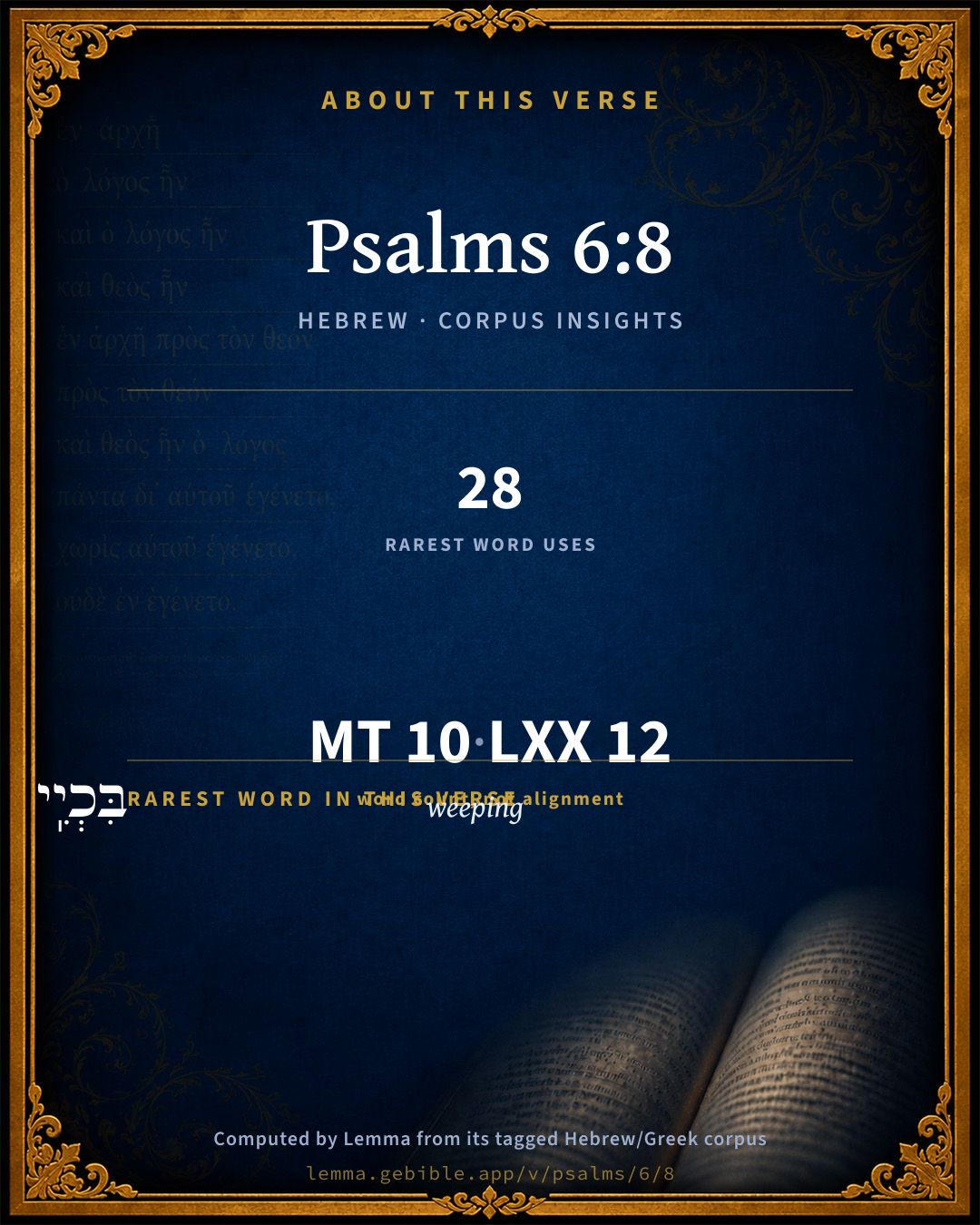
בִּכְיִֽי weeping H1065 occurs in 27 verses of the Hebrew Bible. Also found in:

Grammatical profile

  • 3 verbs
  • 5 nouns
  • 1 preposition
  • 1 conjunction

Verb forms

  • ס֣וּרוּ Qal · Imperative
  • פֹּ֣עֲלֵי Qal · Participle Active
  • שָׁמַ֥ע Qal · Perfect

Hebrew & Septuagint length

In English translation the verse runs 17 words from the Hebrew and 18 from the Septuagint (LXX English) — closely comparable.

A rough comparison of the two English renderings, which tokenize alike — not a word-level alignment.

Word counts can differ between the Hebrew and the Greek without any difference in meaning — e.g. the Hebrew direct-object marker אֵת has no separate Greek word, and Greek often adds the article ὁ.

In the original languages it is 10 Hebrew tokens and 12 Greek tokens — but the two are counted differently (Hebrew bundles its prefixes and suffixes into one token; the Greek is in lemma form), so that isn’t a like-for-like length.

Cross-references

13

Topical passages linked to Psalms 6:8 in the Treasury of Scripture Knowledge — connected by theme and wording, ordered by reader-vote popularity; previews shown in the World English Bible.

  • Luke 13:27 He will say, 'I tell you, I don't know where you come from. Depart from me, all you workers of iniquity.'
  • Psalms 119:115 Depart from me, you evildoers, That I may keep the commandments of my God.
  • Psalms 145:18 Yahweh is near to all those who call on him, To all who call on him in truth.
  • Psalms 3:4 I cry to Yahweh with my voice, And he answers me out of his holy hill. Selah.
  • Matthew 7:23 Then I will tell them, 'I never knew you. Depart from me, you who work iniquity.'
  • Psalms 139:19 If only you, God, would kill the wicked. Get away from me, you bloodthirsty men!
  • Matthew 25:41 Then he will say also to those on the left hand, 'Depart from me, you cursed, into the eternal fire which is prepared for the devil and his angels;
  • Hebrews 5:7 He, in the days of his flesh, having offered up prayers and petitions with strong crying and tears to him who was able to save him from death, and having been heard for his godly fear,
  • Psalms 116:8 For you have delivered my soul from death, My eyes from tears, And my feet from falling.
  • Isaiah 30:19 For the people shall dwell in Zion at Jerusalem; you shall weep no more; he will surely be gracious to you at the voice of your cry; when he shall hear, he will answer you.
  • Psalms 56:8 You number my wanderings. You put my tears into your bottle. Aren't they in your book?
  • Isaiah 38:3 and said, Remember now, Yahweh, I beg you, how I have walked before you in truth and with a perfect heart, and have done that which is good in your sight. Hezekiah wept sore.
  • Isaiah 38:5 Go, and tell Hezekiah, Thus says Yahweh, the God of David your father, I have heard your prayer, I have seen your tears: behold, I will add to your days fifteen years.

Cross-references courtesy of OpenBible.info (CC BY 4.0).

Hebrew and Greek witnesses Masoretic Hebrew ↔ Greek Septuagint

The same verse in the two great witnesses to the Old Testament, shown verse-for-verse.

You’re reading Greek Psalm 6 (Hebrew Psalm 6). The Septuagint counts the superscription, so verse numbers can differ from the Hebrew — chapter-level alignment, not verse-by-verse. Numbering follows Rahlfs.

These are two independent witnesses, not word-aligned to each other, and the Septuagint is shown in lemma (dictionary) form.

Hebrew Psalms 6:8 Masoretic · Westminster Leningrad Codex

ס֣וּרוּ מִ֭מֶּנִּי כָּל פֹּ֣עֲלֵי אָ֑וֶן כִּֽי שָׁמַ֥ע יְ֝הוָ֗ה ק֣וֹל בִּכְיִֽי

Depart from me, all you workers of iniquity, For Yahweh has heard the voice of my weeping.

World English Bible · Public Domain

Greek LXX Greek Psalm 6:8 Septuagint · lemma form

ταράσσω ἀπό θυμός ὁ ὀφθαλμός ἐγώ παλαιόω ἐν πᾶς ὁ ἐχθρός ἐγώ

Depart from me, all you⌃ that work iniquity; for the Lord has heard the voice of my weeping.

LXX2012 (modern English Septuagint) · Public Domain

Hebrew: Westminster Leningrad Codex (CC BY 4.0). Greek: Septuagint (public domain); English from LXX2012 (modern English Septuagint) (Public Domain). How the Septuagint differs from the Hebrew →

Commentary

Notes on Psalms 6:8 from classic Christian and Jewish commentators (each source and its license shown beneath its notes). The classic Christian expositions comment on the surrounding passage and are grouped to its opening verse, so a note may address several verses; the Jewish commentaries on the Tanakh (Rashi and others) are per-verse, so they appear only where the commentator wrote on this verse.

Lemma curates 59 commentaries, every one of them public domain or Creative Commons licensed, each selected and text-cleaned for this edition rather than reprinted as found. About our sources →

Matthew Henry's Commentary

What a sudden change is here for the better! He that was groaning, and weeping, and giving up all for gone (Psa 6:6, Psa 6:7), here looks and speaks very pleasantly. Having made his requests known to God, and lodged his case with him, he is very confident the issue will be good and his sorrow is turned into joy.

I. He distinguishes himself from the wicked and ungodly, and fortifies himself against their insults (Psa 6:8): Depart from me, all you workers of iniquity. When he was in the depth of his distress, 1. He was afraid that God's wrath against him would give him his portion with the workers of iniquity; but now that this cloud of melancholy had blown over he was assured that his soul would not be gathered with sinners, for they are not his people. He began to suspect himself to be one of them because of the heavy pressures of God's wrath upon him; but now that all his fears were silenced he bade them depart, knowing that his lot was among the chosen. 2. The workers of iniquity had teased him, and taunted him, and asked him, "Where is thy God?" triumphing in his despondency and despair; but now he had wherewith to answer those that reproached him, for God, who was about to return in mercy to him, had now comforted his spirit and would shortly complete his deliverance. 3. Perhaps they had tempted him to do as they did, to quit his religion and betake himself for ease to the pleasures of sin. But now, "depart from me; I will never lend an ear to your counsel; you would have had me to curse God and die, but I will bless him and live." This good use we should make of God's mercies to us, we should thereby have our resolution strengthened never to have any thing more to do with sin and sinners. David was a king, and he takes this occasion to renew his purpose of using his power for the suppression of sin and the reformation of manners, Psa 75:4; Psa 101:3. When God has done great things for us, this should put us upon studying what we shall do for him. Our Lord Jesus seems to borrow these words from the mouth of his father David, when, having all judgment committed to him, he shall say, Depart from me, all you workers of iniquity (Luk 13:27), and so teaches us to say so now, Psa 119:115.

II. He assures himself that God was, and would be, propitious to him, notwithstanding the present intimations of wrath which he was under. 1. He is confident of a gracious answer to this prayer which he is now making. While he is yet speaking, he is aware that God hears (as Isa 65:24, Dan 9:20), and therefore speaks of it as a thing done, and repeats it with an air of triumph, "The Lord hath heard" (Psa 6:8), and again (Psa 6:9), "The Lord hath heard." By the workings of God's grace upon his heart he knew his prayer was graciously accepted, and therefore did not doubt but it would in due time be effectually answered. His tears had a voice, a loud voice, in the ears of the God of mercy: The Lord has heard the voice of my weeping. Silent tears are not speechless ones. His prayers were cries to God: "The Lord has heard the voice of my supplication, has put his Fiat - Let it be done, to my petitions, and so it will appear shortly." 2. Thence he infers the like favourable audience of all his other prayers: "He has heard the voice of my supplication, and therefore he will receive my prayer; for he gives, and does not upbraid with former grants."

III. He either prays for the conversion or predicts the destruction of his enemies and persecutors, Psa 6:10. 1. It may very well be taken as a prayer for their conversion: "Let them all be ashamed of the opposition they have given me and the censures they have passed upon me. Let them be (as all true penitents are) vexed at themselves for their own folly; let them return to a better temper and disposition of mind, and let them be ashamed of what they have done against me and take shame to themselves." 2. If they be not converted, it is a prediction of their confusion and ruin. They shall be ashamed and sorely vexed (so it maybe read), and that justly. They rejoiced that David was vexed (Psa 6:2, Psa 6:3), and therefore, as usually happens, the evil returns upon themselves; they also shall be sorely vexed. Those that will not give glory to God shall have their faces filled with everlasting shame.

In singing this, and praying over it, we must give glory to God, as a God ready to hear prayer, must own his goodness to us in hearing our prayers, and must encourage ourselves to wait upon him and to trust in him in the greatest straits and difficulties.

Matthew Henry's Commentary on the Whole Bible (1708–1710) — public domain (CC PDM 1.0). Text via the HelloAO Bible API.

Trapp's Complete Commentary

John Trapp

Psa 6:8 Depart from me, all ye workers of iniquity; for the LORD hath heard the voice of my weeping.

Ver. 8. Depart from me, all ye workers of iniquity] What a strange change is here all of a sudden! Well might Luther say, Oratio est hirudo animae, Prayer is the leech of the soul, that sucks out the venom and swelling thereof. Prayer, saith another, is an exorcist with God, and an exorcist against sin and misery. The prophet Isaiah calleth it a charm, Isa 26:16, because it lays our soul distempers, and, like David’s harp, drives away the evil spirit that is upon us. Pray, therefore, when out of order, though not so fit to pray; fall upon the duty, by David’s example here, and that will further fit thee for the duty. Thy leaden lumpish heart, cast into this holy fire, will heat and melt. Quoties me oratio, quem pene desperantem susceperat, reddidit exultantem et praesumentem de venia? saith Bernard: How oft hath prayer found me despairing almost, but left me triumphing and well assured of pardon! The same in effect saith David here, "Depart from me," &c. What a word is that to his insulting enemies, Avoid, come out, vanish! These be words used to devils and dogs, but good enough for a Doeg or a Shimei. And the Son of David shall say the same to his enemies when he comes to judgment.

For the Lord hath heard the voice of my weeping] Tears then have a voice (as well as blood hath), and God hath an ear for them. And as music upon the waters soundeth farther and more harmoniously than upon the land, so do prayers joined with tears: Portae lachrymarum ne sint clausae, let not the wounds of godly sorrow be ever so healed up in us but that they may bleed afresh upon every just occasion (R. Obad. Gaon in Psa 6:1-10).

John Trapp, A Commentary or Exposition upon All the Books of the Old and New Testament (1647–1656) — public domain. Text from a community e-Sword module.

The Biblical Illustrator

Joseph S. Exell

Psa_6:8-9

The Lord hath heard the voice of my weeping.

A change from sorrow to hope

I. Grateful acknowledgment of mercy. The expressions of the Psalm indicate sorrow of no ordinary kind. Much of this sorrow caused by a sense of the indignation of God against sin (Psa_6:1). What he pleads for is the pardon of sin, the restoration of the light of the Divine countenance. His plea is Gods mercy and Gods glory.

II. Holy determination to forsake sin. Depart from me all ye workers of iniquity. Those who have experienced Gods pardoning mercy will never be content to continue in sin.

III. Humble confidence. The Lord will receive my prayer. When under the pressure of different causes of sorrow the believer may take confidence from former deliverances. (J. D. Lane, M. A.)

Sorrow and deliverance

The earlier verses of this Psalm are a wail, but it ends in song. It is like a day of rain which clears at evening.

I. The elements of the Psalmists sorrow (1-7). There was the pressure of Divine displeasure on account of sin (1, 2), combined with soul-anguish (3, 4), perhaps accompanied with sickness, brining nigh unto death (4, 5), whilst enemies add their hate (6, 7).

II. The certainty of the Psalmists deliverance (8-10). The prayer is no sooner uttered than answered. The consciousness of having been heard steals over the weary soul like a glint of light on to a bed in the hospital ward. Weeping has a voice for the ear of God. The Revised Version reads the imprecations of Psa_6:10 as future tenses--they shall be ashamed and turn back. When God returns, cur enemies turn back. (F. B. Meyer, B. A.)

Sin pleasant to begin with, but painful to end with

The work of sin seems pleasant and gainful; but in the end ye shall find it both unpleasant and painful when you get your wages paid you from your master, the devil, you shall know the truth of the saying of the apostle, the reward of sin is death. (A. Symson, B. D.)

Workers of iniquity

Let us refuse, therefore, to work any longer task unto Satan, and betake us to a better Master and better service, and work in the Lords vineyard. (A. Symson, B. D.)

The voice of weeping.

As Davids prayers were not dumb, but had a voice, so they are not dry but full of tears: those sappy prayers be acceptable to God, which proceed not from a barren and dry heart, but from a heart well watered with the clouds of heaven, hearts planted at the Rivers of waters which we should all pray for. Think ye not that a mother will discern the voice, but much more the weeping of her own child, and the ewe discern the bleating of her own lamb among a thousand; and will not God regard the prayer of His own child being in affliction? (A. Symson, B. D.)

The Biblical Illustrator, edited by Joseph S. Exell (c. 1880s–1900s) — public domain. Text from a community e-Sword module.

Joseph Benson's Commentary

Psa 6:8-9. Depart from me, all ye workers of iniquity — With whom I am resolved not to associate or have any fellowship; and cease from opposing or molesting, or insulting, over me, or approaching me with designs of deceiving and betraying me, all ye my wicked enemies; desist from all your wicked contrivances against me, and be not so vain as to hope to triumph over me; for the Lord hath heard the voice of my weeping — And will grant me that which I have sought with so many tears. By the workings of God’s grace upon his heart, he knew his prayer was accepted. His tears had a voice in the ears of the God of mercy. Silent tears are not speechless ones. Our tears are cries to God. The Lord hath heard my supplication — He hath not rejected me, I say, as you imagine; but is graciously pleased both with my deprecation of his displeasure and with my petitions to him for his favour.

Joseph Benson's Commentary on the Old and New Testaments (1811–1818) — public domain. Text from a community e-Sword module.

Whedon's Commentary on the Bible

Daniel D. Whedon

8. Depart from me—The psalmist suddenly assumes a new character. From the darkness and storm of his sufferings he announces the answer of his prayer, and warns his oppressors to withdraw and desist.

The Lord hath heard—God has now taken the matter in hand.

Voice of my weeping— “Silent grief is not much known in the East; therefore, when the people speak of sorrow, they say its voice: ‘Have I not heard the voice of his lamentation?’”—Roberts. He is so filled with joy and confidence upon receiving assurance of answer to prayer, that three times, Psa_6:8-9, he reiterates the joyful fact: the Lord hath heard my weeping; the Lord hath heard my supplication; the Lord will receive my prayer.

Daniel D. Whedon (gen. ed.), Commentary on the Old and New Testaments (1874–1909) — public domain. Text from a community e-Sword module.

J. A. Alexander on Psalms

Joseph Addison Alexander

9. (Psa 6:8). Here the key abruptly changes from the tone of sorrowful complaint to that of joyful confidence. No gradual transition could have so successfully conveyed the idea that the prayer of the psalmist has been heard, and will be answered. The effect is like that of a whisper in the sufferer's ear, while still engrossed with his distresses, to assure him that they are about to terminate. This he announces by a direct and bold address to his persecuting enemies. Depart from me, all ye doers of iniquity, the same phrase that occurs in Psa 5:6 (5). The sense is not that he will testify his gratitude by abjuring all communion with the wicked, but that his assurance of divine protection relieves him from all fear of his wicked foes. When God arises, then his enemies are scattered. This sense is required by the last clause of Psa 6:8 (7), and confirmed by a comparison with Psa 6:9 (10), For the Lord, Jehovah, hath heard the voice of my weeping(Psa 6:8), or my weeping voice. The infrequency of silent grief is said to be characteristic of the orientals, and the same thing may be observed in Homer's pictures of heroic manners.

Joseph Addison Alexander, The Psalms Translated and Explained (1850) — public domain. Text from a community e-Sword module.

Tyndale Open Study Notes

Tyndale Open Resources

6:8-10 In a closing note of triumph, the psalmist reasserts his confidence in the Lord.

Tyndale Open Study Notes — © Tyndale Open Resources, licensed CC BY-SA 4.0. Text via the HelloAO Bible API.

Geneva Bible (1599)

Geneva Bible translators

God sendeth comfort and boldness, in affliction, that we may triumph over our enemies.

Geneva Bible (1599) marginal notes — public domain. Text via Bolls.life.

Jamieson, Fausset & Brown

Robert Jamieson, A. R. Fausset & David Brown

Assured of God's hearing, he suddenly defies his enemies by an address indicating that he no longer fears them.

Jamieson, Fausset & Brown — Commentary Critical and Explanatory on the Whole Bible (1871) — public domain (CC PDM 1.0). Text via the HelloAO Bible API.

Adam Clarke's Commentary

Verse 8. Depart from me, all ye workers of iniquity] It seems that while he was suffering grievously through the disease, his enemies had insulted and mocked him;-upbraided him with his transgressions, not to increase his penitence, but to cast him into despair.

The Lord hath heard the voice of my weeping.] The Lord pitifully beheld the sorrows of his heart, and mercifully forgave his sins.

Adam Clarke's Commentary on the Bible (1810–1826) — public domain. Text from a community e-Sword/MySword module.

John Calvin's Commentaries

After David has disburdened his griefs and troubles into the bosom of God, he now, as it were, assumes a new character. And, without doubt, he had been afflicted with long-continued despondency of spirit before he could recover himself, and attain to such a degree of assurance as he here displays; “Avant que pouvoir se relever et venir a sentir telle asseurance qu’il monstre yci.” — Fr.

“The voice of my weeping, my loud weeping.” says Hengstenberg, and then he adds, quoting from Roberts’ Orient. Illustr. of the Sacred Scrip., “Silent grief is not much known in the East. Hence, when the people speak of lamentation, they say, Have I not heard the voice of his mourning?”

“Qu’il n’y a rien en tout le monde qui se dresse contre nous.” — Fr.

John Calvin's Commentaries (1540-1563) — public domain. Text from the Calvin Translation Society English edition (1840s-50s) via the Christian Classics Ethereal Library (ccel.org). Calvin's coverage is partial (roughly two-thirds of the Bible); uncommented books and verses are honest gaps, never fabricated. The 19th-century editor's footnotes and remarks are omitted so the notes are faithfully Calvin's own voice.

Ellicott's Commentary for English Readers

(8) Depart from me.—After the night of sorrow comes the morning of revived faith and confidence, if not of joy. The poet can turn to address his maligners with the assurance that God has heard his prayer, which in his agony he poured out, as he feared at the time, into deaf and unsympathising ears.

A Bible Commentary for English Readers, edited by Charles John Ellicott (1878–1897) — public domain. Text from a community e-Sword module.

The Cambridge Bible for Schools and Colleges

gen. ed. J. J. S. Perowne

8. Depart from me, all ye workers of iniquity] Words used by our Lord, Mat_7:23.

8–10. The cloud breaks. Heaviness is turned to joy. With a sudden inspiration of faith the Psalmist realises that his prayer is heard, and predicts the speedy confusion of his enemies.

The Cambridge Bible for Schools and Colleges (gen. ed. J. J. S. Perowne; Cambridge University Press, 1878–1918) — public domain. Text from a community e-Sword module.

John Gill's Exposition

Depart from me, all ye workers of iniquity,.... The psalmist being fully assured that God had heard his prayer, that he should recover from his disorder, or be delivered out of his calamities, whether corporeal or spiritual, has on a sudden a spring of joy, faith, and comfort; as sometimes there is a quick transition from comfortable to uncomfortable frames; see Psa 30:7; so on the contrary, there is as quick a passage from uncomfortable to comfortable ones; see Lam 3:18; who may be called "workers of iniquity" See Gill on Psa 5:5; and these were either his open enemies, as Saul and his men, or Absalom and the conspirators with him, whom he bids to cease from following and pursuing after him; or his secret ones, hypocritical courtiers, that were about him, who were wishing and hoping for his death. It is the lot of God's people to be among the workers of iniquity; Lot was among the Sodomites, David was in Meshech and in the tents of Kedar, Isaiah was among men of unclean lips; Christ's lily is among thorns, and his sheep among goats; and though in some respects a civil conversation with wicked men cannot be avoided, for then good men must needs go out of the world; yet as little company should be kept with them as can be, and no fellowship should be had with them in sinful practices, nor in superstitious worship; and though there will not be a full and final separation from them in the present state of things, there will be hereafter, when these very words will be used by David's antitype, the Lord Jesus Christ; not only to profane sinners, but to carnal professors of religion, who have herded themselves with the people of God, Mat 25:41. The reason why the psalmist took heart and courage, and ordered his wicked persecutors, or sycophants, to be gone from him, was his assurance of being heard by the Lord;

for the Lord hath heard the voice of my weeping; referring to what is said Psa 6:6; he had not only lifted up his voice in prayer, but he had wept and made supplication, as Jacob did, Hos 12:4; sometimes God brings his people to the throne of grace weeping, and with supplications leads them, Jer 31:9; and then hears their cry and answers them.

John Gill's Exposition of the Whole Bible (1746–1763) — public domain (CC PDM 1.0). Text via the HelloAO Bible API.

Albert Barnes' Notes on the Bible

Depart from me, all ye workers of iniquity - Referring, by the “workers of iniquity,” to his enemies, as if they now surrounded him, and calling on them “now” to leave him, since God had heard his prayer, and they could not be successful in their purposes. This is an indirect but most emphatic way of saying that God had heard his prayer; and the sentiment in this verse is strongly in contrast with the desponding state of feeling - the deep and dreadful sorrow - indicated in the previous verses. Light broke in suddenly upon him; his prayer had come up before God, and, in some way, he was assured that it would be answered. Already he sees his enemies scattered, and his own cause triumphant; and in this exulting feeling he addresses his foes, and commands them to leave him. This is, therefore, a remarkable and striking proof that prayer may be heard, even while we are speaking to God (compare Isa 65:24); that the assurance may be conveyed suddenly to the mind that God will hear and answer the prayer which is addressed to him; and also a beautiful illustration of the effect of this on a mind overwhelmed with trouble and sorrow, in giving it calmness and peace.

For the Lord hath heard - That is, my prayer has ascended before him, and I am certain that he regards it favorably, and will answer it. “In what way” he had this assurance he does not inform us. As he was an inspired man, we may suppose that the assurance was given to him directly by the Holy Spirit. “We” are not to expect the “same kind” of assurance that our prayers are heard; we are to look for no revelation to that effect; but there may be “as real” an intimation to the mind that our prayers are heard - as real “evidence” - as in this case. There may be a firm confidence of the mind that God is a hearer of prayer now coming to the soul with the freshness of a new conviction of that truth; and there may be, in trouble and sorrow, a sweet calmness and peace breathed through the soul - an assurance that all will be right and well, as if the prayer were heard, and such as there would be if we were assured by direct revelation that it is heard. The Spirit of God can produce this in our case as really as he did in the case of David.

The voice of my weeping - The voice of prayer that accompanied my weeping, or the voice of the weeping itself - the cry of anguish and distress which was in itself of the nature of prayer.

Albert Barnes' Notes on the Bible (1834–1885) — public domain. Text from a community e-Sword/MySword module.

Matthew Poole's English Annotations

Depart from me; I advise you for your own sakes to cease from opposing or molesting me, or insulting over me, or approaching to me with design of deceiving and betraying me; for all your labour will be lost.

All ye workers of iniquity; all you wicked enemies of mine.

The Lord hath heard, i.e. he will hear, the past time being put for the future, as is usual in prophetical passages, such as this was; David having received by the Spirit of God particular assurance that God would hear and deliver him.

The voice of my weeping, i.e. of my fervent prayers joined with my tears.

Matthew Poole's English Annotations on the Holy Bible (1683–1685) — public domain. Text from a community e-Sword/MySword module.

The Treasury of David

Charles H. Spurgeon

Ver. 8. Depart from me, etc., i.e., you may now go your way; for that which you look for, namely, my death, you shall not have at this present; for the Lord hath heard the voice of my weeping, i.e., has graciously granted me that which with tears I asked of him. Thomas Wilcocks.

Ver. 8. Depart from me, all ye workers of iniquity. May not too much familiarity with profane wretches be justly charged upon church members? I know man is a sociable creature, but that will not excuse saints as to their carelessness of the choice of their company. The very fowls of the air, and beasts of the field, love not heterogeneous company. "Birds of a feather flock together." I have been afraid that many who would be thought eminent, of a high stature in grace and godliness, yet see not the vast difference there is between nature and regeneration, sin and grace, the old and the new man, seeing all company is alike unto them. Lewis Stuckley's "Gospel Glass", 1667.

Ver. 8. The voice of my weeping. Weeping hath a voice, and as music upon the water sounds farther and more harmoniously than upon the land, so prayers, joined with tears, cry louder in God's ears, and make sweeter music than when tears are absent. When Antipater had written a large letter against Alexander's mother unto Alexander, the king answered him, "One tear from my mother will wash away all her faults." So it is with God. A penitent tear is an undeniable ambassador, and never returns from the throne of grace unsatisfied. Spencer's Things New and Old.

Ver. 8. The wicked are called, workers of iniquity, because they are free and ready to sin, they have a strong tide and bent of spirit to do evil, and they do it not to halves but thoroughly; they do not only begin or nibble at the bait a little (as a good man often doth), but greedily swallow it down, hook and all; they are fully in it, and do it fully; they make a work of it, and so are "workers of iniquity." Joseph Caryl.

Ver. 8. Some may say, "My constitution is such that I cannot weep; I may as well go to squeeze a rock, as think to get a tear." But if thou canst not weep for sin, canst thou grieve? Intellectual mourning is best; there may be sorrow where there are no tears, the vessel may be full though it wants vent; it is not so much the weeping eye God respects as the broken heart; yet I would be loath to stop their tears who can weep. God stood looking on Hezekiah's tears (Isa 38:5), "I have seen thy tears." David's tears made music in God's ears, The Lord hath heard the voice of my weeping. It is a sight fit for angels to behold, tears as pearls dropping from a penitent eye. T. Watson.

Ver. 8. The Lord hath heard the voice of my weeping. God hears the voice of our looks, God hears the voice of our tears sometimes better than the voice of our words; for it is the Spirit itself that makes intercession for us. Ro 8:26. Gemitibus inenarrabilibus, in those groans, and so in those tears, which we cannot utter; ineloquacibus, as Tertullian reads that place, devout, and simple tears, which cannot speak, speak aloud in the ears of God; nay, tears which we cannot utter; not only utter the force of the tears, but not utter the very tears themselves. As God sees the water in the spring in the veins of the earth before it bubble upon the face of the earth, so God sees tears in the heart of a man before they blubber his face; God hears the tears of that sorrowful soul, which for sorrow cannot shed tears. From this casting up of the eyes, and pouring out the sorrow of the heart at the eyes, at least opening God a window through which he may see a wet heart through a dry eye; from these overtures of repentance, which are as those imperfect sounds of words, which parents delight in, in their children, before they speak plain, a penitent sinner comes to a verbal and a more expressive prayer. To these prayers, these vocal and verbal prayers from David, God had given ear, and from this hearing of those prayers was David come to this thankful confidence, The Lord hath heard, the Lord will hear. John Donne.

Ver. 8. What a strange change is here all of a sudden! Well might Luther say, "Prayer is the leech of the soul, that sucks out the venom and swelling thereof." "Prayer," saith another, "is an exorcist with God, and an exorcist against sin and misery." Bernard saith, "How oft hath prayer found me despairing almost, but left me triumphing, and well assured of pardon!" The same in effect saith David here, "Depart from me, all ye workers of iniquity; for the Lord hath heard the voice of my weeping." What a word is that to his insulting enemies! Avaunt! come out! vanish! These be words used to devils and dogs, but good enough for a Doeg or a Shimei. And the Son of David shall say the same to his enemies when he comes to judgment. John Trapp.

Ver. 8. The pardoned sinner forsaking his bad companions.

Charles H. Spurgeon's The Treasury of David (1869–1885) — public domain. Psalms only. Text from a community e-Sword/MySword module.

The Pulpit Commentary

Depart from me, all ye workers of iniquity! Note the sudden change of tone, very characteristic of the Davidical psalms. The psalmist, having offered his prayer, is so certain of its acceptance that he at once turns upon his adversaries with words of reproach, and almost of menace. "Depart from me!" he exclaims; "get ye gone! do not dare any more to persecute me or plot against me! Your efforts are in vain." For the Lord hath heard the voice of my weeping. David speaks from an inward conviction. He knows that he has prayed sincerely and fervently. He is certain, therefore, that his prayer is heard and accepted.

The Pulpit Commentary (1880–1919), ed. H.D.M. Spence-Jones & Joseph S. Exell — public domain. Text from a community e-Sword module.

John Wesley's Explanatory Notes

Hath heard - By the workings of God's grace upon his heart, he knew his prayer was accepted. His tears had a voice, in the ears of the God of mercy. Silent tears are no speechless ones. Our tears are cries to God.

John Wesley, Explanatory Notes Upon the Whole Bible (1754–1765) — public domain. Text via the GEBible commentary corpus.

Keil & Delitzsch

C. F. Keil & F. Delitzsch

(Heb.: 6:9-11) Even before his plaintive prayer is ended the divine light and comfort come quickly into his heart, as Frisch says in his "Neuklingende Harfe Davids." His enemies mock him as one forsaken of God, but even in the face of his enemies he becomes conscious that this is not his condition. Thrice in Psa 6:9, Psa 6:10 his confidence that God will answer him flashes forth: He hears his loud sobbing, the voice of his weeping that rises towards heaven, He hears his supplication, and He graciously accepts his prayer. The twofold שׁמע expresses the fact and יקח its consequence. That which he seems to have to suffer, shall in reality be the lot of his enemies, viz., the end of those who are rejected of God: they shall be put to shame. The בּושׁ, Syr. behet, Chald. בּהת, בּהת, which we meet with here for the first time, is not connected with the Arab. bht, but (since the Old Arabic as a rule has t` as a mediating vowel between ש and t, )ת with Arab. bât, which signifies "to turn up and scatter about things that lie together (either beside or upon each other)" eruere et diruere, disturbare, - a root which also appears in the reduplicated form Arab. bṯṯ: to root up and disperse, whence Arab. battun, sorrow and anxiety, according to which therefore בּושׁ (= בּושׁ as Arab. bâta = bawata) prop. signifies disturbare, to be perplexed, lose one's self-control, and denotes shame according to a similar, but somewhat differently applied conception to confundi, συγχεῖσθαι, συγχύνεσθαι. ויבּהלוּ points back to Psa 6:2, Psa 6:3 : the lot at which the malicious have rejoiced, shall come upon themselves. As is implied in יבשׁוּ ישׁבוּ, a higher power turns back the assailants filled with shame (Psa 9:4; Psa 35:4).

What an impressive finish we have here in these three Milels, jashûbu jebôshu rāga), in relation to the tripping measure of the preceding words addressed to his enemies! And, if not intentional, yet how remarkable is the coincidence, that shame follows the involuntary reverse of the foes, and that יבשׁו in its letters and sound is the reverse of ישׁבו! What music there is in the Psalter! If composers could but understand it!!

Keil & Delitzsch — Biblical Commentary on the Old Testament (1861–1891) — public domain (CC PDM 1.0). Text via the HelloAO Bible API. (Old Testament only.)

unfoldingWord translationNotes

Door43 World Missions Community

Yahweh has heard my appeal for mercy ... Yahweh has accepted my prayer

These two lines have very similar meanings. (See: Parallelism)

Yahweh has accepted my prayer

Being willing to do what David has prayed for is spoken of as accepting his prayer. AT: "Yahweh will respond to my prayer" (See: Metaphor)

translationWords

iniquity

mercy

pray

adversary

shame

trouble

humiliate

unfoldingWord translationNotes — © Distant Shores Media and the Door43 World Missions Community, licensed CC BY-SA 4.0. Source: git.door43.org/Door43/en_tn.

Rashi

Rabbi Shlomo Yitzchaki (Rashi)

is dimmed Heb. עשׁשׁה, an expression of a lantern (עשׁשׁית), an eye which has impaired vision and seems to see through glass [held] before its eyes. Menachem (p. 139) defines it as an expression of decay, and so every expression of עשׁ, like (below 31:1 1) “and my bones are wasted away (עשׁשׁו).”

it has aged Heb. עתקה. My eye has aged and become old in that its light has dimmed. Menachem (p. 139) associated it with (Gen. 12:8): “And he moved (ויעתק) from there to the mountain.”

because of all my adversaries Because of the troubles that distress me.

Rashi on the Tanakh — English translations: “The Judaica Press complete Tanach with Rashi, translated by A. J. Rosenberg” (CC BY 4.0); “Pentateuch with Rashi's commentary by M. Rosenbaum and A.M. Silbermann, 1929-1934” (public domain); “The Metsudah Tanach series, Lakewood, N.J” (CC BY 4.0); and “The Book of Joshua, Metsudah Publications, 1997” (CC BY 4.0). Text via Sefaria.

Radak

Rabbi David Kimhi (Radak)

Decayed: – (The word) עָשְֽׁשָׁה (“is moth-eaten”) is of the same origin (as עָשׁ, “moth”; cf) “the moth (עָשׁ) shall devour them” (Is. 1. 9), as if he had said “decays.”

because of vexation is mine eye: – And the reason why I weep is because of the vexation with which I am vexed against my enemies, who rejoice at my sickness. And the interpretation of (the word rendered)

it is removed (עתקה) – may be gathered from “And the rock is removed (יעתק) out of its place” (Job 14:18). The expressions decayed (“moth-eaten”) and removed (ועתקה ועשׁשׁה) are used hyperbolically. And the explanation of with (ב) all my adversaries is “on account of” (בעבור) all my adversaries. And there are some (Targum, Rashi ad loc.) who explain עתקה in the sense of “is grown old (נתישנה),” in accordance with the Targum rendering of ישׁן (“the old store”) in Lev. 25:22 by עתיק.

Radak on the Tanakh — English translations: “Sefaria Community Translation” (CC0 1.0 (public-domain dedication)); “Eliyahu Munk, HaChut Hameshulash” (CC BY 4.0); “Rabbi Mike Feuer, Jerusalem Anthology” (CC BY 4.0); and “R. David Kimhi on the first book of Psalms, Translated by R.G. Finch, London, 1919” (public domain). Text via Sefaria.

Lesson kit

Teaching starters — assembled from the data on this page, not authored interpretation. Every prompt links to the verse data it draws on. Edit before teaching.

Psalms, in the Wisdom, opens this verse with 10 words (10 distinct Hebrew lemmas). Its most distinctive word is Bᵉkîy (“weeping”). A historical commentator’s framing appears above. Read the whole chapter for the surrounding context.

Discussion questions

  1. How does “weeping” (Bᵉkîy) shape what this verse is saying?
  2. Genesis 45:2 shares the word «weeping» with this verse. How do the two illuminate each other?
  3. These translations render this verse differently. What is at stake in choosing one wording over another?
  4. The verb «ס֣וּרוּ» is Qal Imperative. How does its form color the action?
  5. Reading how Matthew Henry's Commentary and Trapp's Complete Commentary read this verse, where do the two commentators agree and where do they part?

Things to notice

Reading settings

Reading text

Shown beneath each verse's original-language words.

Old Testament
Old Testament edition

Read the OT as the Masoretic Hebrew (MT) or the Greek Septuagint (LXX).

English shown for the Greek Septuagint (in the Hebrew ↔ Greek comparison).

Comparing translations? Open the Compare panel on any verse page to stack up to four side by side.