
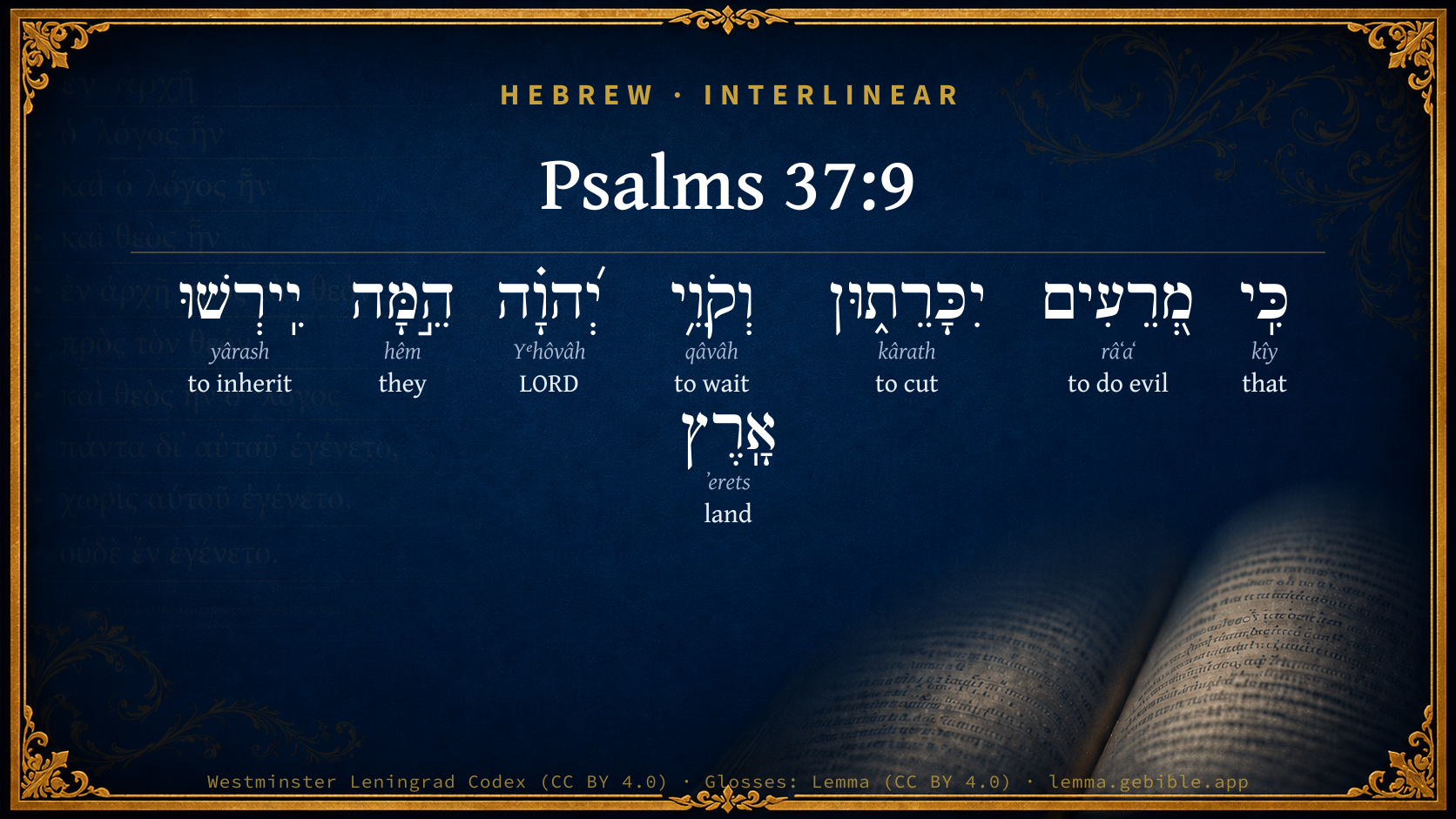
Psalms 37:9

Hebrew (Westminster Leningrad Codex) Psalms 37:9 appears in the Hebrew Old Testament. The text above is from the Westminster Leningrad Codex. Each word links to its Strong’s number, a concise gloss, and parsing drawn from the Open Scriptures Hebrew Bible morphology. Click any word for its full Brown-Driver-Briggs (BDB) entry.
Download image
Cite this verse

Psalms 37:9 (World English Bible). Public Domain. Lemma interlinear Bible study tool, https://lemma.gebible.app/v/psalms/37/9.

Show BibTeX & RIS
BibTeX
RIS
English Translation
For evildoers shall be cut off, But those who wait for Yahweh shall inherit the land.
World English Bible · Public Domain
Download a study sheet

One document with this verse’s original text, its word-by-word gloss line, the meaning frame, cross-references with their text, attributed commentary, and full source and license credits — printable, and it pastes into notes with its structure intact.

This verse Autodidact and up

Study sheet (.html) Plain text (.txt)

A passage Seminary Student

Up to 50 verses in one chapter. A passage sheet keeps up to 6 commentary sources and 12 cross-references per verse, in the order this page ranks them, and says so on the sheet whenever that leaves anything out. Ask for a single verse and you get the Autodidact verse sheet above.

Everything on this page stays free to read, with no account — the sheet is a download of what is already on screen, not access to it.

Want to remove ads? Support Godless Engineer
Compare translations 3

The same verse in 3 English versions, stacked beneath the original-language interlinear above. Click any original word for its lexicon entry.

Each is an independent rendering of the whole verse — the interlinear is not word-aligned to these translations.

Highlighted words mark where these versions differ — a whole-verse word diff, not a word-by-word alignment.

  • World English Bible Public Domain
    For evildoers shall be cut off, But those who wait for Yahweh shall inherit the land.
  • King James Version Public Domain
    For evildoers shall be cut off: but those that wait upon the LORD, they shall inherit the earth.
  • unfoldingWord Literal Text CC BY-SA 4.0
    For evildoers will be cut off, but the ones waiting for Yahweh, they, they will inherit the land.

unfoldingWord Literal Text — © unfoldingWord, licensed CC BY-SA 4.0. Word-aligned USFM3 via Door43 (git.door43.org/unfoldingWord/en_ult).

Versions to compare (up to 4)

3 of 4 selected

Show all 18 translations

Every available English version of this verse, each an independent rendering of the whole verse.

  • World English Bible Public Domain
    For evildoers shall be cut off, But those who wait for Yahweh shall inherit the land.
  • Berean Standard Bible Public Domain
    For the evildoers will be cut off, but those who hope in the LORD will inherit the land.
  • Majority Standard Bible Public Domain
    For the evildoers will be cut off, but those who hope in the LORD will inherit the land.
  • King James Version Public Domain
    For evildoers shall be cut off: but those that wait upon the LORD, they shall inherit the earth.
  • American Standard Version (1901) Public Domain
    For evil-doers shall be cut off; But those that wait for Jehovah, they shall inherit the land.
  • Revised Version (1885) Public Domain
    For evil-doers shall be cut off: but those that wait upon the LORD, they shall inherit the land.
  • Geneva Bible (1599) Public Domain
    For euill doers shalbe cut off, and they that wait vpon the Lord, they shall inherite the land.
  • Douay-Rheims (1899) Public Domain
    For the evildoers shall be cut off: but they that wait upon the Lord shall inherit the land.
  • Young's Literal Translation Public Domain
    For evil doers are cut off, As to those waiting on Jehovah, they possess the land.
  • Literal Standard Version CC BY-SA 4.0
    For evildoers are cut off, || As for those waiting on YHWH, they possess the land.
  • Unlocked Literal Bible CC BY-SA 4.0
    Evildoers will be cut off, but those who wait for Yahweh will inherit the land.
  • unfoldingWord Literal Text CC BY-SA 4.0
    For evildoers will be cut off, but the ones waiting for Yahweh, they, they will inherit the land.
  • Darby Bible Public Domain
    For evil-doers shall be cut off; but those that wait on Jehovah, they shall possess the land.
  • World Messianic Bible Public Domain
    For evildoers shall be cut off, but those who wait for the LORD shall inherit the land.
  • Webster's Bible Public Domain
    For evil doers shall be cut off: but those that wait upon the LORD, they shall inherit the earth.
  • Free Bible Version CC BY-SA 4.0
    For the wicked will be destroyed, and those who trust in the Lord will take possession of the land.
  • Bible in Basic English Public Domain
    For the evil-doers will be cut off: but those who have faith in the Lord will have the earth for their heritage.
  • JPS Tanakh (1917) Public Domain
    For evil-doers shall be cut off; but those that wait for the LORD, they shall inherit the land.

Literal Standard Version (2020), Covenant Press — licensed CC BY-SA 4.0. Text via the HelloAO Bible API (eBible.org). Unlocked Literal Bible (unfoldingWord) — licensed CC BY-SA 4.0. Text via the HelloAO Bible API (eBible.org). unfoldingWord Literal Text — © unfoldingWord, licensed CC BY-SA 4.0. Word-aligned USFM3 via Door43 (git.door43.org/unfoldingWord/en_ult). Free Bible Version, Dr. Jonathan Gallagher — licensed CC BY-SA 4.0. Text via the HelloAO Bible API (eBible.org).

Word by word

More ways to search: Search by grammar → Find every occurrence → Compare this word →

Practice this passage: Drill this verse → Learn its vocabulary →

וְקֹוֵ֥י
qâvâh
H6960
“and · waiting”
Conjunction + Verb, Qal, Participle Active, Masculine, Plural, Construct
Part of Speech
Conjunction + Verb
Stem
Qal
Form
Participle Active
Gender
Masculine
Number
Plural
State
Construct
Full BDB Definition

Origin: a primitive root

TWOT: 1994 , 1995

to wait, look for, hope, expect - (Qal) waiting (participle) - (Piel) - to wait or look eagerly for - to lie in wait for - to wait for, linger for - to collect, bind together - (Niphal) to be collected
  1. כִּֽי kîy H3588 “that” Conjunction
  2. מְ֭רֵעִים râʻaʻ H7489 “doing evil” Verb, Hiphil, Participle Active, Masculine, Plural, Absolute
  3. יִכָּרֵת֑וּן kârath H3772 “to cut” Verb, Niphal, Imperfect, 3rd Person, Masculine, Plural + Suffix, n
  4. יְ֝הוָ֗ה Yᵉhôvâh H3068 “LORD” Noun, Proper
  5. הֵ֣מָּה hêm H1992 “they” Pronoun, Personal, 3rd Person, Masculine, Plural
  6. יִֽירְשׁוּ yârash H3423 “to inherit” Verb, Qal, Imperfect, 3rd Person, Masculine, Plural
  7. אָֽרֶץ ʼerets H776 “land” Noun, Common, Both, Singular, Absolute

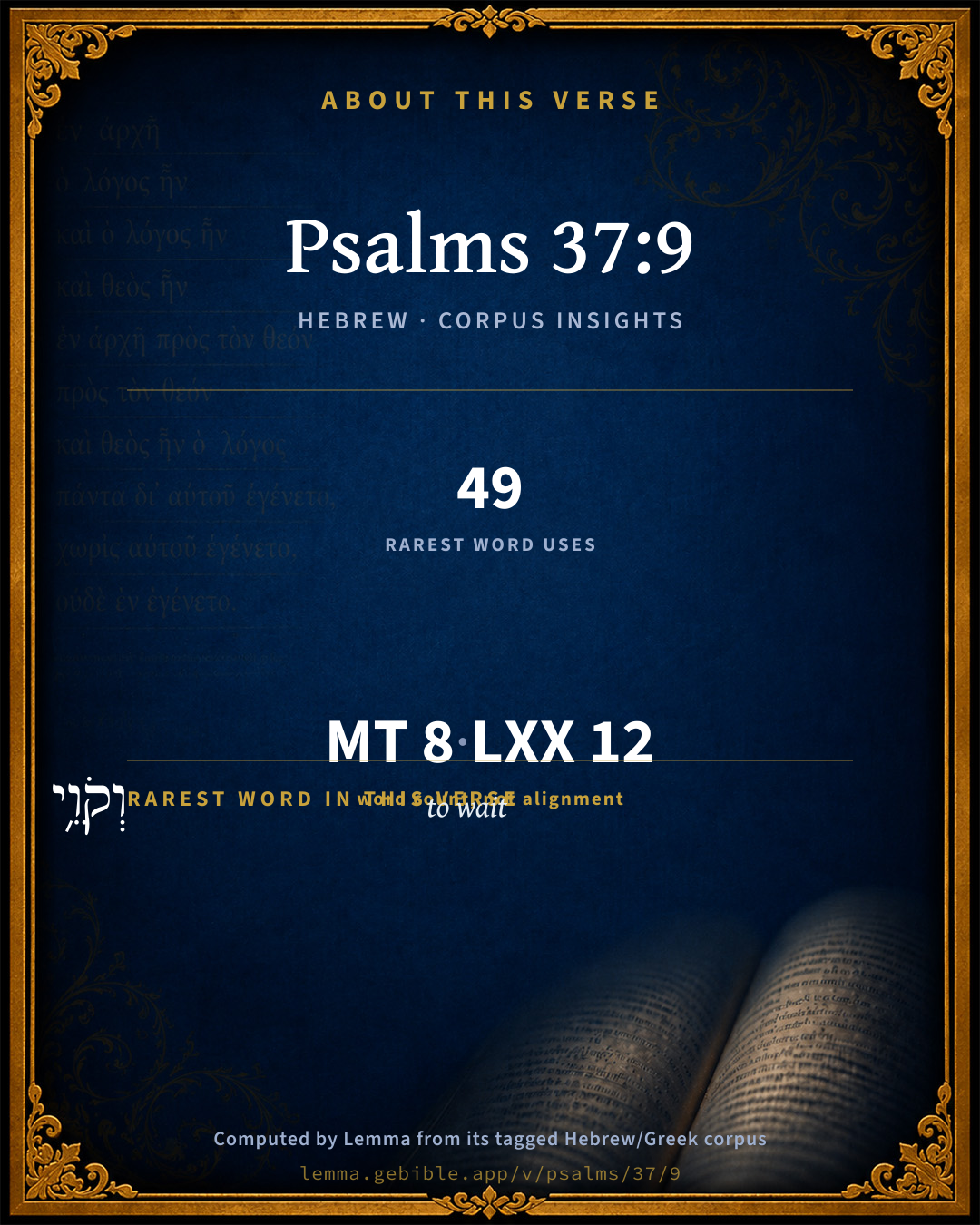
About this verse

These counts appear in no published source. They are computed here, from the morphology-tagged text and Lemma’s own curated glosses. What Lemma adds →

8
words
8
distinct lemmas
Wisdom
section

Shared distinctive vocabulary

וְקֹוֵ֥י to wait H6960 occurs in 45 verses of the Hebrew Bible. Also found in:

Grammatical profile

  • 4 verbs
  • 2 nouns
  • 1 pronoun
  • 1 conjunction

Verb forms

  • מְ֭רֵעִים Hiphil · Participle Active
  • יִכָּרֵת֑וּן Niphal · Imperfect
  • וְקֹוֵ֥י Qal · Participle Active
  • יִֽירְשׁוּ Qal · Imperfect

Hebrew & Septuagint length

In English translation the verse runs 16 words from the Hebrew and 17 from the Septuagint (LXX English) — closely comparable.

A rough comparison of the two English renderings, which tokenize alike — not a word-level alignment.

Word counts can differ between the Hebrew and the Greek without any difference in meaning — e.g. the Hebrew direct-object marker אֵת has no separate Greek word, and Greek often adds the article ὁ.

In the original languages it is 8 Hebrew tokens and 12 Greek tokens — but the two are counted differently (Hebrew bundles its prefixes and suffixes into one token; the Greek is in lemma form), so that isn’t a like-for-like length.

Cross-references

13

Topical passages linked to Psalms 37:9 in the Treasury of Scripture Knowledge — connected by theme and wording, ordered by reader-vote popularity; previews shown in the World English Bible.

  • Isaiah 60:21 Your people also shall be all righteous; they shall inherit the land forever, the branch of my planting, the work of my hands, that I may be glorified.
  • Psalms 25:13 His soul shall dwell at ease. His seed shall inherit the land.
  • Psalms 37:29 The righteous shall inherit the land, And live in it forever.
  • Proverbs 2:21 For the upright will dwell in the land. The perfect will remain in it.
  • Isaiah 57:13 When you cry, let those who you have gathered deliver you; but the wind shall take them, a breath shall carry them all away: but he who takes refuge in me shall possess the land, and shall inherit my holy mountain.
  • Psalms 37:11–12 But the humble shall inherit the land, And shall delight themselves in the abundance of peace.
  • Psalms 55:23 But you, God, will bring them down into the pit of destruction. Bloodthirsty and deceitful men shall not live out half their days, But I will trust in you.
  • Job 27:13–23 "This is the portion of a wicked man with God, The heritage of oppressors, which they receive from the Almighty.
  • Isaiah 58:14 then shall you delight yourself in Yahweh; and I will make you to ride on the high places of the earth; and I will feed you with the heritage of Jacob your father: for the mouth of Yahweh has spoken it.
  • Revelation 5:10 And made them kings and priests to our God, And they reign on earth."
  • Job 20:23–29 When he is about to fill his belly, God will cast the fierceness of his wrath on him. It will rain on him while he is eating.
  • Hebrews 11:16 But now they desire a better country, that is, a heavenly one. Therefore God is not ashamed of them, to be called their God, for he has prepared a city for them.
  • Psalms 37:35–36 I have seen the wicked in great power, Spreading himself like a green tree in its native soil.

Cross-references courtesy of OpenBible.info (CC BY 4.0).

Hebrew and Greek witnesses Masoretic Hebrew ↔ Greek Septuagint

The same verse in the two great witnesses to the Old Testament, shown verse-for-verse.

You’re reading Greek Psalm 36 (Hebrew Psalm 37). The Septuagint counts the superscription, so verse numbers can differ from the Hebrew — chapter-level alignment, not verse-by-verse. Numbering follows Rahlfs.

These are two independent witnesses, not word-aligned to each other, and the Septuagint is shown in lemma (dictionary) form.

Hebrew Psalms 37:9 Masoretic · Westminster Leningrad Codex

כִּֽי מְ֭רֵעִים יִכָּרֵת֑וּן וְקֹוֵ֥י יְ֝הוָ֗ה הֵ֣מָּה יִֽירְשׁוּ אָֽרֶץ

For evildoers shall be cut off, But those who wait for Yahweh shall inherit the land.

World English Bible · Public Domain

Greek LXX Greek Psalm 36:9 Septuagint · lemma form

ὅτι ὁ πονηρεύομαι ἐκὀλεθρεύω ὁ δέ ὑπομένω ὁ κύριος αὐτός κληρονομέω γῆ

For evil-doers shall be destroyed: but they that wait on the Lord, they shall inherit the land.

LXX2012 (modern English Septuagint) · Public Domain

Hebrew: Westminster Leningrad Codex (CC BY 4.0). Greek: Septuagint (public domain); English from LXX2012 (modern English Septuagint) (Public Domain). How the Septuagint differs from the Hebrew →

Commentary

Notes on Psalms 37:9 from classic Christian and Jewish commentators (each source and its license shown beneath its notes). The classic Christian expositions comment on the surrounding passage and are grouped to its opening verse, so a note may address several verses; the Jewish commentaries on the Tanakh (Rashi and others) are per-verse, so they appear only where the commentator wrote on this verse.

Lemma curates 59 commentaries, every one of them public domain or Creative Commons licensed, each selected and text-cleaned for this edition rather than reprinted as found. About our sources →

Trapp's Complete Commentary

John Trapp

Psa 37:9 For evildoers shall be cut off: but those that wait upon the LORD, they shall inherit the earth.

Ver. 9. For evildoers shall be cut off] Yea, they shall soon be cut off, Psa 37:10, and so shall all such as, having a while fretted at them, do at length revolt to them; as David was ready to do, once at least, Psa 73:12-14, and as some others did out and out, as they say, Psa 37:10, therefore his people return hither to their temporal undoing at least.

But those that wait upon the Lord] For deliverance in due season, and for accomplishment of the promises. All good people are such expectants, and should they die in a waiting condition (for comfort, I mean), yet are they blessed, because God hath said, Blessed are all they that wait for him, Isa 30:18.

They shall inherit the earth] Having a right to all, as heirs of the world together with faithful Abraham, Rom 4:13, and although it be detained from them for a while, as the promised land was from the Israelites, by the Amorites, till their sins were full, Gen 15:16; yet the saints shall one day have power over all things; and meanwhile they are sure of a sufficiency, if not a superfluity. An heir during his minority is many times held to strait allowance, and forced to borrow of servants; so it is with the saints.

John Trapp, A Commentary or Exposition upon All the Books of the Old and New Testament (1647–1656) — public domain. Text from a community e-Sword module.

Joseph Benson's Commentary

Psa 37:9-11. For evil-doers shall be cut off — Namely, from the earth, as appears by comparing this with the next clause, and with Psa 34:16. Their end shall certainly be most miserable. But those that wait, &c., shall inherit the earth — According to God’s promise, often made to such; which also generally was literally fulfilled in that state of the church; and if in any instances it was not, it was fulfilled with far greater advantage in spiritual and eternal blessings. For yet a little while, and the wicked shall not be — Namely, in the land of the living. His time and prosperity are very short, and therefore no matter for envy. He shall be dead and gone; as the phrase here used is commonly taken. Thou shalt diligently consider his place — Industriously seeking to find him; and it shall not be — That is, his place, and estate, and glory shall be gone. Or, he shall not be, as איננו, eenennu, rather signifies. But the meek — The godly, who are frequently so called; those who patiently bear God’s afflicting hand, and meekly pass by injuries from ungodly men; shall delight themselves in the abundance of peace — Partly of outward peace and prosperity, which God, in his due time, will give them: but principally of inward peace and satisfaction of mind, arising from a sense of God’s favour and the assurance of their own endless happiness.

Joseph Benson's Commentary on the Old and New Testaments (1811–1818) — public domain. Text from a community e-Sword module.

J. A. Alexander on Psalms

Joseph Addison Alexander

9. (Psa 37:9) For evil-doers shall be cut off. This is a twofold reason for obeying the injunction of the preceding verse: first, because the certain destruction of the wicked made such anger unnecessary as well as uncharitable; secondly, because the same destruction would befall the servant of the Lord, if he indulged an anger tending only to evil. And (those) waiting for Jehovah, patiently expecting the fulfilment of his promises and threatenings. As for them, they, with emphasis on the pronoun, shall inherit the land, the land of promise, the common formula for covenanted blessings. See above, on Psa 37:3, and on Psa 25:13.

Joseph Addison Alexander, The Psalms Translated and Explained (1850) — public domain. Text from a community e-Sword module.

Tyndale Open Study Notes

Tyndale Open Resources

37:9-11 The wicked will not possess the land; those who trust in the Lord will. The Lord promises an inheritance because he is committed to caring for his people.

Tyndale Open Study Notes — © Tyndale Open Resources, licensed CC BY-SA 4.0. Text via the HelloAO Bible API.

Jamieson, Fausset & Brown

Robert Jamieson, A. R. Fausset & David Brown

Two reasons: The prosperity of the wicked is short; and the pious, by humble trust, will secure all covenant blessing, denoted here by "inherit the earth" (compare Psa 25:13).

Jamieson, Fausset & Brown — Commentary Critical and Explanatory on the Whole Bible (1871) — public domain (CC PDM 1.0). Text via the HelloAO Bible API.

Adam Clarke's Commentary

Verse 9. They shall inherit the earth.] The word ארץ arets, throughout this Psalm, should be translated land, not earth; for it is most probable that it refers to the land of Judea; and in this verse there is a promise of their return thither.

Adam Clarke's Commentary on the Bible (1810–1826) — public domain. Text from a community e-Sword/MySword module.

John Calvin's Commentaries

9. For the wicked shall be cut off. It is not without cause that he repeatedly inculcates the same thing, namely, that the happiness and prosperity which the ungodly enjoy is only a mask or phantom; for the first sight of it so dazzles our senses, that we are unable to form a proper estimate of what will be its issue, in the light of which alone we ought to judge of the value of all that has preceded. But the contrast between the two clauses of the verse ought to be observed. First, in saying that the wicked shall be cut off, he intimates that they shall flourish fresh and green till the time of their destruction shall arrive; and, secondly, in allotting the earth to the godly, saying, They shall inherit the earth, he means that they shall live in such a manner as that the blessing of God shall follow them, even to the grave. Now, as I have already said, the present condition of men is to be estimated by the state in which it will terminate. From the epithet by which he distinguishes the children of God, we learn that they are exercised by a severe conflict for the trial of their faith; for he speaks of them, not as righteous or godly, but as those that wait upon the Lord. What purpose would this waiting serve, unless they groaned under the burden of the cross? Moreover, the possession of the earth which he promises to the children of God is not always realised to them; because it is the will of the Lord that they should live as strangers and pilgrims in it; neither does he permit them to have any fixed abode in it, but rather tries them with frequent troubles, that they may desire with greater alacrity the everlasting dwelling-place of heaven. The flesh is always seeking to build its nest for ever here; and were we not tossed hither and thither, and not suffered to rest, we would by and by forget heaven and the everlasting inheritance. Yet, in the midst of this disquietude, the possession of the earth, of which David here speaks, is not taken away from the children of God; for they know most certainly that they are the rightful heirs of the world. Hence it is that they eat their bread with a quiet conscience, and although they suffer want, yet God provides for their necessities in due season. Finally, although the ungodly labor to effect their destruction, and reckon them unworthy to live upon the earth, yet God stretches forth his hand and protects them; nay, he so upholds them by his power, that they live more securely in a state of exile, than the wicked do in their nests to which they are attached. And thus the blessing, of which David speaks, is in part secret and hidden, because our reason is so dull, that we cannot comprehend what it is to possess the earth; and yet the faithful truly feel and understand that this promise is not made to them in vain, since, having fixed the anchor of their faith in God, they pass their life every day in peace, while God makes it manifest in their experience, that the shadow of his hand is sufficient to protect them.

John Calvin's Commentaries (1540-1563) — public domain. Text from the Calvin Translation Society English edition (1840s-50s) via the Christian Classics Ethereal Library (ccel.org). Calvin's coverage is partial (roughly two-thirds of the Bible); uncommented books and verses are honest gaps, never fabricated. The 19th-century editor's footnotes and remarks are omitted so the notes are faithfully Calvin's own voice.

The Cambridge Bible for Schools and Colleges

gen. ed. J. J. S. Perowne

9. the earth] Rather, as in Psa_37:3, the land; and so in Psa_37:11; Psa_37:22; Psa_37:29; Psa_37:34. As the nations were “cut off” before Israel (Deu_12:29; Deu_19:1), that Israel might possess the Promised Land, so will the wicked be destroyed, that the true Israel may have undisturbed enjoyment of their inheritance. Cp. Psa_25:13.

The Cambridge Bible for Schools and Colleges (gen. ed. J. J. S. Perowne; Cambridge University Press, 1878–1918) — public domain. Text from a community e-Sword module.

John Gill's Exposition

For yet a little while, and the wicked shall not be,.... Not that they shall be annihilated or reduced to nothing, because nonentities have no place nor being any where; when they die they shall lift up their eyes in hell; their bodies will rise again at the last day; they shall stand before the judgment seat of Christ, and go into everlasting punishment; but they shall be no more in the world, and in the same flourishing and prosperous circumstances they were: and this their destruction will be in a short time, very quickly;

yea, thou shalt diligently consider his place, and it shall not be; his dwelling place, called after his own name, to perpetuate the memory of him; see Job 7:10; an instance of this the psalmist gives of his own knowledge, Psa 37:35.

John Gill's Exposition of the Whole Bible (1746–1763) — public domain (CC PDM 1.0). Text via the HelloAO Bible API.

Albert Barnes' Notes on the Bible

For evil-doers shall be cut off - See Psa 37:2. This will be the termination of their course. They shall not ultimately prosper. God will order all things in equity, and though such men now seem to be prosperous, and to be the objects of the divine favor, yet all this is temporary. The day of retribution will certainly come, and they will be dealt with as they deserve. The reference here probably is to judgment in this life, or to the fact that God will, as a general law, show his disapprobation of the course of the wicked by judgments inflicted on them in this world. See Psa 55:23, “Bloody and deceitful men shall not live out half their days.” Pro 10:27, “the years of the wicked shall be shortened.” Compare Job 15:32. The idea here is that wicked men will be cut down before they reach the ordinary term of human life, or before they would be cut off if they were not wicked. Compare Psa 37:35-36. This is not indeed universally true, but there are instances enough of this kind to establish it as a general rule. Intemperance, voluptuousness, the indulgence of violent passions, and the crimes proceeding therefrom, shorten the lives of multitudes who, but for these, might have lived long on the earth. As it is a general rule that virtue, piety, the fear of God, temperance, honesty, and the calmness of spirit which results from these, tend to lengthen out life, so it is certain that the opposites of these tend to abridge it. Neither virtue nor piety indeed make it absolutely certain that a man will live to be old; but vice and crime make it morally certain that he will not. At all events, it is true that the wicked are to live but a little while upon the earth; that they soon will, like other men, be cut down and removed; and therefore we should not fret and complain in regard to those who are so soon to pass away. Compare Ps. 73.

But those that wait upon the Lord - The pious; they who fear God and serve him.

They shall inherit the earth - Compare the notes at Psa 37:3. See also Psa 37:11, Psa 37:22, Psa 37:25.

Albert Barnes' Notes on the Bible (1834–1885) — public domain. Text from a community e-Sword/MySword module.

Matthew Poole's English Annotations

Shall be cut off, to wit, from the earth, by comparing this with the next clause, and with Psa 34:16. Their end shall certainly be most miserable.

Shall inherit the earth, according to God’s promise oft made to such; which also for the most part was literally fulfilled in that state of the church; and if it was not, it was fulfilled with far greater advantage in spiritual and eternal blessings.

Matthew Poole's English Annotations on the Holy Bible (1683–1685) — public domain. Text from a community e-Sword/MySword module.

The Treasury of David

Charles H. Spurgeon

Ver. 9. For evil doers shall be cut off. Their death shall be a penal judgment; not a gentle removal to a better state, but an execution in which the axe of justice will be used. But those that wait upon the Lord those who in patient faith expect their portion in another lifethey shall inherit the earth. Even in this life they have the most of real enjoyment, and in the ages to come theirs shall be the glory and the triumph. Passion, according to Bunyan's parable, has his good things first, and they are soon over; Patience has his good things last, and they last for ever.

Ver. 9. They shall inherit the earth. He means that they shall live in such a manner as that the blessing of God shall follow them, even to the grave. John Calvin.

Ver. 9. How the humble are the true lords of the land.

Psalms 37:10*

Charles H. Spurgeon's The Treasury of David (1869–1885) — public domain. Psalms only. Text from a community e-Sword/MySword module.

The Pulpit Commentary

For evil-doers shall be out off. It is foolish to "fret" and rage and storm against the ungodly whom we see prospering, since they will certainly be "cut off" sooner or later sooner rather than later, according to the belief of the writer (see vers. 2, 10). But those that wait upon the Lord (see Ver. 7), they shall inherit the earth. It is doubly foolish, since when the wicked are "cut off," as they will be assuredly some day, the godly will find themselves the inheritors of the earth. This prophecy is partially fulfilled from time to time, and will find its complete fulfilment in the "new heavens and new earth, wherein dwelleth righteousness". (2Pe_3:13)

The Pulpit Commentary (1880–1919), ed. H.D.M. Spence-Jones & Joseph S. Exell — public domain. Text from a community e-Sword module.

John Wesley's Explanatory Notes

The earth - This for the most part was literally fulfilled in that state of the church.

John Wesley, Explanatory Notes Upon the Whole Bible (1754–1765) — public domain. Text via the GEBible commentary corpus.

Rashi

Rabbi Shlomo Yitzchaki (Rashi)

For evildoers whom you now see prospering they will be cut off.

Rashi on the Tanakh — English translations: “The Judaica Press complete Tanach with Rashi, translated by A. J. Rosenberg” (CC BY 4.0); “Pentateuch with Rashi's commentary by M. Rosenbaum and A.M. Silbermann, 1929-1934” (public domain); “The Metsudah Tanach series, Lakewood, N.J” (CC BY 4.0); and “The Book of Joshua, Metsudah Publications, 1997” (CC BY 4.0). Text via Sefaria.

Lesson kit

Teaching starters — assembled from the data on this page, not authored interpretation. Every prompt links to the verse data it draws on. Edit before teaching.

Psalms, in the Wisdom, opens this verse with 8 words (8 distinct Hebrew lemmas). Its most distinctive word is qâvâh (“to wait”). A historical commentator’s framing appears above. Read the whole chapter for the surrounding context.

Discussion questions

  1. The word qâvâh carries the sense “to wait.” How does it shape the verse?
  2. How does Genesis 1:9, which shares the word «to wait», read alongside this verse?
  3. The translations on this page render this verse differently — a whole-verse word diff, not a word-by-word alignment. What might account for the different wordings?
  4. «מְ֭רֵעִים» is a Hiphil Participle Active verb. How does that grammatical form shape the action described?
  5. Compare how Trapp's Complete Commentary and Joseph Benson's Commentary read this verse. Where do they agree or differ?

Things to notice

Reading settings

Reading text

Shown beneath each verse's original-language words.

Old Testament
Old Testament edition

Read the OT as the Masoretic Hebrew (MT) or the Greek Septuagint (LXX).

English shown for the Greek Septuagint (in the Hebrew ↔ Greek comparison).

Comparing translations? Open the Compare panel on any verse page to stack up to four side by side.