
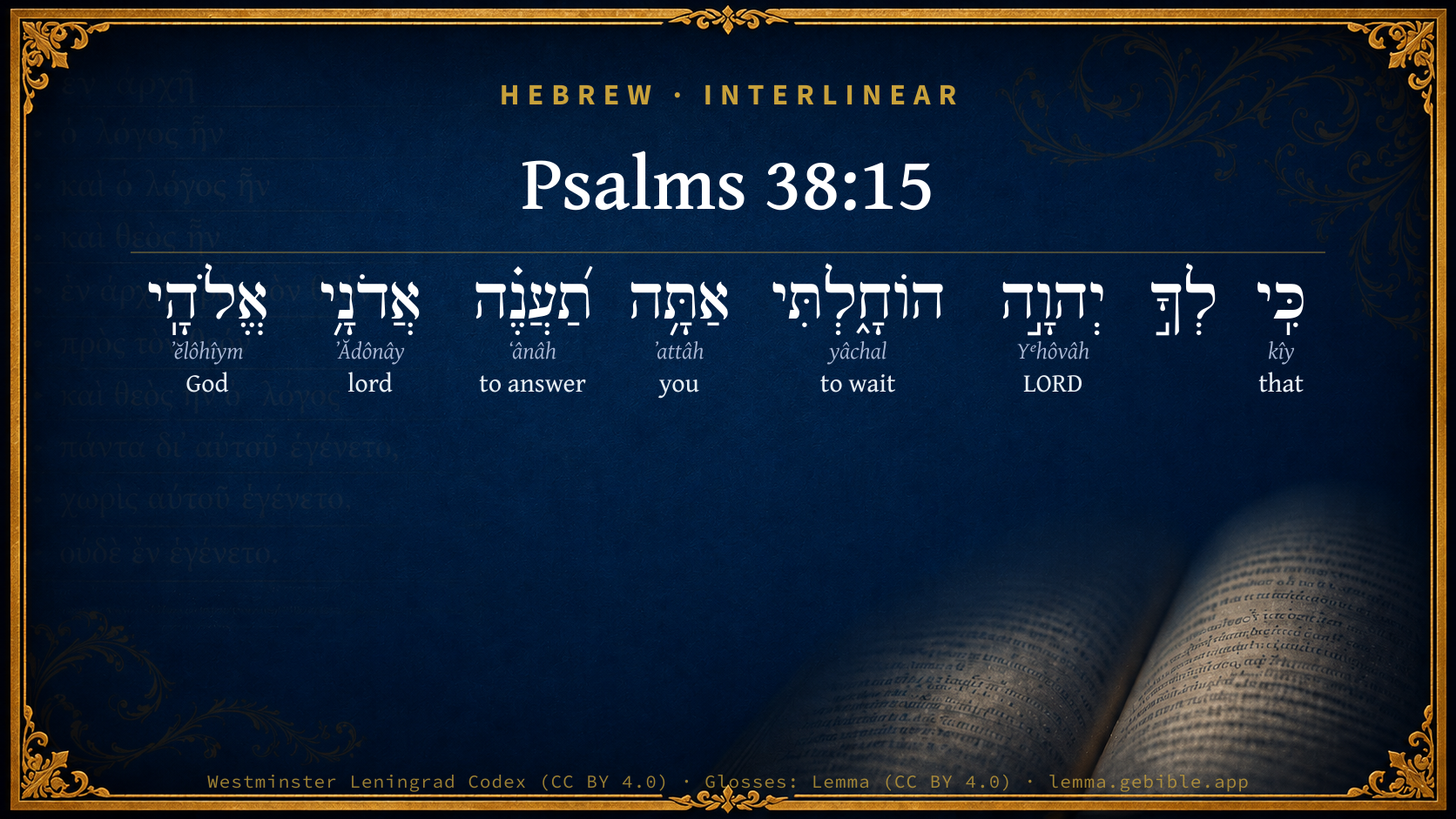
Psalms 38:15

Hebrew (Westminster Leningrad Codex) Psalms 38:15 appears in the Hebrew Old Testament. The text above is from the Westminster Leningrad Codex. Each word links to its Strong’s number, a concise gloss, and parsing drawn from the Open Scriptures Hebrew Bible morphology. Click any word for its full Brown-Driver-Briggs (BDB) entry.
Download image
Cite this verse

Psalms 38:15 (World English Bible). Public Domain. Lemma interlinear Bible study tool, https://lemma.gebible.app/v/psalms/38/15.

Show BibTeX & RIS
BibTeX
RIS
English Translation
For in you, Yahweh, do I hope. You will answer, Lord my God.
World English Bible · Public Domain
Download a study sheet

One document with this verse’s original text, its word-by-word gloss line, the meaning frame, cross-references with their text, attributed commentary, and full source and license credits — printable, and it pastes into notes with its structure intact.

This verse Autodidact and up

Study sheet (.html) Plain text (.txt)

A passage Seminary Student

Up to 50 verses in one chapter. A passage sheet keeps up to 6 commentary sources and 12 cross-references per verse, in the order this page ranks them, and says so on the sheet whenever that leaves anything out. Ask for a single verse and you get the Autodidact verse sheet above.

Everything on this page stays free to read, with no account — the sheet is a download of what is already on screen, not access to it.

Want to remove ads? Support Godless Engineer
Compare translations 3

The same verse in 3 English versions, stacked beneath the original-language interlinear above. Click any original word for its lexicon entry.

Each is an independent rendering of the whole verse — the interlinear is not word-aligned to these translations.

Highlighted words mark where these versions differ — a whole-verse word diff, not a word-by-word alignment.

  • World English Bible Public Domain
    For in you, Yahweh, do I hope. You will answer, Lord my God.
  • King James Version Public Domain
    For in thee, O LORD, do I hope: thou wilt hear, O Lord my God.
  • unfoldingWord Literal Text CC BY-SA 4.0
    Because for you, Yahweh, I have waited; you, you will answer, Lord my God.

unfoldingWord Literal Text — © unfoldingWord, licensed CC BY-SA 4.0. Word-aligned USFM3 via Door43 (git.door43.org/unfoldingWord/en_ult).

Versions to compare (up to 4)

3 of 4 selected

Show all 18 translations

Every available English version of this verse, each an independent rendering of the whole verse.

  • World English Bible Public Domain
    For in you, Yahweh, do I hope. You will answer, Lord my God.
  • Berean Standard Bible Public Domain
    I wait for You, O LORD; You will answer, O Lord my God.
  • Majority Standard Bible Public Domain
    I wait for You, O LORD; You will answer, O Lord my God.
  • King James Version Public Domain
    For in thee, O LORD, do I hope: thou wilt hear, O Lord my God.
  • American Standard Version (1901) Public Domain
    For in thee, O Jehovah, do I hope: Thou wilt answer, O Lord my God.
  • Revised Version (1885) Public Domain
    For in thee, O LORD, do I hope: thou wilt answer, O Lord my God.
  • Geneva Bible (1599) Public Domain
    For on thee, O Lord, do I waite: thou wilt heare me, my Lord, my God.
  • Douay-Rheims (1899) Public Domain
    And I became as a man that heareth not: and that hath no reproofs in his mouth.
  • Young's Literal Translation Public Domain
    Because for Thee, O Jehovah, I have waited, Thou dost answer, O Lord my God.
  • Literal Standard Version CC BY-SA 4.0
    Because for You, O YHWH, I have waited, || You answer, O Lord my God.
  • Unlocked Literal Bible CC BY-SA 4.0
    Surely I wait for you, Yahweh; you will answer, Lord my God.
  • unfoldingWord Literal Text CC BY-SA 4.0
    Because for you, Yahweh, I have waited; you, you will answer, Lord my God.
  • Darby Bible Public Domain
    For in thee, Jehovah, do I hope: *thou* wilt answer, O Lord my God.
  • World Messianic Bible Public Domain
    For I hope in you, LORD. You will answer, Lord my God.
  • Webster's Bible Public Domain
    \\38:14\\Thus I was as a man that heareth not, and in whose mouth are no reproofs.
  • Free Bible Version CC BY-SA 4.0
    For I'm waiting on you, Lord! You will answer for me, my Lord and my God.
  • Bible in Basic English Public Domain
    In you, O Lord, is my hope: you will give me an answer, O Lord, my God.
  • JPS Tanakh (1917) Public Domain
    (38-16) For in Thee, O LORD, do I hope; Thou wilt answer, O Lord my God.

Literal Standard Version (2020), Covenant Press — licensed CC BY-SA 4.0. Text via the HelloAO Bible API (eBible.org). Unlocked Literal Bible (unfoldingWord) — licensed CC BY-SA 4.0. Text via the HelloAO Bible API (eBible.org). unfoldingWord Literal Text — © unfoldingWord, licensed CC BY-SA 4.0. Word-aligned USFM3 via Door43 (git.door43.org/unfoldingWord/en_ult). Free Bible Version, Dr. Jonathan Gallagher — licensed CC BY-SA 4.0. Text via the HelloAO Bible API (eBible.org).

Word by word

More ways to search: Search by grammar → Find every occurrence → Compare this word →

Practice this passage: Drill this verse → Learn its vocabulary →

About this verse

These counts appear in no published source. They are computed here, from the morphology-tagged text and Lemma’s own curated glosses. What Lemma adds →

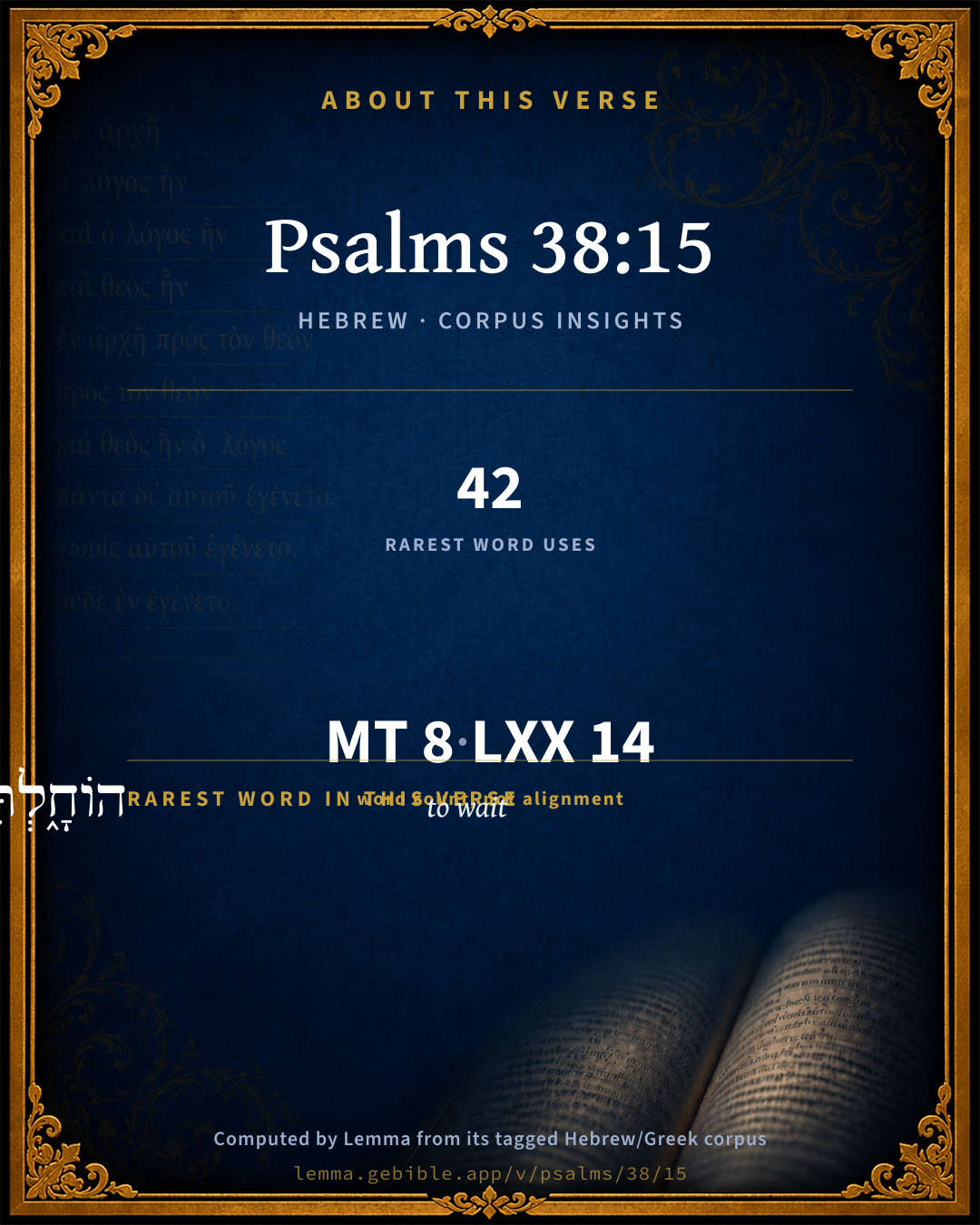
8
words
7
distinct lemmas
Wisdom
section

Shared distinctive vocabulary

הוֹחָ֑לְתִּי to wait H3176 occurs in 41 verses of the Hebrew Bible. Also found in:

Grammatical profile

  • 2 verbs
  • 3 nouns
  • 1 pronoun
  • 1 preposition
  • 1 conjunction

Verb forms

  • הוֹחָ֑לְתִּי Hiphil · Perfect
  • תַ֝עֲנֶ֗ה Qal · Imperfect

Hebrew & Septuagint length

In English translation the verse runs 13 words from the Hebrew and 14 from the Septuagint (LXX English) — closely comparable.

A rough comparison of the two English renderings, which tokenize alike — not a word-level alignment.

Word counts can differ between the Hebrew and the Greek without any difference in meaning — e.g. the Hebrew direct-object marker אֵת has no separate Greek word, and Greek often adds the article ὁ.

In the original languages it is 8 Hebrew tokens and 14 Greek tokens — but the two are counted differently (Hebrew bundles its prefixes and suffixes into one token; the Greek is in lemma form), so that isn’t a like-for-like length.

Cross-references

4

Topical passages linked to Psalms 38:15 in the Treasury of Scripture Knowledge — connected by theme and wording, ordered by reader-vote popularity; previews shown in the World English Bible.

  • Psalms 39:7 Now, Lord, what do I wait for? My hope is in you.
  • Psalms 17:6 I have called on you, for you will answer me, God: Turn your ear to me. Hear my speech.
  • Psalms 138:3 In the day that I called, you answered me. You encouraged me with strength in my soul.
  • Psalms 123:1–3 To you I do lift up my eyes, You who sit in the heavens.

Cross-references courtesy of OpenBible.info (CC BY 4.0).

Hebrew and Greek witnesses Masoretic Hebrew ↔ Greek Septuagint

The same verse in the two great witnesses to the Old Testament, shown verse-for-verse.

You’re reading Greek Psalm 37 (Hebrew Psalm 38). The Septuagint counts the superscription, so verse numbers can differ from the Hebrew — chapter-level alignment, not verse-by-verse. Numbering follows Rahlfs.

These are two independent witnesses, not word-aligned to each other, and the Septuagint is shown in lemma (dictionary) form.

Hebrew Psalms 38:15 Masoretic · Westminster Leningrad Codex

כִּֽי לְךָ֣ יְהוָ֣ה הוֹחָ֑לְתִּי אַתָּ֥ה תַ֝עֲנֶ֗ה אֲדֹנָ֥י אֱלֹהָֽי

For in you, Yahweh, do I hope. You will answer, Lord my God.

World English Bible · Public Domain

Greek LXX Greek Psalm 37:15 Septuagint · lemma form

καί γίγνομαι ὡσεί ἄνθρωπος οὐ ἀκούω καί οὐ ἔχω ἐν ὁ στόμα αὐτός ἐλεγμός

For I hoped in you, O Lord: you will hear, O Lord my God.

LXX2012 (modern English Septuagint) · Public Domain

On this verse, Keil & Delitzsch discusses the Septuagint’s reading. Read the note in Commentary ↓

Hebrew: Westminster Leningrad Codex (CC BY 4.0). Greek: Septuagint (public domain); English from LXX2012 (modern English Septuagint) (Public Domain). How the Septuagint differs from the Hebrew →

Commentary

Notes on Psalms 38:15 from classic Christian and Jewish commentators (each source and its license shown beneath its notes). The classic Christian expositions comment on the surrounding passage and are grouped to its opening verse, so a note may address several verses; the Jewish commentaries on the Tanakh (Rashi and others) are per-verse, so they appear only where the commentator wrote on this verse.

Lemma curates 59 commentaries, every one of them public domain or Creative Commons licensed, each selected and text-cleaned for this edition rather than reprinted as found. About our sources →

Trapp's Complete Commentary

John Trapp

Psa 38:15 For in thee, O LORD, do I hope: thou wilt hear, O Lord my God.

Ver. 15. For in thee, O Lord, do I hope] This was the ground of his patience, and differenced it from that of heathens, which was rather pertinace than patience, and came not from a right principle.

Thou wilt hear] Or answer; and, therefore, what need is there of my answer?

John Trapp, A Commentary or Exposition upon All the Books of the Old and New Testament (1647–1656) — public domain. Text from a community e-Sword module.

The Biblical Illustrator

Joseph S. Exell

Psa_38:15

For in Thee, O Lord, do I hope.

Hopes lever

You have heard, no doubt, of the great Grecian mechanician who once said, If I had a lever long and strong enough, and a fulcrum on which to rest it, I could move the earth. Such was the philosophers confidence in the power of the mechanical lever. There is in the world of mind and spirit a corresponding power which we call Hope. What can be stronger than this sacred, invisible influence? See that man yonder, going along with his head bent; when he speaks, there is no music in his voice, and no light in his eye. What is the cause? You reply, Ah, that man has lost all his hope. Remove this divine influence from us, and existence, to the poor, and sick, and disappointed, would be like an eternal night without a star. Hope is a Divinely-given grace to bear us heavenward, like the wings of a bird. And as a bird puts forth efforts to fly, so we should continually aspire to be better men and women than we are.

I. Hope inspires us to act as if we in reality could see and hear god speaking to us. When we read in the Gospel that God forgives sin, hope inspires us to believe that our Father has really forgiven us. The men on yonder ship which has sprung a leak, hoist a flag of distress, and while that steamer passes by they hope her captain will see their message and deliver them from peril and distress. So, with the same feeling, a man when in sorrow, or when he feels that without some great change taking place he will sink utterly in sin--that man goes into his room, shuts the door, kneels down, and lifts his flag of distress to God in the cry, Lord, save me; I perish! And as no humane sailor would pass by a ship which carries a flag of distress, neither will God pass by the cry of any man, or woman, or child, who calls upon Him in trouble.

II. God has given us the faculty of hope in order that it may prompt us to great actions. The prodigal of whom we read in the fifteenth chapter of Luke, was a very feeble creature. The parable is not told us to exalt the prodigal, but to show Gods love and forgiveness. But hope in his fathers love prompted him to arise and go to his father: it lifted him from hell to heaven. So, do not be afraid of the self-denial of becoming a Christian. You will suffer; it is not for me to deceive you. The man who will live a true Christian life does suffer. Ah, but there is a divine sweetness in it, such as never comes from sin. Let hope come into your breast. You can be sober; you can be self-denying; you can be truthful; you can be honest and manly in the highest sense of these words. Let hope in Gods Word encourage you to believe that you can do great and good actions.

III. There is hope in death. Have you this hope? If so, and your life is right with God and with man, you will be ready for death. (W. Birch.)

The Biblical Illustrator, edited by Joseph S. Exell (c. 1880s–1900s) — public domain. Text from a community e-Sword module.

J. A. Alexander on Psalms

Joseph Addison Alexander

16. (Psa 38:15). Because for thee I waited; thou wilt answer, Lord, my God! His silence and forbearance, though a part of his sore trial, did not spring from weakness, but, from faith in God, and submission to his precept. (See above, Psa 37:7.) "I retorted not their calumnies and taunts, because I waited for thee to vindicate my cause, and so thou wilt, thou wilt certainly answer." The last verb does not mean shalt answer for me, as the Prayer-Book version has it, but as in other cases, hear or answer my petition for relief and vindication, whether silent or expressed. See above, on Psa 5:2 (1), and compare Psa 3:5 (4), Psa 4:2 (1), Psa 13:4 (3), Psa 17:6; Psa 18:42 (41), Psa 22:3 (2), Psa 27:7; Psa 34:5 (4).—Lord, not Jehovah, but Adhonai, the divine name which properly means Lord or Sovereign. See above, Psa 2:4; Psa 22:31 (30), Psa 35:17; Psa 35:22-23; Psa 37:13. —My God, and as such bound by covenant to hear me.

Joseph Addison Alexander, The Psalms Translated and Explained (1850) — public domain. Text from a community e-Sword module.

Tyndale Open Study Notes

Tyndale Open Resources

38:15 The Lord alone will resolve the conflict (9:18; 27:14; 37:9, 34).

Tyndale Open Study Notes — © Tyndale Open Resources, licensed CC BY-SA 4.0. Text via the HelloAO Bible API.

Jamieson, Fausset & Brown

Robert Jamieson, A. R. Fausset & David Brown

for he is confident the

Lord--literally, "Sovereign" (to whom he was a servant), would answer his prayer (Psa 3:4; Psa 4:1), and not permit their triumph in his partial halting, of which he was in danger.

Jamieson, Fausset & Brown — Commentary Critical and Explanatory on the Whole Bible (1871) — public domain (CC PDM 1.0). Text via the HelloAO Bible API.

Adam Clarke's Commentary

Verse 15. In thee, O Lord, do I hope] I have no helper but thee.

Thou wilt hear, O Lord my God.] Thou art eternal in thy compassions, and wilt hear the prayer of a penitent soul. In the printed copies of the Hebrew text we have אדני אלהי Adonai Elohai, Lord my God; but, instead of אדני Adonai, one hundred and two of Kennicott's and De Rossi's MSS. read יהוה Yehovah. As this word is never pronounced by the Jews, and they consider it dreadfully sacred, in reading, wherever it occurs, they pronounce אדני Adonai; and we may well suppose that Jewish scribes, in writing out copies of the sacred Scriptures, would as naturally write Adonai for Yehovah, as they would in reading supply the former for the latter.

Adam Clarke's Commentary on the Bible (1810–1826) — public domain. Text from a community e-Sword/MySword module.

John Calvin's Commentaries

15 For on thee, O Jehovah! do I wait. David here shows the source of his patience. It consisted in this, that, trusting in the grace of God, he overcame all the temptations of the world. And certainly, the mind of man will never be framed to gentleness and meekness, nor will he be able to subdue his passions, until he has learned never to give up hope. The Psalmist, at the same time, adds, that he cherished his hope by constant meditation, lest he should yield to despair. And this is the only means of our perseverance, when, on the ground of his own promises, with which we are furnished, we appeal to him, yea, rather when setting before our view his fidelity and his constancy in fulfilling what he has promised, we are sureties to ourselves for him. Accordingly, Paul, in Romans 5:4, very properly joins patience to hope and consolation. The repetition of terms in this verse shows, that this holy man was subjected to a severe and arduous conflict. Thou, he says, O Lord! my God, wilt answer me. His language implies, that if God should delay to come to his help, there was reason to fear that he would faint from weariness, or fall into despair, unless, setting this double defense before him, he persevered valiantly in the conflict.

John Calvin's Commentaries (1540-1563) — public domain. Text from the Calvin Translation Society English edition (1840s-50s) via the Christian Classics Ethereal Library (ccel.org). Calvin's coverage is partial (roughly two-thirds of the Bible); uncommented books and verses are honest gaps, never fabricated. The 19th-century editor's footnotes and remarks are omitted so the notes are faithfully Calvin's own voice.

Ellicott's Commentary for English Readers

(15) Thou wilt hear.—Thou is emphatic.

A Bible Commentary for English Readers, edited by Charles John Ellicott (1878–1897) — public domain. Text from a community e-Sword module.

The Cambridge Bible for Schools and Colleges

gen. ed. J. J. S. Perowne

15. The motive of silence and resignation.

in thee … do I hope] Or, for thee do I wait. Patience and hope are inseparable. Cp. Psa_39:7; Mic_7:7.

thou wilt hear] Thou, thou wilt answer. The pronoun is emphatically expressed. It is possible to complete the sense by supplying me, with reference to the prayer of which Psa_38:16 speaks: or for me (P.B.V.) with reference to Psa_38:14. But the one involves the other. An answer to his prayer must be a refutation of the taunts of his enemies.

15–22. Fresh pleadings with God.

The Cambridge Bible for Schools and Colleges (gen. ed. J. J. S. Perowne; Cambridge University Press, 1878–1918) — public domain. Text from a community e-Sword module.

John Gill's Exposition

For I said, hear me,.... This he had expressed in prayer to God; he had committed his cause to him, and entreated him that he would hear and answer him; giving this as a reason,

lest otherwise they should rejoice over me; at his misfortunes and calamities, at the continuance of his trouble and distress, both of body and mind;

when my foot slippeth; as it sometimes did through the corruptions of nature, the temptations of Satan, and the snares of the world; which is more or less the case of all the people of God, who are all subject to slips and falls, though they shall not finally and totally fall away;

they magnify themselves against me; that is, his enemies exulted and triumphed over him: this was what he found by experience; and therefore makes use of it as an argument with God, that he would hear and answer and deliver him out of his trouble, and preserve him from falling.

John Gill's Exposition of the Whole Bible (1746–1763) — public domain (CC PDM 1.0). Text via the HelloAO Bible API.

Albert Barnes' Notes on the Bible

For in thee, O Lord, do I hope - This shows the reason or ground of his patience. He committed his whole cause to God. He believed that God would take care of his reputation, and that he would vindicate him. See Psa 37:5-6. He had no doubt that He would protect his character, and that, notwithstanding the reproaches of his enemies, his true character would at last be made to shine forth, so that all men would see that he had been unjustly aspersed. The exact idea here is expressed, and the sentiment was beautifully and perfectly illustrated, in what is said of the Lord Jesus: “Who, when he was reviled, reviled not again; when he suffered, he threatened not; but committed himself to him that judgeth righteously,” 1Pe 2:23.

Thou wilt hear, O Lord my God - Margin, as in Hebrew: “answer.” The idea is, that God would answer his prayers, and that his character would, in answer to those prayers, be set right before the world.

Albert Barnes' Notes on the Bible (1834–1885) — public domain. Text from a community e-Sword/MySword module.

Matthew Poole's English Annotations

I bore their carriage silently and patiently, because I hoped and knew that thou wouldst answer for me, and plead my cause better than myself; which I would not prevent by my impatience, and avenging myself. Or, but in thee

do I hope, i.e. though friends forsake me, and mine enemies plot and practise against me, yet I do not despair, because I have thee on my side.

Matthew Poole's English Annotations on the Holy Bible (1683–1685) — public domain. Text from a community e-Sword/MySword module.

The Treasury of David

Charles H. Spurgeon

Ver. 15. David committed himself to him that judgeth righteously, and so in patience was able to possess his soul. Hope in God's intervention, and belief in the power of prayer, are two most blessed stays to the soul in time of adversity. Turning right away from the creature to the sovereign Lord of all, and to him as our own covenant God, we shall find the richest solace in waiting upon him. Reputation like a fair pearl may be cast into the mire, but in due time when the Lord makes up his jewels, the godly character shall shine with unclouded splendour. Rest then, O slandered one, and let not thy soul be tossed to and fro with anxiety.

Ver. 15. A man that is to go down into a deep pit, he does not throw himself headlong into it, or leap down at all adventures, but fastens a rope at top upon a cross beam or some sure place, and so lets himself down by degrees: so let thyself down into the consideration of thy sin, hanging upon Christ; and when thou art gone so low that thou canst endure no longer, but art ready to be overcome with the horror and darkness of thy miserable estate, dwell not too long at the gates of hell, lest the devil pull thee in, but wind thyself up again by renewed acts of faith, and "fly for refuge unto the hope that is set before thee." Heb 6:18. Thomas Cole (1627-1697), in "Morning Exercises."

Ver. 15. Prayer, the offspring of hope.

Hope strengthened by confidence in God's answering prayer.

Psalms 38:16*

Charles H. Spurgeon's The Treasury of David (1869–1885) — public domain. Psalms only. Text from a community e-Sword/MySword module.

Whedon's Commentary on the Bible

Daniel D. Whedon

15. Thou wilt hear—The psalmist was silent towards men, because his cause did not lie between him and them, but he appeals to God, who will “hear”—rather, answer, as the word properly means, and in this place imports a judicial answer, a vindication.

Daniel D. Whedon (gen. ed.), Commentary on the Old and New Testaments (1874–1909) — public domain. Text from a community e-Sword module.

The Pulpit Commentary

For in thee, O Lord, do I hope. Thus I acted, because my hope was in thee. I looked for thy interposition. I knew that thou wouldst "maintain my right, and my cause" (Psa_9:4) in thine own good time and in thine own good way. I said to myself in my heart, Thou wilt hear or rather, thou wilt answer (Revised Version)O Lord my God; and I was content to leave my defence to thee.

The Pulpit Commentary (1880–1919), ed. H.D.M. Spence-Jones & Joseph S. Exell — public domain. Text from a community e-Sword module.

Keil & Delitzsch

C. F. Keil & F. Delitzsch

(Heb.: 38:16-23) Become utterly useless in himself, he renounces all self-help, for (כּי) he hopes in Jahve, who alone can help him. He waits for His answer, for (כי) he says, etc. - he waits for an answer, for the hearing of this his petition which is directed towards the glory of God, that God would not suffer his foes to triumph over him, nor strengthen them in their mercilessness and injustice. Psa 38:18 appears also to stand under the government of the פּן;

(Note: The following are the constructions of פן when a clause of ore than one member follows it: (1) fut. and perf., the latter with the tone of the perf. consec., e.g., Exo 34:15., or without it, e.g., Psa 28:1 (which see); (2) fut. and fut. as in Psa 2:12, Jer 51:46. This construction is indispensable where it is intended to give special prominence to the subject notion or a secondary notion of the clause, e.g., Deu 20:6. In one instance פן is even followed (3) by the perf. and fut. consec., viz., Kg2 2:10.)

but, since in this case one would look for a Waw relat. and a different order of the words, Psa 38:18 is to be regarded as a subject clause: "who, when my foot totters, i.e., when my affliction changes to entire downfall, would magnify themselves against me." In Psa 38:18, כּי connects what follows with בּמוט רגלי by way of confirmation: he is נכון לצלע, ready for falling (Psa 35:15), he will, if God does not graciously interpose, assuredly fall headlong. The fourth כּי in Psa 38:19 is attached confirmatorily to Psa 38:18: his intense pain or sorrow is ever present to him, for he is obliged to confess his guilt, and this feeling of guilt is just the very sting of his pain. And whilst he in the consciousness of well-deserved punishment is sick unto death, his foes are numerous and withal vigorous and full of life. Instead of חיּים, probably חנּם, as in Psa 35:19; Psa 69:5, is to be read (Houbigant, Hitzig, Kster, Hupfeld, Ewald, and Olshausen). But even the lxx read חיים; and the reading which is so old, although it does not very well suit עצמוּ (instead of which one would look for ועצוּמים), is still not without meaning: he looks upon himself, according to Psa 38:9, more as one dead than living; his foes, however, are חיּים, living, i.e., vigorous. The verb frequently ash this pregnant meaning, and the adjective can also have it. Just as the accentuation of the form סבּוּ varies elsewhere out of pause, ורבּוּ here has the tone on the ultima, although it is not perf. consec.

(Note: As perf. consec. the following have the accent on the ultima: - וחתּוּ, Isa 20:5, Oba 1:9, and ורבּוּ, Isa 66:16; perhaps also וחדּוּ, וקלּוּ, Hab 1:8, and ורבּוּ (perf. hypoth.), Job 32:15. But there is no special reason for the ultima-accentuation of רכּוּ, Psa 55:22; רבּוּ, Psa 69:5; דּלּוּ, Isa 38:14; קלּוּ, Jer 4:13; שׁחוּ, Pro 14:19; Hab 3:6; חתּוּ, Job 32:15; זכּוּ, צחוּ, Lam 4:7.)

Psa 38:21 is an apposition of the subject, which remains the same as in Psa 38:20. Instead of רדופי (Ges. 61, rem. 2) the Ker is רדפי, rādephî (without any Makkeph following), or רדפי, rādophî; cf. on this pronunciation, Psa 86:2; Psa 16:1, and with the Chethb רדופי, the Chethb צרופה, Psa 26:2, also מיורדי, Psa 30:4. By the "following of that which is good" David means more particularly that which is brought into exercise in relation to his present foes.

(Note: In the Greek and Latin texts, likewise in all the Aethiopic and several Arabic texts, and in the Syriac Psalterium Medilanense, the following addition is found after Psa 38:21 : Ce aperripsan me ton agapeton osi necron ebdelygmenon, Et projecerunt me dilectum tanquam mortuum abominatum (so the Psalt. Veronense). Theodoret refers it to Absalom's relation to David. The words ὡσεὶ νεκρὸν ἐβδελυγμένον are taken from Isa 14:19.)

He closes in Psa 38:22 with sighs for help. No lighting up of the darkness of wrath takes place. The fides supplex is not changed into fides triumphans. But the closing words, "O Lord, my salvation" (cf. Psa 51:16), show where the repentance of Cain and that of David differ. True repentance has faith within itself, it despairs of itself, but not of God.

Keil & Delitzsch — Biblical Commentary on the Old Testament (1861–1891) — public domain (CC PDM 1.0). Text via the HelloAO Bible API. (Old Testament only.)

unfoldingWord translationNotes

Door43 World Missions Community

you will answer

Possible meanings are 1) "you will answer me" or 2) "you will answer my enemies."

will not gloat over me

"will not delight over my trouble"

If my foot slips

Here "my foot" represents the writer. The slipping of his foot is a metaphor that refers to the writer's troubles and misfortunes. AT: "If I make mistakes that cause me trouble" (See: Synecdoche and Metaphor)

translationWords

God

unfoldingWord translationNotes — © Distant Shores Media and the Door43 World Missions Community, licensed CC BY-SA 4.0. Source: git.door43.org/Door43/en_tn.

Lesson kit

Teaching starters — assembled from the data on this page, not authored interpretation. Every prompt links to the verse data it draws on. Edit before teaching.

Psalms, in the Wisdom, opens this verse with 8 words (7 distinct Hebrew lemmas). Its most distinctive word is yâchal (“to wait”). A historical commentator’s framing appears above. Read the whole chapter for the surrounding context.

Discussion questions

  1. How does “to wait” (yâchal) shape what this verse is saying?
  2. How does Genesis 8:12, which shares the word «to wait», read alongside this verse?
  3. These translations render this verse differently; the difference is in the English rendering, not the original. What questions does that raise?
  4. «הוֹחָ֑לְתִּי» is a Hiphil Perfect verb. How does that grammatical form shape the action described?
  5. Compare how Trapp's Complete Commentary and The Biblical Illustrator read this verse. Where do they agree or differ?

Things to notice

Reading settings

Reading text

Shown beneath each verse's original-language words.

Old Testament
Old Testament edition

Read the OT as the Masoretic Hebrew (MT) or the Greek Septuagint (LXX).

English shown for the Greek Septuagint (in the Hebrew ↔ Greek comparison).

Comparing translations? Open the Compare panel on any verse page to stack up to four side by side.