
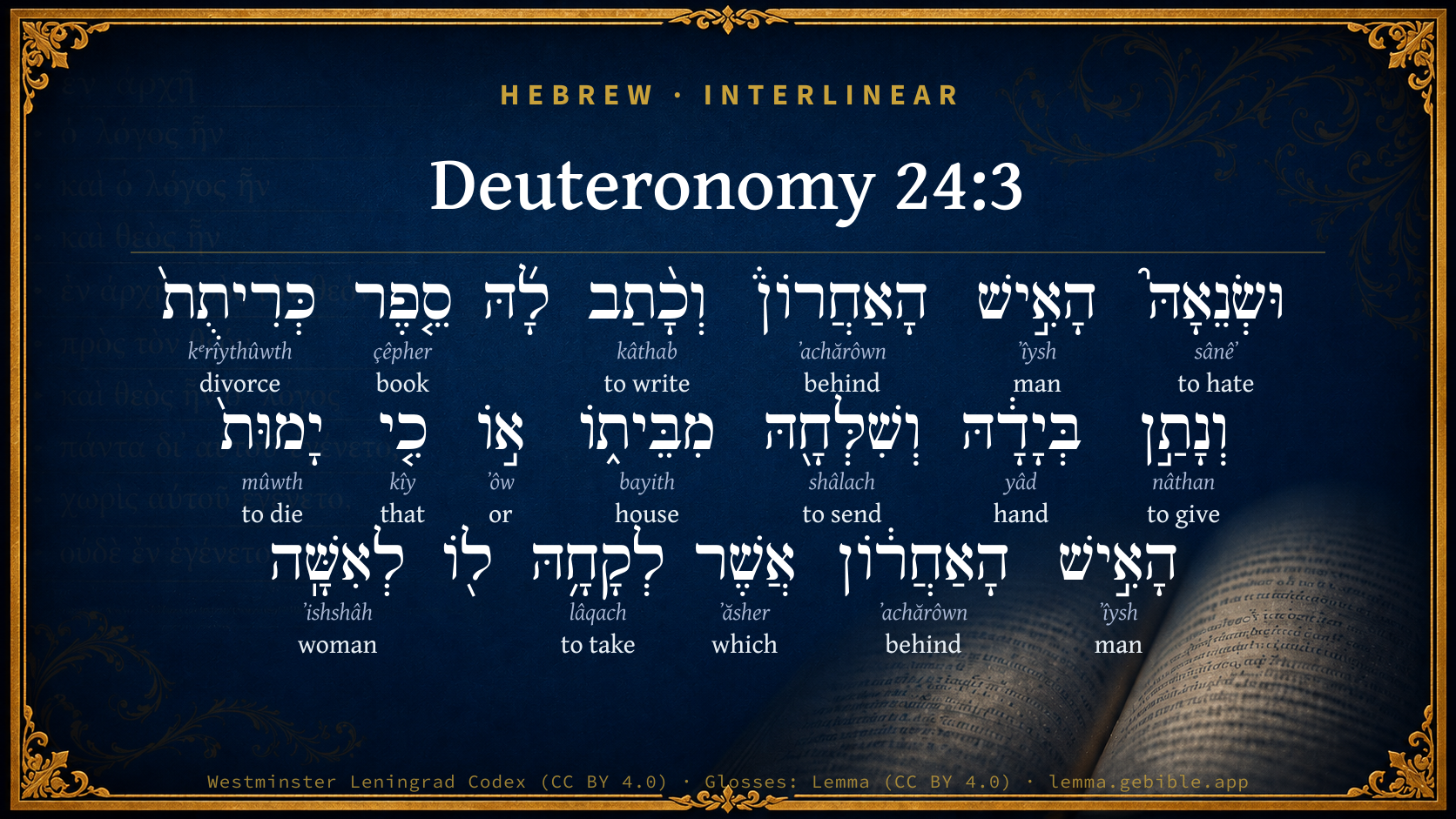
Deuteronomy 24:3

Hebrew (Westminster Leningrad Codex) Deuteronomy 24:3 appears in the Hebrew Old Testament. The text above is from the Westminster Leningrad Codex. Each word links to its Strong’s number, a concise gloss, and parsing drawn from the Open Scriptures Hebrew Bible morphology. Click any word for its full Brown-Driver-Briggs (BDB) entry.
Download image
Cite this verse

Deuteronomy 24:3 (World English Bible). Public Domain. Lemma interlinear Bible study tool, https://lemma.gebible.app/v/deuteronomy/24/3.

Show BibTeX & RIS
BibTeX
RIS
English Translation
If the latter husband hate her, and write her a bill of divorce, and give it in her hand, and send her out of his house; or if the latter husband die, who took her to be his wife;
World English Bible · Public Domain
Download a study sheet

One document with this verse’s original text, its word-by-word gloss line, the meaning frame, cross-references with their text, attributed commentary, and full source and license credits — printable, and it pastes into notes with its structure intact.

This verse Autodidact and up

Study sheet (.html) Plain text (.txt)

A passage Seminary Student

Up to 50 verses in one chapter. A passage sheet keeps up to 6 commentary sources and 12 cross-references per verse, in the order this page ranks them, and says so on the sheet whenever that leaves anything out. Ask for a single verse and you get the Autodidact verse sheet above.

Everything on this page stays free to read, with no account — the sheet is a download of what is already on screen, not access to it.

Want to remove ads? Support Godless Engineer
Compare translations 3

The same verse in 3 English versions, stacked beneath the original-language interlinear above. Click any original word for its lexicon entry.

Each is an independent rendering of the whole verse — the interlinear is not word-aligned to these translations.

Highlighted words mark where these versions differ — a whole-verse word diff, not a word-by-word alignment.

  • World English Bible Public Domain
    If the latter husband hate her, and write her a bill of divorce, and give it in her hand, and send her out of his house; or if the latter husband die, who took her to be his wife;
  • King James Version Public Domain
    And if the latter husband hate her, and write her a bill of divorcement, and giveth it in her hand, and sendeth her out of his house; or if the latter husband die, which took her to be his wife;
  • unfoldingWord Literal Text CC BY-SA 4.0
    And the latter husband hates her and writes her a letter of divorce and puts into her hand and sends her out from his house; or if the latter husband dies, who took her as his wife,

unfoldingWord Literal Text — © unfoldingWord, licensed CC BY-SA 4.0. Word-aligned USFM3 via Door43 (git.door43.org/unfoldingWord/en_ult).

Versions to compare (up to 4)

3 of 4 selected

Show all 18 translations

Every available English version of this verse, each an independent rendering of the whole verse.

  • World English Bible Public Domain
    If the latter husband hate her, and write her a bill of divorce, and give it in her hand, and send her out of his house; or if the latter husband die, who took her to be his wife;
  • Berean Standard Bible Public Domain
    and the second man hates her, writes her a certificate of divorce, hands it to her, and sends her away from his house, or if he dies,
  • Majority Standard Bible Public Domain
    and the second man hates her, writes her a certificate of divorce, hands it to her, and sends her away from his house, or if he dies,
  • King James Version Public Domain
    And if the latter husband hate her, and write her a bill of divorcement, and giveth it in her hand, and sendeth her out of his house; or if the latter husband die, which took her to be his wife;
  • American Standard Version (1901) Public Domain
    And if the latter husband hate her, and write her a bill of divorcement, and give it in her hand, and send her out of his house; or if the latter husband die, who took her to be his wife;
  • Revised Version (1885) Public Domain
    And if the latter husband hate her, and write her a bill of divorcement, and give it in her hand, and send her out of his house; or if the latter husband die, which took her to be his wife;
  • Geneva Bible (1599) Public Domain
    And if the latter husband hate her, and write her a letter of diuorcement, and put it in her hand, and send her out of his house, or if the latter man die which tooke her to wife:
  • Douay-Rheims (1899) Public Domain
    And he also hateth her, and hath given her a bill of divorce, and hath sent her out of his house or is dead:
  • Young's Literal Translation Public Domain
    and the latter man hath hated her, and written for her a writing of divorce, and given `it' into her hand, and sent her out of his house, or when the latter man dieth, who hath taken her to himself for a wife:
  • Literal Standard Version CC BY-SA 4.0
    and the latter man has hated her, and written a writing of divorce for her, and given [it] into her hand, and sent her out of his house, or when the latter man dies, who has taken her to himself for a wife,
  • Unlocked Literal Bible CC BY-SA 4.0
    If the second husband hates her and writes her a certificate of divorce, puts it into her hand, and sends her out of his house; or if the second husband dies, the man who took her to be his wife—
  • unfoldingWord Literal Text CC BY-SA 4.0
    And the latter husband hates her and writes her a letter of divorce and puts into her hand and sends her out from his house; or if the latter husband dies, who took her as his wife,
  • Darby Bible Public Domain
    And if the latter husband hate her, and write her a letter of divorce, and give it into her hand, and send her out of his house; or if the latter husband die who took her as his wife;
  • World Messianic Bible Public Domain
    If the latter husband hates her, and writes her a certificate of divorce, puts it in her hand, and sends her out of his house; or if the latter husband dies, who took her to be his wife;
  • Webster's Bible Public Domain
    And if the latter husband shall hate her, and write her a bill of divorcement, and give it in her hand, and send her out of his house; or if the latter husband shall die, who took her to be his wife;
  • Free Bible Version CC BY-SA 4.0
    and suppose the second man also ends up hating her, writes out a certificate of divorce for her, gives it to her, and sends her out of his house—or he may happen to die.
  • Bible in Basic English Public Domain
    And if the second husband has no love for her and, giving her a statement in writing, sends her away; or if death comes to the second husband to whom she was married;
  • JPS Tanakh (1917) Public Domain
    and the latter husband hateth her, and writeth her a bill of divorcement, and giveth it in her hand, and sendeth her out of his house; or if the latter husband die, who took her to be his wife;

Literal Standard Version (2020), Covenant Press — licensed CC BY-SA 4.0. Text via the HelloAO Bible API (eBible.org). Unlocked Literal Bible (unfoldingWord) — licensed CC BY-SA 4.0. Text via the HelloAO Bible API (eBible.org). unfoldingWord Literal Text — © unfoldingWord, licensed CC BY-SA 4.0. Word-aligned USFM3 via Door43 (git.door43.org/unfoldingWord/en_ult). Free Bible Version, Dr. Jonathan Gallagher — licensed CC BY-SA 4.0. Text via the HelloAO Bible API (eBible.org).

Word by word

More ways to search: Search by grammar → Find every occurrence → Compare this word →

Practice this passage: Drill this verse → Learn its vocabulary →

כְּרִיתֻת֙
kᵉrîythûwth
H3748
“divorce”
Noun, Common, Feminine, Singular, Absolute
Part of Speech
Noun
Type
Common
Gender
Feminine
Number
Singular
State
Absolute
Full BDB Definition

Origin: from H3772

TWOT: 1048a

divorce, dismissal, divorcement
  1. וּשְׂנֵאָהּ֮ sânêʼ H8130 “and · to hate · her” Conjunction + Verb, Qal, Sequential Perfect, 3rd Person, Masculine, Singular + Suffix, Personal, 3rd Person, Feminine, Singular
  2. הָאִ֣ישׁ ʼîysh H376 “the · man” Particle, Definite Article + Noun, Common, Masculine, Singular, Absolute
  3. הָאַחֲרוֹן֒ ʼachărôwn H314 “the · behind” Particle, Definite Article + Adjective, Adjective, Masculine, Singular, Absolute
  4. וְכָ֨תַב kâthab H3789 “and · to write” Conjunction + Verb, Qal, Sequential Perfect, 3rd Person, Masculine, Singular
  5. סֵ֤פֶר çêpher H5612 “book of” Noun, Common, Masculine, Singular, Construct
  6. וְנָתַ֣ן nâthan H5414 “and · to give” Conjunction + Verb, Qal, Sequential Perfect, 3rd Person, Masculine, Singular
  7. בְּיָדָ֔הּ yâd H3027 “in/at · hand · her” Preposition + Noun, Common, Both, Singular, Construct + Suffix, Personal, 3rd Person, Feminine, Singular
  8. וְשִׁלְּחָ֖הּ shâlach H7971 “and · to send · her” Conjunction + Verb, Piel, Sequential Perfect, 3rd Person, Masculine, Singular + Suffix, Personal, 3rd Person, Feminine, Singular
  9. מִבֵּית֑וֹ bayith H1004 “from · house · his” Preposition + Noun, Common, Masculine, Singular, Construct + Suffix, Personal, 3rd Person, Masculine, Singular
  10. א֣וֹ ʼôw H176 “or” Conjunction
  11. כִ֤י kîy H3588 “that” Conjunction
  12. יָמוּת֙ mûwth H4191 “to die” Verb, Qal, Imperfect, 3rd Person, Masculine, Singular
  13. הָאִ֣ישׁ ʼîysh H376 “the · man” Particle, Definite Article + Noun, Common, Masculine, Singular, Absolute
  14. הָאַחֲר֔וֹן ʼachărôwn H314 “the · behind” Particle, Definite Article + Adjective, Adjective, Masculine, Singular, Absolute
  15. אֲשֶׁר ʼăsher H834 “which” Particle, Relative
  16. לְקָחָ֥הּ lâqach H3947 “to take · her” Verb, Qal, Perfect, 3rd Person, Masculine, Singular + Suffix, Personal, 3rd Person, Feminine, Singular
  17. לְאִשָּֽׁה ʼishshâh H802 “to/for · woman” Preposition + Noun, Common, Feminine, Singular, Absolute

About this verse

These counts appear in no published source. They are computed here, from the morphology-tagged text and Lemma’s own curated glosses. What Lemma adds →

20
words
16
distinct lemmas
Pentateuch
section

Notable vocabulary

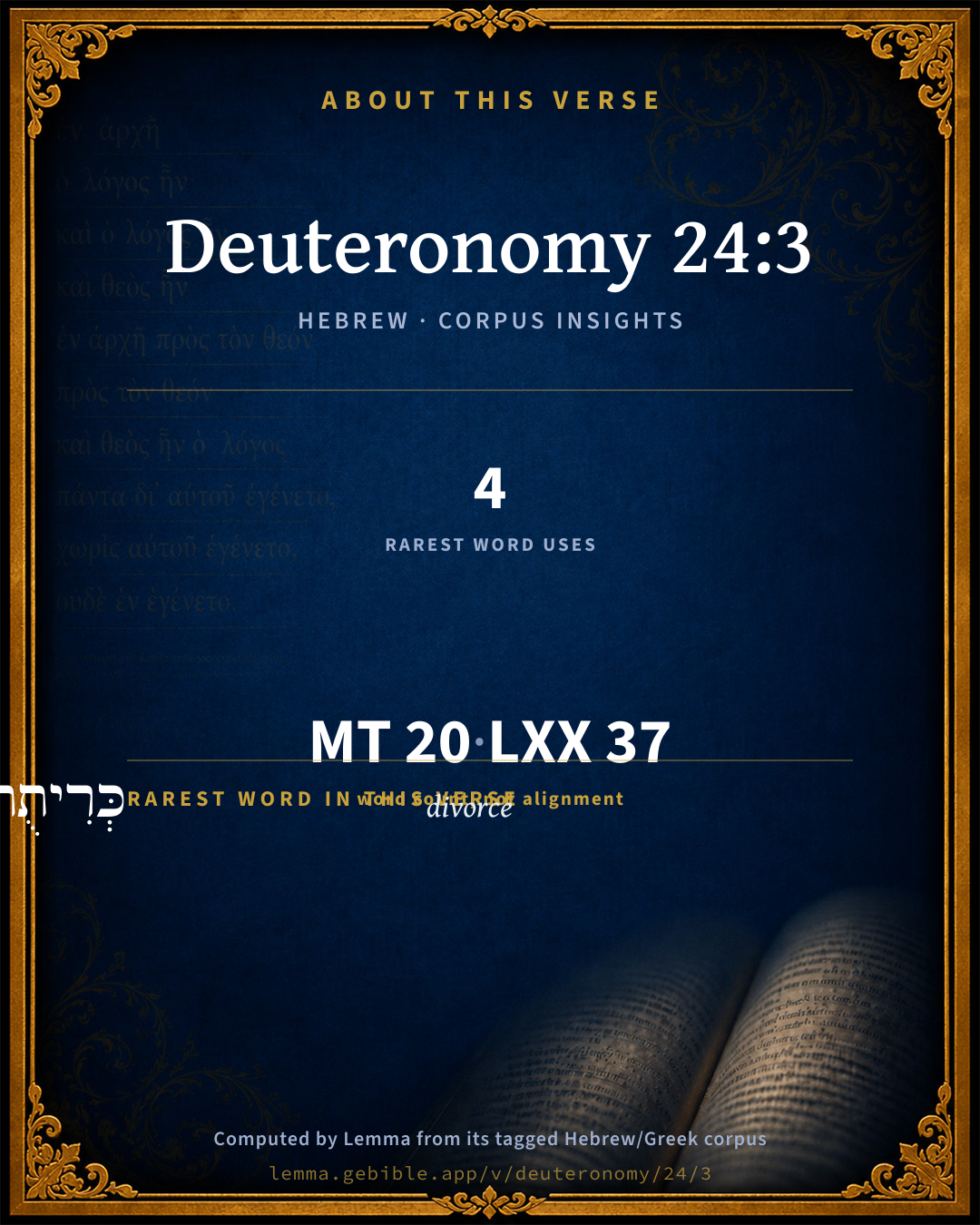
The rarest word here is כְּרִיתֻת֙ divorce H3748 — appearing just 4 times in the whole Hebrew Bible.

Shared distinctive vocabulary

כְּרִיתֻת֙ divorce H3748 occurs in 4 verses of the Hebrew Bible. Also found in:

Grammatical profile

  • 6 verbs
  • 7 nouns
  • 2 adjectives
  • 2 prepositions
  • 2 conjunctions
  • 1 particle

Verb forms

  • וּשְׂנֵאָהּ֮ Qal · Sequential Perfect
  • וְכָ֨תַב Qal · Sequential Perfect
  • וְנָתַ֣ן Qal · Sequential Perfect
  • וְשִׁלְּחָ֖הּ Piel · Sequential Perfect
  • יָמוּת֙ Qal · Imperfect
  • לְקָחָ֥הּ Qal · Perfect

Repetition

Words recur within this verse — often emphatic in Hebrew:

  • הָאִ֣ישׁ man H376 ×2
  • הָאַחֲרוֹן֒ behind H314 ×2

Hebrew & Septuagint length

In English translation the verse runs 39 words from the Hebrew and 63 from the Septuagint (LXX English) — the Septuagint runs noticeably longer here. See the side-by-side →

A rough comparison of the two English renderings, which tokenize alike — not a word-level alignment.

Word counts can differ between the Hebrew and the Greek without any difference in meaning — e.g. the Hebrew direct-object marker אֵת has no separate Greek word, and Greek often adds the article ὁ.

In the original languages it is 20 Hebrew tokens and 37 Greek tokens — but the two are counted differently (Hebrew bundles its prefixes and suffixes into one token; the Greek is in lemma form), so that isn’t a like-for-like length.

Hebrew and Greek witnesses Masoretic Hebrew ↔ Greek Septuagint

The same verse in the two great witnesses to the Old Testament, shown verse-for-verse.

Here the Septuagint runs noticeably longer than the Hebrew — LXX2012 (modern English Septuagint) 63 words vs World English Bible 39. A rough length comparison of the two English translations, not a word-level alignment — read both below.

These are two independent witnesses, not word-aligned to each other, and the Septuagint is shown in lemma (dictionary) form.

Hebrew Deuteronomy 24:3 Masoretic · Westminster Leningrad Codex

וּשְׂנֵאָהּ֮ הָאִ֣ישׁ הָאַחֲרוֹן֒ וְכָ֨תַב לָ֜הּ סֵ֤פֶר כְּרִיתֻת֙ וְנָתַ֣ן בְּיָדָ֔הּ וְשִׁלְּחָ֖הּ מִבֵּית֑וֹ א֣וֹ כִ֤י יָמוּת֙ הָאִ֣ישׁ הָאַחֲר֔וֹן אֲשֶׁר לְקָחָ֥הּ ל֖וֹ לְאִשָּֽׁה

If the latter husband hate her, and write her a bill of divorce, and give it in her hand, and send her out of his house; or if the latter husband die, who took her to be his wife;

World English Bible · Public Domain

Greek LXX Deuteronomy 24:3 Septuagint · lemma form

καί μισέω αὐτός ὁ ἀνήρ ὁ ἔσχατο καί γράφω αὐτός βιβλίον ἀποστάσιον καί δίδωμι εἰς ὁ χείρ αὐτός καί ἐκ ἀποστέλλω αὐτός ἐκ ὁ οἰκία αὐτός ἤ ἀποθνήσκω ὁ ἀνήρ ὁ ἔσχατο ὅς λαμβάνω αὐτός ἑαυτοῦ γυνή

And if any one should take a wife, and should dwell with her, then it shall come to pass if she should not have found favor before him, because he has found some unbecoming thing in her, that he shall write for her a bill of divorcement, and give it into her hands, and he shall send her away out of his house.

LXX2012 (modern English Septuagint) · Public Domain

Hebrew: Westminster Leningrad Codex (CC BY 4.0). Greek: Septuagint (public domain); English from LXX2012 (modern English Septuagint) (Public Domain). How the Septuagint differs from the Hebrew →

Targum (Aramaic paraphrase)

2

The Targum is the ancient Jewish Aramaic paraphrase of the Hebrew Scriptures — an interpretive translation, not the Hebrew text itself. Onkelos (literal) and Pseudo-Jonathan (expansive) render the Torah, and Jonathan the Prophets. Coverage is partial: where no permissively-licensed English translation exists for a verse, only the Aramaic is shown. This is verse-level text, not a word-by-word alignment to the Hebrew.

  1. Targum Onkelos Torah (Genesis–Deuteronomy)
    וְיִסְנִנַהּ גַבְרָא בַתְרָאָה וְיִכְתּוֹב לַהּ גֵטּ פִטּוּרִין וְיִתֵּן בִּידַהּ וְיִפְטְרִנַהּ מִבֵּיתֵהּ אוֹ אֲרֵי יְמוּת גַבְרָא בַתְרָאָה דְנָסְבַהּ לֵה לְאִנְתּוּ

    (no public-domain English translation for this verse)

    Targum Onkelos — Aramaic: “Onkelos Genesis” (public domain); “Onkelos Exodus” (public domain); “Onkelos Leviticus” (public domain); “Onkelos Numbers” (public domain); “Onkelos Deuteronomy” (public domain). English: “Sefaria Community Translation” (CC0 1.0 (public-domain dedication)); “J.W. Etheridge. The Targums of Onkelos and Jonathan Ben Uzziel on the Pentateuch. London: Longmans, Green, 1862” (public domain). Text via Sefaria.

  2. Targum Pseudo-Jonathan Torah (Genesis–Deuteronomy)
    וְאַכְרִיזוּ עֲלָהּ מִן שְׁמַיָא דְיַסְנִינָהּ גַּבְרָא בַּתְרָאָה וְיִכְתּוֹב לָהּ סֵפֶר תִּירוּכִין וְיִתֵּן בִּרְשׁוּתָהּ וִיטַיֵּיל לָהּ מִבַּיְיתֵיהּ אוֹ אַכְרִיזוּ עֲלוֹי וְיֵמוּת גַּבְרָא בַּתְרָאָה דְנַסְבָהּ לֵיהּ לְאִנְתּוּ

    But should they proclaim from the heavens about her that the latter husband shall dislike her, and write her a bill of divorce, and put it into her power to go from his house; or should they proclaim about him that lie the latter husband shall die:

    Targum Pseudo-Jonathan — Aramaic: “Targum Jonathan on Genesis” (public domain); “Targum Jonathan on Exodus” (public domain); “Targum Jonathan on Leviticus” (public domain); “Targum Jonathan on Numbers” (public domain); “Targum Jonathan on Deuteronomy” (public domain). English: “The Targum of Jonathan ben Uzziel, trans. J. W. Etheridge, London, 1862” (public domain). Text via Sefaria.

Commentary

Notes on Deuteronomy 24:3 from classic Christian and Jewish commentators (each source and its license shown beneath its notes). The classic Christian expositions comment on the surrounding passage and are grouped to its opening verse, so a note may address several verses; the Jewish commentaries on the Tanakh (Rashi and others) are per-verse, so they appear only where the commentator wrote on this verse.

Lemma curates 59 commentaries, every one of them public domain or Creative Commons licensed, each selected and text-cleaned for this edition rather than reprinted as found. About our sources →

Trapp's Complete Commentary

John Trapp

Deu 24:3 And [if] the latter husband hate her, and write her a bill of divorcement, and giveth [it] in her hand, and sendeth her out of his house; or if the latter husband die, which took her [to be] his wife;

Ver. 3. And if the latter husband hate her.] As many Nabals now-a-days do. Job was not more weary of his boils, than they are of their bedfellows, cursing their weddingday as much as he did his birthday, and thirsting after a divorce as he did after death: which, because it cannot be had, their lives prove like the sojourning of Israel in Marah, where almost nothing could be heard but mourning, conjuring, and complaining.

John Trapp, A Commentary or Exposition upon All the Books of the Old and New Testament (1647–1656) — public domain. Text from a community e-Sword module.

Adam Clarke's Commentary

Verse 3. And write her a bill of divorcement] These bills, though varying in expression, are the same in substance among the Jews in all places. The following, collected from Maimonides and others, is a general form, and contains all the particulars of such instruments. The reader who is curious may find a full account of divorces in the Biblioth. Rab. of Bartolocci, and the following form in that work, vol. iv., p. 550.

"In ---- day of the week, or day ---- of the month A., in ---- year from the creation of the world, or from the supputation (of Alexander) after the account that we are accustomed to count by, here, in the place B., I, C., the son of D., of the place B., (or if there be any other name which I have, or my father hath had, or which my place or my father's place hath had,) have voluntarily, and with the willingness of my soul, without constraint, dismissed, and left, and put away thee, even thee, E., the daughter of F., of the city G., (or if thou have any other name or surname, thou or thy father, or thy place or thy father's place,) who hast been my wife heretofore; but now I dismiss thee, and leave thee, and put thee away, that thou mayest be free, and have power over thy own life, to go away to be married to any man whom thou wilt; and that no man be refused of thine hand, for my name, from this day and for ever. And thus thou art lawful for any man; and this is unto thee, from me, a writing of divorcement, and book (instrument) of dismission, and an epistle of putting away; according to the Law of Moses and Israel.

A., son of B., witness.

C., son of D., witness."

Adam Clarke's Commentary on the Bible (1810–1826) — public domain. Text from a community e-Sword/MySword module.

The Cambridge Bible for Schools and Colleges

gen. ed. J. J. S. Perowne

3. Still the protasis; delete if and if.

The Cambridge Bible for Schools and Colleges (gen. ed. J. J. S. Perowne; Cambridge University Press, 1878–1918) — public domain. Text from a community e-Sword module.

John Gill's Exposition

And if the latter husband hate her,.... Or less loves her than another woman, and she is disliked by him as she was by her former husband:

and write her a bill off divorcement, and giveth it into her hand,

and sendeth her out of his house: as he had by this law a permission, in like manner as her former husband had; See Gill on Deu 24:1,

or if her latter husband die, which took her to be his wife; and she survives him; as she is then by death loosed from the law of an husband, she may lawfully marry another man, but not her former husband, as follows.

John Gill's Exposition of the Whole Bible (1746–1763) — public domain (CC PDM 1.0). Text via the HelloAO Bible API.

unfoldingWord translationNotes

Door43 World Missions Community

General Information:

Moses continues speaking to the people of Israel about a woman who gets a divorce and marries another man.

General Information:

Moses speaks to the Israelites as if they were one man, so the words "you" and "your" here are singular. (See: Forms of You)

If the second husband hates her

"If the second husband decides that he hates the woman"

certificate of divorce

This is an official paper saying that the man and woman are not married anymore. See how you translated this in Deuteronomy 24:1.

puts it into her hand

"gives it to the woman"

the man who took her to be his wife

"the second man who married the woman"

after she has become impure

The full meaning of this statement can be made explicit. AT: "after she has become unclean by the divorce and remarriage to another man" (See: Assumed Knowledge and Implicit Information)

You must not cause the land to become guilty

The land is spoken of as if it could sin. AT: "You must not spread guilt around in the land" (See: Personification)

translationWords

divorce

die

pure

abomination

Yahweh

God

inherit

unfoldingWord translationNotes — © Distant Shores Media and the Door43 World Missions Community, licensed CC BY-SA 4.0. Source: git.door43.org/Door43/en_tn.

Rashi

Rabbi Shlomo Yitzchaki (Rashi)

ושנאה האיש האחרון AND IF THE LATTER HUSBAND HATE HER — (these words lit. mean: and the other will hate her): Scripture tells you that in the end he will hate her and divorce her, and if not, she will bury him (be the cause of his death) as it states “or if the latter husband die” (Sifrei Devarim 270:4-5).

Rashi on the Tanakh — English translations: “The Judaica Press complete Tanach with Rashi, translated by A. J. Rosenberg” (CC BY 4.0); “Pentateuch with Rashi's commentary by M. Rosenbaum and A.M. Silbermann, 1929-1934” (public domain); “The Metsudah Tanach series, Lakewood, N.J” (CC BY 4.0); and “The Book of Joshua, Metsudah Publications, 1997” (CC BY 4.0). Text via Sefaria.

Lesson kit

Teaching starters — assembled from the data on this page, not authored interpretation. Every prompt links to the verse data it draws on. Edit before teaching.

Deuteronomy, in the Pentateuch, opens this verse with 20 words (16 distinct Hebrew lemmas). Its most distinctive word is kᵉrîythûwth (“divorce”). The Greek Septuagint runs longer here. A historical commentator’s framing appears above. Read the whole chapter for the surrounding context.

Discussion questions

  1. What does “divorce” (kᵉrîythûwth) contribute to the verse as a whole?
  2. Deuteronomy 24:1 shares the word «divorce» with this verse. How do the two illuminate each other?
  3. “man” occurs 2× in this one verse. What is the effect of the repetition?
  4. Compared with the Hebrew, the Septuagint runs longer here. What questions does that raise?
  5. The translations on this page render this verse differently — a whole-verse word diff, not a word-by-word alignment. What might account for the different wordings?
  6. The verb «וּשְׂנֵאָהּ֮» is Qal Sequential Perfect. How does its form color the action?
  7. Reading how Trapp's Complete Commentary and Adam Clarke's Commentary read this verse, where do the two commentators agree and where do they part?

Things to notice

Reading settings

Reading text

Shown beneath each verse's original-language words.

Old Testament
Old Testament edition

Read the OT as the Masoretic Hebrew (MT) or the Greek Septuagint (LXX).

English shown for the Greek Septuagint (in the Hebrew ↔ Greek comparison).

Comparing translations? Open the Compare panel on any verse page to stack up to four side by side.