
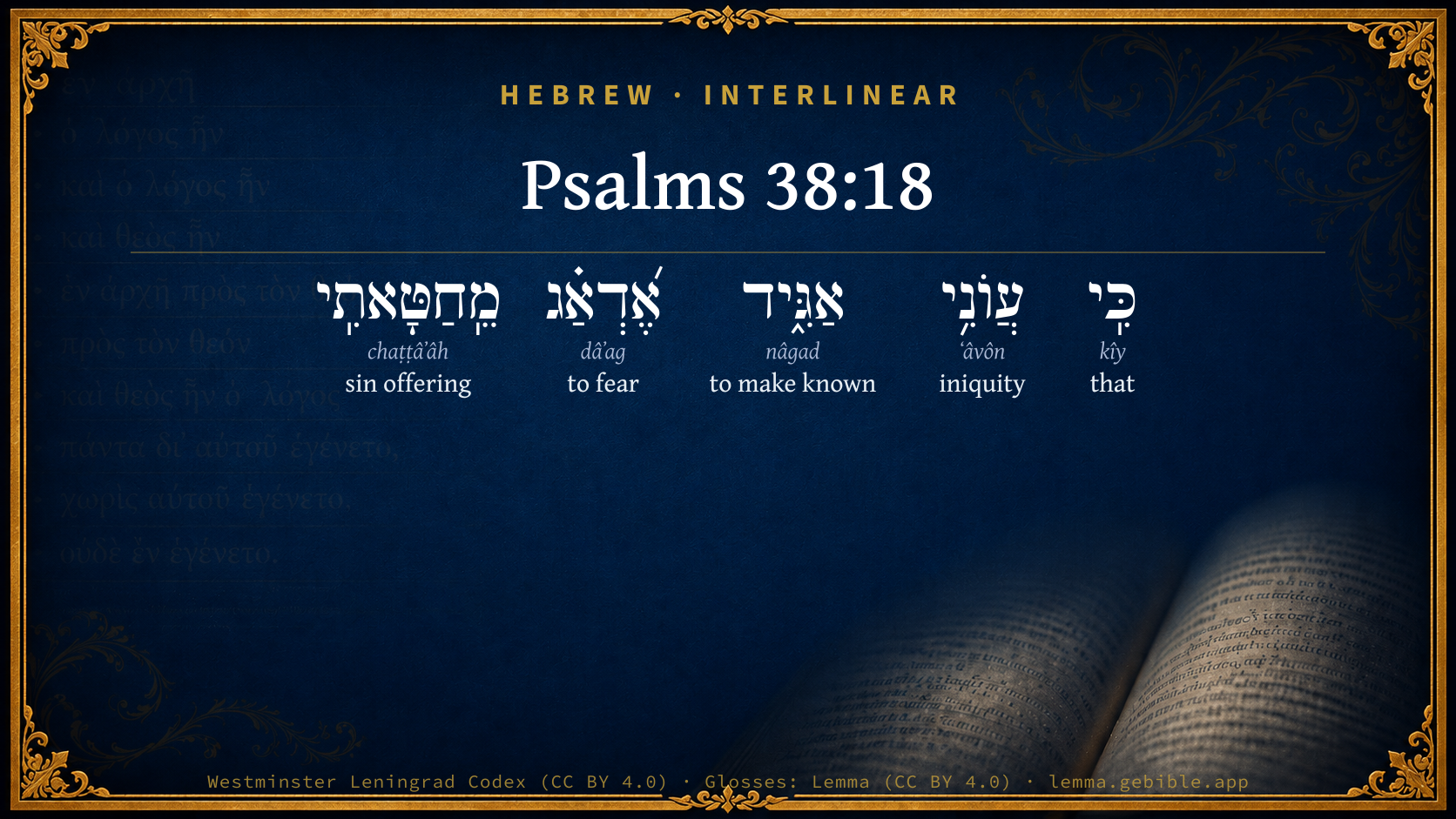
Psalms 38:18

Hebrew (Westminster Leningrad Codex) Psalms 38:18 appears in the Hebrew Old Testament. The text above is from the Westminster Leningrad Codex. Each word links to its Strong’s number, a concise gloss, and parsing drawn from the Open Scriptures Hebrew Bible morphology. Click any word for its full Brown-Driver-Briggs (BDB) entry.
Download image
Cite this verse

Psalms 38:18 (World English Bible). Public Domain. Lemma interlinear Bible study tool, https://lemma.gebible.app/v/psalms/38/18.

Show BibTeX & RIS
BibTeX
RIS
English Translation
For I will declare my iniquity. I will be sorry for my sin.
World English Bible · Public Domain
Download a study sheet

One document with this verse’s original text, its word-by-word gloss line, the meaning frame, cross-references with their text, attributed commentary, and full source and license credits — printable, and it pastes into notes with its structure intact.

This verse Autodidact and up

Study sheet (.html) Plain text (.txt)

A passage Seminary Student

Up to 50 verses in one chapter. A passage sheet keeps up to 6 commentary sources and 12 cross-references per verse, in the order this page ranks them, and says so on the sheet whenever that leaves anything out. Ask for a single verse and you get the Autodidact verse sheet above.

Everything on this page stays free to read, with no account — the sheet is a download of what is already on screen, not access to it.

Want to remove ads? Support Godless Engineer
Compare translations 3

The same verse in 3 English versions, stacked beneath the original-language interlinear above. Click any original word for its lexicon entry.

Each is an independent rendering of the whole verse — the interlinear is not word-aligned to these translations.

Highlighted words mark where these versions differ — a whole-verse word diff, not a word-by-word alignment.

  • World English Bible Public Domain
    For I will declare my iniquity. I will be sorry for my sin.
  • King James Version Public Domain
    For I will declare mine iniquity; I will be sorry for my sin.
  • unfoldingWord Literal Text CC BY-SA 4.0
    For I declare my iniquity; I am anxious because of my sin.

unfoldingWord Literal Text — © unfoldingWord, licensed CC BY-SA 4.0. Word-aligned USFM3 via Door43 (git.door43.org/unfoldingWord/en_ult).

Versions to compare (up to 4)

3 of 4 selected

Show all 18 translations

Every available English version of this verse, each an independent rendering of the whole verse.

  • World English Bible Public Domain
    For I will declare my iniquity. I will be sorry for my sin.
  • Berean Standard Bible Public Domain
    Yes, I confess my iniquity; I am troubled by my sin.
  • Majority Standard Bible Public Domain
    Yes, I confess my iniquity; I am troubled by my sin.
  • King James Version Public Domain
    For I will declare mine iniquity; I will be sorry for my sin.
  • American Standard Version (1901) Public Domain
    For I will declare mine iniquity; I will be sorry for my sin.
  • Revised Version (1885) Public Domain
    For I will declare mine iniquity; I will be sorry for my sin.
  • Geneva Bible (1599) Public Domain
    When I declare my paine, and am sory for my sinne,
  • Douay-Rheims (1899) Public Domain
    For I am ready for scourges: and my sorrow is continually before me.
  • Young's Literal Translation Public Domain
    For mine iniquity I declare, I am sorry for my sin.
  • Literal Standard Version CC BY-SA 4.0
    For I declare my iniquity, || I am sorry for my sin.
  • Unlocked Literal Bible CC BY-SA 4.0
    I confess my guilt; I am concerned about my sin.
  • unfoldingWord Literal Text CC BY-SA 4.0
    For I declare my iniquity; I am anxious because of my sin.
  • Darby Bible Public Domain
    For I will declare mine iniquity, I am grieved for my sin.
  • World Messianic Bible Public Domain
    For I will declare my iniquity. I will be sorry for my sin.
  • Webster's Bible Public Domain
    \\38:17\\For I am ready to halt, and my sorrow is continually before me.
  • Free Bible Version CC BY-SA 4.0
    I do confess my sins; I am terribly sorry for what I've done.
  • Bible in Basic English Public Domain
    I will make clear my wrongdoing, with sorrow in my heart for my sin.
  • JPS Tanakh (1917) Public Domain
    (38-19) For I do declare mine iniquity; I am full of care because of my sin.

Literal Standard Version (2020), Covenant Press — licensed CC BY-SA 4.0. Text via the HelloAO Bible API (eBible.org). Unlocked Literal Bible (unfoldingWord) — licensed CC BY-SA 4.0. Text via the HelloAO Bible API (eBible.org). unfoldingWord Literal Text — © unfoldingWord, licensed CC BY-SA 4.0. Word-aligned USFM3 via Door43 (git.door43.org/unfoldingWord/en_ult). Free Bible Version, Dr. Jonathan Gallagher — licensed CC BY-SA 4.0. Text via the HelloAO Bible API (eBible.org).

Word by word

More ways to search: Search by grammar → Find every occurrence → Compare this word →

Practice this passage: Drill this verse → Learn its vocabulary →

About this verse

These counts appear in no published source. They are computed here, from the morphology-tagged text and Lemma’s own curated glosses. What Lemma adds →

5
words
5
distinct lemmas
Wisdom
section

Notable vocabulary

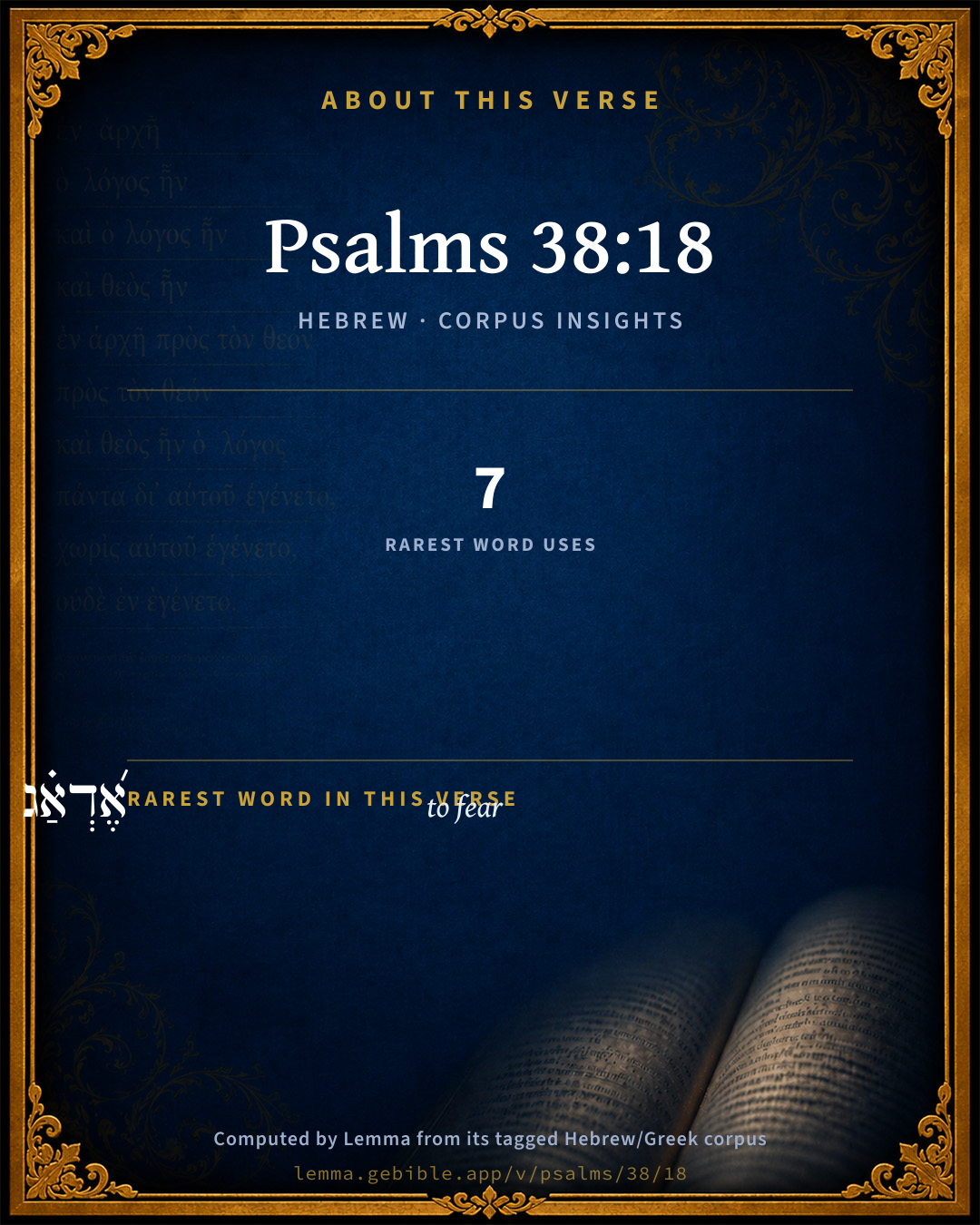
The rarest word here is אֶ֝דְאַ֗ג to fear H1672 — appearing just 7 times in the whole Hebrew Bible.

Shared distinctive vocabulary

אֶ֝דְאַ֗ג to fear H1672 occurs in 7 verses of the Hebrew Bible. Also found in:

Grammatical profile

  • 2 verbs
  • 2 nouns
  • 1 conjunction

Verb forms

  • אַגִּ֑יד Hiphil · Imperfect
  • אֶ֝דְאַ֗ג Qal · Imperfect

Hebrew & Septuagint length

In English translation the verse runs 13 words from the Hebrew and 12 from the Septuagint (LXX English) — closely comparable.

A rough comparison of the two English renderings, which tokenize alike — not a word-level alignment.

Word counts can differ between the Hebrew and the Greek without any difference in meaning — e.g. the Hebrew direct-object marker אֵת has no separate Greek word, and Greek often adds the article ὁ.

Cross-references

6

Topical passages linked to Psalms 38:18 in the Treasury of Scripture Knowledge — connected by theme and wording, ordered by reader-vote popularity; previews shown in the World English Bible.

  • Psalms 32:5 I acknowledged my sin to you. I didn't hide my iniquity. I said, I will confess my transgressions to Yahweh, And you forgave the iniquity of my sin. Selah.
  • Proverbs 28:13 He who conceals his sins doesn't prosper, But whoever confesses and renounces them finds mercy.
  • Job 33:27 He sings before men, and says, 'I have sinned, and perverted that which was right, And it didn't profit me.
  • Psalms 51:3 For I know my transgressions. My sin is constantly before me.
  • 2 Corinthians 7:7–11 and not by his coming only, but also by the comfort with which he was comforted in you, while he told us of your longing, your mourning, and your zeal for me; so that I rejoiced still more.
  • Job 31:33 If like Adam I have covered my transgressions, By hiding my iniquity in my heart,

Cross-references courtesy of OpenBible.info (CC BY 4.0).

Hebrew and Greek witnesses Masoretic Hebrew ↔ Greek Septuagint

The same verse in the two great witnesses to the Old Testament, shown verse-for-verse.

You’re reading Greek Psalm 37 (Hebrew Psalm 38). The Septuagint counts the superscription, so verse numbers can differ from the Hebrew — chapter-level alignment, not verse-by-verse. Numbering follows Rahlfs.

These are two independent witnesses, not word-aligned to each other, and the Septuagint is shown in lemma (dictionary) form.

Hebrew Psalms 38:18 Masoretic · Westminster Leningrad Codex

כִּֽי עֲוֺנִ֥י אַגִּ֑יד אֶ֝דְאַ֗ג מֵֽחַטָּאתִֽי

For I will declare my iniquity. I will be sorry for my sin.

World English Bible · Public Domain

Greek LXX Greek Psalm 37:18 Septuagint · lemma form

ὅτι ἐγώ εἰς μάστιξ ἕτοιμος καί ὁ ἀλγηδών ἐγώ ἐνώπιον ἐγώ διά πᾶς

For I will declare my iniquity, and be distressed for my sin.

LXX2012 (modern English Septuagint) · Public Domain

Hebrew: Westminster Leningrad Codex (CC BY 4.0). Greek: Septuagint (public domain); English from LXX2012 (modern English Septuagint) (Public Domain). How the Septuagint differs from the Hebrew →

Commentary

Notes on Psalms 38:18 from classic Christian and Jewish commentators (each source and its license shown beneath its notes). The classic Christian expositions comment on the surrounding passage and are grouped to its opening verse, so a note may address several verses; the Jewish commentaries on the Tanakh (Rashi and others) are per-verse, so they appear only where the commentator wrote on this verse.

Lemma curates 59 commentaries, every one of them public domain or Creative Commons licensed, each selected and text-cleaned for this edition rather than reprinted as found. About our sources →

Trapp's Complete Commentary

John Trapp

Psa 38:18 For I will declare mine iniquity; I will be sorry for my sin.

Ver. 18. For I will declare mine iniquity] To them that visit me in this disease, saith Aben Ezra, that they may pray for me, according to Jas 5:16; or rather to God, that he may pardon me and ease me. Or thus, When I declare, &c. Then

John Trapp, A Commentary or Exposition upon All the Books of the Old and New Testament (1647–1656) — public domain. Text from a community e-Sword module.

The Biblical Illustrator

Joseph S. Exell

Psa_38:18

I will declare mine iniquity; I will be sorry for my sin.

Of confession of sin

I. What confession of sin is. It is a declaration of acknowledgment of some moral evil or fault to another.

II. How far confession of our sins is necessary.

1. It is a necessary part of repentance, that we should confess our sins to God, with a due sense of the evil of them (Pro_28:18; 1Jn_1:9).

2. As for our confessing our sins to men, both Scripture and reason do, in some cases, recommend and enjoin it.

(1) In order to the obtaining of the prayers of good men for us (Jam_5:16).

(2) In order to the ease and satisfaction of our minds, and our being directed in our duty for the future.

(3) In case our sins have been public and scandalous, both reason and the practice of the Christian Church do require, that, when men have publicly offended, they should give public satisfaction and open testimony of their repentance. (J. Tillotson.)

Sorrow for sin

I. The nature of this passion. Sorrow is a trouble or disturbance of mind, occasioned by something that is evil, done or suffered by us, or which we are in danger of suffering, that tends greatly to our damage or mischief: so that to be sorry for a thing is nothing else but to be sensibly affected with the consideration of the evil of it, and of the mischief and inconvenience which is like to redound to us from it; which, if it be a moral evil, such as sin is, to be sorry for it, is to be troubled that we have done it, and to wish with all our hearts that we had been wiser, and had done otherwise; and if this sorrow be true and real, if it abide and stay upon us, it will produce a firm purpose and resolution in us, not to do the like for the future.

II. The reason and grounds of our sorrow for sin.

1. The great mischief that sin is like to bring upon us.

2. Another and better principle of sorrow for sin is ingenuity; because we are sensible that we have carried ourselves very unworthily towards God, and have been injurious to Him, who hath laid all possible obligations upon us.

III. The measure and degree of our sorrow for sin.

1. Sin being so great an evil in itself, and of so pernicious a consequence to us, it cannot be too much lamented and grieved for by us; and the more and greater our sins have been, and the longer we have continued and lived in them, they call for so much the greater sorrow, and deeper humiliation from us; for the reasoning of our Saviour, She loved much, because much was forgiven her, is proportionably true in this case--those who have sinned much, should sorrow the more.

2. If we would judge aright of the truth of our sorrow for sin, we must not measure it so much by the degrees of sensible trouble and affliction, as by the rational effects of it, which are hatred of sin, and a fixed purpose and resolution against it for the future.

IV. How far the outward expression of our inward grief by tears is necessary to a true repentance. The usual sign and outward expression of sorrow is tears; but these being not the substance of our duty, but an external testimony of it, which some tempers are more unapt to than others; we are much less to judge of the truth of our sorrow for sin by these, than by our inward sensible trouble and affliction of spirit. He that cannot weep like a child may resolve like a man, and that undoubtedly will find acceptance with God. Two persons walking together espy a serpent; the one shrieks and cries out at the sight of it, the other kills it: so it is in sorrow for sin; some express it by great lamentation and tears, and vehement transports of passions; others by greater and more real effects of hatred and detestation, by forsaking their sins, and by mortifying and subduing their lusts: but he that kills it does certainly best express his inward displeasure and enmity against it. The application shall be in two particulars--

1. By way of caution, and that against a double mistake about sorrow for sin.

(1) Some look upon trouble and sorrow for sin as the whole of repentance. If this were so, there would be store of penitents in hell; for there is the deepest and most intense sorrow, weeping, and wailing and gnashing of teeth.

(2) Another mistake which men ought to be cautioned against in this matter is, of those who exact from themselves such a degree of sorrow for sin as ends in deep melancholy, as renders them unfit both for the duties of religion, and of their particular callings. The end of sorrow for sin is the forsaking of it and returning to our duty; but he that sorrows for sin, so as to unfit him for his duty, defeats his own design, and destroys the end he aims at.

2. The other part of the application of this discourse should be to stir up this affection of sorrow in us. If the holy men in Scripture, David, and Jeremiah, and St. Paul, were so deeply affected with the sins of others as to shed rivers of tears at the remembrance of them, how ought we to be touched with the sense of our own sins, who are equally concerned in the dishonour brought to God by them, and infinitely more in the danger they expose us to! Can we weep for our dead friends; and have we no sense of that heavy load of guilt, of that body of death which we carry about with us? Can we be sad and melancholy for temporal losses and sufferings, and refuse to be comforted; and is it no trouble to us to have lost heaven and happiness, and to be in continual danger of the intolerable sufferings and endless torments of another world? I shall only offer to your consideration the great benefit and advantage which will redound us from this godly sorrow; it worketh repentance to salvation, not to be repented of. If we would thus sow in tears, we should reap in joy. (Samuel Martin.)

Hindrances to repentance

I. There are various ways, and there are many ways, in which men try to hide themselves from themselves; to escape their own detection; wilfully to evade their own nominal search.

(1) One of these is the sorcery of words. Men call sins, which they see others commit, by their true names; they call their own sins by false and glozing names. What is pride in others is in themselves proper spirit; what is slander in others is in themselves moral indignation; what is cheating in others is in themselves legitimate profit; what is in others an immoral acquiescence is in themselves a practical common sense; what is in others licence is in themselves Christian liberty.

(2) Men will hardly ever look at their own actual deeds in connection with their own true motives. They live two lives. One is their common, habitual round of conduct, which is often base, and mean, and unworthy. The other is their traditional and imaginative homage to righteousness, which is upright and respectable. Their lives are a stately temple front; its frieze is sculptured with heroic imagery; its entablature, like that of our Royal Exchange, is enriched with a pious inscription. Alas! alas I Enter beyond the vestibule, and in some inmost shrine, noiseless and far away, approached, it may be, only by secret stairs and half-hidden entrances--there, in little, mean, dark closets, so completely behind their ostensible lives and their expressed opinions, that they almost succeed in hiding it from themselves, all the bad, the impure, the dishonourable work of their lives is done!

(3) They freely condemn every other sin but the one to which they are themselves addicted.

(4) They find the sweet, soft pleadings of egotism and of self-love so irresistible, that anything seems to be at least excusable which results from yielding to such temptations. Religion appeals to the reason and to the spirit; it nerves and braces; it puts iron into our resolutions; it infuses the soul with manliness, and the will with strength. And, on the other hand, sins--the sins of the world, the flesh and the devil--degrade us into the animal: they unnerve, they effeminate, they debase, they paralyze; they bid us listen to the base pleadings of a miserable, hungry, shivering self, which is, like a crawling serpent, ever rustling amid the dead leaves of our weakened purposes, and ever hissing in our own ears: Only this once. There is no harm in it. Thou shalt not surely die. This is the explanation, and the only possible one, of the insane infatuation which so often marks either the whole lives or the sudden actions of many men.

2. What should be our protection against these specious thoughts of our own heart and our own counsel? God has not left you unshielded. He has assigned the soul of man to the special, immediate guardianship of two pure and strong holy spirits. The name of one of those great archangels of our being is Duty--Duty, that angel so stern and yet so beautiful! And the name of the other great archangel is Conscience--Conscience, that aboriginal vicar of Christ, a prophet in its informations, a monarch in its peremptoriness, a priest in its blessings and anathemas, with a voice now like the blast of a trumpet, now thrilling, and still, and small. (Dean Ferret.)

Psa_39:1-13

The Biblical Illustrator, edited by Joseph S. Exell (c. 1880s–1900s) — public domain. Text from a community e-Sword module.

J. A. Alexander on Psalms

Joseph Addison Alexander

19. (Psa 38:18). For my iniquity I will declare, I will be anxious on account of my sin. In our idiom this is tantamount to saying, I must confess that I am guilty; I have reason to be anxious on account of my sin.

Joseph Addison Alexander, The Psalms Translated and Explained (1850) — public domain. Text from a community e-Sword module.

Jamieson, Fausset & Brown

Robert Jamieson, A. R. Fausset & David Brown

Consciousness of sin makes suffering pungent, and suffering, rightly received, leads to confession.

Jamieson, Fausset & Brown — Commentary Critical and Explanatory on the Whole Bible (1871) — public domain (CC PDM 1.0). Text via the HelloAO Bible API.

Adam Clarke's Commentary

Verse 18. I will declare mine iniquity] I will confess it with the deepest humiliation and self-abasement.

Adam Clarke's Commentary on the Bible (1810–1826) — public domain. Text from a community e-Sword/MySword module.

John Calvin's Commentaries

18 and 19 Surely I declare my iniquity. By comparison, he amplifies what he had just said concerning the pride and the reproachful conduct of his enemies; for he says, that whilst he is lying in a filthy and wretched condition, like a wicked man, and one abandoned by God, they fly about in mirth and gladness, nay, they carry their heads high, because they are rich and powerful. But first, it is proper to notice in what sense it is that he declares his sin. Those, in my judgment, are mistaken, who understand this passage simply in the sense of a confession of his guilt before God, that he might obtain forgiveness. According to their interpretation, the Psalmist is supposed to repeat here what we have seen he said

“I acknowledged my sin unto thee, and mine iniquity have I not hid.”— (Psalm 32:5)

But in this place he is not speaking so much of his repentance, as he is bewailing his sad and miserable condition; and, therefore, sin and iniquity are to be understood of the afflictions and chastisements which are the tokens of God’s wrath; as if he had said, that the hand of God was against him, and lying so heavily upon him, that from the very sight of the misery to which he was reduced, the world in general might regard him as a condemned and reprobate man. In order to render the meaning more obvious, the 18th and 19th verses must be read together, thus: I declare my iniquity, and my enemies are living; I am dismayed because of my sin, but they are become strong. I do not, however, deny that he regards the miseries to which he was subjected as proceeding from his sins. In this respect, the godly differ from the wicked, that, being admonished of their transgression by adversity, they humbly sist themselves before the judgment-seat of God. Accordingly, judging of the cause from the effects, he takes into account these two things: First, That thus overwhelmed and afflicted, he is lying under a heavy load of miseries; and, secondly, That all these evils are justly inflicted as chastisements for sin.

John Calvin's Commentaries (1540-1563) — public domain. Text from the Calvin Translation Society English edition (1840s-50s) via the Christian Classics Ethereal Library (ccel.org). Calvin's coverage is partial (roughly two-thirds of the Bible); uncommented books and verses are honest gaps, never fabricated. The 19th-century editor's footnotes and remarks are omitted so the notes are faithfully Calvin's own voice.

Ellicott's Commentary for English Readers

(18) Sorry.—The note of true penitence is here. The sorrow is for the sin itself, not for its miserable results.

A Bible Commentary for English Readers, edited by Charles John Ellicott (1878–1897) — public domain. Text from a community e-Sword module.

The Cambridge Bible for Schools and Colleges

gen. ed. J. J. S. Perowne

18. For &c.] Sin, he confesses, is the cause of that suffering.

I will be sorry] Or, I will be troubled. Jer. sollicitus ero: Psa_5:1. contristabor.

The Cambridge Bible for Schools and Colleges (gen. ed. J. J. S. Perowne; Cambridge University Press, 1878–1918) — public domain. Text from a community e-Sword module.

John Gill's Exposition

But mine enemies are lively,.... Or "living" (q) or "live"; not in a spiritual sense; for they had no lively hope, nor living faith, but were dead in trespasses and sins; nor merely in a natural sense, or corporeally, so David was living himself; but in great prosperity and worldly happiness, and so were brisk and cheerful, and lived a merry and pleasent life;

and they are strong; not only hale and robust in body, but abounded in riches and wealth, which are the strength of wicked men;

and they that hate me wrongfully are multiplied; that is, such as hated him without a cause, and made lies and falsehoods the reasons of it: these increased in numbers, or in their outward state and circumstances; see Psa 73:4.

(q) "viventes", Pagninus, Montanus, Musculus, Junius & Tremellius, Piscator, Cocceius.

John Gill's Exposition of the Whole Bible (1746–1763) — public domain (CC PDM 1.0). Text via the HelloAO Bible API.

Albert Barnes' Notes on the Bible

For I will declare mine iniquity - That is, he was not disposed to hide his sin. He would make no concealment of the fact that he regarded himself as a sinner. He admitted this to be true, and he admitted that his sin was the cause of all his troubles. It was the fact that he was a sinner that so painfully affected his mind; and he was not disposed to attempt to conceal it from anyone.

I will be sorry for my sin - I will not deny it; I will not apologize for it. I admit the truth of what my conscience charges on me; I admit the correctness and the propriety of the divine judgment by which I have been affiicted on account of my sin; I desire to repent of all my transgressions, and to turn from them. Compare Lev 26:41. The calamity brought upon the psalmist for his sin had produced the desired effect in this respect, that it had brought him to true repentance; and now, with the full confession of his sin, he was anxious only lest he should fall utterly, and should give his enemies, and the enemies of the truth, the occasion to triumph over him which they desired.

Albert Barnes' Notes on the Bible (1834–1885) — public domain. Text from a community e-Sword/MySword module.

Matthew Poole's English Annotations

Declare mine iniquity; either to thee; or publicly to the world, because my sin hath been public and scandalous.

I will be sorry, Heb. I will be (or, I am; futures being oft so taken) solicitous or anxious; full of grief for what is past, and of cares and fears for the future; partly lest I should relapse into the same folly upon new temptations; and partly lest thou shouldst cut me off for my sins. Therefore pity, and pardon, and save me.

For my sin; or, by reason of my sin, or upon that occasion.

Matthew Poole's English Annotations on the Holy Bible (1683–1685) — public domain. Text from a community e-Sword/MySword module.

The Treasury of David

Charles H. Spurgeon

Ver. 18. For I will declare mine iniquity. The slander of his enemies he repudiates, but the accusations of his conscience he admits. Open confession is good for the soul. When sorrow leads to hearty and penitent acknowledgment of sin it is blessed sorrow, a thing to thank God for most devoutly. I will be sorry for my sin. My confession will be salted with briny tears. It is well not so much to bewail our sorrows as to denounce the sins which lie at the root of them. To be sorry for sin is no atonement for it, but it is the right spirit in which to repair to Jesus, who is the reconciliation and the Saviour. A man is near to the end of his trouble when he comes to an end with his sins.

Ver. 18. Pliny writeth of some families that had private marks on their bodies peculiar to those of that line, and every man hath, as it were, a private sin, which is most justly called his; but if we will confess our sins aright, we must not leave out that sin; nay, our chiefest spite must be against it, according to David's resolve: I will declare mine iniquity; I will be sorry for my sin....David doth not only say, I will declare, but, I will be sorry for my sin. The people of God 1Sa 7:6 in the day of their confession not only say, "We have sinned, "but draw water, and pour it out before the Lord in token of contrition. We should, in confessing sin, have our hearts so affected, that our eyes, with Job, may "pour tears before God" Job 16:20; that, with David, "rivers of tears may run down our eyes" Ps 119:136; yea, we should wish with Jeremiah, that "our head were waters, and our eyes a fountain of tears." Jer 9:1. But, however, nonne stillabit oculus noster? if we cannot pour out, shall we not drop a tear? or at least, if we cannot shed a tear, let us breathe forth a sigh for our sins. It is only the heart broken with godly sorrow that sends forth a true confession. Nathanael Hardy.

Ver. 18. The excellence of penitent confession.

Ver. 18. The twin children of graceconfession and contrition: their mutual revelation and reaction.

Ver. 18. (last clause). There is good reason for such sorrow, God is well pleased with it. It benefits the mourner.

Psalms 38:19*

Charles H. Spurgeon's The Treasury of David (1869–1885) — public domain. Psalms only. Text from a community e-Sword/MySword module.

Whedon's Commentary on the Bible

Daniel D. Whedon

18. Another sad recurrence to, and confession of, the moral cause of all his sufferings.

Daniel D. Whedon (gen. ed.), Commentary on the Old and New Testaments (1874–1909) — public domain. Text from a community e-Sword module.

The Pulpit Commentary

For I will declare mine iniquity; I will be sorry for my sin. The four "fors," beginning four consecutive verses, are somewhat puzzling. Canon Cook suggests that they introduce four reasons for the psalmist"s silence (vers. 13, 14) and abstinence front self-justification:

(1) because God hears him, and will make answer for him (ver. 15);

(2) because, if he spoke, he might give further occasion to his enemies (ver. 16);

(3) because he feels in danger, and is conscious of sin (ver. 17); and

(4) because he has no course open to him but confession and contrition. If we are justified in attributing the psalm to David, and in assigning its composition to the period immediately preceding Absalom"s rebellion, we must look upon it as opening to us a view of David"s condition of mind at that time which is of great interest.

The Pulpit Commentary (1880–1919), ed. H.D.M. Spence-Jones & Joseph S. Exell — public domain. Text from a community e-Sword module.

John Wesley's Explanatory Notes

Declare - To thee.

John Wesley, Explanatory Notes Upon the Whole Bible (1754–1765) — public domain. Text via the GEBible commentary corpus.

Rashi

Rabbi Shlomo Yitzchaki (Rashi)

For I am ready for disaster For this reason, we are concerned lest they rejoice over us, because we are accustomed to blows and are always ready and prepared for disaster.

and my pain is always before me It is always prepared to come before me.

Rashi on the Tanakh — English translations: “The Judaica Press complete Tanach with Rashi, translated by A. J. Rosenberg” (CC BY 4.0); “Pentateuch with Rashi's commentary by M. Rosenbaum and A.M. Silbermann, 1929-1934” (public domain); “The Metsudah Tanach series, Lakewood, N.J” (CC BY 4.0); and “The Book of Joshua, Metsudah Publications, 1997” (CC BY 4.0). Text via Sefaria.

Lesson kit

Teaching starters — assembled from the data on this page, not authored interpretation. Every prompt links to the verse data it draws on. Edit before teaching.

Psalms, in the Wisdom, opens this verse with 5 words (5 distinct Hebrew lemmas). Its most distinctive word is dâʼag (“to fear”). A historical commentator’s framing appears above. Read the whole chapter for the surrounding context.

Discussion questions

  1. How does “to fear” (dâʼag) shape what this verse is saying?
  2. 1 Samuel 9:5 shares the word «to fear» with this verse. How do the two illuminate each other?
  3. These translations render this verse differently; the difference is in the English rendering, not the original. What questions does that raise?
  4. The verb «אַגִּ֑יד» is Hiphil Imperfect. How does its form color the action?
  5. Reading how Trapp's Complete Commentary and The Biblical Illustrator read this verse, where do the two commentators agree and where do they part?

Things to notice

Reading settings

Reading text

Shown beneath each verse's original-language words.

Old Testament
Old Testament edition

Read the OT as the Masoretic Hebrew (MT) or the Greek Septuagint (LXX).

English shown for the Greek Septuagint (in the Hebrew ↔ Greek comparison).

Comparing translations? Open the Compare panel on any verse page to stack up to four side by side.