
Deuteronomy 14:24

Hebrew (Westminster Leningrad Codex) Deuteronomy 14:24 appears in the Hebrew Old Testament. The text above is from the Westminster Leningrad Codex. Each word links to its Strong’s number, a concise gloss, and parsing drawn from the Open Scriptures Hebrew Bible morphology. Click any word for its full Brown-Driver-Briggs (BDB) entry.
Download image
Cite this verse

Deuteronomy 14:24 (World English Bible). Public Domain. Lemma interlinear Bible study tool, https://lemma.gebible.app/v/deuteronomy/14/24.

Show BibTeX & RIS
BibTeX
RIS
English Translation
If the way be too long for you, so that you are not able to carry it, because the place is too far from you, which Yahweh your God shall choose, to set his name there, when Yahweh your God shall bless you;
World English Bible · Public Domain
Download a study sheet

One document with this verse’s original text, its word-by-word gloss line, the meaning frame, cross-references with their text, attributed commentary, and full source and license credits — printable, and it pastes into notes with its structure intact.

This verse Autodidact and up

Study sheet (.html) Plain text (.txt)

A passage Seminary Student

Up to 50 verses in one chapter. A passage sheet keeps up to 6 commentary sources and 12 cross-references per verse, in the order this page ranks them, and says so on the sheet whenever that leaves anything out. Ask for a single verse and you get the Autodidact verse sheet above.

Everything on this page stays free to read, with no account — the sheet is a download of what is already on screen, not access to it.

Want to remove ads? Support Godless Engineer
Compare translations 3

The same verse in 3 English versions, stacked beneath the original-language interlinear above. Click any original word for its lexicon entry.

Each is an independent rendering of the whole verse — the interlinear is not word-aligned to these translations.

Highlighted words mark where these versions differ — a whole-verse word diff, not a word-by-word alignment.

  • World English Bible Public Domain
    If the way be too long for you, so that you are not able to carry it, because the place is too far from you, which Yahweh your God shall choose, to set his name there, when Yahweh your God shall bless you;
  • King James Version Public Domain
    And if the way be too long for thee, so that thou art not able to carry it; or if the place be too far from thee, which the LORD thy God shall choose to set his name there, when the LORD thy God hath blessed thee:
  • unfoldingWord Literal Text CC BY-SA 4.0
    And if the journey is too long for you, that you are not able to carry it (because the place that Yahweh your God will choose to put his name there is too far from you), when Yahweh your God blesses you,

unfoldingWord Literal Text — © unfoldingWord, licensed CC BY-SA 4.0. Word-aligned USFM3 via Door43 (git.door43.org/unfoldingWord/en_ult).

Versions to compare (up to 4)

3 of 4 selected

Show all 18 translations

Every available English version of this verse, each an independent rendering of the whole verse.

  • World English Bible Public Domain
    If the way be too long for you, so that you are not able to carry it, because the place is too far from you, which Yahweh your God shall choose, to set his name there, when Yahweh your God shall bless you;
  • Berean Standard Bible Public Domain
    But if the distance is too great for you to carry that with which the LORD your God has blessed you, because the place where the LORD your God will choose to put His Name is too far away,
  • Majority Standard Bible Public Domain
    But if the distance is too great for you to carry that with which the LORD your God has blessed you, because the place where the LORD your God will choose to put His Name is too far away,
  • King James Version Public Domain
    And if the way be too long for thee, so that thou art not able to carry it; or if the place be too far from thee, which the LORD thy God shall choose to set his name there, when the LORD thy God hath blessed thee:
  • American Standard Version (1901) Public Domain
    And if the way be too long for thee, so that thou art not able to carry it, because the place is too far from thee, which Jehovah thy God shall choose, to set his name there, when Jehovah thy God shall bless thee;
  • Revised Version (1885) Public Domain
    And if the way be too long for thee, so that thou art not able to carry it, because the place is too far from thee, which the LORD thy God shall choose to set his name there, when the LORD thy God shall bless thee:
  • Geneva Bible (1599) Public Domain
    And if the way be too long for thee, so that thou art not able to cary it, because the place is farre from thee, where the Lord thy God shall chose to set his Name, when the Lord thy God shall blesse thee,
  • Douay-Rheims (1899) Public Domain
    But when the way and the place which the Lord thy God shall choose, are far off, and he hath blessed thee, and thou canst not carry all these things thither,
  • Young's Literal Translation Public Domain
    `And when the way is too much for thee, that thou art not able to carry it -- when the place is too far off from thee which Jehovah thy God doth choose to put His name there, when Jehovah thy God doth bless thee; --
  • Literal Standard Version CC BY-SA 4.0
    And when the way is too much for you, that you are not able to carry it—when the place is too far off from you which your God YHWH chooses to put His Name there, when your God YHWH blesses you—
  • Unlocked Literal Bible CC BY-SA 4.0
    If the journey is too long for you so that you are not able to carry it, because the place that Yahweh your God will choose as his sanctuary is too far from you, then, when Yahweh God blesses you,
  • unfoldingWord Literal Text CC BY-SA 4.0
    And if the journey is too long for you, that you are not able to carry it (because the place that Yahweh your God will choose to put his name there is too far from you), when Yahweh your God blesses you,
  • Darby Bible Public Domain
    And if the way be too long for thee, so that thou art not able to carry it, because the place is too far from thee, which Jehovah thy God will choose to set his name there, when Jehovah thy God blesseth thee;
  • World Messianic Bible Public Domain
    If the way is too long for you, so that you are not able to carry it because the place which the LORD your God shall choose to set his name there is too far from you, when the LORD your God blesses you,
  • Webster's Bible Public Domain
    And if the way is too long for thee, so that thou art not able to carry it; or if the place is too far from thee, which the LORD thy God shall choose to set his name there, when the LORD thy God hath blessed thee:
  • Free Bible Version CC BY-SA 4.0
    However, if it's too far to carry all the tithe that the Lord your God has blessed you with, because the place where the Lord your God will choose to live with you is too distant,
  • Bible in Basic English Public Domain
    And if the way is so long that you are not able to take these things to the place marked out by the Lord your God for his name, when he has given you his blessing, because it is far away from you;
  • JPS Tanakh (1917) Public Domain
    And if the way be too long for thee, so that thou art not able to carry it, because the place is too far from thee, which the LORD thy God shall choose to set His name there, when the LORD thy God shall bless thee;

Literal Standard Version (2020), Covenant Press — licensed CC BY-SA 4.0. Text via the HelloAO Bible API (eBible.org). Unlocked Literal Bible (unfoldingWord) — licensed CC BY-SA 4.0. Text via the HelloAO Bible API (eBible.org). unfoldingWord Literal Text — © unfoldingWord, licensed CC BY-SA 4.0. Word-aligned USFM3 via Door43 (git.door43.org/unfoldingWord/en_ult). Free Bible Version, Dr. Jonathan Gallagher — licensed CC BY-SA 4.0. Text via the HelloAO Bible API (eBible.org).

Word by word

More ways to search: Search by grammar → Find every occurrence → Compare this word →

Practice this passage: Drill this verse → Learn its vocabulary →

יִרְחַ֤ק
râchaq
H7368
“to be far”
Verb, Qal, Imperfect, 3rd Person, Masculine, Singular
Part of Speech
Verb
Stem
Qal
Form
Imperfect
Person
3rd Person
Gender
Masculine
Number
Singular
Full BDB Definition

Origin: a primitive root

TWOT: 2151

to be or become far, be or become distant, be removed, go far away (verb) - (Qal) to be far, be distant - (Piel) to send far away, extend - (Hiphil) - to make or exhibit distance, be gone far - to remove, put far away - (Niphal) loose (verb) - at a distance (verbal infinitive [as adverb])
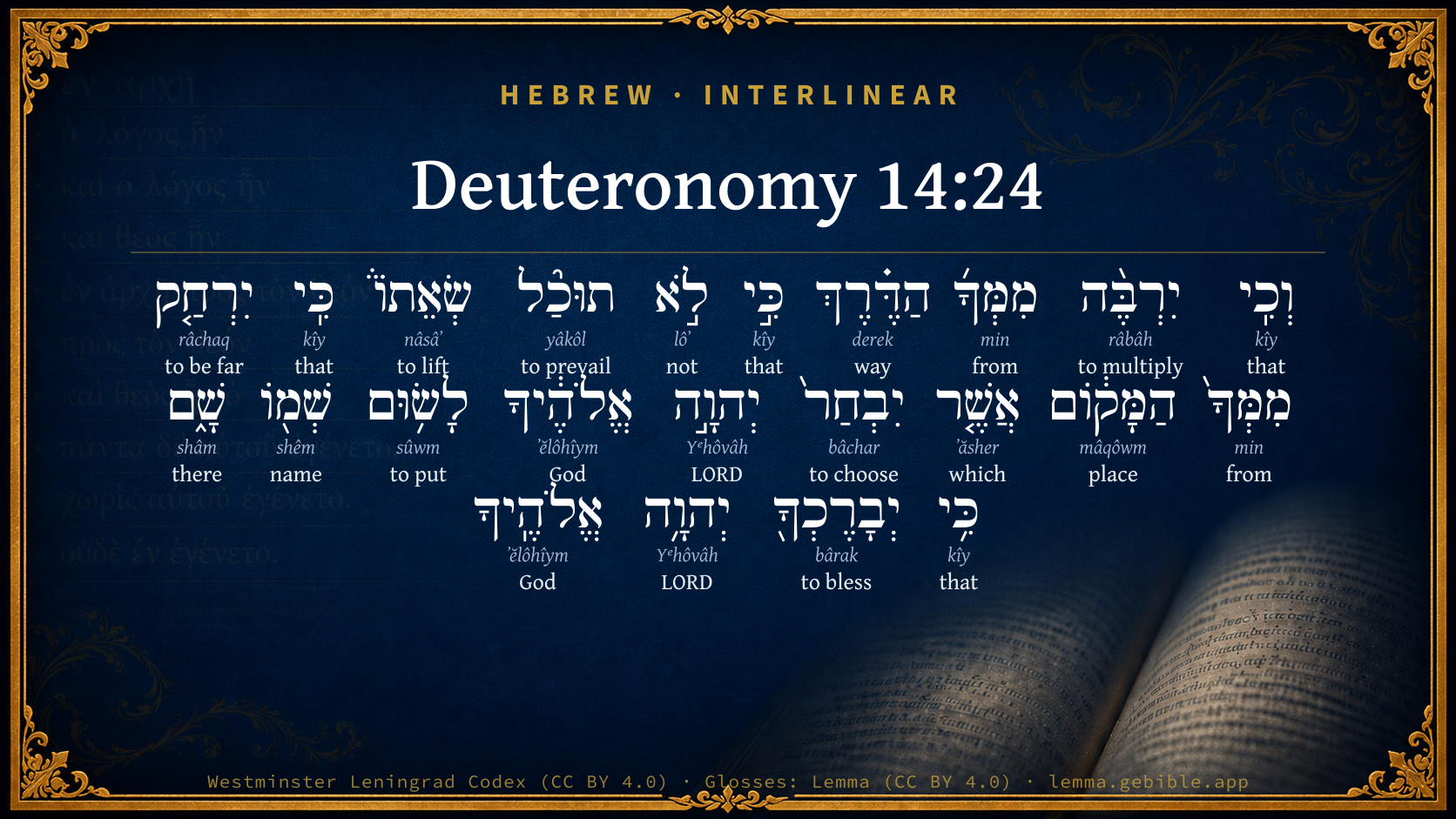
  1. וְכִֽי kîy H3588 “and · that” Conjunction + Conjunction
  2. יִרְבֶּ֨ה râbâh H7235 “to multiply” Verb, Qal, Imperfect, 3rd Person, Masculine, Singular
  3. מִמְּךָ֜ min H4480 “from · you” Preposition + Suffix, Personal, 2nd Person, Masculine, Singular
  4. הַדֶּ֗רֶךְ derek H1870 “the · way” Particle, Definite Article + Noun, Common, Both, Singular, Absolute
  5. כִּ֣י kîy H3588 “that” Conjunction
  6. לֹ֣א lôʼ H3808 “not” Particle, Negative
  7. תוּכַ֘ל yâkôl H3201 “to prevail” Verb, Qal, Imperfect, 2nd Person, Masculine, Singular
  8. שְׂאֵתוֹ֒ nâsâʼ H5375 “to lift · him” Verb, Qal, Infinitive Construct + Suffix, Personal, 3rd Person, Masculine, Singular
  9. כִּֽי kîy H3588 “that” Conjunction
  10. מִמְּךָ֙ min H4480 “from · you” Preposition + Suffix, Personal, 2nd Person, Masculine, Singular
  11. הַמָּק֔וֹם mâqôwm H4725 “the · place” Particle, Definite Article + Noun, Common, Masculine, Singular, Absolute
  12. אֲשֶׁ֤ר ʼăsher H834 “which” Particle, Relative
  13. יִבְחַר֙ bâchar H977 “to choose” Verb, Qal, Imperfect, 3rd Person, Masculine, Singular
  14. יְהוָ֣ה Yᵉhôvâh H3068 “LORD” Noun, Proper
  15. אֱלֹהֶ֔יךָ ʼĕlôhîym H430 “God(s) · your” Noun, Common, Masculine, Plural, Construct + Suffix, Personal, 2nd Person, Masculine, Singular
  16. לָשׂ֥וּם sûwm H7760 “to put” Preposition + Verb, Qal, Infinitive Construct
  17. שְׁמ֖וֹ shêm H8034 “name · his” Noun, Common, Masculine, Singular, Construct + Suffix, Personal, 3rd Person, Masculine, Singular
  18. שָׁ֑ם shâm H8033 “there” Adverb
  19. כִּ֥י kîy H3588 “that” Conjunction
  20. יְבָרֶכְךָ֖ bârak H1288 “to bless · you” Verb, Piel, Imperfect, 3rd Person, Masculine, Singular + Suffix, Personal, 2nd Person, Masculine, Singular
  21. יְהוָ֥ה Yᵉhôvâh H3068 “LORD” Noun, Proper
  22. אֱלֹהֶֽיךָ ʼĕlôhîym H430 “God(s) · your” Noun, Common, Masculine, Plural, Construct + Suffix, Personal, 2nd Person, Masculine, Singular

About this verse

These counts appear in no published source. They are computed here, from the morphology-tagged text and Lemma’s own curated glosses. What Lemma adds →

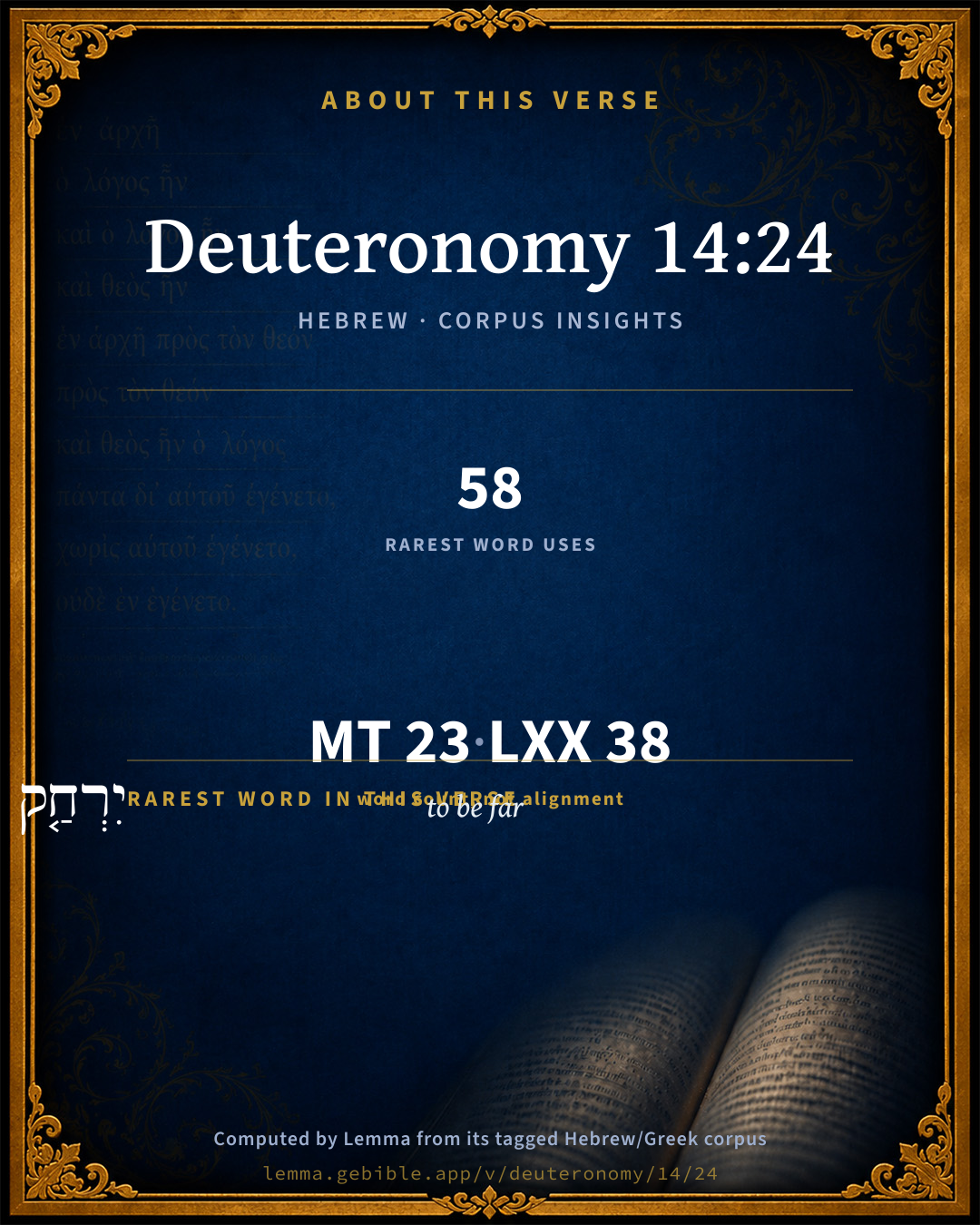
23
words
17
distinct lemmas
Pentateuch
section

Shared distinctive vocabulary

יִרְחַ֤ק to be far H7368 occurs in 56 verses of the Hebrew Bible. Also found in:

Grammatical profile

  • 7 verbs
  • 7 nouns
  • 2 prepositions
  • 4 conjunctions
  • 1 adverb
  • 2 particles

Verb forms

  • יִרְבֶּ֨ה Qal · Imperfect
  • תוּכַ֘ל Qal · Imperfect
  • שְׂאֵתוֹ֒ Qal · Infinitive Construct
  • יִרְחַ֤ק Qal · Imperfect
  • יִבְחַר֙ Qal · Imperfect
  • לָשׂ֥וּם Qal · Infinitive Construct
  • יְבָרֶכְךָ֖ Piel · Imperfect

Repetition

Words recur within this verse — often emphatic in Hebrew:

  • יְהוָ֣ה LORD H3068 ×2
  • אֱלֹהֶ֔יךָ God H430 ×2
  • וְכִֽי that H3588 ×4
  • מִמְּךָ֜ from H4480 ×2

Hebrew & Septuagint length

In English translation the verse runs 43 words from the Hebrew and 45 from the Septuagint (LXX English) — closely comparable.

A rough comparison of the two English renderings, which tokenize alike — not a word-level alignment.

Word counts can differ between the Hebrew and the Greek without any difference in meaning — e.g. the Hebrew direct-object marker אֵת has no separate Greek word, and Greek often adds the article ὁ.

In the original languages it is 23 Hebrew tokens and 38 Greek tokens — but the two are counted differently (Hebrew bundles its prefixes and suffixes into one token; the Greek is in lemma form), so that isn’t a like-for-like length.

Cross-references

4

Topical passages linked to Deuteronomy 14:24 in the Treasury of Scripture Knowledge — connected by theme and wording, ordered by reader-vote popularity; previews shown in the World English Bible.

  • Deuteronomy 12:21 If the place which Yahweh your God shall choose, to put his name there, be too far from you, then you shall kill of your herd and of your flock, which Yahweh has given you, as I have commanded you; and you may eat within your gates, after all the desire of your soul.
  • Deuteronomy 12:5 But to the place which Yahweh your God shall choose out of all your tribes, to put his name there, even to his habitation shall you seek, and there you shall come;
  • Exodus 23:31 I will set your border from the Red Sea even to the sea of the Philistines, and from the wilderness to the River; for I will deliver the inhabitants of the land into your hand, and you shall drive them out before you.
  • Deuteronomy 11:24 Every place whereon the sole of your foot shall tread shall be yours: from the wilderness, and Lebanon, from the river, the river Euphrates, even to the hinder sea shall be your border.

Cross-references courtesy of OpenBible.info (CC BY 4.0).

Hebrew and Greek witnesses Masoretic Hebrew ↔ Greek Septuagint

The same verse in the two great witnesses to the Old Testament, shown verse-for-verse.

These are two independent witnesses, not word-aligned to each other, and the Septuagint is shown in lemma (dictionary) form.

Hebrew Deuteronomy 14:24 Masoretic · Westminster Leningrad Codex

וְכִֽי יִרְבֶּ֨ה מִמְּךָ֜ הַדֶּ֗רֶךְ כִּ֣י לֹ֣א תוּכַ֘ל שְׂאֵתוֹ֒ כִּֽי יִרְחַ֤ק מִמְּךָ֙ הַמָּק֔וֹם אֲשֶׁ֤ר יִבְחַר֙ יְהוָ֣ה אֱלֹהֶ֔יךָ לָשׂ֥וּם שְׁמ֖וֹ שָׁ֑ם כִּ֥י יְבָרֶכְךָ֖ יְהוָ֥ה אֱלֹהֶֽיךָ

If the way be too long for you, so that you are not able to carry it, because the place is too far from you, which Yahweh your God shall choose, to set his name there, when Yahweh your God shall bless you;

World English Bible · Public Domain

Greek LXX Deuteronomy 14:24 Septuagint · lemma form

ἐάν δέ μακράν γίγνομαι ἀπό σύ ὁ ὁδός καί μή δύναμαι ἀναφέρω αὐτός ὅτι μακράν ἀπό σύ ὁ τόπος ὅς ἄν ἐκλέγω κύριος ὁ θεός σύ ἐπικαλέω ὁ ὄνομα αὐτός ἐκεῖ ὅτι εὐλογέω σύ κύριος ὁ θεός σύ

And if the journey be too far for you, and you are not able to bring them, because the place is far from you which the Lord your God shall choose to have his name called there, because the Lord your God will bless you;

LXX2012 (modern English Septuagint) · Public Domain

Hebrew: Westminster Leningrad Codex (CC BY 4.0). Greek: Septuagint (public domain); English from LXX2012 (modern English Septuagint) (Public Domain). How the Septuagint differs from the Hebrew →

Targum (Aramaic paraphrase)

2

The Targum is the ancient Jewish Aramaic paraphrase of the Hebrew Scriptures — an interpretive translation, not the Hebrew text itself. Onkelos (literal) and Pseudo-Jonathan (expansive) render the Torah, and Jonathan the Prophets. Coverage is partial: where no permissively-licensed English translation exists for a verse, only the Aramaic is shown. This is verse-level text, not a word-by-word alignment to the Hebrew.

  1. Targum Onkelos Torah (Genesis–Deuteronomy)
    וַאֲרֵי יִסְגֵי מִנָךְ אָרְחָא אֲרֵי לָא תִכּוּל לְמִטְלֵהּ אֲרֵי יִתְרָחַק מִנָךְ אַתְרָא דִי יִתִּרְעֵי יְיָ אֱלָהָךְ לְאַשְׁרָאָה שְׁכִנְתֵּהּ תַּמָן אֲרֵי יְבָרֵכִנָךְ יְיָ אֱלָהָךְ

    (no public-domain English translation for this verse)

    Targum Onkelos — Aramaic: “Onkelos Genesis” (public domain); “Onkelos Exodus” (public domain); “Onkelos Leviticus” (public domain); “Onkelos Numbers” (public domain); “Onkelos Deuteronomy” (public domain). English: “Sefaria Community Translation” (CC0 1.0 (public-domain dedication)); “J.W. Etheridge. The Targums of Onkelos and Jonathan Ben Uzziel on the Pentateuch. London: Longmans, Green, 1862” (public domain). Text via Sefaria.

  2. Targum Pseudo-Jonathan Torah (Genesis–Deuteronomy)
    וַאֲרוּם יִסְגֵי מִנְכוֹן אוֹרְחָא אֲרוּם לָא תֵיכוּל לְמִיסוֹבְרָא יַת מַעַשְרָא אֲרוּם יִתְרְחַק מִנְכוֹן אַתְרָא דְיִתְרְעֵי יְיָ אֱלָהָכוֹן לְאַשְׁרָאָה שְׁכִינְתֵּיהּ תַּמָּן אֲרוּם יְבָרְכִינָךְ יְיָ אֱלָהָךְ

    And if the way be too great for you to be able to carry the tenth, because the place which the Lord thy God will choose for His Shekinah to dwell there is too distant from you, when the Lord thy God shall have blessed thee,

    Targum Pseudo-Jonathan — Aramaic: “Targum Jonathan on Genesis” (public domain); “Targum Jonathan on Exodus” (public domain); “Targum Jonathan on Leviticus” (public domain); “Targum Jonathan on Numbers” (public domain); “Targum Jonathan on Deuteronomy” (public domain). English: “The Targum of Jonathan ben Uzziel, trans. J. W. Etheridge, London, 1862” (public domain). Text via Sefaria.

Commentary

Notes on Deuteronomy 14:24 from classic Christian and Jewish commentators (each source and its license shown beneath its notes). The classic Christian expositions comment on the surrounding passage and are grouped to its opening verse, so a note may address several verses; the Jewish commentaries on the Tanakh (Rashi and others) are per-verse, so they appear only where the commentator wrote on this verse.

Lemma curates 59 commentaries, every one of them public domain or Creative Commons licensed, each selected and text-cleaned for this edition rather than reprinted as found. About our sources →

Joseph Benson's Commentary

Deu 14:24-25. When the Lord thy God hath blessed thee — Hath given thee so great an increase that the tenth thereof is more than thou canst carry to the sanctuary. Bind up the money in thy hand — That is, in a bag, to be taken in thy hand and carried with thee.

Joseph Benson's Commentary on the Old and New Testaments (1811–1818) — public domain. Text from a community e-Sword module.

Geneva Bible (1599)

Geneva Bible translators

When he shall give thee ability.

Geneva Bible (1599) marginal notes — public domain. Text via Bolls.life.

John Gill's Exposition

And the Levite that is within thy gates, thou shalt not forsake him,.... As not from giving him the first tithe, as Jarchi remarks, so he was not to forget him in this; he was not to leave him behind, but take him with him to partake of this entertainment:

for he hath no part nor inheritance with thee in the land: see Deu 12:12.

John Gill's Exposition of the Whole Bible (1746–1763) — public domain (CC PDM 1.0). Text via the HelloAO Bible API.

Whedon's Commentary on the Bible

Daniel D. Whedon

24. If the way be too long for thee — If they lived at so great a distance from the appointed place that it would be difficult to carry the prescribed tithes they were allowed to sell them and buy provision at the sanctuary.

Daniel D. Whedon (gen. ed.), Commentary on the Old and New Testaments (1874–1909) — public domain. Text from a community e-Sword module.

The Pulpit Commentary

In the land of Canaan, as the people would be dispersed over a wide tract, it might happen that the place which the Lord should choose was at such a distance from the usual residence of many that to observe this injunction would be to them very difficult, if not impossible. To meet this, therefore, it was enacted that the tithe might be commuted into money, and with this the things required for the sacrificial meals at the sanctuary might be purchased.

The Pulpit Commentary (1880–1919), ed. H.D.M. Spence-Jones & Joseph S. Exell — public domain. Text from a community e-Sword module.

Keil & Delitzsch

C. F. Keil & F. Delitzsch

In the land of Canaan, however, where the people would be scattered over a great extent of country, there would be many for whom the fulfilment of this command would be very difficult-would, in fact, appear almost impossible. To meet this difficulty, permission was given for those who lived at a great distance from the sanctuary to sell the tithes at home, provided they could not convey them in kind, and then to spend the money so obtained in the purchase of the things required for the sacrificial meals at the place of the sanctuary. ממּך ירבּה כּי, "if the way be too great (too far) for thee," etc., sc., for the delivery of the tithe. The parenthetical clause, "if Jehovah thy God shall bless thee," hardly means "if He shall extend thy territory" (Knobel), but if He shall bless thee by plentiful produce from the field and the cattle.

Keil & Delitzsch — Biblical Commentary on the Old Testament (1861–1891) — public domain (CC PDM 1.0). Text via the HelloAO Bible API. (Old Testament only.)

unfoldingWord translationNotes

Door43 World Missions Community

carry it

Here "it" refers to the tithe of crops and livestock.

you will convert the offering into money

"you will sell your offering for money"

tie up the money in your hand, and go

"put the money in a bag and take it with you"

translationWords

sanctuary

bless

sacrifice

unfoldingWord translationNotes — © Distant Shores Media and the Door43 World Missions Community, licensed CC BY-SA 4.0. Source: git.door43.org/Door43/en_tn.

Rashi

Rabbi Shlomo Yitzchaki (Rashi)

כי יברכך WHEN [THE LORD THY GOD] HATH BLESSED THEE — so that your produce will be too much to carry [as far as Jerusalem].

Rashi on the Tanakh — English translations: “The Judaica Press complete Tanach with Rashi, translated by A. J. Rosenberg” (CC BY 4.0); “Pentateuch with Rashi's commentary by M. Rosenbaum and A.M. Silbermann, 1929-1934” (public domain); “The Metsudah Tanach series, Lakewood, N.J” (CC BY 4.0); and “The Book of Joshua, Metsudah Publications, 1997” (CC BY 4.0). Text via Sefaria.

Lesson kit

Teaching starters — assembled from the data on this page, not authored interpretation. Every prompt links to the verse data it draws on. Edit before teaching.

Deuteronomy, in the Pentateuch, opens this verse with 23 words (17 distinct Hebrew lemmas). Its most distinctive word is râchaq (“to be far”). A historical commentator’s framing appears above. Read the whole chapter for the surrounding context.

Discussion questions

  1. What does “to be far” (râchaq) contribute to the verse as a whole?
  2. Genesis 21:16 shares the word «to be far» with this verse. How do the two illuminate each other?
  3. “LORD” occurs 2× in this one verse. What is the effect of the repetition?
  4. These translations render this verse differently; the difference is in the English rendering, not the original. What questions does that raise?
  5. The verb «יִרְבֶּ֨ה» is Qal Imperfect. How does its form color the action?
  6. Reading how Joseph Benson's Commentary and Geneva Bible (1599) read this verse, where do the two commentators agree and where do they part?

Things to notice

Reading settings

Reading text

Shown beneath each verse's original-language words.

Old Testament
Old Testament edition

Read the OT as the Masoretic Hebrew (MT) or the Greek Septuagint (LXX).

English shown for the Greek Septuagint (in the Hebrew ↔ Greek comparison).

Comparing translations? Open the Compare panel on any verse page to stack up to four side by side.