Psalms 63:11

Hebrew (Westminster Leningrad Codex) Psalms 63:11 appears in the Hebrew Old Testament. The text above is from the Westminster Leningrad Codex. Each word links to its Strong’s number, a concise gloss, and parsing drawn from the Open Scriptures Hebrew Bible morphology. Click any word for its full Brown-Driver-Briggs (BDB) entry.
Download image
Cite this verse

Psalms 63:11 (World English Bible). Public Domain. Lemma interlinear Bible study tool, https://lemma.gebible.app/v/psalms/63/11.

Show BibTeX & RIS
BibTeX
RIS
English Translation
But the king shall rejoice in God. Everyone who swears by him will praise him, For the mouth of those who speak lies shall be silenced.
World English Bible · Public Domain
Download a study sheet

One document with this verse’s original text, its word-by-word gloss line, the meaning frame, cross-references with their text, attributed commentary, and full source and license credits — printable, and it pastes into notes with its structure intact.

This verse Autodidact and up

Study sheet (.html) Plain text (.txt)

A passage Seminary Student

Up to 50 verses in one chapter. A passage sheet keeps up to 6 commentary sources and 12 cross-references per verse, in the order this page ranks them, and says so on the sheet whenever that leaves anything out. Ask for a single verse and you get the Autodidact verse sheet above.

Everything on this page stays free to read, with no account — the sheet is a download of what is already on screen, not access to it.

Want to remove ads? Support Godless Engineer
Compare translations 3

The same verse in 3 English versions, stacked beneath the original-language interlinear above. Click any original word for its lexicon entry.

Each is an independent rendering of the whole verse — the interlinear is not word-aligned to these translations.

Highlighted words mark where these versions differ — a whole-verse word diff, not a word-by-word alignment.

  • World English Bible Public Domain
    But the king shall rejoice in God. Everyone who swears by him will praise him, For the mouth of those who speak lies shall be silenced.
  • King James Version Public Domain
    But the king shall rejoice in God; every one that sweareth by him shall glory: but the mouth of them that speak lies shall be stopped.
  • unfoldingWord Literal Text CC BY-SA 4.0
    But the king will rejoice in God; all of the swearers by him will exult, for the mouth of speakers of falsehood will be shut.

unfoldingWord Literal Text — © unfoldingWord, licensed CC BY-SA 4.0. Word-aligned USFM3 via Door43 (git.door43.org/unfoldingWord/en_ult).

Versions to compare (up to 4)

3 of 4 selected

Show all 18 translations

Every available English version of this verse, each an independent rendering of the whole verse.

  • World English Bible Public Domain
    But the king shall rejoice in God. Everyone who swears by him will praise him, For the mouth of those who speak lies shall be silenced.
  • Berean Standard Bible Public Domain
    But the king will rejoice in God; all who swear by Him will exult, for the mouths of liars will be shut.
  • Majority Standard Bible Public Domain
    But the king will rejoice in God; all who swear by Him will exult, for the mouths of liars will be shut.
  • King James Version Public Domain
    But the king shall rejoice in God; every one that sweareth by him shall glory: but the mouth of them that speak lies shall be stopped.
  • American Standard Version (1901) Public Domain
    But the king shall rejoice in God: Every one that sweareth by him shall glory; For the mouth of them that speak lies shall be stopped. Psalm 64 For the Chief Musician. A Psalm of David.
  • Revised Version (1885) Public Domain
    But the king shall rejoice in God: every one that sweareth by him shall glory; for the mouth of them that speak lies shall be stopped.
  • Geneva Bible (1599) Public Domain
    But the King shall reioyce in God, and all that sweare by him shall reioyce in him: for the mouth of them that speake lyes, shall be stopped.
  • Douay-Rheims (1899) Public Domain
    They shall be delivered into the hands of the sword, they shall be the portions of foxes.
  • Young's Literal Translation Public Domain
    And the king doth rejoice in God, Boast himself doth every one swearing by Him, But stopped is the mouth of those speaking lies!
  • Literal Standard Version CC BY-SA 4.0
    And the king rejoices in God, || Everyone swearing by Him boasts, || But the mouth of those speaking lies is stopped!
  • Unlocked Literal Bible CC BY-SA 4.0
    But the king will rejoice in God; everyone who swears by him will be proud of him, but the mouth of those who speak lies will be stopped up.
  • unfoldingWord Literal Text CC BY-SA 4.0
    But the king will rejoice in God; all of the swearers by him will exult, for the mouth of speakers of falsehood will be shut.
  • Darby Bible Public Domain
    But the king shall rejoice in God; every one that sweareth by him shall glory: for the mouth of them that speak lies shall be stopped.
  • World Messianic Bible Public Domain
    But the king shall rejoice in God. Everyone who swears by him will praise him, for the mouth of those who speak lies shall be silenced.
  • Webster's Bible Public Domain
    \\63:10\\They shall fall by the sword: they shall be a portion for foxes.
  • Free Bible Version CC BY-SA 4.0
    But the king will be happy for what God has done. All who follow God will praise him, but those who tell lies will be silenced.
  • Bible in Basic English Public Domain
    But the king will have joy in God; everyone who takes an oath by him will have cause for pride; but the false mouth will be stopped.
  • JPS Tanakh (1917) Public Domain
    (63-12) But the king shall rejoice in God; every one that sweareth by Him shall glory; for the mouth of them that speak lies shall be stopped.

Literal Standard Version (2020), Covenant Press — licensed CC BY-SA 4.0. Text via the HelloAO Bible API (eBible.org). Unlocked Literal Bible (unfoldingWord) — licensed CC BY-SA 4.0. Text via the HelloAO Bible API (eBible.org). unfoldingWord Literal Text — © unfoldingWord, licensed CC BY-SA 4.0. Word-aligned USFM3 via Door43 (git.door43.org/unfoldingWord/en_ult). Free Bible Version, Dr. Jonathan Gallagher — licensed CC BY-SA 4.0. Text via the HelloAO Bible API (eBible.org).

Word by word

More ways to search: Search by grammar → Find every occurrence → Compare this word →

Practice this passage: Drill this verse → Learn its vocabulary →

יִ֝סָּכֵ֗ר
çâkar
H5534
“to shut up”
Verb, Niphal, Imperfect, 3rd Person, Masculine, Singular
Part of Speech
Verb
Stem
Niphal
Form
Imperfect
Person
3rd Person
Gender
Masculine
Number
Singular
Full BDB Definition

Origin: a primitive root

TWOT: 1497 , 1498

to shut up, stop up - (Niphal) to be stopped, be shut up - (Piel) to shut up, give over
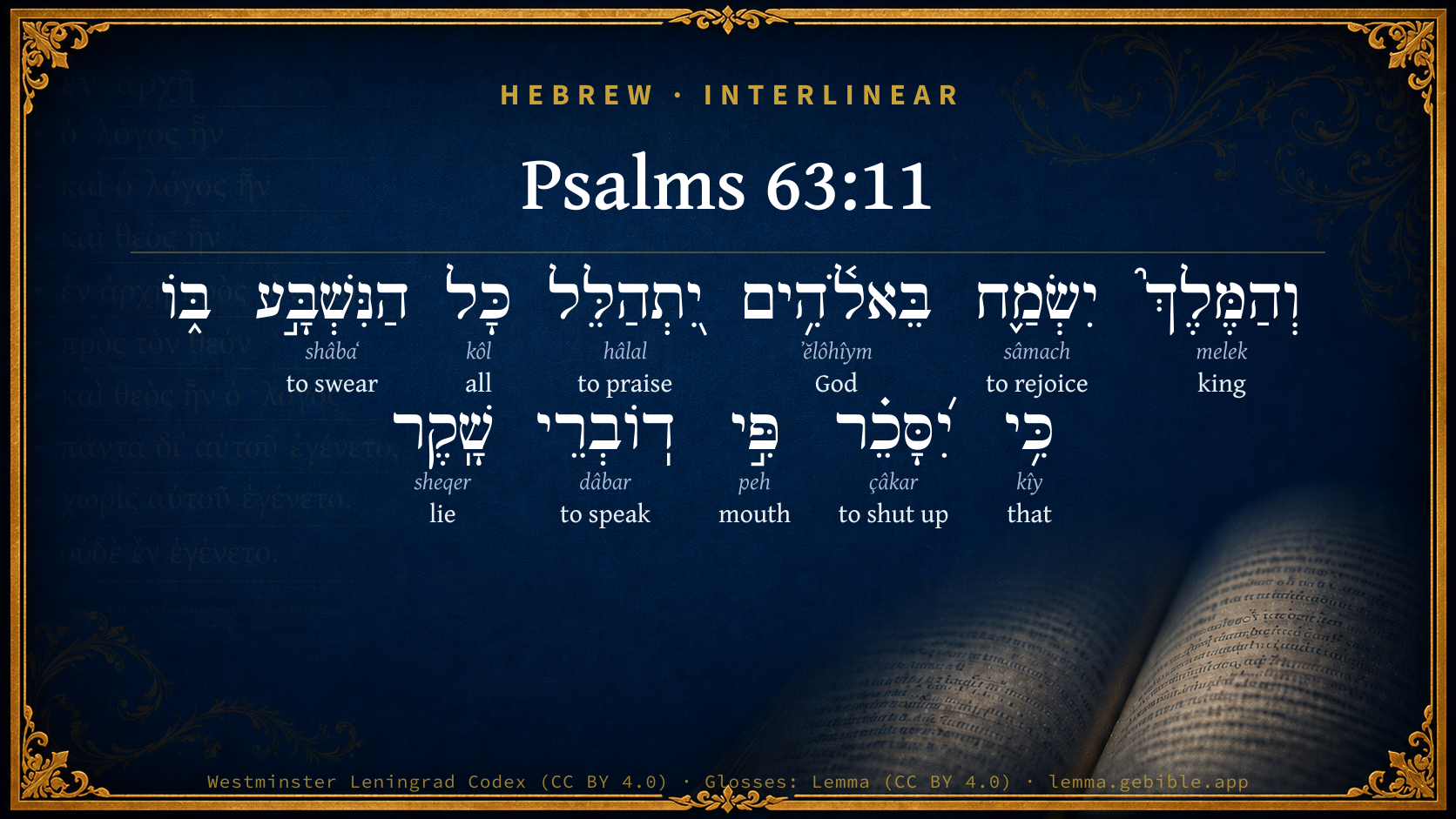
  1. וְהַמֶּלֶךְ֮ melek H4428 “and · the · king” Conjunction + Particle, Definite Article + Noun, Common, Masculine, Singular, Absolute
  2. יִשְׂמַ֪ח sâmach H8055 “to rejoice” Verb, Qal, Imperfect, 3rd Person, Masculine, Singular
  3. בֵּאלֹ֫הִ֥ים ʼĕlôhîym H430 “in/at · God(s)” Preposition + Noun, Common, Masculine, Plural, Absolute
  4. יִ֭תְהַלֵּל hâlal H1984 “to praise” Verb, Hithpael, Imperfect, 3rd Person, Masculine, Singular
  5. כָּל kôl H3605 “all of” Noun, Common, Masculine, Singular, Construct
  6. הַנִּשְׁבָּ֣ע shâbaʻ H7650 “the · swearing” Particle, Definite Article + Verb, Niphal, Participle Active, Masculine, Singular, Absolute
  7. כִּ֥י kîy H3588 “that” Conjunction
  8. פִּ֣י peh H6310 “mouth of” Noun, Common, Masculine, Singular, Construct
  9. דֽוֹבְרֵי dâbar H1696 “speaking” Verb, Qal, Participle Active, Masculine, Plural, Construct
  10. שָֽׁקֶר sheqer H8267 “lie” Noun, Common, Masculine, Singular, Absolute

About this verse

These counts appear in no published source. They are computed here, from the morphology-tagged text and Lemma’s own curated glosses. What Lemma adds →

12
words
11
distinct lemmas
Wisdom
section

Notable vocabulary

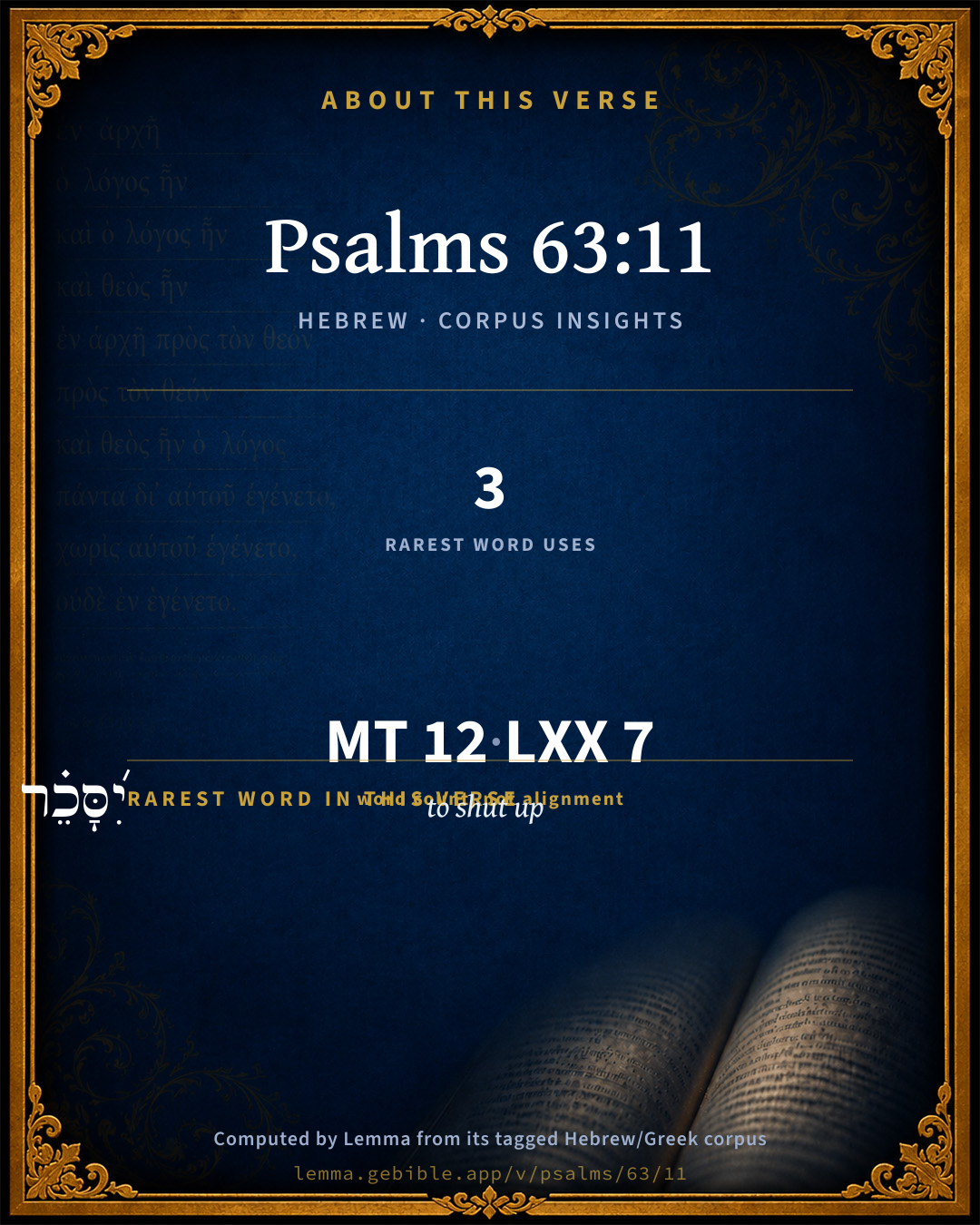
The rarest word here is יִ֝סָּכֵ֗ר to shut up H5534 — appearing just 3 times in the whole Hebrew Bible.

Shared distinctive vocabulary

יִ֝סָּכֵ֗ר to shut up H5534 occurs in 3 verses of the Hebrew Bible. Also found in:

Grammatical profile

  • 5 verbs
  • 5 nouns
  • 1 preposition
  • 1 conjunction

Verb forms

  • יִשְׂמַ֪ח Qal · Imperfect
  • יִ֭תְהַלֵּל Hithpael · Imperfect
  • הַנִּשְׁבָּ֣ע Niphal · Participle Active
  • יִ֝סָּכֵ֗ר Niphal · Imperfect
  • דֽוֹבְרֵי Qal · Participle Active

Hebrew & Septuagint length

In English translation the verse runs 26 words from the Hebrew and 28 from the Septuagint (LXX English) — closely comparable.

A rough comparison of the two English renderings, which tokenize alike — not a word-level alignment.

Word counts can differ between the Hebrew and the Greek without any difference in meaning — e.g. the Hebrew direct-object marker אֵת has no separate Greek word, and Greek often adds the article ὁ.

In the original languages it is 12 Hebrew tokens and 7 Greek tokens — but the two are counted differently (Hebrew bundles its prefixes and suffixes into one token; the Greek is in lemma form), so that isn’t a like-for-like length.

Cross-references

15

Topical passages linked to Psalms 63:11 in the Treasury of Scripture Knowledge — connected by theme and wording, ordered by reader-vote popularity; previews shown in the World English Bible.

  • Deuteronomy 6:13 You shall fear Yahweh your God; and him shall you serve, and shall swear by his name.
  • Psalms 21:1 The king rejoices in your strength, Yahweh! How greatly he rejoices in your salvation!
  • Isaiah 45:23 By myself have I sworn, the word is gone forth from my mouth [in] righteousness, and shall not return, that to me every knee shall bow, every tongue shall swear.
  • Isaiah 65:16 so that he who blesses himself in the earth shall bless himself in the God of truth; and he who swears in the earth shall swear by the God of truth; because the former troubles are forgotten, and because they are hid from my eyes.
  • Romans 3:19 Now we know that whatever things the law says, it speaks to those who are under the law, that every mouth may be closed, and all the world may be brought under the judgment of God.
  • Hebrews 6:13 For when God made a promise to Abraham, since he could swear by none greater, he swore by himself,
  • 1 Samuel 23:17 He said to him, Don't be afraid; for the hand of Saul my father shall not find you; and you shall be king over Israel, and I shall be next to you; and that also Saul my father knows.
  • 1 Samuel 24:20 Now, behold, I know that you shall surely be king, and that the kingdom of Israel shall be established in your hand.
  • Job 5:16 So the poor has hope, And injustice shuts her mouth.
  • Psalms 31:18 Let the lying lips be mute, Which speak against the righteous insolently, with pride and contempt.
  • Isaiah 19:18 In that day there shall be five cities in the land of Egypt that speak the language of Canaan, and swear to Yahweh of hosts; one shall be called The city of destruction.
  • Zephaniah 1:5 those who worship the host of the sky on the housetops, those who worship and swear by Yahweh and also swear by Malcam,
  • Titus 1:10–11 For there are also many unruly men, vain talkers and deceivers, especially those of the circumcision,
  • Psalms 2:6 "Yet I have set my king on my holy hill of Zion."
  • Psalms 107:42 The upright will see it, and be glad. All the wicked will shut their mouths.

Cross-references courtesy of OpenBible.info (CC BY 4.0).

Hebrew and Greek witnesses Masoretic Hebrew ↔ Greek Septuagint

The same verse in the two great witnesses to the Old Testament, shown verse-for-verse.

You’re reading Greek Psalm 62 (Hebrew Psalm 63). The Septuagint counts the superscription, so verse numbers can differ from the Hebrew — chapter-level alignment, not verse-by-verse. Numbering follows Rahlfs.

These are two independent witnesses, not word-aligned to each other, and the Septuagint is shown in lemma (dictionary) form.

Hebrew Psalms 63:11 Masoretic · Westminster Leningrad Codex

וְהַמֶּלֶךְ֮ יִשְׂמַ֪ח בֵּאלֹ֫הִ֥ים יִ֭תְהַלֵּל כָּל הַנִּשְׁבָּ֣ע בּ֑וֹ כִּ֥י יִ֝סָּכֵ֗ר פִּ֣י דֽוֹבְרֵי שָֽׁקֶר

But the king shall rejoice in God. Everyone who swears by him will praise him, For the mouth of those who speak lies shall be silenced.

World English Bible · Public Domain

Greek LXX Greek Psalm 62:11 Septuagint · lemma form

παραδίδωμι εἰς χείρ ῥομφαία μερίς ἀλώπηξ εἰμί

But the king shall rejoice in God; every one that swears by him shall be praised; for the mouth of them that speak unjust things has been stopped.

LXX2012 (modern English Septuagint) · Public Domain

Hebrew: Westminster Leningrad Codex (CC BY 4.0). Greek: Septuagint (public domain); English from LXX2012 (modern English Septuagint) (Public Domain). How the Septuagint differs from the Hebrew →

Commentary

Notes on Psalms 63:11 from classic Christian and Jewish commentators (each source and its license shown beneath its notes). The classic Christian expositions comment on the surrounding passage and are grouped to its opening verse, so a note may address several verses; the Jewish commentaries on the Tanakh (Rashi and others) are per-verse, so they appear only where the commentator wrote on this verse.

Lemma curates 59 commentaries, every one of them public domain or Creative Commons licensed, each selected and text-cleaned for this edition rather than reprinted as found. About our sources →

Adam Clarke's Commentary

Verse 11. But the king shall rejoice] David shall come to the kingdom according to the promise of God. Or, if it refer to the captivity, the blood royal shall be preserved in and by Zerubbabel till the Messiah come, who shall be David's spiritual successor in the kingdom for ever.

That sweareth by him] It was customary to swear by the life of the king. The Egyptians swore by the life of Pharaoh; and Joseph conforms to this custom, as may be seen in the book of Genesis, Ge 42:15-16. See also 1Sa 1:26; 1Sa 17:55, and Judith 11:7. But here it may refer to GOD. He is THE KING, and swearing by his name signifies binding themselves by his authority, acknowledging his supremacy, and devoting themselves to his glory and service alone.

The Chaldee has: "And the King shall rejoice במימר אלהא bemeymar Eloha, in the WORD of God;" or, in the WORD GOD; Meymar, WORD, being taken here substantially, as in many other places, by the Targumist.

The mouth of them that speak lies] The mouth of those who acknowledge lying vanities, that worship false gods, shall be stopped. All false religions shall be destroyed by the prevalence of the truth. For he, CHRIST, shall reign till all his enemies are put under his feet. "Thy kingdom come, and hell's o'erpower: and to thy sceptre all subdue." Amen and Amen.

ANALYSIS OF THE SIXTY-THIRD PSALM

The contents are, -

I. David's ardent desire to be in the assembly of the saints, Ps 63:1. And the reasons on which this desire was founded, Ps 63:2-5.

II. That though absent from God's ordinances, yet he forgot not his Maker, Ps 63:6-8.

III. A double prophecy. 1. What should befall his enemies, Ps 63:9-10. And, 2. What should come to himself, Ps 63:11.

I. 1. In the first part he states his confidence in God, as the foundation of his desires, contemplations, meditations, invocations, and consolations: "O God, thou art my God," Ps 63:1.

2. Then he expresses his fervent desire and ardent affection. 1. "Early will I seek thee." THEE, not other things. 2. "My soul thirsteth for thee," c. There is no doubt that he wanted many things in this barren thirsty land but of this he does not complain, but of his want of God in the sanctuary.

And so he expresses himself in the following verse: He was about to see the power and glory of God in the sanctuary, as he had formerly done. He gives the reason of this: "Because thy loving-kindness is better than life," Ps 63:3. To see thy goodness in the use of thy ordinances, I count far beyond all the blessings of life; and could I again be admitted there, these effects would follow: -

1. Praise: "My lips shall praise," c., Ps 63:4.

2. Invocation and prayer: "I will lift up my hands," c., Ps 63:4.

3. The satisfaction he should receive from these: "My mouth shall be satisfied as with marrow and fatness," &c., Ps 63:5.

II. Though David is now in the wilderness, he does not forget his duty.

1. Even there he remembered God upon his bed and meditated, c., Ps 63:6.

2. "Because thou hast been my help therefore," c., Ps 63:7.

3. "My soul followeth hard after thee," &c., Ps 63:8. It is evident, therefore, that even here David was not without comfort for, 1. He meditates, and remembers what God had done for him. 2. He remembers that he had been his help and therefore he rejoices. 3. He still adheres to him, and follows hard after him for help still.

III. And now, being secure of God's protection, he foretells, 1. What would befall his enemies; and, 2. What would come to himself.

1. To his enemies, ruin: "Those who seek after my soul, they shall go (some) into the lower parts of the earth," the grave or hell.

Others should "fall by the sword," lie unburied, and be devoured by wild beasts.

-----------ελωρια τευχε κυνεσσιν

οιωνοισι τε πασι

Il., I. ver. 4.

"Whose limbs, unburied on the naked shore,

Devouring dogs and hungry vultures tore."

POPE.

2. To himself, honour and a crown: "But the king (David) shall rejoice in God." The reason is, -

1. "Every one that swears by him," that is who worships and fears God, an oath being put by synecdoche for the whole worship of God. See the notes.

2. "The mouth of them that speak lies," utter blasphemies, curses, and perjuries, or pray and confess to strange gods, "shall be stopped;" they shall be ashamed and confounded, and an end be put to their iniquity by a sudden and violent death. The mouth of God's people shall glory; but the mouth of the wicked shall be stopped, and be silent in the dust.

Adam Clarke's Commentary on the Bible (1810–1826) — public domain. Text from a community e-Sword/MySword module.

Trapp's Complete Commentary

John Trapp

Psa 63:11 But the king shall rejoice in God; every one that sweareth by him shall glory: but the mouth of them that speak lies shall be stopped.

Ver. 11. But the king shall rejoice in God] i.e. I shall, who am anointed and appointed king after Saul, and therefore doubt not to speak thus of myself, as if I were king already. Wicked men praesumendo sperant, et sperando pereunt, hope groundlessly, and perish by their presumption; but true believers trust God upon his bare word, and that against sense in things invisible, and against reason in things incredible, and according to their faith so is it unto them.

Every one that sweareth by him shall glory] By whom? not by the king (though the Egyptians did so of old, and the Spaniards to this day, in the pride of their monarchs, swear by the life of their king), but by God, the sole and proper object of an oath; for to swear by his name in due manner is a special piece of his service, and is here put for the whole. So, then, every one that sincerely serveth God shall be glad and thankful to God that David reigneth; for now παντα καλως εσται (as the raven is said to have crouped from the Capitol when Augustus came to the empire), all shall go well with them, according to their own heart’s desires (Dio).

But the mouth of them that speak lies] A fault whereof Saul’s courtiers were deeply guilty. Some take this for a general description of all graceless and godless persons, who are liars habitually at least; as godly men are right swearers, and fearers of God’s name.

Shall be stopped] Either with shame and confusion, or with death, as was Saul’s and his flatters’. Saunders’s foul mouth was stopped with famine (as hath been above noted), that had uttered so many blasphemies against God, and so many lies against men.

John Trapp, A Commentary or Exposition upon All the Books of the Old and New Testament (1647–1656) — public domain. Text from a community e-Sword module.

Joseph Benson's Commentary

Psa 63:11. But the king shall rejoice in God — I, who am anointed to be king, and who shall actually be king when these my enemies are fallen by the sword. Every one that sweareth by him — By the name of God, namely, in truth, and judgment, and righteousness, as it is expressed Jer 4:2, that is, every sincere servant and worshipper of God that invokes his name, and makes him the object of his religious reverence and fear: all which is implied in swearing by him, as an oath taken, as in the presence of God, is an immediate appeal and solemn act of worship to him. Accordingly, swearing is often put for the whole worship of God, and swearers by him, for worshippers of him. See Isa 45:23, compared with Rom 14:16; Isa 65:16. Shall glory — Shall rejoice in my deliverance and exaltation, both for their respect for the honour and service of God, which I shall advance, and for the benefits which all good men and the whole kingdom shall receive by my government: whereas, in Saul’s time, the vilest men were exalted, good men oppressed and persecuted, and the whole kingdom groaned under his tyranny. But the mouth of them that speak lies — That now make it their business to invent or spread slanderous reports concerning me and others of God’s people; shall be stopped — They shall be so silenced that they shall not have a word to say for themselves. He may mean also, that when he should be in power, he would severely restrain and punish such wicked practices. Apply this to Christ’s enemies. Those that speak lies against him, who pervert the right ways of the Lord, and speak ill of his holy religion, their mouths will be stopped too, when the Lord shall come to reckon for all the hard speeches which ungodly sinners have spoken against him. Christ’s second coming will be the everlasting triumph of all his faithful friends and followers, who may therefore now triumph in the believing hopes of it.

Joseph Benson's Commentary on the Old and New Testaments (1811–1818) — public domain. Text from a community e-Sword module.

J. A. Alexander on Psalms

Joseph Addison Alexander

12. (Psa 63:11). And the king shall rejoice in God; (in him) shall every one boast (or glory) that swears by him, because the mouth of those speaking falsehood shall be shut (or stopped). Instead of the personal pronoun he inserts his official title, the king, i e. I as king. Rejoice in God, i.e. in union with him and in the experience of his favour. Boast or praise himself, i.e. felicitate himself on the possession of these glorious distinctions and advantages. Swearing by him, i.e. as some suppose, by the king here mentioned, according to the old Egyptian custom (Gen 42:15-16), of which we find some traces even in Israel (1Sa 17:55; 1Sa 25:26, 2Sa 11:11). If this were the true grammatical construction we might perhaps explain the phrase to mean swearing to him, i. e. swearing fealty or allegiance, doing homage to him as a rightful sovereign. But there is, in fact, no sufficient reason for departing from the obvious construction which refers the pronoun to the nearest antecedent, God. The last clause assigns the immediate occasion of the joy and triumph here predicted, namely, the defeat of false and treacherous insurgents. See above, on Psa 62:4), and compare 2Sa 18:7-8.

Joseph Addison Alexander, The Psalms Translated and Explained (1850) — public domain. Text from a community e-Sword module.

Geneva Bible (1599)

Geneva Bible translators

All that swear by God aright or profess him, shall rejoice in this worthy king.

Geneva Bible (1599) marginal notes — public domain. Text via Bolls.life.

Jamieson, Fausset & Brown

Robert Jamieson, A. R. Fausset & David Brown

the king--that is, David himself, and all who reverence God, "shall share a glorious part," while treacherous foes shall be for ever silenced (Psa 62:4).

Next: Psalms Chapter 64

Jamieson, Fausset & Brown — Commentary Critical and Explanatory on the Whole Bible (1871) — public domain (CC PDM 1.0). Text via the HelloAO Bible API.

John Calvin's Commentaries

11. But the king will rejoice in God. The deliverance which David received had not been extended to him as a private person, but the welfare of the whole Church was concerned in it, as that of the body in the safety of the head, and there is therefore a propriety in his representing all the people of God as rejoicing with him. Nor can we fail to admire his holy magnanimity in not scrupling to call himself king, overwhelming as the dangers were by which he was surrounded, because he laid claim to that honor by faith, though yet denied him in actual possession. In saying that he would rejoice in God, he refers to the gratitude which he would feel; at the same time, in extolling the divine goodness shown to him, he views it as it affected the common body of the faithful. As was already remarked, the safety of God’s chosen people, at that time, was inseparably connected with the reign of David and its prosperity — a figure by which it was the divine intention to teach us, that our happiness and glory depend entirely upon Christ. By those who swear in the name of the Lord, he means in general all his genuine servants. The act of solemnly calling upon God to witness and judge what we say, is one part of divine worship: hence an oath, by the figure of speech called synecdoche, is made to signify the profession of religion in general. We are not to imagine from this that God reckons all those to be his servants who make mention of his name. Many take it into their lips only to profane it by the grossest perjury; others outrage or slight it by entering into trifling and unnecessary oaths; and hypocrites are chargeable with wickedly abusing it. But those whom David refers to are such as swear by the Lord, considerately and with reverence, and whose hearts respond to what they declare. This appears more clearly from the contrast which follows in the verse, where he opposes those who swear by the name of God to those who speak lies, understanding by that term, not only treacherous and deceitful men, but men who profane the name of God by falsehoods of a sacrilegious kind.

John Calvin's Commentaries (1540-1563) — public domain. Text from the Calvin Translation Society English edition (1840s-50s) via the Christian Classics Ethereal Library (ccel.org). Calvin's coverage is partial (roughly two-thirds of the Bible); uncommented books and verses are honest gaps, never fabricated. The 19th-century editor's footnotes and remarks are omitted so the notes are faithfully Calvin's own voice.

Ellicott's Commentary for English Readers

(11) Sweareth by him.—This is explained as meaning, “swear allegiance to him as the king,” on the analogy of Zep_1:5. And this suits the context. On the other hand, the natural way to understand the phrase, “swear by” or “in him,” is to refer it to the only oath allowed to the Israelite,” by the name of Jehovah” (Deu_6:13; Isa_65:16; comp. Amo_8:14), in which case we must explain by Deu_10:20-21, “Swear by his (Jehovah’s) name; He is thy praise.” Those who are loyal to Jehovah, who appeal to Him in all troubles, will find this promise true, “They shall glory,” while the unfaithful and false, not daring to make the solemn appeal, will have their mouth stopped. (Comp. Rom_3:19.)

A Bible Commentary for English Readers, edited by Charles John Ellicott (1878–1897) — public domain. Text from a community e-Sword module.

The Cambridge Bible for Schools and Colleges

gen. ed. J. J. S. Perowne

11. But the king] The connexion is unintelligible unless the king is identified with the Psalmist, whose enemies are destroyed. Cp. Psa_61:6 ff.

that sweareth by him] Grammatically ‘him’ may refer to the king or to God, but usage decides that God is meant. Cp. Deu_6:13; Deu_10:20; Isa_65:16. Those who invoke His Name as the attestation of their oaths are His loyal worshippers; they share the triumph of the king who is His representative.

but the mouth &c.] For the mouth &c. Those who ‘speak lies’ are those who rebel against God and His king, deluding men by false promises to join an undertaking which is false in its principle and aim. See Psa_4:2, note; Psa_62:4. They are all completely silenced.

Cp. the similar ending of Psalms 64. St Paul may have had the phrase in mind in Rom_3:19. The context shews how familiar the Psalms were to him.

The Cambridge Bible for Schools and Colleges (gen. ed. J. J. S. Perowne; Cambridge University Press, 1878–1918) — public domain. Text from a community e-Sword module.

John Gill's Exposition

But the king shall rejoice in God,.... Not Saul, as R. Obadiah; as if David wished him well, and that he might have reason to rejoice in God, though he sought his hurt; which sense is rejected by Abea Ezra: but either David, who speaks of himself as king, being anointed by Samuel, and who, upon the death of Saul, was so in fact; and who rejoiced, not merely at the destruction of his enemies, for he lamented the death of Saul, Sa2 1:17; but in God, in his grace and goodness to him, and in his power and justice shown in the vengeance taken on them. Or rather, the King Messiah, who rejoiced in God because of the good of his people, their conversion and salvation, and their deliverance from their enemies, Psa 21:1;

everyone that sweareth by him shall glory; not by David, though such a form of swearing was used; see Sa2 15:21; or, "to him": and so describes his faithful subjects swearing allegiance to him: but rather by the Lord, in whom the king should rejoice; and designs the worshippers of him; swearing by him being sometimes put for the whole worship and service of God, Deu 6:13. The Heathens used to swear by their deities, and their chief was called Jupiter Horcius, because he presided over oaths (x). Or else that the King Christ should rejoice in God; and intends such as believe in him and confess him; see Isa 45:23, compared with Rom 14:11. And every such an one will glory, not in themselves, nor in anything of theirs, but in Christ, in his grace and righteousness, and in what he is unto them;

but the mouth of them that speak lies shall be stopped; such as Saul's courtiers, who invented and spread lies of David; but now upon the death of Saul, and David's advancement to the throne, would be silent; their mouths being stopped either by death, or through fear: and so all the followers of antichrist, that make and believe a lie, will have their mouths stopped, when cast into the lake of fire, Rev 21:8.

(x) Euripidis Medea, v. 170. Vid. Alex. ab Alex. Genial. Dier. l. 5. c. 10.

Next: Psalms Chapter 64

John Gill's Exposition of the Whole Bible (1746–1763) — public domain (CC PDM 1.0). Text via the HelloAO Bible API.

Albert Barnes' Notes on the Bible

But the king shall rejoice in God - This passage, as was remarked in the Introduction to the psalm, shows that this psalm could not have been composed in the time of Saul, since the title king was not then given to David. The use of the term here in the third person does not prove that the psalm could not have been written by David himself, for he may have spoken of himself simply as “the king,” and all the more forcibly and properly as he was driven unjustly from his throne, and was now an exile, yet was still a king - the king. The title was his; the throne belonged to him, and not to Absalom who had driven him from it. It was not improper to allude to this fact in the manner in which it is referred to here, and to say that “the king” - the true, the real king - himself - should and would rejoice in God. He would find God to be his helper; and by God he would yet be restored to his throne.

Every one that sweareth by him shall glory - Everyone that sweareth to him, or maintains his oath of allegiance to him, shall be honored.

But the mouth of them that speak lies - All who have sworn falsely; all who have professed allegiance and have proved unfaithful; all those who, contrary to their oaths and their obligations, have been found in the rebellion. They shall not be permitted to exult or rejoice, but they shall be confounded and silenced. This expresses, therefore, the fullest confidence in God; the absolute belief of David that he would be again placed on his throne, and again permitted “to see the power and glory of God as” he had “seen it in the sanctuary” Psa 63:2; the belief that he would be restored to prosperity, and that his enemies would be humbled and destroyed - So it will be with all who put their trust in God. There is certain joy and triumph for them, if not in this world, at least in the world to come.

Albert Barnes' Notes on the Bible (1834–1885) — public domain. Text from a community e-Sword/MySword module.

Matthew Poole's English Annotations

The king; I, who am already anointed king, and who shall be actually king, when these mine enemies are fallen by the sword. He speaks of himself in the third person, either out of modesty or out of prudence, because it was ambiguous, and might be understood either of himself or of Saul, whereby, he might avoid the envy of the expression, if this Psalm was composed before he was king. That sweareth by him; either,

1. By the king; by whom they sometimes did swear, as Gen 42:15; 2Sa 15:21. But they did also swear by some other persons, of eminent place and authority, though under the king, as 1Sa 1:26; 20:3. Nor is it likely that the psalmist would justify those kinds of oaths; this practice of swearing by one’s name being accounted a part of that worship which is proper to God, both in the Old and New Testament. If this were meant of the king, it might better be rendered, that sweareth it, (for so the particle beth is sometimes used) him, as subjects used to swear homage to their prince. So the sense is, all those that shall own me for their king. Or,

2. By God, who was last mentioned, that sweareth by the name of God, to wit, in truth, and judgment, and righteousness, as it is expressed, Jer 4:2, i.e. every sincere servant and worshipper of God; swearing being oft put for the whole worship of God, whereof it is a considerable part, and swearers by God for worshippers of him, as Isa 19:18; 45:23, compared with Rom 14:11; Isa 65:16. Shall glory; shall rejoice in my deliverance and exaltation, both for their respect to the honour and service of God, which I shall advance, and for the benefits which all good men and the whole kingdom shall feel by my government; whereas in Saul’s time the vilest men were exalted, and good men oppressed and persecuted, and the whole kingdom groaned under his tyranny.

That speak lies; that now make it their business to invent or spread lying and slanderous reports concerning me and others of God’s people.

Shall be stopped; I shall severely restrain and punish such wicked practices.

Matthew Poole's English Annotations on the Holy Bible (1683–1685) — public domain. Text from a community e-Sword/MySword module.

The Treasury of David

Charles H. Spurgeon

Ver. 11. But the king shall rejoice in God. Usurpers shall fade, but he shall flourish; and his prosperity shall be publicly acknowledged as the gift of God. The Lord's anointed shall not fail to offer his joyful thanksgiving: his well established throne shall own the superior lordship of the King of kings; his rejoicing shall be alone in God. When his subjects sing, "Io triumphe, "he will bid them chant, "Te Deum."

Every one that sweareth by him shall glory. His faithful followers shall have occasion for triumph; they shall never need to blush for the oath of their allegiance. Or, "swearing by him, "may signify adherence to God, and worship paid to him. The heathen swore by their gods, and the Israelite called Jehovah to witness to his asseveration; those, therefore, who owned the Lord as their God should have reason to glory when he proved himself the defender of the king's righteous cause, and the destroyer of traitors.

But the mouth of them that speak lies shall be stopped. And the sooner the better. If shame will not do it, nor fear, nor reason, then let them be stopped with the sexton's shovelful of earth; for a liar is a human devil, he is the curse of men, and accursed of God, who has comprehensively said, "all liars shall have their part in the lake which burneth with fire and brimstone." See the difference between the mouth that praises God, and the mouth that forges lies: the first shall never be stopped, but shall sing on for ever; the second shall be made speechless at the bar of God. O Lord, we seek thee and thy truth; deliver us from all malice and slander, and reveal to us thine own self, for Jesus' sake. Amen.

Ver. 11. Every one that sweareth by him, i.e., to David, that comes into his interest, and takes an oath of allegiance to him, shall glory in his success. Or, that swears by him, i.e., by the blessed name of God, and not by any idol. De 6:15. And then it means all good people that make a sincere and open profession of God's name: they shall glory in God; they shall glory in David's advancement: "They that fear thee will be glad when they see me." They that heartily espouse the cause of Christ, shall glory in its victory at last. "If we suffer with him, we shall reign with him." Matthew Henry.

Ver. 11. Three topics.

I. Royal rejoicing.

II. Lawful swearing.

III. Evil speaking.

Charles H. Spurgeon's The Treasury of David (1869–1885) — public domain. Psalms only. Text from a community e-Sword/MySword module.

Whedon's Commentary on the Bible

Daniel D. Whedon

11. But… king— “King,” according to the date given to the psalm, cannot here mean David, who never assumed that title during the life of Saul, though afterwards he thus spoke of himself in the third person, Psa_21:1; Psa_21:7; Psa_61:6. It can, therefore, apply to none but Saul, and this eminently suits the unvarying tenor of David’s loyalty; his high conceptions of the theocracy; his marvellous reverence for Saul as the Lord’s anointed; his constant refusal to take Saul’s life, when in two instances he could have done it with a single stroke; his uniform distinction between Saul as rightful sovereign and those lying flatterers who led him astray; and the unaffected lamentation and inimitable elegy upon his death. It further illustrates his forgiving piety.

Every one that sweareth by him—Whether the pronoun refers to “God,” or to “king,” in the preceding clause, may be grammatically indifferent; but it may be urged against the latter, and in favour of the former, that though in a heathen country it might pass as an allowable custom to swear by the king, (see Gen_42:15,) the Hebrews were strictly forbidden to swear by any but God. Deu_6:13; Deu_10:20; Isa_65:16. What the prophet, Isa_45:23, calls “swearing,” the apostle, Rom_14:11, calls “confessing.” It was a religious acknowledgment of the supremacy of God.

But the mouth of them that speak lies—This, with the preceding line, forms an antithetic parallelism, falsehood being opposed to truthful swearing in God’s name, and the rejoicing, or boasting in God to the shutting up the mouths of those who “speak lies.” This confirms the sense given of the passage.

Daniel D. Whedon (gen. ed.), Commentary on the Old and New Testaments (1874–1909) — public domain. Text from a community e-Sword module.

The Pulpit Commentary

But the king shall rejoice in God. The "king," thus suddenly introduced, cannot be an entirely new personage, unknown to the rest of the psalm, and, therefore, must be the composer, speaking of himself in the third person. (comp. Psa_18:50 Psa_72:1) Every one that sweareth by him (i.e. by God) shall glory; or, shall triumph (Kay). Those who swear by the Name of God show themselves to be believers in God, and will be upheld by him in time of danger. (see Deu_6:13 Isa_65:16) But the mouth of them that speak lies shall be stopped. (On the falsehoods told by David"s enemies, see 2Sa_15:3 2Sa_16:7, 2Sa_16:8; and comp. Psa_38:12 Psa_41:5-8)

The Pulpit Commentary (1880–1919), ed. H.D.M. Spence-Jones & Joseph S. Exell — public domain. Text from a community e-Sword module.

John Wesley's Explanatory Notes

The king - I who am already anointed king. Everyone - That sweareth by the name of God, in truth, and judgment, and righteousness. Every sincere servant and worshipper of God. Shall glory - Shall rejoice in my deliverance.

John Wesley, Explanatory Notes Upon the Whole Bible (1754–1765) — public domain. Text via the GEBible commentary corpus.

unfoldingWord translationNotes

Door43 World Missions Community

the king will

David is speaking about himself. This can be stated clearly in the translation. AT: "I, the king of Israel, will" (See: Assumed Knowledge and Implicit Information)

swears by him ... proud of him

The word "him" refers to "God."

but the mouth of those who speak lies will be stopped up

Here "the mouth" represents the whole person. This can be stated in active form. AT: "but God will silence the liars" or "but God will silence those who lie" (See: Synecdoche and Active or Passive)

translationWords

king

joy

oath

proud

unfoldingWord translationNotes — © Distant Shores Media and the Door43 World Missions Community, licensed CC BY-SA 4.0. Source: git.door43.org/Door43/en_tn.

Rashi

Rabbi Shlomo Yitzchaki (Rashi)

May he be dragged by the sword May enemies come upon my pursuers and drag each one of them with a sword, killing him. This is an elliptical verse, since it does not explain who will drag him. יגירהוּ is an expression of dragging, as (Micah 1:4): “as water poured down (המוגרים) a steep place”; (Job. 28:4), “A stream bursts forth from the place of its flow (גר).”

the portion of foxes (I found: the portion of foxes May their dwellings be destroyed, that foxes should walk there.)

Rashi on the Tanakh — English translations: “The Judaica Press complete Tanach with Rashi, translated by A. J. Rosenberg” (CC BY 4.0); “Pentateuch with Rashi's commentary by M. Rosenbaum and A.M. Silbermann, 1929-1934” (public domain); “The Metsudah Tanach series, Lakewood, N.J” (CC BY 4.0); and “The Book of Joshua, Metsudah Publications, 1997” (CC BY 4.0). Text via Sefaria.

Lesson kit

Teaching starters — assembled from the data on this page, not authored interpretation. Every prompt links to the verse data it draws on. Edit before teaching.

Psalms, in the Wisdom, opens this verse with 12 words (11 distinct Hebrew lemmas). Its most distinctive word is çâkar (“to shut up”). A historical commentator’s framing appears above. Read the whole chapter for the surrounding context.

Discussion questions

  1. How does “to shut up” (çâkar) shape what this verse is saying?
  2. How does Genesis 8:2, which shares the word «to shut up», read alongside this verse?
  3. These translations render this verse differently; the difference is in the English rendering, not the original. What questions does that raise?
  4. «יִשְׂמַ֪ח» is a Qal Imperfect verb. How does that grammatical form shape the action described?
  5. Compare how Adam Clarke's Commentary and Trapp's Complete Commentary read this verse. Where do they agree or differ?

Things to notice

Reading settings

Reading text

Shown beneath each verse's original-language words.

Old Testament
Old Testament edition

Read the OT as the Masoretic Hebrew (MT) or the Greek Septuagint (LXX).

English shown for the Greek Septuagint (in the Hebrew ↔ Greek comparison).

Comparing translations? Open the Compare panel on any verse page to stack up to four side by side.