
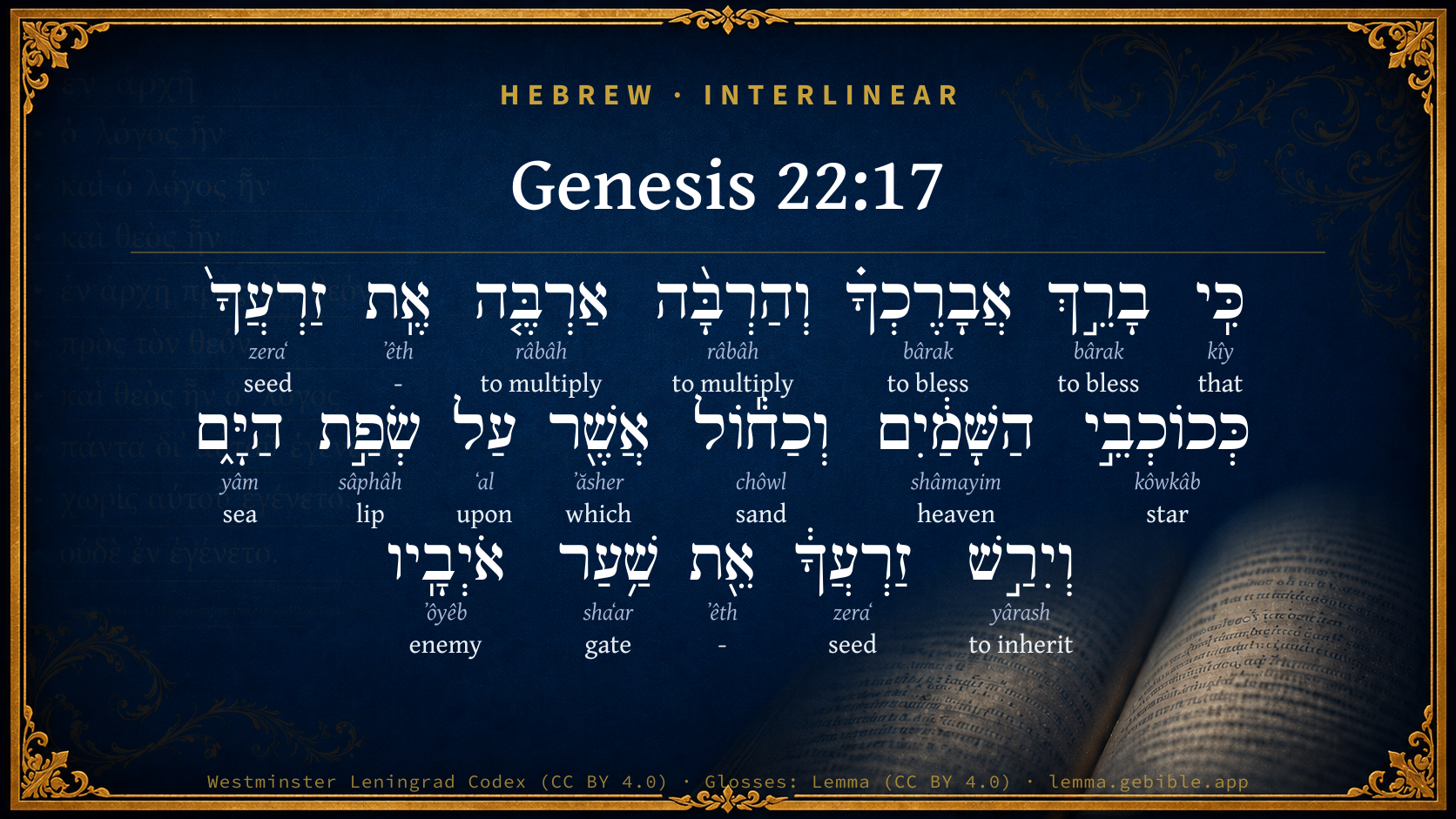
Genesis 22:17

Hebrew (Westminster Leningrad Codex) Genesis 22:17 appears in the Hebrew Old Testament. The text above is from the Westminster Leningrad Codex. Each word links to its Strong’s number, a concise gloss, and parsing drawn from the Open Scriptures Hebrew Bible morphology. Click any word for its full Brown-Driver-Briggs (BDB) entry.
Download image
Cite this verse

Genesis 22:17 (World English Bible). Public Domain. Lemma interlinear Bible study tool, https://lemma.gebible.app/v/genesis/22/17.

Show BibTeX & RIS
BibTeX
RIS
English Translation
that in blessing I will bless you, and in multiplying I will multiply your seed as the stars of the heavens, and as the sand which is on the seashore. Your seed will possess the gate of his enemies.
World English Bible · Public Domain
Highlights Full analysis ↓
Download a study sheet

One document with this verse’s original text, its word-by-word gloss line, the meaning frame, cross-references with their text, attributed commentary, and full source and license credits — printable, and it pastes into notes with its structure intact.

This verse Autodidact and up

Study sheet (.html) Plain text (.txt)

A passage Seminary Student

Up to 50 verses in one chapter. A passage sheet keeps up to 6 commentary sources and 12 cross-references per verse, in the order this page ranks them, and says so on the sheet whenever that leaves anything out. Ask for a single verse and you get the Autodidact verse sheet above.

Everything on this page stays free to read, with no account — the sheet is a download of what is already on screen, not access to it.

Want to remove ads? Support Godless Engineer
Compare translations 3

The same verse in 3 English versions, stacked beneath the original-language interlinear above. Click any original word for its lexicon entry.

Each is an independent rendering of the whole verse — the interlinear is not word-aligned to these translations.

Highlighted words mark where these versions differ — a whole-verse word diff, not a word-by-word alignment.

  • World English Bible Public Domain
    that in blessing I will bless you, and in multiplying I will multiply your seed as the stars of the heavens, and as the sand which is on the seashore. Your seed will possess the gate of his enemies.
  • King James Version Public Domain
    That in blessing I will bless thee, and in multiplying I will multiply thy seed as the stars of the heaven, and as the sand which is upon the sea shore; and thy seed shall possess the gate of his enemies;
  • unfoldingWord Literal Text CC BY-SA 4.0
    that I will greatly bless you, and I will greatly multiply your offspring as the stars of the heavens and as the sand that on the shore of the sea, and your offspring will possess the gate of their enemies.

unfoldingWord Literal Text — © unfoldingWord, licensed CC BY-SA 4.0. Word-aligned USFM3 via Door43 (git.door43.org/unfoldingWord/en_ult).

Versions to compare (up to 4)

3 of 4 selected

Show all 18 translations

Every available English version of this verse, each an independent rendering of the whole verse.

  • World English Bible Public Domain
    that in blessing I will bless you, and in multiplying I will multiply your seed as the stars of the heavens, and as the sand which is on the seashore. Your seed will possess the gate of his enemies.
  • Berean Standard Bible Public Domain
    I will surely bless you, and I will multiply your descendants like the stars in the sky and the sand on the seashore. Your descendants will possess the gates of their enemies.
  • Majority Standard Bible Public Domain
    I will surely bless you, and I will multiply your descendants like the stars in the sky and the sand on the seashore. Your descendants will possess the gates of their enemies.
  • King James Version Public Domain
    That in blessing I will bless thee, and in multiplying I will multiply thy seed as the stars of the heaven, and as the sand which is upon the sea shore; and thy seed shall possess the gate of his enemies;
  • American Standard Version (1901) Public Domain
    that in blessing I will bless thee, and in multiplying I will multiply thy seed as the stars of the heavens, and as the sand which is upon the seashore. And thy seed shall possess the gate of his enemies.
  • Revised Version (1885) Public Domain
    that in blessing I will bless thee, and in multiplying I will multiply thy seed as the stars of the heaven, and as the sand which is upon the sea shore; and thy seed shall possess the gate of his enemies;
  • Geneva Bible (1599) Public Domain
    Therefore will I surely blesse thee, and will greatly multiplie thy seede, as the starres of the heauen, and as the sand which is vpon the sea shore, and thy seede shall possesse the gate of his enemies.
  • Douay-Rheims (1899) Public Domain
    I will bless thee, and I will multiply thy seed as the stars of heaven, and as the sand that is by the seashore: thy seed shall possess the gates of their enemies.
  • Young's Literal Translation Public Domain
    that blessing I bless thee, and multiplying I multiply thy seed as stars of the heavens, and as sand which `is' on the sea-shore; and thy seed doth possess the gate of his enemies;
  • Literal Standard Version CC BY-SA 4.0
    that blessing I bless you, and multiplying I multiply your seed as stars of the heavens, and as sand which [is] on the seashore; and your Seed possesses the gate of His enemies;
  • Unlocked Literal Bible CC BY-SA 4.0
    I will surely bless you and I will greatly multiply your descendants as the stars of the heavens, and as the sand which is upon the seashore; and your descendants will possess the gate of their enemies.
  • unfoldingWord Literal Text CC BY-SA 4.0
    that I will greatly bless you, and I will greatly multiply your offspring as the stars of the heavens and as the sand that on the shore of the sea, and your offspring will possess the gate of their enemies.
  • Darby Bible Public Domain
    I will richly bless thee, and greatly multiply thy seed, as the stars of heaven, and as the sand that is on the sea-shore; and thy seed shall possess the gate of his enemies;
  • World Messianic Bible Public Domain
    that I will bless you greatly, and I will multiply your offspring greatly like the stars of the heavens, and like the sand which is on the seashore. Your offspring will possess the gate of his enemies.
  • Webster's Bible Public Domain
    That in blessing I will bless thee, and in multiplying I will multiply thy seed as the stars of heaven, and as the sand which is on the sea shore; and thy seed shall possess the gate of his enemies;
  • Free Bible Version CC BY-SA 4.0
    you can be sure that I will bless you and give you many descendants. They will be as numerous as the stars of heaven and the sand of the seashore, and they will conquer their enemies.
  • Bible in Basic English Public Domain
    That I will certainly give you my blessing, and your seed will be increased like the stars of heaven and the sand by the seaside; your seed will take the land of those who are against them;
  • JPS Tanakh (1917) Public Domain
    that in blessing I will bless thee, and in multiplying I will multiply thy seed as the stars of the heaven, and as the sand which is upon the seashore; and thy seed shall possess the gate of his enemies;

Literal Standard Version (2020), Covenant Press — licensed CC BY-SA 4.0. Text via the HelloAO Bible API (eBible.org). Unlocked Literal Bible (unfoldingWord) — licensed CC BY-SA 4.0. Text via the HelloAO Bible API (eBible.org). unfoldingWord Literal Text — © unfoldingWord, licensed CC BY-SA 4.0. Word-aligned USFM3 via Door43 (git.door43.org/unfoldingWord/en_ult). Free Bible Version, Dr. Jonathan Gallagher — licensed CC BY-SA 4.0. Text via the HelloAO Bible API (eBible.org).

Word by word

More ways to search: Search by grammar → Find every occurrence → Compare this word →

Practice this passage: Drill this verse → Learn its vocabulary →

וְכַח֕וֹל
chôwl
H2344
“and · like/as the · sand”
Conjunction + Preposition, Determined + Noun, Common, Masculine, Singular, Absolute
Part of Speech
Conjunction + Preposition + Noun
Type
Common
Gender
Masculine
Number
Singular
State
Absolute
Full BDB Definition

Origin: from H2342

TWOT: 623a

sand
  1. כִּֽי kîy H3588 “that” Conjunction
  2. בָרֵ֣ךְ bârak H1288 “to bless” Verb, Piel, Infinitive Absolute
  3. אֲבָרֶכְךָ֗ bârak H1288 “to bless · you” Verb, Piel, Imperfect, 1st Person, Common, Singular + Suffix, Personal, 2nd Person, Masculine, Singular
  4. וְהַרְבָּ֨ה râbâh H7235 “and · to multiply” Conjunction + Verb, Hiphil, Infinitive Absolute
  5. אַרְבֶּ֤ה râbâh H7235 “to multiply” Verb, Hiphil, Imperfect, 1st Person, Common, Singular
  6. אֶֽת ʼêth H853 “-” Particle, Direct Object
  7. זַרְעֲךָ֙ zeraʻ H2233 “seed · your” Noun, Common, Masculine, Singular, Construct + Suffix, Personal, 2nd Person, Masculine, Singular
  8. כְּכוֹכְבֵ֣י kôwkâb H3556 “like/as · stars of” Preposition + Noun, Common, Masculine, Plural, Construct
  9. הַשָּׁמַ֔יִם shâmayim H8064 “the · heaven(s)” Particle, Definite Article + Noun, Common, Masculine, Plural, Absolute
  10. אֲשֶׁ֖ר ʼăsher H834 “which” Particle, Relative
  11. עַל ʻal H5921 “upon” Preposition
  12. שְׂפַ֣ת sâphâh H8193 “lip of” Noun, Common, Feminine, Singular, Construct
  13. הַיָּ֑ם yâm H3220 “the · sea” Particle, Definite Article + Noun, Common, Masculine, Singular, Absolute
  14. וְיִרַ֣שׁ yârash H3423 “and · to inherit” Conjunction + Verb, Qal, Imperfect, 3rd Person, Masculine, Singular
  15. זַרְעֲךָ֔ zeraʻ H2233 “seed · your” Noun, Common, Masculine, Singular, Construct + Suffix, Personal, 2nd Person, Masculine, Singular
  16. אֵ֖ת ʼêth H853 “-” Particle, Direct Object
  17. שַׁ֥עַר shaʻar H8179 “gate of” Noun, Common, Masculine, Singular, Construct
  18. אֹיְבָֽיו ʼôyêb H341 “enemy · him” Verb, Qal, Participle Active, Masculine, Plural, Construct + Suffix, Personal, 3rd Person, Masculine, Singular

About this verse

These counts appear in no published source. They are computed here, from the morphology-tagged text and Lemma’s own curated glosses. What Lemma adds →

19
words
15
distinct lemmas
Pentateuch
section

Notable vocabulary

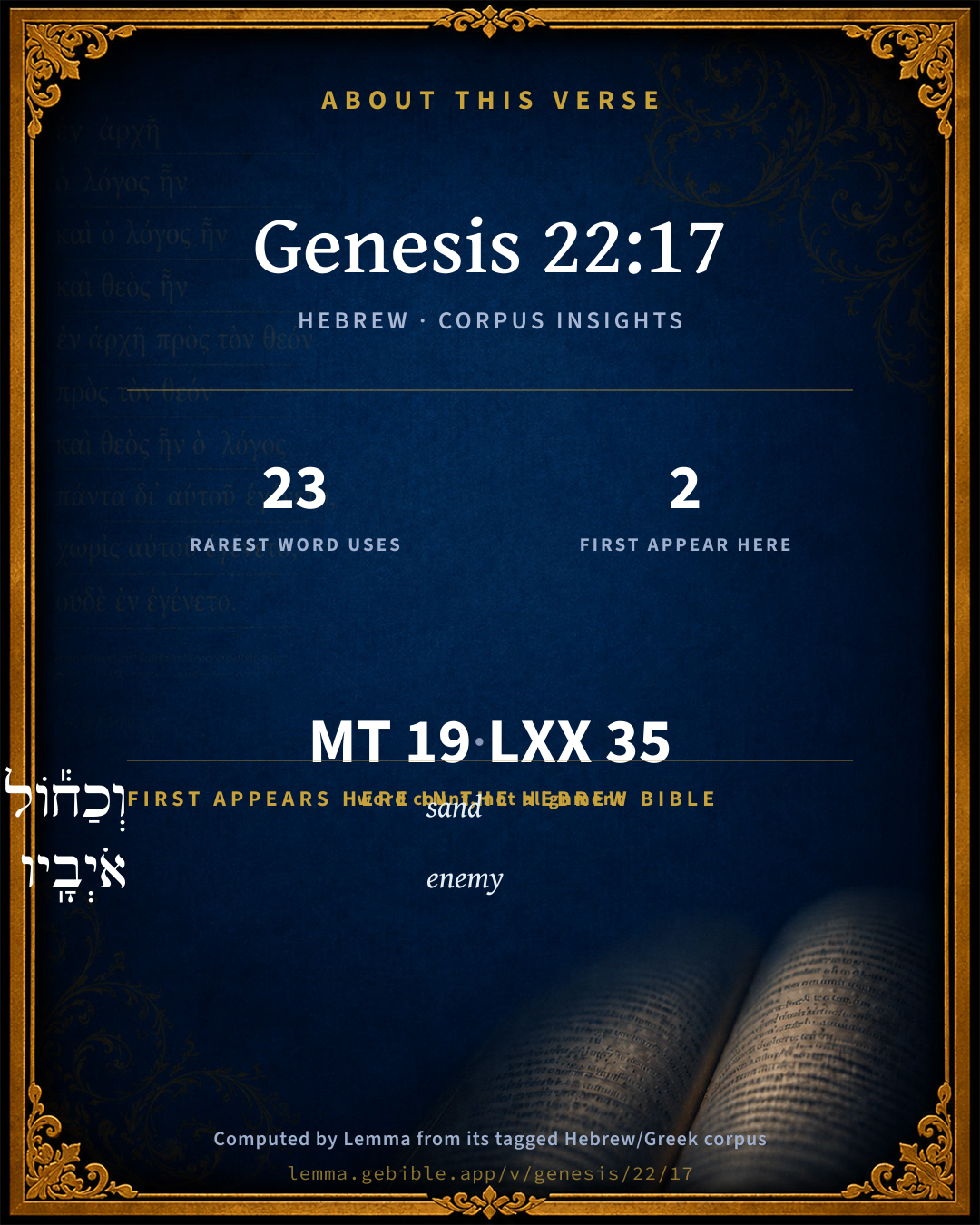
The rarest word here is וְכַח֕וֹל sand H2344 — appearing just 23 times in the whole Hebrew Bible.

First appearance in Scripture

These words make their first canonical appearance in the Hebrew Bible here:

  • וְכַח֕וֹל sand H2344
  • אֹיְבָֽיו enemy H341

Shared distinctive vocabulary

וְכַח֕וֹל sand H2344 occurs in 23 verses of the Hebrew Bible. Also found in:

Grammatical profile

  • 6 verbs
  • 8 nouns
  • 1 preposition
  • 1 conjunction
  • 3 particles

Verb forms

  • בָרֵ֣ךְ Piel · Infinitive Absolute
  • אֲבָרֶכְךָ֗ Piel · Imperfect
  • וְהַרְבָּ֨ה Hiphil · Infinitive Absolute
  • אַרְבֶּ֤ה Hiphil · Imperfect
  • וְיִרַ֣שׁ Qal · Imperfect
  • אֹיְבָֽיו Qal · Participle Active

Repetition

Words recur within this verse — often emphatic in Hebrew:

  • בָרֵ֣ךְ to bless H1288 ×2
  • וְהַרְבָּ֨ה to multiply H7235 ×2
  • זַרְעֲךָ֙ seed H2233 ×2

Hebrew & Septuagint length

In English translation the verse runs 39 words from the Hebrew and 20 from the Septuagint (LXX English) — the Septuagint runs noticeably shorter here. See the side-by-side →

A rough comparison of the two English renderings, which tokenize alike — not a word-level alignment.

Word counts can differ between the Hebrew and the Greek without any difference in meaning — e.g. the Hebrew direct-object marker אֵת has no separate Greek word, and Greek often adds the article ὁ.

In the original languages it is 19 Hebrew tokens and 35 Greek tokens — but the two are counted differently (Hebrew bundles its prefixes and suffixes into one token; the Greek is in lemma form), so that isn’t a like-for-like length.

Cross-references

29

Topical passages linked to Genesis 22:17 in the Treasury of Scripture Knowledge — connected by theme and wording, ordered by reader-vote popularity; previews shown in the World English Bible.

  • Genesis 15:5 Yahweh brought him outside, and said, "Look now toward the sky, and count the stars, if you are able to count them." He said to Abram, "So shall your seed be."
  • Genesis 24:60 They blessed Rebekah, and said to her, "Our sister, may you be the mother of thousands of ten thousands, and let your seed possess the gate of those who hate them."
  • Jeremiah 33:22 As the host of the sky can't be numbered, neither the sand of the sea measured; so will I multiply the seed of David my servant, and the Levites who minister to me.
  • Genesis 26:4 I will multiply your seed as the stars of the sky, and will give to your seed all these lands. In your seed will all the nations of the earth be blessed,
  • Genesis 13:16 I will make your offspring as the dust of the earth, so that if a man can number the dust of the earth, then your seed may also be numbered.
  • Numbers 24:17–19 I see him, but not now; I see him, but not near: There shall come forth a star out of Jacob, A scepter shall rise out of Israel, Shall strike through the corners of Moab, Break down all the sons of tumult.
  • Psalms 2:8–9 Ask of me, and I will give the nations for your inheritance, The uttermost parts of the earth for your possession.
  • Psalms 72:8–9 He shall have dominion also from sea to sea, From the River to the ends of the earth.
  • Ephesians 1:3 Blessed be the God and Father of our Lord Jesus Christ, who has blessed us with every spiritual blessing in the heavenly places in Christ;
  • Revelation 11:15 The seventh angel sounded, and great voices in heaven followed, saying, "The kingdom of the world has become the Kingdom of our Lord, and of his Christ. He will reign forever and ever!"
  • Deuteronomy 1:10 Yahweh your God has multiplied you, and, behold, you are this day as the stars of the sky for multitude.
  • Joshua 1:1–10 Now it happened after the death of Moses the servant of Yahweh, that Yahweh spoke to Joshua the son of Nun, Moses' minister, saying,
  • 1 Corinthians 15:57 But thanks be to God, who gives us the victory through our Lord Jesus Christ.
  • Genesis 12:2 I will make of you a great nation. I will bless you, and make your name great. You will be a blessing.
  • Genesis 17:6 I will make you exceeding fruitful, and I will make nations of you. Kings will come out of you.
  • Genesis 27:28–29 God give you of the dew of the sky, of the fatness of the earth, and plenty of grain and new wine.
  • Genesis 32:12 You said, 'I will surely do you good, and make your seed as the sand of the sea, which can't be numbered because there are so many.'"
  • Genesis 49:25–26 Even by the God of your father, who will help you, By the Almighty, who will bless you, With blessings of heaven above, Blessings of the deep that lies below, Blessings of the breasts, and of the womb.
  • Deuteronomy 28:2–13 and all these blessings shall come on you, and overtake you, if you shall listen to the voice of Yahweh your God.
  • Jeremiah 32:22 and gave them this land, which you did swear to their fathers to give them, a land flowing with milk and honey;
  • Luke 1:68–75 "Blessed be the Lord, the God of Israel, For he has visited and worked redemption for his people;
  • Genesis 28:3 May God Almighty bless you, and make you fruitful, and multiply you, that you may be a company of peoples,
  • Genesis 28:14–22 Your seed will be as the dust of the earth, and you will spread abroad to the west, and to the east, and to the north, and to the south. In you and in your seed will all the families of the earth be blessed.
  • Deuteronomy 21:19 then shall his father and his mother lay hold on him, and bring him out to the elders of his city, and to the gate of his place;
  • 2 Samuel 8:1–18 After this it happened that David struck the Philistines, and subdued them: and David took the bridle of the mother city out of the hand of the Philistines.
  • Daniel 2:44–45 In the days of those kings shall the God of heaven set up a kingdom which shall never be destroyed, nor shall the sovereignty of it be left to another people; but it shall break in pieces and consume all these kingdoms, and it shall stand forever.
  • Micah 1:9 For her wounds are incurable; For it has come even to Judah. It reaches to the gate of my people, Even to Jerusalem.
  • 2 Samuel 10:1–19 It happened after this, that the king of the children of Ammon died, and Hanun his son reigned in his place.
  • 1 Kings 9:26 King Solomon made a navy of ships in Ezion Geber, which is beside Eloth, on the shore of the Red Sea, in the land of Edom.

Cross-references courtesy of OpenBible.info (CC BY 4.0).

Hebrew and Greek witnesses Masoretic Hebrew ↔ Greek Septuagint

The same verse in the two great witnesses to the Old Testament, shown verse-for-verse.

Here the Septuagint runs noticeably shorter than the Hebrew — LXX2012 (modern English Septuagint) 20 words vs World English Bible 39. A rough length comparison of the two English translations, not a word-level alignment — read both below.

These are two independent witnesses, not word-aligned to each other, and the Septuagint is shown in lemma (dictionary) form.

Hebrew Genesis 22:17 Masoretic · Westminster Leningrad Codex

כִּֽי בָרֵ֣ךְ אֲבָרֶכְךָ֗ וְהַרְבָּ֨ה אַרְבֶּ֤ה אֶֽת זַרְעֲךָ֙ כְּכוֹכְבֵ֣י הַשָּׁמַ֔יִם וְכַח֕וֹל אֲשֶׁ֖ר עַל שְׂפַ֣ת הַיָּ֑ם וְיִרַ֣שׁ זַרְעֲךָ֔ אֵ֖ת שַׁ֥עַר אֹיְבָֽיו

that in blessing I will bless you, and in multiplying I will multiply your seed as the stars of the heavens, and as the sand which is on the seashore. Your seed will possess the gate of his enemies.

World English Bible · Public Domain

Greek LXX Genesis 22:17 Septuagint · lemma form

ἦ μήν εὐλογέω εὐλογέω σύ καί πληθύνω πληθύνω ὁ σπέρμα σύ ὡς ὁ ἀστήρ ὁ οὐρανός καί ὡς ὁ ἄμμος ὁ παρά ὁ χεῖλος ὁ θάλασσα καί κληρονομέω ὁ σπέρμα σύ ὁ πόλις ὁ ὑπεναντίος

And in your seed shall all the nations of the earth be blessed, because you have listened to my voice.

LXX2012 (modern English Septuagint) · Public Domain

On this verse, Adam Clarke's Commentary discusses the Septuagint’s reading. Read the note in Commentary ↓

Hebrew: Westminster Leningrad Codex (CC BY 4.0). Greek: Septuagint (public domain); English from LXX2012 (modern English Septuagint) (Public Domain). How the Septuagint differs from the Hebrew →

Targum (Aramaic paraphrase)

2

The Targum is the ancient Jewish Aramaic paraphrase of the Hebrew Scriptures — an interpretive translation, not the Hebrew text itself. Onkelos (literal) and Pseudo-Jonathan (expansive) render the Torah, and Jonathan the Prophets. Coverage is partial: where no permissively-licensed English translation exists for a verse, only the Aramaic is shown. This is verse-level text, not a word-by-word alignment to the Hebrew.

  1. Targum Onkelos Torah (Genesis–Deuteronomy)
    אֲרֵי בָרָכָא אֲבָרְכִנָּךְ וְאַסְגָּאָה אַסְגֵּי יָת בְּנָיךְ כְּכוֹכְבֵי שְׁמַיָּא וּכְחָלָא דִּי עַל כֵּיף יַמָּא וְיִרְתוּן בְּנָיךְ יָת קִרְוֵי סַנְאֵיהוֹן

    (no public-domain English translation for this verse)

    Targum Onkelos — Aramaic: “Onkelos Genesis” (public domain); “Onkelos Exodus” (public domain); “Onkelos Leviticus” (public domain); “Onkelos Numbers” (public domain); “Onkelos Deuteronomy” (public domain). English: “Sefaria Community Translation” (CC0 1.0 (public-domain dedication)); “J.W. Etheridge. The Targums of Onkelos and Jonathan Ben Uzziel on the Pentateuch. London: Longmans, Green, 1862” (public domain). Text via Sefaria.

  2. Targum Pseudo-Jonathan Torah (Genesis–Deuteronomy)
    אֲרוּם בְּרָכָא אֵיבָרְכִינָךְ וְאַסְגָא אַסְגֵי יַת בְּנָךְ כְּכוֹכְבֵי שְׁמַיָא וִיהֵי כְּחָלָא דְעַל כֵּיף יַמָא וְיֵירְתוּן בְּנָךְ יַת קִרְוֵי קוּמִי סַנְאֵיהוֹן

    that in blessing I will bless thee, and in multiplying I will multiply thy sons as the stars of the heavens, and they shall be as the sand which is upon the shore of the sea, and thy sons shall inherit the cities before their enemies.

    Targum Pseudo-Jonathan — Aramaic: “Targum Jonathan on Genesis” (public domain); “Targum Jonathan on Exodus” (public domain); “Targum Jonathan on Leviticus” (public domain); “Targum Jonathan on Numbers” (public domain); “Targum Jonathan on Deuteronomy” (public domain). English: “The Targum of Jonathan ben Uzziel, trans. J. W. Etheridge, London, 1862” (public domain). Text via Sefaria.

Commentary

Notes on Genesis 22:17 from classic Christian and Jewish commentators (each source and its license shown beneath its notes). The classic Christian expositions comment on the surrounding passage and are grouped to its opening verse, so a note may address several verses; the Jewish commentaries on the Tanakh (Rashi and others) are per-verse, so they appear only where the commentator wrote on this verse.

Lemma curates 59 commentaries, every one of them public domain or Creative Commons licensed, each selected and text-cleaned for this edition rather than reprinted as found. About our sources →

Trapp's Complete Commentary

John Trapp

Gen 22:17 That in blessing I will bless thee, and in multiplying I will multiply thy seed as the stars of the heaven, and as the sand which [is] upon the sea shore; and thy seed shall possess the gate of his enemies;

Ver. 17. Shall possess the gate,] i.e., Both their strength and government.

John Trapp, A Commentary or Exposition upon All the Books of the Old and New Testament (1647–1656) — public domain. Text from a community e-Sword module.

Tyndale Open Study Notes

Tyndale Open Resources

22:17 Joshua and Old Testament Israel partially fulfilled the promise that Abraham’s descendants would conquer the cities (literally take possession of the gates) of God’s enemies; this will be fulfilled fully by the church (cp. Matt 16:18 and study note there).

Tyndale Open Study Notes — © Tyndale Open Resources, licensed CC BY-SA 4.0. Text via the HelloAO Bible API.

Geneva Bible (1599)

Geneva Bible translators

Or, holds.

Geneva Bible (1599) marginal notes — public domain. Text via Bolls.life.

Adam Clarke's Commentary

Verse 17. Shall possess the gate of his enemies] Instead of gate the Septuagint have πολεις, cities; but as there is a very near resemblance between πολεισ, cities, and πυλασ, gates, the latter might have been the original reading in the Septuagint, though none of the MSS. now acknowledge it. By the gates may be meant all the strength, whether troops, counsels, or fortified cities of their enemies. So Mt 16:18: On this rock I will build my Church, and the gates of hell shall not prevail against it-the counsels, stratagems, and powers of darkness shall not be able to prevail against or overthrow the true Church of Christ; and possibly our Lord had this promise to Abraham and his spiritual posterity in view, when he spoke these words.

Adam Clarke's Commentary on the Bible (1810–1826) — public domain. Text from a community e-Sword/MySword module.

John Calvin's Commentaries

17. Thy seed shall possess the gate of his enemies. He means that the offspring of Abraham should be victorious over their enemies; for in the gates were their bulwarks, and in them they administered judgment. Now, although God often suffered the enemies of the Jews tyrannically to rule over them; yet he so moderated their revenge, that this promise always prevailed in the end. Moreover, we must remember what has before been stated from Paul, concerning the unity of the seed; for we hence infer, that the victory is promised, not to the sons of Abraham promiscuously, but to Christ, and to his members, so far as they adhere together under one Head. For unless we retain some mark which may distinguish between the legitimate and the degenerate sons of Abraham, this promise will indiscriminately comprehend, as well the Ishmaelites and Idumeans, as the people of Israel: but the unity of a people depends on its head. Therefore the prophets, whenever they wish to confirm this promise of God, assume the principle, that they who have hitherto been divided, shall be united, under David, in one body. What further pertains to this subject may be found in the twelfth chapter Genesis 12:1

John Calvin's Commentaries (1540-1563) — public domain. Text from the Calvin Translation Society English edition (1840s-50s) via the Christian Classics Ethereal Library (ccel.org). Calvin's coverage is partial (roughly two-thirds of the Bible); uncommented books and verses are honest gaps, never fabricated. The 19th-century editor's footnotes and remarks are omitted so the notes are faithfully Calvin's own voice.

The Cambridge Bible for Schools and Colleges

gen. ed. J. J. S. Perowne

17. that in blessing, &c.] The language of this benediction combines the substance of previous blessings pronounced upon the patriarch, under three heads: (1) multiplication of seed; (2) victory over enemies; (3) universal happiness.

bless] Cf. Gen_12:2.

as the stars of the heaven] Cf. Gen_15:5.

as the sand] Cf. Gen_13:16.

the gate of his enemies] See note on Gen_24:60. The phrase denotes conquest. LXX reads πόλεις, both here and in Gen_24:60.

The Cambridge Bible for Schools and Colleges (gen. ed. J. J. S. Perowne; Cambridge University Press, 1878–1918) — public domain. Text from a community e-Sword module.

John Gill's Exposition

And in thy seed shall all nations of the earth be blessed,.... That is, in his one and principal seed, the Messiah, that should spring from him, Gal 3:16, in whom all the elect of God, of all nations under the heavens, are blessed with all spiritual blessings, with peace, pardon, righteousness, and eternal life, with grace here and glory hereafter; See Gill on Gen 12:3; or, "shall bless themselves" (o) in him; or, "account themselves blessed"; apply to him for blessings, claim their interest in them, and glory in them, and make their boast of them:

because thou hast obeyed my voice; in taking his son and offering him up unto him, as much as he was permitted to do; and thus honouring God by his obedience to him, he of his grace and goodness honours him with the promise of being the father of multitudes, both in a literal and spiritual sense, and with being the ancestor of the Messiah, in whom all the blessings of grace and goodness meet.

(o) "benedicent se", Munster; to the same purpose Vatablus, Tigurine version, Piscator.

John Gill's Exposition of the Whole Bible (1746–1763) — public domain (CC PDM 1.0). Text via the HelloAO Bible API.

Haydock's Catholic Bible Commentary

Stars and dust, comprising the just and sinners. --- Gates, shall judge and rule. (Haydock)

George Leo Haydock (1774–1849), Haydock's Catholic Family Bible and Commentary, 1859 edition — public domain. Excludes Psalms (Douay-Rheims chapter numbering differs from Protestant) and Deuterocanonical books (Catholic canon only).

Matthew Poole's English Annotations

i.e. The city, by a usual synecdoche, as Deu 12:15; 18:6, all the cities, and consequently the country adjacent; gate for gates. The sense is, they shall subdue their enemies. For the gates of cities were the places both of jurisdiction or judicature, Deu 21:19; 22:15; Amo 5:12,15; Zec 8:16; and of fortification and chief strength in war, Jdg 5:8; Psa 147:13; Isa 22:7; Eze 21:22. And this promise was fulfilled both literally in Israel’s conquest of Canaan, in David, Solomon, &c., and spiritually in Christ, Psa 110:1-3.

Matthew Poole's English Annotations on the Holy Bible (1683–1685) — public domain. Text from a community e-Sword/MySword module.

Whedon's Commentary on the Bible

Daniel D. Whedon

17. Bless… multiply — Compare the promises that had gone before. Gen_12:2; Gen_12:8; Gen_13:14-17; Gen_15:5; Gen_15:7; Gen_15:18; Gen_17:1-8; and Gen_18:18.

Thy seed shall possess the gate of his enemies — Fulfilled primarily in the conquest of Canaan, (comp. Gen_15:18-21,) but pointing even now to Christ’s ultimate triumph over the gates of hell. Mat_16:18. In the rapturous hour of this revelation and promise, Abraham, doubtless, saw Messiah’s day, and was glad. Joh_8:5-6.

With this account of the attempted offering of Isaac it has been common to compare the Grecian legends of Phrixus, Idomeneus, and Iphigenia; and also the Phoenician tradition of Chronos, who in a time of war and impending perils took his only son Jehoud, clothed him in royal apparel, and offered him in sacrifice upon an altar which he had built. But these tales have no more connexion with Abraham and Isaac than have the narratives of Jephthah’s vow (Judges 11) or the sacrifice of the king of Moab’s son. 2Ki_3:27.

The bearing of this act of Abraham on human sacrifices is worthy of notice. We need not go to the extent of Kurtz, who imagines that Abraham might have descried, on all the heights around him, altars smoking with human sacrifices; but we may believe that the idea of human sacrifice sprung from deep religious promptings; the consciousness of guilt, and the felt necessity of offering up the dearest and most precious gift as an atonement. Abraham’s act, adapted to be monumental in the history of the chosen race, recognised at once the necessity of sacrifice, and that our life is not our own; but it also revealed the authority from heaven to substitute animal life instead. In this revelation human sacrifices stand condemned, and animal sacrifices sanctioned and established as meeting the divine requirement.

The typical significance of the offering of Isaac has been recognised by nearly all Christian divines, but the pressing of all analogies and correspondencies as types may well be condemned. We have noted above (on Gen_22:12) how Isaac is no proper type of Christ; but as the apostle speaks of Abraham’s receiving his son from the dead “in a figure,” (Heb_11:19,) we may, by a legitimate accommodation, speak of the points in the narrative which in any way prefigure or suggest great Gospel facts. Thus 1) Abraham’s not withholding his only son suggests that greater act of Him “who spared not his own Son, but freely gave him up for us all.” Rom_8:32. 2) Isaac bearing the wood for the sacrifice suggests Christ bearing his own cross. 3) The ram caught in the thicket of thorns reminds us of Jesus with the thorn-wreath on his brow. 4) Isaac and the ram together have been taken as a double type, Isaac representing the divinity of our Lord, and the ram the humanity which Christ assumed (“a body hast thou prepared me,” Heb_10:5,) that he might taste death for Man_1:5) The three days from the command to sacrifice his son to the time of the deliverance of Isaac, his son was as one already dead to Abraham; and so, “in a figure,” his release was a resurrection from the dead. Heb_11:19. All these analogies may be truthfully presented as parabolic, (εν παραβολη,) but not as proper types.

Other lessons of this chapter are abundant. 1) Here is the notable instance in which to see how faith wrought with works and was thus made perfect. Jas_2:22. 2) The moral sublimity of ready obedience and submission when God demands our beloved. 3) The moral value of temptation and stern discipline. 4) The word of God the highest law. 5) Two immutable things, the oath and promise of God, a permanent source of consolation to the Christian believer. Heb_6:17-18. NAHOR’S CHILDREN, 20-24.

Daniel D. Whedon (gen. ed.), Commentary on the Old and New Testaments (1874–1909) — public domain. Text from a community e-Sword module.

John Wesley's Explanatory Notes

Multiplying I will multiply thee - Those that part with any thing for God, shall have it made up to them with unspeakable advantage. Abraham has but one son, and is willing to part with that one in obedience to God; well, saith God, thou shalt be recompensed with thousands and millions. Here is a promise,

1. Of the Spirit, In blessing I will bless thee - The Gift of the Holy Ghost; the promise of the Spirit was that blessing of Abraham which was to come upon the Gentiles through Jesus Christ, Gal. iii, 14.

2. Of the increase of the church; that believers, his spiritual seed, should be many as the stars of heaven.

3. Of spiritual victories; Thy seed shall possess the gate of his enemies - Believers by their faith overcome the world, and triumph over all the powers of darkness. Probably Zacharias refers to this part of the oath, Luke i, 74. That we being delivered out of the hand of our enemies might serve him without fear. But the crown of all is the last promise,

4. Of the incarnation of Christ; In thy seed (one particular person that shall descend from thee, for he speaks not of many but of one, as the apostle observes, Gal. iii, 16.) shall all the nations of the earth be blessed - Christ is the great blessing of the world. Abraham was ready to give up his son for a sacrifice to the honour of God, and on that occasion God promised to give his son a sacrifice for the salvation of man.

John Wesley, Explanatory Notes Upon the Whole Bible (1754–1765) — public domain. Text via the GEBible commentary corpus.

Rashi

Rabbi Shlomo Yitzchaki (Rashi)

ברך אברכך I WILL SURELY BLESS THEE — The double use of the term “bless” is intended to signify a blessing for the father and a blessing for the son (Genesis Rabbah 56:11).

והרבה ארבה AND I WILL GREATLY MULTIPLY— once for the father, and once for the son (Genesis Rabbah 56:11).

Rashi on the Tanakh — English translations: “The Judaica Press complete Tanach with Rashi, translated by A. J. Rosenberg” (CC BY 4.0); “Pentateuch with Rashi's commentary by M. Rosenbaum and A.M. Silbermann, 1929-1934” (public domain); “The Metsudah Tanach series, Lakewood, N.J” (CC BY 4.0); and “The Book of Joshua, Metsudah Publications, 1997” (CC BY 4.0). Text via Sefaria.

Radak

Rabbi David Kimhi (Radak)

וירש זרעך את שער אויביו, the meaning of the words שער אויביו is ארץ אויביו, the land of its enemies. A land surrounded by oceans and mountains is difficult to conquer. Eretz Yisrael is such a country. When one has breached the coastal defences, or conquered the mountain ranges, it is as if one had broken through the gates of the fortified walls around a city. This is why the Torah here describes such a victory as “inheriting the gates of one’s enemies.” We find a similar expression used in Nachum 3,13 פתח נפתחו שערי ארצך, “the gates of your country will be completely open.” The prophet refers to the country lying at the mercy of an invader. G’d added further:

ככוכבי השמים וכחול, by this simile, and especially the repeated reference to two different hyperboles, He wanted to reinforce the meaning of this promise. Up until now, the only simile for the multiplying of Avraham’s seed had been the expression כעפר הארץ, “as the dust of the earth.” (13,15) On another occasion (15,5) the comparison had been to the stars. Now, two comparisons are mentioned, showing that the blessing had been reinforced. והתברכו בזרעך, this too is an additional dimension of the promise made to Avraham concerning his offspring.

וירש, one of the letters י that we would have expected as part of this word is missing. It is the י which is part of the root of the verb ירש. The י which does appear is the one describing the future tense indirect speech masculine. [this is common for roots beginning with the letter י. Ed.]

כי ברך, we already explained the meaning of the repetition of such formulations.

Radak on the Tanakh — English translations: “Sefaria Community Translation” (CC0 1.0 (public-domain dedication)); “Eliyahu Munk, HaChut Hameshulash” (CC BY 4.0); “Rabbi Mike Feuer, Jerusalem Anthology” (CC BY 4.0); and “R. David Kimhi on the first book of Psalms, Translated by R.G. Finch, London, 1919” (public domain). Text via Sefaria.

Lesson kit

Teaching starters — assembled from the data on this page, not authored interpretation. Every prompt links to the verse data it draws on. Edit before teaching.

Genesis, in the Pentateuch, opens this verse with 19 words (15 distinct Hebrew lemmas). Its most distinctive word is chôwl (“sand”). The Greek Septuagint runs shorter here. A historical commentator’s framing appears above. Read the whole chapter for the surrounding context.

Discussion questions

  1. The word chôwl carries the sense “sand.” How does it shape the verse?
  2. 2 words here appear for the first time in Scripture. What is being introduced at this debut?
  3. Genesis 32:12 shares the word «sand» with this verse. How do the two illuminate each other?
  4. “to bless” occurs 2× in this one verse. What is the effect of the repetition?
  5. Compared with the Hebrew, the Septuagint runs shorter here. What questions does that raise?
  6. These translations render this verse differently. What is at stake in choosing one wording over another?
  7. The verb «בָרֵ֣ךְ» is Piel Infinitive Absolute. How does its form color the action?
  8. Reading how Trapp's Complete Commentary and Tyndale Open Study Notes read this verse, where do the two commentators agree and where do they part?

Things to notice

Reading settings

Reading text

Shown beneath each verse's original-language words.

Old Testament
Old Testament edition

Read the OT as the Masoretic Hebrew (MT) or the Greek Septuagint (LXX).

English shown for the Greek Septuagint (in the Hebrew ↔ Greek comparison).

Comparing translations? Open the Compare panel on any verse page to stack up to four side by side.