Psalms 47:9

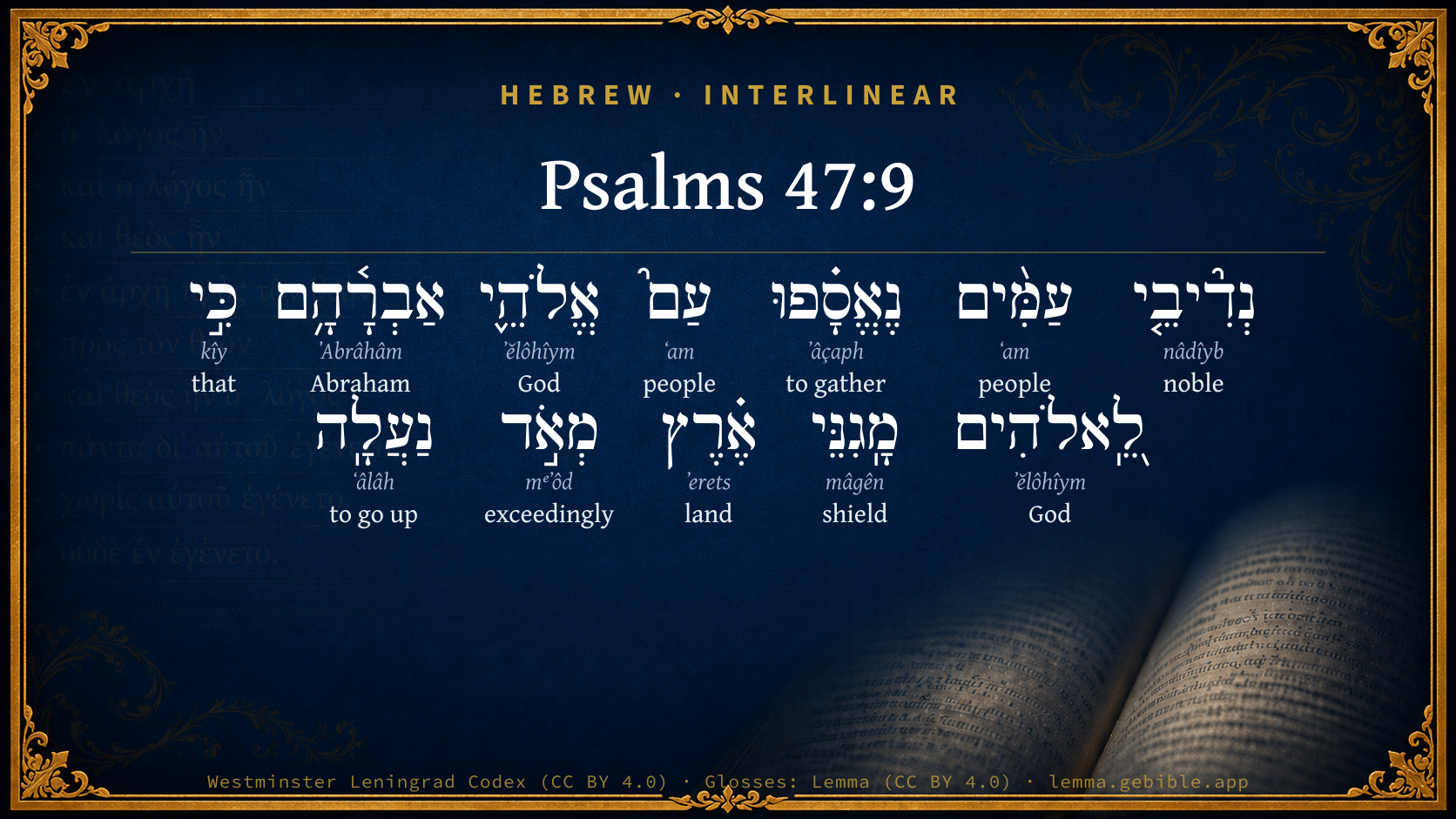
Hebrew (Westminster Leningrad Codex) Psalms 47:9 appears in the Hebrew Old Testament. The text above is from the Westminster Leningrad Codex. Each word links to its Strong’s number, a concise gloss, and parsing drawn from the Open Scriptures Hebrew Bible morphology. Click any word for its full Brown-Driver-Briggs (BDB) entry.
Download image
Cite this verse

Psalms 47:9 (World English Bible). Public Domain. Lemma interlinear Bible study tool, https://lemma.gebible.app/v/psalms/47/9.

Show BibTeX & RIS
BibTeX
RIS
English Translation
The princes of the peoples are gathered together, The people of the God of Abraham. For the shields of the earth belong to God. He is greatly exalted!
World English Bible · Public Domain
Download a study sheet

One document with this verse’s original text, its word-by-word gloss line, the meaning frame, cross-references with their text, attributed commentary, and full source and license credits — printable, and it pastes into notes with its structure intact.

This verse Autodidact and up

Study sheet (.html) Plain text (.txt)

A passage Seminary Student

Up to 50 verses in one chapter. A passage sheet keeps up to 6 commentary sources and 12 cross-references per verse, in the order this page ranks them, and says so on the sheet whenever that leaves anything out. Ask for a single verse and you get the Autodidact verse sheet above.

Everything on this page stays free to read, with no account — the sheet is a download of what is already on screen, not access to it.

Want to remove ads? Support Godless Engineer
Compare translations 3

The same verse in 3 English versions, stacked beneath the original-language interlinear above. Click any original word for its lexicon entry.

Each is an independent rendering of the whole verse — the interlinear is not word-aligned to these translations.

Highlighted words mark where these versions differ — a whole-verse word diff, not a word-by-word alignment.

  • World English Bible Public Domain
    The princes of the peoples are gathered together, The people of the God of Abraham. For the shields of the earth belong to God. He is greatly exalted!
  • King James Version Public Domain
    The princes of the people are gathered together, even the people of the God of Abraham: for the shields of the earth belong unto God: he is greatly exalted.
  • unfoldingWord Literal Text CC BY-SA 4.0
    The nobles of the peoples will gather themselves the people of the God of Abraham, for God are the shields of the earth. He is greatly exalted!

unfoldingWord Literal Text — © unfoldingWord, licensed CC BY-SA 4.0. Word-aligned USFM3 via Door43 (git.door43.org/unfoldingWord/en_ult).

Versions to compare (up to 4)

3 of 4 selected

Show all 18 translations

Every available English version of this verse, each an independent rendering of the whole verse.

  • World English Bible Public Domain
    The princes of the peoples are gathered together, The people of the God of Abraham. For the shields of the earth belong to God. He is greatly exalted!
  • Berean Standard Bible Public Domain
    The nobles of the nations have assembled as the people of the God of Abraham; for the shields of the earth belong to God; He is highly exalted.
  • Majority Standard Bible Public Domain
    The nobles of the nations have assembled as the people of the God of Abraham; for the shields of the earth belong to God; He is highly exalted.
  • King James Version Public Domain
    The princes of the people are gathered together, even the people of the God of Abraham: for the shields of the earth belong unto God: he is greatly exalted.
  • American Standard Version (1901) Public Domain
    The princes of the peoples are gathered together `To be' the people of the God of Abraham: For the shields of the earth belong unto God; He is greatly exalted. Psalm 48 A Song; a Psalm of the sons of Korah.
  • Revised Version (1885) Public Domain
    The princes of the peoples are gathered together to be the people of the God of Abraham: for the shields of the earth belong unto God; he is greatly exalted.
  • Geneva Bible (1599) Public Domain
    The princes of the people are gathered vnto the people of the God of Abraham: for the shields of the world belong to God: he is greatly to be exalted.
  • Douay-Rheims (1899) Public Domain
    God shall reign over the nations: God sitteth on his holy throne.
  • Young's Literal Translation Public Domain
    Nobles of peoples have been gathered, `With' the people of the God of Abraham, For to God `are' the shields of earth, Greatly hath He been exalted!
  • Literal Standard Version CC BY-SA 4.0
    Nobles of peoples have been gathered, || [With] the people of the God of Abraham, || For the shields of earth [are] to God, || Greatly has He been exalted!
  • Unlocked Literal Bible CC BY-SA 4.0
    The princes of the peoples have gathered together to the people of the God of Abraham; for the shields of the earth belong to God; he is greatly exalted.
  • unfoldingWord Literal Text CC BY-SA 4.0
    The nobles of the peoples will gather themselves the people of the God of Abraham, for God are the shields of the earth. He is greatly exalted!
  • Darby Bible Public Domain
    The willing-hearted of the peoples have gathered together, [with] the people of the God of Abraham. For unto God [belong] the shields of the earth: he is greatly exalted.
  • World Messianic Bible Public Domain
    The princes of the peoples are gathered together, the people of the God of Abraham. For the shields of the earth belong to God. He is greatly exalted!
  • Webster's Bible Public Domain
    \\47:8\\God reigneth over the heathen: God sitteth upon the throne of his holiness.
  • Free Bible Version CC BY-SA 4.0
    The rulers of the nations gather together with the people of the God of Abraham, for the defenders of the earth belong to God. He is highly honored everywhere.
  • Bible in Basic English Public Domain
    The rulers of the peoples have come together, with the people of the God of Abraham; because the powers of the earth are God's: he is lifted up on high.
  • JPS Tanakh (1917) Public Domain
    (47-10) The princes of the peoples are gathered together, the people of the God of Abraham; for unto God belong the shields of the earth; He is greatly exalted.

Literal Standard Version (2020), Covenant Press — licensed CC BY-SA 4.0. Text via the HelloAO Bible API (eBible.org). Unlocked Literal Bible (unfoldingWord) — licensed CC BY-SA 4.0. Text via the HelloAO Bible API (eBible.org). unfoldingWord Literal Text — © unfoldingWord, licensed CC BY-SA 4.0. Word-aligned USFM3 via Door43 (git.door43.org/unfoldingWord/en_ult). Free Bible Version, Dr. Jonathan Gallagher — licensed CC BY-SA 4.0. Text via the HelloAO Bible API (eBible.org).

Word by word

More ways to search: Search by grammar → Find every occurrence → Compare this word →

Practice this passage: Drill this verse → Learn its vocabulary →

נְדִ֘יבֵ֤י
nâdîyb
H5081
“noble of”
Adjective, Adjective, Masculine, Plural, Construct
Part of Speech
Adjective
Type
Adjective
Gender
Masculine
Number
Plural
State
Construct
Full BDB Definition

Origin: from H5068

TWOT: 1299b

inclined, willing, noble, generous (adjective) - incited, inclined, willing - noble, princely (in rank) - noble (in mind and character) - noble one (noun masculine)
  1. עַמִּ֨ים ʻam H5971 “peoples” Noun, Common, Masculine, Plural, Absolute
  2. נֶאֱסָ֗פוּ ʼâçaph H622 “to gather” Verb, Niphal, Perfect, 3rd Person, Common, Plural
  3. עַם֮ ʻam H5971 “people of” Noun, Common, Masculine, Singular, Construct
  4. אֱלֹהֵ֪י ʼĕlôhîym H430 “God(s) of” Noun, Common, Masculine, Plural, Construct
  5. אַבְרָ֫הָ֥ם ʼAbrâhâm H85 “Abraham” Noun, Proper
  6. כִּ֣י kîy H3588 “that” Conjunction
  7. לֵֽ֭אלֹהִים ʼĕlôhîym H430 “to/for · God(s)” Preposition + Noun, Common, Masculine, Plural, Absolute
  8. מָֽגִנֵּי mâgên H4043 “shields of” Noun, Common, Both, Plural, Construct
  9. אֶ֗רֶץ ʼerets H776 “land” Noun, Common, Both, Singular, Absolute
  10. מְאֹ֣ד mᵉʼôd H3966 “exceedingly” Adverb
  11. נַעֲלָֽה ʻâlâh H5927 “to go up” Verb, Niphal, Perfect, 3rd Person, Masculine, Singular

About this verse

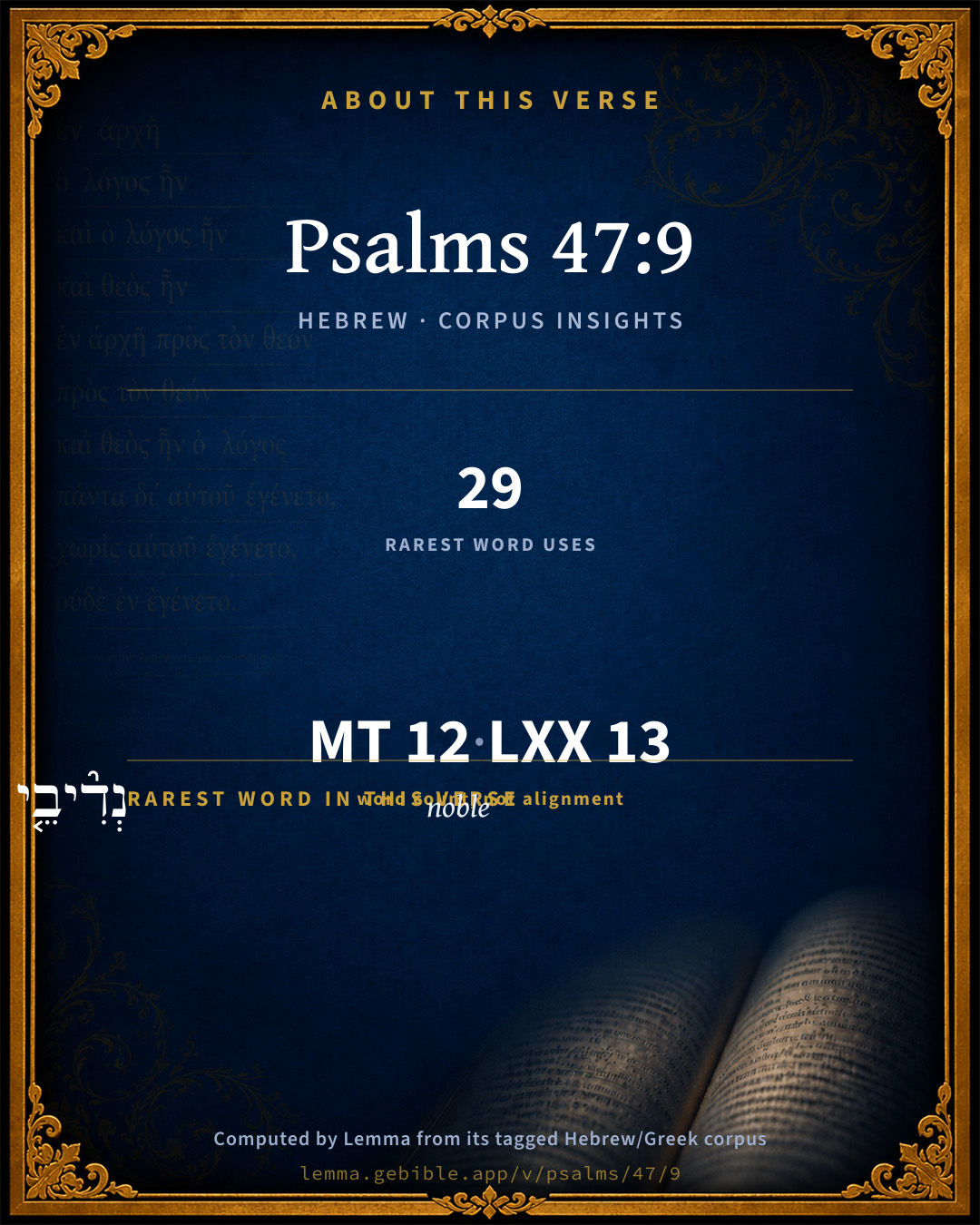
These counts appear in no published source. They are computed here, from the morphology-tagged text and Lemma’s own curated glosses. What Lemma adds →

12
words
10
distinct lemmas
Wisdom
section

Shared distinctive vocabulary

נְדִ֘יבֵ֤י noble H5081 occurs in 26 verses of the Hebrew Bible. Also found in:

Grammatical profile

  • 2 verbs
  • 7 nouns
  • 1 adjective
  • 1 conjunction
  • 1 adverb

Verb forms

  • נֶאֱסָ֗פוּ Niphal · Perfect
  • נַעֲלָֽה Niphal · Perfect

Repetition

Words recur within this verse — often emphatic in Hebrew:

  • עַמִּ֨ים people H5971 ×2
  • אֱלֹהֵ֪י God H430 ×2

Hebrew & Septuagint length

In English translation the verse runs 28 words from the Hebrew and 23 from the Septuagint (LXX English) — closely comparable.

A rough comparison of the two English renderings, which tokenize alike — not a word-level alignment.

Word counts can differ between the Hebrew and the Greek without any difference in meaning — e.g. the Hebrew direct-object marker אֵת has no separate Greek word, and Greek often adds the article ὁ.

In the original languages it is 12 Hebrew tokens and 13 Greek tokens — but the two are counted differently (Hebrew bundles its prefixes and suffixes into one token; the Greek is in lemma form), so that isn’t a like-for-like length.

Cross-references

21

Topical passages linked to Psalms 47:9 in the Treasury of Scripture Knowledge — connected by theme and wording, ordered by reader-vote popularity; previews shown in the World English Bible.

  • Psalms 89:18 For our shield belongs to Yahweh; Our king to the Holy One of Israel.
  • Genesis 49:10 The scepter will not depart from Judah, Nor the ruler's staff from between his feet, Until he comes to whom it belongs. To him will the obedience of the peoples be.
  • Psalms 72:7–9 In his days, the righteous shall flourish, And abundance of peace, until the moon is no more.
  • Genesis 17:7–8 I will establish my covenant between me and you and your seed after you throughout their generations for an everlasting covenant, to be a God to you and to your seed after you.
  • Exodus 3:6 Moreover he said, "I am the God of your father, the God of Abraham, the God of Isaac, and the God of Jacob." Moses hid his face; for he was afraid to look at God.
  • Isaiah 41:8–10 But you, Israel, my servant, Jacob whom I have chosen, the seed of Abraham my friend,
  • Exodus 3:15 God said moreover to Moses, "You shall tell the children of Israel this, 'Yahweh, the God of your fathers, the God of Abraham, the God of Isaac, and the God of Jacob, has sent me to you.' This is my name forever, and this is my memorial to all generations.
  • Psalms 46:10 "Be still, and know that I am God. I will be exalted among the nations. I will be exalted in the earth."
  • Proverbs 30:5 "Every word of God is flawless. He is a shield to those who take refuge in him.
  • Matthew 22:32 'I am the God of Abraham, and the God of Isaac, and the God of Jacob?' God is not the God of the dead, but of the living."
  • Galatians 3:29 If you are Christ's, then you are Abraham's seed and heirs according to promise.
  • Psalms 72:11 Yes, all kings shall fall down before him. All nations shall serve him.
  • Psalms 97:9 For you, Yahweh, are most high above all the earth. You are exalted far above all gods.
  • Psalms 110:2–3 Yahweh will send forth the rod of your strength out of Zion. Rule in the midst of your enemies.
  • Romans 4:11–12 He received the sign of circumcision, a seal of the righteousness of the faith which he had while he was in uncircumcision, that he might be the father of all those who believe, though they be in uncircumcision, that righteousness might also be accounted to them.
  • Isaiah 11:10 It shall happen in that day, that the root of Jesse, who stands for an ensign of the peoples, to him shall the nations seek; and his resting-place shall be glorious.
  • Isaiah 49:7 Thus says Yahweh, the Redeemer of Israel, [and] his Holy One, to him whom man despises, to him whom the nation abhors, to a servant of rulers: Kings shall see and arise; princes, and they shall worship; because of Yahweh who is faithful, [even] the Holy One of Israel, who has chosen you.
  • Isaiah 49:23 Kings shall be your nursing fathers, and their queens your nursing mothers: they shall bow down to you with their faces to the earth, and lick the dust of your feet; and you shall know that I am Yahweh; and those who wait for me shall not be disappointed.
  • Isaiah 60:4–5 Lift up your eyes round about, and see: they all gather themselves together, they come to you; your sons shall come from far, and your daughters shall be carried in the arms.
  • Isaiah 66:19–20 I will set a sign among them, and I will send such as escape of them to the nations, to Tarshish, Pul, and Lud, who draw the bow, to Tubal and Javan, to the isles afar off, who have not heard my fame, neither have seen my glory; and they shall declare my glory among the nations.
  • Romans 11:25 For I don't desire, brothers, to have you ignorant of this mystery, so that you won't be wise in your own conceits, that a partial hardening has happened to Israel, until the fullness of the Gentiles has come in,

Cross-references courtesy of OpenBible.info (CC BY 4.0).

Hebrew and Greek witnesses Masoretic Hebrew ↔ Greek Septuagint

The same verse in the two great witnesses to the Old Testament, shown verse-for-verse.

You’re reading Greek Psalm 46 (Hebrew Psalm 47). The Septuagint counts the superscription, so verse numbers can differ from the Hebrew — chapter-level alignment, not verse-by-verse. Numbering follows Rahlfs.

These are two independent witnesses, not word-aligned to each other, and the Septuagint is shown in lemma (dictionary) form.

Hebrew Psalms 47:9 Masoretic · Westminster Leningrad Codex

נְדִ֘יבֵ֤י עַמִּ֨ים נֶאֱסָ֗פוּ עַם֮ אֱלֹהֵ֪י אַבְרָ֫הָ֥ם כִּ֣י לֵֽ֭אלֹהִים מָֽגִנֵּי אֶ֗רֶץ מְאֹ֣ד נַעֲלָֽה

The princes of the peoples are gathered together, The people of the God of Abraham. For the shields of the earth belong to God. He is greatly exalted!

World English Bible · Public Domain

Greek LXX Greek Psalm 46:9 Septuagint · lemma form

βασιλεύω ὁ θεός ἐπί ὁ ἔθνος ὁ θεός καταἧμαι ἐπί θρόνος ἅγιος αὐτός

The rulers of the people are assembled with the God of Abraam: for God's mighty ones of the earth have been greatly exalted.

LXX2012 (modern English Septuagint) · Public Domain

On this verse, Adam Clarke's Commentary discusses the Septuagint’s reading. Read the note in Commentary ↓

Hebrew: Westminster Leningrad Codex (CC BY 4.0). Greek: Septuagint (public domain); English from LXX2012 (modern English Septuagint) (Public Domain). How the Septuagint differs from the Hebrew →

Commentary

Notes on Psalms 47:9 from classic Christian and Jewish commentators (each source and its license shown beneath its notes). The classic Christian expositions comment on the surrounding passage and are grouped to its opening verse, so a note may address several verses; the Jewish commentaries on the Tanakh (Rashi and others) are per-verse, so they appear only where the commentator wrote on this verse.

Lemma curates 59 commentaries, every one of them public domain or Creative Commons licensed, each selected and text-cleaned for this edition rather than reprinted as found. About our sources →

Trapp's Complete Commentary

John Trapp

Psa 47:9 The princes of the people are gathered together, [even] the people of the God of Abraham: for the shields of the earth [belong] unto God: he is greatly exalted.

Ver. 9. The princes of the people are gathered together] Or, the voluntary of the people. The great ones disdain not to meet with the meanest at the public assemblies, for performance of holy duties; but thither they flee one with another, as the doves do to their windows, Isa 60:8, glorying in this, that they are Christ’s vassals, as did Constantine, Valentinian, and Theodosius, those three great emperors, casting their crowns at his feet, and willing to come under the common yoke of his obedience, with the rest of the people of the God of Abraham, the common sort of Christians (Socrates).

For the shields of the earth belong unto God] That is, those princes and magistrates also, Hos 4:18 Psa 89:18, belong to the covenant of election; though not many mighty, not many noble are called, 1Co 1:26, and it was grown to a proverb, omnium bonorum Principum imagines in uno annulo sculpi posse. The Spanish friar was wont to say there were but few princes in hell; and why? because there were but few in all. If such shall show themselves shields to their people to protect them from wrong; and not sharks, rather, to peel them and pillage them God will own and honour such. Others thus: the shields of the earth belong to the Lord, that is, the militia of the world is his; he hath and can quickly raise the Posse comitatus of all countries.

He is greatly exalted] How should he be otherwise who hath so great a command, and useth it for the defence of his people? Especially if the grandees of the earth become religious, and draw on others by their example and liberality? Magnates Magnetes.

John Trapp, A Commentary or Exposition upon All the Books of the Old and New Testament (1647–1656) — public domain. Text from a community e-Sword module.

The Biblical Illustrator

Joseph S. Exell

Psa_47:9

The shields of the earth belong unto God:

Gods shields

The shields of the earth, all veritable protectives, are the property of God, and are of His creation.

But why do I require a shield? What are my perils and foes? The fire of passion. The sharp gnawing tooth of care. The dull, heavy pressure of monotony. The burden of apparently unrequited toil. The slug of sloth. The moth of indifference. The rust of contempt. The awful weight of accumulating years. If I am to be protected against these perils I require varieties of shields, and the shields of the earth belong unto God. He has shields for every type of peril; there is no unprotected corner which has been overlooked by our Lord. Our perils change their guise with our changing seasons, and the gradient of our age. In youth we frequently find our antagonism in the lust of the flesh. Against this all-consuming passion we require a shield I In our prime the lust of the flesh changes into the lust of the eyes, and perhaps matures into the pride of life. Passion is converted into acquisitiveness, and acquisitiveness refines itself into vanity. If we are to resist these fatal fascinations we require a shield. In age we are imperilled by our disillusions. The unaccomplished purpose becomes a snare. The radiant ideal seems no nearer achievement, and our poor attainments look upon us with confounding mockery. Then are we prone to become sour and crabbed, and life may pass into an impoverishing loneliness. If we are to be guarded against these perils we need a shield! And right through our life, from early youth to extreme old age, our course lies through perils of over-changing variety. With these environments of continuous danger, what shall we do? We must seek for an adequate shield, and the shields of the earth belong unto God. Let us leek at two or three of them.

I. The shield of good spirits. We often say of a man, His good spirits were his salvation. There was a certain cheery radiancy of spirit about his life. He was possessed by unfailing cheer and geniality, lie saw everything through his own warmth. His warmth was his shield, and by it he was delivered from a thousand snares. Where did he get his warmth? The shields of the earth belong unto God. I have often known men who have been passing through a November season of life in which other people have found nothing but coldness and gloom, but their life has been so possessed by the spirit of geniality, that the bird-song had never seemed to be silent, and the atmosphere was always redolent of the spring. Charles Kingsley passed through many a November season; trials and persecutions were not absent from his day, and yet his good spirits were always abounding, and by his good spirits the gloom was always illumined. Where do these people get their good spirits? They get them from the Lord. Just outside Buda Pesth there is now a spring of continuous hot water, which is practically supplying the needs of an entire population. Boring has been continued to the depth of five thousand feet, and the genial spring has been unloosed. Is not this parabolic? If we want the genial springs, we must go to the requisite depths; we must not be surface characters, or our waters will be chilled in the first day of a cold November. We must bore deep. We must reach as far as God, and when we come into communion with Him, tits water shall be in us a well of water springing up into everlasting life.

II. The shield of holiness. The pure allures the pure and resists the impure. But the life must be scrupulously pure! It must be healthy. Our imperfect consecrations are our perils; they are like ridged and wrinkled surfaces in which uncleanness easily hides. Holiness will not take stains. Lay your unclean finger upon soft and unfinished porcelain, and it will take the impress of your defiling touch. But lay your finger upon the shining, finished, perfected ware, and the substance will not take the stain. The virus which is inoculated for the prevention of small-pox frequently does not take; the body is so healthy that it affords no foothold for the invader! And surely that is what we need in the spirit! We require a spirit so healthy that evil suggestions will not take. Let integrity and uprightness preserve me. That is the shield we require! How can we get it? We shall have to get away unto the Lord, and in deep humility of spirit pray that He will communicate unto us His own saving health.

III. The shield of faith. The shield of faith, wherewith ye shall be able to quench all the fiery darts of the evil one. What are the perils? Darts--sharp, sudden, fierce experiences; fiery darts--sharp experiences that come to us in heat; fiery darts of the evil one--sharp experiences in the nature of sinful temptations that come to us in the feverish moments of our life. They are provocatives to temper, impatience, rashness, and sinful pique. What do we need as our protective? The shield of faith. Faith gives quietness. Let not your heart be troubled, believe! Where belief is settled, the heart is delivered from distraction, and remains in fruitful peace. Faith gives collectedness. Our powers are no longer a turbulent mob, but a deliberative assembly. A man is not all sixes and sevens, he is a living unit, all his powers co-operating in gracious harmony. This is the shield we require. Where can we get it? We must go to the Lord our Saviour, and in simplicity of spirit we must urge upon Him the prayer of the disciples of old, Lord, increase our faith. (J. H. Jowett, M. A.)

The law of protection

The text has a special appropriateness for troublous times, and in troublous times the Church has often remembered and verified it. When threatened and terrified, hunted and harried, made the victim of earthly tyranny, the object of earthly assaults, the Church has discovered that just where the earthly danger was, there also was the earthly shield--raised up, brought near, and made available by Him who is the Sovereign of the earth, for the assistance of His cause and the safe-keeping of His people.

I. The shield political is in the hand of God. We refer to the protecting influence of good government. What an unspeakable, yet often forgotten, blessing is the blessing of a civilized and enlightened constitution, considered simply as a shield! It is the principle and the pride of good government like our own that it aims at the throwing of its protecting screen over strong and weak, rich and poor alike, seeking to deal open and even-handed justice to all, without favour and without fear. Well, the shield political is in the hand of God. It is He who appoints it, maintains it, and directs it as need arises or danger demands. What is the practical lesson? For one thing, let there be recognition of Gods power and gratitude for Gods goodness in extending such a shield, so near, so ample, so strong; thus setting our lines in pleasant places, and appointing us a goodly heritage. Let there be prayer for Gods blessing, that those who compose that shield, the living minds that plan, the living hands that execute, may lend themselves more and more to the influence of a Christian spirit and the accomplishment of Christian ends.

II. The shield domestic is in the hand of God. We refer to the protective influence of a pious home. Home is home, indeed, only when it surrounds the growing boy or girl with a whole investiture of pure and affectionate influences--kind deeds, kind words, kind thoughts--and thus forms a quiet pavilion, where the young life can feel itself safe. Let parents grudge no pains, spare no expedients, that tend to the maintenance of this feeling, and the drawing and the keeping of their children together under the shadow of that safeguard which we call home. And let all, whether parents or children, remember that, like other shields, the shield of a happy Christian home is in the hand of God. It is God who erects it. It is God who keeps it together. Therefore, in all that pertains to our home, let God have the guidance, and let God have the glory.

III. Shields social are in the hands of God. Here we pass to another protective influence of life, and note the preserving power of helpful and beneficent institutions. We live in an age of organizations. They are with us upon every hand--organizations philanthropic, moral, religious. We have our societies for the promotion of health, the diffusion of literature, the increase of temperance, the preservation of purity. And all these are shields, or are meant to be shields, for the young, the innocent, the feeble, the tempted, and the penitent. The point we should always notice is this, that they are shields in the hand of God. The fact is suggestive of two things we do well to keep constantly in mind.

1. Such safeguards owe their origin to Divine revelation. Philanthropy springs from the plains of Galilee, where the Saviour fed the hungry and healed the ailments of the multitude.

2. They owe their efficiency to Divine grace. A white cross will not keep a man pure; again, it is only a symbol and expression: what will save and preserve him is the same grace of God.

IV. Shields physical are in the hands of God. Among the protecting influences of life there is the influence of the powers and processes of natural law. Think of these influences in their broadest and most general sense as a protection and a benefit to the race at large. How wonderfully force balances force, and principle supplements or cheeks principle!--the great and grand resultant being the safety and stability of the natural order we belong to, and the safety and stability of ourselves in the midst of it. Let us believe in a Providence that keeps the feet of the saints, and, if necessary for the keeping of them, can make nature itself a minister of grace. A friend writes thus in a letter: Did I tell you of my escape from drowning last year in Derwentwater, after my return from Brittany? My canoe upset. But angels that remove some stones out of the way can place other stones in it when needful. So was I preserved!

V. Shields spiritual are in the hands of God. Let us select, as our last illustration, the protection afforded by the prayers and the presence of the saints. It is a fruitful and inspiring thought! For as the supplications of the saints go up, from the public assembly, from the household hearth, from the solitude and secrecy of private chambers and private hearts, for a race beset by sorrow and defiled by sin, they interpose a real and a solid barrier between those interceded for and the dangers that surround. Tim world owes more to them than it knows. Why is anger restrained? Why is chastisement delayed? Often for the saints sake. May He in whose hand are the shields of the earth continue this shield, the shield of earnest and faithful intercession, till those that are sheltered beneath its shadow make their peace with Himself, and become intercessors in their turn! (W. A. Gray.)

Psa_48:1-14

The Biblical Illustrator, edited by Joseph S. Exell (c. 1880s–1900s) — public domain. Text from a community e-Sword module.

Joseph Benson's Commentary

Psa 47:9. The princes of the people — The heads of the tribes; even the people of the God of Abraham — With all the people that worship him, who promised to give this country unto Abraham; are gathered together — Are assembled at their solemn feasts, without any fear of invasion from their foreign neighbours; for the shields of the earth belong unto God — For God (to attend whose service they have left their own houses unguarded) hath undertaken their protection; and he is infinitely superior to all other gods, who pretend to be the defenders of the earth. So Bishop Patrick. But almost all the ancient versions and more modern translators render the former clause of this verse, The princes of the nations are incorporated with the God of Abraham: similar to which is the version of our Liturgy; The princes of the people are joined to the people of the God of Abraham. “In this prophetical sense,” says Dr. Dodd, “which seems most proper, the princes of the people mean the heathen princes, who were to be converted to Christianity, and to join themselves to the people of the God of Abraham; that is, to the Jewish converts under the dominion of Christ. The shields mean the sovereignty of the whole earth: for God takes to him the shields of the earth; all the princes of it under his own immediate government. King and shield are synonymous, Psa 84:9.”

Joseph Benson's Commentary on the Old and New Testaments (1811–1818) — public domain. Text from a community e-Sword module.

J. A. Alexander on Psalms

Joseph Addison Alexander

10. (Psa 47:9). Princes of nations are assembled—the people of the God of Abraham; for unto God belong the shields of the earth; he is greatly exalted. The first word properly means willing, and especially spontaneous givers; then by a natural deduction, liberal, generous, noble, and as a substantive, nobles, princes. They are here named as the representatives of the nations, gathered in the presence of God, to do him homage and acknowledge his supremacy. The next phrase may mean either as, with, or to the people of God, most probably the first. The God of Abraham, their founder and progenitor, with whom the covenant was made, not only for himself but for his children. See the same phrase, Gen 31:42, Exo 3:6, Mat 22:32. The shields of the earth, its protectors, here put for protection in the abstract, or for the princes mentioned in the foregoing clause. Compare Hos 4:18. It is not till all the principalities and powers of earth acknowledge their subjection to Jehovah, that he can be duly and sufficiently exalted. See above, on Psa 22:29 (28).

Joseph Addison Alexander, The Psalms Translated and Explained (1850) — public domain. Text from a community e-Sword module.

Geneva Bible (1599)

Geneva Bible translators

He praiseth God’s highness, for that he joineth the great princes of the world (whom he calleth shields) to the fellowship of his Church.

Geneva Bible (1599) marginal notes — public domain. Text via Bolls.life.

Jamieson, Fausset & Brown

Robert Jamieson, A. R. Fausset & David Brown

princes--who represent peoples. For--

even--supply, "as," or, "to"--that is, they all become united under covenant with Abraham's God.

shields--as in Hos 4:18, "rulers" [Margin].

Next: Psalms Chapter 48

Jamieson, Fausset & Brown — Commentary Critical and Explanatory on the Whole Bible (1871) — public domain (CC PDM 1.0). Text via the HelloAO Bible API.

Adam Clarke's Commentary

Verse 9. The princes of the people are gathered together] נדיבי עמים nedibey ammim. The voluntary people - the princely, noble, or free-willed people; those who gladly receive the word of life; those who, like the Bereans, were of a noble or liberal disposition; and, when they heard the Gospel, searched the Scriptures to see whether these things were so. It is a similar word which is used Ps 110:3; and I believe both texts speak of the same people - the Gentiles who gladly come unto his light, and present themselves a free-will offering to the Lord.

The people of the God of Abraham] Who were Abraham's people? Not the Jews; the covenant was made with him while yet in urcircumcision. Properly speaking, the Gentiles are those whom he represented; for the covenant was made with him while yet a Gentile; and in his seed all the nations-the Gentiles, of the earth were to be blessed. The people of the God of Abraham are the Gentiles, who, receiving the Gospel, are made partakers of the faith of Abraham, and are his spiritual children. The God of Abraham has Abraham's spiritual posterity, the believing Gentiles, for his own people.

The shields of the earth belong unto God.] The Septuagint translate this οἱ κραταιοι, the strong ones of the earth. The Vulgate reads, Quoniam dii fortes terrae vehementer elevati sunt; "Because the strong gods of the earth are exceedingly exalted." These are supposed to mean kings and rulers of provinces which were present at the dedication of the temple; (for some suppose the Psalm to have been composed for this solemnity;) and that they are said here to be greatly exalted, because they exercised a very high degree of power over their respective districts. The words refer to something by which the inhabitants of the earth are defended; God's providence, guardian angels, c., c.

He is greatly exalted.] Great as secular rulers are, God is greater, and is above all King of kings and Lord of lords and the hearts of kings and governors are in his hand; and he turns them whithersoever he pleases.

ANALYSIS OF THE FORTY-SEVENTH PSALM

This Psalm, under the figure of the ark being brought into the temple, foretells the ascension of Christ to heaven; who was the true ark of the covenant, and the propitiatory or mercy-seat. It contains a prophecy of Christ's kingdom, and has two especial parts: -

First, An invitation to sing praises to Christ.

Secondly, The reasons why we should do it.

1. The ascension of Christ is typified under the ark's ascension, Ps 47:1: "God is gone up with a shout; the Lord with the sound of a trumpet."

2. On which he invites the people to do now what was then done, "that we clap our hands, and sing praises." This should be done, 1. Cheerfully: "Clap your hands;" for this is a sign of inward joy, Na 3:19. 2. Universally: "O clap your hands, all ye people." 3. Vocally: "Shout unto God with the voice of triumph." 4. Frequently: "Sing praises - sing praises - sing praises - sing praises," Ps 47:6, and again "sing praises," Ps 47:7. It cannot be done too frequently. 5. Knowingly and discreetly: "Sing ye praises with understanding;" know the reason why ye are to praise him.

3. Now these reasons are drawn from his greatness and from his goodness.

1. He is GREAT. 1. He is the Lord Most High; 2. He is terrible; 3. He is a great King over all the earth. All power, at his ascension, was given unto him in heaven and earth.

2. He is GOOD. 1. In collecting his Church by subduing the nations, not by the sword, but by his word and Spirit, by which he would subdue their iniquities, the iniquity of the Jew first, and then of the Gentile; for the law was to come out of Zion, and the word of the Lord from Jerusalem. To the discipline of that religion both were to submit; and therefore both might well be said "to be subdued to us, and brought under our feet."

2. In honouring and rewarding his Church: "He shall choose out our inheritance for us, the excellency of Jacob whom he loved."

1. His Church was his choice: "It is a chosen generation, a peculiar people."

2. His heritage; for he will dwell among them, and provide an inheritance for them; blessings on earth and glory in heaven.

3. This is "the excellency of Jacob;" of Jacob after the Spirit; the kingdom, priesthood, and all the promises made unto Jacob and the fathers being theirs.

4. The cause: "His love only - he chose - the excellency of Jacob whom he loved."

3. In the increase and amplification of his Church: "God is now the king of all the earth;" not of the Jews only, for he "reigns over the heathen" also. He "sits upon a throne of holiness;" rules by his holy word and Spirit. 1. Making them holy who were unholy. 2. They are "a willing people" also. For the princes - the volunteers, among the people, are gathered together; even the people of the God of Abraham - the Gentiles, converted and reconciled to God.

4. In protecting his Church; whether by himself, or by the princes he raises up; by his providence, or his angels, or all together. For the "shields of the earth belong unto God." Secular rulers, and ecclesiastical governors, are shields of the Church. But God is the Head of it, and the Chief: "He is greatly exalted."

Adam Clarke's Commentary on the Bible (1810–1826) — public domain. Text from a community e-Sword/MySword module.

John Calvin's Commentaries

9 The princes of the peoples are gathered together. The Psalmist enriches and amplifies by various expressions the preceding sentence. He again declares that the way in which God obtained dominion over the Gentiles was, that those who before were aliens united in the adoption of the same faith with the Jews; and thus different nations, from a state of miserable dispersion, were gathered together into one body. When the doctrine of the Gospel was manifested and shone forth, it did not remove the Jews from the covenant which God had long before made with them. On the contrary, it has rather joined us to them. As then the calling of the Gentiles was nothing else than the means by which they were grafted and incorporated into the family of Abraham, the prophet justly states, that strangers or aliens from every direction were gathered together to the chosen people, that by such an increase the kingdom of God might be extended through all quarters of the globe. On this account Paul says, (Ephesians 3:6,) that the Gentiles were made one body with the Jews, that they might be partakers of the everlasting inheritance. By the abolition of the ceremonies of the Mosaic economy, “the middle wall of partitions” which made a separation between the Jews and the Gentiles, is now removed, (Ephesians 2:14;) but it nevertheless remains true, that we are not accounted among the children of God unless we have been grafted into the stock of Abraham. The prophet does not merely speak of the common people: he also tells us that princes themselves will regard it as the height of their felicity to be gathered together with the Jews; as we shall see in another psalm, (Psalm 87:5,)

“And of Zion it shall be said, This and that man was born in her.”

Farther, it is said that this gathering together will be to the people of the God of Abraham, to teach us that it is not here meant to attribute to the Jews any superiority which they naturally possess above others, but that all their excellence depends upon this, that the pure worship of God flourishes among them, and that they hold heavenly doctrine in high estimation. This, therefore, is not spoken of the bastard or cast-off Jews, whom their own unbelief has cut off from the Church. But as, according to the statement of the Apostle Paul, (Romans 11:16,) the root being holy, the branches are also holy, it follows that the falling away of the greater part does not prevent this honor from continuing to belong to the rest. Accordingly, the “consumption” which, as is stated in the prophecy of Isaiah, overflowed the whole earth, is called the people of the God of Abraham, (chapter 10:22, 23.) This passage contains two very important and instructive truths. In the first place, we learn from it, that all who would be reckoned among the children of God ought to seek to have a place in the Church, and to join themselves to it, that they may maintain fraternal unity with all the godly; and, secondly, that when the unity of the Church is spoken of, it is to be considered as consisting in nothing else but an unfeigned agreement to yield obedience to the word of God, that there may be one sheepfold and one Shepherd. Moreover, those who are exalted in the world in respect of honors and riches, are here admonished to divest themselves of all pride, and willingly and submissively to bear the yoke in common with others, that they may show themselves the obedient children of the Church.

What follows immediately after, The shields of the earth are God’s, is understood by many as spoken of princes. I admit that this metaphor is of frequent occurrence in Scripture, nor does this sense seem to be unsuitable to the scope of the passage. It is as if the prophet had said, It is in the power of God to ingraft into his Church the great ones of the world whenever he pleases; for he reigns over them also. Yet the sense will be more simple if we explain the words thus: That, as it is God alone who defends and preserves the world, the high and supreme majesty, which is sufficient for so exalted and difficult a work as the preservation of the world, is justly looked upon with admiration. The sacred writer expressly uses the word shields in the plural number, for, considering the various and almost innumerable dangers which unceasingly threaten every part of the world, the providence of God must necessarily interpose in many ways, and make use, as it were, of many bucklers.

John Calvin's Commentaries (1540-1563) — public domain. Text from the Calvin Translation Society English edition (1840s-50s) via the Christian Classics Ethereal Library (ccel.org). Calvin's coverage is partial (roughly two-thirds of the Bible); uncommented books and verses are honest gaps, never fabricated. The 19th-century editor's footnotes and remarks are omitted so the notes are faithfully Calvin's own voice.

Ellicott's Commentary for English Readers

(9) The shields of the earth—i.e., the princes just mentioned, as in Hos_4:18; so LXX. and Vulg. (“strong ones”), which, however, they make the subject of the verb—“have been mightily exalted.”

A Bible Commentary for English Readers, edited by Charles John Ellicott (1878–1897) — public domain. Text from a community e-Sword module.

The Cambridge Bible for Schools and Colleges

gen. ed. J. J. S. Perowne

9. In the spirit of prophecy the Psalmist beholds the realisation of the hope expressed in Psa_47:1. The nations acknowledge Jehovah’s sovereignty. Cp. Psa_102:22. As the representatives of the nations which they rule, the princes of the peoples are gathered together to Jerusalem to pay homage to Jehovah. The Massoretic text ot the next line must be rendered with R.V., ‘To be the people of the God of Abraham’: a bold phrase, reaching the very climax of Messianic hope, and hardly paralleled elsewhere. For though the nations are frequently spoken of as attaching themselves to Israel in the worship of Jehovah (Isa_2:2 ff; Isa_11:10; Isa_56:6 ff; Isa_60:3 ff.; Zec_8:20 ff.; &c, &c), they are not called “the people of God.” This title is reserved for Israel, and only in the N.T. are the promises made to Israel extended to the Gentiles (Rom_9:25). Yet see Isa_19:25, where Egypt receives the title ‘my people.’ The rendering of R.V. marg. ‘Unto the people,’ is scarcely legitimate. It is however to be noted that the consonants of the word ‘am’ ‘people’ are identical with those of ‘im, ‘with,’ and the LXX read them as the preposition (with the God of A.). It is a natural conjecture that we should restore the preposition and render;

The princes of the peoples are gathered together,

Along with the people of the God of Abraham.

the God of Abraham] The title recalls the promises of blessing to the nations made through Abraham (Gen_12:2 f. &c.).

the shields of the earth] Princes are so called, as the protectors of their people. Jehovah is their overlord, and they come to acknowledge their dependence. The title shield is often applied to God, and sometimes to the kings and princes of Israel (Hos_4:18; Psa_89:18).

he is greatly exalted] Cp. Psa_97:9; and, though the Heb. word is different, Psa_46:10.

The Cambridge Bible for Schools and Colleges (gen. ed. J. J. S. Perowne; Cambridge University Press, 1878–1918) — public domain. Text from a community e-Sword module.

Albert Barnes' Notes on the Bible

The princes of the people are gathered together - The marginal reading is, “The voluntary of the people are gathered unto the people of the God of Abraham.” The word rendered “princes” - נדיב nâdı̂yb - means properly, voluntary, ready, prompt; then, generous, liberal; then, those of noble birth, princes, nobles. It is evidently used here in this latter sense. The word “people” here may mean either the people of Israel, or the people of other lands; but in this place it seems evidently to denote the latter. The words “are gathered together” may refer either to a voluntary or an involuntary assembling; meaning either that they came in chains as prisoners of war, subdued by the arms of the people of God, and thus rendering an involuntary tribute to their power and their religion; or that they came in a voluntary manner, and submitted themselves, acknowledging the God of Israel to be the true God. It seems to me that the connection requires that we should understand this in the former sense, as referring to the subjugation of the enemies of of the people of God, and to their being led along as captives, assembled thus from distant parts of the world as proof that the God of Israel reigned.

Even the people of the God of Abraham - The word “even” is not in the original. The meaning is, “to” the people of the God of Abraham; that is, they come and mingle with the people of the God of Abraham; or, they come as captives in war “to” that people, and confess in this manner that their God is the true God. The image is that of the assemblage of great numbers of foriegn princes and nobles as furnishing either a voluntary or involuntary acknowledgment of the fact that the God of Abraham was the true God, and that the people of Israel were his people.

For the shields of the earth belong unto God - Are of right his. This would seem to have been suggested by the marching in triumph of subdued and vanquished princes and warriors, their shields or weapons of war being borne along in the procession, demonstrating that Jehovah was King among the nations. It was seen in such a march that all those weapons of war “belonged” to him, or that he had a right to dispose of them, and to use them as he pleased.

He is greatly exalted - That is, one who can thus subdue nations, and lead along captive princes and warriors, “must” be a Being greatly exalted; a Being that has dominion over the nations of the earth. This completes the imagery in the psalm, and gives occasion for the shouts and the joys of triumph. God had shown that he was a great King over the earth. Princes and armies were subdued to his will. They were led along as captives, and were gathered together to the people of God, as if to acknowledge their own inferiority; and in this solemn manner the nations thus subdued owned Yahweh to be the true God. In a higher sense this will be true when all the earth shall be subdued by the power of truth, and when kings, and princes, and people everywhere shall come and acknowledge God, reigning through the Messiah, to be the King of all nations. Compare Isa. 60.

Albert Barnes' Notes on the Bible (1834–1885) — public domain. Text from a community e-Sword/MySword module.

Matthew Poole's English Annotations

The princes of the people; either,

1. The heads of the tribes of Israel, who were gathered together to the tabernacle or temple upon solemn feasts. Or rather,

2. The princes (or the voluntary or willing ones, as this word is rendered, Psa 110:3) of the Gentiles, who are here known by the name of the people, Psa 47:1,3, who were divided in their principles, and interests, and religions, but are now united and gathered together unto Christ, laying their sceptres at his feet, and jointly owning and promoting his worship and service. So he speaks of the conversion of the Gentiles; although he mentions only their princes, because their conversion might seem to be most difficult in sundry respects, and therefore that being affirmed, the conversion of their people with or after them might very reasonably be supposed.

The people of the God of Abraham; so he explains the former clause, and shows what people he spoke of; and it is observable, he doth not say the people of Abraham, lest this should be appropriated to the Israelites; but

the people of the God of Abraham, i.e. which worship the God of Abraham, whether they be Jews or Gentiles. So this is a prophecy of the conversion of the Gentiles; which also is intimated by the name here used, which is not his old and first name, Abram, but his new name, Abraham, given to him to signify that he should be the father of many nations, Gen 17:5. Or these words with the former may be, and are by divers learned interpreters, rendered thus: The princes of the people (i.e. of the Gentiles) are (i.e. shall be, as is usual in prophetic style) gathered unto which particle is sometimes understood, as Psa 5:8; Jer 26:10; Hos 2:14 the people of the God of Abraham, i.e. unto the Jews, and so both Jews and Gentiles shall be united in one religion; and so God shall reign over the heathen, and be King of all the earth, as is here said, Psa 47:7,8, and all people shall clap their hands for joy, as it is Psa 47:1.

The shields of the earth; either,

1. The protection of the people of all the earth. Or rather,

2. Their princes or rulers, who are fitly called shields, Hos 4:18, because by their office they are or should be the common parents and protectors of all their people, to defend them from all oppressions and injuries. These, saith he, are the Lord’s, i.e. at his disposal, or subject to his dominion, both as to their hearts and kingdoms. And so this is here conveniently added, as the reason of that great and improbable event, foretold in the foregoing words, that the princes of the people (which of all others were the most lofty, and wilful, and incorrigible) should join and subject themselves to the Lord, and to his church.

He is greatly exalted; by this means God shall be greatly glorified, and appear to be far above all the princes of the world, and above all other gods.

Matthew Poole's English Annotations on the Holy Bible (1683–1685) — public domain. Text from a community e-Sword/MySword module.

The Treasury of David

Charles H. Spurgeon

Ver. 9. The princes of the people are gathered together. The prophetic eye of the psalmist sees the willing subjects of the great King assembled to celebrate his glory. Not only the poor and the men of low estate are there, but nobles bow their willing necks to his sway. "All kings shall bow down before him." No people shall be unrepresented; their great men shall be good men, their royal ones regenerate ones. How august will be the parliament where the Lord Jesus shall open the court, and princes shall rise up to do him honour! Even the people of the God of Abraham. That same God, who was known only to here and there a patriarch like the father of the faithful, shall be adored by a seed as many as the stars of heaven. The covenant promise shall be fulfilled, "In thee and in thy seed shall all the nations of the earth be blessed." Shiloh shall come, and "to him shall the gathering of the people be." Babel's dispersion shall be obliterated by the gathering arm of the Great Shepherd King.

For the shields of the earth belong unto God. The insignia of pomp, the emblems of rank, the weapons of war, all must pay loyal homage to the King of all. Right honourables must honour Jesus, and majesties must own him to be far more majestic. Those who are earth's protectors, the shields of the commonwealth, derive their might from him, and are his. All principalities and powers must be subject unto Jehovah and his Christ, for He is greatly exalted. In nature, in power, in character, in glory, there is none to compare with him. Oh, glorious vision of a coming era! Make haste, ye wheels of time! Meanwhile, ye saints, "Be ye steadfast, unmovable, always abounding in the work of the Lord, forasmuch as ye know that your labour is not in vain in the Lord."

Ver. 9. The princes of the people are gathered together. I note from hence, 1. That it is not impossible for great men to be good men; for the heads of a country to be members of Christ; and for princes as well as the people to serve the God of Abraham. It is said by the prophet, "upon my peace came great bitterness; ""a thousand fell on the left hand, but ten thousand at the right hand" Ps 91:7: ten perish in their prosperity, for one that falleth in adversity. Homo victus in paradiso, victum in stercore: Adam in the garden of pleasure was overcome by the subtil serpent, whereas Job on the dunghill of misery was more than a conqueror. Woodmen say that deer are more circumspect in fat pastures; so the godly fear most in a rich estate: nihil timendum video (saith one), timeo tamen. (Seneca.) It is a sweet prayer of our church in the Litany, "Good Lord, deliver us in all time of our wealth, "insinuating that our minds are not so wanton as in abundance: yet, as you see, such is Christ's unspeakable goodness towards all sort of men, in preventing them even with the riches of his mercy, that not only the mean people, but also the mighty princes among the heathen are joined unto the church of the God of Abraham. John Boys.

Ver. 9. Gathered together. Christ's gathering of the saints together unto him will be at his second coming, his coming to judgment, the general and final judgment. "Now we beseech you, brethren, by the coming of our Lord Jesus Christ, and by our gathering together unto him." 2Th 2:1. James Scott (1773), in "A Collection of Sermons, "1774.

Ver. 9. The people of the God of Abraham. First, touching the God of Abraham, it is Christ, whose day Abraham desired to see, and in seeing whereof he did so much rejoice Joh 8:1-59; that is, not only the day of his birth, which he saw, as we learn by the oath which he caused his servant to take Ge 24:1-67 but also the day of his passion, which he saw long ago, and rejoiced in seeing it, when he said to his son Isaac in the mount, "The Lord will provide a sacrifice." Ge 22:8. Secondly, The people of the God of Abraham, are his children and posterity: not only that they are the seed of Abraham, coming out of his loins, and are "the children of the flesh" Ro 9:9; but "the children of the promise; "for if they that come out of Abraham's loins were only his children, then the Hagarins, the Turks, and Ishmaelites should be the people of God; "But in Isaac shall thy seed be called." They that lay hold of the promise by faith, "They that are of the faith, are the children of Abraham" Ga 3:7, that have the same spirit of faith that Abraham had. As the apostle saith Ro 2:28, "He is not a Jew that is one outwardly, but a Jew inwardly is the true Jew." They that worship the Messias by believing in him with the faith of Abraham, they are Abraham's children, and the people of Abraham's God, which thing John Baptist affirms Mt 3:1-17, "God can of stones raise up children unto Abraham." So the Gentiles, which worshipped stones, and therefore were "like unto them" Ps 115:1-18, were notwithstanding raised up to be children to Abraham. Lancelot Andrewes.

Ver. 9. The shields of the earth belong unto God. There we have the rulers of the earth set forth by a double relation; the one upward, they are scuta Deo, they belong to God; the other downward, they are scuta terae, "the shields of the earth; "and both these noting two things, their dignity and their duty. They belong to God, it is their honour that he hath sealed them: they belong to God, it is their duty to be subject to him. They are shields of the earth, it is their honour that they are above others: they are the shields of the earth, it is their duty to protect others. Edward Reynolds (Bishop).

Ver. 9. The shields of the earth are God's, is understood by many as spoken of princes. I admit that this metaphor is of frequent occurrence in Scripture, nor does this sense seem to be unsuitable to the scope of the passage...Yet the sense will be more simple if we explain the words thus: That, as it is God alone who defends and preserves the world, the high and supreme majesty which is sufficient for so exalted and difficult a work as the preservation of the world, is justly looked upon with admiration. The sacred writer expressly uses the word shields in the plural number, for, considering the various and almost innumerable dangers which unceasingly threaten every part of the world, the providence of God must necessarily interpose in many ways, and make use, as it were, of many bucklers. John Calvin.

Ver. 9. The shields of the earth. Magistrates are said to bear the sword, not to be swords; and they are said to be shields, not to bear shields; and all this to show that protection and preservation are more essential and intrinsical to their office than destruction and punishment are. Joseph Caryl.

Ver. 9.

1. A shield is a merciful weapon, none more so.

2. A shield is a venturous weapon, a kind of surety, which bears the blows and receives the injuries which were intended for another.

3. A shield is a strong weapon, to repel the darts of wickedness and break them in pieces.

4. A shield is an honourable weapon, none more: taking away of shields was a sign of victory; preserving them a sign of glory.

5. Remember, a shield must ever have an eye to guide it you the shields, the law the eye. Bishop Reynolds.

Charles H. Spurgeon's The Treasury of David (1869–1885) — public domain. Psalms only. Text from a community e-Sword/MySword module.

Whedon's Commentary on the Bible

Daniel D. Whedon

9. The princes of the people are gathered—Literally, the willing minded of the nations are gathered. The word rendered “princes” means, willing minded, free, voluntary, and hence nobles, princes. These had voluntarily assembled, as representatives, to pay tribute to Jehovah, their liege Lord and sovereign. The language has a prophetic outlook of gospel times. The poet had just announced that “God reigneth over the Gentiles,” (Psa_47:8;) and now the princes of the עמים, am-meem—peoples, nations—meet to tender their submission and homage.

Even the people of the God of Abraham—The word “even” is not in the Hebrew, and “people,” here, (עם,) is in the singular, of which peoples in the preceding line is plural. Taking the singular in its definitive sense of “people of the God of Abraham “—the Hebrew stock—and the plural in the sense of peoples, or nations of the Gentiles, which is in harmony with the connexion and admissible in usage, we derive the idea of the Church universal gathered out of all the nations: or, with Delitzsch, we may suppose “the princes of the nations band themselves into a people of the God of Abraham.”

Shields of the earth belong unto God— “Shields of the earth” are, probably, here put for the princes of the nations just mentioned, who are the natural protectors of society. See Hos_4:18, where shields is translated rulers. So God is called “our shield,” Psa_84:9. These centres and heads of civil power are in the hands and at the disposal of God, and when they submit the people will follow.

Daniel D. Whedon (gen. ed.), Commentary on the Old and New Testaments (1874–1909) — public domain. Text from a community e-Sword module.

The Pulpit Commentary

The princes of the people (literally, princes of peoples) are gathered together, even the people of the God of Abraham; rather, to be the people of the God of Abraham (Revised Version)i.e. to form, together with Israel, the one people, or Church, of God. (comp. Isa_49:18-23) For the shields of the earth belong unto God. The "shields" are the "princes" of the first clause, those whose business it is to protect and defend their subjects. (comp. Hos_4:18) The princes of the earth belong especially to God, since "by him kings reign, and princes decree justice". (Pro_8:15) At the great ingathering of the Gentiles into the Church, they would belong to him still more, since they would voluntarily place themselves under his rule. (Isa_49:23 Isa_60:3, Isa_60:11, Isa_60:16) He is greatly exalted. The perfect submission to God of all his rational creatures is his highest exaltation and glory. When "all people bow down before him," and "all nations do him service," when rebellion and resistance to his will are at an end, then will he be established in his rightful position, and his exaltation will be complete.

The Pulpit Commentary (1880–1919), ed. H.D.M. Spence-Jones & Joseph S. Exell — public domain. Text from a community e-Sword module.

John Wesley's Explanatory Notes

The princes - The Gentiles, who were divided in their principles, and interests, and religions, are now united and gathered together to Christ, laying their scepters at his feet, and jointly owning his worship and service. And altho' he mentions their conversion only, yet the conversion of their people might reasonably be supposed. Of the God - He doth not say the people of Abraham, lest this should be appropriated to the Israelites; but the people of the God of Abraham who worship the God of Abraham, whether they be Jews or Gentiles. The Shields - The princes or rulers, who are called shields, Hosea iv, 18, because by their office they are the common prosecutors of all their people. These are the Lord's, at his disposal, or subject to his dominion, both as to their hearts and kingdoms. Exalted - By this means God shall be greatly glorified.

John Wesley, Explanatory Notes Upon the Whole Bible (1754–1765) — public domain. Text via the GEBible commentary corpus.

Keil & Delitzsch

C. F. Keil & F. Delitzsch

(Heb.: 47:10) In the mirror of the present event, the poet reads the great fact of the conversion of all peoples to Jahve which closes the history of the world. The nobles of the peoples (נדיבי with the twofold meaning of generosi), the "shields (i.e., the lords who are the defenders of their people) of the earth" (Hos 4:18), enter into the society of the people of the God of Abraham; πέρας αἱ πρὸς τὸν πατριάρχην Ἀβραὰμ ἔλαβον ὑποσχέσεις, as Theodoret observes. The promise concerning the blessing of the tribes of the nations in the seed of the patriarch is being fulfilled; for the nobles draw the peoples who are protected by them after themselves. It is unnecessary to read עם instead of עם with Ewald, and following the lxx and Syriac; and it is also inadmissible, since one does not say נאסף עם, but ל or אל. Even Eusebius has rightly praised Symmachus and Theodotion, because they have translated the ambiguous ἀμ by λαὸς (τοῦ Θεοῦ Ἀβραάμ), viz., as being a nominative of the effect or result, as it is also understood by the Targum, Jerome, Luther, and most of the Jewish expositors, and among modern expositors by Crusius, Hupfeld, and Hitzig: They gather and band themselves together as a people or into a people of the God of Abraham, they submit themselves with Israel to the one God who is proved to be so glorious.

(Note: It is also accented accordingly, viz., נאספו with Rebia magnum, which (and in this respect it is distinguished from Mugrash) makes a pause; and this is then followed by the supplementing clause with Zinnor, Galgal, and Olewejored.)

The conclusion (v. 11) reminds one of the song of Hannah, Sa1 2:8. Thus universal homage is rendered to Him: He is gone up in triumph, and is in consequence thereof highly exalted (נעלה, 3rd praet., the result of consequence of the עלה in Psa 47:6).

Keil & Delitzsch — Biblical Commentary on the Old Testament (1861–1891) — public domain (CC PDM 1.0). Text via the HelloAO Bible API. (Old Testament only.)

Rashi

Rabbi Shlomo Yitzchaki (Rashi)

God has reigned over nations So will everyone say.

God has sat upon His holy throne Now the throne is complete and the greatness is recognized, and they will declare that the volunteers of the people have gathered to His city.

Rashi on the Tanakh — English translations: “The Judaica Press complete Tanach with Rashi, translated by A. J. Rosenberg” (CC BY 4.0); “Pentateuch with Rashi's commentary by M. Rosenbaum and A.M. Silbermann, 1929-1934” (public domain); “The Metsudah Tanach series, Lakewood, N.J” (CC BY 4.0); and “The Book of Joshua, Metsudah Publications, 1997” (CC BY 4.0). Text via Sefaria.

Lesson kit

Teaching starters — assembled from the data on this page, not authored interpretation. Every prompt links to the verse data it draws on. Edit before teaching.

Psalms, in the Wisdom, opens this verse with 12 words (10 distinct Hebrew lemmas). Its most distinctive word is nâdîyb (“noble”). A historical commentator’s framing appears above. Read the whole chapter for the surrounding context.

Discussion questions

  1. What does “noble” (nâdîyb) contribute to the verse as a whole?
  2. Exodus 35:5 shares the word «noble» with this verse. How do the two illuminate each other?
  3. “people” occurs 2× in this one verse. What is the effect of the repetition?
  4. These translations render this verse differently; the difference is in the English rendering, not the original. What questions does that raise?
  5. The verb «נֶאֱסָ֗פוּ» is Niphal Perfect. How does its form color the action?
  6. Reading how Trapp's Complete Commentary and The Biblical Illustrator read this verse, where do the two commentators agree and where do they part?

Things to notice

Reading settings

Reading text

Shown beneath each verse's original-language words.

Old Testament
Old Testament edition

Read the OT as the Masoretic Hebrew (MT) or the Greek Septuagint (LXX).

English shown for the Greek Septuagint (in the Hebrew ↔ Greek comparison).

Comparing translations? Open the Compare panel on any verse page to stack up to four side by side.