
Deuteronomy 7:25

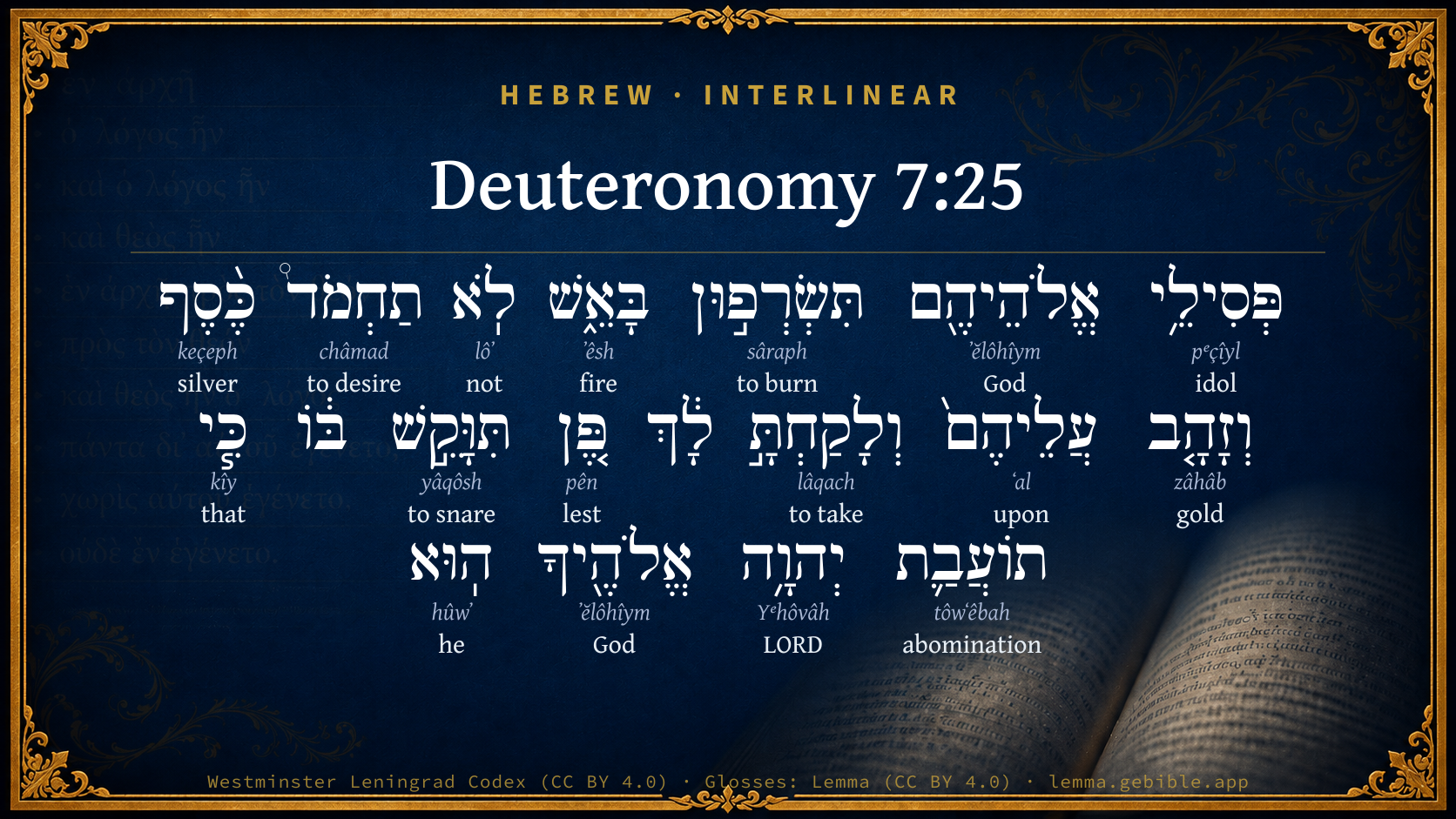
Hebrew (Westminster Leningrad Codex) Deuteronomy 7:25 appears in the Hebrew Old Testament. The text above is from the Westminster Leningrad Codex. Each word links to its Strong’s number, a concise gloss, and parsing drawn from the Open Scriptures Hebrew Bible morphology. Click any word for its full Brown-Driver-Briggs (BDB) entry.
Download image
Cite this verse

Deuteronomy 7:25 (World English Bible). Public Domain. Lemma interlinear Bible study tool, https://lemma.gebible.app/v/deuteronomy/7/25.

Show BibTeX & RIS
BibTeX
RIS
English Translation
The engraved images of their gods shall you burn with fire: you shall not covet the silver or the gold that is on them, nor take it to you, lest you be snared therein; for it is an abomination to Yahweh your God.
World English Bible · Public Domain
Highlights
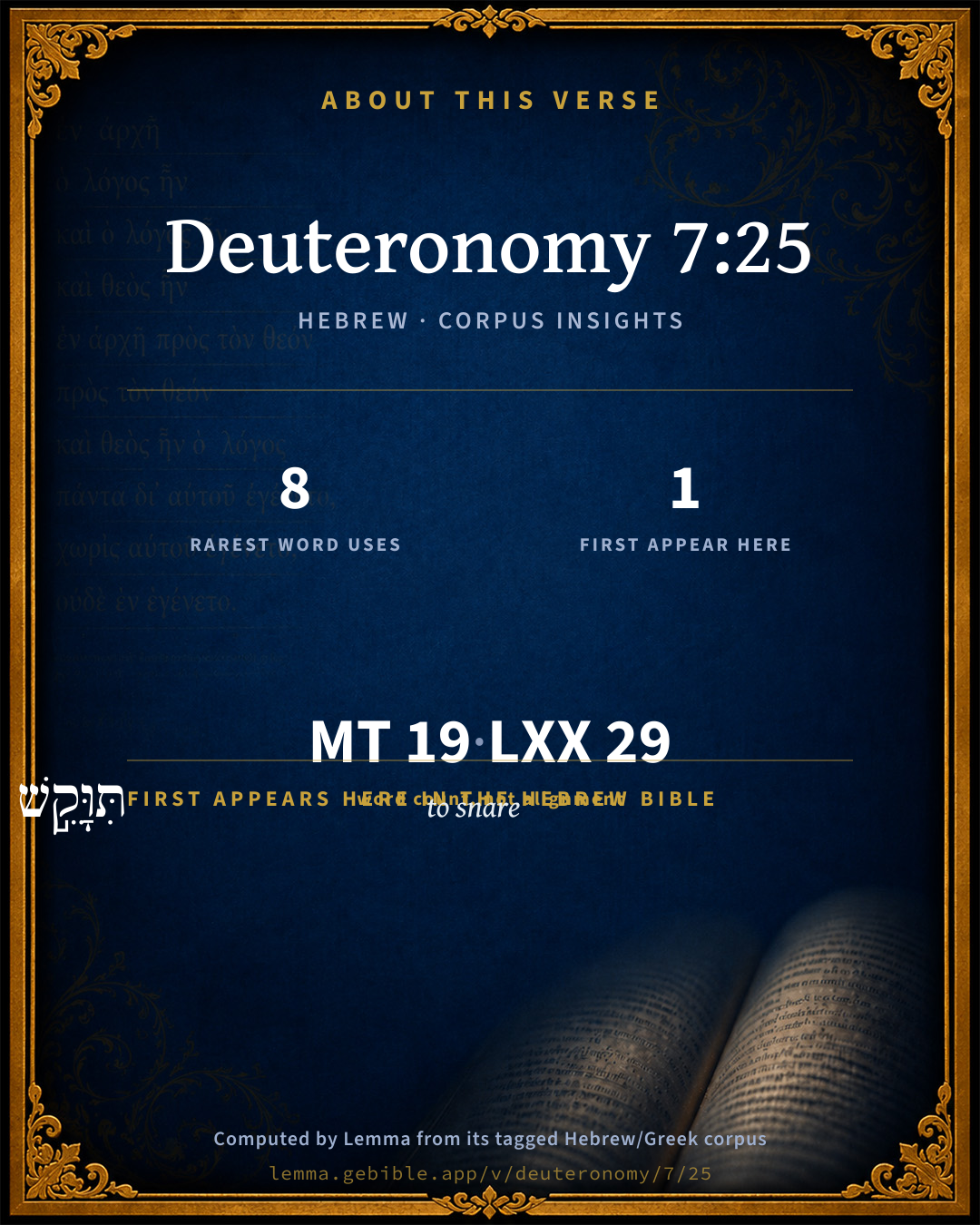
  • 1 first appearance in the Hebrew Bible
Full analysis ↓
Download a study sheet

One document with this verse’s original text, its word-by-word gloss line, the meaning frame, cross-references with their text, attributed commentary, and full source and license credits — printable, and it pastes into notes with its structure intact.

This verse Autodidact and up

Study sheet (.html) Plain text (.txt)

A passage Seminary Student

Up to 50 verses in one chapter. A passage sheet keeps up to 6 commentary sources and 12 cross-references per verse, in the order this page ranks them, and says so on the sheet whenever that leaves anything out. Ask for a single verse and you get the Autodidact verse sheet above.

Everything on this page stays free to read, with no account — the sheet is a download of what is already on screen, not access to it.

Want to remove ads? Support Godless Engineer
Compare translations 3

The same verse in 3 English versions, stacked beneath the original-language interlinear above. Click any original word for its lexicon entry.

Each is an independent rendering of the whole verse — the interlinear is not word-aligned to these translations.

Highlighted words mark where these versions differ — a whole-verse word diff, not a word-by-word alignment.

  • World English Bible Public Domain
    The engraved images of their gods shall you burn with fire: you shall not covet the silver or the gold that is on them, nor take it to you, lest you be snared therein; for it is an abomination to Yahweh your God.
  • King James Version Public Domain
    The graven images of their gods shall ye burn with fire: thou shalt not desire the silver or gold that is on them, nor take it unto thee, lest thou be snared therein: for it is an abomination to the LORD thy God.
  • unfoldingWord Literal Text CC BY-SA 4.0
    You shall burn idols of their gods in fire, do not covet silver and gold on them and take for yourself, lest you become trapped by it, for it an abomination to Yahweh your God.

unfoldingWord Literal Text — © unfoldingWord, licensed CC BY-SA 4.0. Word-aligned USFM3 via Door43 (git.door43.org/unfoldingWord/en_ult).

Versions to compare (up to 4)

3 of 4 selected

Show all 18 translations

Every available English version of this verse, each an independent rendering of the whole verse.

  • World English Bible Public Domain
    The engraved images of their gods shall you burn with fire: you shall not covet the silver or the gold that is on them, nor take it to you, lest you be snared therein; for it is an abomination to Yahweh your God.
  • Berean Standard Bible Public Domain
    You must burn up the images of their gods; do not covet the silver and gold that is on them or take it for yourselves, or you will be ensnared by it; for it is detestable to the LORD your God.
  • Majority Standard Bible Public Domain
    You must burn up the images of their gods; do not covet the silver and gold that is on them or take it for yourselves, or you will be ensnared by it; for it is detestable to the LORD your God.
  • King James Version Public Domain
    The graven images of their gods shall ye burn with fire: thou shalt not desire the silver or gold that is on them, nor take it unto thee, lest thou be snared therein: for it is an abomination to the LORD thy God.
  • American Standard Version (1901) Public Domain
    The graven images of their gods shall ye burn with fire: thou shalt not covet the silver or the gold that is on them, nor take it unto thee, lest thou be snared therein; for it is an abomination to Jehovah thy God.
  • Revised Version (1885) Public Domain
    The graven images of their gods shall ye burn with fire: thou shalt not covet the silver or the gold that is on them, nor take it unto thee, lest thou be snared therein: for it is an abomination to the LORD thy God:
  • Geneva Bible (1599) Public Domain
    The grauen images of their gods shall ye burne with fire, and couet not the siluer and golde, that is on them, nor take it vnto thee, least thou be snared therewith: for it is an abomination before the Lord thy God.
  • Douay-Rheims (1899) Public Domain
    Their graven things thou shalt burn with fire: thou shalt not covet the silver and gold of which they are made, neither shalt thou take to thee any thing thereof, lest thou offend, because it is an abomination to the Lord thy God.
  • Young's Literal Translation Public Domain
    `The graven images of their gods ye do burn with fire; thou dost not desire the silver and gold on them, nor hast thou taken `it' to thyself, lest thou be snared by it, for the abomination of Jehovah thy God it `is';
  • Literal Standard Version CC BY-SA 4.0
    You burn the carved images of their gods with fire; you do not desire the silver and gold on them, nor have you taken [it] for yourself, lest you are snared by it, for it [is] an abomination [to] your God YHWH;
  • Unlocked Literal Bible CC BY-SA 4.0
    You will burn the carved figures of their gods—do not covet the silver or the gold that covers them and take it for yourself, because if you do, you will become trapped by it—for it is an abomination to Yahweh your God.
  • unfoldingWord Literal Text CC BY-SA 4.0
    You shall burn idols of their gods in fire, do not covet silver and gold on them and take for yourself, lest you become trapped by it, for it an abomination to Yahweh your God.
  • Darby Bible Public Domain
    The graven images of their gods shall ye burn with fire; thou shalt not covet the silver and gold [that is] on them and take it unto thee, lest thou be ensnared therein; for it is an abomination to Jehovah thy God.
  • World Messianic Bible Public Domain
    You shall burn the engraved images of their gods with fire. You shall not covet the silver or the gold that is on them, nor take it for yourself, lest you be snared in it; for it is an abomination to the LORD your God.
  • Webster's Bible Public Domain
    The graven images of their gods shall ye burn with fire: thou shalt not desire the silver or gold that is on them, nor take it to thee, lest thou shouldst be snared in it: for it is an abomination to the LORD thy God.
  • Free Bible Version CC BY-SA 4.0
    You must burn the idols of their god. Don't desire the silver and gold that covers them. Don't take it or otherwise it will be a trap for you because the Lord your God detests anything to do with idols.
  • Bible in Basic English Public Domain
    The images of their gods are to be burned with fire: have no desire for the gold and silver on them, and do not take it for yourselves, for it will be a danger to you: it is a thing disgusting to the Lord your God:
  • JPS Tanakh (1917) Public Domain
    The graven images of their gods shall ye burn with fire; thou shalt not covet the silver or the gold that is on them, nor take it unto thee, lest thou be snared therein; for it is an abomination to the LORD thy God.

Literal Standard Version (2020), Covenant Press — licensed CC BY-SA 4.0. Text via the HelloAO Bible API (eBible.org). Unlocked Literal Bible (unfoldingWord) — licensed CC BY-SA 4.0. Text via the HelloAO Bible API (eBible.org). unfoldingWord Literal Text — © unfoldingWord, licensed CC BY-SA 4.0. Word-aligned USFM3 via Door43 (git.door43.org/unfoldingWord/en_ult). Free Bible Version, Dr. Jonathan Gallagher — licensed CC BY-SA 4.0. Text via the HelloAO Bible API (eBible.org).

Word by word

More ways to search: Search by grammar → Find every occurrence → Compare this word →

Practice this passage: Drill this verse → Learn its vocabulary →

תִּוָּקֵ֣שׁ
yâqôsh
H3369
“to snare”
Verb, Niphal, Imperfect, 2nd Person, Masculine, Singular
Part of Speech
Verb
Stem
Niphal
Form
Imperfect
Person
2nd Person
Gender
Masculine
Number
Singular
Full BDB Definition

Origin: a primitive root

TWOT: 906

to lure, entice, snare, lay a snare or lure, set a trap - (Qal) - to lay snares (figuratively of devices of wicked) - fowlers (participle) - (Niphal) to be ensnared, be caught by a bait - (Pual) to be entrapped
  1. פְּסִילֵ֥י pᵉçîyl H6456 “idols of” Noun, Common, Masculine, Plural, Construct
  2. אֱלֹהֵיהֶ֖ם ʼĕlôhîym H430 “God(s) · their” Noun, Common, Masculine, Plural, Construct + Suffix, Personal, 3rd Person, Masculine, Plural
  3. תִּשְׂרְפ֣וּן sâraph H8313 “to burn” Verb, Qal, Imperfect, 2nd Person, Masculine, Plural + Suffix, n
  4. בָּאֵ֑שׁ ʼêsh H784 “in/at the · fire” Preposition, Determined + Noun, Common, Both, Singular, Absolute
  5. לֹֽא lôʼ H3808 “not” Particle, Negative
  6. תַחְמֹד֩ châmad H2530 “to desire” Verb, Qal, Imperfect, 2nd Person, Masculine, Singular
  7. כֶּ֨סֶף keçeph H3701 “silver” Noun, Common, Masculine, Singular, Absolute
  8. וְזָהָ֤ב zâhâb H2091 “and · gold” Conjunction + Noun, Common, Masculine, Singular, Absolute
  9. עֲלֵיהֶם֙ ʻal H5921 “upon · them” Preposition + Suffix, Personal, 3rd Person, Masculine, Plural
  10. וְלָקַחְתָּ֣ lâqach H3947 “and · to take” Conjunction + Verb, Qal, Sequential Perfect, 2nd Person, Masculine, Singular
  11. פֶּ֚ן pên H6435 “lest” Conjunction
  12. כִּ֧י kîy H3588 “that” Conjunction
  13. תוֹעֲבַ֛ת tôwʻêbah H8441 “abomination of” Noun, Common, Feminine, Singular, Construct
  14. יְהוָ֥ה Yᵉhôvâh H3068 “LORD” Noun, Proper
  15. אֱלֹהֶ֖יךָ ʼĕlôhîym H430 “God(s) · your” Noun, Common, Masculine, Plural, Construct + Suffix, Personal, 2nd Person, Masculine, Singular
  16. הֽוּא hûwʼ H1931 “he” Pronoun, Personal, 3rd Person, Masculine, Singular

About this verse

These counts appear in no published source. They are computed here, from the morphology-tagged text and Lemma’s own curated glosses. What Lemma adds →

19
words
16
distinct lemmas
Pentateuch
section

Notable vocabulary

The rarest word here is תִּוָּקֵ֣שׁ to snare H3369 — appearing just 8 times in the whole Hebrew Bible.

First appearance in Scripture

This word makes its first canonical appearance in the Hebrew Bible here:

  • תִּוָּקֵ֣שׁ to snare H3369

Shared distinctive vocabulary

תִּוָּקֵ֣שׁ to snare H3369 occurs in 8 verses of the Hebrew Bible. Also found in:

Grammatical profile

  • 4 verbs
  • 8 nouns
  • 1 pronoun
  • 3 prepositions
  • 2 conjunctions
  • 1 particle

Verb forms

  • תִּשְׂרְפ֣וּן Qal · Imperfect
  • תַחְמֹד֩ Qal · Imperfect
  • וְלָקַחְתָּ֣ Qal · Sequential Perfect
  • תִּוָּקֵ֣שׁ Niphal · Imperfect

Repetition

A word recurs within this verse — often emphatic in Hebrew:

  • אֱלֹהֵיהֶ֖ם God H430 ×2

Hebrew & Septuagint length

In English translation the verse runs 43 words from the Hebrew and 41 from the Septuagint (LXX English) — closely comparable.

A rough comparison of the two English renderings, which tokenize alike — not a word-level alignment.

Word counts can differ between the Hebrew and the Greek without any difference in meaning — e.g. the Hebrew direct-object marker אֵת has no separate Greek word, and Greek often adds the article ὁ.

In the original languages it is 19 Hebrew tokens and 29 Greek tokens — but the two are counted differently (Hebrew bundles its prefixes and suffixes into one token; the Greek is in lemma form), so that isn’t a like-for-like length.

Cross-references

14

Topical passages linked to Deuteronomy 7:25 in the Treasury of Scripture Knowledge — connected by theme and wording, ordered by reader-vote popularity; previews shown in the World English Bible.

  • Exodus 32:20 He took the calf which they had made, and burnt it with fire, ground it to powder, and scattered it on the water, and made the children of Israel drink of it.
  • Deuteronomy 17:1 You shall not sacrifice to Yahweh your God an ox, or a sheep, in which is a blemish, [or] anything evil; for that is an abomination to Yahweh your God.
  • 1 Chronicles 14:12 They left their gods there; and David gave commandment, and they were burned with fire.
  • Deuteronomy 12:3 and you shall break down their altars, and dash in pieces their pillars, and burn their Asherim with fire; and you shall cut down the engraved images of their gods; and you shall destroy their name out of that place.
  • Joshua 7:21 when I saw among the spoil a goodly Babylonian mantle, and two hundred shekels of silver, and a wedge of gold of fifty shekels weight, then I coveted them, and took them; and, behold, they are hid in the earth in the midst of my tent, and the silver under it.
  • Deuteronomy 7:5 But thus shall you deal with them: you shall break down their altars, and dash in pieces their pillars, and hew down their Asherim, and burn their engraved images with fire.
  • Deuteronomy 7:16 You shall consume all the peoples who Yahweh your God shall deliver to you; your eye shall not pity them: neither shall you serve their gods; for that will be a snare to you.
  • Deuteronomy 23:18 You shall not bring the hire of a prostitute, or the wages of a dog, into the house of Yahweh your God for any vow: for even both these are an abomination to Yahweh your God.
  • Joshua 7:1 But the children of Israel committed a trespass in the devoted thing; for Achan, the son of Carmi, the son of Zabdi, the son of Zerah, of the tribe of Judah, took of the devoted thing: and the anger of Yahweh was kindled against the children of Israel.
  • Judges 8:24–27 Gideon said to them, I would make a request of you, that you would give me every man the ear-rings of his spoil. (For they had golden ear-rings, because they were Ishmaelites.)
  • Isaiah 30:22 You shall defile the overlaying of your engraved images of silver, and the plating of your molten images of gold: you shall cast them away as an unclean thing; you shall tell it, Get you hence.
  • 1 Timothy 6:9–10 But those who are determined to be rich fall into a temptation and a snare and many foolish and harmful lusts, such as drown men in ruin and destruction.
  • Zephaniah 1:3 I will sweep away man and animal. I will sweep away the birds of the sky, the fish of the sea, and the heaps of rubble with the wicked. I will cut off man from the surface of the earth, says Yahweh.
  • Revelation 17:5 And on her forehead a name was written, "MYSTERY, BABYLON THE GREAT, THE MOTHER OF THE PROSTITUTES AND OF THE ABOMINATIONS OF THE EARTH."

Cross-references courtesy of OpenBible.info (CC BY 4.0).

Hebrew and Greek witnesses Masoretic Hebrew ↔ Greek Septuagint

The same verse in the two great witnesses to the Old Testament, shown verse-for-verse.

These are two independent witnesses, not word-aligned to each other, and the Septuagint is shown in lemma (dictionary) form.

Hebrew Deuteronomy 7:25 Masoretic · Westminster Leningrad Codex

פְּסִילֵ֥י אֱלֹהֵיהֶ֖ם תִּשְׂרְפ֣וּן בָּאֵ֑שׁ לֹֽא תַחְמֹד֩ כֶּ֨סֶף וְזָהָ֤ב עֲלֵיהֶם֙ וְלָקַחְתָּ֣ לָ֔ךְ פֶּ֚ן תִּוָּקֵ֣שׁ בּ֔וֹ כִּ֧י תוֹעֲבַ֛ת יְהוָ֥ה אֱלֹהֶ֖יךָ הֽוּא

The engraved images of their gods shall you burn with fire: you shall not covet the silver or the gold that is on them, nor take it to you, lest you be snared therein; for it is an abomination to Yahweh your God.

World English Bible · Public Domain

Greek LXX Deuteronomy 7:25 Septuagint · lemma form

ὁ γλυπτός ὁ θεός αὐτός κατακαίω πῦρ οὐ ἐπιθυμέω ἀργύριον οὐδέ χρυσίον ἀπό αὐτός καί οὐ λαμβάνω σεαυτοῦ μή πταίω διά αὐτός ὅτι βδέλυγμα κύριος ὁ θεός σύ εἰμί

You⌃ shall burn with fire the graven images of their gods: you shall not covet their silver, neither shall you take to yourself gold from them, lest you should offend thereby, because it is an abomination to the Lord your God.

LXX2012 (modern English Septuagint) · Public Domain

On this verse, The Cambridge Bible for Schools and Colleges discusses the Septuagint’s reading. Read the note in Commentary ↓

Hebrew: Westminster Leningrad Codex (CC BY 4.0). Greek: Septuagint (public domain); English from LXX2012 (modern English Septuagint) (Public Domain). How the Septuagint differs from the Hebrew →

Targum (Aramaic paraphrase)

2

The Targum is the ancient Jewish Aramaic paraphrase of the Hebrew Scriptures — an interpretive translation, not the Hebrew text itself. Onkelos (literal) and Pseudo-Jonathan (expansive) render the Torah, and Jonathan the Prophets. Coverage is partial: where no permissively-licensed English translation exists for a verse, only the Aramaic is shown. This is verse-level text, not a word-by-word alignment to the Hebrew.

  1. Targum Onkelos Torah (Genesis–Deuteronomy)
    צַלְמֵי טַעֲוָתְהוֹן תּוֹקְדוּן בְּנוּרָא לָא תַחְמֵד כַּסְפָּא וְדַהֲבָא דִי עֲלֵיהוֹן וְתִסַב לָךְ דִילְמָא תִּתָּקַל בֵּהּ אֲרֵי מְרָחָקָא דַיְיָ אֱלָהָךְ הוּא

    (no public-domain English translation for this verse)

    Targum Onkelos — Aramaic: “Onkelos Genesis” (public domain); “Onkelos Exodus” (public domain); “Onkelos Leviticus” (public domain); “Onkelos Numbers” (public domain); “Onkelos Deuteronomy” (public domain). English: “Sefaria Community Translation” (CC0 1.0 (public-domain dedication)); “J.W. Etheridge. The Targums of Onkelos and Jonathan Ben Uzziel on the Pentateuch. London: Longmans, Green, 1862” (public domain). Text via Sefaria.

  2. Targum Pseudo-Jonathan Torah (Genesis–Deuteronomy)
    צַלְמֵי טַעֲוַותְהוֹן תּוֹקְדוּן בְּנוּרָא לָא תְחַמְדוּן כַּסְפָּא וְדַהֲבָא דַּעֲלֵיהוֹן וְתִסְבוּן לְכוֹן דִּלְמָא תִתַּקְלוּן בְּהוֹן אֲרוּם מְרָחֵק קֳדָם יְיָ אֱלָהָכוֹן הוּא

    You shall burn their images with fire, nor desire the silver and gold that may be upon them, nor take them, lest through them you offend, for they are an abomination before the Lord your God.

    Targum Pseudo-Jonathan — Aramaic: “Targum Jonathan on Genesis” (public domain); “Targum Jonathan on Exodus” (public domain); “Targum Jonathan on Leviticus” (public domain); “Targum Jonathan on Numbers” (public domain); “Targum Jonathan on Deuteronomy” (public domain). English: “The Targum of Jonathan ben Uzziel, trans. J. W. Etheridge, London, 1862” (public domain). Text via Sefaria.

Commentary

Notes on Deuteronomy 7:25 from classic Christian and Jewish commentators (each source and its license shown beneath its notes). The classic Christian expositions comment on the surrounding passage and are grouped to its opening verse, so a note may address several verses; the Jewish commentaries on the Tanakh (Rashi and others) are per-verse, so they appear only where the commentator wrote on this verse.

Lemma curates 59 commentaries, every one of them public domain or Creative Commons licensed, each selected and text-cleaned for this edition rather than reprinted as found. About our sources →

The Cambridge Bible for Schools and Colleges

gen. ed. J. J. S. Perowne

25. The graven images … burn with fire] Deu_7:5. Curiously in the Pl., as there is an otherwise Sg. context (the text is confirmed by Sam. and LXX). Steuern marks the verse as secondary, but unnecessarily; the isolated Pl. may be due to a scribe whose eye or ear was impressed with Deu_7:5 (so, too, Bertholet). Burn, the body of the image therefore was of wood, but plated or ornamented with metal (yet cp. Exo_32:20). Hence further—

thou shalt not covet the silver or the gold that is on them] Cp. Jos_7:1; Jos_7:21, Achan’s trespass in the devoted thing. The former of these is editorial; the latter, with Achan’s confession that he had coveted 200 shekels of silver and a wedge of gold, belongs to JE.

snared] See on Deu_7:16.

an abomination] The Heb. tô‘ebah is that which is ritually unlawful, and therefore unclean and abhorrent, in respect to some religious system. Thus it is used of Israel’s own sacrifices as unlawful in Egypt, which the Egyptians would stone Israel for performing there, Exo_8:26, J (see note on that verse). Similarly it is frequently used in D) (either alone or followed by Jehovah) of the rites and religious practices of heathen nations as unlawful and unclean for Israel, Deu_12:31, Deu_13:14 (the effort to seduce to those rites), Deu_17:4, Deu_18:9, Deu_20:18; and by metonymy of the things used in those rites, Deu_7:25-26, Deu_27:15 (images, cp. Deu_32:16 parallel to strange gods); of a blemished sacrifice, Deu_17:1, and unclean food, Deu_14:3; and also of persons participating in such rites, Deu_18:12, Deu_23:18, or following other unlawful courses, Deu_22:5 (wearing the garments of the other sex), Deu_25:16 (using unjust weights); and finally, Deu_24:4, of re-marriage with one’s divorced wife after she has been married to another. All these 16 instances occur in Sg. passages with two exceptions, Deu_20:18, a Pl. clause in a Sg. context, and Deu_32:16 a line in the Song (the verb, to abhor, Deu_7:26, Deu_23:7). No such use of the noun with reference to Israel occurs in JE, but-in Leviticus 17-26, the Holiness-Code, it is used several times of the sin of unchastity. In Proverbs Jehovah’s abomination has an ethical force.

The Cambridge Bible for Schools and Colleges (gen. ed. J. J. S. Perowne; Cambridge University Press, 1878–1918) — public domain. Text from a community e-Sword module.

Trapp's Complete Commentary

John Trapp

Deu 7:25 The graven images of their gods shall ye burn with fire: thou shalt not desire the silver or gold [that is] on them, nor take [it] unto thee, lest thou be snared therein: for it [is] an abomination to the LORD thy God.

Ver. 25. Lest thou be snared.] Lest it prove as the gold of Toulouse, {a} baneful to all that fingered it; or the sepulchre of Semiramis, which they that rifled, expecting to find treasure, met with a deadly poison.

{a} Aurum Tolosanum.

John Trapp, A Commentary or Exposition upon All the Books of the Old and New Testament (1647–1656) — public domain. Text from a community e-Sword module.

The Biblical Illustrator

Joseph S. Exell

Deu_7:25

Thou shalt not desire the silver or gold.

Things not to be desired

Showing, as he always shows, a most penetrating mind, Moses points to a very subtle temptation which would arise in connection with the progress of Israel. The graven images of the heathen nations were to be burned with fire. Moses says in the twenty-fifth verse: Thou shalt not desire . . . lest thou be ensnared therein. How subtle is the temptation in that direction! Shall we cast in the hideous gods and the valuable gold, and consume them both in the unsparing fire? How much better first to strip the god of his golden coat and then burn the wood or clay or grind the stone to powder! Moses, foreseeing this temptation, and by the very inspiration of God, knowing the mysteries of human nature, said: Touch not; taste not; handle not. In such abstention is the only possible safety of the Church. The temptation operates today. Men will sustain a questionable mode of earning a livelihood on the pretence that they can gather from the forbidden trade gold and silver which they can melt down and mint with the image and superscription of God; they can allow the devastating traffic to proceed, reeking like the pit of hell, destroying countless thousands of lives, and yet justify the continuance of the iniquity by taking off the gold and the silver and throwing part of it into the coffers of the Church. Missions so sustained are dishonoured. The gold torn from any evil way of getting a livelihood and given to the Church is an abomination to the Lord thy God. He does not want even good gold stolen for His purposes, or gold won by unholy means thrown into His exchequer. Let us give honest money. Let us eat bread unleavened by wrong-doing; there may be little of it, but Christ will break it with His own hands, and it shall be more than our hunger needs. Marvellous, too, is the prevision of Moses when he lays down the only law or principle by which all these abstentions and all these actions can be sustained. Do not let us ascribe these regulations to the prevision of Moses unless we understand by that term the inspiration of God. What is the principle which guarantees safety and protects the soul from the unclean things of heathen nations? That principle is laid down in the twenty-sixth verse. Speaking of heathen abomination Moses says: Thou shalt utterly detest it, and thou shalt utterly abhor it. There is no middle feeling; there is no intermediate way of dealing with bad things. If thy right, hand offend thee, cut it off; if thy right eye offend thee, pluck it out. Abhor that which is evil; cleave to that which is good. Thus the Testaments are one: the moral tone is the same; the stern law never yields to time--its phrase changes, its words may come and go, its forms may take upon them the colour of the transient times, but the inner spirit of righteousness is the Spirit of God, without beginning, without measure, without end. (J. Parker, D. D.)

.

The Biblical Illustrator, edited by Joseph S. Exell (c. 1880s–1900s) — public domain. Text from a community e-Sword module.

Joseph Benson's Commentary

Deu 7:25. The silver or the gold — Wherewith the idols were covered or adorned, nor consequently any other of their ornaments. This God commanded, to show his utter detestation of idolatry, and to cut off all occasions of it.

Joseph Benson's Commentary on the Old and New Testaments (1811–1818) — public domain. Text from a community e-Sword module.

Tyndale Open Study Notes

Tyndale Open Resources

7:25-26 Worship of false gods is detestable to the Lord: It denies that God is unique and rejects his demand for exclusive worship (5:7-9). The horrific and disgusting rituals typically associated with pagan worship were antithetical to God’s holy nature, but Israel was in danger of being led into similar beliefs and practices (12:31; 13:12-17). An Israelite who acknowledged false gods committed an act of treason. The only remedy was complete and total destruction of these detestable objects.

Tyndale Open Study Notes — © Tyndale Open Resources, licensed CC BY-SA 4.0. Text via the HelloAO Bible API.

Geneva Bible (1599)

Geneva Bible translators

And be enticed to idolatry.

Geneva Bible (1599) marginal notes — public domain. Text via Bolls.life.

Adam Clarke's Commentary

Verse 25. Thou shalt not desire the silver or gold that is on them] Some of the ancient idols were plated over with gold, and God saw that the value of the metal and the excellence of the workmanship might be an inducement for the Israelites to preserve them; and this might lead, remotely at least, to idolatry. As the idols were accursed, all those who had them, or any thing appertaining to them, were accursed also, De 7:26.

Adam Clarke's Commentary on the Bible (1810–1826) — public domain. Text from a community e-Sword/MySword module.

Ellicott's Commentary for English Readers

(25, 26) These words are a special warning against the sin which Achan committed (Jos_7:21): “I coveted them, and took them.” They also describe the consequences which he experienced, together with his whole household, being made chêrem. devoted or accursed by the spoil which he took from Jericho. (See on Joshua 7)

A Bible Commentary for English Readers, edited by Charles John Ellicott (1878–1897) — public domain. Text from a community e-Sword module.

John Gill's Exposition

Neither shalt thou bring an abomination into thy house,.... An idol, so the Targum of Jonathan, the abominations of idols and their utensils, or what is ministered to them, with anything that appertains to them, or is used in the service of them, as well as the gold and silver upon them; this care was taken as much as possible to prevent idolatry, and all appearance of it, and to show what might lead on and be a temptation to it:

lest thou be a cursed thing like it; as an idol is, and so is everyone that worships it; for what more exposes to the curse of God than idolatry, a breach of the first table of the law? and therefore subjects a man to the curse of it; nay, the bringing of an idol into a man's house brings a curse into it, and makes him liable thereunto; for if the curse enters into the house of the thief or perjurer, much more into the house of a man guilty of idolatry in any degree of it; see Zac 5:3 but thou shalt utterly detest it; the Targum of Jonathan adds, as the pollution of an abominable thing:

and thou shalt utterly abhor it, for it is a cursed thing; devoted to destruction; and to have anything to do with it is the way to entail a curse, and bring to everlasting ruin and destruction; see Rev 21:8.

Next: Deuteronomy Chapter 8

John Gill's Exposition of the Whole Bible (1746–1763) — public domain (CC PDM 1.0). Text via the HelloAO Bible API.

Albert Barnes' Notes on the Bible

The silver or gold that is on them - The silver and gold with which the statues of the gods were overlaid. Paul is probably alluding to this command in Rom 2:22; and his accusation of the Jew thus shows that the prohibition of the text was very necessary.

Lest thou be snared - As by the rich ephod made by Gideon: compare the marginal reference.

Albert Barnes' Notes on the Bible (1834–1885) — public domain. Text from a community e-Sword/MySword module.

Haydock's Catholic Bible Commentary

CHAPTER VII.

Graven things. Idols, so called by contempt. (Challoner) --- Made. Hebrew, "gold (plates) on them," to cover the wood, &c. See ver. 5.

George Leo Haydock (1774–1849), Haydock's Catholic Family Bible and Commentary, 1859 edition — public domain. Excludes Psalms (Douay-Rheims chapter numbering differs from Protestant) and Deuterocanonical books (Catholic canon only).

Matthew Poole's English Annotations

That is on them, wherewith the idols are covered or adorned, nor consequently any other of their ornaments. This he commands to show his utter detestation of idolatry, and to cut off all occasions of it.

Matthew Poole's English Annotations on the Holy Bible (1683–1685) — public domain. Text from a community e-Sword/MySword module.

Whedon's Commentary on the Bible

Daniel D. Whedon

25. Lest thou be snared — The Israelites were to utterly destroy the idols of the conquered nations, to obliterate all trace of heathen worship. In the subsequent history we see how easily the people were snared — how readily they went after other gods. See Jdg_8:27 : “And Gideon made an ephod thereof, and put it in his city, even in Ophrah: and all Israel went thither a whoring after it: which thing became a snare unto Gideon, and to his house.”

Daniel D. Whedon (gen. ed.), Commentary on the Old and New Testaments (1874–1909) — public domain. Text from a community e-Sword module.

The Pulpit Commentary

Vers. 25, 26. The idols of the Canaanites they were utterly to destroy by fire, not saving even the silver or gold with which the images were overlaid, lest, if that were coveted and retained, it might bring them under the ban which fell on all things connected with idolatry; as happened in the case of Achan. (Jos 7)

Vers. 25, 26. The cursed thing.

The Israelites were not to desire the silver and gold on the graven images. They were not to take it. They were not to bring it into God"s house. They were to detest and abhor it, to count it an abomination, a cursed thing, and to beware lest, by lusting after it, they became accursed like unto it. We are taught a lesson

I OF DISINTERESTEDNESS IN GOD"S SERVICE. No motive of gain was to be allowed to mingle with their work. Their service was to be disinterested. Under the cloak of religious zeal there was to be no gratification of covetousness.

II OF AVOIDING OCCASIONS OF SIN. The gold and silver of the idols tended to ensnare. There would be a temptation to a superstitious and idolatrous use of it. (Jud_1:8:27)

III OF REFUSING GAIN DERIVED FROM IMMORAL SOURCES. The Church is not profited by an influx of the money of the worldling. Still less are the gains of sin to be coveted by her: money derived from gambling, immoral speculation, bubble companies, gin-palaces, sale of irreligious and immoral books, etc.

IV OF HEARTY DETESTATION OF EVIL. The gildings of vice have an attraction for many who dislike the thing itself. But vice is to be abhorred in its gilded forms, as in every other. "Looking begets liking. J.O.

The Pulpit Commentary (1880–1919), ed. H.D.M. Spence-Jones & Joseph S. Exell — public domain. Text from a community e-Sword module.

John Wesley's Explanatory Notes

The silver or gold - Wherewith the idols are covered or adorned, nor consequently any other of their ornaments. This he commands to shew his utter detestation of idolatry, and to cut off all occasions of it.

John Wesley, Explanatory Notes Upon the Whole Bible (1754–1765) — public domain. Text via the GEBible commentary corpus.

unfoldingWord translationNotes

Door43 World Missions Community

General Information:

Moses continues to tell the people of Israel Yahweh's words. In verse 25 he speaks to the group as a group, so the forms of "you" are plural, but in verse 26 he speaks as if the Israelites are one person, so the forms are singular. (See: Forms of You)

You will burn

This is a command.

their gods

"the gods of the other nations"

do not covet ... trapped by it

These words add to the instruction to burn the idols.

you will become trapped by it

Even taking the gold or silver on the idols could cause the people to start worshiping them. By doing this they would become like an animal caught by a trap. This can be stated in active form. AT: "it will become a trap to you" (See: Metaphor and Active or Passive)

for it is an abomination to Yahweh your God

These words tell why Yahweh wants the people to burn the idols. "do this because Yahweh your God hates it very much"

You will utterly detest and abhor

The words "detest" and "abhor" mean basically the same thing and emphasize the intensity of hatred. AT: "You will completely hate" (See: Doublet)

for it is set apart for destruction

Yahweh cursing something and promising to destroy it is spoken of as if Yahweh were setting the object apart from everything else. This can be stated in active form. AT: "for Yahweh has set it apart for destruction" (See: Metaphor and Active or Passive)

translationWords

image

false god

envy

silver

gold

Yahweh

God

worship

set apart

unfoldingWord translationNotes — © Distant Shores Media and the Door43 World Missions Community, licensed CC BY-SA 4.0. Source: git.door43.org/Door43/en_tn.

Ramban (Nachmanides)

Rabbi Moshe ben Nachman (Ramban / Nachmanides)

THOU SHALT NOT COVET THE SILVER OR THE GOLD ON THEM. The verse omits the word asher (which), [and the meaning is]: thou shalt not covet the silver or the gold which is on them, these being the ornaments of the idols. Thus he first commanded to burn the idol itself, this [being expressed in the statement] The graven images of their gods shall ye burn, and then he also prohibited the ornaments that are upon them. He further warned, And thou shalt not bring an abomination into thy house, lest thou be a doomed thing like it in order to prohibit benefit derived from any aspect of idol-worship — the idol itself, its appurtenances, its offerings, and its ornaments.

Ramban (Nachmanides) on the Tanakh — English translation: “Commentary on the Torah by Ramban (Nachmanides). Translated and annotated by Charles B. Chavel. New York, Shilo Pub. House, 1971-1976” (CC BY 4.0). Text via Sefaria.

Sforno

Rabbi Ovadia Sforno

Lest you be ensnared by it. Sometimes it will happen that you will be successful with that silver and gold which you took from the idol, and you will think that the success can be attributed to the idol from which it came.

Sforno on the Tanakh — English translation: “Yalkut, Sifsei Chachomim Chumash, Metsudah Publications, 2009” (CC BY 4.0). Text via Sefaria.

Lesson kit

Teaching starters — assembled from the data on this page, not authored interpretation. Every prompt links to the verse data it draws on. Edit before teaching.

Deuteronomy, in the Pentateuch, opens this verse with 19 words (16 distinct Hebrew lemmas). Its most distinctive word is yâqôsh (“to snare”). A historical commentator’s framing appears above. Read the whole chapter for the surrounding context.

Discussion questions

  1. What does “to snare” (yâqôsh) contribute to the verse as a whole?
  2. This is the first place “to snare” appears in Scripture (first appears here). What does its debut here establish?
  3. How does Psalms 124:7, which shares the word «to snare», read alongside this verse?
  4. What does the repetition of “God” (2× in this one verse) do in this verse?
  5. The translations on this page render this verse differently — a whole-verse word diff, not a word-by-word alignment. What might account for the different wordings?
  6. «תִּשְׂרְפ֣וּן» is a Qal Imperfect verb. How does that grammatical form shape the action described?
  7. Compare how The Cambridge Bible for Schools and Colleges and Trapp's Complete Commentary read this verse. Where do they agree or differ?

Things to notice

Reading settings

Reading text

Shown beneath each verse's original-language words.

Old Testament
Old Testament edition

Read the OT as the Masoretic Hebrew (MT) or the Greek Septuagint (LXX).

English shown for the Greek Septuagint (in the Hebrew ↔ Greek comparison).

Comparing translations? Open the Compare panel on any verse page to stack up to four side by side.