
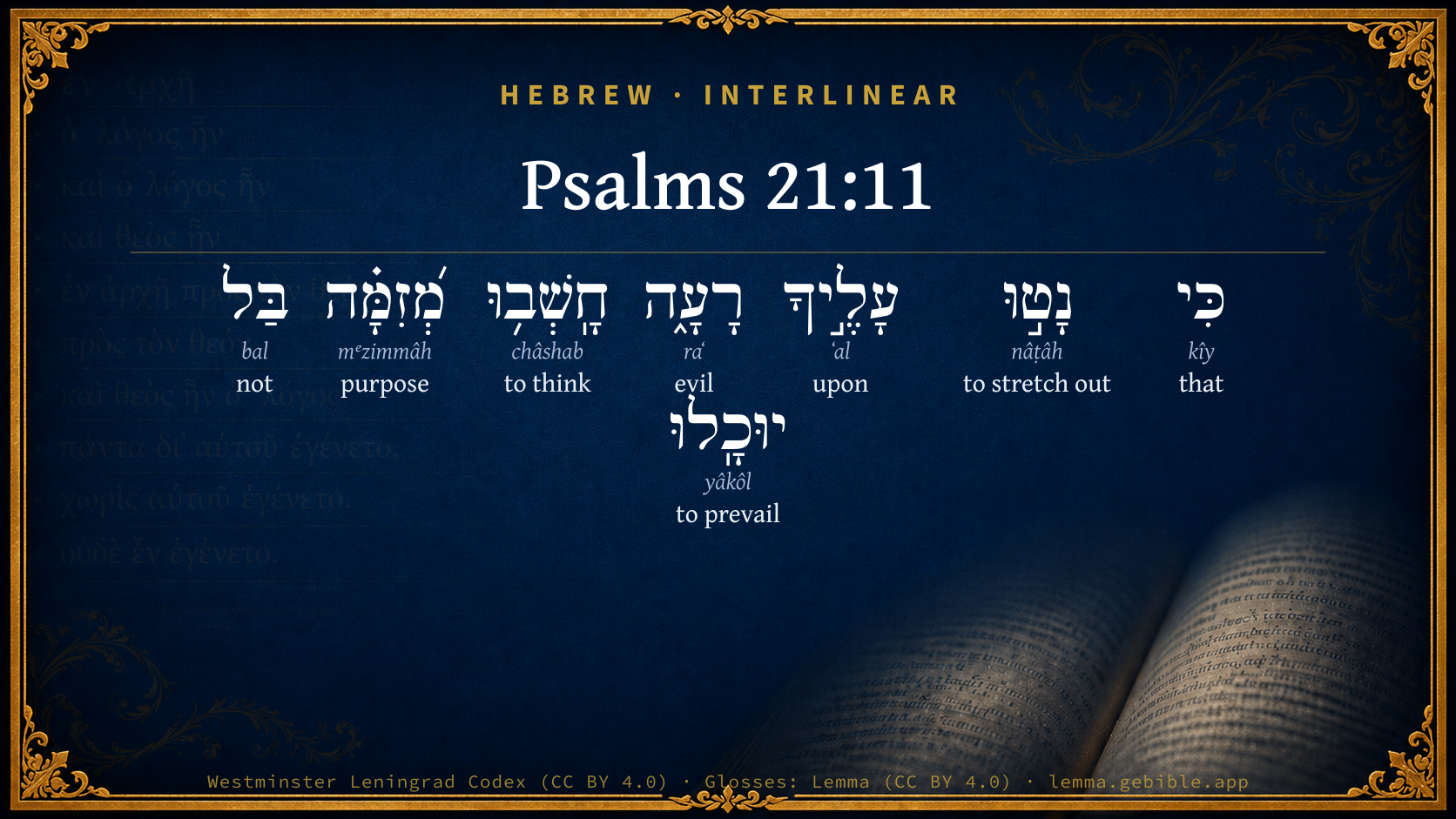
Psalms 21:11

Hebrew (Westminster Leningrad Codex) Psalms 21:11 appears in the Hebrew Old Testament. The text above is from the Westminster Leningrad Codex. Each word links to its Strong’s number, a concise gloss, and parsing drawn from the Open Scriptures Hebrew Bible morphology. Click any word for its full Brown-Driver-Briggs (BDB) entry.
Download image
Cite this verse

Psalms 21:11 (World English Bible). Public Domain. Lemma interlinear Bible study tool, https://lemma.gebible.app/v/psalms/21/11.

Show BibTeX & RIS
BibTeX
RIS
English Translation
For they intended evil against you. They plotted evil against you which cannot succeed.
World English Bible · Public Domain
Download a study sheet

One document with this verse’s original text, its word-by-word gloss line, the meaning frame, cross-references with their text, attributed commentary, and full source and license credits — printable, and it pastes into notes with its structure intact.

This verse Autodidact and up

Study sheet (.html) Plain text (.txt)

A passage Seminary Student

Up to 50 verses in one chapter. A passage sheet keeps up to 6 commentary sources and 12 cross-references per verse, in the order this page ranks them, and says so on the sheet whenever that leaves anything out. Ask for a single verse and you get the Autodidact verse sheet above.

Everything on this page stays free to read, with no account — the sheet is a download of what is already on screen, not access to it.

Want to remove ads? Support Godless Engineer
Compare translations 3

The same verse in 3 English versions, stacked beneath the original-language interlinear above. Click any original word for its lexicon entry.

Each is an independent rendering of the whole verse — the interlinear is not word-aligned to these translations.

Highlighted words mark where these versions differ — a whole-verse word diff, not a word-by-word alignment.

  • World English Bible Public Domain
    For they intended evil against you. They plotted evil against you which cannot succeed.
  • King James Version Public Domain
    For they intended evil against thee: they imagined a mischievous device, which they are not able to perform.
  • unfoldingWord Literal Text CC BY-SA 4.0
    Though they stretch out evil against you, they plan a plot they will not be able.

unfoldingWord Literal Text — © unfoldingWord, licensed CC BY-SA 4.0. Word-aligned USFM3 via Door43 (git.door43.org/unfoldingWord/en_ult).

Versions to compare (up to 4)

3 of 4 selected

Show all 18 translations

Every available English version of this verse, each an independent rendering of the whole verse.

  • World English Bible Public Domain
    For they intended evil against you. They plotted evil against you which cannot succeed.
  • Berean Standard Bible Public Domain
    Though they intend You harm, the schemes they devise will not prevail.
  • Majority Standard Bible Public Domain
    Though they intend You harm, the schemes they devise will not prevail.
  • King James Version Public Domain
    For they intended evil against thee: they imagined a mischievous device, which they are not able to perform.
  • American Standard Version (1901) Public Domain
    For they intended evil against thee; They conceived a device which they are not able to perform.
  • Revised Version (1885) Public Domain
    For they intended evil against thee: they imagined a device, which they are not able to perform.
  • Geneva Bible (1599) Public Domain
    For they intended euill against thee, and imagined mischiefe, but they shall not preuaile.
  • Douay-Rheims (1899) Public Domain
    Their fruit shalt thou destroy from the earth: and their seed from among the children of men.
  • Young's Literal Translation Public Domain
    For they stretched out against Thee evil, They devised a wicked device, they prevail not,
  • Literal Standard Version CC BY-SA 4.0
    For they stretched out evil against You, || They devised a wicked scheme, they do not prevail,
  • Unlocked Literal Bible CC BY-SA 4.0
    For they intended evil against you; they conceived a plot with which they will not succeed!
  • unfoldingWord Literal Text CC BY-SA 4.0
    Though they stretch out evil against you, they plan a plot they will not be able.
  • Darby Bible Public Domain
    For they intended evil against thee; they imagined a mischievous device, which they could not execute.
  • World Messianic Bible Public Domain
    For they intended evil against you. They plotted evil against you which cannot succeed.
  • Webster's Bible Public Domain
    \\21:10\\Their fruit shalt thou destroy from the earth, and their seed from among the children of men.
  • Free Bible Version CC BY-SA 4.0
    Though they plot evil against you, their malicious schemes will not succeed.
  • Bible in Basic English Public Domain
    For their thoughts were bitter against you: they had an evil design in their minds, which they were not able to put into effect.
  • JPS Tanakh (1917) Public Domain
    (21-12) For they intended evil against thee, they imagined a device, wherewith they shall not prevail.

Literal Standard Version (2020), Covenant Press — licensed CC BY-SA 4.0. Text via the HelloAO Bible API (eBible.org). Unlocked Literal Bible (unfoldingWord) — licensed CC BY-SA 4.0. Text via the HelloAO Bible API (eBible.org). unfoldingWord Literal Text — © unfoldingWord, licensed CC BY-SA 4.0. Word-aligned USFM3 via Door43 (git.door43.org/unfoldingWord/en_ult). Free Bible Version, Dr. Jonathan Gallagher — licensed CC BY-SA 4.0. Text via the HelloAO Bible API (eBible.org).

Word by word

More ways to search: Search by grammar → Find every occurrence → Compare this word →

Practice this passage: Drill this verse → Learn its vocabulary →

About this verse

These counts appear in no published source. They are computed here, from the morphology-tagged text and Lemma’s own curated glosses. What Lemma adds →

8
words
8
distinct lemmas
Wisdom
section

Notable vocabulary

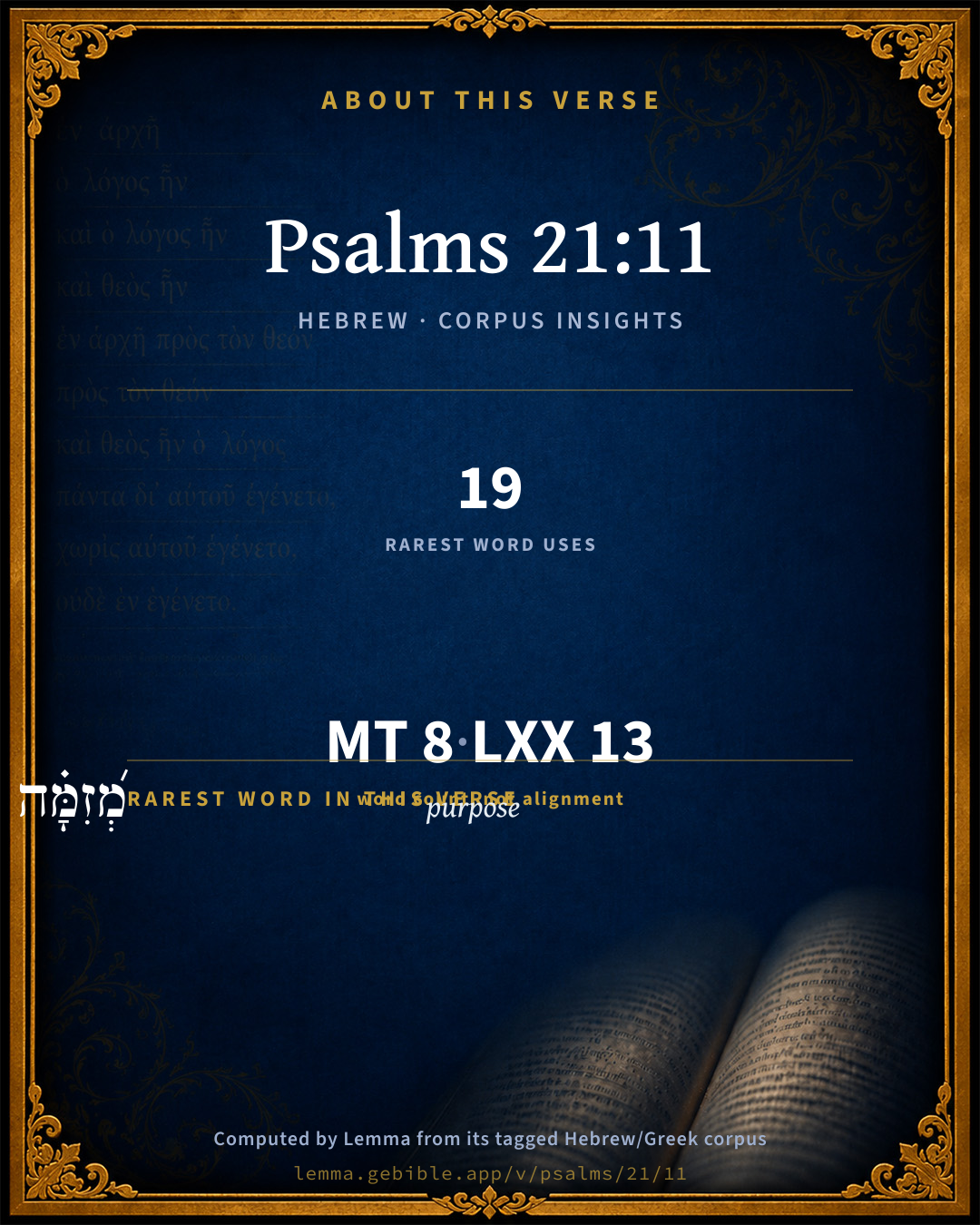
The rarest word here is מְ֝זִמָּ֗ה purpose H4209 — appearing just 19 times in the whole Hebrew Bible.

Shared distinctive vocabulary

מְ֝זִמָּ֗ה purpose H4209 occurs in 19 verses of the Hebrew Bible. Also found in:

Grammatical profile

  • 3 verbs
  • 2 nouns
  • 1 preposition
  • 1 conjunction
  • 1 particle

Verb forms

  • נָט֣וּ Qal · Perfect
  • חָֽשְׁב֥וּ Qal · Perfect
  • יוּכָֽלוּ Qal · Imperfect

Hebrew & Septuagint length

In English translation the verse runs 14 words from the Hebrew and 20 from the Septuagint (LXX English) — closely comparable.

A rough comparison of the two English renderings, which tokenize alike — not a word-level alignment.

Word counts can differ between the Hebrew and the Greek without any difference in meaning — e.g. the Hebrew direct-object marker אֵת has no separate Greek word, and Greek often adds the article ὁ.

In the original languages it is 8 Hebrew tokens and 13 Greek tokens — but the two are counted differently (Hebrew bundles its prefixes and suffixes into one token; the Greek is in lemma form), so that isn’t a like-for-like length.

Cross-references

17

Topical passages linked to Psalms 21:11 in the Treasury of Scripture Knowledge — connected by theme and wording, ordered by reader-vote popularity; previews shown in the World English Bible.

  • Psalms 10:2 In arrogance, the wicked hunt down the weak; They are caught in the schemes that they devise.
  • Psalms 2:1 Why do the nations rage, And the peoples plot a vain thing?
  • Psalms 31:13 For I have heard the slander of many, terror on every side, While they conspire together against me, They plot to take away my life.
  • Jeremiah 11:18–19 Yahweh gave me knowledge of it, and I knew it: then you shown me their doings.
  • Isaiah 7:6–7 "Let's go up against Judah, and tear it apart, and let's divide it among ourselves, and set up a king in the midst of it, even the son of Tabeel."
  • Isaiah 8:9–10 Make an uproar, O you peoples, and be broken in pieces! And give ear, all you of far countries: gird yourselves, and be broken in pieces! Gird yourselves, and be broken in pieces!
  • Matthew 2:16 Then Herod, when he saw that he was mocked by the wise men, was exceedingly angry, and sent out, and killed all the male children who were in Bethlehem and in all the surrounding countryside, from two years old and under, according to the exact time which he had learned from the wise men.
  • Matthew 28:2–6 Behold, there was a great earthquake, for an angel of the Lord descended from the sky, and came and rolled away the stone from the door, and sat on it.
  • Acts 4:17–18 But so that this spreads no further among the people, let's threaten them, that from now on they don't speak to anyone in this name."
  • Psalms 35:20 For they don't speak peace, But they devise deceitful words against those who are quiet in the land.
  • Psalms 83:4 "Come," they say, "and let's destroy them as a nation, That the name of Israel may be remembered no more."
  • Matthew 2:8 He sent them to Bethlehem, and said, "Go and search diligently for the young child. When you have found him, bring me word, so that I also may come and worship him."
  • Matthew 27:63–64 saying, "Sir, we remember what that deceiver said while he was still alive: 'After three days I will rise again.'
  • Ezekiel 11:2 He said to me, Son of man, these are the men who devise iniquity, and who give wicked counsel in this city;
  • Matthew 21:46 When they sought to seize him, they feared the multitudes, because they considered him to be a prophet.
  • Matthew 26:4–5 They took counsel together that they might take Jesus by deceit, and kill him.
  • Acts 5:27–28 When they had brought them, they set them before the council. The high priest questioned them,

Cross-references courtesy of OpenBible.info (CC BY 4.0).

Hebrew and Greek witnesses Masoretic Hebrew ↔ Greek Septuagint

The same verse in the two great witnesses to the Old Testament, shown verse-for-verse.

You’re reading Greek Psalm 20 (Hebrew Psalm 21). The Septuagint counts the superscription, so verse numbers can differ from the Hebrew — chapter-level alignment, not verse-by-verse. Numbering follows Rahlfs.

These are two independent witnesses, not word-aligned to each other, and the Septuagint is shown in lemma (dictionary) form.

Hebrew Psalms 21:11 Masoretic · Westminster Leningrad Codex

כִּי נָט֣וּ עָלֶ֣יךָ רָעָ֑ה חָֽשְׁב֥וּ מְ֝זִמָּ֗ה בַּל יוּכָֽלוּ

For they intended evil against you. They plotted evil against you which cannot succeed.

World English Bible · Public Domain

Greek LXX Greek Psalm 20:11 Septuagint · lemma form

ὁ καρπός αὐτός ἀπό γῆ ἀποὀλλύω καί ὁ σπέρμα αὐτός ἀπό υἱός ἄνθρωπος

For they intended evils against you; they imagined a device which they shall by no means be able to perform.

LXX2012 (modern English Septuagint) · Public Domain

Hebrew: Westminster Leningrad Codex (CC BY 4.0). Greek: Septuagint (public domain); English from LXX2012 (modern English Septuagint) (Public Domain). How the Septuagint differs from the Hebrew →

Commentary

Notes on Psalms 21:11 from classic Christian and Jewish commentators (each source and its license shown beneath its notes). The classic Christian expositions comment on the surrounding passage and are grouped to its opening verse, so a note may address several verses; the Jewish commentaries on the Tanakh (Rashi and others) are per-verse, so they appear only where the commentator wrote on this verse.

Lemma curates 59 commentaries, every one of them public domain or Creative Commons licensed, each selected and text-cleaned for this edition rather than reprinted as found. About our sources →

Trapp's Complete Commentary

John Trapp

Psa 21:11 For they intended evil against thee: they imagined a mischievous device, [which] they are not able [to perform].

Ver. 11. For they intended evil against thee] Because against thy people. He that wrongeth a subject is arraigned for injury done to the king, his crown and dignity. And as a certain gentleman of Normandy was executed for but intending only to kill Francis II, king of France, which he told to a priest, sub sigillo confessionis, not thinking ever to hear further of it again; so here.

John Trapp, A Commentary or Exposition upon All the Books of the Old and New Testament (1647–1656) — public domain. Text from a community e-Sword module.

The Biblical Illustrator

Joseph S. Exell

Psa_21:11

For they intended evil against Thee . . . which they are not able to perform.

A memorable instance of intended evil that the wicked were not able to perform

At Rome the news of this great blow (given by the massacre on St. Bartholomews Day) was hailed with extravagant manifestations of joy; the Pope (Gregory XII) and cardinals went in state to return thanks to heaven for this signal mercy, and medals were struck in its honour. Philip II. extolled it as one of the most memorable triumphs of Christianity, compared it to the splendid victory of Lepanto, and boasted that the total ruin of Protestantism was now finally assured. Nevertheless, this great wickedness, like all state crimes, was quite ineffectual for the purpose toward which it was directed. The Huguenots had lost their ablest leaders: they were stunned, confounded, scattered, weakened, but they were by no means wholly crushed. As soon as they recovered from their consternation they once more rushed to arms . . . The persecuted party once more raised their heads, and within a year from the date of the great massacre were in a position to address the king in bolder and more importunate language than at any former period of the contest . . . The full and public exercise of the reformed religion was authorised throughout the kingdom; the parliaments were to consist of an equal number of Protestant and Catholic judges; all sentences passed against the Huguenots were annulled, and the insurgents were pronounced to have acted for the good of the king and kingdom; eight towns were placed in their hands for an unlimited period; and the States-General were to be convoked within six months. Such were the conditions of the Peace of Monsieur, as it was termed, which was signed on the 6th of May 1576--less than four years after that frightful massacre by which it was hoped that the Huguenot faction would be finally extirpated from France. (Students France.)

.

Psa_22:1-31

The Biblical Illustrator, edited by Joseph S. Exell (c. 1880s–1900s) — public domain. Text from a community e-Sword module.

J. A. Alexander on Psalms

Joseph Addison Alexander

12. (Psa 21:11). For they stretched out evil over thee; they devised a plot; they shall not be able (to effect it). The figure of the first clause is the same as in 1Ch 21:10. (Compare 2Sa 24:12.) The idea here is that they threatened to bring evil on thee. As the verb to be able is sometimes used absolutely, it is translated, they shall not prevail.

Joseph Addison Alexander, The Psalms Translated and Explained (1850) — public domain. Text from a community e-Sword module.

Geneva Bible (1599)

Geneva Bible translators

They laid as it were their nets to make God’s power to give place to their wicked enterprises.

Geneva Bible (1599) marginal notes — public domain. Text via Bolls.life.

Jamieson, Fausset & Brown

Robert Jamieson, A. R. Fausset & David Brown

This terrible overthrow, reaching to posterity, is due to their crimes (Exo 20:5-6).

Jamieson, Fausset & Brown — Commentary Critical and Explanatory on the Whole Bible (1871) — public domain (CC PDM 1.0). Text via the HelloAO Bible API.

Adam Clarke's Commentary

Verse 11. For they intended evil] Sinners shall not be permitted to do all that is in their power against the godly; much less shall they be able to perform all that they wish.

Adam Clarke's Commentary on the Bible (1810–1826) — public domain. Text from a community e-Sword/MySword module.

John Calvin's Commentaries

11. For they have spread out. In this verse David shows that the ungodly had deserved the awful ruin which he predicted would befall them, since they had not only molested mortal man, but had also rushed forth in the fury of their pride to make war against God himself. No man, as has been stated in our exposition of the second psalm, could offer violence to the kingdom of Israel, which was consecrated in the person of David, by the commandment of God, without making foul and impious war against God. Much more when persons directly attack the kingdom of Christ to overthrow it, is the majesty of God violated, since it is the will of God to reign in the world only by the hand of his Son. As the Hebrew word נטה, natah, which we have translated to spread out, also sometimes signifies to turn aside, it may not unsuitably be here rendered either way. According to the first view the meaning is, that the wicked, as if they had spread out their nets, endeavored to subject to themselves the power of God. According to the second the meaning is, that for the purpose of hindering, and as it were swallowing up his power, “Pour icello empescher et comme engloutir.” — Fr.

John Calvin's Commentaries (1540-1563) — public domain. Text from the Calvin Translation Society English edition (1840s-50s) via the Christian Classics Ethereal Library (ccel.org). Calvin's coverage is partial (roughly two-thirds of the Bible); uncommented books and verses are honest gaps, never fabricated. The 19th-century editor's footnotes and remarks are omitted so the notes are faithfully Calvin's own voice.

Ellicott's Commentary for English Readers

(11) For they.—Better, though they have intended evil against thee, have plotted mischief, they have no power at all.

A Bible Commentary for English Readers, edited by Charles John Ellicott (1878–1897) — public domain. Text from a community e-Sword module.

The Cambridge Bible for Schools and Colleges

gen. ed. J. J. S. Perowne

11, 12. Though they threaten thee with evil,

Though they devise a mischievous plan, they shall avail naught,

For thou shalt make them turn their backs,

Aiming with thy bowstrings against their faces.

The Cambridge Bible for Schools and Colleges (gen. ed. J. J. S. Perowne; Cambridge University Press, 1878–1918) — public domain. Text from a community e-Sword module.

John Gill's Exposition

For they intended evil against thee,.... All evil, whether in thought or deed, if not immediately and directly, yet is ultimately against the Lord, whose law is transgressed, and who is despised and reflected upon as a lawgiver; all sin is an hostility committed against God, or against Christ, against the Lord and his Anointed, or against his people, who are all one as himself: the intention of evil is evil, and is cognizable by the Lord, and punishable by him:

they imagined a mischievous device, which they are not able to perform; not the death of Christ; that was indeed in itself a mischievous device of theirs, but that they performed, though they had not their end in it; they expected his name would then perish, and they should hear no more of him: but rather it respects his resurrection from the dead, they could not prevent, though they took all imaginable care that them might be no show of it; and when they found he was really raised from the dead, they contrived a wicked scheme to stop the credit of it, but in vain, Mat 27:63; and Jews and Gentiles, and Papists, have formed schemes and done all they can to root the Gospel, cause, and interest of Christ, out of the world, but have not been able to perform it.

John Gill's Exposition of the Whole Bible (1746–1763) — public domain (CC PDM 1.0). Text via the HelloAO Bible API.

Albert Barnes' Notes on the Bible

For they intended evil against thee - literally, “They stretched out evil.” The idea seems to be derived from “stretching out” or laying snares, nets, or gins, for the purpose of taking wild beasts. That is, they formed a plan or purpose to bring evil upon God and his cause: as the hunter or fowler forms a purpose or plan to take wild beasts or fowls. It is not merely a purpose in the head, as our word “intended” would seem to imply; it supposes that arrangements had been entered into, or that a scheme had been formed to injure the cause of God - that is, through the person referred to in the psalm. The purposes of wicked men against religion are usually much more than a mere “intention.” The intention is accompanied with a scheme or plan in their own mind by which the act may be accomplished. The evil here referred to was that of resisting or overpowering him who was engaged in the cause of God, or whom God had appointed to administer his laws.

They imagined a mischievous device - They thought, or they purposed. The word rendered “mischievous device” מזמה mezimmâh - means properly “counsel, purpose; then prudence, sagacity;” then, in a bad sense, “machination, device, trick.” Gesenius, Lexicon. Pro 12:2; Pro 14:17; Pro 24:8.

Which they are not able to perform - literally, “they could not;” that is, they had not the power to accomplish it, or to carry out their purpose. Their purpose was plain; their guilt was therefore clear; but they were prevented from executing their design. Many such designs are kept from being carried into execution for the want of power. If all the devices and the desires of the wicked were accomplished, righteousness would soon cease in the earth, religion and virtue would come to an end, and even God would cease to occupy the throne.

Albert Barnes' Notes on the Bible (1834–1885) — public domain. Text from a community e-Sword/MySword module.

Matthew Poole's English Annotations

Against thee, i.e. against God, not directly, but by conseqence, because it was against David, whom God had anointed, and against the Lord’s people, whose injuries God takes as done to himself, Zec 2:8.

To perform; such supplements are usual after this verb, as Exo 8:18; Psa 101:5; 139:6; Isa 1:13. Or, for which

they were unable or insufficient. Or, but they did not prevail, as this verb signifies, Psa 13:4; 129:2. This clause seems to be added to teach us this great and necessary lesson, that men are justly punished by God for their wicked intentions, although they be hindered from the execution of them, contrary to what some Jewish doctors and others have taught.

Matthew Poole's English Annotations on the Holy Bible (1683–1685) — public domain. Text from a community e-Sword/MySword module.

The Treasury of David

Charles H. Spurgeon

Ver. 11. For they intended evil against thee. God takes notice of intentions. He who would but could not is as guilty as he who did. Christ's church and cause are not only attacked by those who do not understand it, but there are many who have the light and yet hate it. Intentional evil has a virus in it which is not found in sins of ignorance; now as ungodly men with malice aforethought attack the gospel of Christ, their crime is great, and their punishment will be proportionate. The words "against thee" show us that he who intends evil against the poorest believer means ill to the King himself: let persecutors beware.

They imagined a mischievous device, which they are not able to perform. Want of power is the clog on the foot of the haters of the Lord Jesus. They have the wickedness to imagine, and the cunning to devise, and the malice to plot mischief, but blessed be God, they fail in ability; yet they shall be judged as to their hearts, and the will shall be taken for the deed in the great day of account. When we read the boastful threatenings of the enemies of the gospel at the present day, we may close our reading by cheerfully repeating, "which they are not able to perform." The serpent may hiss, but his head is broken; the lion may worry, but he cannot devour: the tempest may thunder, but cannot strike. Old Giant Pope bites his nails at the pilgrims, but he cannot pick their bones as aforetime. Growling forth a hideous "non possumus", the devil and all his allies retire in dismay from the walls of Zion, for the Lord is there.

Ver. 11. They intended, or warped. Hebrew, have bent or stretched. A similitude taken from weavers, who warp their yarn before they weave: or from archers, who, when they have bent their bow and put in their arrow, do take their aim. John Diodati.

Ver. 11-12. The guilt and punishment of evil intentions.

Psalms 21:12*

Ver. 11-12. The guilt and punishment of evil intentions.

Charles H. Spurgeon's The Treasury of David (1869–1885) — public domain. Psalms only. Text from a community e-Sword/MySword module.

Whedon's Commentary on the Bible

Daniel D. Whedon

11. They intended—Rather, they extended, in a hostile sense, as the word more commonly means. They “extended,” or directed, their evil designs against God. Job_15:15; Jer_21:5. So, also, the second hemistich.

Daniel D. Whedon (gen. ed.), Commentary on the Old and New Testaments (1874–1909) — public domain. Text from a community e-Sword module.

The Pulpit Commentary

For they intended evil against thee. Their destruction is brought upon them by their own selves. They plot against the people of God, and thus provoke God to anger, and cause him to deliver them into their enemy" s hand. It does not matter that they can effect nothing. The "intention" is enough. They imagined a mischievous device, which they are not able to perform. The inability is not so much from a deficiency of strength in themselves, as from the opposition offered to their schemes by God. The best-laid plans and powerless, if God wills to baffle them.

The Pulpit Commentary (1880–1919), ed. H.D.M. Spence-Jones & Joseph S. Exell — public domain. Text from a community e-Sword module.

John Wesley's Explanatory Notes

Thee - Against God, not directly, but by consequence, because it was against David, whom God had anointed, and against the Lord's people, whose injuries God takes as done to himself.

John Wesley, Explanatory Notes Upon the Whole Bible (1754–1765) — public domain. Text via the GEBible commentary corpus.

Keil & Delitzsch

C. F. Keil & F. Delitzsch

(Heb.: 21:12-13) And this fate is the merited frustration of their evil project. The construction of the sentences in Psa 21:12 is like Psa 27:10; Psa 119:83; Ew. 362, b. נטה רעה is not to be understood according to the phrase נטה רשׁת (= פּרשׁ), for this phrase is not actually found; we have rather, with Hitzig, to compare Psa 55:4, Sa2 15:14 : to incline evil down upon any one is equivalent to: to put it over him, so that it may fall in upon him. נטה signifies "to extend lengthwise," to unfold, but also to bend by drawing tight. שׁית שׁכם to make into a back, i.e., to make them into such as turn the back to you, is a more choice expression than נתן ערף, Psa 18:41, cf. Sa1 10:9; the half segolate form שׁכם, (= שׁכם) becomes here, in pause, the full segolate form שׁכם. חצּים must be supplied as the object to תּכונן, as it is in other instances after הורה, השׁליך, ידה; כּונן חץ, Psa 11:2, cf. Psa 7:14, signifies to set the swift arrow upon the bow-string (מיתר = יתר) = to aim. The arrows hit the front of the enemy, as the pursuer overtakes them.

Keil & Delitzsch — Biblical Commentary on the Old Testament (1861–1891) — public domain (CC PDM 1.0). Text via the HelloAO Bible API. (Old Testament only.)

unfoldingWord translationNotes

Door43 World Missions Community

they intended

"they planned." The word "they" refers to the enemies of God and the king.

evil against you

"to do evil things to you"

they conceived a plot

"they made a plan" or "they created a scheme"

For you will turn them back; you will draw your bow before them

Possible meanings for "you" and "your" are 1) they refer to the king or 2) they refer to God and speak about him as if he were a warrior with a bow and arrows. (See: Metaphor)

you will turn them back

This is a way of saying that God and the king will defeat their enemies in battle. (See: Idiom)

you will draw your bow before them

This implies that he actually shoots his arrows at his enemies. (See: Assumed Knowledge and Implicit Information)

translationWords

evil

turn

bow and arrow

unfoldingWord translationNotes — © Distant Shores Media and the Door43 World Missions Community, licensed CC BY-SA 4.0. Source: git.door43.org/Door43/en_tn.

Rashi

Rabbi Shlomo Yitzchaki (Rashi)

You shall destroy their fruit from the earth He prays to the Holy One, blessed be He, that He destroy the descendants of the wicked Esau.

Rashi on the Tanakh — English translations: “The Judaica Press complete Tanach with Rashi, translated by A. J. Rosenberg” (CC BY 4.0); “Pentateuch with Rashi's commentary by M. Rosenbaum and A.M. Silbermann, 1929-1934” (public domain); “The Metsudah Tanach series, Lakewood, N.J” (CC BY 4.0); and “The Book of Joshua, Metsudah Publications, 1997” (CC BY 4.0). Text via Sefaria.

Lesson kit

Teaching starters — assembled from the data on this page, not authored interpretation. Every prompt links to the verse data it draws on. Edit before teaching.

Psalms, in the Wisdom, opens this verse with 8 words (8 distinct Hebrew lemmas). Its most distinctive word is mᵉzimmâh (“purpose”). A historical commentator’s framing appears above. Read the whole chapter for the surrounding context.

Discussion questions

  1. How does “purpose” (mᵉzimmâh) shape what this verse is saying?
  2. How does Job 21:27, which shares the word «purpose», read alongside this verse?
  3. The translations on this page render this verse differently — a whole-verse word diff, not a word-by-word alignment. What might account for the different wordings?
  4. «נָט֣וּ» is a Qal Perfect verb. How does that grammatical form shape the action described?
  5. Compare how Trapp's Complete Commentary and The Biblical Illustrator read this verse. Where do they agree or differ?

Things to notice

Reading settings

Reading text

Shown beneath each verse's original-language words.

Old Testament
Old Testament edition

Read the OT as the Masoretic Hebrew (MT) or the Greek Septuagint (LXX).

English shown for the Greek Septuagint (in the Hebrew ↔ Greek comparison).

Comparing translations? Open the Compare panel on any verse page to stack up to four side by side.