
Psalms 25:15

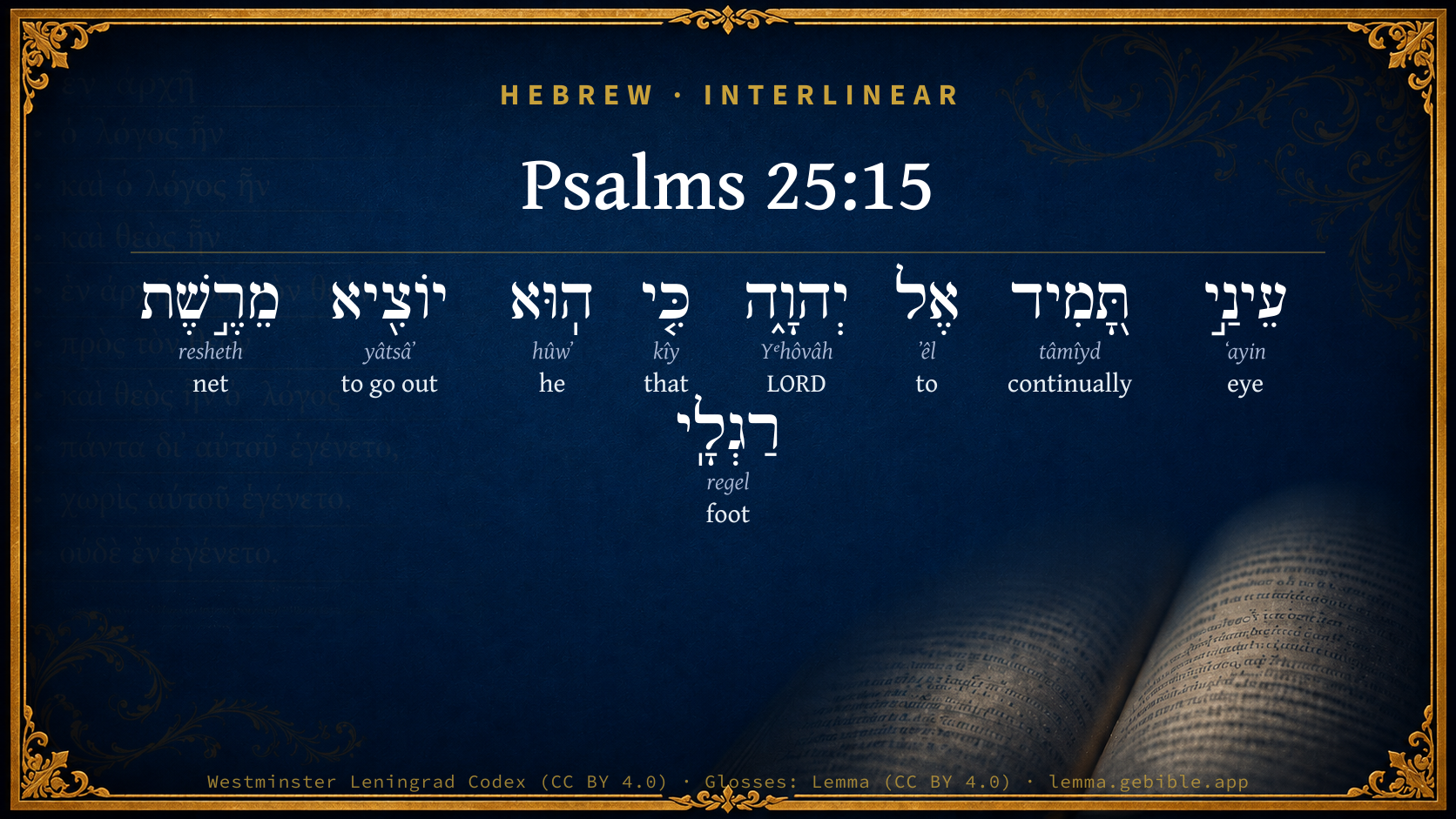
Hebrew (Westminster Leningrad Codex) Psalms 25:15 appears in the Hebrew Old Testament. The text above is from the Westminster Leningrad Codex. Each word links to its Strong’s number, a concise gloss, and parsing drawn from the Open Scriptures Hebrew Bible morphology. Click any word for its full Brown-Driver-Briggs (BDB) entry.
Download image
Cite this verse

Psalms 25:15 (World English Bible). Public Domain. Lemma interlinear Bible study tool, https://lemma.gebible.app/v/psalms/25/15.

Show BibTeX & RIS
BibTeX
RIS
English Translation
My eyes are ever on Yahweh, For he will pluck my feet out of the net.
World English Bible · Public Domain
Download a study sheet

One document with this verse’s original text, its word-by-word gloss line, the meaning frame, cross-references with their text, attributed commentary, and full source and license credits — printable, and it pastes into notes with its structure intact.

This verse Autodidact and up

Study sheet (.html) Plain text (.txt)

A passage Seminary Student

Up to 50 verses in one chapter. A passage sheet keeps up to 6 commentary sources and 12 cross-references per verse, in the order this page ranks them, and says so on the sheet whenever that leaves anything out. Ask for a single verse and you get the Autodidact verse sheet above.

Everything on this page stays free to read, with no account — the sheet is a download of what is already on screen, not access to it.

Want to remove ads? Support Godless Engineer
Compare translations 3

The same verse in 3 English versions, stacked beneath the original-language interlinear above. Click any original word for its lexicon entry.

Each is an independent rendering of the whole verse — the interlinear is not word-aligned to these translations.

Highlighted words mark where these versions differ — a whole-verse word diff, not a word-by-word alignment.

  • World English Bible Public Domain
    My eyes are ever on Yahweh, For he will pluck my feet out of the net.
  • King James Version Public Domain
    Mine eyes are ever toward the LORD; for he shall pluck my feet out of the net.
  • unfoldingWord Literal Text CC BY-SA 4.0
    My eyes are continually toward Yahweh, for he will make my feet go out of the net.

unfoldingWord Literal Text — © unfoldingWord, licensed CC BY-SA 4.0. Word-aligned USFM3 via Door43 (git.door43.org/unfoldingWord/en_ult).

Versions to compare (up to 4)

3 of 4 selected

Show all 18 translations

Every available English version of this verse, each an independent rendering of the whole verse.

  • World English Bible Public Domain
    My eyes are ever on Yahweh, For he will pluck my feet out of the net.
  • Berean Standard Bible Public Domain
    My eyes are always on the LORD, for He will free my feet from the mesh.
  • Majority Standard Bible Public Domain
    My eyes are always on the LORD, for He will free my feet from the mesh.
  • King James Version Public Domain
    Mine eyes are ever toward the LORD; for he shall pluck my feet out of the net.
  • American Standard Version (1901) Public Domain
    Mine eyes are ever toward Jehovah; For he will pluck my feet out of the net.
  • Revised Version (1885) Public Domain
    Mine eyes are ever toward the LORD; for he shall pluck my feet out of the net.
  • Geneva Bible (1599) Public Domain
    Mine eyes are euer towarde the Lord: for he will bring my feete out of the net.
  • Douay-Rheims (1899) Public Domain
    My eyes are ever towards the Lord: for he shall pluck my feet out of the snare.
  • Young's Literal Translation Public Domain
    Mine eyes `are' continually unto Jehovah, For He bringeth out from a net my feet.
  • Literal Standard Version CC BY-SA 4.0
    My eyes [are] continually to YHWH, || For He brings my feet out from a net.
  • Unlocked Literal Bible CC BY-SA 4.0
    My eyes are always on Yahweh, for he will free my feet from the net.
  • unfoldingWord Literal Text CC BY-SA 4.0
    My eyes are continually toward Yahweh, for he will make my feet go out of the net.
  • Darby Bible Public Domain
    Mine eyes are ever toward Jehovah; for he will bring my feet out of the net.
  • World Messianic Bible Public Domain
    My eyes are ever on the LORD, for he will pluck my feet out of the net.
  • Webster's Bible Public Domain
    My eyes are ever towards the LORD; for he will pluck my feet out of the net.
  • Free Bible Version CC BY-SA 4.0
    I always look to the Lord, for he rescues me when I'm trapped.
  • Bible in Basic English Public Domain
    My eyes are turned to the Lord at all times; for he will take my feet out of the net.
  • JPS Tanakh (1917) Public Domain
    Mine eyes are ever toward the LORD; for He will bring forth my feet out of the net.

Literal Standard Version (2020), Covenant Press — licensed CC BY-SA 4.0. Text via the HelloAO Bible API (eBible.org). Unlocked Literal Bible (unfoldingWord) — licensed CC BY-SA 4.0. Text via the HelloAO Bible API (eBible.org). unfoldingWord Literal Text — © unfoldingWord, licensed CC BY-SA 4.0. Word-aligned USFM3 via Door43 (git.door43.org/unfoldingWord/en_ult). Free Bible Version, Dr. Jonathan Gallagher — licensed CC BY-SA 4.0. Text via the HelloAO Bible API (eBible.org).

Word by word

More ways to search: Search by grammar → Find every occurrence → Compare this word →

Practice this passage: Drill this verse → Learn its vocabulary →

About this verse

These counts appear in no published source. They are computed here, from the morphology-tagged text and Lemma’s own curated glosses. What Lemma adds →

9
words
9
distinct lemmas
Wisdom
section

Notable vocabulary

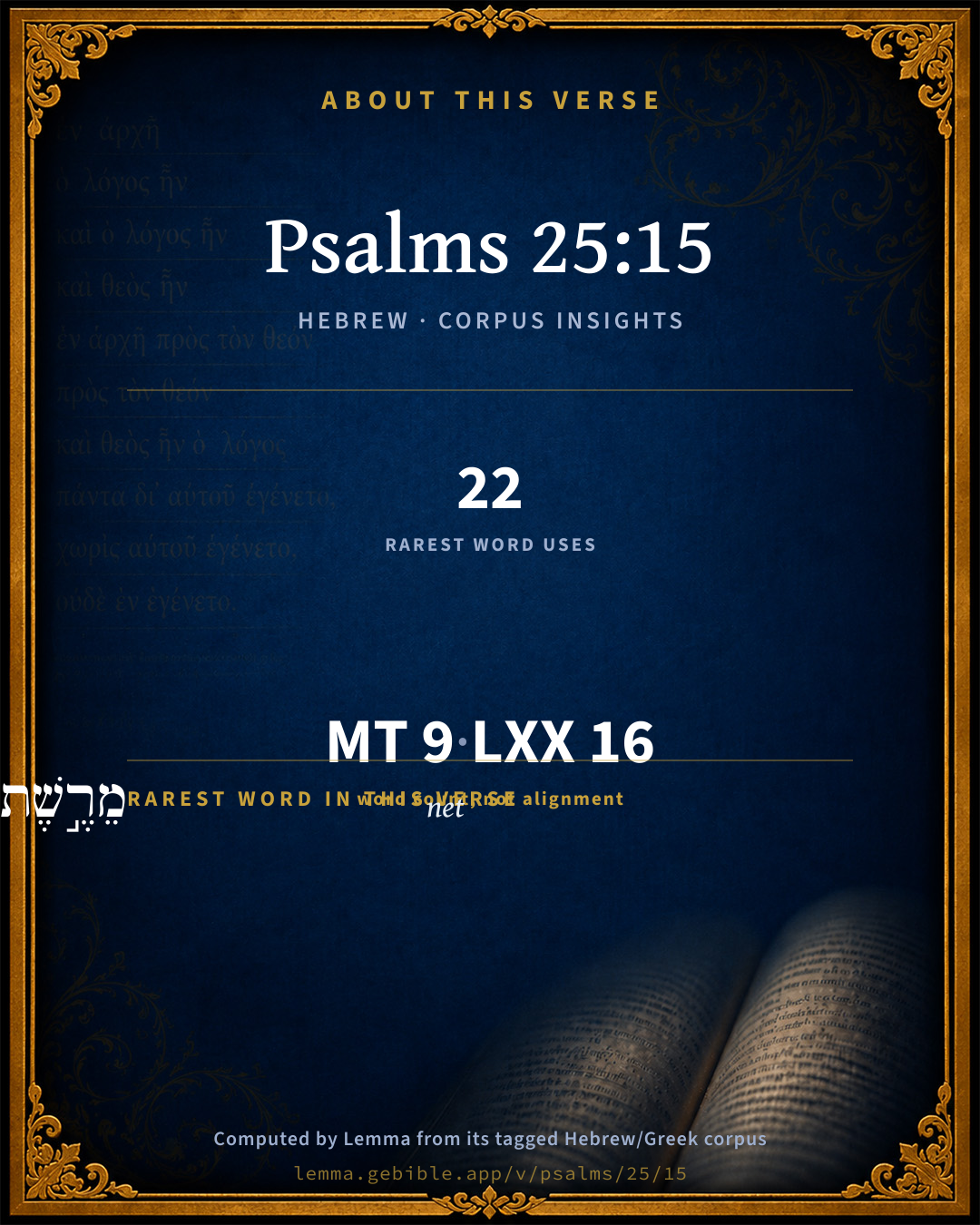
The rarest word here is מֵרֶ֣שֶׁת net H7568 — appearing just 22 times in the whole Hebrew Bible.

Shared distinctive vocabulary

מֵרֶ֣שֶׁת net H7568 occurs in 21 verses of the Hebrew Bible. Also found in:

Grammatical profile

  • 1 verb
  • 5 nouns
  • 1 pronoun
  • 1 preposition
  • 1 conjunction

Verb forms

  • יוֹצִ֖יא Hiphil · Imperfect

Hebrew & Septuagint length

In English translation the verse runs 16 words from the Hebrew and 17 from the Septuagint (LXX English) — closely comparable.

A rough comparison of the two English renderings, which tokenize alike — not a word-level alignment.

Word counts can differ between the Hebrew and the Greek without any difference in meaning — e.g. the Hebrew direct-object marker אֵת has no separate Greek word, and Greek often adds the article ὁ.

In the original languages it is 9 Hebrew tokens and 16 Greek tokens — but the two are counted differently (Hebrew bundles its prefixes and suffixes into one token; the Greek is in lemma form), so that isn’t a like-for-like length.

Cross-references

7

Topical passages linked to Psalms 25:15 in the Treasury of Scripture Knowledge — connected by theme and wording, ordered by reader-vote popularity; previews shown in the World English Bible.

  • Psalms 141:8 For my eyes are on you, Yahweh, the Lord. In you, I take refuge. Don't leave my soul destitute.
  • Psalms 124:7–8 Our soul has escaped like a bird out of the fowler's snare. The snare is broken, and we have escaped.
  • Psalms 31:4 Pluck me out of the net that they have laid secretly for me, For you are my stronghold.
  • Psalms 121:1–2 I will lift up my eyes to the hills. Where does my help come from?
  • Psalms 123:2 Behold, as the eyes of servants look to the hand of their master, As the eyes of a maid to the hand of her mistress; So our eyes look to Yahweh, our God, Until he has mercy on us.
  • Jeremiah 5:26 For among my people are found wicked men: they watch, as fowlers lie in wait; they set a trap, they catch men.
  • 2 Timothy 2:25–26 in gentleness correcting those who oppose him: perhaps God may give them repentance leading to a full knowledge of the truth,

Cross-references courtesy of OpenBible.info (CC BY 4.0).

Hebrew and Greek witnesses Masoretic Hebrew ↔ Greek Septuagint

The same verse in the two great witnesses to the Old Testament, shown verse-for-verse.

You’re reading Greek Psalm 24 (Hebrew Psalm 25). The Septuagint counts the superscription, so verse numbers can differ from the Hebrew — chapter-level alignment, not verse-by-verse. Numbering follows Rahlfs.

These are two independent witnesses, not word-aligned to each other, and the Septuagint is shown in lemma (dictionary) form.

Hebrew Psalms 25:15 Masoretic · Westminster Leningrad Codex

עֵינַ֣י תָּ֭מִיד אֶל יְהוָ֑ה כִּ֤י הֽוּא יוֹצִ֖יא מֵרֶ֣שֶׁת רַגְלָֽי

My eyes are ever on Yahweh, For he will pluck my feet out of the net.

World English Bible · Public Domain

Greek LXX Greek Psalm 24:15 Septuagint · lemma form

ὁ ὀφθαλμός ἐγώ διά πᾶς πρός ὁ κύριος ὅτι αὐτός ἐκσπάω ἐκ παγίς ὁ πούς ἐγώ

My eyes are continually to the Lord; for he shall draw my feet out of the snare.

LXX2012 (modern English Septuagint) · Public Domain

Hebrew: Westminster Leningrad Codex (CC BY 4.0). Greek: Septuagint (public domain); English from LXX2012 (modern English Septuagint) (Public Domain). How the Septuagint differs from the Hebrew →

Commentary

Notes on Psalms 25:15 from classic Christian and Jewish commentators (each source and its license shown beneath its notes). The classic Christian expositions comment on the surrounding passage and are grouped to its opening verse, so a note may address several verses; the Jewish commentaries on the Tanakh (Rashi and others) are per-verse, so they appear only where the commentator wrote on this verse.

Lemma curates 59 commentaries, every one of them public domain or Creative Commons licensed, each selected and text-cleaned for this edition rather than reprinted as found. About our sources →

Matthew Henry's Commentary

David, encouraged by the promises he had been meditating upon, here renews his addresses to God, and concludes the psalm, as he began, with professions of dependence upon God and desire towards him.

I. He lays open before God the calamitous condition he was in. His feet were in the net, held fast and entangled, so that he could not extricate himself out of his difficulties, Psa 25:15. He was desolate and afflicted, Psa 25:16. It is common for those that are afflicted to be desolate; their friends desert them then, and they are themselves disposed to sit alone and keep silence, Lam 3:28. David calls himself desolate and solitary because he depended not upon his servants and soldiers, but relied as entirely upon God as if he had no prospect at all of help and succour from any creature. Being in distress, in many distresses, the troubles of his heart were enlarged (Psa 25:17), he grew more and more melancholy and troubled in mind. Sense of sin afflicted him more than any thing else: this it was that broke and wounded his spirit, and made his outward troubles lie heavily upon him. He was in affliction and pain, Psa 25:18. His enemies that persecuted him were many and malicious (they hated him), and very barbarous; it was with a cruel hatred that they hated him, Psa 25:19. Such were Christ's enemies and the persecutors of his church.

II. He expresses the dependence he had upon God in these distresses (Psa 25:15): My eyes are ever towards the Lord. Idolaters were for gods that they could see with their bodily eyes, and they had their eyes ever towards their idols, Isa 17:7, Isa 17:8. But it is an eye of faith that we must have towards God, who is a Spirit, Zac 9:1. Our meditation of him must be sweet, and we must always set him before us: in all our ways we must acknowledge him and do all to his glory. Thus we must live a life of communion with God, not only in ordinances, but in providences, not only in acts of devotion, but in the whole course of our conversation. David had the comfort of this in his affliction; for, because his eyes were ever towards the Lord, he doubted not but he would pluck his feet out of the net, that he would deliver him from the corruptions of his own heart (so some), from the designs of his enemies against him, so others. Those that have their eye ever towards God shall not have their feet long in the net. He repeats his profession of dependence upon God (Psa 25:20) - Let me not be ashamed, for I put my trust in thee; and of expectation from him - I wait on thee, Psa 25:21. It is good thus to hope and quietly wait for the salvation of the Lord.

III. He prays earnestly to God for relief and succour,

1. For himself.

(1.) See how he begs, [1.] For the remission of sin (Psa 25:18): Forgive all my sins. Those were his heaviest burdens, and which brought upon him all other burdens. He had begged (Psa 25:7) for the pardon of the sins of his youth, and (Psa 25:11) for the pardon of some one particular iniquity that was remarkably great, which some think, was his sin in the matter of Uriah. But her he prays, Lord, forgive all, take away all iniquity. It is observable that, as to his affliction, he asks for no more than God's regard to it: "Look upon my affliction and my pain, and do with it as thou pleasest." But, as to his sin, he asks for no less than a full pardon: Forgive all my sins. When at any time we are in trouble we should be more concerned about our sins, to get them pardoned, than about our afflictions, to get them removed. Yet he prays, [2.] For the redress of his grievances. His mind was troubled for God's withdrawings from him and under the sense he had of his displeasure against him for his sins; and therefore he prays (Psa 25:16), Turn thou unto me. And, if God turn to us, no matter who turns from us. His condition was troubled, and, in reference to that, he prays, "O bring thou me out of my distresses. I see no way of deliverance open; but thou canst either find one or make one." His enemies were spiteful; and in reference to that, he prays, "O keep my soul from falling into their hands, or else deliver me out of their hands."

(2.) Four things he mentions by way of plea to enforce these petitions, and refers himself and them to God's consideration: - [1.] He pleads God's mercy: Have mercy upon me. Men of the greatest merits would be undone if they had not to do with a God of infinite mercies. [2.] He pleads his own misery, the distress he was in, his affliction and pain, especially the troubles of his heart, all which made him the proper object of divine mercy. [3.] He pleads the iniquity of his enemies: "Lord, consider them, how cruel they are, and deliver me out of their hands." [4.] He pleads his own integrity, Psa 25:12. Though he had owned himself guilty before God, and had confessed his sins against him, yet, as to his enemies, he had the testimony of his conscience that he had done them no wrong, which was his comfort when they hated him with cruel hatred; and he prays that this might preserve him, This intimates that he did not expect to be safe any longer than he continued in his integrity and uprightness, and that, while he did continue in it, he did not doubt of being safe. Sincerity will be our best security in the worst of times. Integrity and uprightness will be a man's preservation more than the wealth and honour of the world can be. These will preserve us to the heavenly kingdom. We should therefore pray to God to preserve us in our integrity and then be assured that that will preserve us.

2. For the church of God (Psa 25:22): Redeem Israel, O God! out of all his troubles. David was now in trouble himself, but he thinks it not strange, since trouble is the lot of all God's Israel. Why should any one member fare better than the whole body? David's troubles were enlarged, and very earnest he was with God to deliver him, yet he forgets not the distresses of God's church; for, when we have ever so much business of our own at the throne of grace, we must still remember to pray for the public. Good men have little comfort in their own safety while the church is in distress and danger. This prayer is a prophecy that God would, at length, give David rest, and therewith give Israel rest from all their enemies round about. It is a prophecy of the sending of the Messiah in due time to redeem Israel from his iniquities (Psa 130:8) and so to redeem them from their troubles. It refers also to the happiness of the future state. In heaven, and in heaven only, will God's Israel be perfectly redeemed from all troubles.

Matthew Henry's Commentary on the Whole Bible (1708–1710) — public domain (CC PDM 1.0). Text via the HelloAO Bible API.

Trapp's Complete Commentary

John Trapp

Psa 25:15 Mine eyes [are] ever toward the LORD; for he shall pluck my feet out of the net.

Ver. 15. Mine eyes are ever toward the Lord] I look him full in the face, and confidently expect deliverance. This he speaketh, saith one, in reference to the army that he had sent out to meet Absalom, 2Sa 18:1, nothing doubting of getting the day.

For he shall pluck my feet out of the net] Of evil concupiscence, saith Aben Ezra; rather of my foes, those crafty and cruel fowlers.

John Trapp, A Commentary or Exposition upon All the Books of the Old and New Testament (1647–1656) — public domain. Text from a community e-Sword module.

Joseph Benson's Commentary

Psa 25:15-16. Mine eyes are ever toward the Lord — My trust is in him, and my expectation of relief is from him only. He shall pluck my feet out of the net — He will deliver me out of all my temptations and tribulations. Turn thee unto me — Turn thy face and favour to me; for I am desolate and afflicted — Destitute of all other hopes and succours, persecuted by mine enemies, and forsaken by most of my friends. Such was his condition during Absalom’s rebellion. “They who are ever looking unto the Lord will be heard when they beseech him to turn his face, and to look upon them.” — Horne.

Joseph Benson's Commentary on the Old and New Testaments (1811–1818) — public domain. Text from a community e-Sword module.

Tyndale Open Study Notes

Tyndale Open Resources

25:15-22 The psalmist expresses confidence in the Lord, commits to a life of integrity, and prays for rescue.

25:15 the traps of my enemies: See 5:9-10; 31:4; 140:5; Prov 3:26.

Tyndale Open Study Notes — © Tyndale Open Resources, licensed CC BY-SA 4.0. Text via the HelloAO Bible API.

Jamieson, Fausset & Brown

Robert Jamieson, A. R. Fausset & David Brown

His trust in God is fixed.

net--is frequently used as a figure for dangers by enemies (Psa 9:15; Psa 10:9).

Jamieson, Fausset & Brown — Commentary Critical and Explanatory on the Whole Bible (1871) — public domain (CC PDM 1.0). Text via the HelloAO Bible API.

Adam Clarke's Commentary

Verse 15. Mine eyes are ever toward the Lord] All my expectation is from him alone. If I get at any time entangled, he will pluck my feet out of the net.

Adam Clarke's Commentary on the Bible (1810–1826) — public domain. Text from a community e-Sword/MySword module.

John Calvin's Commentaries

15. Mine eyes are continually towards Jehovah. David here speaks of his own faith, and of its perseverance, not in the way of boasting, but to encourage himself in the hope of obtaining his requests, so that he might give himself the more readily and cheerfully to prayer. As the promise is made to all who trust in God, that they shall not be disappointed of their hope, and that they shall never be put to shame, the saints often make this their shield of defense. Meanwhile, David shows to others, by his own example, the right manner of prayer, telling them that they should endeavor to keep their thoughts fixed upon God. As the sense of sight is very quick, and exercises an entire influence over the whole frame, it is no uncommon thing to find all the affections denoted by the term eyes. The reason which immediately follows shows still more plainly, that in the mind of David hope was associated with desire; as if he had said, That in resting his confidence in the help of God, he did so, not in doubt or uncertainty, but because he was persuaded that he would be his deliverer. The pronoun He, it ought to be observed, is also emphatic. It shows that David did not gaze around him in every direction, after the manner of those who, being in uncertainty, devise for themselves various methods of deliverance and salvation, but that he was contented with God alone.

John Calvin's Commentaries (1540-1563) — public domain. Text from the Calvin Translation Society English edition (1840s-50s) via the Christian Classics Ethereal Library (ccel.org). Calvin's coverage is partial (roughly two-thirds of the Bible); uncommented books and verses are honest gaps, never fabricated. The 19th-century editor's footnotes and remarks are omitted so the notes are faithfully Calvin's own voice.

The Cambridge Bible for Schools and Colleges

gen. ed. J. J. S. Perowne

15. Mine eyes &c.] The attitude of expectant prayer. Cp. Psa_141:8; Psa_123:1 ff.; 1Th_5:17. Prof. Cheyne compares the proper name Elyôçnai or Elyehôçnai, ‘Unto Yahve are mine eyes,’ 1Ch_3:23, Ezr_8:4.

for he shall pluck &c.] Release me from the entanglements and perplexities of life, whether due to my own faults or to the hostility of enemies. Cp. Psa_9:15; Psa_31:4.

15–21. Renewed prayer, for deliverance and preservation.

The Cambridge Bible for Schools and Colleges (gen. ed. J. J. S. Perowne; Cambridge University Press, 1878–1918) — public domain. Text from a community e-Sword module.

John Gill's Exposition

Mine eyes are ever towards the Lord,.... Not only as the God of nature and providence, for his daily support and supply, in which sense the eyes of all creatures wait upon him; but as his covenant God and Father, having the eyes of his understanding opened to see and know him as such, and the eye of his faith directed to him, to believe in him, and make him his hope and trust; and his eye was single to him; it was to him, and him only, that he looked; and it was constant, it was ever to him, he set the Lord always before him; and such a look was well pleasing to God: it may also respect the lifting up of his eyes to God in prayer for all mercies temporal and spiritual, and his prayer was the prayer of faith; as follows:

for he shall pluck my feet out of the net; of the corruption of nature, and the lusts of it, as Aben Ezra interprets it; by which the saints are sometimes ensnared and taken captive, and out of which they cannot make their escape of themselves; but there is a deliverance from it by Jesus Christ their Lord: or out of the temptations of Satan, called his devices, and wiles, and the snares of the devil; and as the Lord knows how to deliver his out of temptations, he does deliver them in his own time; or rather out of the nets and snares laid for him by wicked men; as by his son Absalom, Ahithophel, and others, in which his feet were as a bird in the snare of the fowler; but he believed the net, or snare, would be broken, and he should escape, as he did.

John Gill's Exposition of the Whole Bible (1746–1763) — public domain (CC PDM 1.0). Text via the HelloAO Bible API.

Albert Barnes' Notes on the Bible

Mine eyes are ever toward the Lord - This is an indication of the habitual state of mind of the psalmist. He had said that God would lead and guide those who were meek, gentle, teachable, humble; and he now says that this was his habitual state of mind. He constantly looked to God. He sought His direction. In perplexity, in doubt, in difficulty, in danger, in view of death and the future world, he looked to God as his guide. In other words, in reference to himself, he carried out the principles which he had stated as constituting true religion. It was a religion of dependence on God, for man’s only hope is in him.

For he shall pluck my feet out of the net - Margin, “bring forth.” Compare Psa 9:15-16, note; Psa 10:9, note. The “net” here is that which had been laid for him by the wicked. He trusted in God alone to deliver him from it.

Albert Barnes' Notes on the Bible (1834–1885) — public domain. Text from a community e-Sword/MySword module.

Matthew Poole's English Annotations

i.e. My trust is in him, my expectation of relief is from him only, and he will deliver me out of all my temptations and tribulations.

Matthew Poole's English Annotations on the Holy Bible (1683–1685) — public domain. Text from a community e-Sword/MySword module.

The Treasury of David

Charles H. Spurgeon

Ver. 15. Mine eyes are ever toward the Lord. The writer claims to be fixed in his trust, and constant in his expectation; he looks in confidence, and waits in hope. We may add to this look of faith and hope the obedient look of service, the humble look of reverence, the admiring look of wonder, the studious look of meditation, and the tender look of affection. Happy are those whose eyes are never removed from their God. "The eye, "says Solomon, "is never satisfied with seeing, "but this sight is the most satisfying in the world. For he shall pluck my feet out of the net. Observe the conflicting condition in which a gracious soul may be placed, his eyes are in heaven and yet his feet are sometimes in a net; his nobler nature ceases not to behold the glories of God, while his baser parts are enduring the miseries of the world. A net is the common metaphor for temptation. The Lord often keeps his people from falling into it, and if they have fallen he rescues them. The word "pluck" is a rough word, and saints who have fallen into sin find that the means of their restoration are not always easy to the flesh; the Lord plucks at us sharply to let us feel that sin is an exceeding bitter thing. But what a mercy is here: Believer, be very grateful for it. The Lord will deliver us from the cunning devices of our cruel enemy, and even if through infirmity we have fallen into sin, he will not leave us to be utterly destroyed but will pluck us out of our dangerous state; though our feet are in the net, if our eyes are up unto God, mercy certainly will interpose.

Ver. 15. Mine eyes are ever toward the Lord. Though we cannot see him by reason of our present distance and darkness, yet we must look towards him, towards the place where his honour dwells, as those that desire the knowledge of him and his will, and direct all to his honour as the mark we aim at, labouring in this, that "whether present or absent, we may be accepted of him." Matthew Henry.

Ver. 15. Mine eyes. As the sense of sight is very quick, and exercises an entire influence over the whole frame, it is no uncommon thing to find all the affections denoted by the term "eyes." John Calvin.

Ver. 15. He shall pluck my feet out of the net. An unfortunate dove, whose feet are taken in the snare of the fowler, is a fine emblem of the soul, entangled in the cares or pleasures of the world; from which she desires, through the power of grace, to fly away, and to be at rest, with her glorified Redeemer. George Horne.

Ver. 15.

1. What we are like. A silly bird.

2. What is our danger? "Net."

3. Who is our friend? "The Lord."

4. What is our wisdom? "Mine eyes, "etc.

Psalms 25:16*

Charles H. Spurgeon's The Treasury of David (1869–1885) — public domain. Psalms only. Text from a community e-Sword/MySword module.

Whedon's Commentary on the Bible

Daniel D. Whedon

15-21. The psalmist returns to agonizing prayer, mingled with confession of sin, a special reference to the cruel hatred and violence of his enemies, the depth of his distress, and his sole reliance on God that his hope shall not be disappointed nor his integrity be unavailing for his righteous judgment. Psa_25:22 appears as if it might have been added by a later hand. It sounds like an echo from the captivity, and is a summing up of the petitions of the psalm. Psa_130:8.

Daniel D. Whedon (gen. ed.), Commentary on the Old and New Testaments (1874–1909) — public domain. Text from a community e-Sword module.

The Pulpit Commentary

Mine eyes are ever toward the Lord. David is always looking to God, (Psa_141:8) waiting for him, (Psa_40:1 Psa_62:1, 5 69:3, etc.) expecting his providences, anticipating his deliverances. (Psa_3:7 Psa_5:11 Psa_7:1 Psa_9:3, etc.) He is now, apparently, in some danger or difficulty, and in need of the Divine succour (comp. ver. 2). For he shall pluck my feet out of the net. (comp. Psa_9:15 Psa_10:10 Psa_31:5 Psa_35:7, etc.)

Vers. 15-22. There are three stages depicted here In the godly man"s life.

I THE GODLY MAN IN FEAR. Trouble comes. Perhaps there has been over-confidence, or unwatchfulness, or entanglement with the things of the world. Our feet are caught in the net. Enemies scoff. We are harassed and perplexed. Our efforts to relieve ourselves may make things worse. It is hard to be alone when one falleth; hut it is harder when troubles increase till they are heavier than can be borne, and there seems no eye to pity nor arm to bring deliverance.

II THE GODLY MAN CRYING FOR RESCUE. (Vers. 16-22) Prayer is a sure resource in trouble. To whom but God can we lay bare our hearts? and who is there but God that can bring help when the help of man faileth? He loves us; therefore we can cry to him with hope. We can weary him with our sins, but never with our prayers. The very greatness of our need is our best plea for God"s doing great things for us. Our cause is his care; our relief is his pleasure; our salvation is his glory.

III THE GODLY MAN REJOICING FOR DELIVERANCE. (Vers. 20-22) The prayer implies the performance. The hope which God begets he will never betray. The consciousness of integrity, of simple faith and willingness to submit to God"s guidance, without byways or secret ways, gives the assurance that God will save. "They shall not be ashamed that wait for me," is the promise. Having this confidence, we can rejoice, not only in deliverance for ourselves, but in like deliverances for others, whose needs are like ours. As it was in the past, so shall it be to the end. From many a land, and in many a tongue, the cry will go up, "The troubles of my heart are enlarged." But let us be of good cheer. Christ lives. He has not only overcome the world, but he promises the victory to his people also. He has not only ascended to heaven, but he has engaged to bring his people there also, "where there shall be no more death, neither sorrow, nor crying". W.F. (Joh_14:3 Rev_21:4)

Vers. 15-22. The troubles of the righteous.

The two previous sections of the psalm express trust in the Divine help and prayer for guidance. From the fifteenth verse we see the reasons of the urgency of his prayer. The friends and the enemies of God are in conflict in this world, and the psalmist is suffering at the hands of the wicked, and needs the interposition of God. The troubles of the righteous.

I EVIL COUNSELS ARE SET IN MOTION AGAINST HIM. (Ver. 15) "A net is laid for his feet." This may mean physical or moral danger, putting in peril his life or his character, aiming either at his death or drawing him into evil courses. Evil men rejoice if they can prevail upon a good man to abandon his principles or sacrifice his character. His danger is not from open temptation, but from artful sophistries, making the worse appear the better reason; plots against his honour.

II HE IS IN SPECIAL NEED OF DIVINE SYMPATHY. (Ver. 16) On account of his loneliness in his trouble desolate. He is isolated from sympathy and companions, and cast upon God"s companionship. We are often thus tried if we are faithful to God and our work as Christ was, and our consolation was his, "I am not alone; for the Father is with me.

III HE HAD MANY INWARD AS WELL AS OUTWARD TROUBLES. (Vers. 17, 18) He suffered pain and affliction, and an intense consciousness of sinfulness. Either of these experiences, separately, is hard enough to bear; but when both have to be endured at the same time, there is no greater misery. We can but cry and pray as the psalmist did.

IV HE DREADED THAT THE ACTIVE HATRED OF Ills MANY ENEMIES WOULD BRING HIM TO OPEN SHAME. (Vers. 19, 20) He was afraid that the Divine cause, as represented in his person, might appear, in some way, to be worsted; and if so, he would feel the deepest humiliation. "Let me not be ashamed, for I put my trust in thee." If God disappointed his hope, his enemies would pour derision on his trust in God, and that would be a deep calamity, if men proclaimed that faith in God was a vain thing. But God is not unfaithful; it is we who are faithless, and expose ourselves to shame.

V HE CONCLUDES WITH A PRAYER FOR INTEGRITY AND UPRIGHTNESS AS HIS DEFENCE. (Ver. 21) He desires to have these as his guardians, because his way is perilous from inward and outward foes. The effect of deep trouble is sometimes to make us reckless, and to forfeit steadfast perseverance; to unstring and relax our moral nature. And sometimes it braces us up to the highest aim and the strongest effort, as here, to realize our trust in God and to seek for the whole armour of righteousness, that "we may withstand in the evil day, and, having done all, to stand." The twenty-second verse was added when this psalm came to be used in public worship. S.

The Pulpit Commentary (1880–1919), ed. H.D.M. Spence-Jones & Joseph S. Exell — public domain. Text from a community e-Sword module.

John Wesley's Explanatory Notes

Pluck - He will deliver me out of all my troubles.

John Wesley, Explanatory Notes Upon the Whole Bible (1754–1765) — public domain. Text via the GEBible commentary corpus.

Keil & Delitzsch

C. F. Keil & F. Delitzsch

He who keeps his eyes constantly directed towards God (Psa 141:8; Psa 123:1), is continually in a praying mood, which cannot remain unanswered. תּמיד corresponds to ἀδιαλείπτως in Th1 5:17. The aim of this constant looking upwards to God, in this instance, is deliverance out of the enemy's net. He can and will pull him out (Psa 31:5) of the net of complicated circumstances into which he has been ensnared without any fault of his own.

Keil & Delitzsch — Biblical Commentary on the Old Testament (1861–1891) — public domain (CC PDM 1.0). Text via the HelloAO Bible API. (Old Testament only.)

J. A. Alexander on Psalms

Joseph Addison Alexander

15. My eyes (are) always towards Jehovah; for he will bring out from the net my feet. The first clause expresses settled trust and constant expectation. The figure of a net is a favourite one for dangers arising from the craft and spite of enemies. See above, on Psa 9:16 (15), Psa 10:9.

Joseph Addison Alexander, The Psalms Translated and Explained (1850) — public domain. Text from a community e-Sword module.

Lesson kit

Teaching starters — assembled from the data on this page, not authored interpretation. Every prompt links to the verse data it draws on. Edit before teaching.

Psalms, in the Wisdom, opens this verse with 9 words (9 distinct Hebrew lemmas). Its most distinctive word is resheth (“net”). A historical commentator’s framing appears above. Read the whole chapter for the surrounding context.

Discussion questions

  1. What does “net” (resheth) contribute to the verse as a whole?
  2. How does Exodus 27:4, which shares the word «net», read alongside this verse?
  3. These translations render this verse differently. What is at stake in choosing one wording over another?
  4. «יוֹצִ֖יא» is a Hiphil Imperfect verb. How does that grammatical form shape the action described?
  5. Compare how Matthew Henry's Commentary and Trapp's Complete Commentary read this verse. Where do they agree or differ?

Things to notice

Reading settings

Reading text

Shown beneath each verse's original-language words.

Old Testament
Old Testament edition

Read the OT as the Masoretic Hebrew (MT) or the Greek Septuagint (LXX).

English shown for the Greek Septuagint (in the Hebrew ↔ Greek comparison).

Comparing translations? Open the Compare panel on any verse page to stack up to four side by side.