
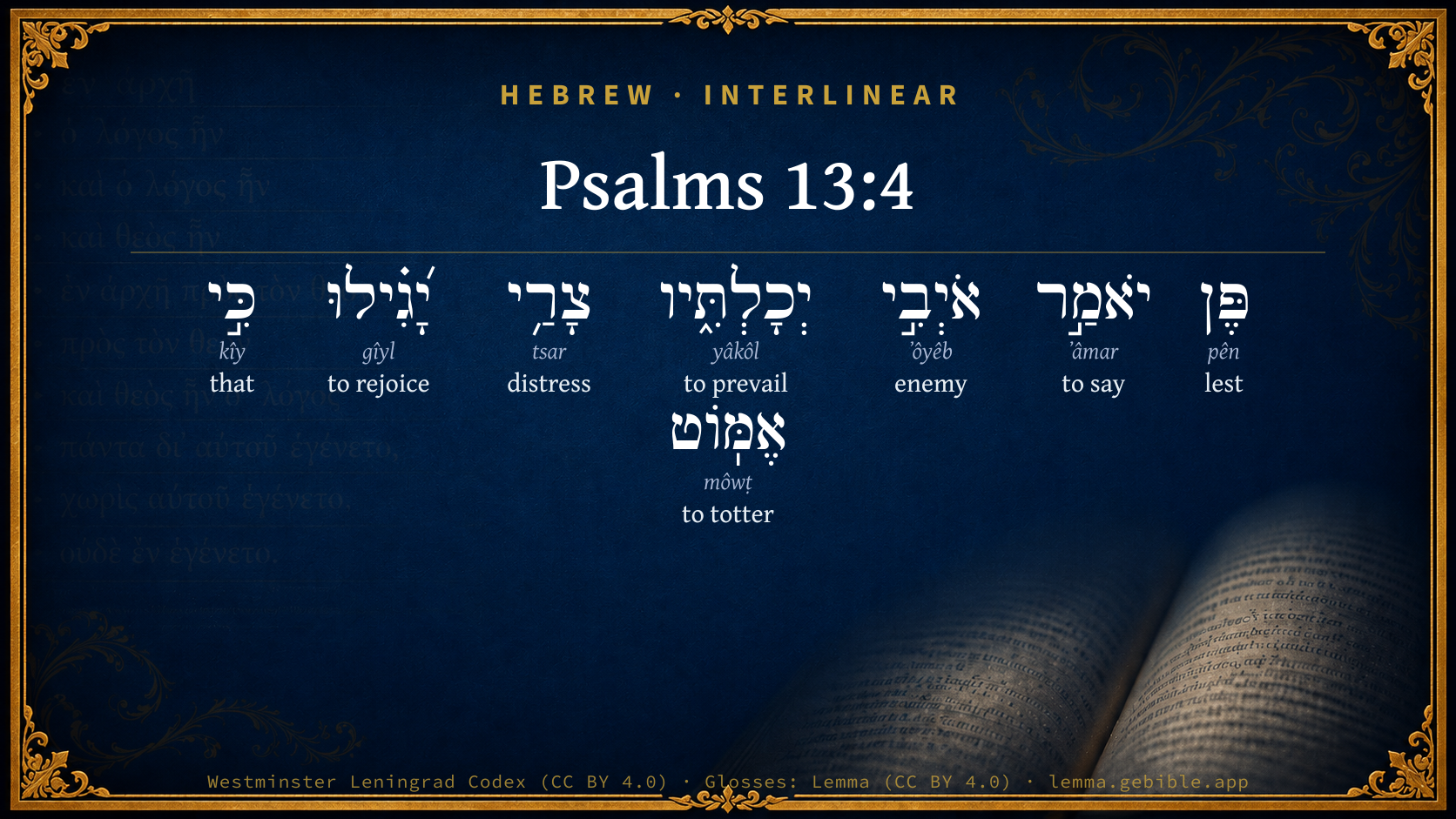
Psalms 13:4

Hebrew (Westminster Leningrad Codex) Psalms 13:4 appears in the Hebrew Old Testament. The text above is from the Westminster Leningrad Codex. Each word links to its Strong’s number, a concise gloss, and parsing drawn from the Open Scriptures Hebrew Bible morphology. Click any word for its full Brown-Driver-Briggs (BDB) entry.
Download image
Cite this verse

Psalms 13:4 (World English Bible). Public Domain. Lemma interlinear Bible study tool, https://lemma.gebible.app/v/psalms/13/4.

Show BibTeX & RIS
BibTeX
RIS
English Translation
Lest my enemy say, "I have prevailed against him;" Lest my adversaries rejoice when I fall.
World English Bible · Public Domain
Download a study sheet

One document with this verse’s original text, its word-by-word gloss line, the meaning frame, cross-references with their text, attributed commentary, and full source and license credits — printable, and it pastes into notes with its structure intact.

This verse Autodidact and up

Study sheet (.html) Plain text (.txt)

A passage Seminary Student

Up to 50 verses in one chapter. A passage sheet keeps up to 6 commentary sources and 12 cross-references per verse, in the order this page ranks them, and says so on the sheet whenever that leaves anything out. Ask for a single verse and you get the Autodidact verse sheet above.

Everything on this page stays free to read, with no account — the sheet is a download of what is already on screen, not access to it.

Want to remove ads? Support Godless Engineer
Compare translations 3

The same verse in 3 English versions, stacked beneath the original-language interlinear above. Click any original word for its lexicon entry.

Each is an independent rendering of the whole verse — the interlinear is not word-aligned to these translations.

Highlighted words mark where these versions differ — a whole-verse word diff, not a word-by-word alignment.

  • World English Bible Public Domain
    Lest my enemy say, "I have prevailed against him;" Lest my adversaries rejoice when I fall.
  • King James Version Public Domain
    Lest mine enemy say, I have prevailed against him; and those that trouble me rejoice when I am moved.
  • unfoldingWord Literal Text CC BY-SA 4.0
    Lest the one being hostile to me say, “I have prevailed over him,” my adversaries rejoice when I am shaken.

unfoldingWord Literal Text — © unfoldingWord, licensed CC BY-SA 4.0. Word-aligned USFM3 via Door43 (git.door43.org/unfoldingWord/en_ult).

Versions to compare (up to 4)

3 of 4 selected

Show all 18 translations

Every available English version of this verse, each an independent rendering of the whole verse.

  • World English Bible Public Domain
    Lest my enemy say, "I have prevailed against him;" Lest my adversaries rejoice when I fall.
  • Berean Standard Bible Public Domain
    lest my enemy say, “I have overcome him,” and my foes rejoice when I fall.
  • Majority Standard Bible Public Domain
    lest my enemy say, “I have overcome him,” and my foes rejoice when I fall.
  • King James Version Public Domain
    Lest mine enemy say, I have prevailed against him; and those that trouble me rejoice when I am moved.
  • American Standard Version (1901) Public Domain
    Lest mine enemy say, I have prevailed against him; `Lest' mine adversaries rejoice when I am moved.
  • Revised Version (1885) Public Domain
    Lest mine enemy say, I have prevailed against him; lest mine adversaries rejoice when I am moved.
  • Geneva Bible (1599) Public Domain
    Lest mine enemie say, I haue preuailed against him: and they that afflict me, reioyce when I slide.
  • Douay-Rheims (1899) Public Domain
    Consider, and hear me, O Lord my God. Enlighten my eyes that I never sleep in death:
  • Young's Literal Translation Public Domain
    Lest mine enemy say, `I overcame him,' Mine adversaries joy when I am moved.
  • Literal Standard Version CC BY-SA 4.0
    Lest my enemy say, “I overcame him,” || My adversaries rejoice when I am moved.
  • Unlocked Literal Bible CC BY-SA 4.0
    Do not let my enemy say, “I have defeated him,” so that my enemy may not say, “I have prevailed over my adversary”; otherwise, my enemies will rejoice when I am brought down.
  • unfoldingWord Literal Text CC BY-SA 4.0
    Lest the one being hostile to me say, “I have prevailed over him,” my adversaries rejoice when I am shaken.
  • Darby Bible Public Domain
    Lest mine enemy say, I have prevailed against him! [lest] mine adversaries be joyful when I am moved.
  • World Messianic Bible Public Domain
    lest my enemy say, “I have prevailed against him;” lest my adversaries rejoice when I fall.
  • Webster's Bible Public Domain
    Lest my enemy say, I have prevailed against him; and those that trouble me rejoice when I am moved.
  • Free Bible Version CC BY-SA 4.0
    and my enemy will say, “I defeated him!” and my opponents will celebrate my downfall.
  • Bible in Basic English Public Domain
    And he who is against me may not say, I have overcome him; and those who are troubling me may not be glad when I am moved.
  • JPS Tanakh (1917) Public Domain
    (13-5) Lest mine enemy say: 'I have prevailed against him'; lest mine adversaries rejoice when I am moved.

Literal Standard Version (2020), Covenant Press — licensed CC BY-SA 4.0. Text via the HelloAO Bible API (eBible.org). Unlocked Literal Bible (unfoldingWord) — licensed CC BY-SA 4.0. Text via the HelloAO Bible API (eBible.org). unfoldingWord Literal Text — © unfoldingWord, licensed CC BY-SA 4.0. Word-aligned USFM3 via Door43 (git.door43.org/unfoldingWord/en_ult). Free Bible Version, Dr. Jonathan Gallagher — licensed CC BY-SA 4.0. Text via the HelloAO Bible API (eBible.org).

Word by word

More ways to search: Search by grammar → Find every occurrence → Compare this word →

Practice this passage: Drill this verse → Learn its vocabulary →

About this verse

These counts appear in no published source. They are computed here, from the morphology-tagged text and Lemma’s own curated glosses. What Lemma adds →

8
words
8
distinct lemmas
Wisdom
section

Shared distinctive vocabulary

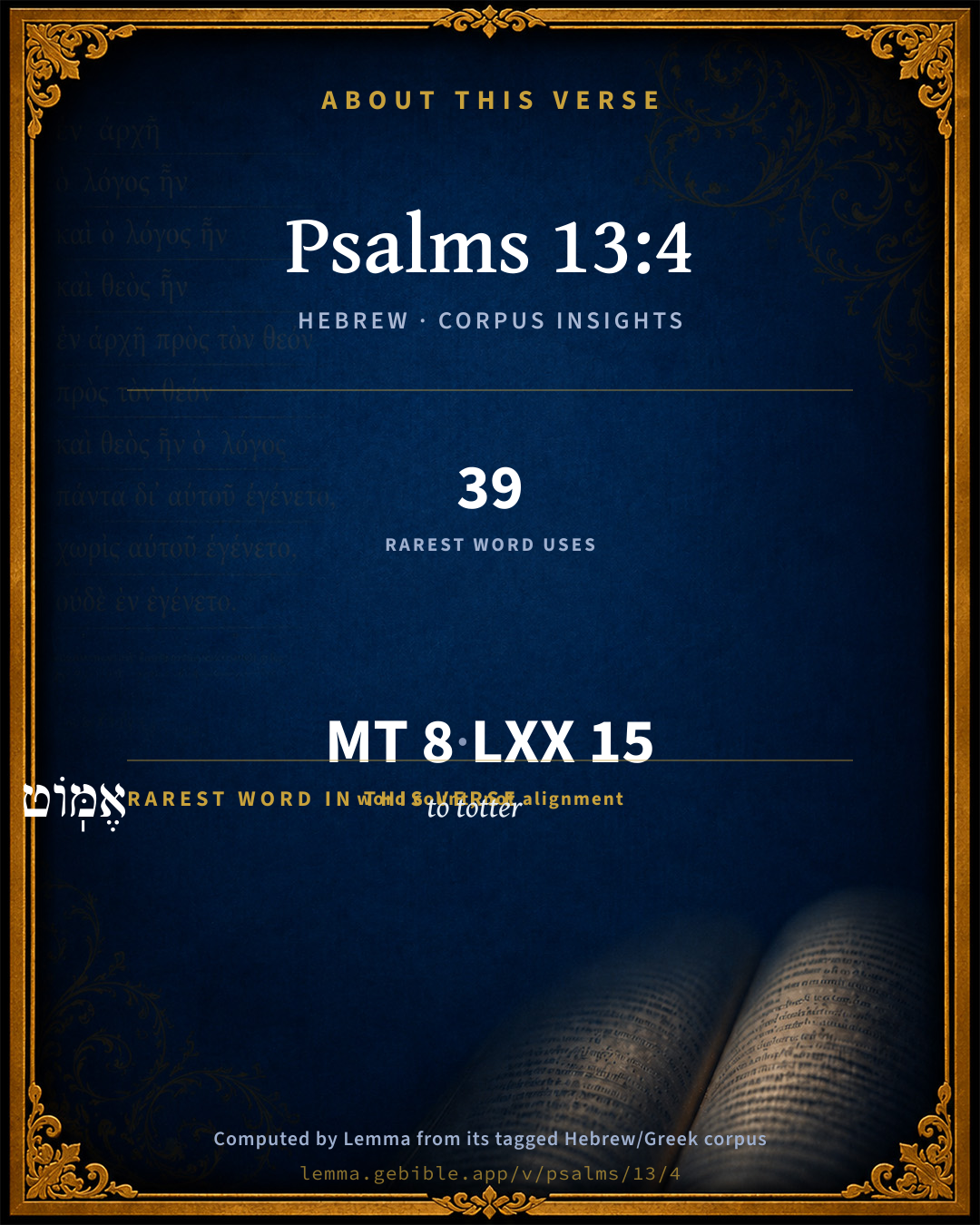
אֶמּֽוֹט to totter H4131 occurs in 36 verses of the Hebrew Bible. Also found in:

Grammatical profile

  • 5 verbs
  • 1 noun
  • 2 conjunctions

Verb forms

  • יֹאמַ֣ר Qal · Imperfect
  • אֹיְבִ֣י Qal · Participle Active
  • יְכָלְתִּ֑יו Qal · Perfect
  • יָ֝גִ֗ילוּ Qal · Imperfect
  • אֶמּֽוֹט Niphal · Imperfect

Hebrew & Septuagint length

In English translation the verse runs 16 words from the Hebrew and 22 from the Septuagint (LXX English) — closely comparable.

A rough comparison of the two English renderings, which tokenize alike — not a word-level alignment.

Word counts can differ between the Hebrew and the Greek without any difference in meaning — e.g. the Hebrew direct-object marker אֵת has no separate Greek word, and Greek often adds the article ὁ.

In the original languages it is 8 Hebrew tokens and 15 Greek tokens — but the two are counted differently (Hebrew bundles its prefixes and suffixes into one token; the Greek is in lemma form), so that isn’t a like-for-like length.

Cross-references

16

Topical passages linked to Psalms 13:4 in the Treasury of Scripture Knowledge — connected by theme and wording, ordered by reader-vote popularity; previews shown in the World English Bible.

  • Psalms 25:2 My God, I have trusted in you, Don't let me be shamed. Don't let my enemies triumph over me.
  • Jeremiah 1:19 They shall fight against you; but they shall not prevail against you: for I am with you, says Yahweh, to deliver you.
  • Proverbs 12:3 A man shall not be established by wickedness, But the root of the righteous shall not be moved.
  • Psalms 62:6 He alone is my rock and my salvation, my fortress. I will not be shaken.
  • Joshua 7:9 For the Canaanites and all the inhabitants of the land will hear of it, and will compass us round, and cut off our name from the earth: and what will you do for your great name?
  • Psalms 38:16 For I said, "Don't let them gloat over me, Or exalt themselves over me when my foot slips."
  • Lamentations 1:16 For these things I weep; my eye, my eye runs down with water; Because the comforter who should refresh my soul is far from me: My children are desolate, because the enemy has prevailed.
  • Psalms 9:19 Arise, Yahweh! Don't let man prevail. Let the nations be judged in your sight.
  • Psalms 10:11 He says in his heart, "God has forgotten. He hides his face. He will never see it."
  • Psalms 35:19 Don't let those who are my enemies wrongfully rejoice over me; Neither let them wink with the eye who hate me without a cause.
  • Psalms 35:25 Don't let them say in their heart, "Aha! That's the way we want it!" Don't let them say, "We have swallowed him up!"
  • Psalms 55:22 Cast your burden on Yahweh, and he will sustain you. He will never allow the righteous to be moved.
  • Psalms 62:2 He alone is my rock and my salvation, my fortress-- I will never be greatly shaken.
  • Psalms 112:6 For he will never be shaken. The righteous will be remembered forever.
  • Psalms 121:1–3 I will lift up my eyes to the hills. Where does my help come from?
  • Ezekiel 35:12–15 You shall know that I, Yahweh, have heard all your insults which you have spoken against the mountains of Israel, saying, They are laid desolate, they are given us to devour.

Cross-references courtesy of OpenBible.info (CC BY 4.0).

Hebrew and Greek witnesses Masoretic Hebrew ↔ Greek Septuagint

The same verse in the two great witnesses to the Old Testament, shown verse-for-verse.

You’re reading Greek Psalm 12 (Hebrew Psalm 13). The Septuagint counts the superscription, so verse numbers can differ from the Hebrew — chapter-level alignment, not verse-by-verse. Numbering follows Rahlfs.

These are two independent witnesses, not word-aligned to each other, and the Septuagint is shown in lemma (dictionary) form.

Hebrew Psalms 13:4 Masoretic · Westminster Leningrad Codex

פֶּן יֹאמַ֣ר אֹיְבִ֣י יְכָלְתִּ֑יו צָרַ֥י יָ֝גִ֗ילוּ כִּ֣י אֶמּֽוֹט

Lest my enemy say, "I have prevailed against him;" Lest my adversaries rejoice when I fall.

World English Bible · Public Domain

Greek LXX Greek Psalm 12:4 Septuagint · lemma form

ἐπιβλέπω εἰςἀκούω ἐγώ κύριος ὁ θεός ἐγώ φωτίζω ὁ ὀφθαλμός ἐγώ μήποτε ὑπνόω εἰς θάνατος

lest at any time my enemy say, I have prevailed against him: my persecutors will exult if ever I should be moved.

LXX2012 (modern English Septuagint) · Public Domain

Hebrew: Westminster Leningrad Codex (CC BY 4.0). Greek: Septuagint (public domain); English from LXX2012 (modern English Septuagint) (Public Domain). How the Septuagint differs from the Hebrew →

Commentary

Notes on Psalms 13:4 from classic Christian and Jewish commentators (each source and its license shown beneath its notes). The classic Christian expositions comment on the surrounding passage and are grouped to its opening verse, so a note may address several verses; the Jewish commentaries on the Tanakh (Rashi and others) are per-verse, so they appear only where the commentator wrote on this verse.

Lemma curates 59 commentaries, every one of them public domain or Creative Commons licensed, each selected and text-cleaned for this edition rather than reprinted as found. About our sources →

Trapp's Complete Commentary

John Trapp

Psa 13:4 Lest mine enemy say, I have prevailed against him; [and] those that trouble me rejoice when I am moved.

Ver. 4. Lest mine enemy say, I have prevailed against him] This David frequently deprecateth as a great evil, because God’s honour was concerned in it, and would suffer by it. As unskilful hunters, shooting at wild beasts, do sometimes kill a man; so persecutors, shooting at saints, hit Christ, reproach him; and this the saints are very aware of.

And those that trouble me rejoice when I am moved] Compose comedies out of my tragedies, et iram Dei ad calumniam rapiant. The wicked are vindictive and implacable, sick of the devil’s disease, επιχαιρεκακια, rejoicing at other men’s harms, revelling in other men’s ruins; but this is to enrage God, and hasten wrath, Pro 24:17-18.

John Trapp, A Commentary or Exposition upon All the Books of the Old and New Testament (1647–1656) — public domain. Text from a community e-Sword module.

Geneva Bible (1599)

Geneva Bible translators

Which might turn to God’s dishonor: if he did not defend his.

Geneva Bible (1599) marginal notes — public domain. Text via Bolls.life.

Jamieson, Fausset & Brown

Robert Jamieson, A. R. Fausset & David Brown

rejoice--literally, "shout as in triumph."

I am moved--cast down from a firm position (Psa 10:6).

Jamieson, Fausset & Brown — Commentary Critical and Explanatory on the Whole Bible (1871) — public domain (CC PDM 1.0). Text via the HelloAO Bible API.

Adam Clarke's Commentary

Verse 4. Let mine enemy say] Satan's ordinary method in temptation is to excite strongly to sin, to blind the understanding and inflame the passions; and when he succeeds, he triumphs by insults and reproaches. None so ready then to tell the poor soul how deeply, disgracefully, and ungratefully it has sinned! Reader, take heed.

When I am moved.] When moved from my steadfastness and overcome by sin. O what desolation is made by the fall of a righteous soul! Itself covered with darkness and desolation, infidels filled with scoffing, the Church clad in mourning, the Spirit of God grieved, and Jesus crucified afresh, and put to an open shame! O God, save the pious reader from such wreck and ruin!

Adam Clarke's Commentary on the Bible (1810–1826) — public domain. Text from a community e-Sword/MySword module.

John Calvin's Commentaries

4. Lest my enemy. David again repeats what he had a little before said concerning the pride of his enemies, namely, how it would be a thing ill becoming the character of God were he to abandon his servant to the mockery of the ungodly. David’s enemies lay, as it were, in ambush watching the hour of his ruin, that they might deride him when they saw him fall. And as it is the peculiar office of God to repress the audacity and insolence of the wicked, as often as they glory in their wickedness, David beseeches God to deprive them of the opportunity of indulging in such boasting. It is, however, to be observed, that he had in his conscience a sufficient testimony to his own integrity, and that he trusted also in the goodness of his cause, so that it would have been unbecoming and unreasonable had he been left without succor in danger, and had he been overwhelmed by his enemies. We can, therefore, with confidence pray for ourselves, in the manner in which David here does for himself, only when we fight under the standard of God, and are obedient to his orders, so that our enemies cannot obtain the victory over us without wickedly triumphing over God himself.

John Calvin's Commentaries (1540-1563) — public domain. Text from the Calvin Translation Society English edition (1840s-50s) via the Christian Classics Ethereal Library (ccel.org). Calvin's coverage is partial (roughly two-thirds of the Bible); uncommented books and verses are honest gaps, never fabricated. The 19th-century editor's footnotes and remarks are omitted so the notes are faithfully Calvin's own voice.

The Cambridge Bible for Schools and Colleges

gen. ed. J. J. S. Perowne

4. and those &c.] R.V., Lest mine adversaries rejoice when I am moved. Cp. Psa_38:16. And by their triumph, as the emphatic contrast of the following verse implies, the honour of God Whom he trusts will suffer.

The Cambridge Bible for Schools and Colleges (gen. ed. J. J. S. Perowne; Cambridge University Press, 1878–1918) — public domain. Text from a community e-Sword module.

John Gill's Exposition

Lest mine enemy say, I have prevailed against him,.... Which is an argument God takes notice of; and for which reason he does not give up his people into the hands of their enemies; see Deu 32:27. The Chaldee paraphrase interprets this of the evil imagination or corruption of nature, and represents it as a person, as the Apostle Paul does in Rom 7:15; and which may be said to prevail, when it pushes on to sin, and hinders doing good, and carries captive; and it may be applied to Satan, the great enemy of God's people, who triumphs over them, when he succeeds in his temptations;

and those that trouble me rejoice when I am moved; meaning from his house and family, from his country and kingdom, from a prosperous state and condition to a distressed one; at which the troublers of David's peace would rejoice. They that trouble the saints are sin, Satan, and the world; and the two last rejoice when they are in an uncomfortable and afflicted condition; and especially Satan rejoices when he gains his point, if it is but to move them from any degree of steadfastness, of faith and hope, or from the ways of God in any respect: the Targum adds, "from thy ways"; for to be moved so as to perish eternally they cannot, being built upon the Rock of ages, and surrounded by the power and grace of God.

John Gill's Exposition of the Whole Bible (1746–1763) — public domain (CC PDM 1.0). Text via the HelloAO Bible API.

Albert Barnes' Notes on the Bible

Lest mine enemy say, I have prevailed against him - I have overpowered him; I have conquered him. That is, to triumph over him as having obtained a complete victory.

And those that trouble me - Hebrew, “My adversaries.” The reference here is the same as in the former member of the verse. It is to the enemies that seemed almost to have triumphed over him already, and under whose power he was ready to sink. “Rejoice.” Exult; triumph.

When I am moved - Moved from my steadfastness or firmness; when I am overcome. Hitherto he had been able to hold out against them; now he began to despair, and to fear that they would accomplish their object by overcoming and subduing him. His ground of apprehension and of appeal was, that by his being vanquished the cause in which he was engaged would suffer, and that the enemies of religion would triumph.

Albert Barnes' Notes on the Bible (1834–1885) — public domain. Text from a community e-Sword/MySword module.

Matthew Poole's English Annotations

I have prevailed against him, to wit, by my art or strength; which will reflect dishonour upon thee, as if thou wept either unfaithful and unmindful of thy promises, or unable to make them good. Therefore repress this their arrogancy and blasphemy, and maintain thine own honour.

When I am moved; or, stumble, or fall, to wit, into mischief.

Matthew Poole's English Annotations on the Holy Bible (1683–1685) — public domain. Text from a community e-Sword/MySword module.

The Treasury of David

Charles H. Spurgeon

Ver. 4. Another plea is urged in the fourth verse, and it is one which the tried believer may handle well when on his knees. We make use of our arch enemy for once, and compel him, like Samson, to grind in our mill while we use his cruel arrogance as an argument in prayer. It is not the Lord's will that the great enemy of our souls should overcome his children. This would dishonour God, and cause the evil one to boast. It is well for us that our salvation and God's honour are so intimately connected, that they stand or fall together.

Our covenant God will complete the confusion of all our enemies, and if for awhile we become their scoff and jest, the day is coming when the shame will change sides, and the contempt shall be poured on those to whom it is due.

Ver. 4.

Ah! can you bear contempt; the venomed tongue Of those whom ruin pleases, the keen sneer, The lewd reproaches of the rascal herd; Who for the selfsame actions, if successful, Would be as grossly lavish in your praise? To sum up all in onecan you support The scornful glances, the malignant joy, Or more, detested pity of a rival Of a triumphant rival?

James Thomson, 1700-1748.

Ver. 4. And those that trouble me rejoice when I am moved compose comedies out of my tragedies. John Trapp.

Ver. 4. Note the nature of the wicked two ways; namely, the more they prevail the more insolent they are; they wonderfully exult over those that are afflicted. T. Wilcocks.

Psalms 13:5*

Charles H. Spurgeon's The Treasury of David (1869–1885) — public domain. Psalms only. Text from a community e-Sword/MySword module.

Whedon's Commentary on the Bible

Daniel D. Whedon

4. Lest mine enemy say—Not only is his own life in danger, but a further reason for divine interference is the reproach that would otherwise fall upon the cause of God. The psalmist’s overthrow would be the triumph of unrighteousness.

Daniel D. Whedon (gen. ed.), Commentary on the Old and New Testaments (1874–1909) — public domain. Text from a community e-Sword module.

The Pulpit Commentary

Lest mine enemy say, I have prevailed against him. The triumph of David"s enemy over him, whether he were Saul or any one else, even the ideal wicked man, would be the triumph of evil over good, of those who had cast God behind their back over those who faithfully served him, of irreligion over piety. He could therefore appeal to God not in his own personal interest, but in the interest of truth and right, and the general good of mankind to prevent his enemy"s triumph. And those that trouble me rejoice when I am moved. There would be a general rejoicing on the part of all his foes, if his arch-enemy succeeded in seriously injuring him.

The Pulpit Commentary (1880–1919), ed. H.D.M. Spence-Jones & Joseph S. Exell — public domain. Text from a community e-Sword module.

J. A. Alexander on Psalms

Joseph Addison Alexander

5. (Psa 15:4). Lest my enemy say, I have overpowered him (and) my adversaries shout when I am shaken, or because I shall be shaken.—The verb here strictly means, I have been able. The unusual construction with a pronoun cannot be literally rendered into English, but the meaning evidently is, I have been able (to subdue) him, or, I have been strong (in comparison with) him. As to the combination of the singular and plural (enemy and adversaries), see above, on Psa 10:11 (10).—Shout, i.e. for joy, or in a and single word, triumph. See above, on Psa 2:11.—The last verb has the same sense as in Psa 10:6, viz., that of being moved or cast down from one's firm position.

Joseph Addison Alexander, The Psalms Translated and Explained (1850) — public domain. Text from a community e-Sword module.

Rashi

Rabbi Shlomo Yitzchaki (Rashi)

lest I sleep the sleep of death For death is called sleep, (as in Jer. 51:39): “and sleep a perpetual sleep.”

Rashi on the Tanakh — English translations: “The Judaica Press complete Tanach with Rashi, translated by A. J. Rosenberg” (CC BY 4.0); “Pentateuch with Rashi's commentary by M. Rosenbaum and A.M. Silbermann, 1929-1934” (public domain); “The Metsudah Tanach series, Lakewood, N.J” (CC BY 4.0); and “The Book of Joshua, Metsudah Publications, 1997” (CC BY 4.0). Text via Sefaria.

Lesson kit

Teaching starters — assembled from the data on this page, not authored interpretation. Every prompt links to the verse data it draws on. Edit before teaching.

Psalms, in the Wisdom, opens this verse with 8 words (8 distinct Hebrew lemmas). Its most distinctive word is môwṭ (“to totter”). A historical commentator’s framing appears above. Read the whole chapter for the surrounding context.

Discussion questions

  1. The word môwṭ carries the sense “to totter.” How does it shape the verse?
  2. Leviticus 25:35 shares the word «to totter» with this verse. How do the two illuminate each other?
  3. These translations render this verse differently. What is at stake in choosing one wording over another?
  4. The verb «יֹאמַ֣ר» is Qal Imperfect. How does its form color the action?
  5. Reading how Trapp's Complete Commentary and Geneva Bible (1599) read this verse, where do the two commentators agree and where do they part?

Things to notice

Reading settings

Reading text

Shown beneath each verse's original-language words.

Old Testament
Old Testament edition

Read the OT as the Masoretic Hebrew (MT) or the Greek Septuagint (LXX).

English shown for the Greek Septuagint (in the Hebrew ↔ Greek comparison).

Comparing translations? Open the Compare panel on any verse page to stack up to four side by side.