
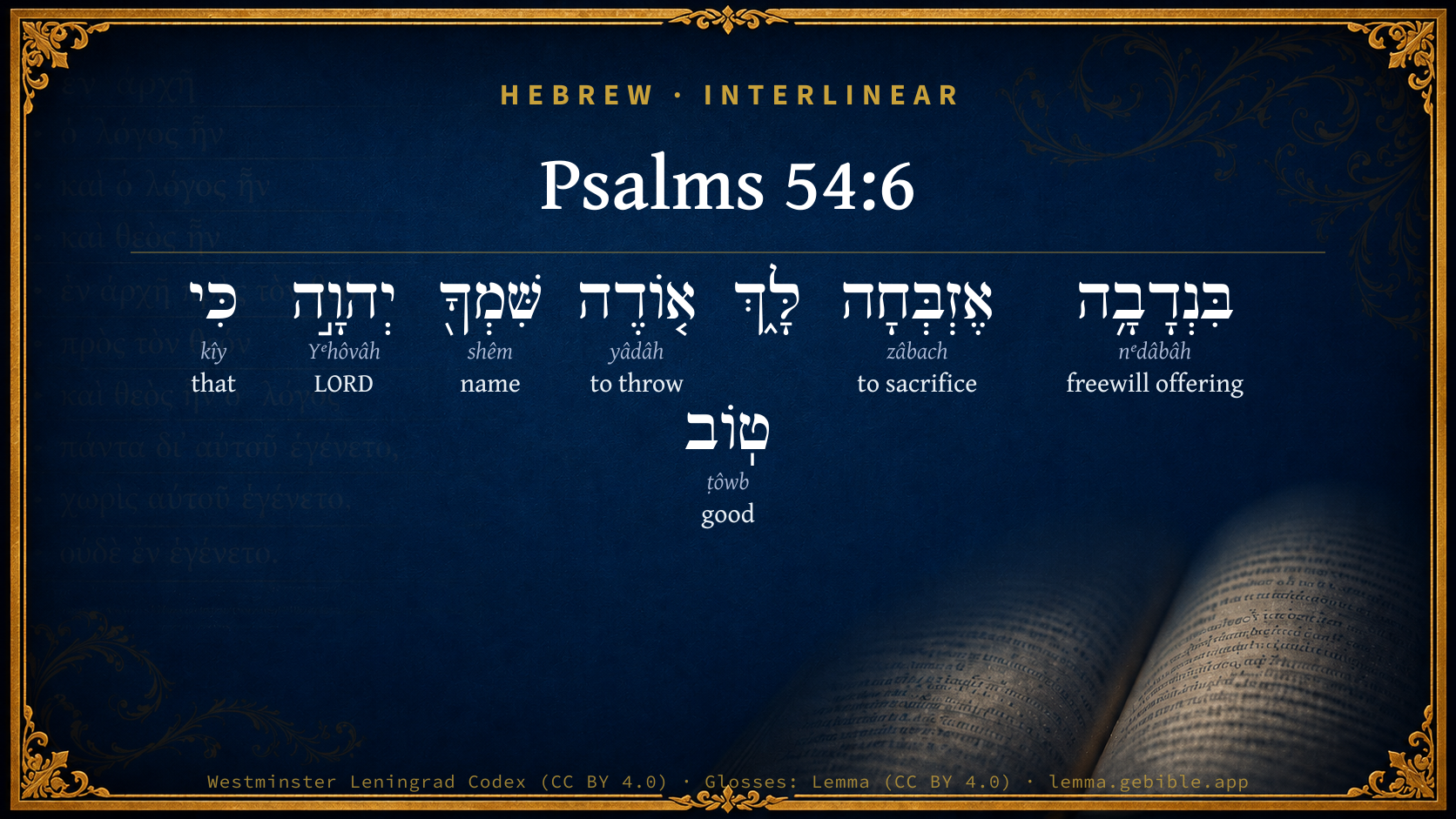
Psalms 54:6

Hebrew (Westminster Leningrad Codex) Psalms 54:6 appears in the Hebrew Old Testament. The text above is from the Westminster Leningrad Codex. Each word links to its Strong’s number, a concise gloss, and parsing drawn from the Open Scriptures Hebrew Bible morphology. Click any word for its full Brown-Driver-Briggs (BDB) entry.
Download image
Cite this verse

Psalms 54:6 (World English Bible). Public Domain. Lemma interlinear Bible study tool, https://lemma.gebible.app/v/psalms/54/6.

Show BibTeX & RIS
BibTeX
RIS
English Translation
With a free will offering, I will sacrifice to you. I will give thanks to your name, Yahweh, for it is good.
World English Bible · Public Domain
Download a study sheet

One document with this verse’s original text, its word-by-word gloss line, the meaning frame, cross-references with their text, attributed commentary, and full source and license credits — printable, and it pastes into notes with its structure intact.

This verse Autodidact and up

Study sheet (.html) Plain text (.txt)

A passage Seminary Student

Up to 50 verses in one chapter. A passage sheet keeps up to 6 commentary sources and 12 cross-references per verse, in the order this page ranks them, and says so on the sheet whenever that leaves anything out. Ask for a single verse and you get the Autodidact verse sheet above.

Everything on this page stays free to read, with no account — the sheet is a download of what is already on screen, not access to it.

Want to remove ads? Support Godless Engineer
Compare translations 3

The same verse in 3 English versions, stacked beneath the original-language interlinear above. Click any original word for its lexicon entry.

Each is an independent rendering of the whole verse — the interlinear is not word-aligned to these translations.

Highlighted words mark where these versions differ — a whole-verse word diff, not a word-by-word alignment.

  • World English Bible Public Domain
    With a free will offering, I will sacrifice to you. I will give thanks to your name, Yahweh, for it is good.
  • King James Version Public Domain
    I will freely sacrifice unto thee: I will praise thy name, O LORD; for it is good.
  • unfoldingWord Literal Text CC BY-SA 4.0
    With a freewill offering, I will sacrifice to you. I will praise your name, Yahweh, for good.

unfoldingWord Literal Text — © unfoldingWord, licensed CC BY-SA 4.0. Word-aligned USFM3 via Door43 (git.door43.org/unfoldingWord/en_ult).

Versions to compare (up to 4)

3 of 4 selected

Show all 18 translations

Every available English version of this verse, each an independent rendering of the whole verse.

  • World English Bible Public Domain
    With a free will offering, I will sacrifice to you. I will give thanks to your name, Yahweh, for it is good.
  • Berean Standard Bible Public Domain
    Freely I will sacrifice to You; I will praise Your name, O LORD, for it is good.
  • Majority Standard Bible Public Domain
    Freely I will sacrifice to You; I will praise Your name, O LORD, for it is good.
  • King James Version Public Domain
    I will freely sacrifice unto thee: I will praise thy name, O LORD; for it is good.
  • American Standard Version (1901) Public Domain
    With a freewill-offering will I sacrifice unto thee: I will give thanks unto thy name, O Jehovah, for it is good.
  • Revised Version (1885) Public Domain
    With a freewill offering will I sacrifice unto thee: I will give thanks unto thy name, O LORD, for it is good.
  • Geneva Bible (1599) Public Domain
    Then I will sacrifice freely vnto thee: I wil praise thy Name, O Lord, because it is good.
  • Douay-Rheims (1899) Public Domain
    For behold God is my helper: and the Lord is the protector of my soul.
  • Young's Literal Translation Public Domain
    With a free will-offering I sacrifice to Thee, I thank Thy name, O Jehovah, for `it is' good,
  • Literal Standard Version CC BY-SA 4.0
    I sacrifice to You with a free-will offering, || I thank Your Name, O YHWH, for [it is] good,
  • Unlocked Literal Bible CC BY-SA 4.0
    I will sacrifice to you with a freewill offering; I will give thanks to your name, Yahweh, for it is good.
  • unfoldingWord Literal Text CC BY-SA 4.0
    With a freewill offering, I will sacrifice to you. I will praise your name, Yahweh, for good.
  • Darby Bible Public Domain
    I will freely sacrifice unto thee; I will praise thy name, O Jehovah, because it is good.
  • World Messianic Bible Public Domain
    With a free will offering, I will sacrifice to you. I will give thanks to your name, LORD, for it is good.
  • Webster's Bible Public Domain
    \\54:4\\Behold, God is my helper: the Lord is with them that uphold my soul.
  • Free Bible Version CC BY-SA 4.0
    I will happily offer a sacrifice to you; I will praise the kind of person you are, Lord, for you are good.
  • Bible in Basic English Public Domain
    Freely will I make my offerings to you; I will give praise to your name, O Lord, for it is good.
  • JPS Tanakh (1917) Public Domain
    (54-8) With a freewill-offering will I sacrifice unto Thee; I will give thanks unto Thy name, O LORD, for it is good.

Literal Standard Version (2020), Covenant Press — licensed CC BY-SA 4.0. Text via the HelloAO Bible API (eBible.org). Unlocked Literal Bible (unfoldingWord) — licensed CC BY-SA 4.0. Text via the HelloAO Bible API (eBible.org). unfoldingWord Literal Text — © unfoldingWord, licensed CC BY-SA 4.0. Word-aligned USFM3 via Door43 (git.door43.org/unfoldingWord/en_ult). Free Bible Version, Dr. Jonathan Gallagher — licensed CC BY-SA 4.0. Text via the HelloAO Bible API (eBible.org).

Word by word

More ways to search: Search by grammar → Find every occurrence → Compare this word →

Practice this passage: Drill this verse → Learn its vocabulary →

About this verse

These counts appear in no published source. They are computed here, from the morphology-tagged text and Lemma’s own curated glosses. What Lemma adds →

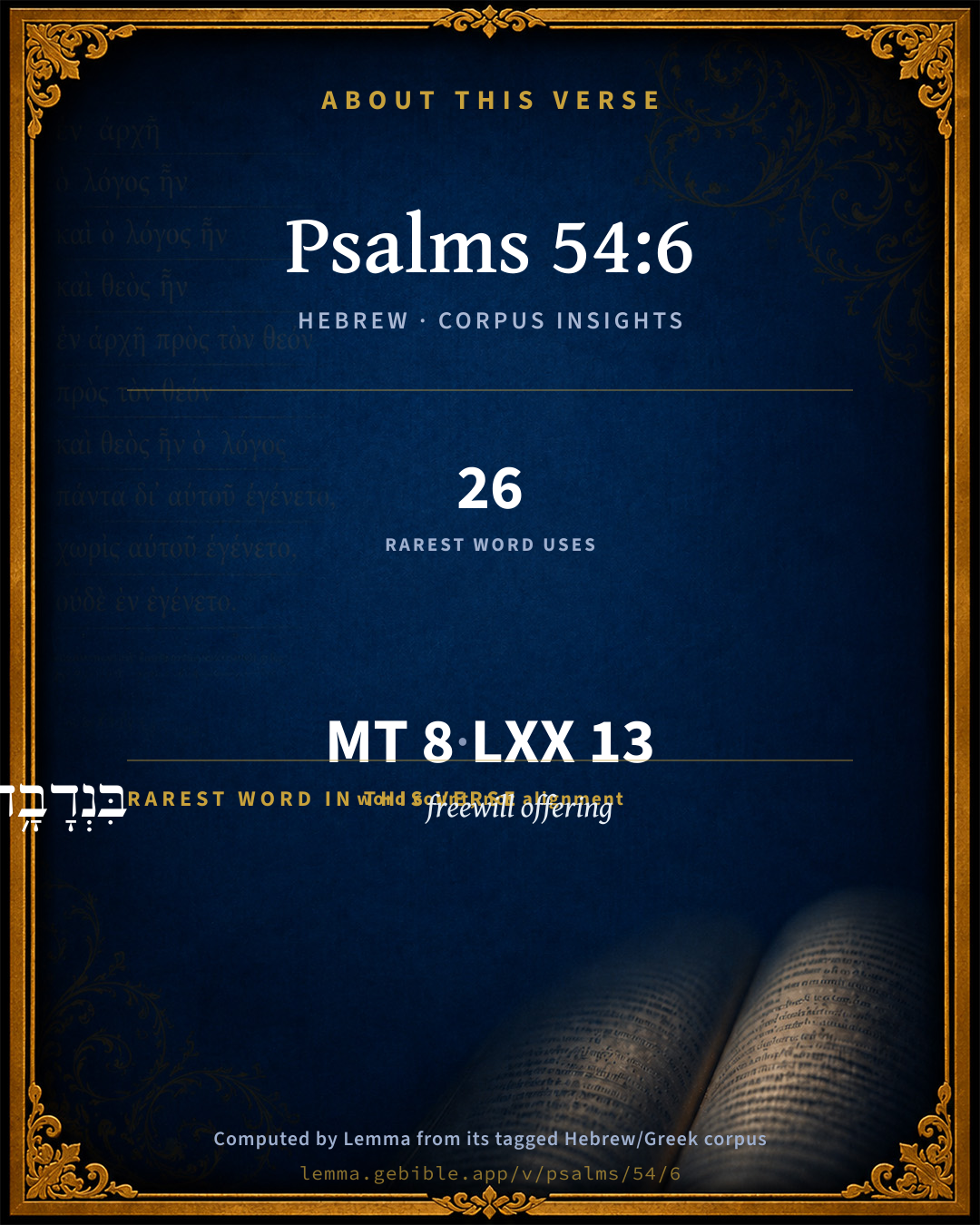
8
words
7
distinct lemmas
Wisdom
section

Shared distinctive vocabulary

בִּנְדָבָ֥ה freewill offering H5071 occurs in 25 verses of the Hebrew Bible. Also found in:

Grammatical profile

  • 2 verbs
  • 3 nouns
  • 1 adjective
  • 1 preposition
  • 1 conjunction

Verb forms

  • אֶזְבְּחָה Qal · Cohortative
  • א֤וֹדֶה Hiphil · Imperfect

Hebrew & Septuagint length

In English translation the verse runs 22 words from the Hebrew and 19 from the Septuagint (LXX English) — closely comparable.

A rough comparison of the two English renderings, which tokenize alike — not a word-level alignment.

Word counts can differ between the Hebrew and the Greek without any difference in meaning — e.g. the Hebrew direct-object marker אֵת has no separate Greek word, and Greek often adds the article ὁ.

In the original languages it is 8 Hebrew tokens and 13 Greek tokens — but the two are counted differently (Hebrew bundles its prefixes and suffixes into one token; the Greek is in lemma form), so that isn’t a like-for-like length.

Cross-references

11

Topical passages linked to Psalms 54:6 in the Treasury of Scripture Knowledge — connected by theme and wording, ordered by reader-vote popularity; previews shown in the World English Bible.

  • Psalms 52:9 I will give you thanks forever, because you have done it. I will hope in your name, for it is good, In the presence of your saints.
  • Psalms 140:13 Surely the righteous will give thanks to your name. The upright will dwell in your presence.
  • Psalms 147:1 Praise Yah, For it is good to sing praises to our God; For it is pleasant and fitting to praise him.
  • Psalms 7:17 I will give thanks to Yahweh according to his righteousness, And will sing praise to the name of Yahweh Most High.
  • Deuteronomy 12:6–7 and there you shall bring your burnt offerings, and your sacrifices, and your tithes, and the heave-offering of your hand, and your vows, and your freewill-offerings, and the firstborn of your herd and of your flock:
  • Psalms 107:22 Let them offer the sacrifices of thanksgiving, And declare his works with singing.
  • Psalms 21:13 Be exalted, Yahweh, in your strength, So we will sing and praise your power.
  • Psalms 92:1 It is a good thing to give thanks to Yahweh, To sing praises to your name, Most High;
  • Psalms 116:17 I will offer to you the sacrifice of thanksgiving, And will call on the name of Yahweh.
  • Psalms 50:14 Offer to God the sacrifice of thanksgiving. Pay your vows to the Most High.
  • Psalms 66:13–16 I will come into your temple with burnt offerings. I will pay my vows to you,

Cross-references courtesy of OpenBible.info (CC BY 4.0).

Hebrew and Greek witnesses Masoretic Hebrew ↔ Greek Septuagint

The same verse in the two great witnesses to the Old Testament, shown verse-for-verse.

You’re reading Greek Psalm 53 (Hebrew Psalm 54). The Septuagint counts the superscription, so verse numbers can differ from the Hebrew — chapter-level alignment, not verse-by-verse. Numbering follows Rahlfs.

These are two independent witnesses, not word-aligned to each other, and the Septuagint is shown in lemma (dictionary) form.

Hebrew Psalms 54:6 Masoretic · Westminster Leningrad Codex

בִּנְדָבָ֥ה אֶזְבְּחָה לָּ֑ךְ א֤וֹדֶה שִּׁמְךָ֖ יְהוָ֣ה כִּי טֽוֹב

With a free will offering, I will sacrifice to you. I will give thanks to your name, Yahweh, for it is good.

World English Bible · Public Domain

Greek LXX Greek Psalm 53:6 Septuagint · lemma form

ἰδού γάρ ὁ θεός βοηθέω ἐγώ καί ὁ κύριος ἀντιλήμπτωρ ὁ ψυχή ἐγώ

I will willingly sacrifice to you: I will give thanks to your name, O Lord; for it is good.

LXX2012 (modern English Septuagint) · Public Domain

On this verse, The Cambridge Bible for Schools and Colleges discusses the Septuagint’s reading. Read the note in Commentary ↓

Hebrew: Westminster Leningrad Codex (CC BY 4.0). Greek: Septuagint (public domain); English from LXX2012 (modern English Septuagint) (Public Domain). How the Septuagint differs from the Hebrew →

Commentary

Notes on Psalms 54:6 from classic Christian and Jewish commentators (each source and its license shown beneath its notes). The classic Christian expositions comment on the surrounding passage and are grouped to its opening verse, so a note may address several verses; the Jewish commentaries on the Tanakh (Rashi and others) are per-verse, so they appear only where the commentator wrote on this verse.

Lemma curates 59 commentaries, every one of them public domain or Creative Commons licensed, each selected and text-cleaned for this edition rather than reprinted as found. About our sources →

Trapp's Complete Commentary

John Trapp

Psa 54:6 I will freely sacrifice unto thee: I will praise thy name, O LORD; for [it is] good.

Ver. 6. I will freely sacrifice unto thee] Or, liberally; not with an ill will and pinchingly. The Arabic rendereth it, Laudabo te obediens. Praise is the best sacrifice, and obedience is the best praise.

I will praise thy name, O Lord; for it is good] Thy name is good, and it is a good thing to praise it; for thereby men do thee right, help thee to thine own, secure to themselves former favours, and procure future.

John Trapp, A Commentary or Exposition upon All the Books of the Old and New Testament (1647–1656) — public domain. Text from a community e-Sword module.

The Biblical Illustrator

Joseph S. Exell

Psa_54:6-7

I will freely sacrifice unto Thee: I will praise Thy name, O Lord, for it is good.

Thank-offerings

The closing verses of this simple little psalm touch very familiar notes. The faith which has prayed has grown so sure of answer that is already begins to think of the thank-offerings. This is not like the superstitious vow, I will give so-and-so if Jupiter--or the Virgin--will hear me. This praying man knows that he is heard, and is not so much vowing as joyfully anticipating his glad sacrifice. The same incipient personification of the name as in Psa_54:1 is very prominent in the closing strains. Thank-offerings--not merely statutory and obligatory, but brought by free, uncommanded impulse--are to be offered to Thy name, because that name is good. Verse 7 probably should be taken as going even further in the same direction of personification, for Thy name is probably to be taken as the subject of hath delivered. The Senses of the verbs in Psa_54:7 are perfects. They contemplate the deliverance as already accomplished. Faith sees the future as present. This psalmist, surrounded by strangers seeking his life, can quietly stretch out a hand of faith, and bring near to himself the to-morrow when he will look back on scattered enemies and present, glad sacrifices! That power of drawing a brighter future into a dark present belongs not to those who build anticipations on wishes, but to those who found their forecasts on Gods known purposes and character. The name is a firm foundation for hope. There is no other. (A. Maclaren, D. D.)

.

Psa_55:1-23

The Biblical Illustrator, edited by Joseph S. Exell (c. 1880s–1900s) — public domain. Text from a community e-Sword module.

Joseph Benson's Commentary

Psa 54:6-7. I will freely sacrifice, &c. — Not by constraint, as many do, because they are obliged to do it, and cannot neglect it without shame and inconvenience to themselves; but with a willing and cheerful mind, which thou lovest in and above all sacrifices. I will praise thy name, for it is good — Thy name is not only great, but good, and therefore to be praised. And to praise thy name is not only our duty, but our interest and our happiness. It is pleasant and profitable; good for us, as well as reasonable, just, and good in itself. For he hath delivered me out of all trouble — Hebrew, מכל צרה, michal tzarah, from every strait. Or, as the Seventy render it, εκ πασης θλιψεως, out of every affliction. He speaks of his deliverance as already effected, either to express his assurance of it, or because this Psalm was made after it was wrought. And mine eye hath seen his desire upon mine enemies — Not seen them cut off and ruined, but forced to retreat; tidings being brought to Saul that the Philistines had invaded the land, 1Sa 23:27-28. All that David desired was to see himself safe: and when he saw Saul draw off his forces, he saw his desire. The words, his desire, however, are not in the Hebrew, which may be properly rendered, mine eye hath looked upon mine enemies, that is, “mine enemies came near enough to be seen by me, and that was all. God kept them from coming near me, so that they have all been disappointed of their prey.” This was the very case with David. He saw his enemies with pleasure at a distance, and he enjoyed the sight; especially when they marched off and left him to escape. His deliverance was great, and was manifestly the work of God, and he gave God the glory of it.

Joseph Benson's Commentary on the Old and New Testaments (1811–1818) — public domain. Text from a community e-Sword module.

J. A. Alexander on Psalms

Joseph Addison Alexander

8. (Psa 54:6). With a free-will offering will I sacrifice unto thee; I will praise thy name, Jehovah, for it is good. In the confident assurance of a favourable answer to his prayer, he promises a suitable acknowledgment. See above, on Psa 5:8 (7). A free-will or voluntary offering, as opposed to one prescribed by law, not to one rendered obligatory by a vow, for then a voluntary offering would in this case be impossible. The Hebrew word is the technical term applied to such an offering in the law. See Lev 7:16; Lev 22:23, and compare Exo 25:2; Exo 35:29, Num 15:3. With the last clause compare Psa 52:9.

Joseph Addison Alexander, The Psalms Translated and Explained (1850) — public domain. Text from a community e-Sword module.

Tyndale Open Study Notes

Tyndale Open Resources

54:6-7 In anticipation of God’s response, the mood of the psalm changes from gloom to thanksgiving.

54:6 A voluntary offering is a sacrifice of praise. Sacrifices of praise are the kind of offering God most desires (see Ps 50:14-15, 23).

Tyndale Open Study Notes — © Tyndale Open Resources, licensed CC BY-SA 4.0. Text via the HelloAO Bible API.

Geneva Bible (1599)

Geneva Bible translators

For hypocrites serve God for fear or upon conditions.

Geneva Bible (1599) marginal notes — public domain. Text via Bolls.life.

Jamieson, Fausset & Brown

Robert Jamieson, A. R. Fausset & David Brown

I will freely, &c.--or, present a freewill offering (Lev 7:16; Num 15:3).

Jamieson, Fausset & Brown — Commentary Critical and Explanatory on the Whole Bible (1871) — public domain (CC PDM 1.0). Text via the HelloAO Bible API.

Adam Clarke's Commentary

Verse 6. I will freely sacrifice unto thee] Or, I will sacrifice nobly unto thee. Not only with a willing mind, but with a liberal hand will I bring sacrifice unto thee.

For it is good] Thy name is good; it is descriptive of thy nature; full of goodness and mercy to man. And it is good to be employed in such a work: whoever worships thee in sincerity is sure to be a gainer. To him who orders his conversation aright, thou dost show thy salvation.

Adam Clarke's Commentary on the Bible (1810–1826) — public domain. Text from a community e-Sword/MySword module.

John Calvin's Commentaries

6. I will freely sacrifice unto thee. According to his usual custom, he engages, provided deliverance should be granted, to feel a grateful sense of it; and there can be no doubt that he here promises also to return thanks to God, in a formal manner, when he should enjoy an opportunity of doing so. Though God principally looks to the inward sentiment of the heart, that would not excuse the neglect of such rites as the Law had prescribed. He would testify his sense of the favor which he received, in the manner common to all the people of God, by sacrifices, and be thus the means of exciting others to their duty by his example. And he would sacrifice freely: by which he does not allude to the circumstance, that sacrifices of thanksgiving were at the option of worshippers, but to the alacrity and cheerfulness with which he would pay his vow when he had escaped his present dangers. The generality of men promise largely to God so long as they are under the present pressure of affliction, but are no sooner relieved than they relapse into that carelessness which is natural to them, and forget the goodness of the Lord. But David engages to sacrifice freely, and in another manner than the hypocrite, whose religion is the offspring of servility and constraint. We are taught by the passage that, in coming into the presence of God, we cannot look for acceptance unless we bring to his service a willing mind. The last clause of this verse, and the verse which follows, evidently refer to the time when the Psalmist had obtained the deliverance which he sought. The whole psalm, it is true, must have been written after his deliverance; but up to this point, it is to be considered as recording the form of prayer which he used when yet exposed to the danger. We are now to suppose him relieved from his anxieties, and subjoining a fresh expression of his gratitude: nor is it improbable that, he refers to mercies which he had experienced at other periods of his history, and which were recalled to his memory by the one more immediately brought under our notice in the preceding verses; so that he is to be understood as declaring, in a more general sense, that the name of God was good, and that he had been delivered out of all trouble I have already adverted, in a former psalm, (Psalm 52:6,) to the sense in which the righteous are said to see the destruction of their enemies. It is such a sight of the event as is accompanied with joy and comfort; and should any inquire, whether it is allowable for the children of God to feel pleasure in witnessing the execution of Divine judgments upon the wicked, the answer is obvious, that all must depend upon the motive by which they are influenced. If their satisfaction proceed in any measure from the gratification of a depraved feeling, it must be condemned; but there is certainly a pure and unblameable delight which we may feel in looking upon such illustrations of the divine justice.

John Calvin's Commentaries (1540-1563) — public domain. Text from the Calvin Translation Society English edition (1840s-50s) via the Christian Classics Ethereal Library (ccel.org). Calvin's coverage is partial (roughly two-thirds of the Bible); uncommented books and verses are honest gaps, never fabricated. The 19th-century editor's footnotes and remarks are omitted so the notes are faithfully Calvin's own voice.

Ellicott's Commentary for English Readers

(6) I will freely sacrifice.—Better, I will offer a willing (or freewill) sacrifice.

For it is good.—Comp. Psa_52:9.

A Bible Commentary for English Readers, edited by Charles John Ellicott (1878–1897) — public domain. Text from a community e-Sword module.

The Cambridge Bible for Schools and Colleges

gen. ed. J. J. S. Perowne

6. I will freely sacrifice unto thee] Or, With a free will I will sacrifice unto thee. So the LXX and Jer. R.V., with a freewill offering. But cp. Num_15:3, “a burnt offering or sacrifice, to accomplish a vow, or of freewill, or in your set feasts.”

I will praise thy name, O Lord] R.V., I will give thanks unto thy name. Cp. Psa_52:9. Lord, i.e. Jehovah, appears here, contrary to the general usage of the book. It may have been retained, or restored, in a familiar formula. For it, viz. Thy name, is good. Cp. Psa_52:9, and Psa_54:1.

The Cambridge Bible for Schools and Colleges (gen. ed. J. J. S. Perowne; Cambridge University Press, 1878–1918) — public domain. Text from a community e-Sword module.

John Gill's Exposition

I will freely sacrifice unto thee,.... Not legal sacrifices; no, nor freewill offerings the law gives directions about, though the allusion is to them; but the freewill offerings of his mouth, Psa 119:108; the sacrifices of praise and thanksgiving, on account of help, salvation, and deliverance, as appears from the following clause; which he determines to offer, not by constraint, but willingly; not by force, but of a ready mind; freely, and with all his heart. The sacrifice of his antitype is himself, his soul and body, as in union with his divine Person; and this was offered up to God, against whom man has sinned, and whose justice must be satisfied; and this was done freely and voluntarily; he gave himself an offering; he laid down his life of himself, and that for sinners. The sacrifices of his people are their prayers and praises, their acts of beneficence, and the presentation of their souls and bodies in divine service; all which they do freely, under the influence of divine grace;

I will praise thy name, O Lord; which explains what is meant by sacrificing: this is what is due to the Lord, and comely in his people;

for it is good; either the name of God; and therefore to be praised. He himself is good, as, he is, both in a way of providence and of grace; and it is good, both pleasantly and profitably good, to sing praises to him, Psa 147:1.

John Gill's Exposition of the Whole Bible (1746–1763) — public domain (CC PDM 1.0). Text via the HelloAO Bible API.

Albert Barnes' Notes on the Bible

I will freely sacrifice unto thee - The Hebrew words rendered “freely,” mean with “willingness, voluntariness, spontaneousness.” The idea is, that he would do it of a free or willing mind; without constraint or compulsion; voluntarily. The reference is to a free-will or voluntary offering, as distinguished from one, that was prescribed by law. See Exo 35:29; Exo 36:3; Lev 7:16; Lev 22:18; Num 15:3; Num 29:39. The idea is, that as the result of the divine interposition which he prayed for, he would bring voluntary offerings to God in acknowledgment of his goodness and mercy.

I will praise thy name, O Lord - I will praise thee. See Psa 52:9.

For it is good - That is, God himself is benevolent; and David says that he would express his sense of God’s goodness by offering him praise.

Albert Barnes' Notes on the Bible (1834–1885) — public domain. Text from a community e-Sword/MySword module.

Matthew Poole's English Annotations

Freely sacrifice; not by constraint, as many do, because they are obliged to it, and cannot neglect it without shame and inconvenience to themselves; but with a willing and cheerful mind, which thou lovest in and above all sacrifices.

It; either thy name; or rather, to praise thy name;

is good, i.e. an act of justice, and piety, and gratitude.

Matthew Poole's English Annotations on the Holy Bible (1683–1685) — public domain. Text from a community e-Sword/MySword module.

The Treasury of David

Charles H. Spurgeon

Ver. 6. I will freely sacrifice unto thee. Spontaneously will I bring my freewill offerings. So certain is he of deliverance that he offers a vow by anticipation. His overflowing gratitude would load the altars of God with victims cheerfully presented. The more we receive, the more we ought to render. The spontaneousness of our gifts is a great element in their acceptance; the Lord loveth a cheerful giver.

I will praise thy name, O Lord. As if no amount of sacrifice could express his joyful feelings, he resolves to be much in vocal thanksgiving. The name which he invoked in prayer (Ps 54:1), he will now magnify in praise. Note how roundly he brings it out:

O Jehovah. This is ever the grand name of the revealed God of Israel, a name which awakens the most sublime sentiments, and so nourishes the most acceptable praise. None can praise the Lord so well as those who have tried and proved the preciousness of his name in seasons of adversity. The psalmist adds,

for it is good, and surely we may read this with a double nominative, God's name is good, and so is his praise. It is of great use to our souls to be much in praise; we are never so holy or so happy as when our adoration of God abounds. Praise is good in itself, good to us, and good to all around us. If David's enemies are described in Ps 54:3 as not setting God before them, he here declares that he is of a different mind from them, for he resolves to have the Lord in perpetual remembrance in his sacrifices and praises.

Ver. 6. I will freely sacrifice unto thee. He would sacrifice freely: by which he does not allude to the circumstance, that sacrifices of thanksgiving were at the option of worshippers, but to the alacrity and cheerfulness with which he would pay his vow when he had escaped his present dangers. John Calvin.

Ver. 6. We should sacrifice voluntarily, liberally, joyfully, continuously, with pure motive.

Ver. 6. The goodness of praising the good name.

Psalms 54:7*

Charles H. Spurgeon's The Treasury of David (1869–1885) — public domain. Psalms only. Text from a community e-Sword/MySword module.

Whedon's Commentary on the Bible

Daniel D. Whedon

6. I will freely sacrifice—Hebrew, with a free-will offering I will sacrifice, etc. נדבה, (nedabah,) is always used for the free-will offering in the Pentateuch, and generally elsewhere. Its peculiarity consisted in its pure spontaneity, springing solely from the willing heart of the worshipper, without the prompting of a legal requirement or an antecedent vow, with which it, namely, the votive offering, stood in contrast. The free-will sacrifices of the text “were not spiritual in opposition to the ritual sacrifices, (as in Psa_50:14; Psa_51:17,) but ritual as an outward representation of the spiritual.”—Delitzsch. The free-will offering belonged to the class of peace offering on receiving the answer of prayer, and assured acceptance and fellowship with God. The remaining members of the verse corroborate the view here given. It is good—That is, thus to give thanks.

Daniel D. Whedon (gen. ed.), Commentary on the Old and New Testaments (1874–1909) — public domain. Text from a community e-Sword module.

The Pulpit Commentary

I will freely sacrifice unto thee. Confidence has now mounted up to certainty. Regarding the deliverance as accomplished, the psalmist promises a freewill offering (Hengstenberg, Kay, Canon Cook) to God, so soon as he can approach the sanctuary. The phrase used is the ordinary one for sacrifices of thanksgiving. (Num_15:3) I will praise thy Name, O Lord; for it is good. (comp. Psa_52:9)

The Pulpit Commentary (1880–1919), ed. H.D.M. Spence-Jones & Joseph S. Exell — public domain. Text from a community e-Sword module.

unfoldingWord translationNotes

Door43 World Missions Community

I will give thanks to your name, Yahweh, for it is good

Yahweh's name represents him. AT: "I will give thanks to you, Yahweh, for you are good" (See: Synecdoche)

my eye has looked

The eye represents the person. AT: "I have looked" (See: Synecdoche)

my eye has looked in triumph on my enemies

Possible meanings are 1) seeing that his enemies have been defeated. AT: "I have seen that my enemies have been defeated" or 2) defeating his enemies. AT: "I have defeated my enemies" (See: Metonymy)

translationWords

sacrifice

freewill offering

name

Yahweh

trouble

adversary

unfoldingWord translationNotes — © Distant Shores Media and the Door43 World Missions Community, licensed CC BY-SA 4.0. Source: git.door43.org/Door43/en_tn.

Lesson kit

Teaching starters — assembled from the data on this page, not authored interpretation. Every prompt links to the verse data it draws on. Edit before teaching.

Psalms, in the Wisdom, opens this verse with 8 words (7 distinct Hebrew lemmas). Its most distinctive word is nᵉdâbâh (“freewill offering”). A historical commentator’s framing appears above. Read the whole chapter for the surrounding context.

Discussion questions

  1. What does “freewill offering” (nᵉdâbâh) contribute to the verse as a whole?
  2. How does Exodus 35:29, which shares the word «freewill offering», read alongside this verse?
  3. These translations render this verse differently; the difference is in the English rendering, not the original. What questions does that raise?
  4. «אֶזְבְּחָה» is a Qal Cohortative verb. How does that grammatical form shape the action described?
  5. Compare how Trapp's Complete Commentary and The Biblical Illustrator read this verse. Where do they agree or differ?

Things to notice

Reading settings

Reading text

Shown beneath each verse's original-language words.

Old Testament
Old Testament edition

Read the OT as the Masoretic Hebrew (MT) or the Greek Septuagint (LXX).

English shown for the Greek Septuagint (in the Hebrew ↔ Greek comparison).

Comparing translations? Open the Compare panel on any verse page to stack up to four side by side.