
Psalms 33:21

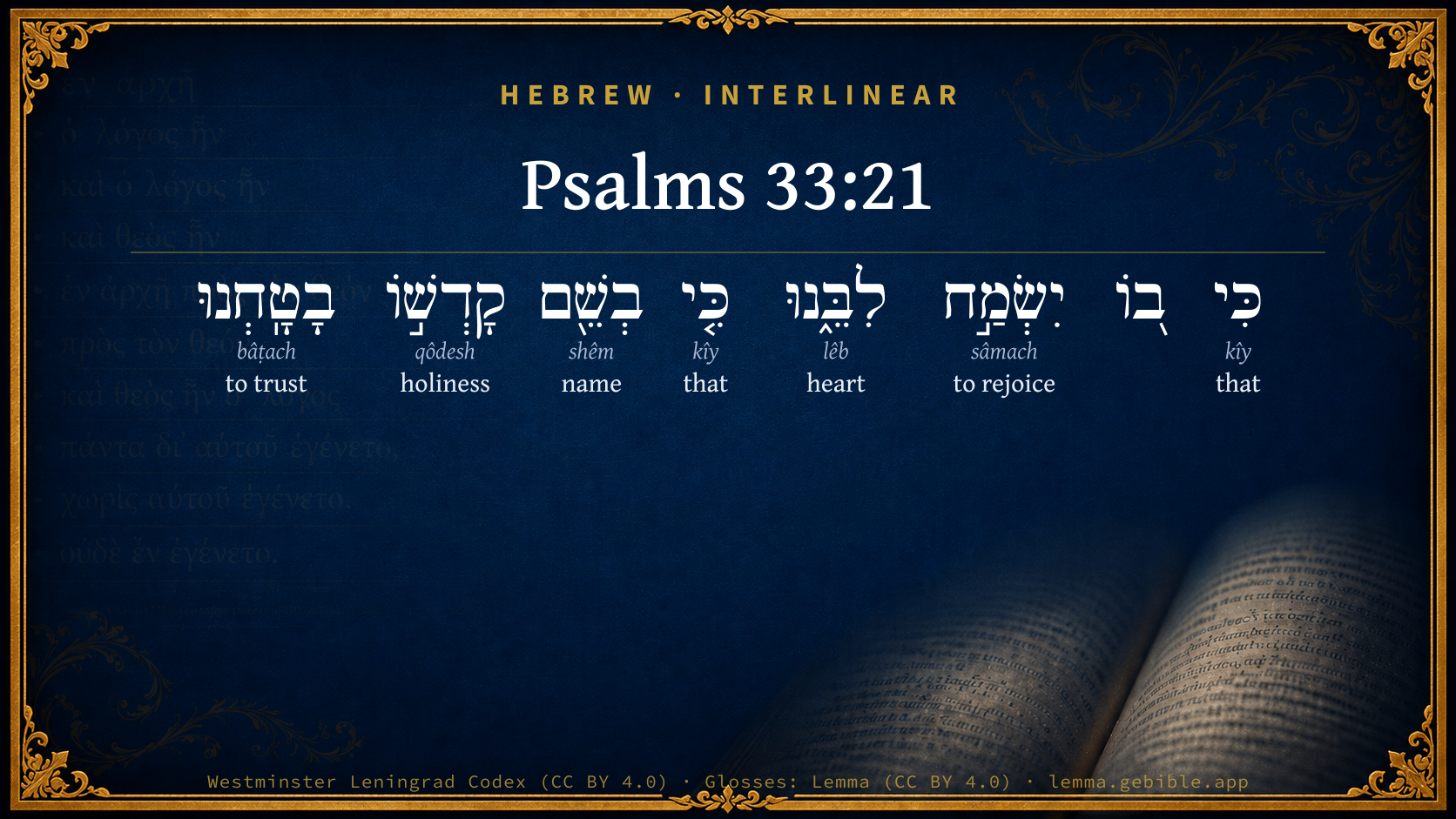
Hebrew (Westminster Leningrad Codex) Psalms 33:21 appears in the Hebrew Old Testament. The text above is from the Westminster Leningrad Codex. Each word links to its Strong’s number, a concise gloss, and parsing drawn from the Open Scriptures Hebrew Bible morphology. Click any word for its full Brown-Driver-Briggs (BDB) entry.
Download image
Cite this verse

Psalms 33:21 (World English Bible). Public Domain. Lemma interlinear Bible study tool, https://lemma.gebible.app/v/psalms/33/21.

Show BibTeX & RIS
BibTeX
RIS
English Translation
For our heart rejoices in him, Because we have trusted in his holy name.
World English Bible · Public Domain
Download a study sheet

One document with this verse’s original text, its word-by-word gloss line, the meaning frame, cross-references with their text, attributed commentary, and full source and license credits — printable, and it pastes into notes with its structure intact.

This verse Autodidact and up

Study sheet (.html) Plain text (.txt)

A passage Seminary Student

Up to 50 verses in one chapter. A passage sheet keeps up to 6 commentary sources and 12 cross-references per verse, in the order this page ranks them, and says so on the sheet whenever that leaves anything out. Ask for a single verse and you get the Autodidact verse sheet above.

Everything on this page stays free to read, with no account — the sheet is a download of what is already on screen, not access to it.

Want to remove ads? Support Godless Engineer
Compare translations 3

The same verse in 3 English versions, stacked beneath the original-language interlinear above. Click any original word for its lexicon entry.

Each is an independent rendering of the whole verse — the interlinear is not word-aligned to these translations.

Highlighted words mark where these versions differ — a whole-verse word diff, not a word-by-word alignment.

  • World English Bible Public Domain
    For our heart rejoices in him, Because we have trusted in his holy name.
  • King James Version Public Domain
    For our heart shall rejoice in him, because we have trusted in his holy name.
  • unfoldingWord Literal Text CC BY-SA 4.0
    For in him our heart rejoices; for in the name of his holiness we trust.

unfoldingWord Literal Text — © unfoldingWord, licensed CC BY-SA 4.0. Word-aligned USFM3 via Door43 (git.door43.org/unfoldingWord/en_ult).

Versions to compare (up to 4)

3 of 4 selected

Show all 18 translations

Every available English version of this verse, each an independent rendering of the whole verse.

  • World English Bible Public Domain
    For our heart rejoices in him, Because we have trusted in his holy name.
  • Berean Standard Bible Public Domain
    For our hearts rejoice in Him, since we trust in His holy name.
  • Majority Standard Bible Public Domain
    For our hearts rejoice in Him, since we trust in His holy name.
  • King James Version Public Domain
    For our heart shall rejoice in him, because we have trusted in his holy name.
  • American Standard Version (1901) Public Domain
    For our heart shall rejoice in him, Because we have trusted in his holy name.
  • Revised Version (1885) Public Domain
    For our heart shall rejoice in him, because we have trusted in his holy name.
  • Geneva Bible (1599) Public Domain
    Surely our heart shall reioyce in him, because we trusted in his holy Name.
  • Douay-Rheims (1899) Public Domain
    For in him our heart shall rejoice: and in his holy name we have trusted.
  • Young's Literal Translation Public Domain
    For in Him doth our heart rejoice, For in His holy name we have trusted.
  • Literal Standard Version CC BY-SA 4.0
    For our heart rejoices in Him, || For we have trusted in His Holy Name.
  • Unlocked Literal Bible CC BY-SA 4.0
    Our hearts rejoice in him, for we trust in his holy name.
  • unfoldingWord Literal Text CC BY-SA 4.0
    For in him our heart rejoices; for in the name of his holiness we trust.
  • Darby Bible Public Domain
    For in him shall our heart rejoice, because we have confided in his holy name.
  • World Messianic Bible Public Domain
    For our heart rejoices in him, because we have trusted in his holy name.
  • Webster's Bible Public Domain
    For our heart shall rejoice in him, because we have trusted in his holy name.
  • Free Bible Version CC BY-SA 4.0
    We are so happy about him, for we trust in his holy character.
  • Bible in Basic English Public Domain
    For in him our hearts have joy; in his holy name is our hope.
  • JPS Tanakh (1917) Public Domain
    For in Him doth our heart rejoice, because we have trusted in His holy name.

Literal Standard Version (2020), Covenant Press — licensed CC BY-SA 4.0. Text via the HelloAO Bible API (eBible.org). Unlocked Literal Bible (unfoldingWord) — licensed CC BY-SA 4.0. Text via the HelloAO Bible API (eBible.org). unfoldingWord Literal Text — © unfoldingWord, licensed CC BY-SA 4.0. Word-aligned USFM3 via Door43 (git.door43.org/unfoldingWord/en_ult). Free Bible Version, Dr. Jonathan Gallagher — licensed CC BY-SA 4.0. Text via the HelloAO Bible API (eBible.org).

Word by word

More ways to search: Search by grammar → Find every occurrence → Compare this word →

Practice this passage: Drill this verse → Learn its vocabulary →

About this verse

These counts appear in no published source. They are computed here, from the morphology-tagged text and Lemma’s own curated glosses. What Lemma adds →

8
words
6
distinct lemmas
Wisdom
section

Grammatical profile

  • 2 verbs
  • 3 nouns
  • 1 preposition
  • 2 conjunctions

Verb forms

  • יִשְׂמַ֣ח Qal · Imperfect
  • בָטָֽחְנוּ Qal · Perfect

Repetition

A word recurs within this verse — often emphatic in Hebrew:

  • כִּי that H3588 ×2

Hebrew & Septuagint length

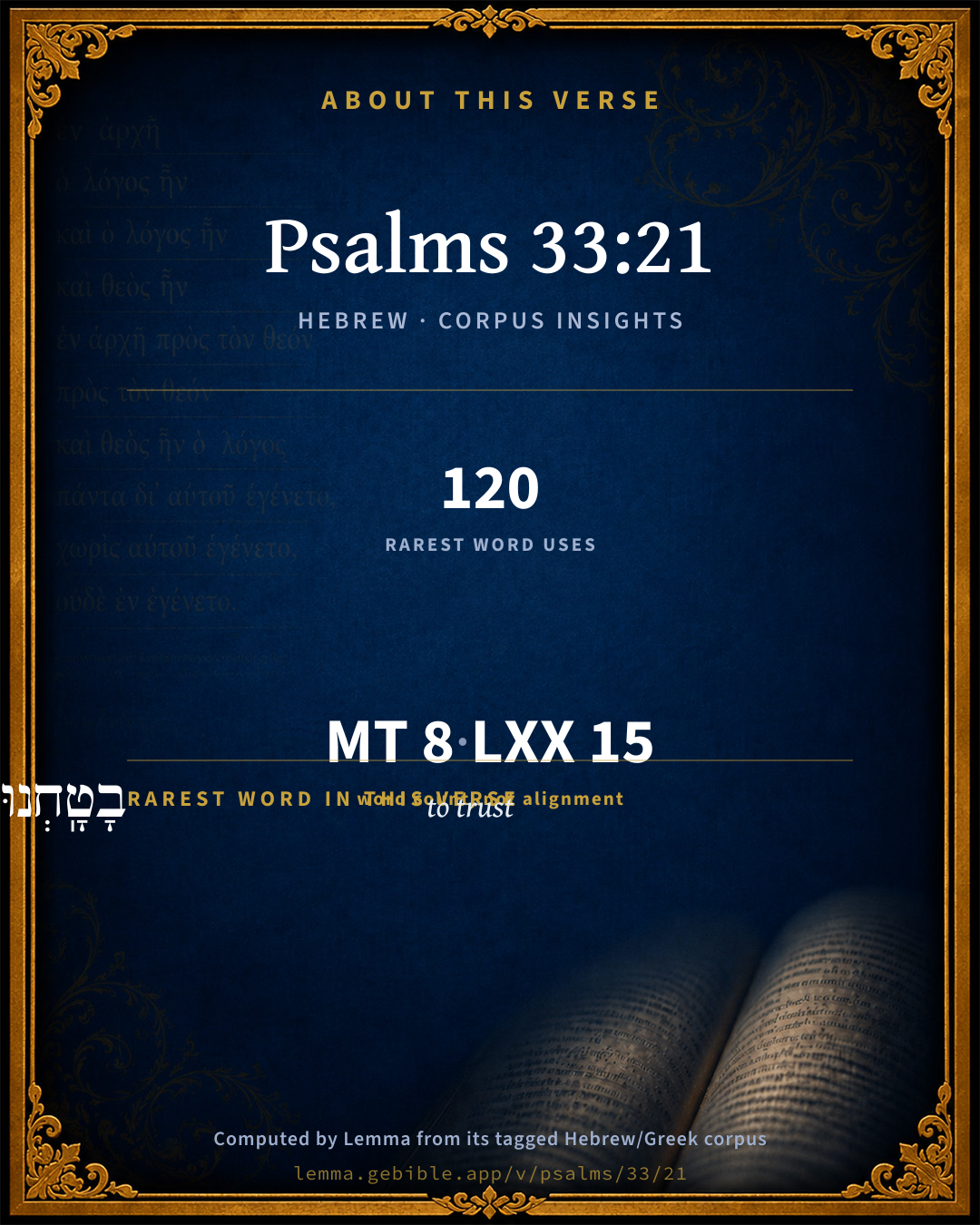
In English translation the verse runs 14 words from the Hebrew and 15 from the Septuagint (LXX English) — closely comparable.

A rough comparison of the two English renderings, which tokenize alike — not a word-level alignment.

Word counts can differ between the Hebrew and the Greek without any difference in meaning — e.g. the Hebrew direct-object marker אֵת has no separate Greek word, and Greek often adds the article ὁ.

In the original languages it is 8 Hebrew tokens and 15 Greek tokens — but the two are counted differently (Hebrew bundles its prefixes and suffixes into one token; the Greek is in lemma form), so that isn’t a like-for-like length.

Cross-references

11

Topical passages linked to Psalms 33:21 in the Treasury of Scripture Knowledge — connected by theme and wording, ordered by reader-vote popularity; previews shown in the World English Bible.

  • Psalms 13:5 But I trust in your loving kindness. My heart rejoices in your salvation.
  • Zechariah 10:7 Ephraim will be like a mighty man, And their heart will rejoice as through wine; Yes, their children will see it, and rejoice. Their heart will be glad in Yahweh.
  • John 16:22 Therefore you now have sorrow, but I will see you again, and your heart will rejoice, and no one will take your joy away from you.
  • Psalms 30:10–12 Hear, Yahweh, and have mercy on me. Yahweh, be my helper."
  • Isaiah 25:9 It shall be said in that day, Behold, this is our God; we have waited for him, and he will save us: this is Yahweh; we have waited for him, we will be glad and rejoice in his salvation.
  • Revelation 4:8 The four living creatures, each one of them having six wings, are full of eyes around about and within. They have no rest day and night, saying, "Holy, holy, holy, holy, holy, holy, holy, holy, holy is the Lord God, the Almighty, who was and who is and who is to come!"
  • 1 Chronicles 16:10 Glory you in his holy name; Let the heart of them rejoice who seek Yahweh.
  • Psalms 28:7 Yahweh is my strength and my shield. My heart has trusted in him, and I am helped. Therefore my heart greatly rejoices. With my song I will thank him.
  • Psalms 32:10–11 Many sorrows shall be to the wicked, But he who trusts in Yahweh, loving kindness shall surround him.
  • 1 Chronicles 16:35 Say you, Save us, God of our salvation, Gather us together and deliver us from the nations, To give thanks to your holy name, To triumph in your praise.
  • Luke 1:47–50 My spirit has rejoiced in God my Savior,

Cross-references courtesy of OpenBible.info (CC BY 4.0).

Hebrew and Greek witnesses Masoretic Hebrew ↔ Greek Septuagint

The same verse in the two great witnesses to the Old Testament, shown verse-for-verse.

You’re reading Greek Psalm 32 (Hebrew Psalm 33). The Septuagint counts the superscription, so verse numbers can differ from the Hebrew — chapter-level alignment, not verse-by-verse. Numbering follows Rahlfs.

These are two independent witnesses, not word-aligned to each other, and the Septuagint is shown in lemma (dictionary) form.

Hebrew Psalms 33:21 Masoretic · Westminster Leningrad Codex

כִּי ב֭וֹ יִשְׂמַ֣ח לִבֵּ֑נוּ כִּ֤י בְשֵׁ֖ם קָדְשׁ֣וֹ בָטָֽחְנוּ

For our heart rejoices in him, Because we have trusted in his holy name.

World English Bible · Public Domain

Greek LXX Greek Psalm 32:21 Septuagint · lemma form

ὅτι ἐν αὐτός εὐφραίνω ὁ καρδία ἐγώ καί ἐν ὁ ὄνομα ὁ ἅγιος αὐτός ἐλπίζω

For our heart shall rejoice in him, and we have hoped in his holy name.

LXX2012 (modern English Septuagint) · Public Domain

Hebrew: Westminster Leningrad Codex (CC BY 4.0). Greek: Septuagint (public domain); English from LXX2012 (modern English Septuagint) (Public Domain). How the Septuagint differs from the Hebrew →

Commentary

Notes on Psalms 33:21 from classic Christian and Jewish commentators (each source and its license shown beneath its notes). The classic Christian expositions comment on the surrounding passage and are grouped to its opening verse, so a note may address several verses; the Jewish commentaries on the Tanakh (Rashi and others) are per-verse, so they appear only where the commentator wrote on this verse.

Lemma curates 59 commentaries, every one of them public domain or Creative Commons licensed, each selected and text-cleaned for this edition rather than reprinted as found. About our sources →

Trapp's Complete Commentary

John Trapp

Psa 33:21 For our heart shall rejoice in him, because we have trusted in his holy name.

Ver. 21. Our heart shall rejoice in him] We shall be sure of a happy issue and event; but yet so as that we pray for it, as in the next words.

John Trapp, A Commentary or Exposition upon All the Books of the Old and New Testament (1647–1656) — public domain. Text from a community e-Sword module.

J. A. Alexander on Psalms

Joseph Addison Alexander

21. (Psa 33:21) For in him shall our heart rejoice, for in his holy name have we trusted. The consecution of the tenses is not unmeaning or fortuitous. The Psalmist's assurance of the future is derived from the possession of a faith already tried and proved to be truly in existence. It is because he has trusted that he knows he shall rejoice. The exchange of both these tenses for a present is at once enfeebling to the sense and ungrammatical.—His holy name, in the wide sense which the epithet so often has in this book, nearly corresponding to his glorious, his divine name. See above on Psa 22:4 (3). To trust in this name is to build one's hopes on the manifestation of God's attributes in previous acts; to believe that what he has heretofore shown himself to be, he will be still in the experience of his people.

Joseph Addison Alexander, The Psalms Translated and Explained (1850) — public domain. Text from a community e-Sword module.

Jamieson, Fausset & Brown

Robert Jamieson, A. R. Fausset & David Brown

his holy name--(Compare Psa 5:12; Psa 22:22; Psa 30:4). Our faith measures mercy (Mat 9:29); and if of grace, it is no more of debt (Rom 11:6).

Next: Psalms Chapter 34

Jamieson, Fausset & Brown — Commentary Critical and Explanatory on the Whole Bible (1871) — public domain (CC PDM 1.0). Text via the HelloAO Bible API.

Adam Clarke's Commentary

Verse 21. For our heart shall rejoice in him] Here is the fruit of our confidence: our souls are always happy, because we have taken God for our portion.

Adam Clarke's Commentary on the Bible (1810–1826) — public domain. Text from a community e-Sword/MySword module.

John Calvin's Commentaries

21. Surely our heart shall rejoice in him. As the particle כי, ki, which is twice employed in this verse, has various meanings in Hebrew, it may be understood in a twofold sense here. If we expound it affirmatively in both clauses, the sense will be, that believers glory both in their joy and in their hope. Nor do I think it improper that these two should be referred to distinctly in the same context thus: Surely God shall always be our joy; surely his holy name shall be like an impregnable fortress for our refuge. Whence is it that believers continue perseveringly to call upon God, but because, satisfied with his favor, they have always, amidst their sorrows and griefs, this comfort, which is sufficient to maintain their cheerfulness? Justly, therefore, do believers affirm, in the first place, that their heart rejoices in the Lord; because, freed from wandering after the fascinations of the world, they neither waver nor hesitate at every change of fortune, but place the whole felicity of their life in enjoying the free and paternal favor of God. They afterwards add, in the second place, that they trust in his holy name. If any one, however, choose to understand the particle כי, ki, as meaning because, assigning a cause or reason, the sense will be no less properly and elegantly expressed in this way: Because our hope is fixed on God, he will be equally ready on his part to minister to us continual matter of joy. And experience undoubtedly proves, that when men are overwhelmed with sorrow, and pine away with care, grief, and anxiety, it is that they may receive the recompense of their folly; seeing that there is nothing to which they are led with more difficulty, than to set their hopes on God alone, and not to exult in their own deceitful imaginations, with which they please themselves.

John Calvin's Commentaries (1540-1563) — public domain. Text from the Calvin Translation Society English edition (1840s-50s) via the Christian Classics Ethereal Library (ccel.org). Calvin's coverage is partial (roughly two-thirds of the Bible); uncommented books and verses are honest gaps, never fabricated. The 19th-century editor's footnotes and remarks are omitted so the notes are faithfully Calvin's own voice.

The Cambridge Bible for Schools and Colleges

gen. ed. J. J. S. Perowne

21. his holy name] See note on Psa_30:4.

The Cambridge Bible for Schools and Colleges (gen. ed. J. J. S. Perowne; Cambridge University Press, 1878–1918) — public domain. Text from a community e-Sword module.

John Gill's Exposition

For our heart shall rejoice in him,.... Not in sin, nor in themselves and in their boastings, all such rejoicing is evil; but in the Lord, "in his Word"; as the Targum is, in the essential Word of God, Christ Jesus; in his person, righteousness, and salvation; and this joy is heart joy, inward joy, real joy, joy in the Holy Ghost; and is unspeakable and full of glory. This is what the psalmist calls upon the saints to do, in the beginning of the psalm; and so his end in composing it is answered;

because we have trusted in his holy name; that is, in himself, who is holy, just, and good; and so faithful to every word of promise, to every engagement of his, and therefore to be trusted in: and hence it appears that the joy before spoken of is the joy of faith.

John Gill's Exposition of the Whole Bible (1746–1763) — public domain (CC PDM 1.0). Text via the HelloAO Bible API.

Albert Barnes' Notes on the Bible

For our heart shall rejoice in him - See the notes at Psa 13:5.

Because we have trusted in his holy name - In “him,” the “name” often being put for the person himself. See the notes at Psa 20:1. The idea is:

(a) that the fact of our having put our trust in God is in itself an occasion of joy or rejoicing;

(b) that the result will be joy, for we shall never be disappointed.

It will always, and in all circumstances, be a source of joy to anyone that he HAS put his trust in the name of God.

Albert Barnes' Notes on the Bible (1834–1885) — public domain. Text from a community e-Sword/MySword module.

Matthew Poole's English Annotations

For; or, therefore; for this seems to be an inference either from the foregoing or from the following sentence.

Matthew Poole's English Annotations on the Holy Bible (1683–1685) — public domain. Text from a community e-Sword/MySword module.

The Treasury of David

Charles H. Spurgeon

Ver. 21. For our hearts shall rejoice in him. The duty commended and commanded in the first verse is here presented to the Lord. We, who trust, cannot but be of a glad heart, our inmost nature must triumph in our faithful God. Because we have trusted in his holy name. The root of faith in due time bears the flower of rejoicing. Doubts breed sorrow, confidence creates joy.

None.

Ver. 21. Joy, the outflow of faith.

Psalms 33:22*

Charles H. Spurgeon's The Treasury of David (1869–1885) — public domain. Psalms only. Text from a community e-Sword/MySword module.

The Pulpit Commentary

For our heart shall rejoice in him, because we have trusted in his holy Name. (comp. Psa_13:5, where the sentiment is the same) Trust in God secures his help, and this brings the deliverance at which the heart rejoices.

The Pulpit Commentary (1880–1919), ed. H.D.M. Spence-Jones & Joseph S. Exell — public domain. Text from a community e-Sword module.

Scofield Reference Notes

C. I. Scofield

trust

(See Scofield "Psa 2:12")

The Scofield Reference Bible (1917 edition), notes by C. I. Scofield — public domain. Text from a community e-Sword module.

Lesson kit

Teaching starters — assembled from the data on this page, not authored interpretation. Every prompt links to the verse data it draws on. Edit before teaching.

Psalms, in the Wisdom, opens this verse with 8 words (6 distinct Hebrew lemmas). Its most distinctive word is bâṭach (“to trust”). A historical commentator’s framing appears above. Read the whole chapter for the surrounding context.

Discussion questions

  1. How does “to trust” (bâṭach) shape what this verse is saying?
  2. How does Psalms 13:5, which shares this passage’s theme, read alongside this verse?
  3. What does the repetition of “that” (2× in this one verse) do in this verse?
  4. The translations on this page render this verse differently — a whole-verse word diff, not a word-by-word alignment. What might account for the different wordings?
  5. «יִשְׂמַ֣ח» is a Qal Imperfect verb. How does that grammatical form shape the action described?
  6. Compare how Trapp's Complete Commentary and J. A. Alexander on Psalms read this verse. Where do they agree or differ?

Things to notice

Reading settings

Reading text

Shown beneath each verse's original-language words.

Old Testament
Old Testament edition

Read the OT as the Masoretic Hebrew (MT) or the Greek Septuagint (LXX).

English shown for the Greek Septuagint (in the Hebrew ↔ Greek comparison).

Comparing translations? Open the Compare panel on any verse page to stack up to four side by side.