
Psalms 37:2

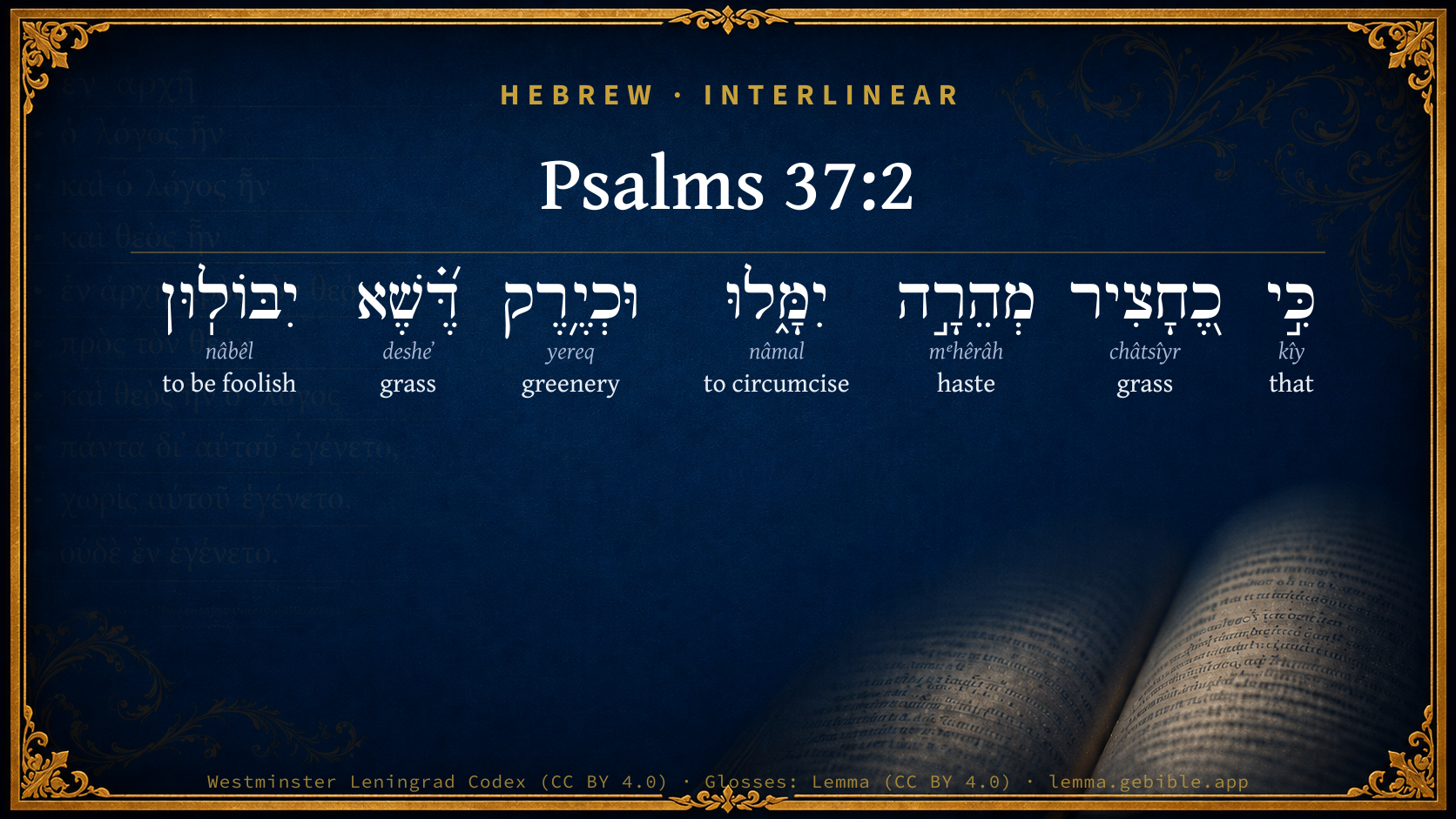
Hebrew (Westminster Leningrad Codex) Psalms 37:2 appears in the Hebrew Old Testament. The text above is from the Westminster Leningrad Codex. Each word links to its Strong’s number, a concise gloss, and parsing drawn from the Open Scriptures Hebrew Bible morphology. Click any word for its full Brown-Driver-Briggs (BDB) entry.
Download image
Cite this verse

Psalms 37:2 (World English Bible). Public Domain. Lemma interlinear Bible study tool, https://lemma.gebible.app/v/psalms/37/2.

Show BibTeX & RIS
BibTeX
RIS
English Translation
For they shall soon be cut down like the grass, And wither like the green herb.
World English Bible · Public Domain
Download a study sheet

One document with this verse’s original text, its word-by-word gloss line, the meaning frame, cross-references with their text, attributed commentary, and full source and license credits — printable, and it pastes into notes with its structure intact.

This verse Autodidact and up

Study sheet (.html) Plain text (.txt)

A passage Seminary Student

Up to 50 verses in one chapter. A passage sheet keeps up to 6 commentary sources and 12 cross-references per verse, in the order this page ranks them, and says so on the sheet whenever that leaves anything out. Ask for a single verse and you get the Autodidact verse sheet above.

Everything on this page stays free to read, with no account — the sheet is a download of what is already on screen, not access to it.

Want to remove ads? Support Godless Engineer
Compare translations 3

The same verse in 3 English versions, stacked beneath the original-language interlinear above. Click any original word for its lexicon entry.

Each is an independent rendering of the whole verse — the interlinear is not word-aligned to these translations.

Highlighted words mark where these versions differ — a whole-verse word diff, not a word-by-word alignment.

  • World English Bible Public Domain
    For they shall soon be cut down like the grass, And wither like the green herb.
  • King James Version Public Domain
    For they shall soon be cut down like the grass, and wither as the green herb.
  • unfoldingWord Literal Text CC BY-SA 4.0
    For like the grass they will quickly wither, and like a green plant they will fade.

unfoldingWord Literal Text — © unfoldingWord, licensed CC BY-SA 4.0. Word-aligned USFM3 via Door43 (git.door43.org/unfoldingWord/en_ult).

Versions to compare (up to 4)

3 of 4 selected

Show all 18 translations

Every available English version of this verse, each an independent rendering of the whole verse.

  • World English Bible Public Domain
    For they shall soon be cut down like the grass, And wither like the green herb.
  • Berean Standard Bible Public Domain
    For they wither quickly like grass and wilt like tender plants.
  • Majority Standard Bible Public Domain
    For they wither quickly like grass and wilt like tender plants.
  • King James Version Public Domain
    For they shall soon be cut down like the grass, and wither as the green herb.
  • American Standard Version (1901) Public Domain
    For they shall soon be cut down like the grass, And wither as the green herb.
  • Revised Version (1885) Public Domain
    For they shall soon be cut down like the grass, and wither as the green herb.
  • Geneva Bible (1599) Public Domain
    For they shall soone bee cut downe like grasse, and shall wither as the greene herbe.
  • Douay-Rheims (1899) Public Domain
    For they shall shortly wither away as grass, and as the green herbs shall quickly fall.
  • Young's Literal Translation Public Domain
    For as grass speedily they are cut off, And as the greenness of the tender grass do fade.
  • Literal Standard Version CC BY-SA 4.0
    For they are cut off speedily as grass, || And fade as the greenness of the tender grass.
  • Unlocked Literal Bible CC BY-SA 4.0
    For they will soon dry up as the grass and wither as the green plants.
  • unfoldingWord Literal Text CC BY-SA 4.0
    For like the grass they will quickly wither, and like a green plant they will fade.
  • Darby Bible Public Domain
    for they shall soon be cut down like the grass, and fade as the green herb.
  • World Messianic Bible Public Domain
    For they shall soon be cut down like the grass, and wither like the green herb.
  • Webster's Bible Public Domain
    For they shall soon be cut down like the grass, and wither as the green herb.
  • Free Bible Version CC BY-SA 4.0
    For like grass, they will quickly dry up; like plants, they will soon wither away.
  • Bible in Basic English Public Domain
    For they will quickly be cut down like grass, and become dry like the green plants.
  • JPS Tanakh (1917) Public Domain
    For they shall soon wither like the grass, and fade as the green herb.

Literal Standard Version (2020), Covenant Press — licensed CC BY-SA 4.0. Text via the HelloAO Bible API (eBible.org). Unlocked Literal Bible (unfoldingWord) — licensed CC BY-SA 4.0. Text via the HelloAO Bible API (eBible.org). unfoldingWord Literal Text — © unfoldingWord, licensed CC BY-SA 4.0. Word-aligned USFM3 via Door43 (git.door43.org/unfoldingWord/en_ult). Free Bible Version, Dr. Jonathan Gallagher — licensed CC BY-SA 4.0. Text via the HelloAO Bible API (eBible.org).

Word by word

More ways to search: Search by grammar → Find every occurrence → Compare this word →

Practice this passage: Drill this verse → Learn its vocabulary →

About this verse

These counts appear in no published source. They are computed here, from the morphology-tagged text and Lemma’s own curated glosses. What Lemma adds →

7
words
7
distinct lemmas
Wisdom
section

Notable vocabulary

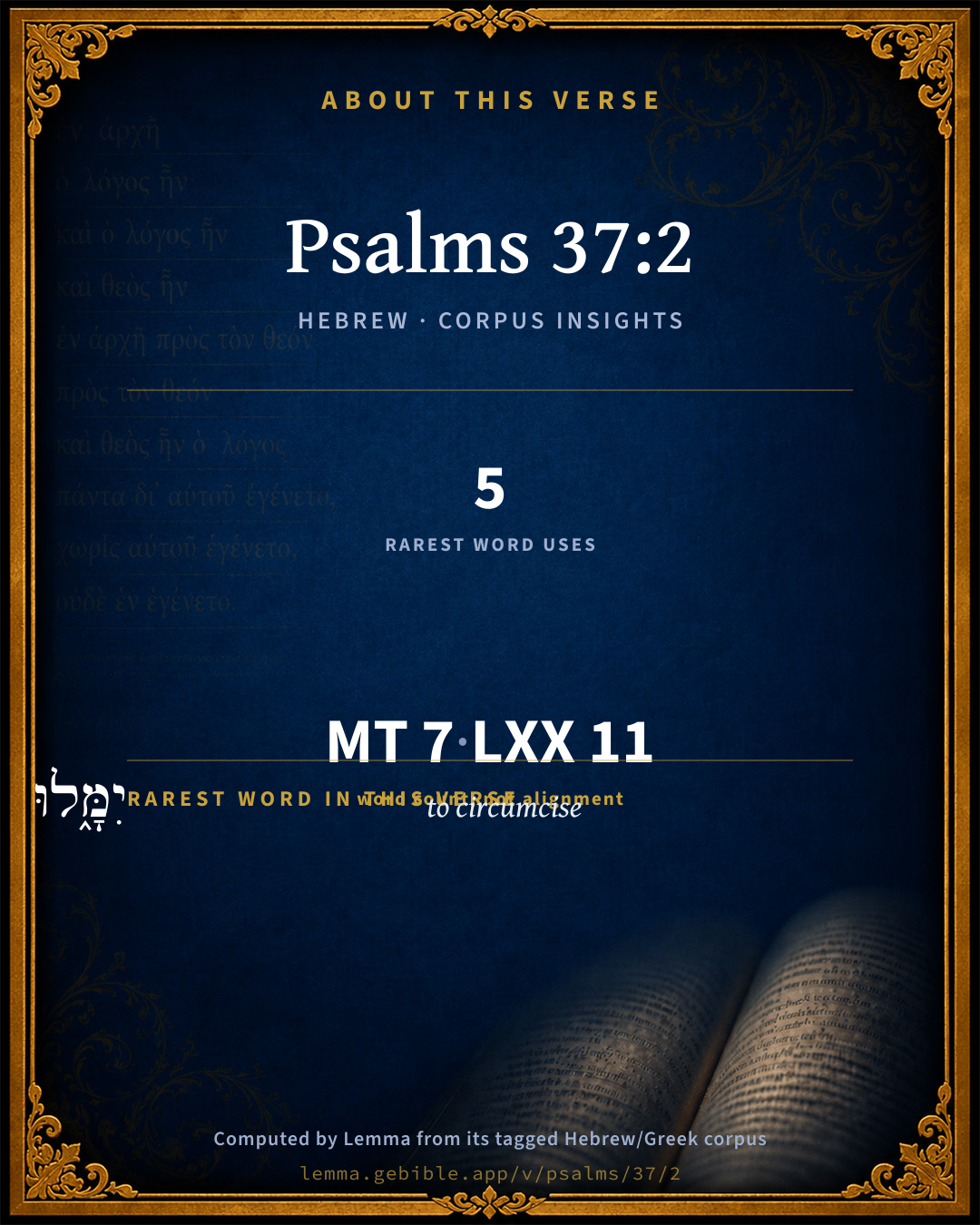
The rarest word here is יִמָּ֑לוּ to circumcise H5243 — appearing just 5 times in the whole Hebrew Bible.

Shared distinctive vocabulary

יִמָּ֑לוּ to circumcise H5243 occurs in 5 verses of the Hebrew Bible. Also found in:

Grammatical profile

  • 2 verbs
  • 4 nouns
  • 1 conjunction

Verb forms

  • יִמָּ֑לוּ Qal · Imperfect
  • יִבּוֹלֽוּן Qal · Imperfect

Hebrew & Septuagint length

In English translation the verse runs 16 words from the Hebrew and 18 from the Septuagint (LXX English) — closely comparable.

A rough comparison of the two English renderings, which tokenize alike — not a word-level alignment.

Word counts can differ between the Hebrew and the Greek without any difference in meaning — e.g. the Hebrew direct-object marker אֵת has no separate Greek word, and Greek often adds the article ὁ.

In the original languages it is 7 Hebrew tokens and 11 Greek tokens — but the two are counted differently (Hebrew bundles its prefixes and suffixes into one token; the Greek is in lemma form), so that isn’t a like-for-like length.

Cross-references

9

Topical passages linked to Psalms 37:2 in the Treasury of Scripture Knowledge — connected by theme and wording, ordered by reader-vote popularity; previews shown in the World English Bible.

  • Psalms 92:7 Though the wicked spring up as the grass, And all the evil-doers flourish, They will be destroyed forever.
  • Psalms 90:5–6 You sweep them away as they sleep. In the morning they sprout like new grass.
  • James 1:10–11 and the rich, in that he is made humble, because like the flower in the grass, he will pass away.
  • Job 14:2 He comes forth like a flower, and is cut down. He also flees like a shadow, and doesn't continue.
  • Psalms 37:35–36 I have seen the wicked in great power, Spreading himself like a green tree in its native soil.
  • Job 20:5–9 That the triumphing of the wicked is short, The joy of the godless but for a moment?
  • Psalms 73:17–20 Until I entered God's sanctuary, And considered their latter end.
  • 1 Peter 1:24 For, "All flesh is like grass, And all of man's glory like the flower in the grass. The grass withers, and its flower falls;
  • Psalms 129:5–7 Let them be disappointed and turned backward, All those who hate Zion.

Cross-references courtesy of OpenBible.info (CC BY 4.0).

Hebrew and Greek witnesses Masoretic Hebrew ↔ Greek Septuagint

The same verse in the two great witnesses to the Old Testament, shown verse-for-verse.

You’re reading Greek Psalm 36 (Hebrew Psalm 37). The Septuagint counts the superscription, so verse numbers can differ from the Hebrew — chapter-level alignment, not verse-by-verse. Numbering follows Rahlfs.

These are two independent witnesses, not word-aligned to each other, and the Septuagint is shown in lemma (dictionary) form.

Hebrew Psalms 37:2 Masoretic · Westminster Leningrad Codex

כִּ֣י כֶ֭חָצִיר מְהֵרָ֣ה יִמָּ֑לוּ וּכְיֶ֥רֶק דֶּ֝֗שֶׁא יִבּוֹלֽוּן

For they shall soon be cut down like the grass, And wither like the green herb.

World English Bible · Public Domain

Greek LXX Greek Psalm 36:2 Septuagint · lemma form

ὅτι ὡσεί χόρτος ταχύς ἀποξηραίνω καί ὡσεί λάχανον χλόη ταχύς ἀποπίπτω

For they shall soon be withered as the grass, and shall soon fall away as the green herbs.

LXX2012 (modern English Septuagint) · Public Domain

Hebrew: Westminster Leningrad Codex (CC BY 4.0). Greek: Septuagint (public domain); English from LXX2012 (modern English Septuagint) (Public Domain). How the Septuagint differs from the Hebrew →

Commentary

Notes on Psalms 37:2 from classic Christian and Jewish commentators (each source and its license shown beneath its notes). The classic Christian expositions comment on the surrounding passage and are grouped to its opening verse, so a note may address several verses; the Jewish commentaries on the Tanakh (Rashi and others) are per-verse, so they appear only where the commentator wrote on this verse.

Lemma curates 59 commentaries, every one of them public domain or Creative Commons licensed, each selected and text-cleaned for this edition rather than reprinted as found. About our sources →

Trapp's Complete Commentary

John Trapp

Psa 37:2 For they shall soon be cut down like the grass, and wither as the green herb.

Ver. 2. For they shall soon be cut down like the grass] Faenea quadam felicitate temporaliter florent, as Austin phraseth it, but their felicity is short-lived; this proud grass shall be mowed down ere long, Psa 92:7, if not sooner, yet at death howsoever, which unto them is but a trapdoor to hell. Envy me not my grapes, said that soldier, I must die for them. So may wicked men say of their present prosperity, which is but like Haman’s banquet before execution.

John Trapp, A Commentary or Exposition upon All the Books of the Old and New Testament (1647–1656) — public domain. Text from a community e-Sword module.

J. A. Alexander on Psalms

Joseph Addison Alexander

2. (Psa 37:2) For like the grass (in) haste shall they be mown, and like the green herb shall they fade (or wither). This verse assigns the reason of the exhortation in the one before it. Why should we vex ourselves or indulge an envious feeling towards that which is so soon to perish, and is therefore rather an object of compassion? These two verses contain the theme, of which the rest is a protracted variation.—In haste, soon, quickly. The preposition is expressed before the same noun in Ecc 4:12, but suppressed as here, in many other places, e.g. Num 17:11, Num 16:46), Deu 11:17.—The green herb, literally greenness of herbage, the second noun denoting the young tender grass, or the first growth of other plants. See above, on Psa 23:2. The verb at the end of the sentence is the same with that in Psa 1:3.

Joseph Addison Alexander, The Psalms Translated and Explained (1850) — public domain. Text from a community e-Sword module.

Tyndale Open Study Notes

Tyndale Open Resources

37:2 Finite existence is part of the human condition (see 90:5-6; 92:7; 102:4, 11; 103:15; 129:6; Isa 40:7-8).

Tyndale Open Study Notes — © Tyndale Open Resources, licensed CC BY-SA 4.0. Text via the HelloAO Bible API.

Geneva Bible (1599)

Geneva Bible translators

For God’s judgment cutteth down their state in a moment.

Geneva Bible (1599) marginal notes — public domain. Text via Bolls.life.

Adam Clarke's Commentary

Verse 2. For they shall soon be cut down] They have their portion in this life; and their enjoyment of it cannot be long, for their breath is but a vapour that speedily vanishes away. They fall before death, as the greensward does before the scythe of the mower.

Adam Clarke's Commentary on the Bible (1810–1826) — public domain. Text from a community e-Sword/MySword module.

Ellicott's Commentary for English Readers

(2) For they . . .—This inevitable metaphor for the brevity of human life, made still more forcible in an Eastern clime where vegetation is so rapid both in growth and decay, and generally in the Bible applied, without distinction of good or bad, with a mournful sigh over human weakness, becomes here a source of comfort to the godly man.

Green herb.—Literally, greenness of herbage.

A Bible Commentary for English Readers, edited by Charles John Ellicott (1878–1897) — public domain. Text from a community e-Sword module.

The Cambridge Bible for Schools and Colleges

gen. ed. J. J. S. Perowne

2. The grass and the green herb are a common image for what is transient and perishable. See note on Psa_37:20; and cp. Psa_90:5 f.; Psa_103:15 f.; Isa_40:6 ff.

be cut down] Or, fade. Cp. Job_14:2; Job_18:16 (R.V. marg.).

The Cambridge Bible for Schools and Colleges (gen. ed. J. J. S. Perowne; Cambridge University Press, 1878–1918) — public domain. Text from a community e-Sword module.

John Gill's Exposition

For they shall soon be cut down like the grass, and wither as the green herb. Which in the morning looks green, pretty, and flourishing, and in the evening is cut down, and then fades away; see Psa 90:5; and so the wicked prosper and flourish for a while, and then they perish with all their honour, riches, and wealth; so that their happiness is a very short lived one, and therefore need not be envied and fretted at.

; and so the wicked prosper and flourish for a while, and then they perish with all their honour, riches, and wealth; so that their happiness is a very short lived one, and therefore need not be envied and fretted at.

Psalms 37:3

psa 37:3

psa 37:3

psa 37:3Trust in the Lord,.... Not in men, who are fading and perishing like the green grass and tender herb; nor in riches, which are very uncertain things; but in the Lord, in whom is everlasting strength; and with whom are riches and honour, yea, durable riches and righteousness; trust in him both for things temporal and spiritual, for soul and body, for time and eternity; the way to have peace and quietness of mind under all dispensations is to exercise faith on a promising God. The Targum is, "trust in the Word of the Lord", in the essential Word of God, the promised Messiah;

and do good; in general, all good actions, in faith, and as the fruits and effects of it, without trusting to them, but in the Lord; doing them in his strength, and with a view to his glory; or in particular, acts of beneficence to the poor, to which the encouragement follows;

so shalt thou dwell in the land; either in the land of Canaan, a continuance in which depended upon the obedience of the people of the Jews to the commands of God; see Isa 1:19; or rather in the good land which is afar off, the heavenly and better country, which those that trust in the Lord, and have that faith in Christ which works by love, shall dwell in to all eternity;

and verily thou shalt be fed; either temporally, shall have food and raiment, even all the necessaries of life; or spiritually, with the word and ordinances, and with Christ the bread of life now; and hereafter shall be fed by him, the Lamb in the midst of the throne, and by him led to fountains of living water: some read the words as an exhortation, and render them, "feed truth" (k), that is, teach it, as Abraham taught his household, and as faithful pastors feed with knowledge and understanding; or "feed by faith" (l), as the just live by it; or, as the Targum renders it, "be strong in faith", as Abraham was, Rom 4:20; or rather, "feed upon truth" (m), the word of truth, the Gospel of salvation, and the several truths and doctrines of it, which are food for faith, and nourish up to everlasting life.

(k) "pasce veritatem", Pagninus, Montanus. (l) "Pascere fide", Junius & Tremellius, Cocceius. (m) "Pasce te veritate", Gejerus; "ut alimentum tuum", Gussetius, Ebr. Comment. p. 942. "feed on faith", Ainsworth.

John Gill's Exposition of the Whole Bible (1746–1763) — public domain (CC PDM 1.0). Text via the HelloAO Bible API.

Albert Barnes' Notes on the Bible

For they shall soon be cut down like the grass - As the grass in the field is cut down by the mower; that is, however prosperous they may seem to be now, they are like the grass in the meadow which is so green and luxuriant, but which is soon to fall under the scythe of the mower. Their prosperity is only temporary, for they will soon pass away. The idea in the word rendered “soon” - מהרה mehêrâh - is that of “haste” or “speed:” Psa 147:15; Num 16:46; Deu 11:17. The thought is not that it will be done immediately, but that “when” it occurs it will be a quick and rapid operation - as the grass falls rapidly before the mower.

And wither as the green herb - When it is cut down. That is, not as the dry and stinted shrub that grows in the desert of sand, but like the herb that grows in a garden, or in a marsh, or by the river, that is full of juices, and that needs abundant water to sustain it - like the flag or rush (compare Job 8:11) - and that withers almost instantly when it is cut down. The rapidity with which things “wilt” is in proportion to the rapidity of their growth, so the prosperity of a sinner is suddenly blasted, and he passes away. Compare Psa 90:5-6.

Albert Barnes' Notes on the Bible (1834–1885) — public domain. Text from a community e-Sword/MySword module.

Matthew Poole's English Annotations

For their happiness, the matter of thy envy, is but shortlived.

Matthew Poole's English Annotations on the Holy Bible (1683–1685) — public domain. Text from a community e-Sword/MySword module.

The Treasury of David

Charles H. Spurgeon

Ver. 2. For they shall soon be cut down like the grass. The scythe of death is sharpening. Green grows the grass, but quick comes the scythe. The destruction of the ungodly will be speedy, sudden, sure, overwhelming, irretrievable. The grass cannot resist or escape the mower. And wither as the green herb. The beauty of the herb dries up at once in the heat of the sun, and so all the glory of the wicked shall disappear at the hour of death. Death kills the ungodly man like grass, and wrath withers him like hay; he dies, and his name rots. How complete an end is made of the man whose boasts had no end! Is it worth while to waste ourselves in fretting about the insect of an hour, an ephemeral which in the same day is born and dies? Within believers there is a living and incorruptible seed which liveth and abideth for ever; why should they envy mere flesh, and the glory of it, which are but as grass, and the flower thereof?

Ver. 2. Cut down like the grass, with a scythe, and even at one blow. Thomas Wilcocks.

Ver. 2. Wither. O bitter word, which will make the ears of them that hear it to tingle! O sentence intolerable, which deprives sinners of all good things, and bringeth them to all woe! The Lord sometime accursed the fig tree, and immediately, not only the leaves, but also the body and root were wholly withered: even so, that fearful curse of the last day shall be no less effectual; for on whomsoever it falleth is shall so scorch them, and shall so make them destitute of God's grace, that they shall never more be able to do, to speak, think, or to hope for any good thing. Thomas Tymme.

Ver. 2. Green herb. We cannot gather riper fruit of patience from any tree than is found upon the low shrubs of man's short life; for if that fretting canker of envy at the prosperity of the wicked have overrun thy mind, a malady from which the saints have no shelter to be freed, out of this apothecary's shop take antidote; either thy time is short to behold it, or theirs shorter to enjoy is; "they are set in slippery places, and are suddenly destroyed, "Ps 73:18; "They spend their days in wealth, and in a moment go down to the grave, " Job 21:13; They shall soon be cut down like the grass, and wither as the green herb. Edmund Layfield's Sermon, entitled "The Mappe of Man's Mortality and Vanity", 1630.

Ver. 2. Sometimes the wicked, like the green herb, wither in their spring, they fall in their rise, they perish in the beginnings of their mischievous designs; but if they do come to a full growth, they grow but to harvest, the fit season of their cutting off. Robert Mossom.

Ver. 2. How and when the wicked perish.

Psalms 37:3*

Charles H. Spurgeon's The Treasury of David (1869–1885) — public domain. Psalms only. Text from a community e-Sword/MySword module.

Whedon's Commentary on the Bible

Daniel D. Whedon

2. They shall soon be cut down—A reason why we should not envy their prosperity.

Daniel D. Whedon (gen. ed.), Commentary on the Old and New Testaments (1874–1909) — public domain. Text from a community e-Sword module.

The Pulpit Commentary

For they shall soon be cut down like the grass. So Zophar, in the Book of Job, (Job_20:5) "The triumphing of the wicked is short, and the joy of the hypocrite but for a moment." And, no doubt, if we compare time with eternity, the longest triumph that the wicked ever enjoy is but for a brief space, is soon gone, endures "but for a moment." It has a continuance, however, which to men in this life seems long, often intolerably long; and hence the disturbance which men"s minds suffer on account of it. (Job_21:7, 13 Psa_73:3-16) And wither as the green herb. (comp. Psa_90:5, 6 103:15 Isa_40:6, 7 Jam_1:10, 11 1Pe_1:24)

The Pulpit Commentary (1880–1919), ed. H.D.M. Spence-Jones & Joseph S. Exell — public domain. Text from a community e-Sword module.

Rashi

Rabbi Shlomo Yitzchaki (Rashi)

they will be...cut off Heb. ימלו, seront tronke in Old French, they will be cut off, an expression of cutting off.

Rashi on the Tanakh — English translations: “The Judaica Press complete Tanach with Rashi, translated by A. J. Rosenberg” (CC BY 4.0); “Pentateuch with Rashi's commentary by M. Rosenbaum and A.M. Silbermann, 1929-1934” (public domain); “The Metsudah Tanach series, Lakewood, N.J” (CC BY 4.0); and “The Book of Joshua, Metsudah Publications, 1997” (CC BY 4.0). Text via Sefaria.

Lesson kit

Teaching starters — assembled from the data on this page, not authored interpretation. Every prompt links to the verse data it draws on. Edit before teaching.

Psalms, in the Wisdom, opens this verse with 7 words (7 distinct Hebrew lemmas). Its most distinctive word is nâmal (“to circumcise”). A historical commentator’s framing appears above. Read the whole chapter for the surrounding context.

Discussion questions

  1. What does “to circumcise” (nâmal) contribute to the verse as a whole?
  2. Genesis 17:11 shares the word «to circumcise» with this verse. How do the two illuminate each other?
  3. These translations render this verse differently. What is at stake in choosing one wording over another?
  4. The verb «יִמָּ֑לוּ» is Qal Imperfect. How does its form color the action?
  5. Reading how Trapp's Complete Commentary and J. A. Alexander on Psalms read this verse, where do the two commentators agree and where do they part?

Things to notice

Reading settings

Reading text

Shown beneath each verse's original-language words.

Old Testament
Old Testament edition

Read the OT as the Masoretic Hebrew (MT) or the Greek Septuagint (LXX).

English shown for the Greek Septuagint (in the Hebrew ↔ Greek comparison).

Comparing translations? Open the Compare panel on any verse page to stack up to four side by side.