
Psalms 21:12

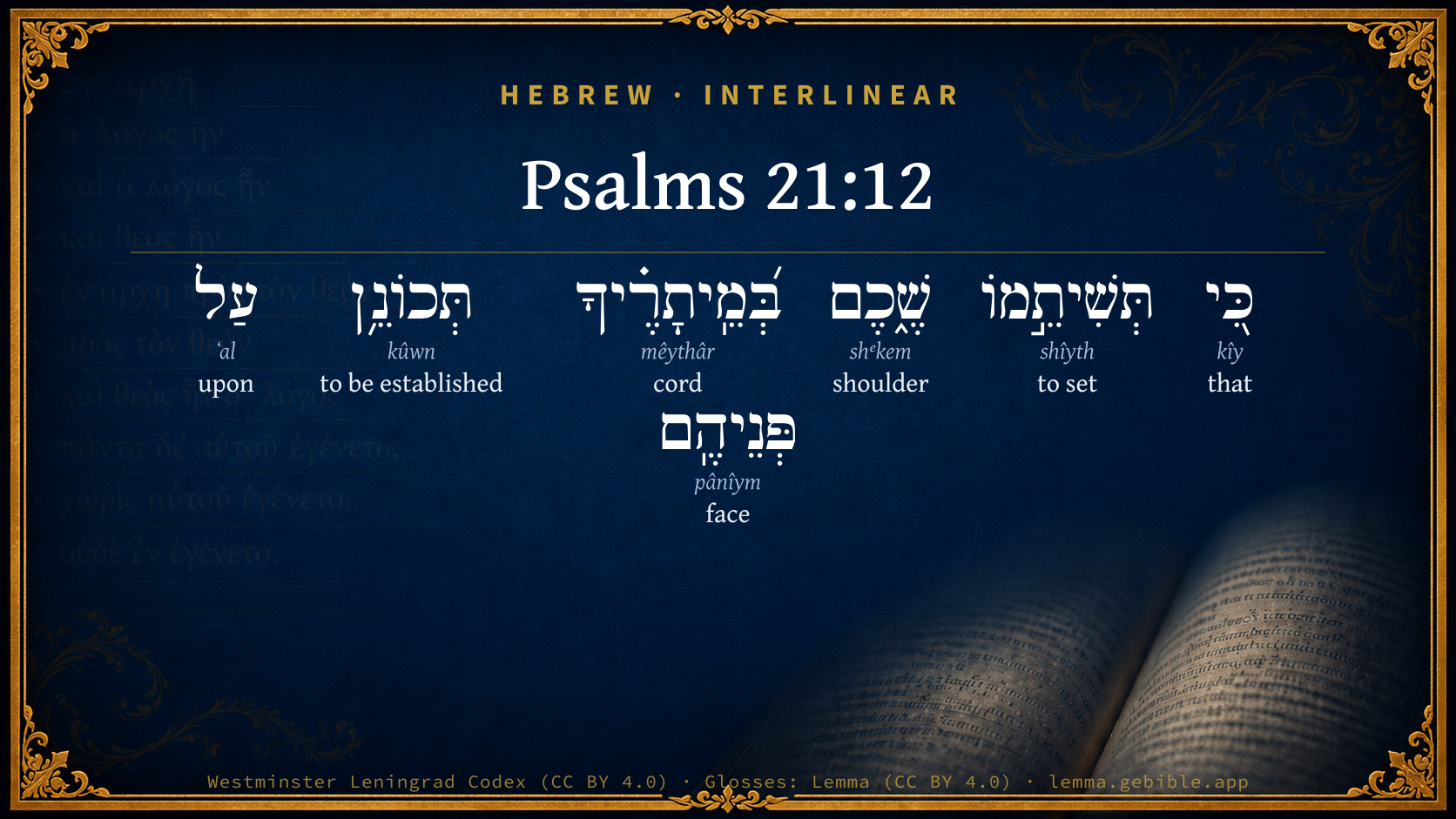
Hebrew (Westminster Leningrad Codex) Psalms 21:12 appears in the Hebrew Old Testament. The text above is from the Westminster Leningrad Codex. Each word links to its Strong’s number, a concise gloss, and parsing drawn from the Open Scriptures Hebrew Bible morphology. Click any word for its full Brown-Driver-Briggs (BDB) entry.
Download image
Cite this verse

Psalms 21:12 (World English Bible). Public Domain. Lemma interlinear Bible study tool, https://lemma.gebible.app/v/psalms/21/12.

Show BibTeX & RIS
BibTeX
RIS
English Translation
For you will make them turn their back, When you aim drawn bows at their face.
World English Bible · Public Domain
Download a study sheet

One document with this verse’s original text, its word-by-word gloss line, the meaning frame, cross-references with their text, attributed commentary, and full source and license credits — printable, and it pastes into notes with its structure intact.

This verse Autodidact and up

Study sheet (.html) Plain text (.txt)

A passage Seminary Student

Up to 50 verses in one chapter. A passage sheet keeps up to 6 commentary sources and 12 cross-references per verse, in the order this page ranks them, and says so on the sheet whenever that leaves anything out. Ask for a single verse and you get the Autodidact verse sheet above.

Everything on this page stays free to read, with no account — the sheet is a download of what is already on screen, not access to it.

Want to remove ads? Support Godless Engineer
Compare translations 3

The same verse in 3 English versions, stacked beneath the original-language interlinear above. Click any original word for its lexicon entry.

Each is an independent rendering of the whole verse — the interlinear is not word-aligned to these translations.

Highlighted words mark where these versions differ — a whole-verse word diff, not a word-by-word alignment.

  • World English Bible Public Domain
    For you will make them turn their back, When you aim drawn bows at their face.
  • King James Version Public Domain
    Therefore shalt thou make them turn their back, when thou shalt make ready thine arrows upon thy strings against the face of them.
  • unfoldingWord Literal Text CC BY-SA 4.0
    For you will make them shoulder; on your strings you will set toward their faces.

unfoldingWord Literal Text — © unfoldingWord, licensed CC BY-SA 4.0. Word-aligned USFM3 via Door43 (git.door43.org/unfoldingWord/en_ult).

Versions to compare (up to 4)

3 of 4 selected

Show all 18 translations

Every available English version of this verse, each an independent rendering of the whole verse.

  • World English Bible Public Domain
    For you will make them turn their back, When you aim drawn bows at their face.
  • Berean Standard Bible Public Domain
    For You will put them to flight when Your bow is trained upon them.
  • Majority Standard Bible Public Domain
    For You will put them to flight when Your bow is trained upon them.
  • King James Version Public Domain
    Therefore shalt thou make them turn their back, when thou shalt make ready thine arrows upon thy strings against the face of them.
  • American Standard Version (1901) Public Domain
    For thou wilt make them turn their back; Thou wilt make ready with thy bowstrings against their face.
  • Revised Version (1885) Public Domain
    For thou shalt make them turn their back, thou shalt make ready with thy bowstrings against the face of them.
  • Geneva Bible (1599) Public Domain
    Therefore shalt thou put them aparte, and the strings of thy bowe shalt thou make readie against their faces.
  • Douay-Rheims (1899) Public Domain
    For they have intended evils against thee: they have devised counsels which they have not been able to establish.
  • Young's Literal Translation Public Domain
    For Thou makest them a butt, When Thy strings Thou preparest against their faces.
  • Literal Standard Version CC BY-SA 4.0
    For You make them turn their back, || When You prepare Your strings against their faces.
  • Unlocked Literal Bible CC BY-SA 4.0
    For you will turn them back; you will draw your bow before them.
  • unfoldingWord Literal Text CC BY-SA 4.0
    For you will make them shoulder; on your strings you will set toward their faces.
  • Darby Bible Public Domain
    For thou wilt make them turn their back; thou wilt make ready thy bowstring against their face.
  • World Messianic Bible Public Domain
    For you will make them turn their back, when you aim drawn bows at their face.
  • Webster's Bible Public Domain
    \\21:11\\For they intended evil against thee: they imagined a mischievous device, which they are not able to perform.
  • Free Bible Version CC BY-SA 4.0
    They will turn and run away when they see your arrows fired at them.
  • Bible in Basic English Public Domain
    Their backs will be turned when you make ready the cords of your bow against their faces.
  • JPS Tanakh (1917) Public Domain
    (21-13) For thou shalt make them turn their back, thou shalt make ready with thy bowstrings against the face of them.

Literal Standard Version (2020), Covenant Press — licensed CC BY-SA 4.0. Text via the HelloAO Bible API (eBible.org). Unlocked Literal Bible (unfoldingWord) — licensed CC BY-SA 4.0. Text via the HelloAO Bible API (eBible.org). unfoldingWord Literal Text — © unfoldingWord, licensed CC BY-SA 4.0. Word-aligned USFM3 via Door43 (git.door43.org/unfoldingWord/en_ult). Free Bible Version, Dr. Jonathan Gallagher — licensed CC BY-SA 4.0. Text via the HelloAO Bible API (eBible.org).

Word by word

More ways to search: Search by grammar → Find every occurrence → Compare this word →

Practice this passage: Drill this verse → Learn its vocabulary →

About this verse

These counts appear in no published source. They are computed here, from the morphology-tagged text and Lemma’s own curated glosses. What Lemma adds →

7
words
7
distinct lemmas
Wisdom
section

Notable vocabulary

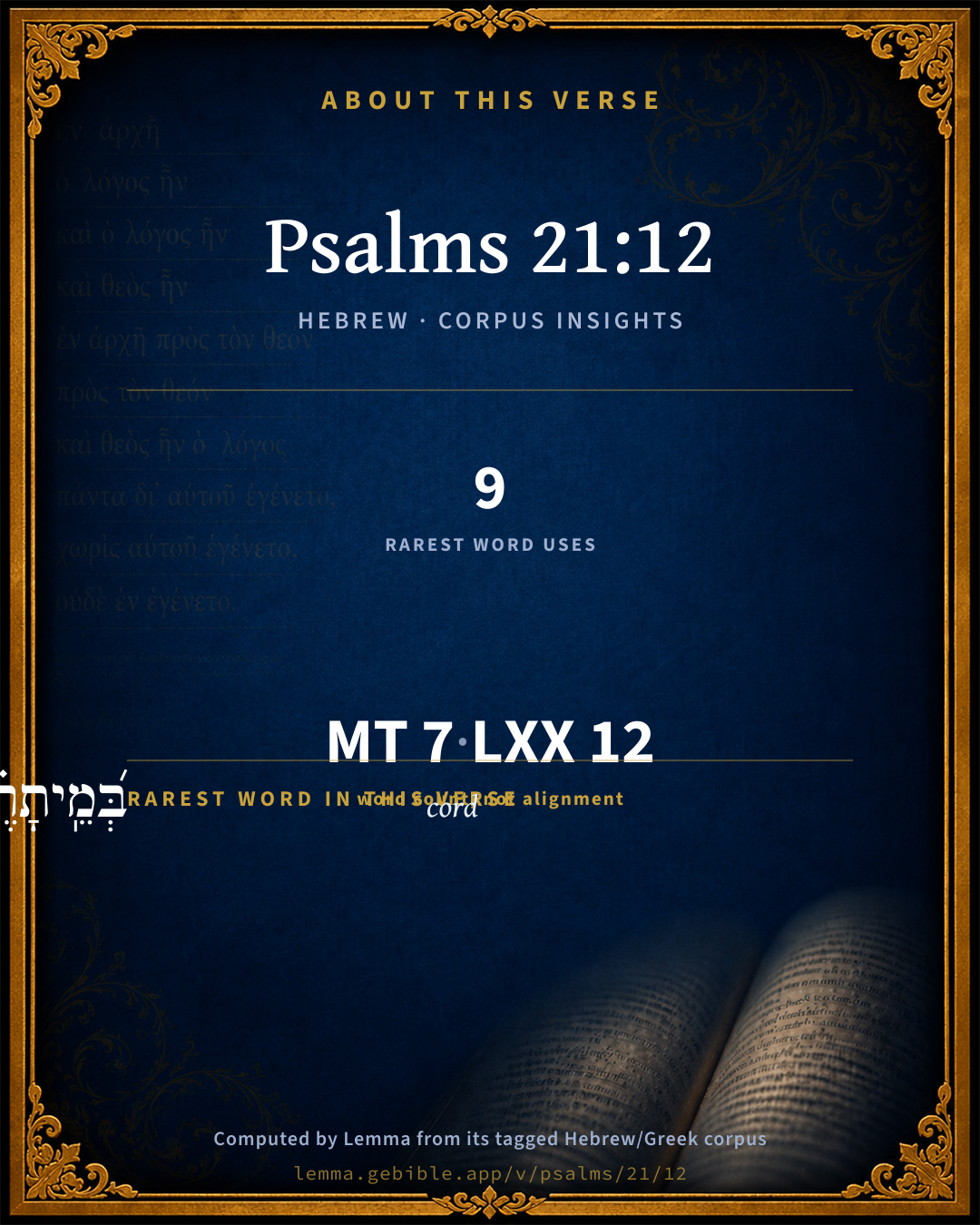
The rarest word here is בְּ֝מֵֽיתָרֶ֗יךָ cord H4340 — appearing just 9 times in the whole Hebrew Bible.

Shared distinctive vocabulary

בְּ֝מֵֽיתָרֶ֗יךָ cord H4340 occurs in 9 verses of the Hebrew Bible. Also found in:

Grammatical profile

  • 2 verbs
  • 3 nouns
  • 1 preposition
  • 1 conjunction

Verb forms

  • תְּשִׁיתֵ֣מוֹ Qal · Imperfect
  • תְּכוֹנֵ֥ן Polel · Imperfect

Hebrew & Septuagint length

In English translation the verse runs 16 words from the Hebrew and 17 from the Septuagint (LXX English) — closely comparable.

A rough comparison of the two English renderings, which tokenize alike — not a word-level alignment.

Word counts can differ between the Hebrew and the Greek without any difference in meaning — e.g. the Hebrew direct-object marker אֵת has no separate Greek word, and Greek often adds the article ὁ.

In the original languages it is 7 Hebrew tokens and 12 Greek tokens — but the two are counted differently (Hebrew bundles its prefixes and suffixes into one token; the Greek is in lemma form), so that isn’t a like-for-like length.

Cross-references

10

Topical passages linked to Psalms 21:12 in the Treasury of Scripture Knowledge — connected by theme and wording, ordered by reader-vote popularity; previews shown in the World English Bible.

  • Psalms 7:12–13 If a man doesn't relent, he will sharpen his sword; He has bent and strung his bow.
  • Psalms 18:40 You have also made my enemies turn their backs to me, That I might cut off those who hate me.
  • Psalms 64:7 But God will shoot at them. They will be suddenly struck down with an arrow.
  • Lamentations 3:12 He has bent his bow, and set me as a mark for the arrow.
  • Job 7:20 If I have sinned, what do I do to you, you watcher of men? Why have you set me as a mark for you, So that I am a burden to myself?
  • Job 16:12–13 I was at ease, and he broke me apart. Yes, he has taken me by the neck, and dashed me to pieces. He has also set me up for his target.
  • Psalms 9:3 When my enemies turn back, They stumble and perish in your presence.
  • Psalms 44:10 You make us turn back from the adversary. Those who hate us take spoil for themselves.
  • Psalms 56:9 Then my enemies shall turn back in the day that I call. I know this, that God is for me.
  • Psalms 18:14 He sent out his arrows, and scattered them; Yes, great lightning bolts, and routed them.

Cross-references courtesy of OpenBible.info (CC BY 4.0).

Hebrew and Greek witnesses Masoretic Hebrew ↔ Greek Septuagint

The same verse in the two great witnesses to the Old Testament, shown verse-for-verse.

You’re reading Greek Psalm 20 (Hebrew Psalm 21). The Septuagint counts the superscription, so verse numbers can differ from the Hebrew — chapter-level alignment, not verse-by-verse. Numbering follows Rahlfs.

These are two independent witnesses, not word-aligned to each other, and the Septuagint is shown in lemma (dictionary) form.

Hebrew Psalms 21:12 Masoretic · Westminster Leningrad Codex

כִּ֭י תְּשִׁיתֵ֣מוֹ שֶׁ֑כֶם בְּ֝מֵֽיתָרֶ֗יךָ תְּכוֹנֵ֥ן עַל פְּנֵיהֶֽם

For you will make them turn their back, When you aim drawn bows at their face.

World English Bible · Public Domain

Greek LXX Greek Psalm 20:12 Septuagint · lemma form

ὅτι κλίνω εἰς σύ κακός διαλογίζομαι βουλή ὅς οὐ μή δύναμαι ἵστημι

For you shall make them turn their back in your latter end, you will prepare their face.

LXX2012 (modern English Septuagint) · Public Domain

Hebrew: Westminster Leningrad Codex (CC BY 4.0). Greek: Septuagint (public domain); English from LXX2012 (modern English Septuagint) (Public Domain). How the Septuagint differs from the Hebrew →

Commentary

Notes on Psalms 21:12 from classic Christian and Jewish commentators (each source and its license shown beneath its notes). The classic Christian expositions comment on the surrounding passage and are grouped to its opening verse, so a note may address several verses; the Jewish commentaries on the Tanakh (Rashi and others) are per-verse, so they appear only where the commentator wrote on this verse.

Lemma curates 59 commentaries, every one of them public domain or Creative Commons licensed, each selected and text-cleaned for this edition rather than reprinted as found. About our sources →

Trapp's Complete Commentary

John Trapp

Psa 21:12 Therefore shalt thou make them turn their back, [when] thou shalt make ready [thine arrows] upon thy strings against the face of them.

Ver. 12. Therefore shall thou make them turn their back] Who faced the very heavens, and ran, as it were, full butt against thee; such was their impudence and insolence. But thy wrath shall so meet them in the teeth, wheresoever they turn, that they shall be forced to give over their chase and pursuit of thy people. Thou shall make them turn their back; Heb. their shoulder; whence some sense the words thus, Thou shalt bind them back to back, and cast them into the sea of perdition. Some read the words thus, Thou shall set them as a butt or mark to shoot at: and this agreeth best with that which followeth, Pone eos ut metam (Kimchi).

Against the face of them] Which is elegantly compared to the white; as their bodies to the whole mark or butt.

John Trapp, A Commentary or Exposition upon All the Books of the Old and New Testament (1647–1656) — public domain. Text from a community e-Sword module.

Joseph Benson's Commentary

Psa 21:12. Therefore shalt thou make them turn their back — That is, flee away at the first sight of thee. Or, thou shalt set them as a butt to shoot at, as the like phrase is used Job 7:20; Job 16:12. When thou shalt make ready thine arrows, &c., against the face of them — Or, against them, the word face being often redundant. “The judgments of God are called his arrows, being sharp, swift, sure, and deadly. What a dreadful situation, to be set as a mark and butt, at which these arrows are directed! View Jerusalem compassed by the Roman armies without, and torn to pieces by the animosity of desperate and bloody factions within. No further commentary is requisite upon this verse. Tremble and repent, is the inference to be drawn by every Christian community under heaven, in which appear the symptoms of degeneracy and apostacy.” — Horne.

Joseph Benson's Commentary on the Old and New Testaments (1811–1818) — public domain. Text from a community e-Sword module.

J. A. Alexander on Psalms

Joseph Addison Alexander

13. (Psa 21:12). For thou, shalt make them turn their back; with thy (bow) strings shalt make ready against their face. The common version of the first word (therefore) is not only contrary to usage, but disturbs the sense by obscuring the connection with the foregoing verse, which is this: "they shall not prevail, because thou shalt make them turn their back." This last phrase, in Hebrew, is so strongly idiomatic that it scarcely admits of an exact translation. Thou shalt make (or place) them shoulder. See above, on Psa 18:41 (40), where a similar idiom occurs. In the verse before us, the chronological succession is reversed; it was by shooting at their face that he should make them turn their back. The true relation of the clauses is denoted, in the English Bible, by supplying a particle of time: "thou shalt make them turn their back (when) thou shalt make ready (thine arrows) upon thy strings against the face of them." The version make ready is also a correct one, although some translate the phrase take aim, which is really expressed by another form of the same verb. The true nse of the one here used is clear from Psa 11:2, and the distinctive use of both from Psa 7:13-14 (12, 13).

Joseph Addison Alexander, The Psalms Translated and Explained (1850) — public domain. Text from a community e-Sword module.

Geneva Bible (1599)

Geneva Bible translators

As a mark to shoot at.

Geneva Bible (1599) marginal notes — public domain. Text via Bolls.life.

Jamieson, Fausset & Brown

Robert Jamieson, A. R. Fausset & David Brown

turn their back--literally, "place them [as to the] shoulder."

against the face of them--The shooting against their faces would cause them to turn their backs in flight.

Jamieson, Fausset & Brown — Commentary Critical and Explanatory on the Whole Bible (1871) — public domain (CC PDM 1.0). Text via the HelloAO Bible API.

Adam Clarke's Commentary

Verse 12. Therefore shalt thou make them turn their back] God can in a moment strike the most powerful and numerous army, even in the moment of victory, with panic; and then even the lame, the army which they had nearly routed, shall take the prey, and divide the spoil.

Against the face of them.] Thou shalt cause them to turn their backs and fly, as if a volley of arrows had been discharged in their faces. This seems to be the sense of this difficult verse.

Adam Clarke's Commentary on the Bible (1810–1826) — public domain. Text from a community e-Sword/MySword module.

John Calvin's Commentaries

12. For thou wilt set them as a butt. As the Hebrew word שכם, shekem, which we have rendered a butt, properly signifies a shoulder, some understand it in that sense here, and explain the sentence thus: Their heads shall be smitten with heavy blows, so that having their bodies bended, their shoulders shall appear sticking out. According to these interpreters, the subjugation of the enemies of God is here metaphorically pointed out. But there is another explanation which is more generally received even among the Jewish expositors, namely, that God will shut them up in some corner, and there keep them from doing mischief; Kimchi and others read, “Thou wilt put them into a corner;” which has been understood in this sense, “Thou wilt thrust them into a corner, and then direct thine arrows against their faces.” — See Poole’s Synopsis Criticorum.

This is the view taken by Ainsworth, Castellio, Cocceius, Diodati, Dathe, Horsley, and Fry. Horsley translates the verse thus:—

“Truly thou shalt make them a butt for thine arrows; Thou shalt take a steady aim against them.”

“I take,” says he, “כונך, [the word which he translates a steady aim,] to be a technical term of archery, to express the act of taking aim at a particular object.” In our English version it is, Therefore thou shalt make them turn their backs.” In defense of this sense of שכם, shekem, see Merrick’s Annotations. Gesenius takes the word in the same sense. Literally, “thy bow-string.”

John Calvin's Commentaries (1540-1563) — public domain. Text from the Calvin Translation Society English edition (1840s-50s) via the Christian Classics Ethereal Library (ccel.org). Calvin's coverage is partial (roughly two-thirds of the Bible); uncommented books and verses are honest gaps, never fabricated. The 19th-century editor's footnotes and remarks are omitted so the notes are faithfully Calvin's own voice.

Ellicott's Commentary for English Readers

(12) Therefore.—Literally, for thou shalt put them shoulder (pones eos dorsum, Vulg.). Upon thy strings thou shalt aim against the face of them. Ewald renders: “Shalt strike them back;” but the English version seems to explain rightly To “give the neck of an enemy” (Psa_18:4) is a similar form of expression.

A Bible Commentary for English Readers, edited by Charles John Ellicott (1878–1897) — public domain. Text from a community e-Sword module.

John Gill's Exposition

Therefore shall thou make them turn their back,.... Or flee and run away to private places, to hide themselves from the wrath of God and of the Lamb, though to no purpose; or "make them turn behind thy back": God will turn his back upon them, and be negligent and careless of them, and not regard them when they cry in their misery and destruction. Some Jewish interpreters (e) understand it of their being put together on one side, in one corner, and be separate from the people of God; to which sense the Targum inclines, rendering the word for "back" the "shoulder", which sometimes signifies unanimity and union, Zep 3:9; and thus, being all together by themselves, the wrath of God shall be poured forth upon them, and they shall be destroyed at once: so the Christians were, by the providence of God, brought out of Jerusalem before its destruction; and the saints will be called out of Babylon before its fall; and the goats, the wicked, will be separated from the righteous, and set together at Christ's left hand; for they shall not stand in the congregation of the righteous: but the best sense of the words is, "thou shalt set them for a butt" or (f) "heap"; or, as it is in the Hebrew text, a shoulder; a butt to shoot at being so called, because it is earth heaped up like a shoulder; see Job 16:12; and to this agrees what follows:

when thou shalt make ready thine arrows upon thy strings against the face of them; that is, direct the arrows of his wrath and vengeance right against them; see Psa 7:11.

(e) Kimchi & Ben Melech in loc. (f) "ponis eos metam", Cocceius; "humerum", Pagninus, Montanus, Gejerus; "velut tumulum", Junius & Tremellius, Piscator.

John Gill's Exposition of the Whole Bible (1746–1763) — public domain (CC PDM 1.0). Text via the HelloAO Bible API.

Albert Barnes' Notes on the Bible

Therefore shalt thou make them turn their back - Margin, “Thou shalt set them as a butt.” The word back also is rendered in the margin “shoulder.” The word translated “therefore” means in this placer or, and the rendering “therefore” obscures the sense. The statement in this verse in connection with the previous verse, is, that they would not be able to “perform” or carry out their well-laid schemes, “for” or “because” God would make them turn the back; that is, he had vanquished them. They were going forward in the execution of their purposes, but God would interpose and turn them back, or compel them to “retreat.” The word rendered “back” in this place - שׁכם shekem - means properly “shoulder,” or, more strictly, the “shoulder-blades,” that is, the part where these approach each other behind; and then the upper part of the back. It is not, therefore, incorrectly rendered by the phrase “thou shalt make them turn “the back.”” The expression is equivalent to saying that they would be defeated or foiled in their plans and purposes.

When thou shalt make ready thine arrows upon thy strings - Compare the notes at Psa 11:2. That is, when God should go forth against them, armed as a warrior.

Against the face of them - Against them; or, in their very front. He would meet them as they seemed to be marching on to certain conquest, and would defeat them. It would not be by a side-blow, or by skillful maneuver, or by turning their flank and attacking them in the rear. Truth meets error boldly, face to face, and is not afraid of a fair fight. In every such conflict error will ultimately yield; and whenever the wicked come openly into conflict with God, they must be compelled to turn and flee.

Albert Barnes' Notes on the Bible (1834–1885) — public domain. Text from a community e-Sword/MySword module.

Matthew Poole's English Annotations

Turn their back, i.e. flee away at the first sight of thee, whereby also they will be a fit mark for thine arrows. Or, thou shalt set them as a butt to shoot at, as the like phrase is used, Deu 7:10; Job 7:20; 16:12. Against the face of them; or, against them, the word

face being oft redundant.

Matthew Poole's English Annotations on the Holy Bible (1683–1685) — public domain. Text from a community e-Sword/MySword module.

The Treasury of David

Charles H. Spurgeon

Ver. 12. Therefore shalt thou make them turn their back, when thou shalt make ready thine arrows upon thy strings against the face of them. For a time the foes of God may make bold advances, and threaten to overthrow everything, but a few ticks of the clock will alter the face of their affairs. At first they advance impudently enough, but Jehovah meets them to their teeth, and a taste of the sharp judgment of God speedily makes them flee in dismay. The original has in it the thought of the wicked being set as a butt for God to shoot at, a target for his wrath to aim at. What a dreadful situation! As an illustration upon a large scale, remember Jerusalem during the siege; and for a specimen in an individual, read the story of the death bed of Francis Spira. God takes sure aim; who would be his target? His arrows are sharp and transfix the heart; who would wish to be wounded by them? Ah, ye enemies of God, your boastings will soon be over when once the shafts begin to fly!

Ver. 12. Therefore shalt thou make them turn their back, or thou shalt set them as a butt, when thou shalt make ready thine arrows upon thy strings against the face of them. The judgments of God are called his "arrows, "being sharp, swift, sure and deadly. What a dreadful situation, to be set as a mark and "butt" at which these arrows are directed! View Jerusalem encompassed by the Roman armies without, and torn to pieces by the animosity of desperate and bloody factions within! No farther commentary is requisite upon this verse. George Horne.

Ver. 12. The retreat of the grand army of hell.

Psalms 21:13*

Charles H. Spurgeon's The Treasury of David (1869–1885) — public domain. Psalms only. Text from a community e-Sword/MySword module.

Whedon's Commentary on the Bible

Daniel D. Whedon

12. Shalt thou make them turn their back—Literally, Thou shalt set them the shoulder. This may mean, thou shalt set or place them in solid ranks, shoulder to shoulder, as if to call forth their utmost strength, and to show them how little they avail against God; or, thou shalt set them as a target, when “thou shalt fit thine arrows to the string,” etc. The phrase is military, and the idea seems to be the consolidation of their troops, as if to do their utmost.

Daniel D. Whedon (gen. ed.), Commentary on the Old and New Testaments (1874–1909) — public domain. Text from a community e-Sword module.

The Pulpit Commentary

Therefore shalt thou make them turn their back; literally, their neck. (comp. Isa_18:4) The meaning is simply, "Thou shalt put them to flight." When thou shalt make ready thine arrows upon thy strings against the face of them. The Authorized Version, by supplying "when" and "thine arrows," expresses what the psalmist has left to the intelligence of the reader. The psalmist says, "Thou shalt put them to flight; thou shalt make ready upon thy strings against the face of them, no doubt meaning that the discharge of arrows would produce the hasty flight, but not saying it.

The Pulpit Commentary (1880–1919), ed. H.D.M. Spence-Jones & Joseph S. Exell — public domain. Text from a community e-Sword module.

Rashi

Rabbi Shlomo Yitzchaki (Rashi)

For they have directed evil against You [This was said] regarding the wicked Titus, who said that he had killed Him.

that they cannot execute.

Rashi on the Tanakh — English translations: “The Judaica Press complete Tanach with Rashi, translated by A. J. Rosenberg” (CC BY 4.0); “Pentateuch with Rashi's commentary by M. Rosenbaum and A.M. Silbermann, 1929-1934” (public domain); “The Metsudah Tanach series, Lakewood, N.J” (CC BY 4.0); and “The Book of Joshua, Metsudah Publications, 1997” (CC BY 4.0). Text via Sefaria.

Lesson kit

Teaching starters — assembled from the data on this page, not authored interpretation. Every prompt links to the verse data it draws on. Edit before teaching.

Psalms, in the Wisdom, opens this verse with 7 words (7 distinct Hebrew lemmas). Its most distinctive word is mêythâr (“cord”). A historical commentator’s framing appears above. Read the whole chapter for the surrounding context.

Discussion questions

  1. The word mêythâr carries the sense “cord.” How does it shape the verse?
  2. Exodus 35:18 shares the word «cord» with this verse. How do the two illuminate each other?
  3. These translations render this verse differently; the difference is in the English rendering, not the original. What questions does that raise?
  4. The verb «תְּשִׁיתֵ֣מוֹ» is Qal Imperfect. How does its form color the action?
  5. Reading how Trapp's Complete Commentary and Joseph Benson's Commentary read this verse, where do the two commentators agree and where do they part?

Things to notice

Reading settings

Reading text

Shown beneath each verse's original-language words.

Old Testament
Old Testament edition

Read the OT as the Masoretic Hebrew (MT) or the Greek Septuagint (LXX).

English shown for the Greek Septuagint (in the Hebrew ↔ Greek comparison).

Comparing translations? Open the Compare panel on any verse page to stack up to four side by side.