2 Samuel 1:5

Hebrew (Westminster Leningrad Codex) 2 Samuel 1:5 appears in the Hebrew Old Testament. The text above is from the Westminster Leningrad Codex. Each word links to its Strong’s number, a concise gloss, and parsing drawn from the Open Scriptures Hebrew Bible morphology. Click any word for its full Brown-Driver-Briggs (BDB) entry.
Download image
Cite this verse

2 Samuel 1:5 (World English Bible). Public Domain. Lemma interlinear Bible study tool, https://lemma.gebible.app/v/2-samuel/1/5.

Show BibTeX & RIS
BibTeX
RIS
English Translation
David said to the young man who told him, How know you that Saul and Jonathan his son are dead?
World English Bible · Public Domain
Download a study sheet

One document with this verse’s original text, its word-by-word gloss line, the meaning frame, cross-references with their text, attributed commentary, and full source and license credits — printable, and it pastes into notes with its structure intact.

This verse Autodidact and up

Study sheet (.html) Plain text (.txt)

A passage Seminary Student

Up to 50 verses in one chapter. A passage sheet keeps up to 6 commentary sources and 12 cross-references per verse, in the order this page ranks them, and says so on the sheet whenever that leaves anything out. Ask for a single verse and you get the Autodidact verse sheet above.

Everything on this page stays free to read, with no account — the sheet is a download of what is already on screen, not access to it.

Want to remove ads? Support Godless Engineer
Compare translations 3

The same verse in 3 English versions, stacked beneath the original-language interlinear above. Click any original word for its lexicon entry.

Each is an independent rendering of the whole verse — the interlinear is not word-aligned to these translations.

Highlighted words mark where these versions differ — a whole-verse word diff, not a word-by-word alignment.

  • World English Bible Public Domain
    David said to the young man who told him, How know you that Saul and Jonathan his son are dead?
  • King James Version Public Domain
    And David said unto the young man that told him, How knowest thou that Saul and Jonathan his son be dead?
  • unfoldingWord Literal Text CC BY-SA 4.0
    And David said to the young man, the one declaring to him, “How do you know that Saul and Jonathan his son died?”

unfoldingWord Literal Text — © unfoldingWord, licensed CC BY-SA 4.0. Word-aligned USFM3 via Door43 (git.door43.org/unfoldingWord/en_ult).

Versions to compare (up to 4)

3 of 4 selected

Show all 18 translations

Every available English version of this verse, each an independent rendering of the whole verse.

  • World English Bible Public Domain
    David said to the young man who told him, How know you that Saul and Jonathan his son are dead?
  • Berean Standard Bible Public Domain
    Then David asked the young man who had brought him the report, “How do you know that Saul and his son Jonathan are dead?”
  • Majority Standard Bible Public Domain
    Then David asked the young man who had brought him the report, “How do you know that Saul and his son Jonathan are dead?”
  • King James Version Public Domain
    And David said unto the young man that told him, How knowest thou that Saul and Jonathan his son be dead?
  • American Standard Version (1901) Public Domain
    And David said unto the young man that told him, How knowest thou that Saul and Jonathan his son are dead?
  • Revised Version (1885) Public Domain
    And David said unto the young man that told him, How knowest thou that Saul and Jonathan his son be dead?
  • Geneva Bible (1599) Public Domain
    And Dauid saide vnto the yong man that tolde it him, Howe knowest thou that Saul and Ionathan his sonne be dead?
  • Douay-Rheims (1899) Public Domain
    And David said to the young man that told him: How knowest thou that Saul and Jonathan his son, are dead?
  • Young's Literal Translation Public Domain
    And David saith unto the youth who is declaring `it' to him, `How hast thou known that Saul and Jonathan his son `are' dead?'
  • Literal Standard Version CC BY-SA 4.0
    And David says to the youth who is declaring [it] to him, “How have you known that Saul and his son Jonathan [are] dead?”
  • Unlocked Literal Bible CC BY-SA 4.0
    David said to the young man, “How do you know that Saul and Jonathan his son are dead?”
  • unfoldingWord Literal Text CC BY-SA 4.0
    And David said to the young man, the one declaring to him, “How do you know that Saul and Jonathan his son died?”
  • Darby Bible Public Domain
    And David said to the young man that told him, How knowest thou that Saul and Jonathan his son are dead?
  • World Messianic Bible Public Domain
    David said to the young man who told him, “How do you know that Saul and Jonathan his son are dead?”
  • Webster's Bible Public Domain
    And David said to the young man that told him, How knowest thou that Saul and Jonathan his son are dead?
  • Free Bible Version CC BY-SA 4.0
    “How do you know Saul and Jonathan died?” David asked the man giving the report.
  • Bible in Basic English Public Domain
    And David said to the young man who gave him the news, Why are you certain that Saul and his son Jonathan are dead?
  • JPS Tanakh (1917) Public Domain
    And David said unto the young man that told him: 'How knowest thou that Saul and Jonathan his son are dead?'

Literal Standard Version (2020), Covenant Press — licensed CC BY-SA 4.0. Text via the HelloAO Bible API (eBible.org). Unlocked Literal Bible (unfoldingWord) — licensed CC BY-SA 4.0. Text via the HelloAO Bible API (eBible.org). unfoldingWord Literal Text — © unfoldingWord, licensed CC BY-SA 4.0. Word-aligned USFM3 via Door43 (git.door43.org/unfoldingWord/en_ult). Free Bible Version, Dr. Jonathan Gallagher — licensed CC BY-SA 4.0. Text via the HelloAO Bible API (eBible.org).

Word by word

More ways to search: Search by grammar → Find every occurrence → Compare this word →

Practice this passage: Drill this verse → Learn its vocabulary →

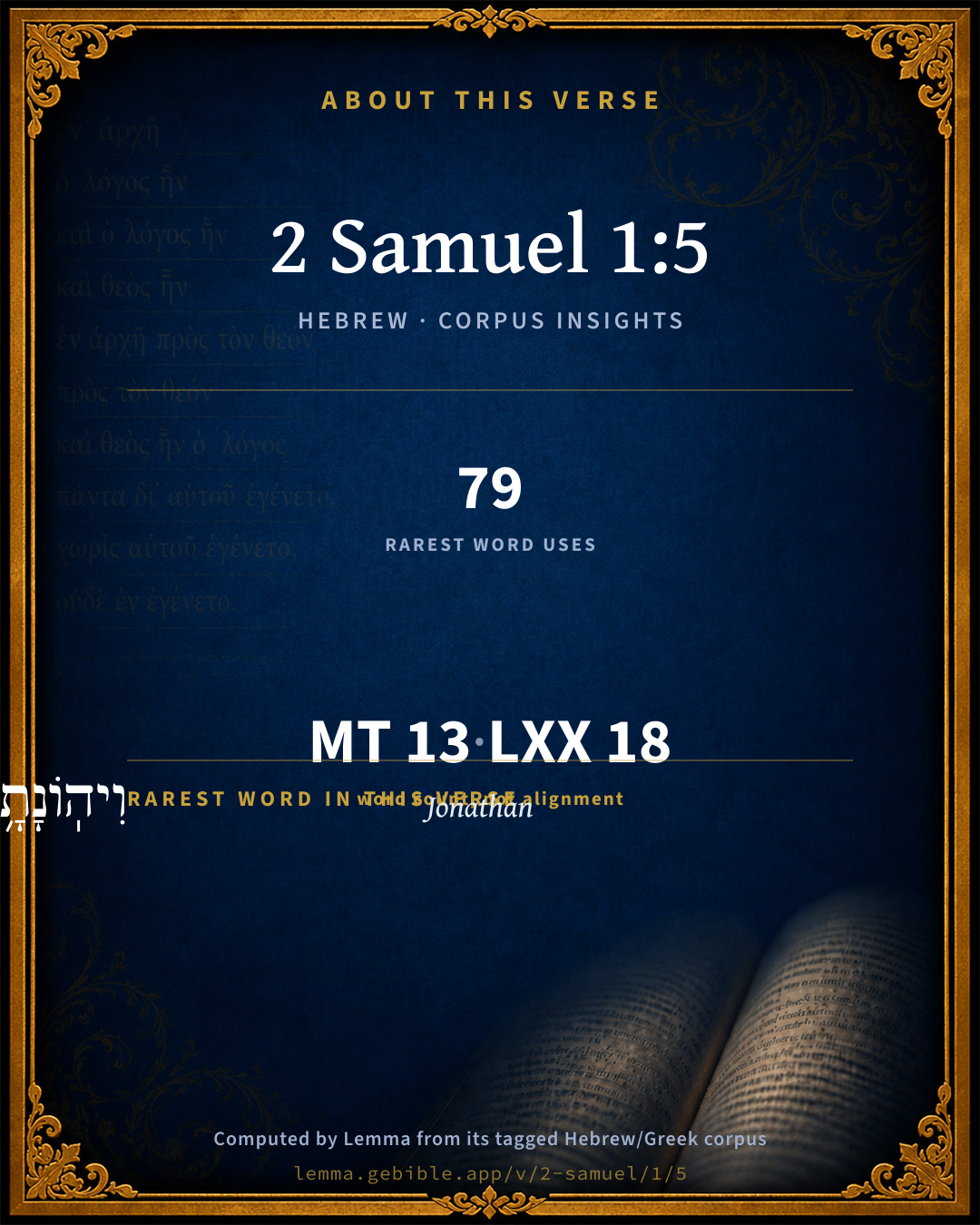
וִיהֽוֹנָתָ֥ן
Yᵉhôwnâthân
H3083
“and · Jonathan”
Conjunction + Noun, Proper
Part of Speech
Conjunction + Noun
Type
Proper
Full BDB Definition

Origin: from H3068 and H5414

TWOT: None

Jonathan or Jehonathan = "Jehovah has given" - a son of king Saul and a friend of David - a son of the high priest Abiathar and the last descendant of Eli of whom we hear - a nephew of David who like David slew a giant of Gath - an uncle of David - one of David's mighty warriors - one of David's treasurers - a scribe in the time of Jeremiah - a Levite and father of Zechariah, a priest who blew the trumpet at the dedication of the wall - a son or descendant of Gershom, the son of Moses, and a priest to the tribe of Dan - a son of Kareah and a brother of Johanan; a Judaite captain after the fall of Jerusalem - another Judaite father of Peleth - father of Ebed in the time of Ezra - son of Asahel in the time of Ezra - a priest of the family of Melicu in the time of Nehemiah - son of Joiada and his successor to the high priesthood in the time of Nehemiah
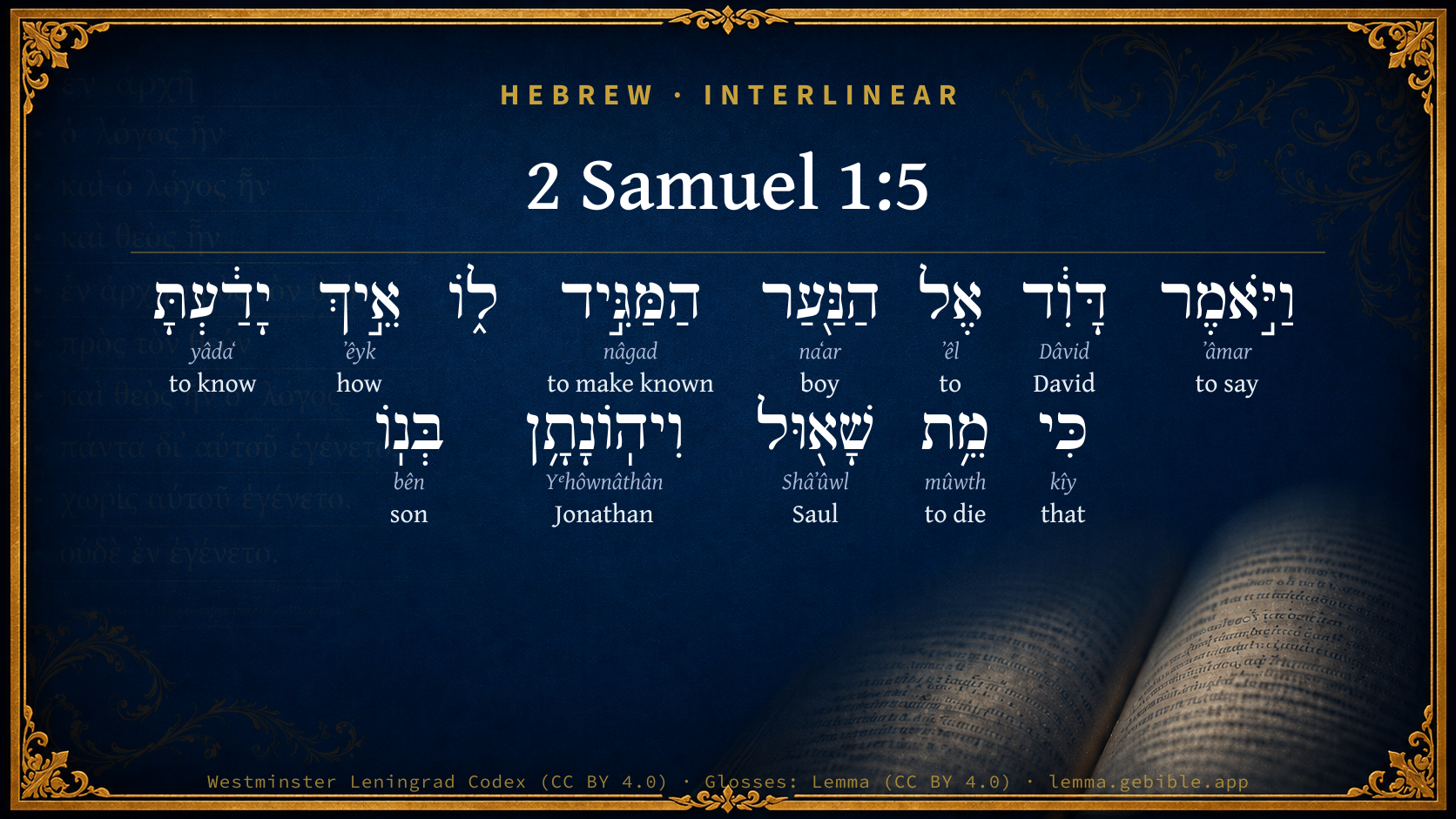
  1. וַיֹּ֣אמֶר ʼâmar H559 “and · to say” Conjunction + Verb, Qal, Sequential Imperfect, 3rd Person, Masculine, Singular
  2. דָּוִ֔ד Dâvid H1732 “David” Noun, Proper
  3. אֶל ʼêl H413 “to” Preposition
  4. הַנַּ֖עַר naʻar H5288 “the · boy” Particle, Definite Article + Noun, Common, Masculine, Singular, Absolute
  5. הַמַּגִּ֣יד nâgad H5046 “the · making known” Particle, Definite Article + Verb, Hiphil, Participle Active, Masculine, Singular, Absolute
  6. אֵ֣יךְ ʼêyk H349 “how” Particle, Interrogative
  7. יָדַ֔עְתָּ yâdaʻ H3045 “to know” Verb, Qal, Perfect, 2nd Person, Masculine, Singular
  8. כִּי kîy H3588 “that” Conjunction
  9. מֵ֥ת mûwth H4191 “to die” Verb, Qal, Perfect, 3rd Person, Masculine, Singular
  10. שָׁא֖וּל Shâʼûwl H7586 “Saul” Noun, Proper
  11. בְּנֽוֹ bên H1121 “son · his” Noun, Common, Masculine, Singular, Construct + Suffix, Personal, 3rd Person, Masculine, Singular

About this verse

These counts appear in no published source. They are computed here, from the morphology-tagged text and Lemma’s own curated glosses. What Lemma adds →

13
words
12
distinct lemmas
Historical
section

Grammatical profile

  • 4 verbs
  • 5 nouns
  • 2 prepositions
  • 1 conjunction
  • 1 particle

Verb forms

  • וַיֹּ֣אמֶר Qal · Sequential Imperfect
  • הַמַּגִּ֣יד Hiphil · Participle Active
  • יָדַ֔עְתָּ Qal · Perfect
  • מֵ֥ת Qal · Perfect

Hebrew & Septuagint length

In English translation the verse runs 20 words from the Hebrew and 23 from the Septuagint (LXX English) — closely comparable.

A rough comparison of the two English renderings, which tokenize alike — not a word-level alignment.

Word counts can differ between the Hebrew and the Greek without any difference in meaning — e.g. the Hebrew direct-object marker אֵת has no separate Greek word, and Greek often adds the article ὁ.

In the original languages it is 13 Hebrew tokens and 18 Greek tokens — but the two are counted differently (Hebrew bundles its prefixes and suffixes into one token; the Greek is in lemma form), so that isn’t a like-for-like length.

Cross-references

2

Topical passages linked to 2 Samuel 1:5 in the Treasury of Scripture Knowledge — connected by theme and wording, ordered by reader-vote popularity; previews shown in the World English Bible.

  • Proverbs 14:15 A simple man believes everything, But the prudent man carefully considers his ways.
  • Proverbs 25:2 It is the glory of God to conceal a thing, But the glory of kings is to search out a matter.

Cross-references courtesy of OpenBible.info (CC BY 4.0).

Hebrew and Greek witnesses Masoretic Hebrew ↔ Greek Septuagint

The same verse in the two great witnesses to the Old Testament, shown verse-for-verse.

These are two independent witnesses, not word-aligned to each other, and the Septuagint is shown in lemma (dictionary) form.

Hebrew 2 Samuel 1:5 Masoretic · Westminster Leningrad Codex

וַיֹּ֣אמֶר דָּוִ֔ד אֶל הַנַּ֖עַר הַמַּגִּ֣יד ל֑וֹ אֵ֣יךְ יָדַ֔עְתָּ כִּי מֵ֥ת שָׁא֖וּל וִיהֽוֹנָתָ֥ן בְּנֽוֹ

David said to the young man who told him, How know you that Saul and Jonathan his son are dead?

World English Bible · Public Domain

Greek LXX 2 Samuel 1:5 Septuagint · lemma form

καί εἶπον δαυίδ ὁ παιδάριον ὁ ἀποἀγγέλλω αὐτός πῶς οἶδα ὅτι θνήσκω σαούλ καί ιωναθαν ὁ υἱός αὐτός

And David said to the young man who brought him the tidings, How know you that Saul and Jonathan his son are dead?

LXX2012 (modern English Septuagint) · Public Domain

Hebrew: Westminster Leningrad Codex (CC BY 4.0). Greek: Septuagint (public domain); English from LXX2012 (modern English Septuagint) (Public Domain). How the Septuagint differs from the Hebrew →

Targum (Aramaic paraphrase)

1

The Targum is the ancient Jewish Aramaic paraphrase of the Hebrew Scriptures — an interpretive translation, not the Hebrew text itself. Onkelos (literal) and Pseudo-Jonathan (expansive) render the Torah, and Jonathan the Prophets. Coverage is partial: where no permissively-licensed English translation exists for a verse, only the Aramaic is shown. This is verse-level text, not a word-by-word alignment to the Hebrew.

  1. Targum Jonathan Prophets (Joshua–Malachi)
    וַאֲמַר דָוִד לְעוּלֵמָא דִמְחַוֵי לֵיהּ אֵיכְדִין יְדַעְתָּ אֲרֵי מִית שָׁאוּל וִיהוֹנָתָן בְּרֵיהּ:

    (no public-domain English translation for this verse)

    Targum Jonathan — Aramaic: “Mikraot Gedolot” (public domain). English: “Sefaria Community Translation” (CC0 1.0 (public-domain dedication)); “London "Chaldee Paraphrase," 1871” (public domain). Text via Sefaria.

Commentary

Notes on 2 Samuel 1:5 from classic Christian and Jewish commentators (each source and its license shown beneath its notes). The classic Christian expositions comment on the surrounding passage and are grouped to its opening verse, so a note may address several verses; the Jewish commentaries on the Tanakh (Rashi and others) are per-verse, so they appear only where the commentator wrote on this verse.

Lemma curates 59 commentaries, every one of them public domain or Creative Commons licensed, each selected and text-cleaned for this edition rather than reprinted as found. About our sources →

Trapp's Complete Commentary

John Trapp

2Sa 1:5 And David said unto the young man that told him, How knowest thou that Saul and Jonathan his son be dead?

Ver. 5. Unto the young man.] The lad, the stripling, the servant, for so David took him to be: and such are called lads or boys in many languages. "Herod said to his servants"; {Mat 14:2} Gr., to his boys. And the Latins call the body Corpus or Corpor, quasi Cordis puer, as some will have it.

That Saul and Jonathan his son be dead.] For there lay the pinch of his grief, and the public concernment.

John Trapp, A Commentary or Exposition upon All the Books of the Old and New Testament (1647–1656) — public domain. Text from a community e-Sword module.

John Gill's Exposition

And David said unto the young man that told him,.... These tidings:

how knowest thou that Saul and Jonathan his son be dead? this he particularly inquired after, as what most affected him, and was most material for him to know; and his meaning is, whether he had this of his own sight and knowledge, or by report.

John Gill's Exposition of the Whole Bible (1746–1763) — public domain (CC PDM 1.0). Text via the HelloAO Bible API.

Matthew Poole's English Annotations

For the knowledge of this did most concern both David and the whole commonwealth of Israel.

Matthew Poole's English Annotations on the Holy Bible (1683–1685) — public domain. Text from a community e-Sword/MySword module.

Lesson kit

Teaching starters — assembled from the data on this page, not authored interpretation. Every prompt links to the verse data it draws on. Edit before teaching.

2 Samuel, in the Historical, opens this verse with 13 words (12 distinct Hebrew lemmas). Its most distinctive word is Yᵉhôwnâthân (“Jonathan”). A historical commentator’s framing appears above. Read the whole chapter for the surrounding context.

Discussion questions

  1. The word Yᵉhôwnâthân carries the sense “Jonathan.” How does it shape the verse?
  2. How does Proverbs 14:15, which shares this passage’s theme, read alongside this verse?
  3. These translations render this verse differently. What is at stake in choosing one wording over another?
  4. «וַיֹּ֣אמֶר» is a Qal Sequential Imperfect verb. How does that grammatical form shape the action described?
  5. Compare how Trapp's Complete Commentary and John Gill's Exposition read this verse. Where do they agree or differ?

Things to notice

Reading settings

Reading text

Shown beneath each verse's original-language words.

Old Testament
Old Testament edition

Read the OT as the Masoretic Hebrew (MT) or the Greek Septuagint (LXX).

English shown for the Greek Septuagint (in the Hebrew ↔ Greek comparison).

Comparing translations? Open the Compare panel on any verse page to stack up to four side by side.