
Psalms 41:4

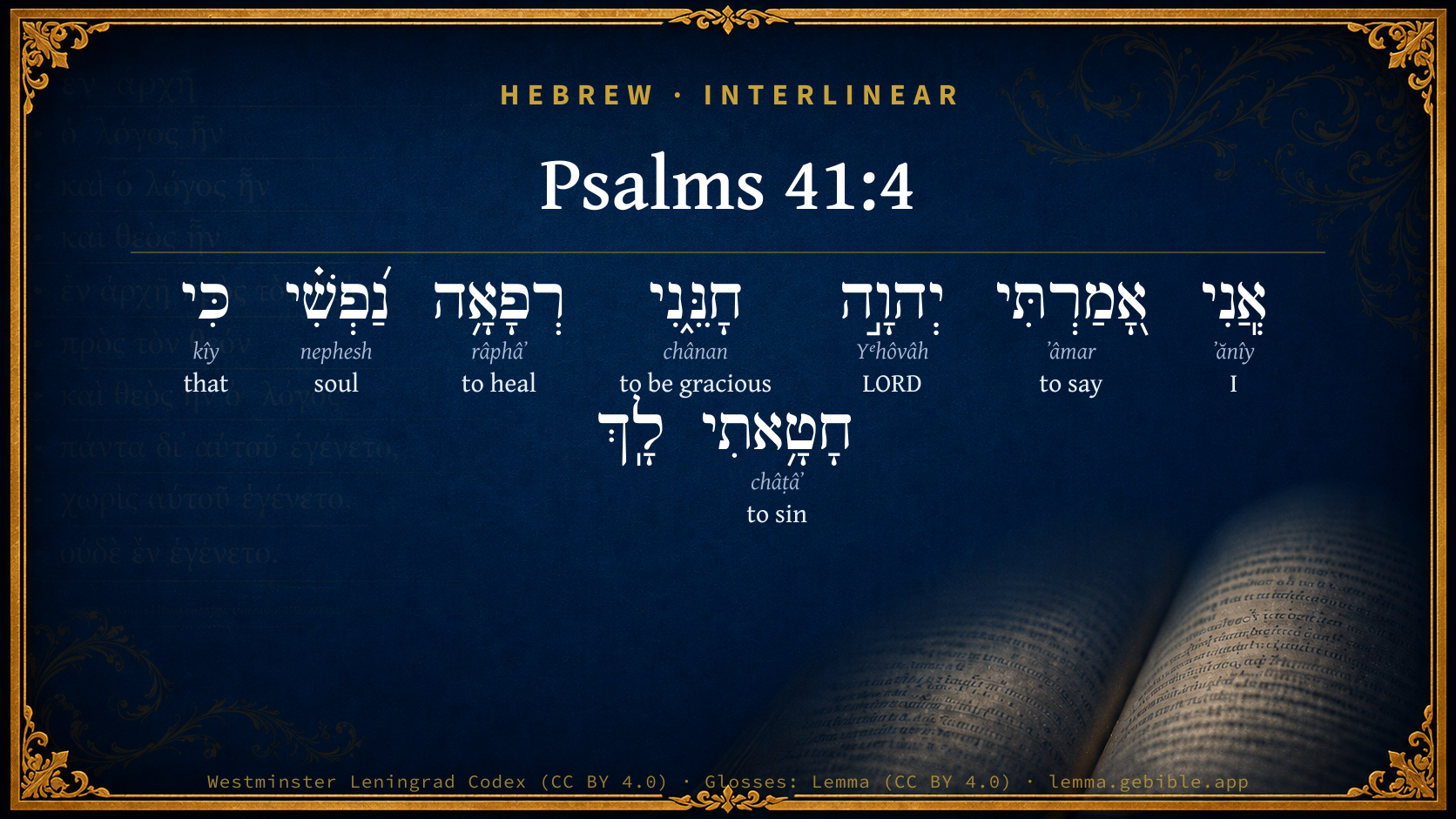
Hebrew (Westminster Leningrad Codex) Psalms 41:4 appears in the Hebrew Old Testament. The text above is from the Westminster Leningrad Codex. Each word links to its Strong’s number, a concise gloss, and parsing drawn from the Open Scriptures Hebrew Bible morphology. Click any word for its full Brown-Driver-Briggs (BDB) entry.
Download image
Cite this verse

Psalms 41:4 (World English Bible). Public Domain. Lemma interlinear Bible study tool, https://lemma.gebible.app/v/psalms/41/4.

Show BibTeX & RIS
BibTeX
RIS
English Translation
I said, "Yahweh, have mercy on me! Heal me, for I have sinned against you."
World English Bible · Public Domain
Download a study sheet

One document with this verse’s original text, its word-by-word gloss line, the meaning frame, cross-references with their text, attributed commentary, and full source and license credits — printable, and it pastes into notes with its structure intact.

This verse Autodidact and up

Study sheet (.html) Plain text (.txt)

A passage Seminary Student

Up to 50 verses in one chapter. A passage sheet keeps up to 6 commentary sources and 12 cross-references per verse, in the order this page ranks them, and says so on the sheet whenever that leaves anything out. Ask for a single verse and you get the Autodidact verse sheet above.

Everything on this page stays free to read, with no account — the sheet is a download of what is already on screen, not access to it.

Want to remove ads? Support Godless Engineer
Compare translations 3

The same verse in 3 English versions, stacked beneath the original-language interlinear above. Click any original word for its lexicon entry.

Each is an independent rendering of the whole verse — the interlinear is not word-aligned to these translations.

Highlighted words mark where these versions differ — a whole-verse word diff, not a word-by-word alignment.

  • World English Bible Public Domain
    I said, "Yahweh, have mercy on me! Heal me, for I have sinned against you."
  • King James Version Public Domain
    I said, LORD, be merciful unto me: heal my soul; for I have sinned against thee.
  • unfoldingWord Literal Text CC BY-SA 4.0
    I, I said, “Yahweh, be gracious to me! Heal my soul, for I have sinned against you.”

unfoldingWord Literal Text — © unfoldingWord, licensed CC BY-SA 4.0. Word-aligned USFM3 via Door43 (git.door43.org/unfoldingWord/en_ult).

Versions to compare (up to 4)

3 of 4 selected

Show all 18 translations

Every available English version of this verse, each an independent rendering of the whole verse.

  • World English Bible Public Domain
    I said, "Yahweh, have mercy on me! Heal me, for I have sinned against you."
  • Berean Standard Bible Public Domain
    I said, “O LORD, be gracious to me; heal me, for I have sinned against You.”
  • Majority Standard Bible Public Domain
    I said, “O LORD, be gracious to me; heal me, for I have sinned against You.”
  • King James Version Public Domain
    I said, LORD, be merciful unto me: heal my soul; for I have sinned against thee.
  • American Standard Version (1901) Public Domain
    I said, O Jehovah, have mercy upon me: Heal my soul; for I have sinned against thee.
  • Revised Version (1885) Public Domain
    I said, O LORD, have mercy upon me: heal my soul; for I have sinned against thee.
  • Geneva Bible (1599) Public Domain
    Therefore I saide, Lord haue mercie vpon me: heale my soule, for I haue sinned against thee.
  • Douay-Rheims (1899) Public Domain
    The Lord help him on his bed of sorrow: thou hast turned all his couch in his sickness.
  • Young's Literal Translation Public Domain
    I -- I said, `O Jehovah, favour me, Heal my soul, for I did sin against Thee,'
  • Literal Standard Version CC BY-SA 4.0
    I said, “O YHWH, favor me, || Heal my soul, for I sinned against You,”
  • Unlocked Literal Bible CC BY-SA 4.0
    I said, “Yahweh, have mercy on me! Heal me, for I have sinned against you.”
  • unfoldingWord Literal Text CC BY-SA 4.0
    I, I said, “Yahweh, be gracious to me! Heal my soul, for I have sinned against you.”
  • Darby Bible Public Domain
    As for me, I said, Jehovah, be gracious unto me: heal my soul; for I have sinned against thee.
  • World Messianic Bible Public Domain
    I said, “LORD, have mercy on me! Heal me, for I have sinned against you.”
  • Webster's Bible Public Domain
    \\41:3\\The LORD will strengthen him upon the bed of languishing: thou wilt make all his bed in his sickness.
  • Free Bible Version CC BY-SA 4.0
    “Lord, please be gracious to me,” I asked. “Please heal me, for I have sinned against you.”
  • Bible in Basic English Public Domain
    I said, Lord, have mercy on me; make my soul well, because my faith is in you.
  • JPS Tanakh (1917) Public Domain
    (41-5) As for me, I said: 'O LORD, be gracious unto me; heal my soul; for I have sinned against Thee.'

Literal Standard Version (2020), Covenant Press — licensed CC BY-SA 4.0. Text via the HelloAO Bible API (eBible.org). Unlocked Literal Bible (unfoldingWord) — licensed CC BY-SA 4.0. Text via the HelloAO Bible API (eBible.org). unfoldingWord Literal Text — © unfoldingWord, licensed CC BY-SA 4.0. Word-aligned USFM3 via Door43 (git.door43.org/unfoldingWord/en_ult). Free Bible Version, Dr. Jonathan Gallagher — licensed CC BY-SA 4.0. Text via the HelloAO Bible API (eBible.org).

Word by word

More ways to search: Search by grammar → Find every occurrence → Compare this word →

Practice this passage: Drill this verse → Learn its vocabulary →

רְפָאָ֥ה
râphâʼ
H7495
“heal”
Verb, Qal, Imperative, 2nd Person, Masculine, Singular + Suffix, h
Part of Speech
Verb
Stem
Qal
Form
Imperative
Person
2nd Person
Gender
Masculine
Number
Singular
Full BDB Definition

Origin: a primitive root

TWOT: 2196

to heal, make healthful - (Qal) to heal - of God - healer, physician (of men) - of hurts of nations involving restored favour (figuratively) - of individual distresses (figuratively) - (Niphal) to be healed - literal (of persons) - of water, pottery - of national hurts (figuratively) - of personal distress (figuratively) - (Piel) to heal - literal - of national defects or hurts (figuratively) - (Hithpael) in order to get healed (infinitive)
  1. אֲֽנִי ʼănîy H589 “I” Pronoun, Personal, 1st Person, Common, Singular
  2. אָ֭מַרְתִּי ʼâmar H559 “to say” Verb, Qal, Perfect, 1st Person, Common, Singular
  3. יְהוָ֣ה Yᵉhôvâh H3068 “LORD” Noun, Proper
  4. חָנֵּ֑נִי chânan H2603 “be gracious · me” Verb, Qal, Imperative, 2nd Person, Masculine, Singular + Suffix, Personal, 1st Person, Common, Singular
  5. נַ֝פְשִׁ֗י nephesh H5315 “soul · my” Noun, Common, Both, Singular, Construct + Suffix, Personal, 1st Person, Common, Singular
  6. כִּי kîy H3588 “that” Conjunction
  7. חָטָ֥אתִי châṭâʼ H2398 “to sin” Verb, Qal, Perfect, 1st Person, Common, Singular

About this verse

These counts appear in no published source. They are computed here, from the morphology-tagged text and Lemma’s own curated glosses. What Lemma adds →

9
words
8
distinct lemmas
Wisdom
section

Grammatical profile

  • 4 verbs
  • 2 nouns
  • 1 pronoun
  • 1 preposition
  • 1 conjunction

Verb forms

  • אָ֭מַרְתִּי Qal · Perfect
  • חָנֵּ֑נִי Qal · Imperative
  • רְפָאָ֥ה Qal · Imperative
  • חָטָ֥אתִי Qal · Perfect

Hebrew & Septuagint length

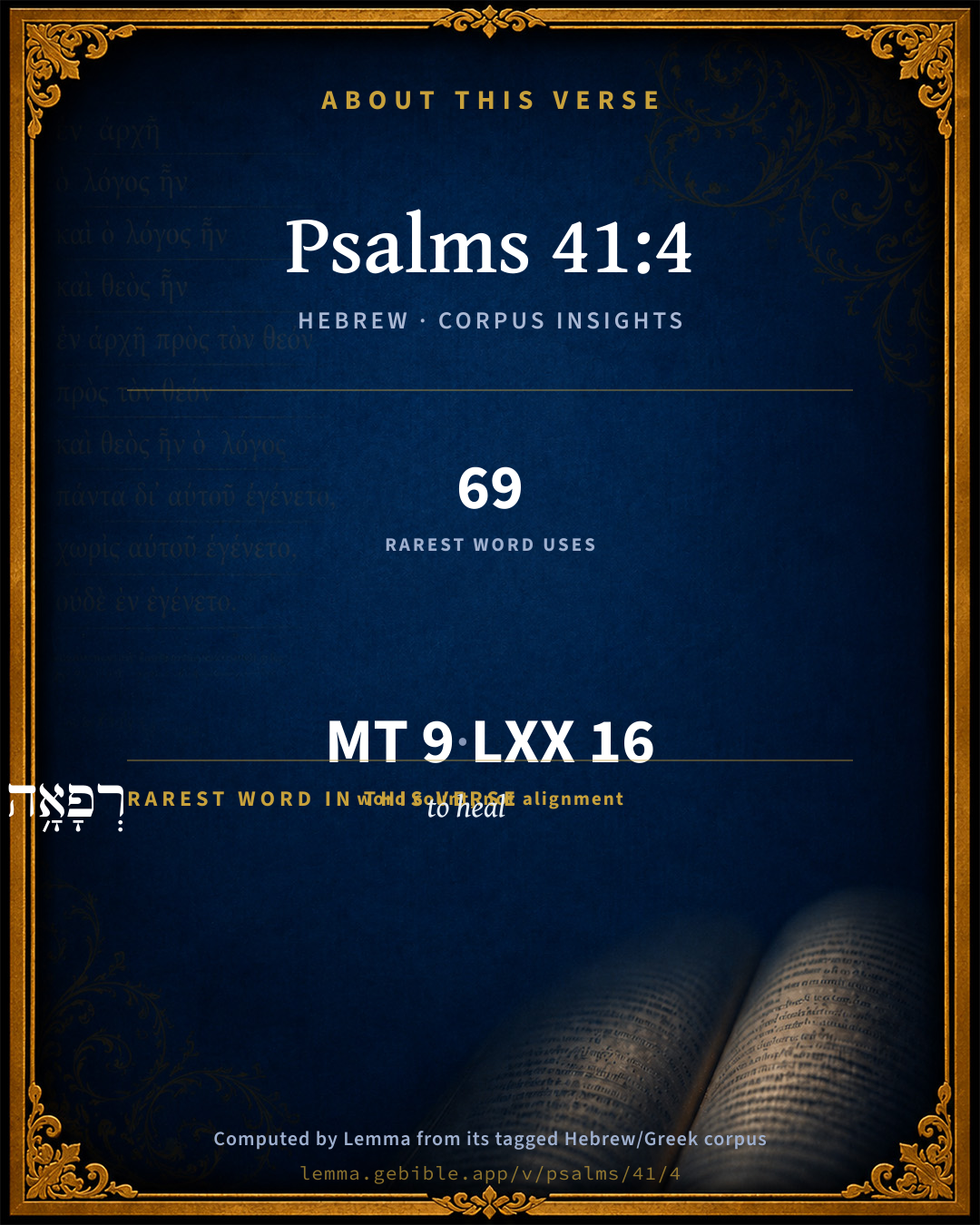
In English translation the verse runs 15 words from the Hebrew and 17 from the Septuagint (LXX English) — closely comparable.

A rough comparison of the two English renderings, which tokenize alike — not a word-level alignment.

Word counts can differ between the Hebrew and the Greek without any difference in meaning — e.g. the Hebrew direct-object marker אֵת has no separate Greek word, and Greek often adds the article ὁ.

In the original languages it is 9 Hebrew tokens and 16 Greek tokens — but the two are counted differently (Hebrew bundles its prefixes and suffixes into one token; the Greek is in lemma form), so that isn’t a like-for-like length.

Cross-references

8

Topical passages linked to Psalms 41:4 in the Treasury of Scripture Knowledge — connected by theme and wording, ordered by reader-vote popularity; previews shown in the World English Bible.

  • Psalms 103:3 Who forgives all your sins; Who heals all your diseases;
  • James 5:15–16 and the prayer of faith will heal him who is sick, and the Lord will raise him up. If he has committed sins, he will be forgiven.
  • Hosea 6:1 "Come, and let us return to Yahweh; For he has torn us to pieces, And he will heal us; He has injured us, And he will bind up our wounds.
  • 2 Chronicles 30:18–20 For a multitude of the people, even many of Ephraim and Manasseh, Issachar and Zebulun, had not cleansed themselves, yet did they eat the Passover otherwise than it is written. For Hezekiah had prayed for them, saying, The good Yahweh pardon everyone
  • Psalms 6:2–4 Have mercy on me, Yahweh, for I am faint. Yahweh, heal me, for my bones are troubled.
  • Psalms 32:5 I acknowledged my sin to you. I didn't hide my iniquity. I said, I will confess my transgressions to Yahweh, And you forgave the iniquity of my sin. Selah.
  • Psalms 147:3 He heals the broken in heart, And binds up their wounds.
  • Psalms 51:1–4 Have mercy on me, God, according to your loving kindness. According to the multitude of your tender mercies, blot out my transgressions.

Cross-references courtesy of OpenBible.info (CC BY 4.0).

Hebrew and Greek witnesses Masoretic Hebrew ↔ Greek Septuagint

The same verse in the two great witnesses to the Old Testament, shown verse-for-verse.

You’re reading Greek Psalm 40 (Hebrew Psalm 41). The Septuagint counts the superscription, so verse numbers can differ from the Hebrew — chapter-level alignment, not verse-by-verse. Numbering follows Rahlfs.

These are two independent witnesses, not word-aligned to each other, and the Septuagint is shown in lemma (dictionary) form.

Hebrew Psalms 41:4 Masoretic · Westminster Leningrad Codex

אֲֽנִי אָ֭מַרְתִּי יְהוָ֣ה חָנֵּ֑נִי רְפָאָ֥ה נַ֝פְשִׁ֗י כִּי חָטָ֥אתִי לָֽךְ

I said, "Yahweh, have mercy on me! Heal me, for I have sinned against you."

World English Bible · Public Domain

Greek LXX Greek Psalm 40:4 Septuagint · lemma form

κύριος βοηθέω αὐτός ἐπί κλίνη ὀδύνη αὐτός ὅλος ὁ κοίτη αὐτός στρέφω ἐν ὁ ἀρρωστία αὐτός

I said, O Lord, have mercy upon me; heal my soul; for I have sinned against you.

LXX2012 (modern English Septuagint) · Public Domain

On this verse, Keil & Delitzsch discusses the Septuagint’s reading. Read the note in Commentary ↓

Hebrew: Westminster Leningrad Codex (CC BY 4.0). Greek: Septuagint (public domain); English from LXX2012 (modern English Septuagint) (Public Domain). How the Septuagint differs from the Hebrew →

Commentary

Notes on Psalms 41:4 from classic Christian and Jewish commentators (each source and its license shown beneath its notes). The classic Christian expositions comment on the surrounding passage and are grouped to its opening verse, so a note may address several verses; the Jewish commentaries on the Tanakh (Rashi and others) are per-verse, so they appear only where the commentator wrote on this verse.

Lemma curates 59 commentaries, every one of them public domain or Creative Commons licensed, each selected and text-cleaned for this edition rather than reprinted as found. About our sources →

Trapp's Complete Commentary

John Trapp

Psa 41:4 I said, LORD, be merciful unto me: heal my soul; for I have sinned against thee.

Ver. 4. I said, Lord, be merciful unto me: heal] Heal me in mercy, and begin at the inside first. Heal my soul of sin, and then my body of sickness; heal me every whit. These, to the end, are the sick man’s words, saith Kimchi. And this is the character of the Lord’s poor man, to whom the foresaid comforts do belong, saith another.

For I have sinned against thee] He crieth peccavi, not peril. Sanationem a capite orditur, he beginneth at the right end.

John Trapp, A Commentary or Exposition upon All the Books of the Old and New Testament (1647–1656) — public domain. Text from a community e-Sword module.

The Biblical Illustrator

Joseph S. Exell

Psa_41:4

I said, Lord be merciful to me: heal my soul, for I have sinned against thee.

An excellent prayer

I. He confesses that he is a sinner. The law brings the conviction of sin, but the greatest sin of all is unbelief.

II. He counts sin the disease of the soul--heal my soul. Sin affects the soul as disease the body.

III. He views God as the only physician--Lord, heal my soul We cannot heal our own soul; nor can any creatures. The sooner we see and feel this the better. But the Lord heals: by His stripes we are healed.

IV. He is also persuaded that nothing but mercy in God will induce him to heal his soul. Here is the only source of our hope. (W. Jay.)

A singular plea in prayer

I. A prayer.

1. Lord, be merciful unto me.

(1) It may--I dare say did--mean, at least in part, Mitigate my pains. When grieved with sore physical pain, you will find that the quiet resignation, holy patience, and childlike submissiveness which enable you just to pray, Lord, be merciful unto me, will often bring a better relief to you than anything that the most skilled physician can prescribe.

(2) He must have meant also, Forgive my sins. It is a blessed prayer, and I charge you never to cease from using it in the sense that our Lord taught it to His disciples,! Forgive us our trespasses, as we forgive them that trespass against us.

(3) I think that David also meant, Fulfil thy promises. Thou hast said of the man who considers the poor, The Lord will deliver him in time of trouble. Lord, be merciful unto me, and deliver me in the time of my trouble, Thou hast said, The Lord will preserve him, and keep him alive. Lord, be merciful unto me, preserve me, and keep me alive. Thou hast said that Thou wilt not deliver him unto the will of his enemies; Lord, be merciful unto me, and guard me from my foes. Thou wilt strengthen him upon the bed of languishing; Lord, be merciful unto me, and strengthen me. Thou wilt make all his bed in his sickness; Lord, make my bed.

2. Heal my soul. David does not pray, Heal my eye; heal my foot; heal my heart; heal me, whatever my disease may be; but he goes at once to the root of the whole matter, and prays, Heal my soul.

(1) Heal me, Lord, of the distress of my soul.

(2) Lord, heal my soul of the effect of sin.

(3) Heal me of my tendency to sin.

II. A confession. I have sinned against Thee.

1. It is a confession without an excuse.

2. It is a confession without any qualification. He does not say, Lord, I have sinned to a certain extent; but, still, I have partly balanced my sins by my virtues, and I hope to wipe out my faults with my tears. No; he says, I have sinned against Thee, as if that were a full description of his whole life.

3. It is without affectation. I like a man, when he makes a confession of sin, not to be carried away into the use of proud expressions without meaning, but to speak with judgment, and to acknowledge and confess only what is true. This is the excellence of Davids confession, that he owns to what no sinner will ever admit till the grace of God makes him do it: I have sinned against Thee.

III. A plea. I said, Lord, be merciful unto me: heal my soul. Why? For I have sinned against Thee. That is a very remarkable way of pleading, but it is the only right one.

1. It is such a plea as no self-righteous man would urge. The Pharisee keeps to this strain, Lord, be merciful unto me, for I have been obedient, I have kept thy law. O foolish, self-righteous man, do you not see that you are shutting the door in your own face? You say, in effect, Be merciful unto me, for I do not need any mercy.

2. This is such a plea as a carnal reasoner could not urge, for he could not spy out any reason or argument in it. (C. H. Spurgeon.)

Sins disease

I. Sin is a soul disease.

1. Of the understanding.

2. Of the affections.

3. Of the conscience.

4. Of the will.

II. God alone can heal it.

1. We must feel our malady, and--

2. Our impotence.

3. We must recognize His power, and--

4. Trust His mercy. (W. W. Whyte.)

The inveterateness of sin

Sin, we are told, is a survival; and that reverses and explodes all the traditional Christian theology. It is, they say, the effort of some past condition to assert itself when its day is over. It may be even a belated virtue which was once a true formula, under which we succeeded in securing our existence. For it has become a vice, in that it would hold us down at a lower level than that which lies open to us. It haunts us with strange and awful memories, it imprisons us with instinctive hopes which we should have forgotten and overgrown; it strikes against its own institution. It has old refuges in the blood and tissue, from out of which it refuses to be wrung. It has a dim, end-of-the-world impulse to appeal to. No wonder it is hard to beat it under. It carries on its subterranean war like the pagan deities of old, beneath the surface triumphant still. That is sin, according to this interpretation. Sin is the shadow cast out of the past; it reveals the law, out of which we have climbed to the new day. Still it sucks us down, and menaces, and defiles; but its death is sure; the future is against it; its sentence has gone out. There may be many a disloyal recrudescence of its ancient mischief; there will be strange moments when a sort of atavism will enable it to occupy lost ground; there may be even partial degradations, in which the higher will succumb to the lower. But the whole trend of life is upward, and under this sin will sink and disappear, for life is not a fail, but a rise, sin is that which is for ever being left behind. Now, of course, if this is the true account of sin, we had better wipe out the entire Bible story. Let us consider what that would mean. It would not be merely an abandonment of some obsolete dogma, nor would it be to realize all real living facts over against some blind authority. Rather it would mean the surrender of the widest, and deepest and most prolonged accumulation of human experience in the things of the living spirit that the world has ever known. Is there any statement more completely falsified by every scrap that we know of our own inward life than the one which pronounces that sin is the merest survival? That is just the sort of illusion with which we all begin, and which all further experience explodes. We fancy at first that sin is a misfortune, an accident, a weak surrender, to some invading and hostile attack. We never lived it, we are not of that sort, we know our own rightness of intention, our innate goodness in our best self. We will face and wipe off this wrong which has besmirched us. It is so unworthy of us and so unlike us. And now we have confessed and repented and we are ourselves again. We shall be stronger when next assailed. These will die away of themselves. How futile! how ignorant! how wrong! The old, old story repeats itself; the relapse recurs with strange regularity; the moral strength just breaks at the crisis when it ought to stand. Always the thing, somehow, is too much for it; always we do again that very thing that we had forsworn for ever. Why the strange persistent failure? Why this tremor at the heart? Why is the hand still put out to pluck that which we know to be forbidden? Why do the feet turn again down the paths which lead to death? Again it is the old cause--the thing that I ought to do I do not; the thing that I would not, that I do. And does this mean that we have not got at the root of the matter, that it is not the outside accident which we hope, that it is a monotonous revelation of a wrong that works by a regular law? It is I and not something that is upon me that is responsible for this disorder. Why cannot I do what I want? I, who seem to myself so inherently good, so thoroughly well-meaning, so far above these degradations, so resolute in my determination? I am somehow guilty. O miserable man that I am! O my God, it is I that have sinned against Thee and done this evil in Thy sight. Your sin will not disappear of itself. You will never grow out of it; it is too deep, too intimate, too personal for that. It will reappear within when you have expelled it from without. You are powerless. But you have the witness in yourself that sin and you can never agree. Sin is not your true life, but your death, and in the strength of that inner weakness you have force and right to appeal to; that invincible love that only waits for your appeal to find its entry. Have mercy upon me, O God, heal my soul, for I have sinned against Thee. Lift that cry, and the answer is in your ears in the Person of Jesus Christ our Saviour: I will, be thou clean. (Canon Scott Holland.)

The Biblical Illustrator, edited by Joseph S. Exell (c. 1880s–1900s) — public domain. Text from a community e-Sword module.

Joseph Benson's Commentary

Psa 41:4. I said, Lord, be merciful unto me — He appeals to mercy, as one that knew he could not stand the test of strict justice. The best saints, even those that have been merciful to the poor, have not made God their debtor; but must throw themselves on his mercy. When we are under the rod, we must thus recommend ourselves to the tender mercy of our God. Heal my soul — Sin is the sickness of the soul and the soul is healed when, being pardoned by mercy, it is also renewed by grace. And this spiritual healing we should be more earnest for than for bodily health. For I have sinned against thee — And, therefore, my soul needs healing: I am a sinner, a miserable sinner; and, therefore, God, be merciful to me. The psalmist does not appear here to refer to any particular gross act of sin, but to his sins in general, which his sickness, and the troubles he met with, set in order before him; and the dread of the consequences of which made him pray, Heal my soul.

Joseph Benson's Commentary on the Old and New Testaments (1811–1818) — public domain. Text from a community e-Sword module.

J. A. Alexander on Psalms

Joseph Addison Alexander

5. (Psa 41:4). I have said, Jehovah, have mercy upon me; heal my soul, for I have sinned against thee. The pronoun at the beginning is emphatic. He is here applying to himself the doctrine which he had before laid down in general terms. "Knowing this to be the rule of the divine administration, I myself have claimed the benefit of it; I myself have said," etc. There is no need of diluting the past tense into a present. The use of the preterite implies that it is not an act yet to be performed, but one that has been done already. The same emphasis, though not required by the form of the original, may be supposed to rest upon the me and the my. The prayer for the healing of his soul may be considered as including that for the removal of his bodily disease, which seems to be referred to in this psalm as a mere (consequence of inward agony. And this is itself referred to sin as its occsion in the last clause of the verse. The intimate connection between sin, and suffering is continually recognised by David. See above, Psa 31:11 (10), Psa 32:5; Psa 38:4-5; Psa 38:19 (3, 4, 18), Psa 40:13 (12). Against thee, literally to thee, as to thee. The idea of direct opposition is suggested by the context. See above, on Psa 30:2 (1), Psa 35:19; Psa 35:24; Psa 38:17 (16).

Joseph Addison Alexander, The Psalms Translated and Explained (1850) — public domain. Text from a community e-Sword module.

Tyndale Open Study Notes

Tyndale Open Resources

41:4 The psalmist applies the blessing to himself (41:12). Apparently he has taken care of the poor (41:1), but he has sinned against the Lord in other ways. Out of his pain, he cries for healing while confessing his sin. The Lord alone can grant the restoration that brings true joy (30:2; 107:20-21).

Tyndale Open Study Notes — © Tyndale Open Resources, licensed CC BY-SA 4.0. Text via the HelloAO Bible API.

Jamieson, Fausset & Brown

Robert Jamieson, A. R. Fausset & David Brown

I said--I asked the mercy I show.

heal my soul--(Compare Psa 30:2). "Sin and suffering are united," is one of the great teachings of the Psalms.

Jamieson, Fausset & Brown — Commentary Critical and Explanatory on the Whole Bible (1871) — public domain (CC PDM 1.0). Text via the HelloAO Bible API.

Adam Clarke's Commentary

Verse 4. I said, Lord, be merciful unto me] I need thy mercy especially, because I have sinned against thee, and my sin is a deadly wound to my soul; therefore heal my soul, for it has sinned against thee.

Adam Clarke's Commentary on the Bible (1810–1826) — public domain. Text from a community e-Sword/MySword module.

John Calvin's Commentaries

4. I have said, O Jehovah! have mercy upon me. By this verse he shows that in his adversity he did not seek to soothe his mind by flattery, as the greater part of men do, who endeavor to assuage their sorrows by some vain consolation. And, certainly, the man who is guided by the Spirit of God will, when warned of God by the afflictions with which he is visited, frankly acknowledge his sins, and quietly submit to the admonitions of his brethren, nay, he will even anticipate them by a voluntary confession. David here lays down a mark by which he distinguishes himself from the reprobate and wicked, when he tells us that he earnestly entreated that his sin might not be laid to his charge, and that he had sought refuge in the mercy of God. He indeed requests that some alleviation might be granted to him under the affliction which he endured: but he rises to a higher source of relief, when he asks that through the forgiveness of his sins he might obtain reconciliation to God. Those, as we have said elsewhere, invert the natural order of things, who seek a remedy only for the outward miseries under which they labor, but all the while neglect the cause of them; acting as a sick man would do who sought only to quench his thirst, but never thought of the fever under which he labors, and which is the chief cause of his trouble. Before David, therefore, speaks at all of the healing of his soul, that is to say, of his life he first says, Have mercy upon me: and with this we must connect the reason which immediately follows — for I have sinned against thee. In saying so, he confesses that God is justly displeased with him, and that he can only be restored again to his favor by his sins being blotted out. I take the particle כי, ki, in its proper and natural signification, and not adversatively, as some would understand it. He asks then that God would have mercy upon him because he had sinned. From that proceeds the healing of the soul, which he interposes between his prayer and confession, as being the effect of the compassion and mercy of God; for David expects that as soon as he had obtained forgiveness, he would also obtain relief from his affliction.

John Calvin's Commentaries (1540-1563) — public domain. Text from the Calvin Translation Society English edition (1840s-50s) via the Christian Classics Ethereal Library (ccel.org). Calvin's coverage is partial (roughly two-thirds of the Bible); uncommented books and verses are honest gaps, never fabricated. The 19th-century editor's footnotes and remarks are omitted so the notes are faithfully Calvin's own voice.

Ellicott's Commentary for English Readers

(4) I said.—After the general statement, the poet applies it to his own case, which showed such sadly different conduct on the part of friends from whom more than sympathy might have been expected. The pronoun is emphatic: In my case, I said, etc.

But it is a singular mark of the psalmist’s sincerity and genuineness that he first looks into his own heart for its evil before exposing that of his friends.

A Bible Commentary for English Readers, edited by Charles John Ellicott (1878–1897) — public domain. Text from a community e-Sword module.

The Cambridge Bible for Schools and Colleges

gen. ed. J. J. S. Perowne

4. I said] Or, I, even I, have said. This has been and is my prayer. Psa_41:10 seems to imply that the sickness is not yet a thing of the past.

be merciful] Be gracious (Psa_4:1; &c.).

heal my soul] The soul is the man’s whole ‘self;’ the living personality which results from the union of spirit and flesh. See Oehler’s Old Test. Theology, § 70. The bodily sickness is the sign and symptom of spiritual disease: he would fain be healed of both. Cp. Psa_6:2-3; Jer_17:14.

for I have sinned against thee] Cp. Psa_51:4; Psa_31:10 He has offended against God; the chastisement comes from Him; and He alone can heal. Cp. Hos_6:1.

4–6. The foregoing sketch of the blessedness of the compassionate man serves to introduce the Psalmist’s description of his own case, partly as a foil and contrast to the heartless treatment he is experiencing, partly because he feels that he can himself plead for a share in the mercy promised to the merciful.

The Cambridge Bible for Schools and Colleges (gen. ed. J. J. S. Perowne; Cambridge University Press, 1878–1918) — public domain. Text from a community e-Sword module.

John Gill's Exposition

I said, Lord, be merciful unto me,.... See Gill on Psa 40:11;

heal my soul; not that it was diseased with sin in such sense as the souls of other men are; but it is to be understood as a petition for comfort while bearing the sins of others, and which Christ as man stood in need of when in the garden and on the cross; so healing signifies comfort in trouble, as in Isa 57:18;

for I have sinned against thee; or "unto thee", or "before thee", as the Targum; not that any sin was committed by him in his own person, but he having all the sins of his people on him, which he calls his own, Psa 40:12; he was treated as a sinner, and as guilty before God, Isa 53:12; and so the words may be read, "for I am a sinner unto thee" (u); I am counted as one by thee, having the sins of my people imputed to me; and am bound unto thee, or under obligation to bear the punishment of sin; or thus, "for I have made an offering for sin unto thee" (w), so the word is used, Lev 6:26; and so it might be rendered in Lev 5:7; and perhaps may be better rendered so in Lev 4:3; and be understood, not of the sin of the anointed priest, but of his offering a sacrifice for the soul that sinned through ignorance, Psa 41:2, which offering is directed to: and then the sense here is, heal me, acquit me, discharge me, and deliver me out of this poor and low estate in which I am; for I have made my soul an offering for sin, and thereby have made atonement for all the sins of my people laid upon me; and accordingly he was acquitted and justified, Ti1 3:16.

(u) "tibi", Pagninus, Montanus, Cocceius. (w) "Obtuli sacrificium pro peccato", Gussetius, Ebr. Comment. p. 249, 923.

John Gill's Exposition of the Whole Bible (1746–1763) — public domain (CC PDM 1.0). Text via the HelloAO Bible API.

Albert Barnes' Notes on the Bible

I said, Lord - I said in my sickness, or in the trial referred to in the psalm. I called on God to be merciful to me when others had no mercy; to be near to me when others turned away; to save me when pressed down with disease on account of my sins. All that follows relates, like this passage, to what occurred when he was sick; to the thoughts that passed through his mind, and to the treatment which he then experienced from others.

Be merciful unto me - In forgiving my sins, and restoring me to health.

Heal my soul - In restoring my soul to spiritual health by forgiving the sin which is the cause of my sickness; or it may mean, Restore my life - regardng his life as (as it were) diseased and in danger of extinction. The probability, however, is that he had particular reference to the soul as the word is commonly understood, or as designating himself; heal, or restore me.

For I have sinned against thee - Regarding his sin as the cause of his sickness. See the notes at Psa 38:3-5.

Albert Barnes' Notes on the Bible (1834–1885) — public domain. Text from a community e-Sword/MySword module.

Matthew Poole's English Annotations

My soul, i.e. either,

1. Myself, to wit, my body. So it is a double synecdoche. And the soul is so taken Psa 16:10. Or,

2. My soul properly so called; which is said to be healed, when it is pardoned and purged, as 2Ch 30:20; Isa 53:5, compared with 1Pe 2:24; Mat 13:15, compared with Mar 4:12; Jam 5:16. So he strikes at the root of his misery, and prays for the removal of the sin of his soul, as the cause of the disease of his body.

For I have sinned against thee: this may be added, either,

1. As a reason or motive to God; Grant this request, for I have sinned, and therefore thy grace in healing me will be more glorious and admirable. Or, for I acknowledge that I have sinned; for the act is oft put for the declaration of it, as Exo 33:13; Psa 51:5. Or,

2. As a reason moving him thus to pray, I said, Lord, be merciful unto me: heal my soul; and great reason I had to say so, for I have sinned against thee.

Matthew Poole's English Annotations on the Holy Bible (1683–1685) — public domain. Text from a community e-Sword/MySword module.

The Treasury of David

Charles H. Spurgeon

Ver. 4-9. Here we have a controversy between the pleader and his God. He has been a tender friend to the poor, and yet in the hour of his need the promised assistance was not forthcoming. In our Lord's case there was a dark and dreary night in which such arguments were well befitting himself and his condition.

Ver. 4. I said said it in earnest prayerLord, be merciful unto me. Prove now thy gracious dealings with my soul in adversity, since thou didst aforetime give me grace to act liberally in my prosperity. No appeal is made to justice; the petitioner but hints at the promised reward, but goes straightforward to lay his plea at the feet of mercy. How low was our Redeemer brought when such petitions could come from his reverend mouth, when his lips like lilies dropped such sweet smelling but bitter myrrh! Heal my soul. My time of languishing is come, now do as thou hast said, and strengthen me, especially in my soul. We ought to be far more earnest for the soul's healing than for the body's ease. We hear much of the cure of souls, but we often forget to care about it. For I have sinned against thee. Here was the root of sorrow. Sin and suffering are inevitable companions. Observe that by the psalmist sin was felt to be mainly evil because directed against God. This is of the essence of true repentance. The immaculate Saviour could never have used such language as this unless there be here a reference to the sin which he took upon himself by imputation; and for our part we tremble to apply words so manifestly indicating personal rather than imputed sin. Applying the petition to David and other sinful believers, how strangely evangelical is the argument: heal me, not for I am innocent, but I have sinned. How contrary is this to all self righteous pleading! How consonant with grace! How inconsistent with merit! Even the fact that the confessing penitent had remembered the poor, is but obliquely urged, but a direct appeal is made to mercy on the ground of great sin. O trembling reader, here is a divinely revealed precedent for thee, be not slow to follow it.

Ver. 4. I said, Lord, be merciful. Mercy, not justice! The extreme of mercy for the extreme of misery. Righteousness as filthy rags; a flesh in which dwelleth no good thing, on the one side; on the other, it is "neither herb nor mollifying plaster that restored" to health; "but thy word, O Lord, which healeth all things." Wisdom

16:12. Thomas Aquinas, quoted by J. M. Neale.

Ver. 4. God is the strength of a Christian's heart, by healing and restoring him when the infused habits of grace fail, and sin grows strong and vigorous. A Christian never fails in the exercise of grace, but sin gives him a wound; and therefore David prayed, Lord, heal my soul, for I have sinned. And what David prayed for, God promises to his people: "I will heal their backsliding." Ho 14:4. The weakness and decay of grace, brings a Christian presently to the falling sickness; and so it did in David and Ephraim; aye, but God will be a physician to the soul in this case, and will heal their diseases; and so he did David's falling sickness, for which he returned the tribute of praise. Ps 103:3. Samuel Blackerby.

Ver. 4. (last clause). Saul and Judas each said, "I have sinned; "but David says, "I have sinned against thee." William S. Plumer.

Ver. 4. (first clause). A saying worth repeating: I said. It expresses penitence, humility, earnestness, faith, importunity, fear of God, etc.

Ver. 4. Heal my soul.

1. The hereditary disease, breaking out in many disordersopen sin, unbelief, decline of grace, etc.

2. Spiritual health struggling with it; shown in spiritual pain, desire, prayer, effort.

3. The well proved Physician. Has healed, and will, by his word, his blood, his Spirit, &c.

Ver. 4. I have sinned against thee. This confession is personal, plain, without pretence of excuse, comprehensive and intelligent, for it reveals the very heart of sin"against thee."

Psalms 41:5*

Charles H. Spurgeon's The Treasury of David (1869–1885) — public domain. Psalms only. Text from a community e-Sword/MySword module.

Whedon's Commentary on the Bible

Daniel D. Whedon

4. I said—The “I” is emphatic. “As for me, I said,” etc. It stands opposed to “mine enemies speak,” etc., Psa_41:5. The contrast is given by a comparison of Psa_41:1-3 with Psa_41:5-8.

I have sinned—Here is a depth of contrition, and an openness of confession, which point unmistakably to the psalmist’s one great sin—forgiven, indeed, but always lamented.

Daniel D. Whedon (gen. ed.), Commentary on the Old and New Testaments (1874–1909) — public domain. Text from a community e-Sword module.

The Pulpit Commentary

I said; rather, as for me, I said. The writer pointedly marks that he turns here from considering the blessedness of the compassionate man to contemplation of his own case his afflictions and sufferings. Lord, be merciful unto me: heal my soul; for I have sinned against thee. The worst of all his woes the root and origin of them allfons et origo mall, is his own sinfulness. Unless that is cured, all other alleviation is vain. Hence, after the first general cry for mercy, he goes to the root of the matter, "Heal my soul. " There, within me, in the depths of my nature, is the worst malady. Heal that, and soon all will be well with me.

Vers. 4, 10. Ill-treated by man, he flees to God.

(Cf. homilies on Psa 7:, Psa_7:17. div. II, 26. div. III, 39, div. I 4.) C.

The Pulpit Commentary (1880–1919), ed. H.D.M. Spence-Jones & Joseph S. Exell — public domain. Text from a community e-Sword module.

John Wesley's Explanatory Notes

Heal - The soul is said to be healed, when it is pardoned and purged. For - For I acknowledge that I have sinned.

John Wesley, Explanatory Notes Upon the Whole Bible (1754–1765) — public domain. Text via the GEBible commentary corpus.

Keil & Delitzsch

C. F. Keil & F. Delitzsch

(Heb.: 41:5-7) He, the poet, is treated in his distress of soul in a manner totally different from the way just described which is so rich in promises of blessing. He is himself just such a דּל, towards whom one ought to manifest sympathising consideration and interest. But, whilst he is addressing God in the language of penitential prayer for mercy and help, his enemies speak evil to him, i.e., with respect to him, wishing that he might die and that his name might perish. רפאה .hs is as an exception Milra, inasmuch as א draws the tone to its own syllable; cf. on the other hand רגזה, Isa 32:11 (Hitzig). מתי (prop. extension, length of time) has only become a Semitic interrogative in the signification quando by the omission of the interrogative אי (common Arabic in its full form Arab. 'ymtâ, êmata). ואבד is a continuation of the future. In Psa 41:7 one is singled out and made prominent, and his hypocritically malicious conduct described. ראות of a visit to a sick person as in Sa2 13:5., Kg2 8:29. אם is used both with the perf. (Psa 50:18; Psa 63:7; Psa 78:34; Psa 94:18; Gen 38:9; Amo 7:2; Isa 24:13; Isa 28:25) and with the fut. (Psa 68:14; Job 14:14), like quum, as a blending together of si and quando, Germ. wenn (if) and wann (when). In ידבר לבו two Rebias come together, the first of which has the greater value as a distinctive, according to the rule laid down in Baer's Psalterium, p. xiv. Consequently, following the accents, it must not be rendered: "falsehood doth his heart speak." The lxx, Vulgate, and Targum have discerned the correct combination of the words. Besides, the accentuation, as is seen from the Targum and expositors, proceeds on the assumption that לבּו is equivalent to בּלבּו. But why may it not be the subject-notion: "His heart gathereth" is an expression of the activity of his mind and feelings, concealed beneath a feigned and friendly outward bearing. The asyndeton portrays the despatch with which he seeks to make the material for slander, which has been gathered together, public both in the city and in the country.

Keil & Delitzsch — Biblical Commentary on the Old Testament (1861–1891) — public domain (CC PDM 1.0). Text via the HelloAO Bible API. (Old Testament only.)

unfoldingWord translationNotes

Door43 World Missions Community

his name perish

If a person's name dies, it means that people forget that he had ever lived. AT: "when will his name perish" or "when will people forget about him" (See: Ellipsis and Idiom)

If my enemy comes to see me

The words "my enemy" refers to any enemy in general, and not to one specific enemy.

he says worthless things

Possible meanings are 1) "he says meaningless things" or 2) his enemies say things to make him think that they are his friends when they are not. AT: "he says deceitful things" or "they pretend to be concerned about me" (See: Idiom)

his heart gathers up my disaster for itself

His enemies try to learn all of the bad things about him. Here the word "heart" refers the whole person. Bad circumstances are spoken of as if they were objects that can be gathered. AT: "he tries to learn about all of my disasters" (See: Synecdoche and Metaphor)

translationWords

mercy

cure

sin

adversary

evil

die

name

perish

worthy

heart

unfoldingWord translationNotes — © Distant Shores Media and the Door43 World Missions Community, licensed CC BY-SA 4.0. Source: git.door43.org/Door43/en_tn.

Rashi

Rabbi Shlomo Yitzchaki (Rashi)

on his sickbed Heb. ערש, lit in French, as (in Deut. 3:11): “Behold his bed is an iron bed.” When he too takes ill, He will support him. What is the meaning of “on his sickbed”? This is the seventh day of the sickness, when he is very ill. In this manner, it is explained in Aggadath Tehillim (Mid. Ps. 41:5).

when You have transformed his entire restfulness in his illness Even in the time that his illness has become more acute, when all his restfulness and tranquility have been transformed.

Rashi on the Tanakh — English translations: “The Judaica Press complete Tanach with Rashi, translated by A. J. Rosenberg” (CC BY 4.0); “Pentateuch with Rashi's commentary by M. Rosenbaum and A.M. Silbermann, 1929-1934” (public domain); “The Metsudah Tanach series, Lakewood, N.J” (CC BY 4.0); and “The Book of Joshua, Metsudah Publications, 1997” (CC BY 4.0). Text via Sefaria.

Lesson kit

Teaching starters — assembled from the data on this page, not authored interpretation. Every prompt links to the verse data it draws on. Edit before teaching.

Psalms, in the Wisdom, opens this verse with 9 words (8 distinct Hebrew lemmas). Its most distinctive word is râphâʼ (“to heal”). A historical commentator’s framing appears above. Read the whole chapter for the surrounding context.

Discussion questions

  1. What does “to heal” (râphâʼ) contribute to the verse as a whole?
  2. How does Psalms 103:3, which shares this passage’s theme, read alongside this verse?
  3. These translations render this verse differently. What is at stake in choosing one wording over another?
  4. «אָ֭מַרְתִּי» is a Qal Perfect verb. How does that grammatical form shape the action described?
  5. Compare how Trapp's Complete Commentary and The Biblical Illustrator read this verse. Where do they agree or differ?

Things to notice

Reading settings

Reading text

Shown beneath each verse's original-language words.

Old Testament
Old Testament edition

Read the OT as the Masoretic Hebrew (MT) or the Greek Septuagint (LXX).

English shown for the Greek Septuagint (in the Hebrew ↔ Greek comparison).

Comparing translations? Open the Compare panel on any verse page to stack up to four side by side.