
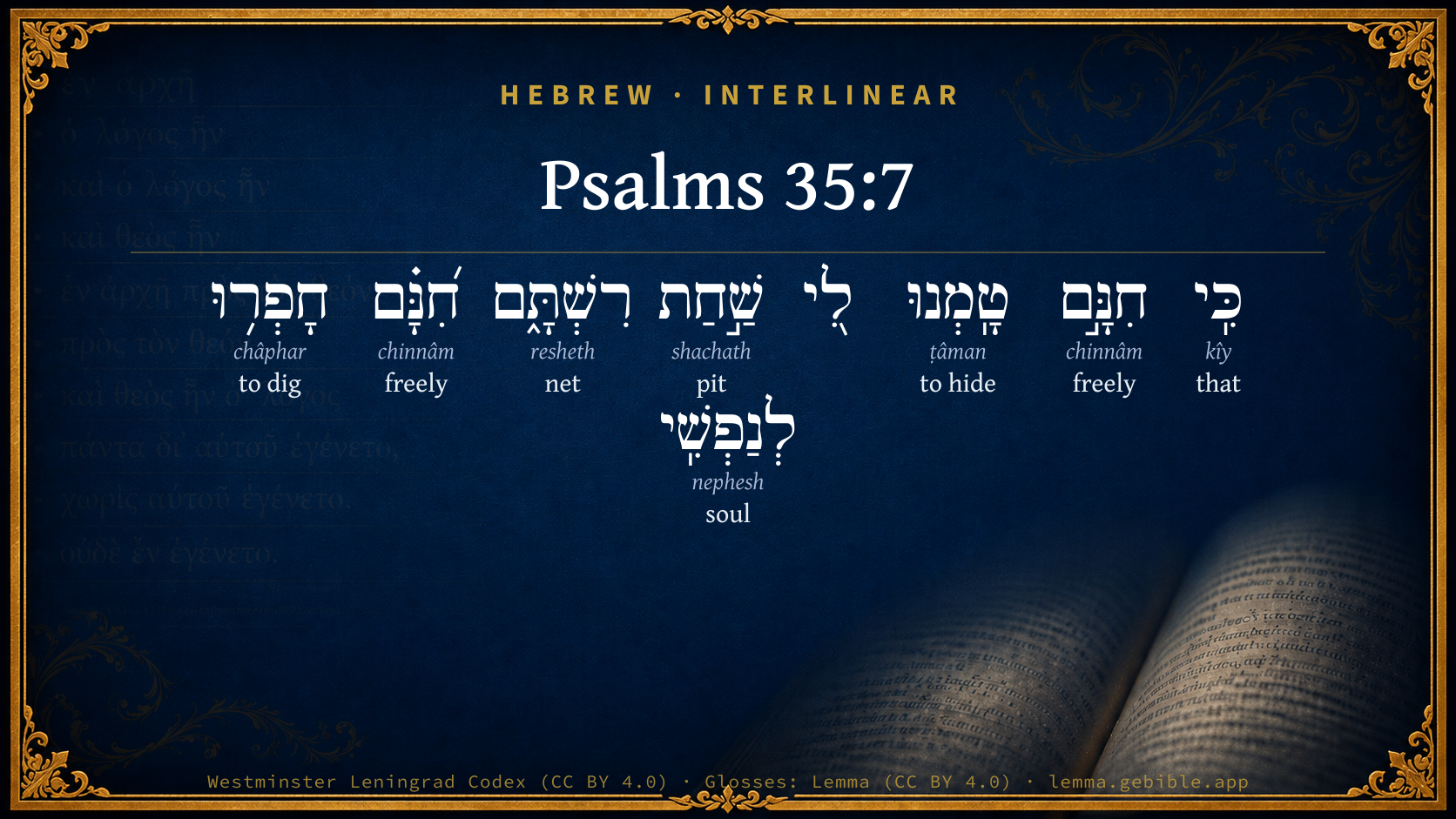
Psalms 35:7

Hebrew (Westminster Leningrad Codex) Psalms 35:7 appears in the Hebrew Old Testament. The text above is from the Westminster Leningrad Codex. Each word links to its Strong’s number, a concise gloss, and parsing drawn from the Open Scriptures Hebrew Bible morphology. Click any word for its full Brown-Driver-Briggs (BDB) entry.
Download image
Cite this verse

Psalms 35:7 (World English Bible). Public Domain. Lemma interlinear Bible study tool, https://lemma.gebible.app/v/psalms/35/7.

Show BibTeX & RIS
BibTeX
RIS
English Translation
For without cause they have hidden their net in a pit for me. Without cause they have dug a pit for my soul.
World English Bible · Public Domain
Download a study sheet

One document with this verse’s original text, its word-by-word gloss line, the meaning frame, cross-references with their text, attributed commentary, and full source and license credits — printable, and it pastes into notes with its structure intact.

This verse Autodidact and up

Study sheet (.html) Plain text (.txt)

A passage Seminary Student

Up to 50 verses in one chapter. A passage sheet keeps up to 6 commentary sources and 12 cross-references per verse, in the order this page ranks them, and says so on the sheet whenever that leaves anything out. Ask for a single verse and you get the Autodidact verse sheet above.

Everything on this page stays free to read, with no account — the sheet is a download of what is already on screen, not access to it.

Want to remove ads? Support Godless Engineer
Compare translations 3

The same verse in 3 English versions, stacked beneath the original-language interlinear above. Click any original word for its lexicon entry.

Each is an independent rendering of the whole verse — the interlinear is not word-aligned to these translations.

Highlighted words mark where these versions differ — a whole-verse word diff, not a word-by-word alignment.

  • World English Bible Public Domain
    For without cause they have hidden their net in a pit for me. Without cause they have dug a pit for my soul.
  • King James Version Public Domain
    For without cause have they hid for me their net in a pit, which without cause they have digged for my soul.
  • unfoldingWord Literal Text CC BY-SA 4.0
    For without cause they hid for me a pit, their net; without cause they dug for my life.

unfoldingWord Literal Text — © unfoldingWord, licensed CC BY-SA 4.0. Word-aligned USFM3 via Door43 (git.door43.org/unfoldingWord/en_ult).

Versions to compare (up to 4)

3 of 4 selected

Show all 18 translations

Every available English version of this verse, each an independent rendering of the whole verse.

  • World English Bible Public Domain
    For without cause they have hidden their net in a pit for me. Without cause they have dug a pit for my soul.
  • Berean Standard Bible Public Domain
    For without cause they laid their net for me; without reason they dug a pit for my soul.
  • Majority Standard Bible Public Domain
    For without cause they laid their net for me; without reason they dug a pit for my soul.
  • King James Version Public Domain
    For without cause have they hid for me their net in a pit, which without cause they have digged for my soul.
  • American Standard Version (1901) Public Domain
    For without cause have they hid for me their net `in' a pit; Without cause have they digged `a pit' for my soul.
  • Revised Version (1885) Public Domain
    For without cause have they hid for me their net in a pit, without cause have they digged a pit for my soul.
  • Geneva Bible (1599) Public Domain
    For without cause they haue hid the pit and their net for me: without cause haue they digged a pit for my soule.
  • Douay-Rheims (1899) Public Domain
    For without cause they have hidden their net for me unto destruction: without cause they have upbraided my soul.
  • Young's Literal Translation Public Domain
    For without cause they hid for me their netpit, Without cause they digged for my soul.
  • Literal Standard Version CC BY-SA 4.0
    For without cause they hid their net [in] a pit for me, || Without cause they dug for my soul.
  • Unlocked Literal Bible CC BY-SA 4.0
    Without cause they set their net for me; without cause they dug a pit for my life.
  • unfoldingWord Literal Text CC BY-SA 4.0
    For without cause they hid for me a pit, their net; without cause they dug for my life.
  • Darby Bible Public Domain
    For without cause have they hidden for me their net [in] a pit; without cause they have digged [it] for my soul.
  • World Messianic Bible Public Domain
    For without cause they have hidden their net in a pit for me. Without cause they have dug a pit for my soul.
  • Webster's Bible Public Domain
    For without cause they have hid for me their net in a pit, which without cause they have digged for my soul.
  • Free Bible Version CC BY-SA 4.0
    For no reason they set a net to catch me; for no reason they dug a pit to trap me.
  • Bible in Basic English Public Domain
    For without cause they have put a net ready for me secretly, in which to take my soul.
  • JPS Tanakh (1917) Public Domain
    For without cause have they hid for me the pit, even their net, without cause have they digged for my soul.

Literal Standard Version (2020), Covenant Press — licensed CC BY-SA 4.0. Text via the HelloAO Bible API (eBible.org). Unlocked Literal Bible (unfoldingWord) — licensed CC BY-SA 4.0. Text via the HelloAO Bible API (eBible.org). unfoldingWord Literal Text — © unfoldingWord, licensed CC BY-SA 4.0. Word-aligned USFM3 via Door43 (git.door43.org/unfoldingWord/en_ult). Free Bible Version, Dr. Jonathan Gallagher — licensed CC BY-SA 4.0. Text via the HelloAO Bible API (eBible.org).

Word by word

More ways to search: Search by grammar → Find every occurrence → Compare this word →

Practice this passage: Drill this verse → Learn its vocabulary →

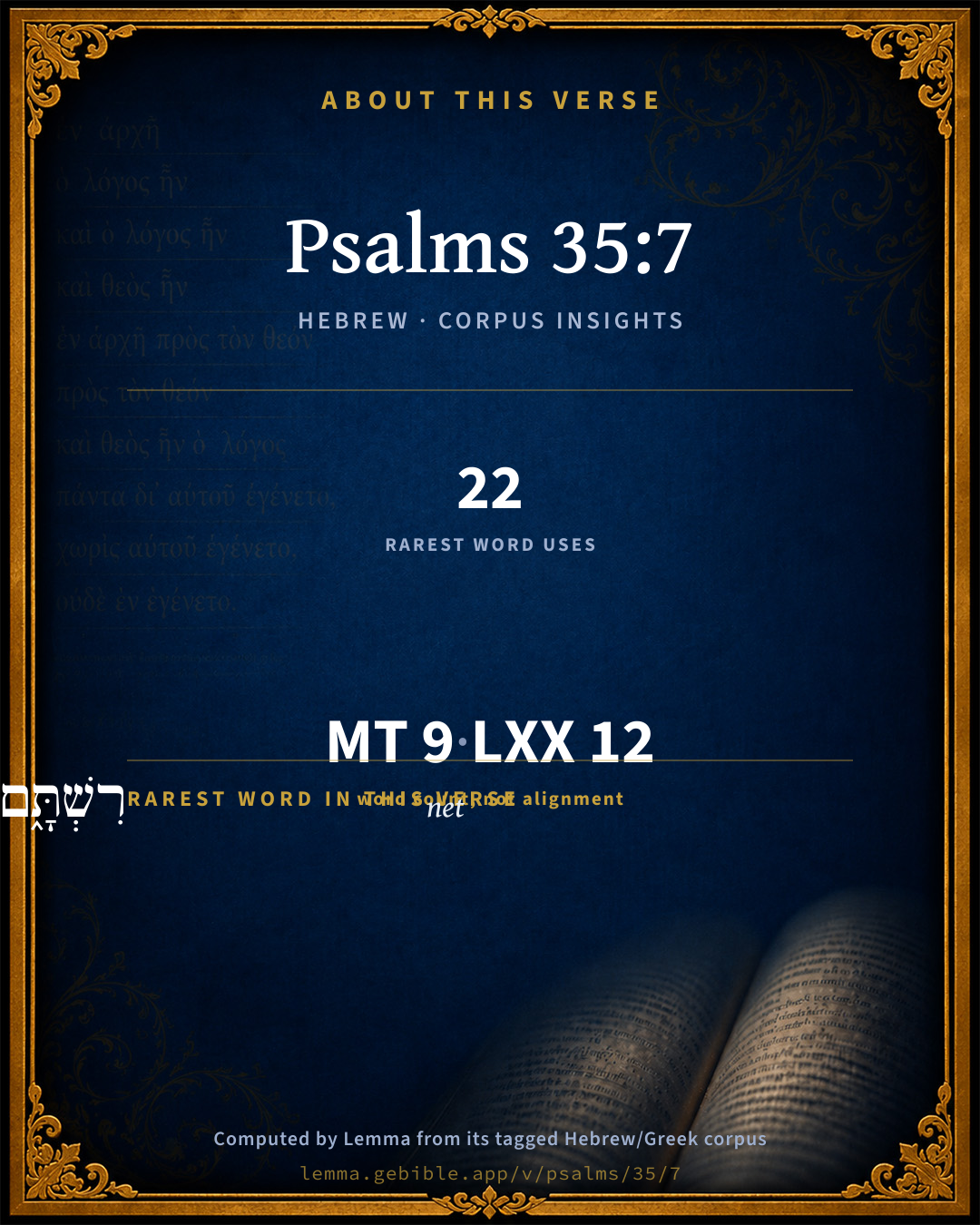
About this verse

These counts appear in no published source. They are computed here, from the morphology-tagged text and Lemma’s own curated glosses. What Lemma adds →

9
words
7
distinct lemmas
Wisdom
section

Notable vocabulary

The rarest word here is רִשְׁתָּ֑ם net H7568 — appearing just 22 times in the whole Hebrew Bible.

Shared distinctive vocabulary

רִשְׁתָּ֑ם net H7568 occurs in 21 verses of the Hebrew Bible. Also found in:

Grammatical profile

  • 2 verbs
  • 3 nouns
  • 1 preposition
  • 1 conjunction
  • 2 adverbs

Verb forms

  • טָֽמְנוּ Qal · Perfect
  • חָפְר֥וּ Qal · Perfect

Repetition

A word recurs within this verse — often emphatic in Hebrew:

  • חִנָּ֣ם freely H2600 ×2

Hebrew & Septuagint length

In English translation the verse runs 23 words from the Hebrew and 19 from the Septuagint (LXX English) — closely comparable.

A rough comparison of the two English renderings, which tokenize alike — not a word-level alignment.

Word counts can differ between the Hebrew and the Greek without any difference in meaning — e.g. the Hebrew direct-object marker אֵת has no separate Greek word, and Greek often adds the article ὁ.

In the original languages it is 9 Hebrew tokens and 12 Greek tokens — but the two are counted differently (Hebrew bundles its prefixes and suffixes into one token; the Greek is in lemma form), so that isn’t a like-for-like length.

Cross-references

9

Topical passages linked to Psalms 35:7 in the Treasury of Scripture Knowledge — connected by theme and wording, ordered by reader-vote popularity; previews shown in the World English Bible.

  • John 15:25 But this happened so that the word may be fulfilled which was written in their law, 'They hated me without a cause.'
  • Psalms 140:5 The proud have hidden a snare for me, They have spread the cords of a net by the path. They have set traps for me. Selah.
  • Psalms 9:15 The nations have sunk down in the pit that they made; In the net which they hid, their own foot is taken.
  • Job 18:8 For he is cast into a net by his own feet, And he wanders into its mesh.
  • Psalms 25:3 Yes, no one who waits for you shall be shamed. They shall be shamed who deal treacherously without cause.
  • Psalms 69:4 Those who hate me without a cause are more than the hairs of my head. Those who want to cut me off, being my enemies wrongfully, are mighty. I have to restore what I didn't take away.
  • Psalms 7:3–5 Yahweh, my God, if I have done this, If there is iniquity in my hands,
  • Psalms 119:85 The proud have dug pits for me, Contrary to your law.
  • Psalms 64:4 To shoot innocent men from ambushes. They shoot at him suddenly and fearlessly.

Cross-references courtesy of OpenBible.info (CC BY 4.0).

Hebrew and Greek witnesses Masoretic Hebrew ↔ Greek Septuagint

The same verse in the two great witnesses to the Old Testament, shown verse-for-verse.

You’re reading Greek Psalm 34 (Hebrew Psalm 35). The Septuagint counts the superscription, so verse numbers can differ from the Hebrew — chapter-level alignment, not verse-by-verse. Numbering follows Rahlfs.

These are two independent witnesses, not word-aligned to each other, and the Septuagint is shown in lemma (dictionary) form.

Hebrew Psalms 35:7 Masoretic · Westminster Leningrad Codex

כִּֽי חִנָּ֣ם טָֽמְנוּ לִ֭י שַׁ֣חַת רִשְׁתָּ֑ם חִ֝נָּ֗ם חָפְר֥וּ לְנַפְשִֽׁי

For without cause they have hidden their net in a pit for me. Without cause they have dug a pit for my soul.

World English Bible · Public Domain

Greek LXX Greek Psalm 34:7 Septuagint · lemma form

ὅτι δωρεά κρύπτω ἐγώ διαφθορά παγίς αὐτός μάτην ὀνειδίζω ὁ ψυχή ἐγώ

For without cause they have hid for me their destructive snare: without a cause they have reproached my soul.

LXX2012 (modern English Septuagint) · Public Domain

Hebrew: Westminster Leningrad Codex (CC BY 4.0). Greek: Septuagint (public domain); English from LXX2012 (modern English Septuagint) (Public Domain). How the Septuagint differs from the Hebrew →

Commentary

Notes on Psalms 35:7 from classic Christian and Jewish commentators (each source and its license shown beneath its notes). The classic Christian expositions comment on the surrounding passage and are grouped to its opening verse, so a note may address several verses; the Jewish commentaries on the Tanakh (Rashi and others) are per-verse, so they appear only where the commentator wrote on this verse.

Lemma curates 59 commentaries, every one of them public domain or Creative Commons licensed, each selected and text-cleaned for this edition rather than reprinted as found. About our sources →

Trapp's Complete Commentary

John Trapp

Psa 35:7 For without cause have they hid for me their net [in] a pit, [which] without cause they have digged for my soul.

Ver. 7. For without cause have they hid for me, &c.] The wicked are so acted and agitated by the devil, their task master, that, though they have no cause to work mischief to the saints, yet they must do it; the old enmity, Gen 3:15, still worketh; but this rendereth their destruction certiorem et celeriorem, more sure and more swift.

John Trapp, A Commentary or Exposition upon All the Books of the Old and New Testament (1647–1656) — public domain. Text from a community e-Sword module.

Keil & Delitzsch

C. F. Keil & F. Delitzsch

Psa 35:7 also needs re-organising, just as in Psa 35:5. the original positions of דחה and רדפס are exchanged. שׁחת רשׁתּם would be a pit deceptively covered over with a net concealed below; but, as even some of the older critics have felt, שׁחת is without doubt to be brought down from Psa 35:7 into Psa 35:7: without cause, i.e., without any provocation on my part, have they secretly laid their net for me (as in Psa 9:16; Psa 31:5), without cause have they digged a pit for my soul. In Psa 35:8 the foes are treated of collectively. לא ידע is a negative circumstantial clause (Ew. 341, b): improviso, as in Pro 5:6; Isa 47:11 extrem. Instead of תּלכּדנּוּ the expression is תּלכּדוּ, as in Hos 8:3; the sharper form is better adapted to depict the suddenness and certainty of the capture. According to Hupfeld, the verb שׁאה signifies a wild, dreary, confused noise or crash, then devastation and destruction, a transition of meaning which - as follows from שׁואה (cf. תּהוּ) as a name of the desolate steppe, from שׁוא, a waste, emptiness, and from other indications - is solely brought about by transferring the idea of a desolate confusion of tones to a desolate confusion of things, without any intermediate notion of the crashing in of ruins. But it may be asked whether the reverse is not rather the case, viz., that the signification of a waste, desert, emptiness or void is the primary one, and the meaning that has reference to sound (cf. Arab. hwâ, to gape, be empty; to drive along, fall down headlong, then also: to make a dull sound as of something falling, just like rumor from ruere, fragor (from frangi) the derived one. Both etymology (cf. תּהה, whence תּהוּ) and the preponderance of other meanings, favour this latter view. Here the two significations are found side by side, inasmuch as שׁואה in the first instance means a waste = devastation, desolation, and in the second a waste = a heavy, dull sound, a rumbling (δουπεῖν). In the Syriac version it is rendered: "into the pit which he has digged let him fall," as though it were שׁחת in the second instance instead of שׁואה; and from his Hupfeld, with J. H. Michaelis, Stier, and others, is of opinion, that it must be rendered: "into the destruction which he himself has prepared let him fall." But this quam ipse paravit is not found in the text, and to mould the text accordingly would be a very arbitrary proceeding.

Keil & Delitzsch — Biblical Commentary on the Old Testament (1861–1891) — public domain (CC PDM 1.0). Text via the HelloAO Bible API. (Old Testament only.)

J. A. Alexander on Psalms

Joseph Addison Alexander

7. (Psa 35:7) For without cause they hid for me their pit fall; without cause they digged for my soul. This verse assigns the reason of the imprecations or denunciations which precede.—Without cause, wantonly, gratuitously, unprovoked, and therefore prompted by mere malice. See below, Psa 35:19.— The pit of their net is an idiomatic phrase like the hill of my holiness. See above, on Psa 2:6. The true sense of the phrase appears to be their net-pit, i.e. their pit covered with a net, a figure borrowed from .the ancient modes of hunting. See above, on Psa 7:16 (15), Psa 9:16 (15). In the last clause we may either supply a relative, as in the common version, which they digged, or take the verb in the absolute sense of making a pit or ditch.

Joseph Addison Alexander, The Psalms Translated and Explained (1850) — public domain. Text from a community e-Sword module.

Geneva Bible (1599)

Geneva Bible translators

Showing that we may not call God to be a revenger, but only for his glory, and when our cause is just.

Geneva Bible (1599) marginal notes — public domain. Text via Bolls.life.

Jamieson, Fausset & Brown

Robert Jamieson, A. R. Fausset & David Brown

net in a pit--or, "pit of their net"--or, "net-pit," as "holy hill" for "hill of holiness" (Psa 2:6); a figure from hunting (Psa 7:15). Their imprecations on impenitent rebels against God need no vindication; His justice and wrath are for such; His mercy for penitents. Compare Psa 7:16; Psa 11:5, on the peculiar fate of the wicked here noticed.

Jamieson, Fausset & Brown — Commentary Critical and Explanatory on the Whole Bible (1871) — public domain (CC PDM 1.0). Text via the HelloAO Bible API.

Adam Clarke's Commentary

Verse 7. For without cause have they hid for me their net in a pit] The word שחת shachath, a pit, belongs to the second member of this verse, and the whole should be read thus: For without a cause they have hidden for me their net, without a cause they have digged a pit for my life. They have used every degree and species of cunning and deceit to ruin me.

Adam Clarke's Commentary on the Bible (1810–1826) — public domain. Text from a community e-Sword/MySword module.

John Calvin's Commentaries

7. For they have hid for me without a cause. He here declares that he did not take the name of God in vain, nor call upon him for protection without just cause, for he openly asserts his innocence, and complains that he was thus severely afflicted without having committed any crime, or given any occasion to his enemies. It becomes us carefully to mark this, so that no one may rush unadvisedly into God’s presence, nor call upon him for vengeance, without the assurance and testimony of a good conscience. When he says that he was assailed by stratagem, fraud, and wicked practices, there is implied in this a tacit commendation of his own integrity.

John Calvin's Commentaries (1540-1563) — public domain. Text from the Calvin Translation Society English edition (1840s-50s) via the Christian Classics Ethereal Library (ccel.org). Calvin's coverage is partial (roughly two-thirds of the Bible); uncommented books and verses are honest gaps, never fabricated. The 19th-century editor's footnotes and remarks are omitted so the notes are faithfully Calvin's own voice.

Ellicott's Commentary for English Readers

(7) Have they hid . . .—Literally, they have hid for me the pit of their net, which, as it stands, can mean nothing but a “pit with a net in it,” such as was used to entrap lions and other wild beasts. But it is better to remove the word “pit” to the second clause, thus doing away with the necessity of supplying a relative, and improving the rhythm.

“ For unprovoked they hid a net for me,

Unprovoked they digged a pit for my soul.”

A Bible Commentary for English Readers, edited by Charles John Ellicott (1878–1897) — public domain. Text from a community e-Sword module.

The Cambridge Bible for Schools and Colleges

gen. ed. J. J. S. Perowne

7. The word for pit must be transposed from the first line, where it is superfluous and awkward, to the second line, where it is required. Render

For without cause have they hid a net for me:

Without cause have they dug a pit for my soul (life).

The metaphors from the hunter’s nets and pitfalls express the insidious character of their secret plots. Cp. again Jer_18:20; Jer_18:22.

7, 8. The causelessness of their insidious enmity is the ground for such a prayer. May their schemes recoil on their own heads.

The Cambridge Bible for Schools and Colleges (gen. ed. J. J. S. Perowne; Cambridge University Press, 1878–1918) — public domain. Text from a community e-Sword module.

John Gill's Exposition

For without cause have they hid for me their net in a pit,.... This is said in allusion to the custom of digging pits, and putting nets into them, for the catching of wild beasts; and covering them with straw or dust, or such like things, as Jarchi observes, that they might not be discerned; and which intends the secret and crafty methods taken by David's enemies to ensnare him and destroy him; though he had given them no cause to use him in such a manner; which is an aggravation of their sins, and a reason of the above imprecations, as well as of what follows: and in the same manner, and without any just cause, Christ and his members have been treated by wicked men, and therefore their damnation is just, and will be inevitable:

which without cause they have digged for my soul; which is added for further explanation's sake, and to aggravate their sin, and to show the justness of their punishment.

John Gill's Exposition of the Whole Bible (1746–1763) — public domain (CC PDM 1.0). Text via the HelloAO Bible API.

Albert Barnes' Notes on the Bible

For without cause have they hid for me their net in a pit - See Psa 7:15, note; Psa 9:15, note. This figure is derived from hunting. The idea is that of digging a pit or hole for a wild beast to fall into, with a net so concealed that the animal could not see it, and that might be suddenly drawn over him so as to secure him. The reference here is to plans that are laid to entrap and ruin others: plots that are concocted so as to secure destruction before one is aware. The psalmist says that, in his case, they had done this without “cause,” or without any sufficient reason. He had done them no wrong; he had given them no show of excuse for their conduct.

Which without cause they have digged for my soul - For my life. That is, they have digged a pit into which I might fall, and into which they designed that I should fall, though I have never done anything to give them occasion thus to seek my destruction.

Albert Barnes' Notes on the Bible (1834–1885) — public domain. Text from a community e-Sword/MySword module.

Matthew Poole's English Annotations

Out of mere malice, without any injury or provocation on my part, and without any necessity on their parts. They are no common, but the worst of enemies; and therefore I may justly pray against them, as I do. These expressions aggravate their sins, and signify that their persecution of him was not the effect of a midden passion, but of a deep and habitual hatred and malice, and of an evil design, carried on in a constant and continued course with deliberation, and cunning, and deceit, and that against his soul or life; for nothing less would satisfy them.

Matthew Poole's English Annotations on the Holy Bible (1683–1685) — public domain. Text from a community e-Sword/MySword module.

The Treasury of David

Charles H. Spurgeon

Ver. 7. In this verse the psalmist brings forward the gravamen of his charge against the servants of the devil. For without cause --without my having injured, assailed, or provoked them; out of their own spontaneous malice have they hid for me their net in a pit, even as men hunt for their game with cunning and deception. Innocent persons have often been ruined by traps set for them, into which they have fallen as guilelessly as beasts which stumble into concealed pits, and are taken as in a net. It is no little thing to be able to feel that the enmity which assails us is undeserved-- not caused by any wilful offence on our part. Twice does David assert in one verse that his adversaries plotted against him without cause. Net making and pit digging require time and labour, and both of these the wicked will expend cheerfully if they may but overthrow the people of God. Fair warfare belongs to honourable men, but the assailants of God's church prefer mean, ungenerous schemes, and so prove their nature and their origin. We must all of us be on our guard, for gins and pitfalls are still the favourite weapons of the powers of evil.

Ver. 7. They hid for me their net in a pit. As if David had said that they had dug a pit, and covered and hid its mouth with a net, that I might pass upon it and fall into it. Kimchi.

None.

Psalms 35:8*

Charles H. Spurgeon's The Treasury of David (1869–1885) — public domain. Psalms only. Text from a community e-Sword/MySword module.

Whedon's Commentary on the Bible

Daniel D. Whedon

7. Without cause—Hence the magnitude of their crime.

Net in a pit— The figure changes from warlike description to the well known method of catching lions.

Daniel D. Whedon (gen. ed.), Commentary on the Old and New Testaments (1874–1909) — public domain. Text from a community e-Sword module.

The Pulpit Commentary

For without cause have they hid for me their net in a pit; literally, the pit of their net. This is explained by some to mean "the destruction of their net;" by others, "the pit that is covered by a net." But neither explanation is altogether saris-factory. Some therefore suppose an accidental transposition of a word. Which without cause they have digged for my soul. "Without cause" means "without provocation on my part."

The Pulpit Commentary (1880–1919), ed. H.D.M. Spence-Jones & Joseph S. Exell — public domain. Text from a community e-Sword module.

John Wesley's Explanatory Notes

For - Out of mere malice.

John Wesley, Explanatory Notes Upon the Whole Bible (1754–1765) — public domain. Text via the GEBible commentary corpus.

unfoldingWord translationNotes

Door43 World Missions Community

they set their net for me

The schemes of the wicked are spoken of as if they were a net that they set to catch the writer. AT: "they want to catch me in a net like a small animal" (See: Metaphor)

they dug a pit for my life

The schemes of the wicked are spoken of as if they were a pit that they dug to catch the writer. AT: "they wanted to capture me in a pit like a big animal" (See: Metaphor)

my life

This refers to the writer. AT: "me" (See: Synecdoche)

Let destruction overtake them by surprise

Destruction is spoken of as if it was a dangerous animal that would suddenly attack them. AT: "Let them be destroyed suddenly" or "Let them be surprised because you destroy them suddenly" (See: Personification)

the net that they have set

The schemes of the wicked are spoken of as if they were a net that they place to catch the writer. AT: "the net that they placed in order to capture me like an animal and harm me" (See: Metaphor)

Let them fall into it

This is the same metaphor as in verse 7. The net is intended to catch the writer. AT: "Let them fall into the pit that they dug for me" (See: Metaphor and Assumed Knowledge and Implicit Information)

fall into it

Possible meanings are 1) fall into the pit of verse 7 or 2) fall into destruction.

to their destruction

The abstract noun "destruction" can be stated as a verb. AT: "so that they will be destroyed" or "that is how you should destroy them" (See: Abstract Nouns)

translationWords

pit

life

unfoldingWord translationNotes — © Distant Shores Media and the Door43 World Missions Community, licensed CC BY-SA 4.0. Source: git.door43.org/Door43/en_tn.

Rashi

Rabbi Shlomo Yitzchaki (Rashi)

they have dug it for my soul they have dug a pit into which I should fall.

Rashi on the Tanakh — English translations: “The Judaica Press complete Tanach with Rashi, translated by A. J. Rosenberg” (CC BY 4.0); “Pentateuch with Rashi's commentary by M. Rosenbaum and A.M. Silbermann, 1929-1934” (public domain); “The Metsudah Tanach series, Lakewood, N.J” (CC BY 4.0); and “The Book of Joshua, Metsudah Publications, 1997” (CC BY 4.0). Text via Sefaria.

Lesson kit

Teaching starters — assembled from the data on this page, not authored interpretation. Every prompt links to the verse data it draws on. Edit before teaching.

Psalms, in the Wisdom, opens this verse with 9 words (7 distinct Hebrew lemmas). Its most distinctive word is resheth (“net”). A historical commentator’s framing appears above. Read the whole chapter for the surrounding context.

Discussion questions

  1. How does “net” (resheth) shape what this verse is saying?
  2. How does Exodus 27:4, which shares the word «net», read alongside this verse?
  3. What does the repetition of “freely” (2× in this one verse) do in this verse?
  4. These translations render this verse differently; the difference is in the English rendering, not the original. What questions does that raise?
  5. «טָֽמְנוּ» is a Qal Perfect verb. How does that grammatical form shape the action described?
  6. Compare how Trapp's Complete Commentary and Keil & Delitzsch read this verse. Where do they agree or differ?

Things to notice

Reading settings

Reading text

Shown beneath each verse's original-language words.

Old Testament
Old Testament edition

Read the OT as the Masoretic Hebrew (MT) or the Greek Septuagint (LXX).

English shown for the Greek Septuagint (in the Hebrew ↔ Greek comparison).

Comparing translations? Open the Compare panel on any verse page to stack up to four side by side.