
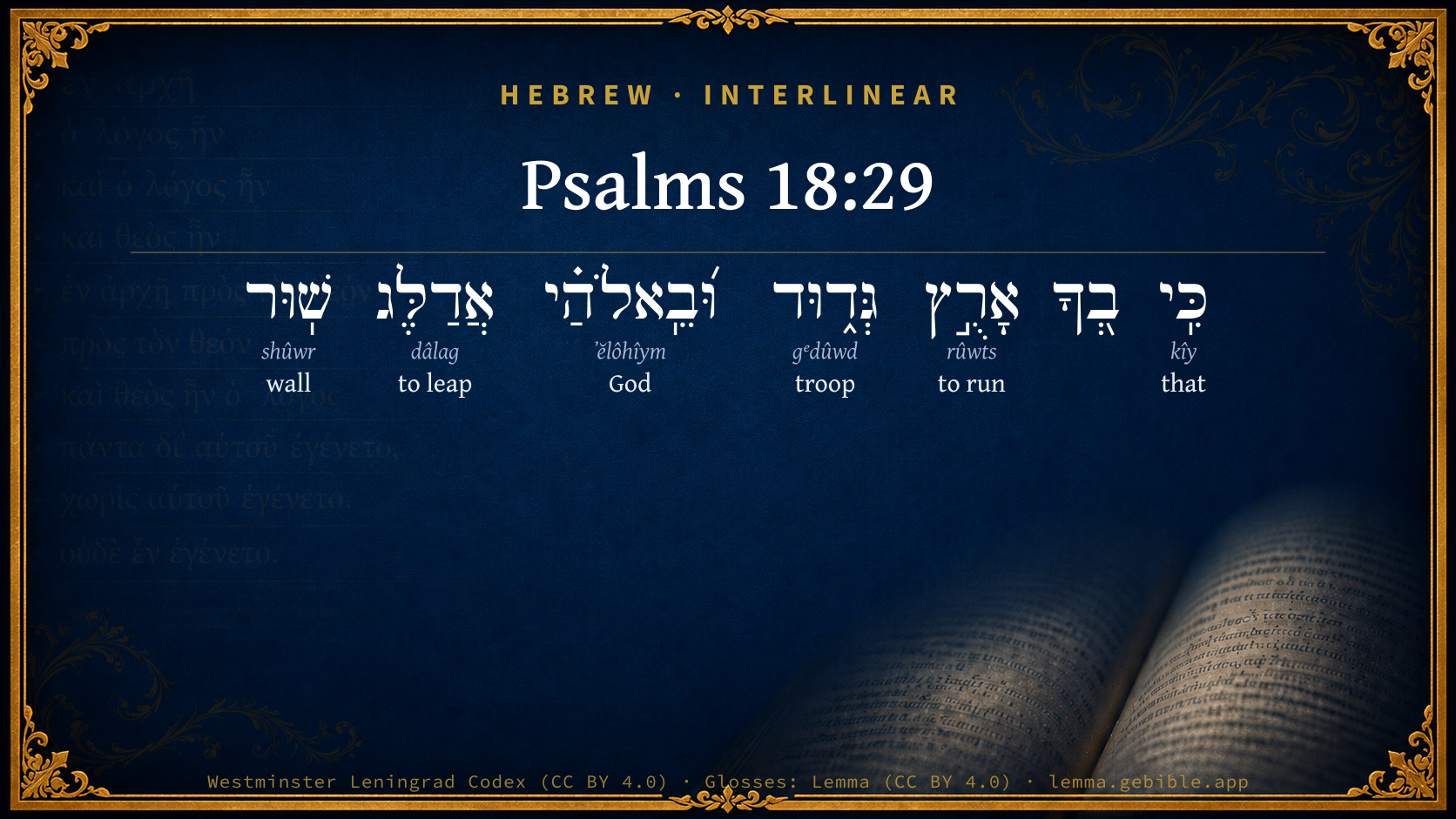
Psalms 18:29

Hebrew (Westminster Leningrad Codex) Psalms 18:29 appears in the Hebrew Old Testament. The text above is from the Westminster Leningrad Codex. Each word links to its Strong’s number, a concise gloss, and parsing drawn from the Open Scriptures Hebrew Bible morphology. Click any word for its full Brown-Driver-Briggs (BDB) entry.
Download image
Cite this verse

Psalms 18:29 (World English Bible). Public Domain. Lemma interlinear Bible study tool, https://lemma.gebible.app/v/psalms/18/29.

Show BibTeX & RIS
BibTeX
RIS
English Translation
For by you, I advance through a troop. By my God, I leap over a wall.
World English Bible · Public Domain
Download a study sheet

One document with this verse’s original text, its word-by-word gloss line, the meaning frame, cross-references with their text, attributed commentary, and full source and license credits — printable, and it pastes into notes with its structure intact.

This verse Autodidact and up

Study sheet (.html) Plain text (.txt)

A passage Seminary Student

Up to 50 verses in one chapter. A passage sheet keeps up to 6 commentary sources and 12 cross-references per verse, in the order this page ranks them, and says so on the sheet whenever that leaves anything out. Ask for a single verse and you get the Autodidact verse sheet above.

Everything on this page stays free to read, with no account — the sheet is a download of what is already on screen, not access to it.

Want to remove ads? Support Godless Engineer
Compare translations 3

The same verse in 3 English versions, stacked beneath the original-language interlinear above. Click any original word for its lexicon entry.

Each is an independent rendering of the whole verse — the interlinear is not word-aligned to these translations.

Highlighted words mark where these versions differ — a whole-verse word diff, not a word-by-word alignment.

  • World English Bible Public Domain
    For by you, I advance through a troop. By my God, I leap over a wall.
  • King James Version Public Domain
    For by thee I have run through a troop; and by my God have I leaped over a wall.
  • unfoldingWord Literal Text CC BY-SA 4.0
    For by you I run a troop, and by my God I leap a wall.

unfoldingWord Literal Text — © unfoldingWord, licensed CC BY-SA 4.0. Word-aligned USFM3 via Door43 (git.door43.org/unfoldingWord/en_ult).

Versions to compare (up to 4)

3 of 4 selected

Show all 18 translations

Every available English version of this verse, each an independent rendering of the whole verse.

  • World English Bible Public Domain
    For by you, I advance through a troop. By my God, I leap over a wall.
  • Berean Standard Bible Public Domain
    For in You I can charge an army, and with my God I can scale a wall.
  • Majority Standard Bible Public Domain
    For in You I can charge an army, and with my God I can scale a wall.
  • King James Version Public Domain
    For by thee I have run through a troop; and by my God have I leaped over a wall.
  • American Standard Version (1901) Public Domain
    For by thee I run upon a troop; And by my God do I leap over a wall.
  • Revised Version (1885) Public Domain
    For by thee I run upon a troop; and by my God do I leap over a wall.
  • Geneva Bible (1599) Public Domain
    For by thee I haue broken through an hoste, and by my God I haue leaped ouer a wall.
  • Douay-Rheims (1899) Public Domain
    For thou lightest my lamp, O Lord: O my God enlighten my darkness.
  • Young's Literal Translation Public Domain
    For by Thee I run -- a troop! And by my God I leap a wall.
  • Literal Standard Version CC BY-SA 4.0
    For by You I run [against] a troop! And by my God I leap a wall.
  • Unlocked Literal Bible CC BY-SA 4.0
    For by you I can run over a barricade; by my God I can leap over a wall.
  • unfoldingWord Literal Text CC BY-SA 4.0
    For by you I run a troop, and by my God I leap a wall.
  • Darby Bible Public Domain
    For by thee I have run through a troop; and by my God have I leaped over a wall.
  • World Messianic Bible Public Domain
    For by you, I advance through a troop. By my God, I leap over a wall.
  • Webster's Bible Public Domain
    \\18:28\\For thou wilt light my candle: the LORD my God will enlighten my darkness.
  • Free Bible Version CC BY-SA 4.0
    With you, I can charge down a troop of soldiers; with you, my God, I can climb a fortress wall.
  • Bible in Basic English Public Domain
    By your help I have made a way through the wall which was shutting me in; by the help of my God I have gone over a wall.
  • JPS Tanakh (1917) Public Domain
    (18-30) For by Thee I run upon a troop; and by my God do I scale a wall.

Literal Standard Version (2020), Covenant Press — licensed CC BY-SA 4.0. Text via the HelloAO Bible API (eBible.org). Unlocked Literal Bible (unfoldingWord) — licensed CC BY-SA 4.0. Text via the HelloAO Bible API (eBible.org). unfoldingWord Literal Text — © unfoldingWord, licensed CC BY-SA 4.0. Word-aligned USFM3 via Door43 (git.door43.org/unfoldingWord/en_ult). Free Bible Version, Dr. Jonathan Gallagher — licensed CC BY-SA 4.0. Text via the HelloAO Bible API (eBible.org).

Word by word

More ways to search: Search by grammar → Find every occurrence → Compare this word →

Practice this passage: Drill this verse → Learn its vocabulary →

About this verse

These counts appear in no published source. They are computed here, from the morphology-tagged text and Lemma’s own curated glosses. What Lemma adds →

7
words
6
distinct lemmas
Wisdom
section

Notable vocabulary

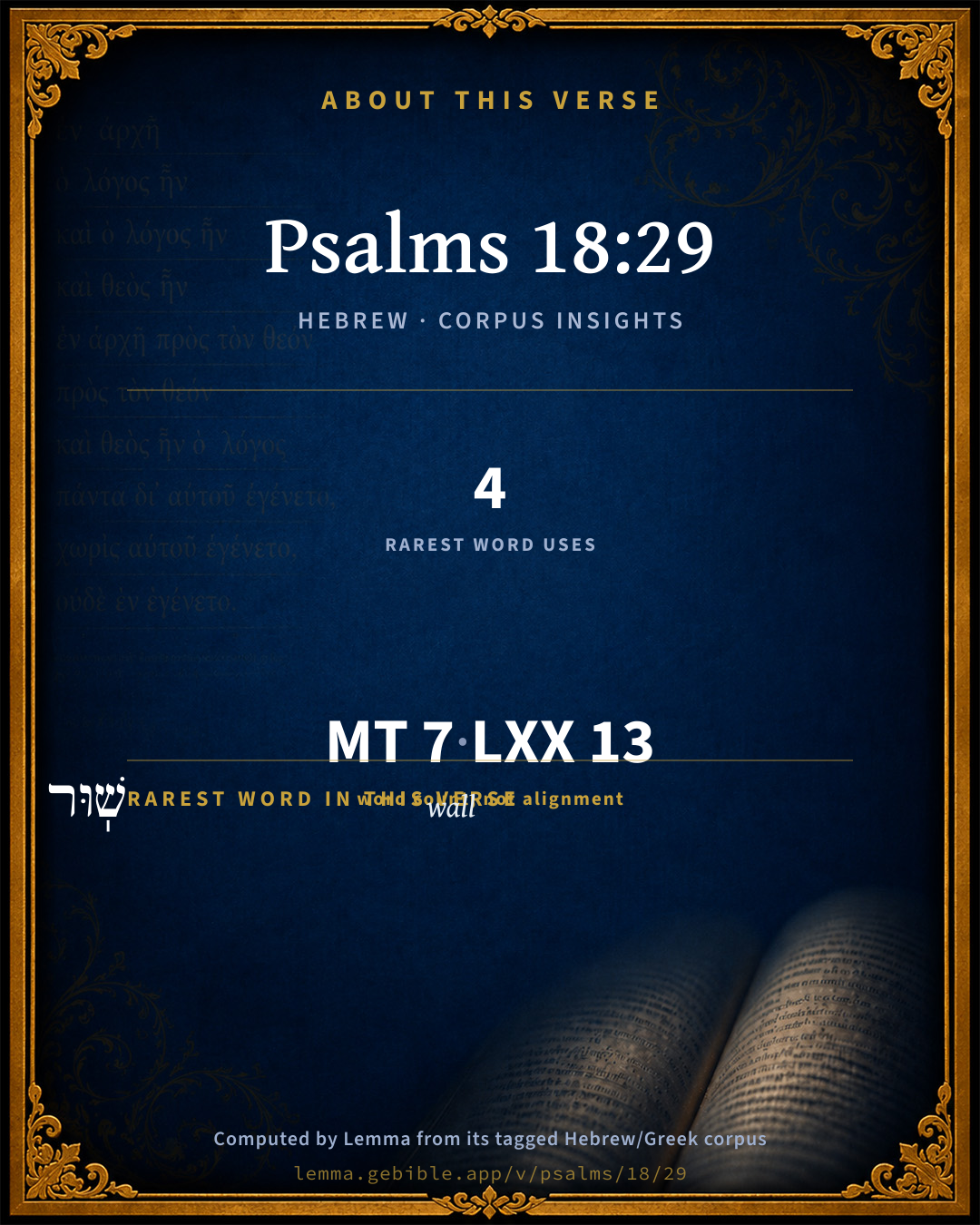
The rarest word here is שֽׁוּר wall H7791 — appearing just 4 times in the whole Hebrew Bible.

Shared distinctive vocabulary

שֽׁוּר wall H7791 occurs in 4 verses of the Hebrew Bible. Also found in:

Grammatical profile

  • 2 verbs
  • 3 nouns
  • 1 preposition
  • 1 conjunction

Verb forms

  • אָרֻ֣ץ Qal · Imperfect
  • אֲדַלֶּג Piel · Imperfect

Hebrew & Septuagint length

In English translation the verse runs 16 words from the Hebrew and 20 from the Septuagint (LXX English) — closely comparable.

A rough comparison of the two English renderings, which tokenize alike — not a word-level alignment.

Word counts can differ between the Hebrew and the Greek without any difference in meaning — e.g. the Hebrew direct-object marker אֵת has no separate Greek word, and Greek often adds the article ὁ.

In the original languages it is 7 Hebrew tokens and 13 Greek tokens — but the two are counted differently (Hebrew bundles its prefixes and suffixes into one token; the Greek is in lemma form), so that isn’t a like-for-like length.

Cross-references

14

Topical passages linked to Psalms 18:29 in the Treasury of Scripture Knowledge — connected by theme and wording, ordered by reader-vote popularity; previews shown in the World English Bible.

  • 2 Samuel 22:30 For by you I run on a troop; By my God do I leap over a wall.
  • Ephesians 6:10–13 Finally, be strong in the Lord, and in the strength of his might.
  • 2 Corinthians 12:9–10 He has said to me, "My grace is sufficient for you, for my power is made perfect in weakness." Most gladly therefore I will rather glory in my weaknesses, that the power of Christ may rest on me.
  • Revelation 3:21 He who overcomes, I will give to him to sit down with me on my throne, as I also overcame, and sat down with my Father on his throne.
  • Colossians 2:15 having stripped the principalities and the powers, he made a show of them openly, triumphing over them in it.
  • 1 Corinthians 15:10 But by the grace of God I am what I am. His grace which was bestowed on me was not futile, but I worked more than all of them; yet not I, but the grace of God which was with me.
  • Psalms 44:6–7 For I will not trust in my bow, Neither shall my sword save me.
  • Psalms 144:10 You are he who gives salvation to kings, Who rescues David, his servant, from the deadly sword.
  • 1 Samuel 23:2 Therefore David inquired of Yahweh, saying, Shall I go and strike these Philistines? Yahweh said to David, Go, and strike the Philistines, and save Keilah.
  • 2 Samuel 5:19–20 David inquired of Yahweh, saying, Shall I go up against the Philistines? will you deliver them into my hand? Yahweh said to David, Go up; for I will certainly deliver the Philistines into your hand.
  • 2 Samuel 5:25 David did so, as Yahweh commanded him, and struck the Philistines from Geba until you come to Gezer.
  • Psalms 144:1 Blessed be Yahweh, my rock, Who teaches my hands to war, And my fingers to battle:
  • 1 Samuel 17:49 David put his hand in his bag, and took there a stone, and slang it, and struck the Philistine in his forehead; and the stone sank into his forehead, and he fell on his face to the earth.
  • 1 Samuel 30:8 David inquired of Yahweh, saying, If I pursue after this troop, shall I overtake them? He answered him, Pursue; for you shall surely overtake [them], and shall without fail recover [all].

Cross-references courtesy of OpenBible.info (CC BY 4.0).

Hebrew and Greek witnesses Masoretic Hebrew ↔ Greek Septuagint

The same verse in the two great witnesses to the Old Testament, shown verse-for-verse.

You’re reading Greek Psalm 17 (Hebrew Psalm 18). The Septuagint counts the superscription, so verse numbers can differ from the Hebrew — chapter-level alignment, not verse-by-verse. Numbering follows Rahlfs.

These are two independent witnesses, not word-aligned to each other, and the Septuagint is shown in lemma (dictionary) form.

Hebrew Psalms 18:29 Masoretic · Westminster Leningrad Codex

כִּֽי בְ֭ךָ אָרֻ֣ץ גְּד֑וּד וּ֝בֵֽאלֹהַ֗י אֲדַלֶּג שֽׁוּר

For by you, I advance through a troop. By my God, I leap over a wall.

World English Bible · Public Domain

Greek LXX Greek Psalm 17:29 Septuagint · lemma form

ὅτι σύ φωτίζω λύχνος ἐγώ κύριος ὁ θεός ἐγώ φωτίζω ὁ σκότος ἐγώ

For by you shall I be delivered from a troop; and by my God I will pass over a wall.

LXX2012 (modern English Septuagint) · Public Domain

On this verse, John Gill's Exposition discusses the Septuagint’s reading. Read the note in Commentary ↓

Hebrew: Westminster Leningrad Codex (CC BY 4.0). Greek: Septuagint (public domain); English from LXX2012 (modern English Septuagint) (Public Domain). How the Septuagint differs from the Hebrew →

Commentary

Notes on Psalms 18:29 from classic Christian and Jewish commentators (each source and its license shown beneath its notes). The classic Christian expositions comment on the surrounding passage and are grouped to its opening verse, so a note may address several verses; the Jewish commentaries on the Tanakh (Rashi and others) are per-verse, so they appear only where the commentator wrote on this verse.

Lemma curates 59 commentaries, every one of them public domain or Creative Commons licensed, each selected and text-cleaned for this edition rather than reprinted as found. About our sources →

Matthew Henry's Commentary

In these verses,

I. David looks back, with thankfulness, upon the great things which God had done for him. He had not only wrought deliverance for him, but had given him victory and success, and made him triumph over those who thought to triumph over him. When we set ourselves to praise God for one mercy we must be led by that to observe the many more with which we have been compassed about, and followed, all our days. Many things had contributed to David's advancement, and he owns the hand of God in them all, to teach us to do likewise, in reviewing the several steps by which we have risen to our prosperity. 1. God had given him all his skill and understanding in military affairs, which he was not bred up to nor designed for, his genius leading him more to music, and poetry, and a contemplative life: He teaches my hands to war, Psa 18:34. 2. God had given him bodily strength to go through the business and fatigue of war: God girded him with strength (Psa 18:32, Psa 18:39), to such a degree that he could break even a bow of steel, Psa 18:34. What service God designs men for he will be sure to fit them for. 3. God had likewise given him great swiftness, not to flee from the enemies but to fly upon them (Psa 18:33): He makes my feet like hinds' feet, Psa 18:36. "Thou hast enlarged my steps under me; but" (whereas those that take large steps are apt to tread awry) "my feet did not slip." He was so swift that he pursued his enemies and overtook them, Psa 18:37. 4. God had made him very bold and daring in his enterprises, and given him spirit proportionable to his strength. If a troop stood in his way, he made nothing of running through them; if a wall, he made nothing of leaping over it (Psa 18:29); if ramparts and bulwarks, he soon mounted them, and by divine assistance set his feet upon the high places of the enemy, Psa 18:33. 5. God had protected him, and kept him safe, in the midst of the greatest perils. Many a time he put his life in his hand, and yet it was wonderfully preserved: "Thou hast given me the shield of thy salvation (Psa 18:35), and that has compassed me on every side. By that I have been delivered from the strivings of the people who aimed at my destruction (Psa 18:43), particularly from the violent man" (Psa 18:48), that is, Saul, who more than once threw a javelin at him. 6. God had prospered him in his designs; he it was that made his way perfect (Psa 18:32) and it was his right hand that held him up, Psa 18:35. 7. God had given him victory over his enemies, the Philistines, Moabites, Ammonites, and all that fought against Israel: those especially he means, yet not excluding the house of Saul, which opposed his coming to the crown, and the partisans of Absalom and Sheba, who would have deposed him. He enlarges much upon the goodness of God to him in defeating his enemies, attributing his victories, not to his own sword or bow, nor to the valour of his mighty men, but to the favour of God: I pursued them (Psa 18:37), I wounded them (Psa 18:38); for thou hast girded me with strength (Psa 18:39), else I could not have done it. All the praise is ascribed to God: Thou hast subdued them under me, Psa 18:39. Thou hast given me their necks (Psa 18:40), not only to trample upon them (as Jos 10:24), but to cut them off. Even those who hated David whom God loved, and were enemies to the Israel of God, in their distress cried unto the Lord: but in vain; he answered them not. How could they expect he should when it was he whom they fought against? And, when he disowned them (as he will all those that act against his people), no other succours could stand them in stead: There was none to save them, Psa 18:41. Those whom God has abandoned are easily vanquished: Then did I beat them small as the dust, Psa 18:42. But those whose cause is just he avenges (Psa 18:47), and those whom he favours will certainly be lifted up above those that rise up against them, Psa 18:48. 8. God had raised him to the throne, and not only delivered him and kept him alive, but dignified him and made him great (Psa 18:35): Thy gentleness has increased me - thy discipline and instruction; so some. The good lessons David learned in his affliction prepared him for the dignity and power that were intended him; and the lessening of him helped very much to increase his greatness. God made him not only a great conqueror, but a great ruler: Thou hast made me the head of the heathen (Psa 18:43); all the neighbouring nations were tributaries to him. See Sa2 8:6, Sa2 8:11. In all this David was a type of Christ, whom the Father brought safely through his conflicts with the powers of darkness, and made victorious over them, and gave to be head over all things to his church, which is his body.

II. David looks up with humble and reverent adorations of the divine glory and perfection. When God had, by his providence, magnified him, he endeavours, with his praises, to magnify God, to bless him and exalt him, Psa 18:46. He gives honour to him, 1. As a living God: The Lord liveth, Psa 18:46. We had our lives at first from, and we owe the continuance of them to, that God who has life in himself and is therefore fitly called the living God. The gods of the heathen were dead gods. The best friends we have among men are dying friends. But God lives, lives for ever, and will not fail those that trust in him, but, because he lives, they shall live also; for he is their life. 2. As a finishing God: As for God, he is not only perfect himself, but his way is perfect, Psa 18:30. He is known by his name Jehovah (Exo 6:3), a God performing and perfecting what he begins in providence as well as creation, Gen 2:1. If it was God that made David's way perfect (Psa 18:32), much more is his own way so. There is no flaw in God's works, nor any fault to be found with what he does, Ecc 3:14. And what he undertakes he will go through with, whatever difficulties lie in the way; what God begins to build he is able to finish. 3. As a faithful God: The word of the Lord is tried. "I have tried it" (says David), "and it has not failed me." All the saints, in all ages, have tried it, and it never failed any that trusted in it. It is tried as silver is tried, refined from all such mixture and alloy as lessen the value of men's words. David, in God's providences concerning him, takes notice of the performance of his promises to him, which, as it puts sweetness into the providence, so it puts honour upon the promise. 4. As the protector and defender of his people. David had found him so to him: "He is the God of my salvation (Psa 18:46), by whose power and grace I am and hope to be saved; but not of mine only: he is a buckler to all those that trust in him (Psa 18:30); he shelters and protects them all, is both able and ready to do so." 5. As a non-such in all this, Psa 18:31. There is a God, and who is God save Jehovah? That God is a rock, for the support and shelter of his faithful worshippers; and who is a rock save our God? Thus he not only gives glory to God, but encourages his own faith in him. Note, (1.) Whoever pretends to be deities, it is certain that there is no God, save the Lord; all others are counterfeits, Isa 44:8; Jer 10:10. (2.) Whoever pretends to be our felicities, there is no rock, save our God; none that we can depend upon to make us happy.

III. David looks forward, with a believing hope that God would still do him good. He promises himself, 1. That his enemies should be completely subdued, and that those of them that yet remained should be made his footstool, - that his government should be extensive, so that even a people whom he had not known should serve him (Psa 18:43), - that his conquests, and, consequently, his acquests, should be easy (As soon as they hear of me they shall obey me, Psa 18:44), - and that his enemies should be convinced that it was to no purpose to oppose him; even those that had retired to their fastnesses should not trust to them, but be afraid out of their close places, having seen so much of David's wisdom, courage, and success. Thus the Son of David, though he sees not yet all things put under him, yet knows he shall reign till all opposing rule, principality, and power shall be quite put down. 2. That his seed should be forever continued in the Messiah, who, he foresaw, should come from his loins, Psa 18:50. He shows mercy to his anointed, his Messiah, to David himself, the anointed of the God of Jacob in the type, and to his seed for evermore. He saith not unto seeds, as of many, but to his seed, as of one, that is Christ, Gal 3:16. It is he only that shall reign for ever, and of the increase of whose government and peace there shall be no end. Christ is called David, Hos 3:5. God has called him his king, Psa 2:6. Great deliverance God does give, and will give to him, and to his church and people, here called his seed, for evermore.

In singing these verses we must give God the glory of the victories of Christ and his church hitherto and of all the deliverances and advancements of the gospel kingdom, and encourage ourselves and one another with an assurance that the church militant will be shortly triumphant, will be eternally so.

Matthew Henry's Commentary on the Whole Bible (1708–1710) — public domain (CC PDM 1.0). Text via the HelloAO Bible API.

Trapp's Complete Commentary

John Trapp

Psa 18:29 For by thee I have run through a troop; and by my God have I leaped over a wall.

Ver. 29. For by thee have I run through a troop] Though but a little man, yet by God’s help he achieved great matters, did great exploits. Homo tricubitalis, saith a Father concerning Paul; Et coelum ascendit: so here. Some render it, Currebam accinctus: I ran well appointed (Bucholcer); and they interpret it of his victory over Goliath, whom he ran upon and cut off his head, after that he had hurled at him with as good a force; Perinde ac si fundae suae tunicis non lapillum, sed Deum ipsum induisset ae implicuisset, saith one; as if he had got not a stone, but God himself, into the bought of his sling.

And by my God have I leapt over a wall] That is, I have stormed a walled town, or fort, with very little ado; being no less valiant and venturous than Alexander the Great was among the Indians; but upon far better grounds, because in the strength of God, as at the fort of Zion.

John Trapp, A Commentary or Exposition upon All the Books of the Old and New Testament (1647–1656) — public domain. Text from a community e-Sword module.

The Biblical Illustrator

Joseph S. Exell

Psa_18:29; Psa_18:33-34

By Thee have I run through a troop.

Surmounting impossible difficulties

This is a poetical way of representing the fact that impossibilities have often been made possible in our own experience. Looking back upon certain combinations of circumstances, we cannot but feel that we were surrounded by great and high walls, and that troops of dangers thickened around us in deadly array, Now that we see ourselves in a large place, we are tempted to believe that we are still in a dream, and that our liberty is a thing which we hold only in the uncertain light of a momentary vision. When our imagination is vexed by the cross colours which make up the panorama of life, it is easy to persuade us that tomorrow we shall be back again in chains, for we have enjoyed but an imaginary liberty. Then, under happier circumstances, we see how the miracle is a simple reality,--that we have in very deed escaped perils which at one time seemed to be insurmountable, and that our escape is due entirely to the exercise of the almightiness of God. It is remarkable how, under such circumstances, we unconsciously magnify our own importance in the universe. We do not mean to be ostentatious and proud when we declare that God has exerted Himself specially on our behalf, and has indeed Himself been disquieted until our comfort was restored and established. The Psalmist speaks here as if he were the sole object of the Lords care, and as if the Infinite took delight only in his well-being and prosperity. (Joseph Parker, D. D.)

Energy put into a man

Sir Alexander Ball was one of those great men who adorned our navy at the end of the eighteenth century. The following anecdote is told of him by his friend the poet Coleridge. In a large party at Malta I had observed a naval officer listening to Sir A. Ball with a mixed expression of awe and affection that gave a more than common interest to so manly a countenance. This officer afterwards told me that he considered himself indebted to Sir Alexander for that which was dearer to him than his life. When he was Lieutenant Ball, said he, he was the officer I accompanied in my first boat expedition, being then a midshipman, and only in my fourteenth year. As we were rowing up to the vessel which we were to attack, amid a discharge of musketry, I was overpowered by fear, and seemed on the point of fainting away. Lieutenant Ball, who saw the condition I was in, placed himself close beside me, and still keeping his countenance directed towards the enemy, pressed my hand in the most friendly manner, and said in a low voice, Courage, my dear boy. You will recover in a minute or so. I was just the same when I first went out in this way. Sir, added the officer to me, it was just as if an angel had put a new soul into me. With the feeling I was not yet dishonoured, the whole burden of agony was removed; and from that moment I was as fearless and forward as the oldest of the boats crew.

One trophy for two exploits

What is true of David is true of Davids Lord. The Holy Ghost has presented to us the experience of Jesus in that model of experience through which David passed. So the text tells both of Christ and the believer also. Let us speak of it.

I. In relation to Christ. And

1. For the first sentence, By Thee have I run through a troop. Christs enemies were as a troop for number. Who can count them? But also for their discipline. They were marshalled under that skilful and crafty leader Satan, the arch fiend and Prince of Darkness. And his servants are well trained. He came against Jesus with his army, in settled order. It was no wild rush of Some Tartar host, but a well arranged and well regulated attack. Never let us undervalue the strength of Christs enemies. Now, this sentence has been read in varied ways, and each is very suggestive. One reads it, By Thee have I run to a troop; so that Jesus did not wait for the attack, but made it Himself, See how He went forth to meet Judas and the armed band on the night of the betrayal. But our version reads, through a troop, and this is also accurate. For His victory was complete. They stood firm as if they would not flinch, they thought they had defeated Him; but His Cross was the very symbol of His omnipotence, for in weakness was He strong. See Him running through this troop. And how speedily. His sufferings were but short. What a stride was that which Jesus took when He marched right through His enemies, and laid them right and left slain before Him. There is yet another version, By Thee have I run after a troop. As if he would say, I met them, fought them, vanquished them, pursued them, and captured them. He led captivity captive. Note the words, By Thee. He acted as the servant of God. But it is blessed to think that the Father as well as the Son, yea, the whole Trinity of sacred Persons, is engaged for our redemption.

2. The second sentence, By my God have I leaped over a wall. David seems to be describing the capture of some fortress, such as Jebus, afterwards called Jerusalem. Now Satan had shut us all up in a mighty fortress. It had as one bulwark the strength of sin and the law; as another the suggestions of Satan to mens hearts; and then there was the deep ditch of mens sins, and the mound outside of Human Depravity. Now Christ comes, and He leaps over these walls. And He not only Himself surmounted these walls, but brought all His people on His shoulders, as AEneas carried off his old father Anchises. And all this also was by my God. He acted as Mediator. Let our souls meditate much upon Christs victories.

II. To the believer. He has his troops of enemies and his imprisoning wall. But sometimes he makes the mistake of trying to climb over the troop when he should break through them, and of trying to break through the wall which he should climb over. Let him have courage for the troop to run through them, and discretion for the wall to climb over it. And by means of faith he can do this. Luther often used to defy Satan to battle. I care not to do that, but he used in his queer quaint way to say, I often laugh at Satan, and there is nothing makes him so angry as when I attack him to his face, and tell him that through God I am more than a match for him, tell him to do his worst, and yet I will beat him; and tell him to put forth his fury, and yet I will overcome him. He that has made God his refuge need fear no storm. Look, said a poor woman to a lady who called to see her, Look, maam, Ill show you all Im worth. And she showed her her cupboard with nothing in it but a dry crust; and a chest, but it was empty. That is all I am worth, maam, but I have not a doubt or fear but that God will supply my need. Now that woman bad learnt how to run through a troop and by her God to leap over a wall. What have you for your soul like that? (C. H. Spurgeon.)

The Biblical Illustrator, edited by Joseph S. Exell (c. 1880s–1900s) — public domain. Text from a community e-Sword module.

The Treasury of David

Charles H. Spurgeon

Ver. 29-45. Some repetitions are not vain repetitions. Second thoughts upon God's mercy should be and often are the best. Like wines on the lees our gratitude grows stronger and sweeter as we meditate upon divine goodness. The verses which we have now to consider are the ripe fruit of a thankful spirit; they are apples of gold as to matter, and they are placed in baskets of silver as to their language. They describe the believer's victorious career and his enemies' confusion.

Ver. 29. For by thee have I run through a troop; and by my God have I leaped over a wall. Whether we meet the foe in the open field or leap upon them while they lurk behind the battlements of a city, we shall by God's grace defeat them in either case; if they hem us in with living legions, or environ us with stone walls, we shall with equal certainty obtain our liberty. Such feats we have already performed, hewing our way at a run through hosts of difficulties, and scaling impossibilities at a leap. God's warriors may expect to have a taste of every form of fighting, and must by the power of faith determine to quit themselves like men; but it behooves them to be very careful to lay all their laurels at Jehovah's feet, each one of them saying, "by my God" have I wrought this valiant deed. Our spolia optima, the trophies of our conflicts, we hereby dedicate to the God of Battles, and ascribe to him all glory and strength.

Ver. 29. By thee have I run through a troop, etc. David ascribes his victories to God, declaring that, under his conduct, he had broken through the wedges or phalanxes of his enemies, and had taken by storm their fortified cities. Thus we see that, although he was a valiant warrior, and skilled in arms, he arrogates nothing to himself. John Calvin.

Ver. 29. By my God have I leaped over a wall; or, "taken a fort." Henry Hammond.

Ver. 29. Leaped over a wall. This probably refers to his having taken some remarkable town by scaling the ramparts. John Kitto, in "The Pictorial Bible."

Ver. 29. Believing exploits recounted. Variety, difficulty in themselves, ease in performance, completeness, impunity, and dependence upon divine working.

Psalms 18:30*

Ver. 29-45. See Psalms on "Ps 18:29" for further information.

Ver. 29-45. See Psalms on "Ps 18:29" for further information.

Ver. 29-45. See Psalms on "Ps 18:29" for further information.

Ver. 29-45. See Psalms on "Ps 18:29" for further information.

Ver. 29-45. See Psalms on "Ps 18:29" for further information.

Ver. 29-45. See Psalms on "Ps 18:29" for further information.

Charles H. Spurgeon's The Treasury of David (1869–1885) — public domain. Psalms only. Text from a community e-Sword/MySword module.

J. A. Alexander on Psalms

Joseph Addison Alexander

30. (Psa 18:29). For in, thee I shall run (through or over) a troop, and in my God I shall leap a wall. From his ideal post of observation he foresees the military triumphs which awaited him, and which were actually past at the time of composition. The for, as in the two preceding verses, connects the illustration with the general preposition in Psa 18:27-29 (26-28). "This is certainly God's mode of dealing, for I know that he will deal thus with me." In thee, and in my God, i. e. in intimate union with him and possession of him, a much stronger sense than that of mere assistance (by thee), which however, is included. See below, on Psa 44:6 (5). —The ellipsis of the preposition, with which the verbs are usually construed, belongs to the licence of poetical style. Even in prose, however, we can say, to walk the streets, to leap a wall. To run a troop may either mean to run against or through it; the phrase may therefore be completed so as to have either an offensive or defensive sense. In like manner, leaping a wall may either mean escaping from an enemy or storming his defences. Most interpreters prefer the stronger meaning of attack, which is certainly entitled to the preference, unless the writer be supposed to have selected his expressions with a view to the suggestion of both these ideas, which together comprehend all possible varieties of success in war. As if he had said, "Weak though I be in myself, I am sure that in conjunction with thee, neither armies nor fortifications shall be able to subdue or even to resist me." With David's tone of triumphant confidence in this verse, compare Paul's in 2Co 2:14, and Php 4:13.

Joseph Addison Alexander, The Psalms Translated and Explained (1850) — public domain. Text from a community e-Sword module.

Tyndale Open Study Notes

Tyndale Open Resources

18:29 scale any wall: God helps his servants fight their battles.

Tyndale Open Study Notes — © Tyndale Open Resources, licensed CC BY-SA 4.0. Text via the HelloAO Bible API.

Geneva Bible (1599)

Geneva Bible translators

He attributeth it to God that he both got the victory in the field, and also destroyed the cities of his enemies.

Geneva Bible (1599) marginal notes — public domain. Text via Bolls.life.

Jamieson, Fausset & Brown

Robert Jamieson, A. R. Fausset & David Brown

And this on past experience in his military life, set forth by these figures.

Jamieson, Fausset & Brown — Commentary Critical and Explanatory on the Whole Bible (1871) — public domain (CC PDM 1.0). Text via the HelloAO Bible API.

Adam Clarke's Commentary

Verse 29. I have run through a troop] This may relate to some remarkable victory, and the taking of some fortified place, possibly Zion, from the Jebusites. See the account 2Sa 5:6-8.

Adam Clarke's Commentary on the Bible (1810–1826) — public domain. Text from a community e-Sword/MySword module.

Ellicott's Commentary for English Readers

(29) Better with the verbs in the present—

“For by thee I scatter a troop,

By thee I scale walls.”

A graphic reminiscence of warlike exploits. Some, however, read from Samuel “break down,” instead of “leap over.”

A Bible Commentary for English Readers, edited by Charles John Ellicott (1878–1897) — public domain. Text from a community e-Sword module.

The Cambridge Bible for Schools and Colleges

gen. ed. J. J. S. Perowne

29. For by thee I run after a troop,

And by my God I leap over a wall.

The language is general, but it seems to contain a reminiscence of two memorable events in David’s life: the successful pursuit of the predatory ‘troop’ of Amalekites which had sacked Ziklag (1 Samuel 30; in Psa_18:8; Psa_18:15; Psa_18:23 the same word troop is used of the Amalekites): and the capture of Zion, effected with such unexpected ease that he seemed to have leapt over the walls which its defenders boasted were impregnable (2Sa_5:6-8).

The rendering run after is preferable to break (A.V. marg.). The point is the speed of the pursuit, not the completeness of the defeat.

The Cambridge Bible for Schools and Colleges (gen. ed. J. J. S. Perowne; Cambridge University Press, 1878–1918) — public domain. Text from a community e-Sword module.

John Gill's Exposition

As for God, his way is perfect,.... Or "without spot" (m), as the Septuagint render the word; without any just charge of inequality, or unrighteousness; such is God's way of providence, though sometimes his methods of providence are cavilled at by wicked men, and murmured at by his own people: they are at a loss, at times, to reconcile promises and providences together, and to account for the justice and equity of them; these ways of his are unsearchable, and not to be traced out by them; but when his judgments will be made manifest, the wisdom, goodness, and righteousness of them will be clearly discerned, and they will be admired; for they are all of a piece, and perfectly consistent with the attributes of God: and such also is his way of grace, and method of salvation; it is agreeable to all his perfections, and according to his purposes, counsel, and covenant; this being resolved on in his breast, contrived by his wisdom, and concluded on in the covenant, has been effected and finished by his son; and his inward way of working upon the heart, though at present imperfect, will be completed; he is a rock, and his work is perfect, and all his ways are judgment: whatever way or method he contrives and enters upon, whether in providence or grace, he pursues and brings to an issue; for he is an omnipotent, omniscient, and unchangeable Being, and neither frustrates, nor is he frustrated; nor is there any insincerity, unrighteousness, and unfaithfulness in him; nor can he act contrary to himself, and the perfections of his nature: the way also which he prescribes to others is perfect and plain, whether the path of doctrine or of duty; the path of truth is plain to the enlightened understanding, and the way of holiness is such, in which men, though fools, shall not err; see Pro 8:8;

the word of the Lord is tried; as silver in a furnace, and is clear of all dross, of error, and falsehood; is free from human mixtures, and without any impurity and unholiness; nor is God's word of promise chargeable with unfaithfulness; all his promises being yea and amen in Christ, and have been tried and proved by the saints in all ages; and have been found true, faithful, constant, and invariable;

he is a buckler to all those that trust in him; not in man, nor in themselves; in their own righteousness, or in any creature or creature enjoyment or performance; but in the providence and power of God, in his grace and mercy, in his word, and especially in his Son; in his person, blood, and righteousness; to such he is a buckler or shield: his power is all around them, his favour encompasses them, and his truth, or faithfulness in his word, is their shield and buckler: and so is his Son, who is both a sun and shield to them; and such are his precious blood, his spotless righteousness, and stoning sacrifice; which, being held up by faith, repel the fiery darts of Satan.

(m) Sept. "impolluta", V. L. so Syriac. Aethiop.

John Gill's Exposition of the Whole Bible (1746–1763) — public domain (CC PDM 1.0). Text via the HelloAO Bible API.

Albert Barnes' Notes on the Bible

For by thee I have run through a troop - Margin, broken. The word troop here refers to bands of soldiers, or hosts of enemies. The word rendered run through means properly to run; and then, as here, to run or rush upon in a hostile sense; to rush with violence upon one. The idea here is that he had been enabled to rush with violence upon his armed opposers; that is, to overcome them, and to secure a victory. The allusion is to the wars in which he had been engaged. Compare Psa 115:1.

And by my God - By the help derived from God.

Have I leaped over a wall - Have I been delivered, as if I had leaped over a wall when I was besieged; or, I have been able to scale the walls of an enemy, and to secure a victory. The probability is that the latter is the true idea, and that he refers to his successful attacks on the fortified towns of his enemies. The general idea is, that all his victories were to be traced to God.

Albert Barnes' Notes on the Bible (1834–1885) — public domain. Text from a community e-Sword/MySword module.

Matthew Poole's English Annotations

By thee I have broken through the armed troops of mine enemies. I have sealed the walls of their strongest cities and castles, and so taken them.

Matthew Poole's English Annotations on the Holy Bible (1683–1685) — public domain. Text from a community e-Sword/MySword module.

Whedon's Commentary on the Bible

Daniel D. Whedon

29. Run through a troop—Charged through a troop. The term is military. Job_15:26; Job 16:24.

Leaped over a wall—Scaled the wall of a besieged city, or, as the Chaldee, “taken a fort.” Joe_2:7

Daniel D. Whedon (gen. ed.), Commentary on the Old and New Testaments (1874–1909) — public domain. Text from a community e-Sword module.

The Pulpit Commentary

For by thee I have run through a troop. The military keynote is at once struck. Gedud (dWdG) is a marauding band of light-armed troops sent out to plunder an enemy"s country. David "ran through" such a "troop," when he pursued and defeated the Amalekites who had plundered and burnt Ziklag. (1Sa_30:17) It is called three times a gedud (vers. 8 and 15 twice). And by my God have I leaped over a wall. Shur (rWv) is a rare word for "wall," occurring in the Hebrew text only here and in Gen_49:22, though used also of the walls of Jerusalem in the Chaldee of Ezra. (Ezr_4:12, Ezr_4:13, Ezr_4:16) It may designate the walls of Jerusalem in this place, and David may intend to allude to his conquest of the stronghold of Zion from the Jebusites. (2Sa_5:6, 2Sa_5:7)

The Pulpit Commentary (1880–1919), ed. H.D.M. Spence-Jones & Joseph S. Exell — public domain. Text from a community e-Sword module.

John Wesley's Explanatory Notes

Troop - Broken through the armed troops of mine enemies. Wall - I have scaled the walls of their strongest cites.

John Wesley, Explanatory Notes Upon the Whole Bible (1754–1765) — public domain. Text via the GEBible commentary corpus.

Rashi

Rabbi Shlomo Yitzchaki (Rashi)

For You light my lamp when he fought at night with the Amalekite troop that attacked Ziklag, as it is stated (in I Sam. 30:17): “And David smote them from evening until evening to their morrow.”

Rashi on the Tanakh — English translations: “The Judaica Press complete Tanach with Rashi, translated by A. J. Rosenberg” (CC BY 4.0); “Pentateuch with Rashi's commentary by M. Rosenbaum and A.M. Silbermann, 1929-1934” (public domain); “The Metsudah Tanach series, Lakewood, N.J” (CC BY 4.0); and “The Book of Joshua, Metsudah Publications, 1997” (CC BY 4.0). Text via Sefaria.

Lesson kit

Teaching starters — assembled from the data on this page, not authored interpretation. Every prompt links to the verse data it draws on. Edit before teaching.

Psalms, in the Wisdom, opens this verse with 7 words (6 distinct Hebrew lemmas). Its most distinctive word is shûwr (“wall”). A historical commentator’s framing appears above. Read the whole chapter for the surrounding context.

Discussion questions

  1. What does “wall” (shûwr) contribute to the verse as a whole?
  2. Genesis 49:22 shares the word «wall» with this verse. How do the two illuminate each other?
  3. These translations render this verse differently. What is at stake in choosing one wording over another?
  4. The verb «אָרֻ֣ץ» is Qal Imperfect. How does its form color the action?
  5. Reading how Matthew Henry's Commentary and Trapp's Complete Commentary read this verse, where do the two commentators agree and where do they part?

Things to notice

Reading settings

Reading text

Shown beneath each verse's original-language words.

Old Testament
Old Testament edition

Read the OT as the Masoretic Hebrew (MT) or the Greek Septuagint (LXX).

English shown for the Greek Septuagint (in the Hebrew ↔ Greek comparison).

Comparing translations? Open the Compare panel on any verse page to stack up to four side by side.