
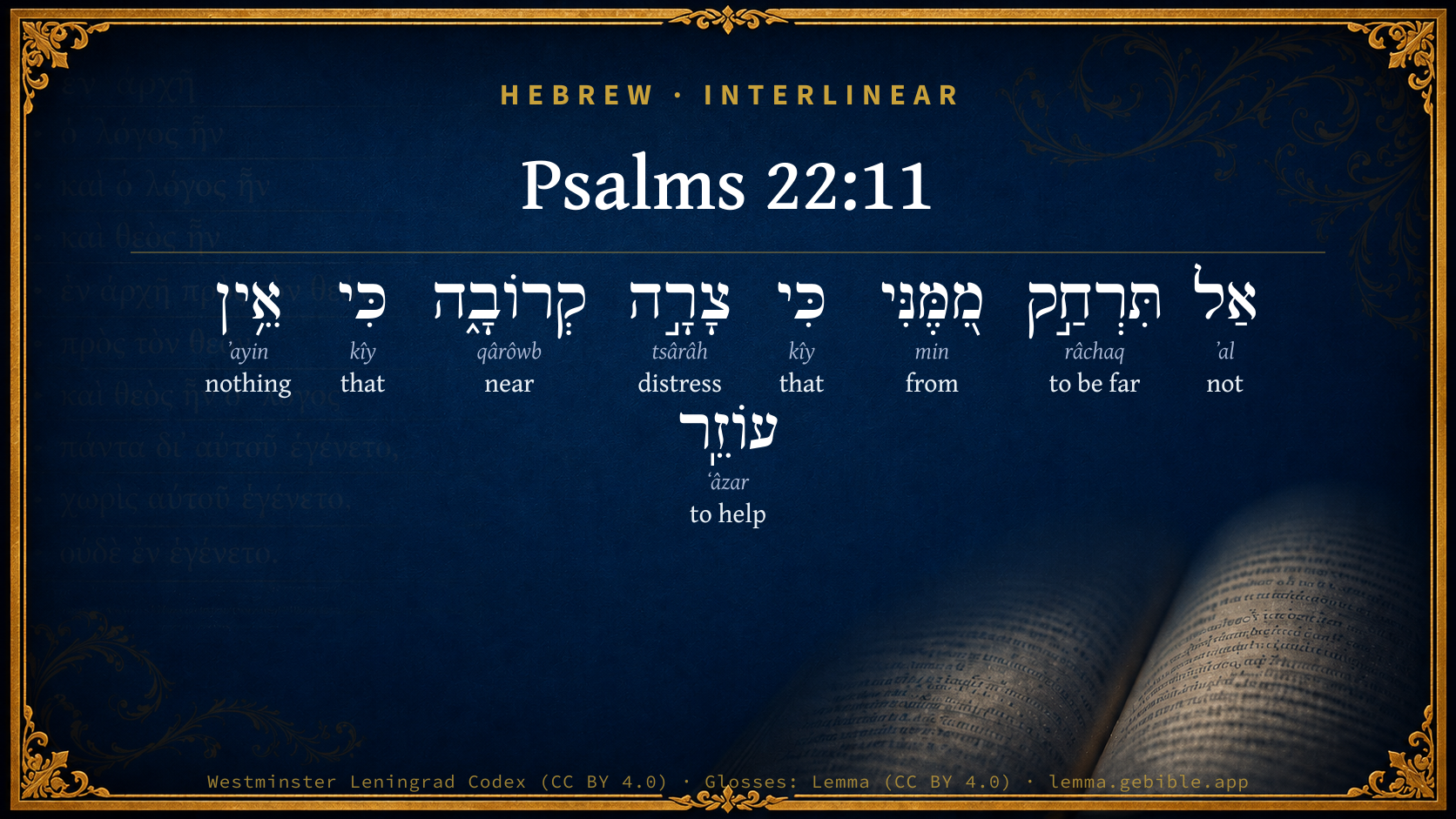
Psalms 22:11

Hebrew (Westminster Leningrad Codex) Psalms 22:11 appears in the Hebrew Old Testament. The text above is from the Westminster Leningrad Codex. Each word links to its Strong’s number, a concise gloss, and parsing drawn from the Open Scriptures Hebrew Bible morphology. Click any word for its full Brown-Driver-Briggs (BDB) entry.
Download image
Cite this verse

Psalms 22:11 (World English Bible). Public Domain. Lemma interlinear Bible study tool, https://lemma.gebible.app/v/psalms/22/11.

Show BibTeX & RIS
BibTeX
RIS
English Translation
Don't be far from me, for trouble is near. For there is none to help.
World English Bible · Public Domain
Download a study sheet

One document with this verse’s original text, its word-by-word gloss line, the meaning frame, cross-references with their text, attributed commentary, and full source and license credits — printable, and it pastes into notes with its structure intact.

This verse Autodidact and up

Study sheet (.html) Plain text (.txt)

A passage Seminary Student

Up to 50 verses in one chapter. A passage sheet keeps up to 6 commentary sources and 12 cross-references per verse, in the order this page ranks them, and says so on the sheet whenever that leaves anything out. Ask for a single verse and you get the Autodidact verse sheet above.

Everything on this page stays free to read, with no account — the sheet is a download of what is already on screen, not access to it.

Want to remove ads? Support Godless Engineer
Compare translations 3

The same verse in 3 English versions, stacked beneath the original-language interlinear above. Click any original word for its lexicon entry.

Each is an independent rendering of the whole verse — the interlinear is not word-aligned to these translations.

Highlighted words mark where these versions differ — a whole-verse word diff, not a word-by-word alignment.

  • World English Bible Public Domain
    Don't be far from me, for trouble is near. For there is none to help.
  • King James Version Public Domain
    Be not far from me; for trouble is near; for there is none to help.
  • unfoldingWord Literal Text CC BY-SA 4.0
    You not be far away from me, for trouble is near, for no one helping.

unfoldingWord Literal Text — © unfoldingWord, licensed CC BY-SA 4.0. Word-aligned USFM3 via Door43 (git.door43.org/unfoldingWord/en_ult).

Versions to compare (up to 4)

3 of 4 selected

Show all 18 translations

Every available English version of this verse, each an independent rendering of the whole verse.

  • World English Bible Public Domain
    Don't be far from me, for trouble is near. For there is none to help.
  • Berean Standard Bible Public Domain
    Be not far from me, for trouble is near and there is no one to help.
  • Majority Standard Bible Public Domain
    Be not far from me, for trouble is near and there is no one to help.
  • King James Version Public Domain
    Be not far from me; for trouble is near; for there is none to help.
  • American Standard Version (1901) Public Domain
    Be not far from me; for trouble is near; For there is none to help.
  • Revised Version (1885) Public Domain
    Be not far from me; for trouble is near; for there is none to help.
  • Geneva Bible (1599) Public Domain
    Be not farre from me, because trouble is neere: for there is none to helpe me.
  • Douay-Rheims (1899) Public Domain
    I was cast upon thee from the womb. From my mother's womb thou art my God,
  • Young's Literal Translation Public Domain
    Be not far from me, For adversity is near, for there is no helper.
  • Literal Standard Version CC BY-SA 4.0
    Do not be far from Me, || For adversity is near, for there is no helper.
  • Unlocked Literal Bible CC BY-SA 4.0
    Do not be far away from me, for trouble is near; there is no one to help.
  • unfoldingWord Literal Text CC BY-SA 4.0
    You not be far away from me, for trouble is near, for no one helping.
  • Darby Bible Public Domain
    Be not far from me, for trouble is near; for there is none to help.
  • World Messianic Bible Public Domain
    Don’t be far from me, for trouble is near. For there is no one to help.
  • Webster's Bible Public Domain
    \\22:10\\I was cast upon thee from my birth: thou art my God from the time I was born.
  • Free Bible Version CC BY-SA 4.0
    Do not be distant from me, because trouble is close by and no one else can help.
  • Bible in Basic English Public Domain
    Be not far from me, for trouble is near; there is no one to give help.
  • JPS Tanakh (1917) Public Domain
    (22-12) Be not far from me; for trouble is near; for there is none to help.

Literal Standard Version (2020), Covenant Press — licensed CC BY-SA 4.0. Text via the HelloAO Bible API (eBible.org). Unlocked Literal Bible (unfoldingWord) — licensed CC BY-SA 4.0. Text via the HelloAO Bible API (eBible.org). unfoldingWord Literal Text — © unfoldingWord, licensed CC BY-SA 4.0. Word-aligned USFM3 via Door43 (git.door43.org/unfoldingWord/en_ult). Free Bible Version, Dr. Jonathan Gallagher — licensed CC BY-SA 4.0. Text via the HelloAO Bible API (eBible.org).

Word by word

More ways to search: Search by grammar → Find every occurrence → Compare this word →

Practice this passage: Drill this verse → Learn its vocabulary →

About this verse

These counts appear in no published source. They are computed here, from the morphology-tagged text and Lemma’s own curated glosses. What Lemma adds →

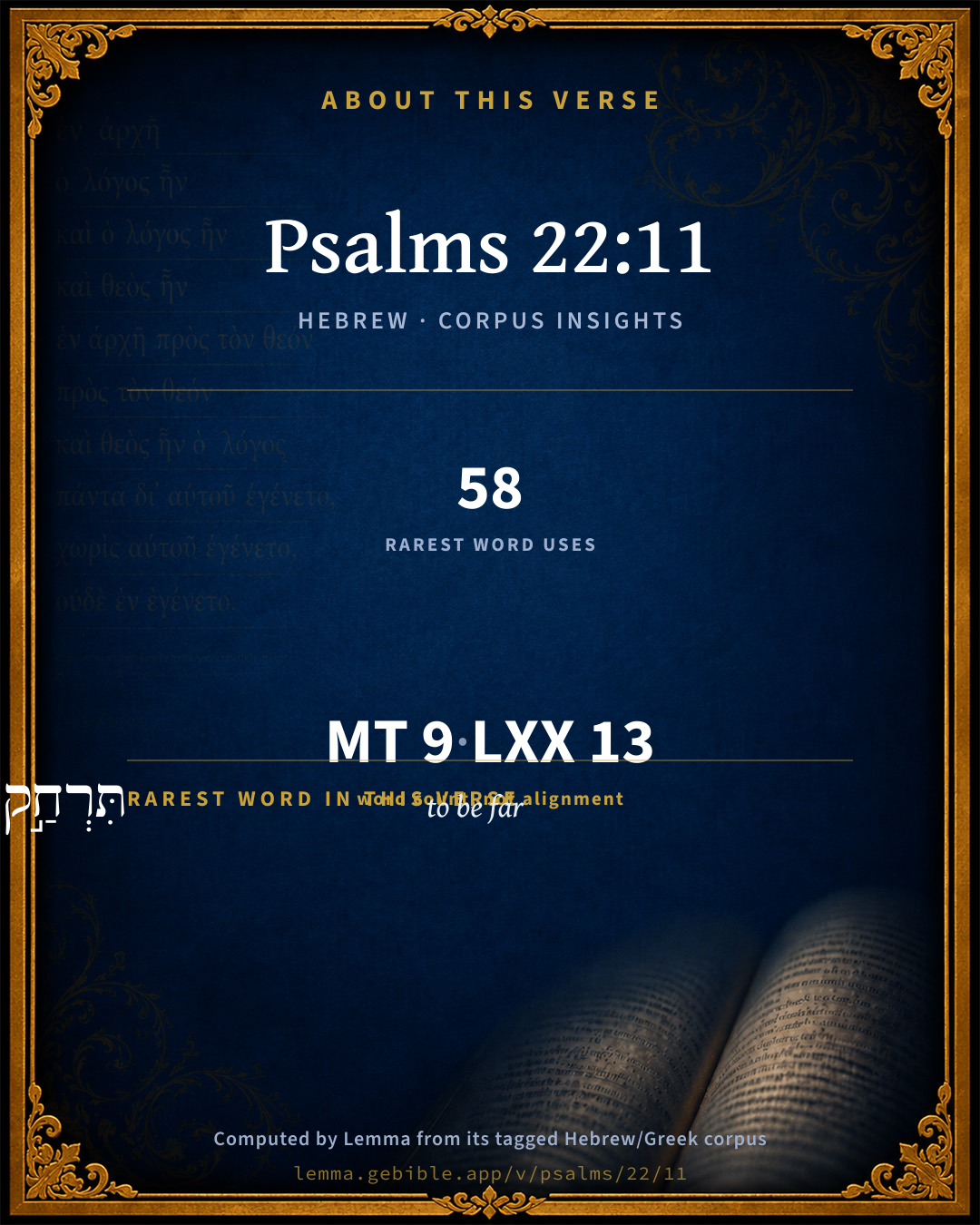
9
words
8
distinct lemmas
Wisdom
section

Shared distinctive vocabulary

תִּרְחַ֣ק to be far H7368 occurs in 56 verses of the Hebrew Bible. Also found in:

Grammatical profile

  • 2 verbs
  • 1 noun
  • 1 adjective
  • 1 preposition
  • 2 conjunctions
  • 2 particles

Verb forms

  • תִּרְחַ֣ק Qal · Jussive
  • עוֹזֵֽר Qal · Participle Active

Repetition

A word recurs within this verse — often emphatic in Hebrew:

  • כִּי that H3588 ×2

Hebrew & Septuagint length

In English translation the verse runs 15 words from the Hebrew and 14 from the Septuagint (LXX English) — closely comparable.

A rough comparison of the two English renderings, which tokenize alike — not a word-level alignment.

Word counts can differ between the Hebrew and the Greek without any difference in meaning — e.g. the Hebrew direct-object marker אֵת has no separate Greek word, and Greek often adds the article ὁ.

In the original languages it is 9 Hebrew tokens and 13 Greek tokens — but the two are counted differently (Hebrew bundles its prefixes and suffixes into one token; the Greek is in lemma form), so that isn’t a like-for-like length.

Cross-references

15

Topical passages linked to Psalms 22:11 in the Treasury of Scripture Knowledge — connected by theme and wording, ordered by reader-vote popularity; previews shown in the World English Bible.

  • Psalms 71:12 God, don't be far from me. My God, hurry to help me.
  • Psalms 10:1 Why do you stand far off, Yahweh? Why do you hide yourself in times of trouble?
  • Psalms 72:12 For he will deliver the needy when he cries; The poor, who has no helper.
  • John 16:32 Behold, the time is coming, yes, and has now come, that you will be scattered, everyone to his own place, and you will leave me alone. Yet I am not alone, because the Father is with me.
  • Hebrews 5:7 He, in the days of his flesh, having offered up prayers and petitions with strong crying and tears to him who was able to save him from death, and having been heard for his godly fear,
  • Psalms 38:21 Don't forsake me, Yahweh. My God, don't be far from me.
  • Psalms 35:22 You have seen it, Yahweh. Don't keep silent. Lord, don't be far from me.
  • Psalms 69:1–2 Save me, God, For the waters have come up to my neck!
  • Psalms 142:4–6 Look on my right, and see; For there is no one who is concerned for me. Refuge has fled from me. No one cares for my soul.
  • Psalms 13:1–3 How long, Yahweh? Will you forget me forever? How long will you hide your face from me?
  • Psalms 69:18 Draw near to my soul, and redeem it. Ransom me because of my enemies.
  • Isaiah 63:5 I looked, and there was none to help; and I wondered that there was none to uphold: therefore my own arm brought salvation to me; and my wrath, it upheld me.
  • Matthew 26:56 But all this has happened, that the Scriptures of the prophets might be fulfilled." Then all the disciples left him, and fled.
  • Deuteronomy 32:36 For Yahweh will judge his people, Repent himself for his servants; When he sees that [their] power is gone, There is none [remaining], shut up or left at large.
  • 2 Kings 14:26 For Yahweh saw the affliction of Israel, that it was very bitter; for there was none shut up nor left at large, neither was there any helper for Israel.

Cross-references courtesy of OpenBible.info (CC BY 4.0).

Hebrew and Greek witnesses Masoretic Hebrew ↔ Greek Septuagint

The same verse in the two great witnesses to the Old Testament, shown verse-for-verse.

You’re reading Greek Psalm 21 (Hebrew Psalm 22). The Septuagint counts the superscription, so verse numbers can differ from the Hebrew — chapter-level alignment, not verse-by-verse. Numbering follows Rahlfs.

These are two independent witnesses, not word-aligned to each other, and the Septuagint is shown in lemma (dictionary) form.

Hebrew Psalms 22:11 Masoretic · Westminster Leningrad Codex

אַל תִּרְחַ֣ק מִ֭מֶּנִּי כִּי צָרָ֣ה קְרוֹבָ֑ה כִּי אֵ֥ין עוֹזֵֽר

Don't be far from me, for trouble is near. For there is none to help.

World English Bible · Public Domain

Greek LXX Greek Psalm 21:11 Septuagint · lemma form

ἐπί σύ ἐπιῥίπτω ἐκ μήτρα ἐκ κοιλία μήτηρ ἐγώ θεός ἐγώ εἰμί σύ

Stand not aloof from me; for affliction is near; for there is no helper.

LXX2012 (modern English Septuagint) · Public Domain

Hebrew: Westminster Leningrad Codex (CC BY 4.0). Greek: Septuagint (public domain); English from LXX2012 (modern English Septuagint) (Public Domain). How the Septuagint differs from the Hebrew →

Commentary

Notes on Psalms 22:11 from classic Christian and Jewish commentators (each source and its license shown beneath its notes). The classic Christian expositions comment on the surrounding passage and are grouped to its opening verse, so a note may address several verses; the Jewish commentaries on the Tanakh (Rashi and others) are per-verse, so they appear only where the commentator wrote on this verse.

Lemma curates 59 commentaries, every one of them public domain or Creative Commons licensed, each selected and text-cleaned for this edition rather than reprinted as found. About our sources →

Matthew Henry's Commentary

In these verses we have Christ suffering and Christ praying, by which we are directed to look for crosses and to look up to God under them.

I. Here is Christ suffering. David indeed was often in trouble, and beset with enemies; but many of the particulars here specified are such as were never true of David, and therefore must be appropriated to Christ in the depth of his humiliation.

1. He is here deserted by his friends: Trouble and distress are near, and there is none to help, none to uphold, Psa 22:11. He trod the wine-press alone; for all his disciples forsook him and fled. It is God's honour to help when all other helps and succours fail.

2. He is here insulted and surrounded by his enemies, such as were of a higher rank, who for their strength and fury, are compared to bulls, strong bulls of Bashan (Psa 22:12), fat and fed to the full, haughty and sour; such were the chief priests and elders that persecuted Christ; and others of a lower rank, who are compared to dogs (Psa 22:16), filthy and greedy, and unwearied in running him down. There was an assembly of the wicked plotting against him (Psa 22:16); for the chief priests sat in council, to consult of ways and means to take Christ. These enemies were numerous and unanimous: "Many, and those of different and clashing interests among themselves, as Herod and Pilate, have agreed to compass me. They have carried their plot far, and seem to have gained their point, for they have beset me round, Psa 22:12. They have enclosed me, Psa 22:16. They are formidable and threatening (Psa 22:13): They gaped upon me with their mouths, to show me that they would swallow me up; and this with as much strength and fierceness as a roaring ravening lion leaps upon his prey."

3. He is here crucified. The very manner of his death is described, though never in use among the Jews: They pierced my hands and my feet (Psa 22:16), which were nailed to the accursed tree, and the whole body left so to hang, the effect of which must needs be the most exquisite pain and torture. There is no one passage in all the Old Testament which the Jews have so industriously corrupted as this, because it is such an eminent prediction of the death of Christ and was so exactly fulfilled.

4. He is here dying (Psa 22:14, Psa 22:15), dying in pain and anguish, because he was to satisfy for sin, which brought in pain, and for which we must otherwise have lain in everlasting anguish. Here is, (1.) The dissolution of the whole frame of his body: I am poured out like water, weak as water, and yielding to the power of death, emptying himself of all the supports of his human nature. (2.) The dislocation of his bones. Care was taken that not one of them should be broken (Joh 19:36), but they were all out of joint by the violent stretching of his body upon the cross as upon a rack. Or it may denote the fear that seized him in his agony in the garden, when he began to be sore amazed, the effect of which perhaps was (as sometimes it has been of great fear, Dan 5:6), that the joints of his loins were loosed and his knees smote one against another. His bones were put out of joint that he might put the whole creation into joint again, which sin had put out of joint, and might make our broken bones to rejoice. (3.) The colliquation of his spirits: My heart is like wax, melted to receive the impressions of God's wrath against the sins he undertook to satisfy for, melting away like the vitals of a dying man; and, as this satisfied for the hardness of our hearts, so the consideration of it should help to soften them. When Job speaks of his inward trouble he says, The Almighty makes my heart soft, Job 23:16, and see Psa 58:2. (4.) The failing of his natural force: My strength is dried up; so that he became parched and brittle like a potsherd, the radical moisture being wasted by the fire of divine wrath preying upon his spirits. Who then can stand before God's anger? Or who knows the power of it? If this was done in the green tree, what shall be done in the dry? (5.) The clamminess of his mouth, a usual symptom of approaching death: My tongue cleaveth to my jaws; this was fulfilled both in his thirst upon the cross (Joh 19:28) and in his silence under his sufferings; for, as a sheep before the shearers is dumb, so he opened not his mouth, nor objected against any thing done to him. (6.) His giving up the ghost: "Thou hast brought me to the dust of death; I am just ready to drop into the grave;" for nothing less would satisfy divine justice. The life of the sinner was forfeited, and therefore the life of the sacrifice must be the ransom for it. The sentence of death passed upon Adam was thus expressed: Unto dust thou shalt return. And therefore Christ, having an eye to that sentence in his obedience to death, here uses a similar expression: Thou hast brought me to the dust of death.

5. He was stripped. The shame of nakedness was the immediate consequence of sin; and therefore our Lord Jesus was stripped of his clothes, when he was crucified, that he might clothe us with the robe of his righteousness, and that the shame of our nakedness might not appear. Now here we are told, (1.) How his body looked when it was thus stripped: I may tell all my bones, Psa 22:17. His blessed body was lean and emaciated with labour, grief, and fasting, during the whole course of his ministry, which made him look as if he was nearly 50 years old when he was yet but 33, as we find, Joh 8:57. His wrinkles now witnessed for him that he was far from being what was called, a gluttonous man and a wine-bibber. Or his bones might be numbered, because his body was distended upon the cross, which made it easy to count his ribs. They look and stare upon me, that is, my bones do, being distorted, and having no flesh to cover them, as Job says (Job 16:8), My leanness, rising up in me, beareth witness to my face. Or "the standers by, the passers by, are amazed to see my bones start out thus; and, instead of pitying me, are pleased even with such a rueful spectacle." (2.) What they did with his clothes, which they took from him (Psa 22:18): They parted my garments among them, to every soldier a part, and upon my vesture, the seamless coat, do they cast lots. This very circumstance was exactly fulfilled, Joh 19:23, Joh 19:24. And though it was no great instance of Christ's suffering, yet it is a great instance of the fulfilling of the scripture in him. Thus it was written, and therefore thus it behoved Christ to suffer. Let this therefore confirm our faith in him as the true Messiah, and inflame our love to him as the best of friends, who loved us and suffered all this for us.

II. Here is Christ praying, and with that supporting himself under the burden of his sufferings. Christ, in his agony, prayed earnestly, prayed that the cup might pass from him. When the prince of this world with his terrors set upon him, gaped upon him as a roaring lion, he fell upon the ground and prayed. And of that David's praying here was a type. He calls God his strength, Psa 22:19. When we cannot rejoice in God as our song, yet let us stay ourselves upon him as out strength, and take the comfort of spiritual supports when we cannot come at spiritual delights. He prays, 1. That God would be with him, and not set himself at a distance from him: Be not thou far from me (Psa 22:11), and again, Psa 22:19. "Whoever stands aloof from my sore, Lord, do not thou." The nearness of trouble should quicken us to draw near to God and then we may hope that he will draw near to us. 2. That he would help him and make haste to help him, help him to bear up under his troubles, that he might not fail nor be discouraged, that he might neither shrink from his undertaking no sink under it. And the Father heard him in that he feared (Heb 5:7) and enabled him to go through with his work. 3. That he would deliver him and save him, Psa 22:20, Psa 22:21. (1.) Observe what the jewel is which he is in care for, "The safety of my soul, my darling; let that be redeemed from the power of the grave, Psa 49:15. Father, into thy hands I commit that, to be conveyed safely to paradise." The psalmist here calls his soul his darling, his only one (so the word is): "My soul is my only one. I have but one soul to take care of, and therefore the greater is my shame if I neglect it and the greater will the loss be if I let it perish. Being my only one, it ought to be my darling, for the eternal welfare of which I ought to be deeply concerned. I do not use my soul as my darling, unless I take care to preserve it from every thing that would hurt it and to provide all necessaries for it, and be entirely tender of its welfare." (2.) Observe what the danger is from which he prays to be delivered, from the sword, the flaming sword of divine wrath, which turns every way. This he dreaded more than any thing, Gen 3:24. God's anger was the wormwood and the gall in the bitter cup that was put into his hands. "O deliver my soul from that. Lord, though I lose my life, let me not lose thy love. Save me from the power of the dog, and from the lion's mouth." This seems to be meant of Satan, that old enemy who bruised the heel of the seed of the woman, the prince of this world, with whom he was to engage in close combat and whom he saw coming, Joh 14:30. "Lord, save me from being overpowered by his terrors." He pleads, "Thou hast formerly heard me from the horns of the unicorn," that is, "saved me from him in answer to my prayer." This may refer to the victory Christ had obtained over Satan and his temptations (Mt. 4), when the devil left him for a season (Luk 4:13), but now returned in another manner to attack him with his terrors. "Lord, thou gavest me the victory then, give it me now, that I may spoil principalities and powers, and cast out the prince of this world." Has God delivered us from the horns of the unicorn, that we be not tossed? Let that encourage us to hope that we shall be delivered from the lion's mouth, that we be not torn. He that has delivered doth and will deliver. This prayer of Christ, no doubt, was answered, for the Father heard him always. And, though he did not deliver him from death, yet he suffered him not to see corruption, but, the third day, raised him out of the dust of death, which was a greater instance of God's favour to him than if he had helped him down from the cross; for that would have hindered his undertaking, whereas his resurrection crowned it.

In singing this we should meditate on the sufferings and resurrection of Christ till we experience in our own souls the power of his resurrection and the fellowship of his sufferings.

Matthew Henry's Commentary on the Whole Bible (1708–1710) — public domain (CC PDM 1.0). Text via the HelloAO Bible API.

Trapp's Complete Commentary

John Trapp

Psa 22:11 Be not far from me; for trouble [is] near; for [there is] none to help.

Ver. 11. Be not far from me, for trouble is near] And so it is high time for thee to put forth a helping hand. Hominibus profanis mirabilis videtur haec ratio, to profane persons, this seemeth to be a strange reason, saith an interpreter; but it is a very good one, as this prophet knew, who therefore makes it his plea.

For there is none to help] Set in, therefore, O Lord, and help, at a dead lift, poor me, who am forsaken of all other hopes.

John Trapp, A Commentary or Exposition upon All the Books of the Old and New Testament (1647–1656) — public domain. Text from a community e-Sword module.

The Biblical Illustrator

Joseph S. Exell

Psa_22:11

Be not far from me; for trouble is near; for there is none to help.

Help in trouble

In this Psalm a greater than David is here, even Christ. You cannot pay a visit to Calvary, while reading this Psalm, without being struck wire the record as giving a history of what subsequently took place in the sufferings and agony of our Lord.

I. First of all, let us look at the principle laid down--a mountains; yet when we approach them we find them to be mole hills, which we can easily step over with a little exercise of faith. But our precious Lord foreboded nothing but what He knew was near and would come to pass, and therefore when He cried out, Father, save Me from this hour, He immediately adds, For this cause came I to this hour; as if He withdrew the petition and would not escape the sorrow. But mark the most prominent feature of His distress was distress of soul. When we look at the fact that Divine wrath lay heavily upon His soul we wonder not that He cried out, Now am I troubled. And so there is distress of soul of which His disciples are the subjects.

1. In their first awakenings.

2. In their after conflicts.

3. But it is never, to the believer, judicial punishment as it was with Jesus. It was Divine wrath that lay upon Him.

4. And there were external assaults. The powers of darkness were let loose. His Church must expect the like. The world and the Church cannot agree, unless the Church will compromise her dignity, her purity, her spirituality, and cringe to the worlds carnal pursuits and carnal religion; then they may go on pretty well, hand in hand; but the curse of God will rest upon them both. A Christianity that brings you out from the world will be sure to bring upon you Satans rage and fiery darts and the worlds scorn. May you be able to make Moses choice, and choose rather to suffer affliction with, etc. Jesus told you it would be thus. Marvel not if the world hate you.

5. And the Church has yet another trouble near.

II. The appalling fact. There is none to help. Now this, so far as Christ is concerned, is a peculiar mercy. For if any had been with Him they would have shared the honour. And for us, too, it is often well that there should be none to help, for if there were we would turn to them and not to God.

III. The concentration of our expectations. For when all help is gone elsewhere there comes the cry, Be not Thou far from me. Oh! we live too low, we cleave to earth too much; but when we can soar, and mount as on eagles wings, gaze on the sun, and enjoy the smiling countenance of our covenant God, our troubles then are mere mole hills; if we look down on them at all we can hardly see them. (Joseph Irons.)

The Biblical Illustrator, edited by Joseph S. Exell (c. 1880s–1900s) — public domain. Text from a community e-Sword module.

Joseph Benson's Commentary

Psa 22:11-13. Be not far from me — As to affection and succour; for trouble is near — At hand, and ready to swallow me up; for there is none to help — Thy help therefore will be the more seasonable, because it is most necessary, and thou wilt have the more glory by it, because it will appear that it is thy work alone. Many bulls have compassed me — Wicked, violent, and potent enemies, for such are so called, Eze 39:18; Amo 4:1. Strong bulls of Bashan — Fat and lusty, as the cattle there bred were, and therefore fierce and furious. “By these,” says Dr. Dodd, “are represented the haughty senators, the chief priests, the scribes, the Pharisees, and the other great men of Judea; who, after having resolved upon his death, Psa 2:2, were so insolent as to make their appearance about his cross, and to insult him with their mockeries.” They gaped upon me with their mouths — To tear and devour me, as the following metaphor explains it.

Joseph Benson's Commentary on the Old and New Testaments (1811–1818) — public domain. Text from a community e-Sword module.

J. A. Alexander on Psalms

Joseph Addison Alexander

12. (Psa 22:11). Be not far from me, for distress is near, for there is no helper. Having shewn that he was justified in expecting that God would not forsake him in extremity, he now shews that the extremity exists. The first clause constitutes the link of connection between the first and second subdivisions of the psalm. "Since, then, thou art my God, and as such must be near in my distress, Oh be not far from me now, for my distress is near, and there is no one else to help me."—Near is not put in opposition to proximity or actual contact, but to distance. The particular form of expression was suggested by the prayer in the first clause. It was no time for God to be afar off, when trouble was so near, so close upon the sufferer.—The second for may be subordinated to the first, and introduce a reason for declaring that distress was near. But it is much more natural to make the two co-relative, and understand the second as suggesting an additional reason for the prayer, be not far from me.

Joseph Addison Alexander, The Psalms Translated and Explained (1850) — public domain. Text from a community e-Sword module.

Jamieson, Fausset & Brown

Robert Jamieson, A. R. Fausset & David Brown

From this statement of reasons for the appeal, he renews it, pleading his double extremity, the nearness of trouble, and the absence of a helper.

Jamieson, Fausset & Brown — Commentary Critical and Explanatory on the Whole Bible (1871) — public domain (CC PDM 1.0). Text via the HelloAO Bible API.

Adam Clarke's Commentary

Verse 11. Be not far from me; for trouble is near] A present God is a present blessing. We always need the Divine help; but more especially when troubles and trials are at hand.

Adam Clarke's Commentary on the Bible (1810–1826) — public domain. Text from a community e-Sword/MySword module.

John Calvin's Commentaries

11. Depart not far from me. Here he employs another argument to induce God to show him mercy, alleging that he is sorely pressed and hemmed in by the greatest distress. He doubtless set before his eyes the office which the Scriptures every where attribute to God of succouring the miserable, and of being the more ready to help us the more we are afflicted. Even despair itself, therefore, served as a ladder to elevate his mind to the exercise of devout and fervent prayer. In like manner, the feeling we have of our afflictions should excite us to take shelter under the wings of God, that by granting us his aid, he may show that he takes a deep interest in our welfare.

John Calvin's Commentaries (1540-1563) — public domain. Text from the Calvin Translation Society English edition (1840s-50s) via the Christian Classics Ethereal Library (ccel.org). Calvin's coverage is partial (roughly two-thirds of the Bible); uncommented books and verses are honest gaps, never fabricated. The 19th-century editor's footnotes and remarks are omitted so the notes are faithfully Calvin's own voice.

The Cambridge Bible for Schools and Colleges

gen. ed. J. J. S. Perowne

11. Be not far from me] The expostulation of Psa_22:1 is turned into a prayer, again repeated in Psa_22:19. He urges his plea on the double ground that while Jehovah still stands afar off in seeming indifference, distress is close at hand, and there is no other helper to whom he can look.

11–21. The Psalmist pleads for help with intenser earnestness. The virulence of his foes increases. Strength and endurance are exhausted.

The Cambridge Bible for Schools and Colleges (gen. ed. J. J. S. Perowne; Cambridge University Press, 1878–1918) — public domain. Text from a community e-Sword module.

John Gill's Exposition

Be not far from me,.... Who had been so near unto him, as to take him out of the womb, and to take the care of him ever since; this is to be understood not with respect to the omnipresence of God, who is everywhere, and is not far from any of us; but of his presence, which was now withdrawn from Christ, and he was filled with a sense of divine wrath, and with sorrow and distress; and also of his powerful and assisting presence which he had promised, and Christ expected, and believed he should have, as he had: the reasons for it follow:

for trouble is near; Satan was marching towards him with his principalities and powers, to attack him in the garden and on the cross; Judas, one of his own disciples, was at hand to betray him; a multitude with swords and staves were about to seize him; the sins and chastisement of his people were just going to be laid upon him; the sword of justice was awaked against him, ready to give the blow; the hour of death was near, he was brought to the dust of it, as in Psa 22:15. A second reason is given,

for there is none to help; none among his disciples: one of them was to betray him, another to deny him, and all to forsake him and flee from him, as they did; nor any among the angels in heaven; for though they ministered to him in the wilderness, and strengthened him in the garden, there were none near him on the cross, that it might be manifest that salvation was wrought out alone by him, Isa 63:5; and, indeed, if any of these had been willing to have helped him, it was not in their power to do it, none but God could; and therefore he applies to him, who had promised and was as good as his word, Isa 49:8.

John Gill's Exposition of the Whole Bible (1746–1763) — public domain (CC PDM 1.0). Text via the HelloAO Bible API.

Albert Barnes' Notes on the Bible

Be not far from me - Do not withdraw from me; do not leave or forsake me.

For trouble is near - Near, in the sense that deep sorrow has come upon me; near, in the sense that I am approaching a dreadful death.

For there is none to help - Margin, as in Hebrew, “not a helper.” There were those who would have helped, but they could not; there were those who could have helped, but they would not. His friends that stood around the cross were unable to aid him; his foes were unwilling to do it; and he was left to suffer unhelped.

Albert Barnes' Notes on the Bible (1834–1885) — public domain. Text from a community e-Sword/MySword module.

Matthew Poole's English Annotations

Be not far from me, to wit, as to affection and succour.

Trouble is near at hand, and ready to swallow me up; and therefore if thou dost not speedily deliver me, it will be too late; which is an argument that David oft useth, as Psa 6:5; 88:11, &c.

There is none to help; thy help therefore will be the more seasonable, because it is most hecessary, and thou wilt have the more of glory by it, because it will appear that it is thy work alone.

Matthew Poole's English Annotations on the Holy Bible (1683–1685) — public domain. Text from a community e-Sword/MySword module.

The Treasury of David

Charles H. Spurgeon

Ver. 11. Be not far from me. This is the petition for which he has been using such varied and powerful pleas. His great woe was that God had forsaken him, his great prayer is that he would be near him. A lively sense of the divine presence is a mighty stay to the heart in times of distress.

For trouble is near; for there is none to help. There are two "fors, "as though faith gave a double knock at mercy's gate; that is a powerful prayer which is full of holy reasons and thoughtful arguments. The nearness of trouble is a weighty motive for divine help; this moves our heavenly Father's heart, and brings down his helping hand. It is his glory to be our very present help in trouble. Our Substitute had trouble in his inmost heart, for he said, "the waters have come in, even unto my soul; "well might he cry, "be not far from me." The absence of all other helpers is another telling plea. In our Lord's case none either could or would help him, it was needful that he should tread the winepress alone; yet was it a sore aggravation to find that all his disciples had forsaken him, and lover and friend were put far from him. There is an awfulness about absolute friendlessness which is crushing to the human mind, for man was not made to be alone, and is like a dismembered limb when he has to endure heart loneliness.

Ver. 11. Be not far from me; for trouble is near; and so it is high time for thee to put forth a helping hand. Hominibus profanis mirabilis videtur haecratio, to profane persons, this seemeth to be a strange reason, saith an interpreter; but it is a very good one, as this prophet knew, who therefore makes it his plea. John Trapp.

Ver. 11. A saint's troubles, his arguments in prayer.

Psalms 22:12*

Charles H. Spurgeon's The Treasury of David (1869–1885) — public domain. Psalms only. Text from a community e-Sword/MySword module.

Whedon's Commentary on the Bible

Daniel D. Whedon

11. Contains two urgent reasons for immediate help.

None to help— Hebrew, Because there is not a helper. See Isa_63:3; Isa_63:5. Luther strikingly observes, “that the more despised and forsaken a man is, the nearer and more gracious God is to him.”

Daniel D. Whedon (gen. ed.), Commentary on the Old and New Testaments (1874–1909) — public domain. Text from a community e-Sword module.

The Pulpit Commentary

Be not far from me. The considerations dwelt upon in vers. 3-5, and again in vers. 9, 10, have removed the sense of desertion expressed in ver. 1; and the Sufferer can now confidently call on God to help him. "Be not far from me," he says, for trouble is near. The time is come when aid is most urgently required. For there is none to help; literally, not a helper. David himself had never been in such straits. He had always had friends and followers. Under Saul"s persecution he had a friend in Jonathan; he was supported by his father and his brethren; (1Sa_22:1) in a short time he found himself at the head of four hundred, (1Sa_22:2) and then of six hundred men. (1Sa_25:13) In Absalom"s rebellion there remained faithful to him the priestly tribe (2Sa_15:24) and the Gibborim, (2Sa_15:18) and others to the number of some thousands. (2Sa_18:4) But he whom David prefigured, his Antitype, was deseeded, was alone the disciples forsook him and fled" (Mat_26:56) he was truly one that "had no helper.

Vers. 11-21. Prayer in suffering.

The persecuted exile continues to speak of his sufferings, but seems to rise up out of the despair of the first verse into the faith implied in prayer. Much of the suffering here described, if not productive, was at least typical , of the suffering of Christ. An argument is still going on in the sufferer"s mind as to whether God had finally forsaken him or not. He has been trying in the first ten verses to argue down the feeling, but has not yet succeeded; and now he breaks out into prayer, driven by the urgency of the crisis into which he has come.

I THE ARGUMENT OF THE PRAYER. The general argument is stated in the eleventh verse. Trouble was near, and there was none to help; it had come to the last extremity with him, and not to help now would be completely and finally to forsake. The particulars of the argument are:

1. The strength and fury of his persecutors. (Vers. 12, 13, 16) They are compared to hulls and lions, the most formidable beasts a man can encounter. Further on his enemies are compared to wild dogs, that have enclosed and surrounded him. So that there is no escape except by the hand of God.

2. He has lost all strength of body and courage of heart. (Vers. 14-17) He sees no human means of escaping death. Severe trials from man and the Divine desertion (ver. 15) have "laid him in the dust of death.

3. The last act of indignity, previous to his death, has been accomplished. (Ver. 18) They strip him, and cast lots for his garments. So that this is a cry for deliverance, uttered in the very jaws of death itself. Of course, the psalm was written after the experiences it describes.

II THE PRAYER ITSELF. It Was begun at the eleventh verse, and now again breaks forth with full power (vers. 19-21).

1. He cries to the Infinite Strength to make haste to help him. This looks back to the second verse, where he complains, "Thou answerest me not;" and, if help is to come, it must come at once, for he is in the very article of death.

2. He is alone and unfriended among ruthless enemies. "My darling," equivalent to "my lovely person" (ver. 20). Utterly and solely dependent on God, as we shall be in dying.

3. The cry ends with an expression of assured confidence (Ver. 21, "Thou hast answered me.") "Thou hast heard me." At last he sees deliverance at hand, and knows that his prayer has been heard, and he has been delivered from death. S.

The Pulpit Commentary (1880–1919), ed. H.D.M. Spence-Jones & Joseph S. Exell — public domain. Text from a community e-Sword module.

unfoldingWord translationNotes

Door43 World Missions Community

Do not be far away from me

This can be stated in positive form. AT: "Come close to me" (See: Litotes)

for trouble is near

The writer speaks about "trouble" as if it were an object that is near him. AT: "for my enemies are near me" (See: Metaphor)

there is no one to help

"there is no helper"

Many bulls surround me; strong bulls of Bashan surround me

The writer speaks about his enemies as if they were bulls. This emphasizes how dangerous and powerful his enemies are. AT: "I have many enemies and they are like bulls that surround me; they are like strong bulls from Bashan that surround me" (See: Metaphor and Parallelism)

They open their mouths wide against me

The writer speaks about his enemies as if they were lions with the mouths open ready to eat him. His enemies may be speaking lies to discredit him. Or they may be threatening him and attacking him. (See: Metaphor)

like a roaring lion ripping its victim

The writer speaks about his enemies as if they were lions. This emphasizes how powerful and dangerous his enemies are. (See: Simile)

translationWords

trouble

cow

Bashan

lions

unfoldingWord translationNotes — © Distant Shores Media and the Door43 World Missions Community, licensed CC BY-SA 4.0. Source: git.door43.org/Door43/en_tn.

Rashi

Rabbi Shlomo Yitzchaki (Rashi)

Upon You, I was cast from birth I was cast from birth since You took me out of the womb, as Scripture states (in Isa. 46:3): “who are carried from birth.” From the time the tribes were born, He carried them and led them.

Rashi on the Tanakh — English translations: “The Judaica Press complete Tanach with Rashi, translated by A. J. Rosenberg” (CC BY 4.0); “Pentateuch with Rashi's commentary by M. Rosenbaum and A.M. Silbermann, 1929-1934” (public domain); “The Metsudah Tanach series, Lakewood, N.J” (CC BY 4.0); and “The Book of Joshua, Metsudah Publications, 1997” (CC BY 4.0). Text via Sefaria.

Radak

Rabbi David Kimhi (Radak)

Upon Thee I was cast from the womb: – for Thou art He who fed my mother with her sustenance, so that she could feed and bring me up. I was cast: the one who actually “casts” is the father and the mother, for he (the child) has not himself the understanding to cast his burden upon God. And so

From my mother's womb my God art Thou: – for they confess Thee on my behalf.

Radak on the Tanakh — English translations: “Sefaria Community Translation” (CC0 1.0 (public-domain dedication)); “Eliyahu Munk, HaChut Hameshulash” (CC BY 4.0); “Rabbi Mike Feuer, Jerusalem Anthology” (CC BY 4.0); and “R. David Kimhi on the first book of Psalms, Translated by R.G. Finch, London, 1919” (public domain). Text via Sefaria.

Lesson kit

Teaching starters — assembled from the data on this page, not authored interpretation. Every prompt links to the verse data it draws on. Edit before teaching.

Psalms, in the Wisdom, opens this verse with 9 words (8 distinct Hebrew lemmas). Its most distinctive word is râchaq (“to be far”). A historical commentator’s framing appears above. Read the whole chapter for the surrounding context.

Discussion questions

  1. The word râchaq carries the sense “to be far.” How does it shape the verse?
  2. Genesis 21:16 shares the word «to be far» with this verse. How do the two illuminate each other?
  3. “that” occurs 2× in this one verse. What is the effect of the repetition?
  4. These translations render this verse differently; the difference is in the English rendering, not the original. What questions does that raise?
  5. The verb «תִּרְחַ֣ק» is Qal Jussive. How does its form color the action?
  6. Reading how Matthew Henry's Commentary and Trapp's Complete Commentary read this verse, where do the two commentators agree and where do they part?

Things to notice

Reading settings

Reading text

Shown beneath each verse's original-language words.

Old Testament
Old Testament edition

Read the OT as the Masoretic Hebrew (MT) or the Greek Septuagint (LXX).

English shown for the Greek Septuagint (in the Hebrew ↔ Greek comparison).

Comparing translations? Open the Compare panel on any verse page to stack up to four side by side.