
Psalms 44:21

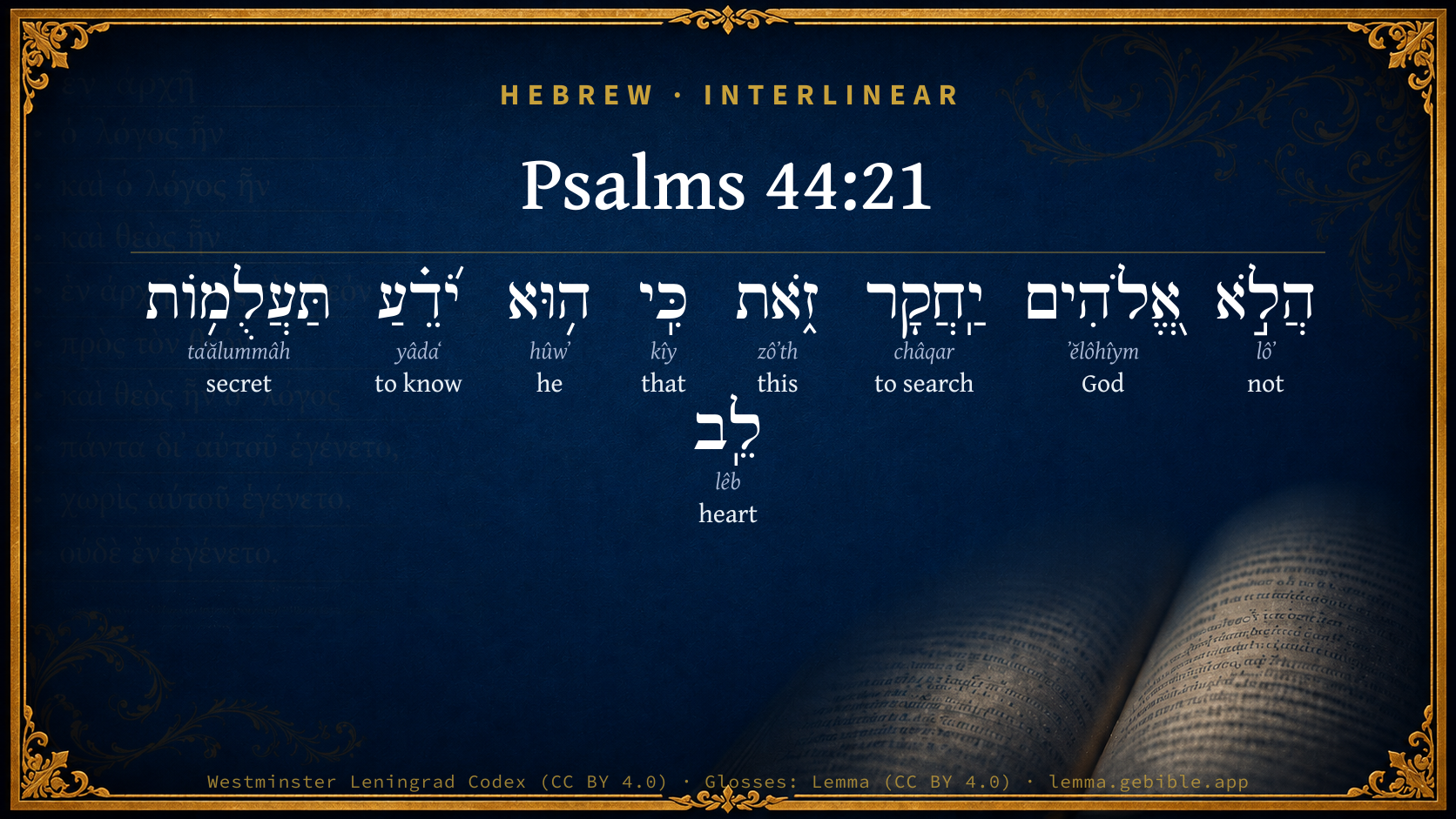
Hebrew (Westminster Leningrad Codex) Psalms 44:21 appears in the Hebrew Old Testament. The text above is from the Westminster Leningrad Codex. Each word links to its Strong’s number, a concise gloss, and parsing drawn from the Open Scriptures Hebrew Bible morphology. Click any word for its full Brown-Driver-Briggs (BDB) entry.
Download image
Cite this verse

Psalms 44:21 (World English Bible). Public Domain. Lemma interlinear Bible study tool, https://lemma.gebible.app/v/psalms/44/21.

Show BibTeX & RIS
BibTeX
RIS
English Translation
Won't God search this out? For he knows the secrets of the heart.
World English Bible · Public Domain
Download a study sheet

One document with this verse’s original text, its word-by-word gloss line, the meaning frame, cross-references with their text, attributed commentary, and full source and license credits — printable, and it pastes into notes with its structure intact.

This verse Autodidact and up

Study sheet (.html) Plain text (.txt)

A passage Seminary Student

Up to 50 verses in one chapter. A passage sheet keeps up to 6 commentary sources and 12 cross-references per verse, in the order this page ranks them, and says so on the sheet whenever that leaves anything out. Ask for a single verse and you get the Autodidact verse sheet above.

Everything on this page stays free to read, with no account — the sheet is a download of what is already on screen, not access to it.

Want to remove ads? Support Godless Engineer
Compare translations 3

The same verse in 3 English versions, stacked beneath the original-language interlinear above. Click any original word for its lexicon entry.

Each is an independent rendering of the whole verse — the interlinear is not word-aligned to these translations.

Highlighted words mark where these versions differ — a whole-verse word diff, not a word-by-word alignment.

  • World English Bible Public Domain
    Won't God search this out? For he knows the secrets of the heart.
  • King James Version Public Domain
    Shall not God search this out? for he knoweth the secrets of the heart.
  • unfoldingWord Literal Text CC BY-SA 4.0
    would God not have discovered this? For he is knowing the secrets of the heart.

unfoldingWord Literal Text — © unfoldingWord, licensed CC BY-SA 4.0. Word-aligned USFM3 via Door43 (git.door43.org/unfoldingWord/en_ult).

Versions to compare (up to 4)

3 of 4 selected

Show all 18 translations

Every available English version of this verse, each an independent rendering of the whole verse.

  • World English Bible Public Domain
    Won't God search this out? For he knows the secrets of the heart.
  • Berean Standard Bible Public Domain
    would not God have discovered, since He knows the secrets of the heart?
  • Majority Standard Bible Public Domain
    would not God have discovered, since He knows the secrets of the heart?
  • King James Version Public Domain
    Shall not God search this out? for he knoweth the secrets of the heart.
  • American Standard Version (1901) Public Domain
    Will not God search this out? For he knoweth the secrets of the heart.
  • Revised Version (1885) Public Domain
    Shall not God search this out? for he knoweth the secrets of the heart.
  • Geneva Bible (1599) Public Domain
    Shall not God searche this out? for hee knoweth the secrets of the heart.
  • Douay-Rheims (1899) Public Domain
    If we have forgotten the name of our God, and if we have spread forth our hands to a strange god:
  • Young's Literal Translation Public Domain
    Doth not God search out this? For He knoweth the secrets of the heart.
  • Literal Standard Version CC BY-SA 4.0
    Does God not search this out? For He knows the secrets of the heart.
  • Unlocked Literal Bible CC BY-SA 4.0
    would not God search this out? For he knows the secrets of the heart.
  • unfoldingWord Literal Text CC BY-SA 4.0
    would God not have discovered this? For he is knowing the secrets of the heart.
  • Darby Bible Public Domain
    Would not God search this out? for he knoweth the secrets of the heart.
  • World Messianic Bible Public Domain
    won’t God search this out? For he knows the secrets of the heart.
  • Webster's Bible Public Domain
    \\44:20\\If we have forgotten the name of our God, or stretched out our hands to a strange god;
  • Free Bible Version CC BY-SA 4.0
    wouldn't God have been aware of this, because he knows everyone's thoughts?
  • Bible in Basic English Public Domain
    Will not God make search for it? for he sees the secrets of the heart.
  • JPS Tanakh (1917) Public Domain
    (44-22) Would not God search this out? For He knoweth the secrets of the heart.

Literal Standard Version (2020), Covenant Press — licensed CC BY-SA 4.0. Text via the HelloAO Bible API (eBible.org). Unlocked Literal Bible (unfoldingWord) — licensed CC BY-SA 4.0. Text via the HelloAO Bible API (eBible.org). unfoldingWord Literal Text — © unfoldingWord, licensed CC BY-SA 4.0. Word-aligned USFM3 via Door43 (git.door43.org/unfoldingWord/en_ult). Free Bible Version, Dr. Jonathan Gallagher — licensed CC BY-SA 4.0. Text via the HelloAO Bible API (eBible.org).

Word by word

More ways to search: Search by grammar → Find every occurrence → Compare this word →

Practice this passage: Drill this verse → Learn its vocabulary →

About this verse

These counts appear in no published source. They are computed here, from the morphology-tagged text and Lemma’s own curated glosses. What Lemma adds →

9
words
9
distinct lemmas
Wisdom
section

Notable vocabulary

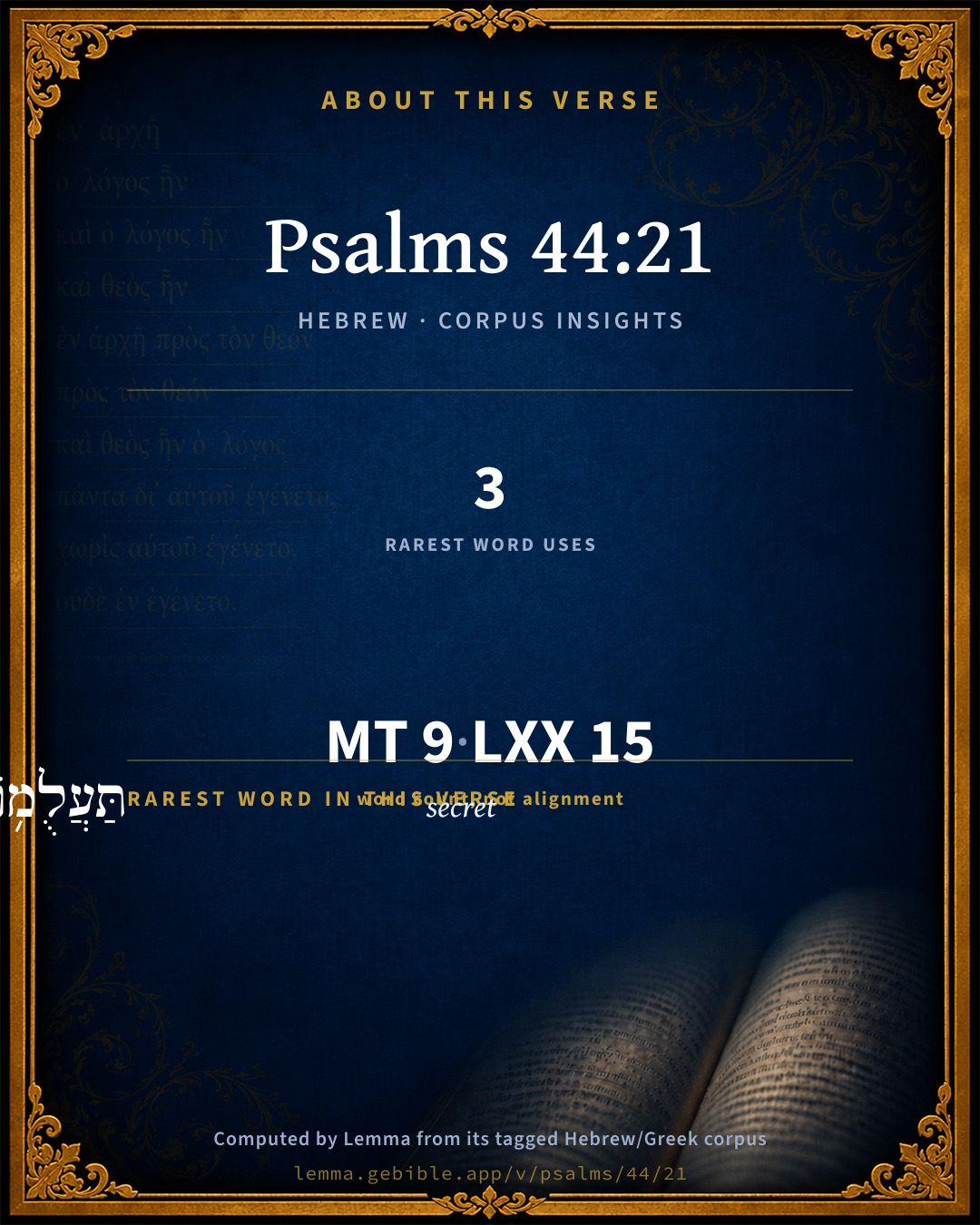
The rarest word here is תַּעֲלֻמ֥וֹת secret H8587 — appearing just 3 times in the whole Hebrew Bible.

Shared distinctive vocabulary

תַּעֲלֻמ֥וֹת secret H8587 occurs in 3 verses of the Hebrew Bible. Also found in:

Grammatical profile

  • 2 verbs
  • 3 nouns
  • 2 pronouns
  • 1 conjunction
  • 1 particle

Verb forms

  • יַֽחֲקָר Qal · Imperfect
  • יֹ֝דֵ֗עַ Qal · Participle Active

Hebrew & Septuagint length

In English translation the verse runs 13 words from the Hebrew and 8 from the Septuagint (LXX English) — closely comparable.

A rough comparison of the two English renderings, which tokenize alike — not a word-level alignment.

Word counts can differ between the Hebrew and the Greek without any difference in meaning — e.g. the Hebrew direct-object marker אֵת has no separate Greek word, and Greek often adds the article ὁ.

In the original languages it is 9 Hebrew tokens and 15 Greek tokens — but the two are counted differently (Hebrew bundles its prefixes and suffixes into one token; the Greek is in lemma form), so that isn’t a like-for-like length.

Cross-references

12

Topical passages linked to Psalms 44:21 in the Treasury of Scripture Knowledge — connected by theme and wording, ordered by reader-vote popularity; previews shown in the World English Bible.

  • Jeremiah 17:10 I, Yahweh, search the mind, I try the heart, even to give every man according to his ways, according to the fruit of his doings.
  • Jeremiah 23:24 Can any hide himself in secret places so that I shall not see him? says Yahweh. Don't I fill heaven and earth? says Yahweh.
  • Job 34:21–22 "For his eyes are on the ways of a man, He sees all his goings.
  • Ecclesiastes 12:14 For God will bring every work into judgment, with every hidden thing, whether it is good, or whether it is evil.
  • Job 31:4 Doesn't he see my ways, And number all my steps?
  • Hebrews 4:12–13 For the word of God is living, and active, and sharper than any two-edged sword, and piercing even to the dividing of soul and spirit, of both joints and marrow, and is able to discern the thoughts and intentions of the heart.
  • Psalms 139:1–24 Yahweh, you have searched me, And you know me.
  • 1 Corinthians 4:5 Therefore judge nothing before the time, until the Lord comes, who will both bring to light the hidden things of darkness, and reveal the counsels of the hearts. Then each man will get his praise from God.
  • Joshua 22:22–23 The Mighty One, God, Yahweh, the Mighty One, God, Yahweh, he knows; and Israel he shall know: if it be in rebellion, or if in trespass against Yahweh (don't save us this day),
  • Job 31:14 What then shall I do when God rises up? When he visits, what shall I answer him?
  • Romans 2:16 in the day when God will judge the secrets of men, according to my Gospel, by Jesus Christ.
  • Revelation 2:23 I will kill her children with Death, and all the assemblies will know that I am he who searches the minds and hearts. I will give to each one of you according to your deeds.

Cross-references courtesy of OpenBible.info (CC BY 4.0).

Hebrew and Greek witnesses Masoretic Hebrew ↔ Greek Septuagint

The same verse in the two great witnesses to the Old Testament, shown verse-for-verse.

You’re reading Greek Psalm 43 (Hebrew Psalm 44). The Septuagint counts the superscription, so verse numbers can differ from the Hebrew — chapter-level alignment, not verse-by-verse. Numbering follows Rahlfs.

These are two independent witnesses, not word-aligned to each other, and the Septuagint is shown in lemma (dictionary) form.

Hebrew Psalms 44:21 Masoretic · Westminster Leningrad Codex

הֲלֹ֣א אֱ֭לֹהִים יַֽחֲקָר זֹ֑את כִּֽי ה֥וּא יֹ֝דֵ֗עַ תַּעֲלֻמ֥וֹת לֵֽב

Won't God search this out? For he knows the secrets of the heart.

World English Bible · Public Domain

Greek LXX Greek Psalm 43:21 Septuagint · lemma form

εἰ ἐπιλανθάνω ὁ ὄνομα ὁ θεός ἐγώ καί εἰ διαπετάζω χείρ ἐγώ πρός θεός ἀλλότριος

for he knows the secrets of the heart.

LXX2012 (modern English Septuagint) · Public Domain

Hebrew: Westminster Leningrad Codex (CC BY 4.0). Greek: Septuagint (public domain); English from LXX2012 (modern English Septuagint) (Public Domain). How the Septuagint differs from the Hebrew →

Commentary

Notes on Psalms 44:21 from classic Christian and Jewish commentators (each source and its license shown beneath its notes). The classic Christian expositions comment on the surrounding passage and are grouped to its opening verse, so a note may address several verses; the Jewish commentaries on the Tanakh (Rashi and others) are per-verse, so they appear only where the commentator wrote on this verse.

Lemma curates 59 commentaries, every one of them public domain or Creative Commons licensed, each selected and text-cleaned for this edition rather than reprinted as found. About our sources →

Trapp's Complete Commentary

John Trapp

Psa 44:21 Shall not God search this out? for he knoweth the secrets of the heart.

Ver. 21. Shall not God search this out?] What pretences or excuses soever be used for the colouring and covering of the same.

For he knoweth, &c.] See Mat 10:26, {See Trapp on "Mat 10:26"}

John Trapp, A Commentary or Exposition upon All the Books of the Old and New Testament (1647–1656) — public domain. Text from a community e-Sword module.

J. A. Alexander on Psalms

Joseph Addison Alexander

22. (Psa 44:21). Shall not God search this out? For he knoweth the secrets of the heart. This is the apodosis of the sentence begun in the preceding verse." If we have done thus, must not God know it?" The primary meaning of the verb translated search out is to dig, to bring to light what is hidden under ground. Thence, by a natural transition, it denotes the investigation and disclosure of all secrets. The interrogation is an indirect but strong affirmation of the fact in question. The for, at the beginning of the last clause, does not indicate the reason of the question, but of the affirmative answer which is tacitly implied. He (is) knowing, a form of expression which denotes continued and habitual knowledge. See above, on Psa 1:6, and with the sentiment compare that of Psa 7:10 (9).

Joseph Addison Alexander, The Psalms Translated and Explained (1850) — public domain. Text from a community e-Sword module.

Geneva Bible (1599)

Geneva Bible translators

They take God to witness that they were upright to himward.

Geneva Bible (1599) marginal notes — public domain. Text via Bolls.life.

Adam Clarke's Commentary

Verse 21. Shall not God search this out?] We confidently appeal to the true God, the searcher of hearts, for the truth of this statement.

Adam Clarke's Commentary on the Bible (1810–1826) — public domain. Text from a community e-Sword/MySword module.

John Calvin's Commentaries

21 Shall not God search this out? We have here a solemn and emphatic protestation, in which the people of God dare to appeal to him as the judge of their integrity and uprightness. From this it appears, that they did not plead their cause openly before men, but communed with themselves as if they had been before the judgment-seat of God; and moreover, as a token of still greater confidence, they add, that nothing is hidden from God. Why is it that hypocrites often call God to witness, if it is not because they imagine that, by concealing their wickedness under some specious disguise, they have escaped the judgment of God? and thus they would represent the character of God to be different from what it is, as if by their deceptions they could dazzle his eyes. Whenever, therefore, we come before God, let us at the same time remember, that there is nothing to be gained by any vain pretense in his presence, inasmuch as he knows the heart.

John Calvin's Commentaries (1540-1563) — public domain. Text from the Calvin Translation Society English edition (1840s-50s) via the Christian Classics Ethereal Library (ccel.org). Calvin's coverage is partial (roughly two-thirds of the Bible); uncommented books and verses are honest gaps, never fabricated. The 19th-century editor's footnotes and remarks are omitted so the notes are faithfully Calvin's own voice.

The Cambridge Bible for Schools and Colleges

gen. ed. J. J. S. Perowne

21. It would be vain to attempt to conceal any faithlessness from the Searcher of hearts. Cp. Job’s protestations of innocence, ch. Psa_31:4 ff.; and Psa_139:1; Psa_139:23; Jer_17:10.

The Cambridge Bible for Schools and Colleges (gen. ed. J. J. S. Perowne; Cambridge University Press, 1878–1918) — public domain. Text from a community e-Sword module.

John Gill's Exposition

Shall not God search this out?.... Undoubtedly he would, was it so, and expose it, and punish for it; as he will the Balaamites and children of Jezebel, Rev 2:18; this seems to be an appeal to God for the truth of all that the church had said concerning her steadfastness and integrity under the most trying exercises;

for he knoweth the secrets of the heart; whether the heart is turned back, or there is any inclination to apostatize from God, or his name is forgotten in it; as well as whether in fact the hand has been stretched out, or prayer made to a strange god, Jer 17:9.

John Gill's Exposition of the Whole Bible (1746–1763) — public domain (CC PDM 1.0). Text via the HelloAO Bible API.

Albert Barnes' Notes on the Bible

Shall not God search this out? - That is, If this had been the case, it would be known to God. If, as a nation, we had been given to idolatry, or if our hearts had been secretly alienated from the true God, though there had been no open manifestation of apostasy, yet that could not have been concealed from him. The question here asked implies a solemn declaration on the part of the psalmist that this was not so; or that there was no such national apostasy from God, and no such prevalence of idolatry in the land as to account for what had occurred. The reason for the calamities which had come upon them, therefore, must be found in something else.

For he knoweth the secrets of the heart - What is in the heart: what is concealed from the world. If there were any such alienation from him in the hearts of the people, he would know it. The fact that God knows the heart, or that he understands all the secret thoughts, purposes, and motives of people, is one that is everywhere affirmed in the Scriptures. See 1Ch 28:9; Rom 8:27; compare the notes at Rev 2:23.

Albert Barnes' Notes on the Bible (1834–1885) — public domain. Text from a community e-Sword/MySword module.

Matthew Poole's English Annotations

We appeal to the heart-searching God, concerning the sincerity of this profession of ours.

Matthew Poole's English Annotations on the Holy Bible (1683–1685) — public domain. Text from a community e-Sword/MySword module.

The Treasury of David

Charles H. Spurgeon

Ver. 21. Shall not God search this out? Could such idolatry be concealed from him? Would he not with holy indignation have detected unfaithfulness to itself, even had it been hidden in the heart and unrevealed in the life? For he knoweth the secrets of the heart. He is acquainted with the inner workings of the mind, and therefore this could not have escaped him. Not the heart only which is secret, but the secrets of the heart, which are secrets of the most secret thing, are as open to God as a book to a reader. The reasoning is that the Lord himself knew the people to be sincerely his followers, and therefore was not visiting them for sin; hence, then, affliction evidently came from quite another cause.

Ver. 21. Shall not God search this out? etc. Are there such variety of trials appointed to examine the sincerity of men's graces? How great a vanity, then, is hypocrisy! and to how little purpose do men endeavour to conceal and hide it! We say, murder will out; and we may as confidently affirm, hypocrisy will out. When Rebekah had laid the plot to disguise her son Jacob, and by personating his brother to get the blessing, Jacob thus objects against it: "My father peradventure will feel me, and I shall seem to him as a deceiver, and I shall bring a curse upon me and not a blessing." As if he should say, But what if my father detect the cheat? How, then, shall I look him in the face? How shall I escape a curse? After the same manner every upright soul scares itself from the way of hypocrisy. If I dissemble, and pretend to be what I am not, my Father will find me out. There is no darkness nor shadow of death that can conceal the hypocrite; but out it will come at last, let him use all the art he can to hide it...If men's works be not good, it is impossible they should be hid long. A gilded piece of brass may pass from hand to hand a little while, but the touchstone will discover the base metal; and if that does not, the fire will. John Flavel.

Ver. 21. A godly man dares not sin secretly. He knows that God sees in secret. As God cannot be deceived by our subtlety, so he cannot be excluded by our secrecy. Thomas Watson.

Ver. 21. In time of persecution for religion, nothing can counterbalance the terrors and allurements of the persecutors, and make a man steadfast in the cause of God, save the fear of God, and love to God settled in the heart; for the reason of the saint's steadfastness in this Psalm, is because God would have searched out their sin if they had done otherwise, for he knoweth the secrets of the heart. David Dickson.

Ver. 21. Can he not? Will he not?

Ver. 21. A question and an assertion.

Psalms 44:22*

Charles H. Spurgeon's The Treasury of David (1869–1885) — public domain. Psalms only. Text from a community e-Sword/MySword module.

Whedon's Commentary on the Bible

Daniel D. Whedon

21. Shall not God search this—The psalmist appeals to the omniscience of God for the confirmation of his words.

Daniel D. Whedon (gen. ed.), Commentary on the Old and New Testaments (1874–1909) — public domain. Text from a community e-Sword module.

The Pulpit Commentary

Shall not God search this out! i.e. visit for it punish it. Such a result was to be expected. But when there had been no precedent idolatry, no neglect of the worship of Jehovah, what then? For he knoweth the secrets of the heart. Secret idolatry would, of course, explain the state of things; but the writer evidently knows of no secret idolatry.

God"s knowledge of men"s hearts.

"Shall not God search," etc.? A world of perfect, mutual knowledge, in which the secrets of every heart lay open to every eye, must needs be either heaven or hell. Every one must be perfectly good or else perfectly miserable. In this world of mixed good and evil, God has mercifully built a wall of secrecy, or at least thrown a veil of privacy, around the consciousness of each one of us. Every heart has its own secrets. But the text reminds us that there is neither wall nor veil to God"s eye, nor thinnest film of obscurity. (Heb_4:13)

I GOD KNOWS THE SECRETS OF THE HEART.

1. Our thoughts. How impenetrably these are veiled from our fellows! Our feelings often betray themselves. They escape our control. A look, a change of colour, a start, an exclamation, a tremor, may discover them against our will. But our thoughts lie deeper. Words may be used not to express, but to conceal them. A man"s outward conduct and apparent character may be such that if the habitual current of his inmost thoughts could be laid open, his nearest friends would stand aghast. But God knows. Thought may flash so swiftly through the mind, that we ourselves are scarcely aware of it; but God sees. It may fade in a moment from the mirror of memory; but God remembers.

2. Our feelings lie as open to God as our thoughts. They are often a mystery to ourselves, not to him. They surprise us by their sudden and unexpected character and power. They do not surprise him. They perplex us by their mixture of good and evil. All is plain to him. Our inmost springs of character lie under his hand as well as eye. He knows how to work in us both to will and to do. (Php_2:13)

3. Our hidden future; unconscious capabilities, good or evil; undeveloped possibilities. Examples: Jer_1:5-9 2Ki_8:13 Luk_5:2-10. Our sins (known or unknown to ourselves), and all our spiritual needs. Perhaps you have not felt your sins. But God takes account; (Psa_90:8) knows your need of pardon; (Isa_1:18) knows your weakness, and need of grace; (Joh_13:37, Joh_13:38) knows your need of trial and discipline. (Heb_13:6)

II WE SEARCH IN ORDER TO KNOW; GOD SEARCHES BECAUSE HE KNOWS.

1. By his providence, proving men and revealing their character. As Abraham, (Gen_22:12) Hezekiah. (2Ch_32:31)

2. By. his Spirit. (Joh_16:8)

3. By his Word. (Heb_4:12, Heb_4:13)

CONCLUSION. The Lord Jesus claims this Divine prerogative. (Rev_2:23 1Co_4:4, 1Co_4:5) But he loves to discover even the little that is good in us, and to reward it. (Rev_3:8) He that probes can heal. He that knows can save. (Rev_3:9) Let us open our hearts to him. (Psa_139:23, Psa_139:24)

The Pulpit Commentary (1880–1919), ed. H.D.M. Spence-Jones & Joseph S. Exell — public domain. Text from a community e-Sword module.

Lesson kit

Teaching starters — assembled from the data on this page, not authored interpretation. Every prompt links to the verse data it draws on. Edit before teaching.

Psalms, in the Wisdom, opens this verse with 9 words (9 distinct Hebrew lemmas). Its most distinctive word is taʻălummâh (“secret”). A historical commentator’s framing appears above. Read the whole chapter for the surrounding context.

Discussion questions

  1. How does “secret” (taʻălummâh) shape what this verse is saying?
  2. How does Job 11:6, which shares the word «secret», read alongside this verse?
  3. The translations on this page render this verse differently — a whole-verse word diff, not a word-by-word alignment. What might account for the different wordings?
  4. «יַֽחֲקָר» is a Qal Imperfect verb. How does that grammatical form shape the action described?
  5. Compare how Trapp's Complete Commentary and J. A. Alexander on Psalms read this verse. Where do they agree or differ?

Things to notice

Reading settings

Reading text

Shown beneath each verse's original-language words.

Old Testament
Old Testament edition

Read the OT as the Masoretic Hebrew (MT) or the Greek Septuagint (LXX).

English shown for the Greek Septuagint (in the Hebrew ↔ Greek comparison).

Comparing translations? Open the Compare panel on any verse page to stack up to four side by side.