
Psalms 71:23

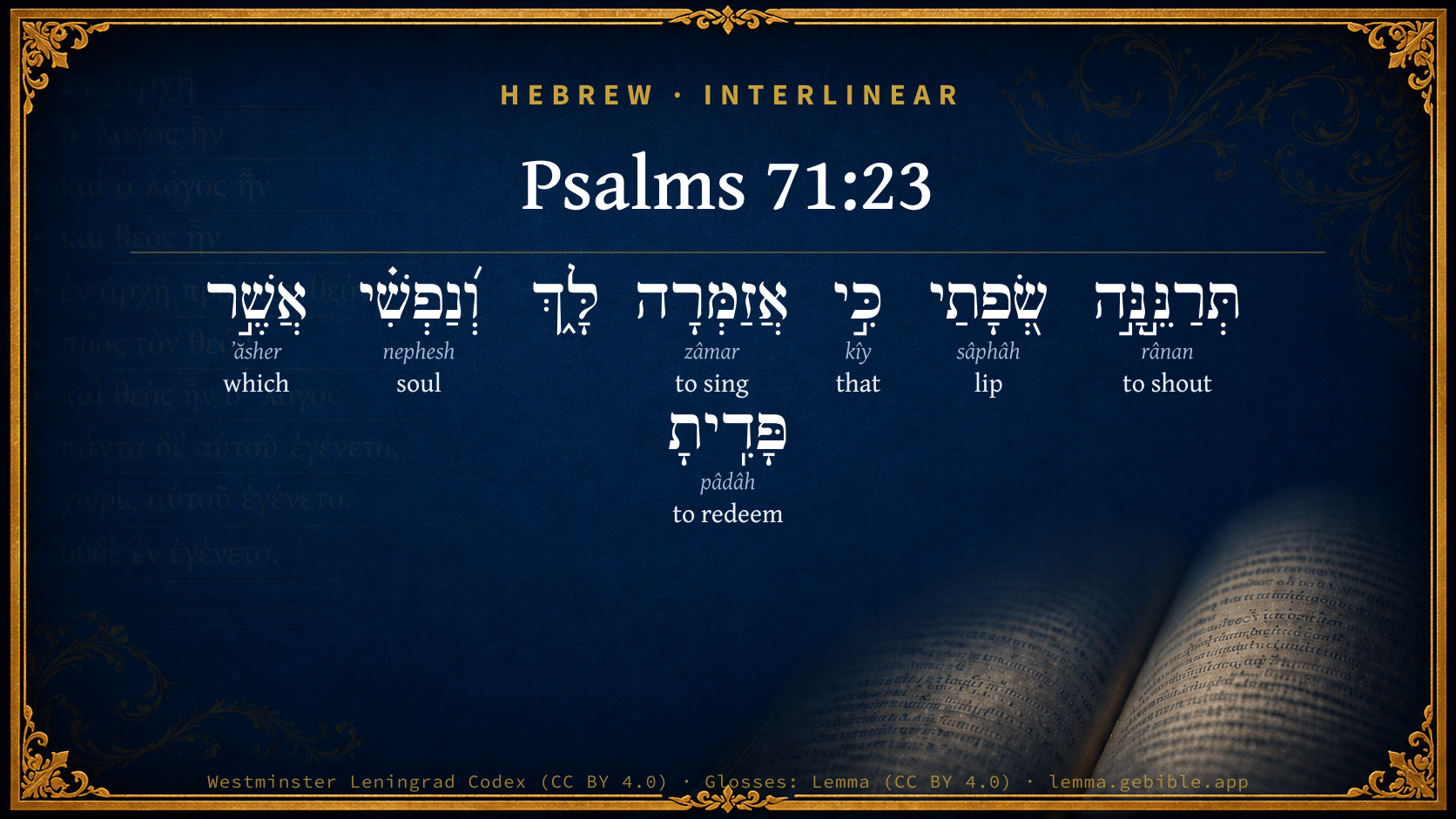
Hebrew (Westminster Leningrad Codex) Psalms 71:23 appears in the Hebrew Old Testament. The text above is from the Westminster Leningrad Codex. Each word links to its Strong’s number, a concise gloss, and parsing drawn from the Open Scriptures Hebrew Bible morphology. Click any word for its full Brown-Driver-Briggs (BDB) entry.
Download image
Cite this verse

Psalms 71:23 (World English Bible). Public Domain. Lemma interlinear Bible study tool, https://lemma.gebible.app/v/psalms/71/23.

Show BibTeX & RIS
BibTeX
RIS
English Translation
My lips shall shout for joy! My soul, which you have redeemed, sings praises to you!
World English Bible · Public Domain
Download a study sheet

One document with this verse’s original text, its word-by-word gloss line, the meaning frame, cross-references with their text, attributed commentary, and full source and license credits — printable, and it pastes into notes with its structure intact.

This verse Autodidact and up

Study sheet (.html) Plain text (.txt)

A passage Seminary Student

Up to 50 verses in one chapter. A passage sheet keeps up to 6 commentary sources and 12 cross-references per verse, in the order this page ranks them, and says so on the sheet whenever that leaves anything out. Ask for a single verse and you get the Autodidact verse sheet above.

Everything on this page stays free to read, with no account — the sheet is a download of what is already on screen, not access to it.

Want to remove ads? Support Godless Engineer
Compare translations 3

The same verse in 3 English versions, stacked beneath the original-language interlinear above. Click any original word for its lexicon entry.

Each is an independent rendering of the whole verse — the interlinear is not word-aligned to these translations.

Highlighted words mark where these versions differ — a whole-verse word diff, not a word-by-word alignment.

  • World English Bible Public Domain
    My lips shall shout for joy! My soul, which you have redeemed, sings praises to you!
  • King James Version Public Domain
    My lips shall greatly rejoice when I sing unto thee; and my soul, which thou hast redeemed.
  • unfoldingWord Literal Text CC BY-SA 4.0
    My lips will shout joyfully when I make music to you, and my soul, which you have redeemed.

unfoldingWord Literal Text — © unfoldingWord, licensed CC BY-SA 4.0. Word-aligned USFM3 via Door43 (git.door43.org/unfoldingWord/en_ult).

Versions to compare (up to 4)

3 of 4 selected

Show all 18 translations

Every available English version of this verse, each an independent rendering of the whole verse.

  • World English Bible Public Domain
    My lips shall shout for joy! My soul, which you have redeemed, sings praises to you!
  • Berean Standard Bible Public Domain
    When I sing praise to You my lips will shout for joy, along with my soul, which You have redeemed.
  • Majority Standard Bible Public Domain
    When I sing praise to You my lips will shout for joy, along with my soul, which You have redeemed.
  • King James Version Public Domain
    My lips shall greatly rejoice when I sing unto thee; and my soul, which thou hast redeemed.
  • American Standard Version (1901) Public Domain
    My lips shall shout for joy when I sing praises unto thee; And my soul, which thou hast redeemed.
  • Revised Version (1885) Public Domain
    My lips shall greatly rejoice when I sing praises unto thee; and my soul, which thou hast redeemed.
  • Geneva Bible (1599) Public Domain
    My lippes will reioyce when I sing vnto thee, and my soule, which thou hast deliuered.
  • Douay-Rheims (1899) Public Domain
    My lips shall greatly rejoice, when I shall sing to thee; and my soul which thou hast redeemed.
  • Young's Literal Translation Public Domain
    My lips cry aloud when I sing praise to Thee, And my soul that Thou hast redeemed,
  • Literal Standard Version CC BY-SA 4.0
    My lips cry aloud when I sing praise to You, || And my soul that You have redeemed,
  • Unlocked Literal Bible CC BY-SA 4.0
    My lips will shout for joy when I sing praises to you— even my soul, which you have redeemed.
  • unfoldingWord Literal Text CC BY-SA 4.0
    My lips will shout joyfully when I make music to you, and my soul, which you have redeemed.
  • Darby Bible Public Domain
    My lips shall exult when I sing psalms unto thee; and my soul, which thou hast redeemed.
  • World Messianic Bible Public Domain
    My lips shall shout for joy! My soul, which you have redeemed, sings praises to you!
  • Webster's Bible Public Domain
    My lips shall greatly rejoice when I sing to thee; and my soul, which thou hast redeemed.
  • Free Bible Version CC BY-SA 4.0
    I will shout for joy as I sing praises to you, for you have redeemed me.
  • Bible in Basic English Public Domain
    Joy will be on my lips when I make melody to you; and in my soul, to which you have given salvation.
  • JPS Tanakh (1917) Public Domain
    My lips shall greatly rejoice when I sing praises unto Thee; and my soul, which Thou hast redeemed.

Literal Standard Version (2020), Covenant Press — licensed CC BY-SA 4.0. Text via the HelloAO Bible API (eBible.org). Unlocked Literal Bible (unfoldingWord) — licensed CC BY-SA 4.0. Text via the HelloAO Bible API (eBible.org). unfoldingWord Literal Text — © unfoldingWord, licensed CC BY-SA 4.0. Word-aligned USFM3 via Door43 (git.door43.org/unfoldingWord/en_ult). Free Bible Version, Dr. Jonathan Gallagher — licensed CC BY-SA 4.0. Text via the HelloAO Bible API (eBible.org).

Word by word

More ways to search: Search by grammar → Find every occurrence → Compare this word →

Practice this passage: Drill this verse → Learn its vocabulary →

About this verse

These counts appear in no published source. They are computed here, from the morphology-tagged text and Lemma’s own curated glosses. What Lemma adds →

8
words
7
distinct lemmas
Wisdom
section

Shared distinctive vocabulary

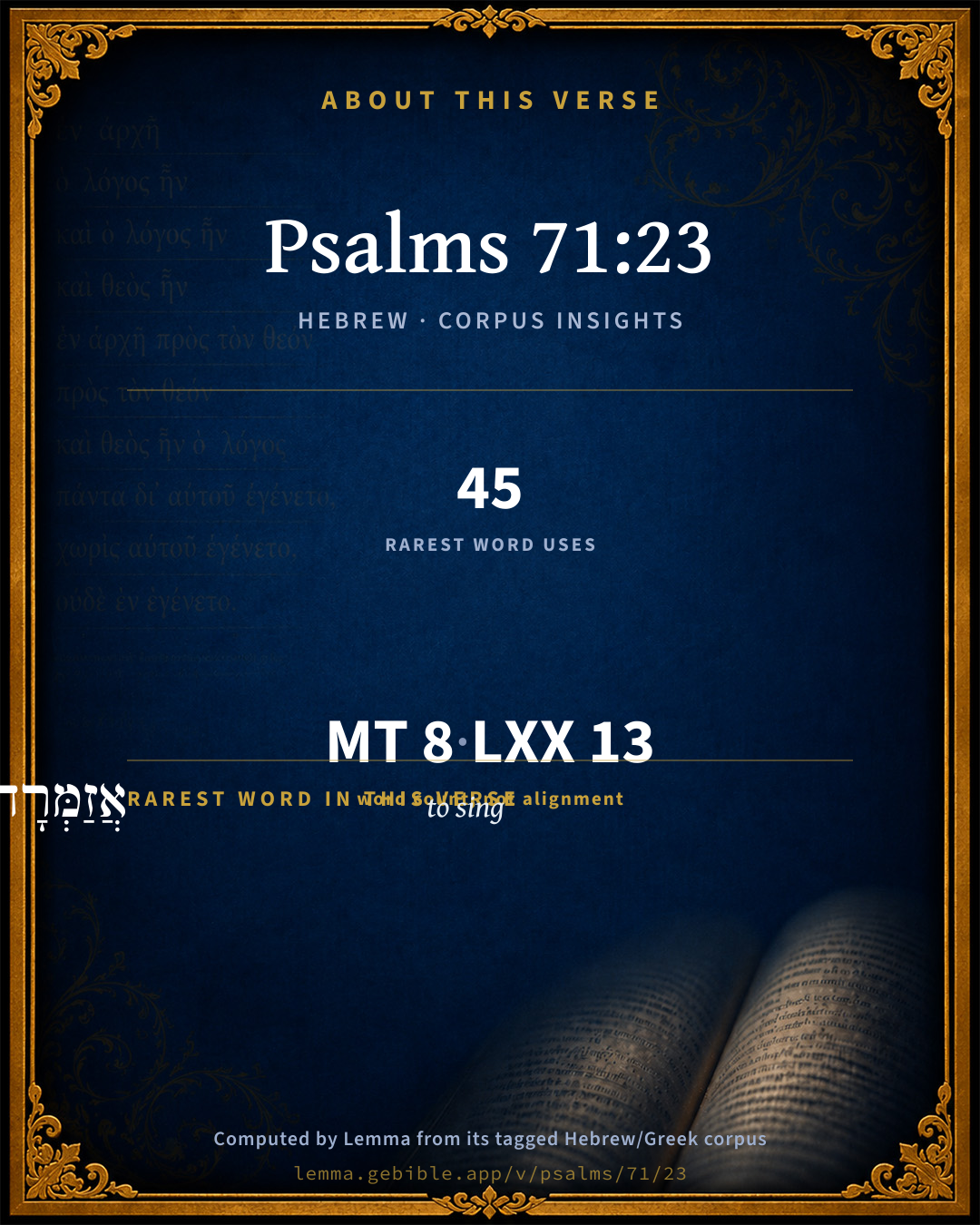
אֲזַמְּרָה to sing H2167 occurs in 41 verses of the Hebrew Bible. Also found in:

Grammatical profile

  • 3 verbs
  • 2 nouns
  • 1 preposition
  • 1 conjunction
  • 1 particle

Verb forms

  • תְּרַנֵּ֣נָּ֣ה Piel · Imperfect
  • אֲזַמְּרָה Piel · Imperfect
  • פָּדִֽיתָ Qal · Perfect

Hebrew & Septuagint length

In English translation the verse runs 16 words from the Hebrew and 16 from the Septuagint (LXX English) — the same length.

A rough comparison of the two English renderings, which tokenize alike — not a word-level alignment.

Word counts can differ between the Hebrew and the Greek without any difference in meaning — e.g. the Hebrew direct-object marker אֵת has no separate Greek word, and Greek often adds the article ὁ.

In the original languages it is 8 Hebrew tokens and 13 Greek tokens — but the two are counted differently (Hebrew bundles its prefixes and suffixes into one token; the Greek is in lemma form), so that isn’t a like-for-like length.

Cross-references

8

Topical passages linked to Psalms 71:23 in the Treasury of Scripture Knowledge — connected by theme and wording, ordered by reader-vote popularity; previews shown in the World English Bible.

  • Psalms 103:4 Who redeems your life from destruction; Who crowns you with loving kindness and tender mercies;
  • Psalms 104:33 I will sing to Yahweh as long as I live. I will sing praise to my God while I have any being.
  • Luke 1:46–47 Mary said, "My soul magnifies the Lord.
  • Revelation 5:9 They sang a new song, saying, "You are worthy to take the book, And to open its seals: For you were killed, And bought us for God with your blood, Out of every tribe, language, people, and nation,
  • Psalms 34:22 Yahweh redeems the soul of his servants. None of those who take refuge in him shall be condemned.
  • 2 Samuel 4:9 David answered Rechab and Baanah his brother, the sons of Rimmon the Beerothite, and said to them, As Yahweh lives, who has redeemed my soul out of all adversity,
  • Genesis 48:16 the angel who has redeemed me from all evil, bless the lads, and let my name be named on them, and the name of my fathers Abraham and Isaac. Let them grow into a multitude in the midst of the earth."
  • Psalms 63:5 My soul shall be satisfied as with the richest food. My mouth shall praise you with joyful lips,

Cross-references courtesy of OpenBible.info (CC BY 4.0).

Hebrew and Greek witnesses Masoretic Hebrew ↔ Greek Septuagint

The same verse in the two great witnesses to the Old Testament, shown verse-for-verse.

You’re reading Greek Psalm 70 (Hebrew Psalm 71). The Septuagint counts the superscription, so verse numbers can differ from the Hebrew — chapter-level alignment, not verse-by-verse. Numbering follows Rahlfs.

These are two independent witnesses, not word-aligned to each other, and the Septuagint is shown in lemma (dictionary) form.

Hebrew Psalms 71:23 Masoretic · Westminster Leningrad Codex

תְּרַנֵּ֣נָּ֣ה שְׂ֭פָתַי כִּ֣י אֲזַמְּרָה לָּ֑ךְ וְ֝נַפְשִׁ֗י אֲשֶׁ֣ר פָּדִֽיתָ

My lips shall shout for joy! My soul, which you have redeemed, sings praises to you!

World English Bible · Public Domain

Greek LXX Greek Psalm 70:23 Septuagint · lemma form

ἀγαλλιάομαι ὁ χεῖλος ἐγώ ὅταν ψάλλω σύ καί ὁ ψυχή ἐγώ ὅς λυτρόω

My lips shall rejoice when I sing to you; and my soul, which you have redeemed.

LXX2012 (modern English Septuagint) · Public Domain

Hebrew: Westminster Leningrad Codex (CC BY 4.0). Greek: Septuagint (public domain); English from LXX2012 (modern English Septuagint) (Public Domain). How the Septuagint differs from the Hebrew →

Commentary

Notes on Psalms 71:23 from classic Christian and Jewish commentators (each source and its license shown beneath its notes). The classic Christian expositions comment on the surrounding passage and are grouped to its opening verse, so a note may address several verses; the Jewish commentaries on the Tanakh (Rashi and others) are per-verse, so they appear only where the commentator wrote on this verse.

Lemma curates 59 commentaries, every one of them public domain or Creative Commons licensed, each selected and text-cleaned for this edition rather than reprinted as found. About our sources →

Trapp's Complete Commentary

John Trapp

Psa 71:23 My lips shall greatly rejoice when I sing unto thee; and my soul, which thou hast redeemed.

Ver. 23. And my soul, which thou hast redeemed] Hearts and lips shall concur in this work. The voice which is made in the mouth is nothing so sweet as that which cometh from the depth of the breast. The deeper and hollower the belly of the lute or viol is, the pleasanter is the sound; the fleeter, the more grating and harsh in our ears.

John Trapp, A Commentary or Exposition upon All the Books of the Old and New Testament (1647–1656) — public domain. Text from a community e-Sword module.

The Treasury of David

Charles H. Spurgeon

Ver. 23. My lips shall greatly rejoice when I sing unto thee. It shall be no weariness to me to praise thee. It shall be a delightful recreation, a solace, a joy. The essence of song lies in the holy joy of the singer.

And my soul, which thou hast redeemed. Soul singing is the soul of singing. Till men are redeemed, they are like instruments out of tune; but when once the precious blood has set them at liberty, then are they fitted to magnify the Lord who bought them. Our being bought with a price is a more than sufficient reason for our dedicating ourselves to the earnest worship of God our Saviour.

Ver. 23. My lips; my soul. Hypocrites praise God with the lips only; but David joins the soul to the lips. William Nicholson.

Ver. 23. Greatly. See how the word great is repeated. Great things done, Ps 71:19; great troubles shown, Ps 71:20; greatness increased, Ps 71:21; and great rejoicing consequent thereon, in Ps 71:23. In a great God, doing great things, it is meet greatly to rejoice. C. H. S.

Charles H. Spurgeon's The Treasury of David (1869–1885) — public domain. Psalms only. Text from a community e-Sword/MySword module.

J. A. Alexander on Psalms

Joseph Addison Alexander

Psa 71:23. My lips shall sing when I play to thee, and my soul which thou hast redeemed. The first clause, as above translated, seems to promise the combination of vocal and instrumental praise. But as the first verb usually means to shout or sing for joy, and sometimes simply to rejoice, and the second commonly conveys the idea, not of music merely, but of praise, the clause may be explained, my lips shall rejoice, for I will sing to thee (or praise thee), and my soul (shall also rejoice). With the last clause compare Psa 34:22.

Joseph Addison Alexander, The Psalms Translated and Explained (1850) — public domain. Text from a community e-Sword module.

Geneva Bible (1599)

Geneva Bible translators

For there is no true praising of God, except it come from the heart: and therefore he promiseth to delight in nothing, but wherein God be glorified.

Geneva Bible (1599) marginal notes — public domain. Text via Bolls.life.

Adam Clarke's Commentary

Verse 23. My lips shall greatly rejoice - and my soul] My lips shall use words expressive of my soul's happiness and gratitude. Thou hast redeemed me; and thou shalt have the eternal praise.

Adam Clarke's Commentary on the Bible (1810–1826) — public domain. Text from a community e-Sword/MySword module.

John Calvin's Commentaries

23. My lips shall rejoice when I sing to thee. In this verse David expresses more distinctly his resolution not to give thanks to God hypocritically, nor in a superficial manner, but to engage with unfeigned earnestness in this religious exercise. By the figures which he introduces, he briefly teaches us, that to praise God would be the source of his greatest pleasure; and thus he indirectly censures the profane mirth of those who, forgetting God, confine their congratulations to themselves in their prosperity. The scope of the last verse is to the same effect, implying that no joy would be sweet and desirable to him, but such as was connected with the praises of God, and that to celebrate his Redeemer’s praises would afford him the greatest satisfaction and delight.

John Calvin's Commentaries (1540-1563) — public domain. Text from the Calvin Translation Society English edition (1840s-50s) via the Christian Classics Ethereal Library (ccel.org). Calvin's coverage is partial (roughly two-thirds of the Bible); uncommented books and verses are honest gaps, never fabricated. The 19th-century editor's footnotes and remarks are omitted so the notes are faithfully Calvin's own voice.

Ellicott's Commentary for English Readers

(23) My lips shall . . .—Rather, my lips shall sing while I play to thee, i.e., a hymn should accompany the harp. There is, therefore, no thought of the union of the bodily and spiritual powers in praise of God, though it is natural the verse should have suggested such an interpretation to the Fathers; and indeed the thought of the poet, if we read the whole psalm, with its retrospect of life, is a wish—

“That mind and soul according well,

May make one music as before,

But vaster.”

A Bible Commentary for English Readers, edited by Charles John Ellicott (1878–1897) — public domain. Text from a community e-Sword module.

The Cambridge Bible for Schools and Colleges

gen. ed. J. J. S. Perowne

23. My lips shall sing aloud when I make melody unto thee. P.B.V. ‘my lips shall be fain,’ i.e. glad: Vulg. exultabunt.

my soul] His whole self and personality, delivered from danger, will join in the glad thanksgiving. Cp. Psa_34:22; Psa_55:18.

The Cambridge Bible for Schools and Colleges (gen. ed. J. J. S. Perowne; Cambridge University Press, 1878–1918) — public domain. Text from a community e-Sword module.

John Gill's Exposition

My lips shall greatly rejoice when I sing unto thee,.... Both with vocal and instrumental music; this is praising the Lord with joyful lips, Psa 63:5;

and my soul, which thou hast redeemed; signifying that it would not be lip labour, or bodily service, only that he should perform; but that his heart would go along with his lips in praise; and that under a sense of redeeming love, than which nothing can more strongly engage in such work, Psa 103:1. For the redemption of the soul is exceeding precious; being the contrivance of infinite wisdom, the fruit of divine grace, and owing to the blood and sacrifice of Christ.

John Gill's Exposition of the Whole Bible (1746–1763) — public domain (CC PDM 1.0). Text via the HelloAO Bible API.

Albert Barnes' Notes on the Bible

My lips shall greatly rejoice ... - My lips will seem to be happy in the privilege of celebrating the praises of God.

And my soul, which thou hast redeemed - Compare Psa 34:22. The word soul here seems to be employed to denote “the soul” properly, as we understand the word - the immortal part. The usual meaning of the word, in the Psalms, however, is “life,” and it is possible that the psalmist meant merely to say here that the “life” which had been spared should find pleasure in celebrating the praises of God; but there is no impropriety in supposing that he has reference to his higher - his immortal - nature.

Albert Barnes' Notes on the Bible (1834–1885) — public domain. Text from a community e-Sword/MySword module.

Whedon's Commentary on the Bible

Daniel D. Whedon

23. My lips shall greatly rejoice—No common joy could express the feelings due to such wonderful deliverance. Bishop Mant versifies it, taking the word rendered “greatly rejoice” as indicating “a brisk, vibratory motion, like that of the lips in singing a lively air;” the lips keeping time with the emotions of the soul:—

“Quick with delight my lips shall move,

My soul an answering rapture prove,

To sing thy guardian name.”

Daniel D. Whedon (gen. ed.), Commentary on the Old and New Testaments (1874–1909) — public domain. Text from a community e-Sword module.

The Pulpit Commentary

My lips shall greatly rejoice when I sing unto thee; and my soul, which thou hast redeemed. Not my mouth only, but my heart and spirit, will "rejoice," or "sing out thy praise" (Cheyne), when the time comes, and my "redemption," or deliverance, has been accomplished.

The Pulpit Commentary (1880–1919), ed. H.D.M. Spence-Jones & Joseph S. Exell — public domain. Text from a community e-Sword module.

Scofield Reference Notes

C. I. Scofield

redeemed

(See Scofield "Isa 59:20"). See Scofield "Exo 14:30".

The Scofield Reference Bible (1917 edition), notes by C. I. Scofield — public domain. Text from a community e-Sword module.

unfoldingWord translationNotes

Door43 World Missions Community

My lips will shout for joy

"Lips" represent the whole person. AT: "I will shout for joy" (See: Synecdoche)

even my soul, which you have redeemed

The words the psalmist has omitted can be stated clearly. AT: "and my soul, which you have redeemed, will sing praises" (See: Ellipsis)

my soul

Here "soul" refers to the whole person. (See: Synecdoche)

My tongue will also talk

Here "tongue" refers to the whole person. AT: "I will also talk" (See: Synecdoche)

they have been put to shame and are confused, those who sought my hurt

"those who sought my hurt have been put to shame and are confused"

for they have been put to shame and are confused

This can be stated in active form. AT: "for God has put to shame and confused them" (See: Active or Passive)

those who sought my hurt

This refers to the enemies of the writer. (Psalms 71:10). See how "those who seek my hurt" is translated in Psalms 71:13.

translationWords

joy

redeem

tongue

shame

seek

unfoldingWord translationNotes — © Distant Shores Media and the Door43 World Missions Community, licensed CC BY-SA 4.0. Source: git.door43.org/Door43/en_tn.

Rashi

Rabbi Shlomo Yitzchaki (Rashi)

My lips will sing praises with the music of the harp when I play to You on the harp.

Rashi on the Tanakh — English translations: “The Judaica Press complete Tanach with Rashi, translated by A. J. Rosenberg” (CC BY 4.0); “Pentateuch with Rashi's commentary by M. Rosenbaum and A.M. Silbermann, 1929-1934” (public domain); “The Metsudah Tanach series, Lakewood, N.J” (CC BY 4.0); and “The Book of Joshua, Metsudah Publications, 1997” (CC BY 4.0). Text via Sefaria.

Lesson kit

Teaching starters — assembled from the data on this page, not authored interpretation. Every prompt links to the verse data it draws on. Edit before teaching.

Psalms, in the Wisdom, opens this verse with 8 words (7 distinct Hebrew lemmas). Its most distinctive word is zâmar (“to sing”). A historical commentator’s framing appears above. Read the whole chapter for the surrounding context.

Discussion questions

  1. How does “to sing” (zâmar) shape what this verse is saying?
  2. How does Judges 5:3, which shares the word «to sing», read alongside this verse?
  3. These translations render this verse differently. What is at stake in choosing one wording over another?
  4. «תְּרַנֵּ֣נָּ֣ה» is a Piel Imperfect verb. How does that grammatical form shape the action described?
  5. Compare how Trapp's Complete Commentary and The Treasury of David read this verse. Where do they agree or differ?

Things to notice

Reading settings

Reading text

Shown beneath each verse's original-language words.

Old Testament
Old Testament edition

Read the OT as the Masoretic Hebrew (MT) or the Greek Septuagint (LXX).

English shown for the Greek Septuagint (in the Hebrew ↔ Greek comparison).

Comparing translations? Open the Compare panel on any verse page to stack up to four side by side.