
Psalms 53:5

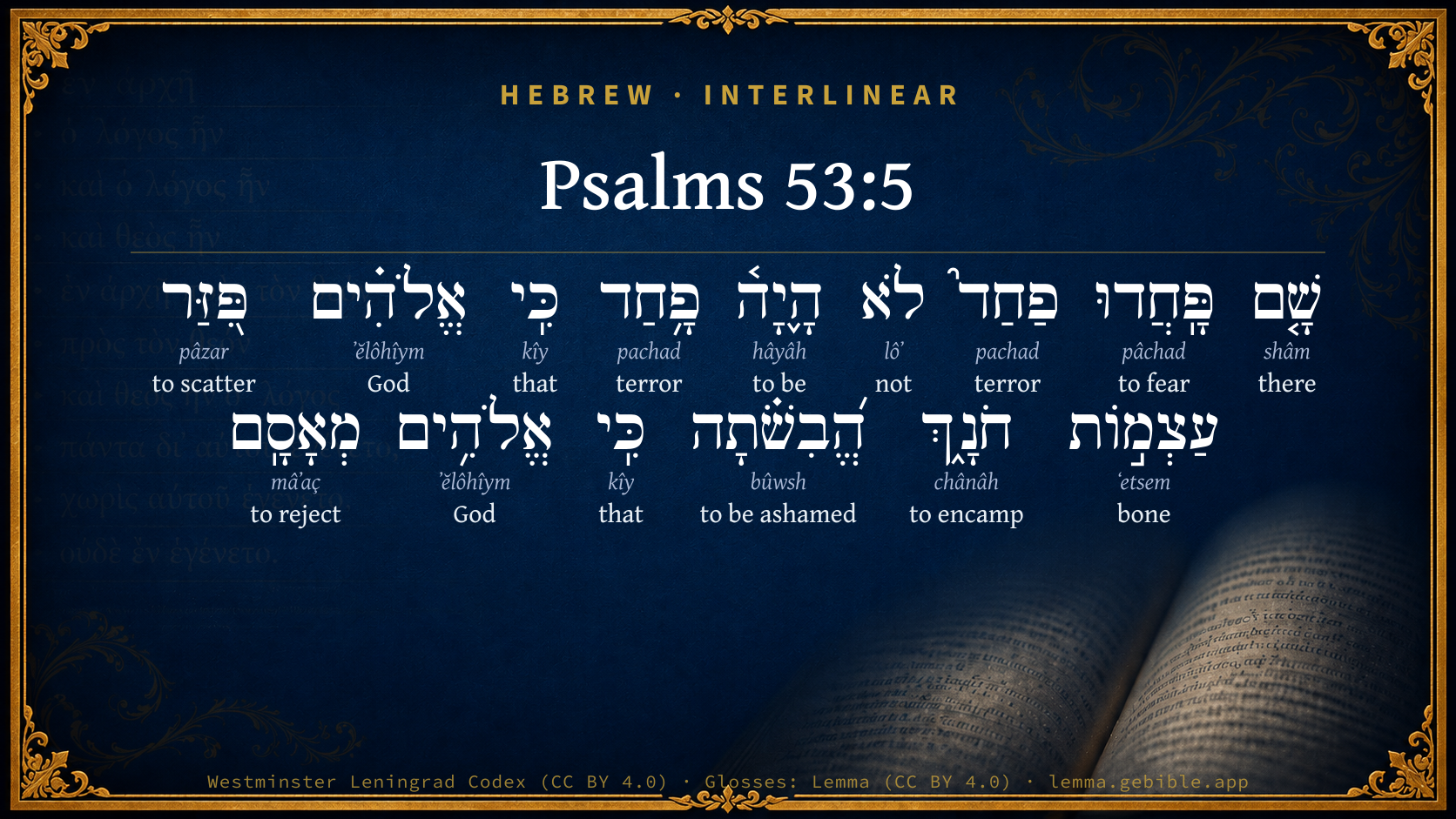
Hebrew (Westminster Leningrad Codex) Psalms 53:5 appears in the Hebrew Old Testament. The text above is from the Westminster Leningrad Codex. Each word links to its Strong’s number, a concise gloss, and parsing drawn from the Open Scriptures Hebrew Bible morphology. Click any word for its full Brown-Driver-Briggs (BDB) entry.
Download image
Cite this verse

Psalms 53:5 (World English Bible). Public Domain. Lemma interlinear Bible study tool, https://lemma.gebible.app/v/psalms/53/5.

Show BibTeX & RIS
BibTeX
RIS
English Translation
There they were in great fear, where no fear was, For God has scattered the bones of him who encamps against you. You have put them to shame, Because God has rejected them.
World English Bible · Public Domain
Download a study sheet

One document with this verse’s original text, its word-by-word gloss line, the meaning frame, cross-references with their text, attributed commentary, and full source and license credits — printable, and it pastes into notes with its structure intact.

This verse Autodidact and up

Study sheet (.html) Plain text (.txt)

A passage Seminary Student

Up to 50 verses in one chapter. A passage sheet keeps up to 6 commentary sources and 12 cross-references per verse, in the order this page ranks them, and says so on the sheet whenever that leaves anything out. Ask for a single verse and you get the Autodidact verse sheet above.

Everything on this page stays free to read, with no account — the sheet is a download of what is already on screen, not access to it.

Want to remove ads? Support Godless Engineer
Compare translations 3

The same verse in 3 English versions, stacked beneath the original-language interlinear above. Click any original word for its lexicon entry.

Each is an independent rendering of the whole verse — the interlinear is not word-aligned to these translations.

Highlighted words mark where these versions differ — a whole-verse word diff, not a word-by-word alignment.

  • World English Bible Public Domain
    There they were in great fear, where no fear was, For God has scattered the bones of him who encamps against you. You have put them to shame, Because God has rejected them.
  • King James Version Public Domain
    There were they in great fear, where no fear was: for God hath scattered the bones of him that encampeth against thee: thou hast put them to shame, because God hath despised them.
  • unfoldingWord Literal Text CC BY-SA 4.0
    There they feared a fear no fear was, because God scattered the bones of the one encamping against you. You have shamed, for God despises them.

unfoldingWord Literal Text — © unfoldingWord, licensed CC BY-SA 4.0. Word-aligned USFM3 via Door43 (git.door43.org/unfoldingWord/en_ult).

Versions to compare (up to 4)

3 of 4 selected

Show all 18 translations

Every available English version of this verse, each an independent rendering of the whole verse.

  • World English Bible Public Domain
    There they were in great fear, where no fear was, For God has scattered the bones of him who encamps against you. You have put them to shame, Because God has rejected them.
  • Berean Standard Bible Public Domain
    There they are, overwhelmed with dread, where there was nothing to fear. For God has scattered the bones of those who besieged you. You put them to shame, for God has despised them.
  • Majority Standard Bible Public Domain
    There they are, overwhelmed with dread, where there was nothing to fear. For God has scattered the bones of those who besieged you. You put them to shame, for God has despised them.
  • King James Version Public Domain
    There were they in great fear, where no fear was: for God hath scattered the bones of him that encampeth against thee: thou hast put them to shame, because God hath despised them.
  • American Standard Version (1901) Public Domain
    There were they in great fear, where no fear was; For God hath scattered the bones of him that encampeth against thee: Thou hast put them to shame, because of God hath rejected them.
  • Revised Version (1885) Public Domain
    There were they in great fear, where no fear was: for God hath scattered the bones of him that encampeth against thee; thou hast put them to shame, because God hath rejected them.
  • Geneva Bible (1599) Public Domain
    There they were afraide for feare, where no feare was: for God hath scattered the bones of him that besieged thee: thou hast put them to confusion, because God hath cast them off.
  • Douay-Rheims (1899) Public Domain
    Shall not all the workers of iniquity know, who eat up my people as they eat bread?
  • Young's Literal Translation Public Domain
    There they feared a fear -- there was no fear, For God hath scattered the bones of him Who is encamping against thee, Thou hast put to shame, For God hath despised them.
  • Literal Standard Version CC BY-SA 4.0
    There they feared a fear—there was no fear, || For God has scattered the bones of him || Who is encamping against you, || You have put to shame, || For God has despised them.
  • Unlocked Literal Bible CC BY-SA 4.0
    They were in great fear, although no reason to fear was there; for God will scatter the bones of whoever will camp against you; such people will be put to shame because God has rejected them.
  • unfoldingWord Literal Text CC BY-SA 4.0
    There they feared a fear no fear was, because God scattered the bones of the one encamping against you. You have shamed, for God despises them.
  • Darby Bible Public Domain
    There were they in great fear, where no fear was; for God scattereth the bones of him that encampeth against thee. Thou hast put [them] to shame, for God hath despised them.
  • World Messianic Bible Public Domain
    There they were in great fear, where no fear was, for God has scattered the bones of him who encamps against you. You have put them to shame, because God has rejected them.
  • Webster's Bible Public Domain
    \\53:4\\Have the workers of iniquity no knowledge? who eat up my people as they eat bread! they have not called upon God.
  • Free Bible Version CC BY-SA 4.0
    They will become completely terrified, more frightened than they have ever been. God will scatter the bones of those who fight against you; you will defeat them because God has rejected them.
  • Bible in Basic English Public Domain
    They were in great fear, where there was no cause for fear: for the bones of those who make war on you have been broken by God; you have put them to shame, because God has no desire for them.
  • JPS Tanakh (1917) Public Domain
    (53-6) There are they in great fear, where no fear was; for God hath scattered the bones of him that encampeth against thee; Thou hast put them to shame, because God hath rejected them.

Literal Standard Version (2020), Covenant Press — licensed CC BY-SA 4.0. Text via the HelloAO Bible API (eBible.org). Unlocked Literal Bible (unfoldingWord) — licensed CC BY-SA 4.0. Text via the HelloAO Bible API (eBible.org). unfoldingWord Literal Text — © unfoldingWord, licensed CC BY-SA 4.0. Word-aligned USFM3 via Door43 (git.door43.org/unfoldingWord/en_ult). Free Bible Version, Dr. Jonathan Gallagher — licensed CC BY-SA 4.0. Text via the HelloAO Bible API (eBible.org).

Word by word

More ways to search: Search by grammar → Find every occurrence → Compare this word →

Practice this passage: Drill this verse → Learn its vocabulary →

פִּ֭זַּר
pâzar
H6340
“to scatter”
Verb, Piel, Perfect, 3rd Person, Masculine, Singular
Part of Speech
Verb
Stem
Piel
Form
Perfect
Person
3rd Person
Gender
Masculine
Number
Singular
Full BDB Definition

Origin: a primitive root

TWOT: 1755

to scatter, disperse - (Qal) - to scatter - scattered (participle) - (Niphal) to be scattered - (Piel) to scatter - (Pual) to be scattered
  1. שָׁ֤ם shâm H8033 “there” Adverb
  2. פָּֽחֲדוּ pâchad H6342 “to fear” Verb, Qal, Perfect, 3rd Person, Common, Plural
  3. פַחַד֮ pachad H6343 “terror” Noun, Common, Masculine, Singular, Absolute
  4. לֹא lôʼ H3808 “not” Particle, Negative
  5. הָ֪יָה֫ hâyâh H1961 “to be” Verb, Qal, Perfect, 3rd Person, Masculine, Singular
  6. פָ֥חַד pachad H6343 “terror” Noun, Common, Masculine, Singular, Absolute
  7. כִּֽי kîy H3588 “that” Conjunction
  8. אֱלֹהִ֗ים ʼĕlôhîym H430 “God(s)” Noun, Common, Masculine, Plural, Absolute
  9. עַצְמ֣וֹת ʻetsem H6106 “bones of” Noun, Common, Feminine, Plural, Construct
  10. חֹנָ֑ךְ chânâh H2583 “encamping · you” Verb, Qal, Participle Active, Masculine, Singular, Construct + Suffix, Personal, 2nd Person, Feminine, Singular
  11. הֱ֝בִשֹׁ֗תָה bûwsh H954 “to be ashamed” Verb, Hiphil, Perfect, 2nd Person, Masculine, Singular
  12. כִּֽי kîy H3588 “that” Conjunction
  13. אֱלֹהִ֥ים ʼĕlôhîym H430 “God(s)” Noun, Common, Masculine, Plural, Absolute
  14. מְאָסָֽם mâʼaç H3988 “to reject · them” Verb, Qal, Perfect, 3rd Person, Masculine, Singular + Suffix, Personal, 3rd Person, Masculine, Plural

About this verse

These counts appear in no published source. They are computed here, from the morphology-tagged text and Lemma’s own curated glosses. What Lemma adds →

15
words
12
distinct lemmas
Wisdom
section

Notable vocabulary

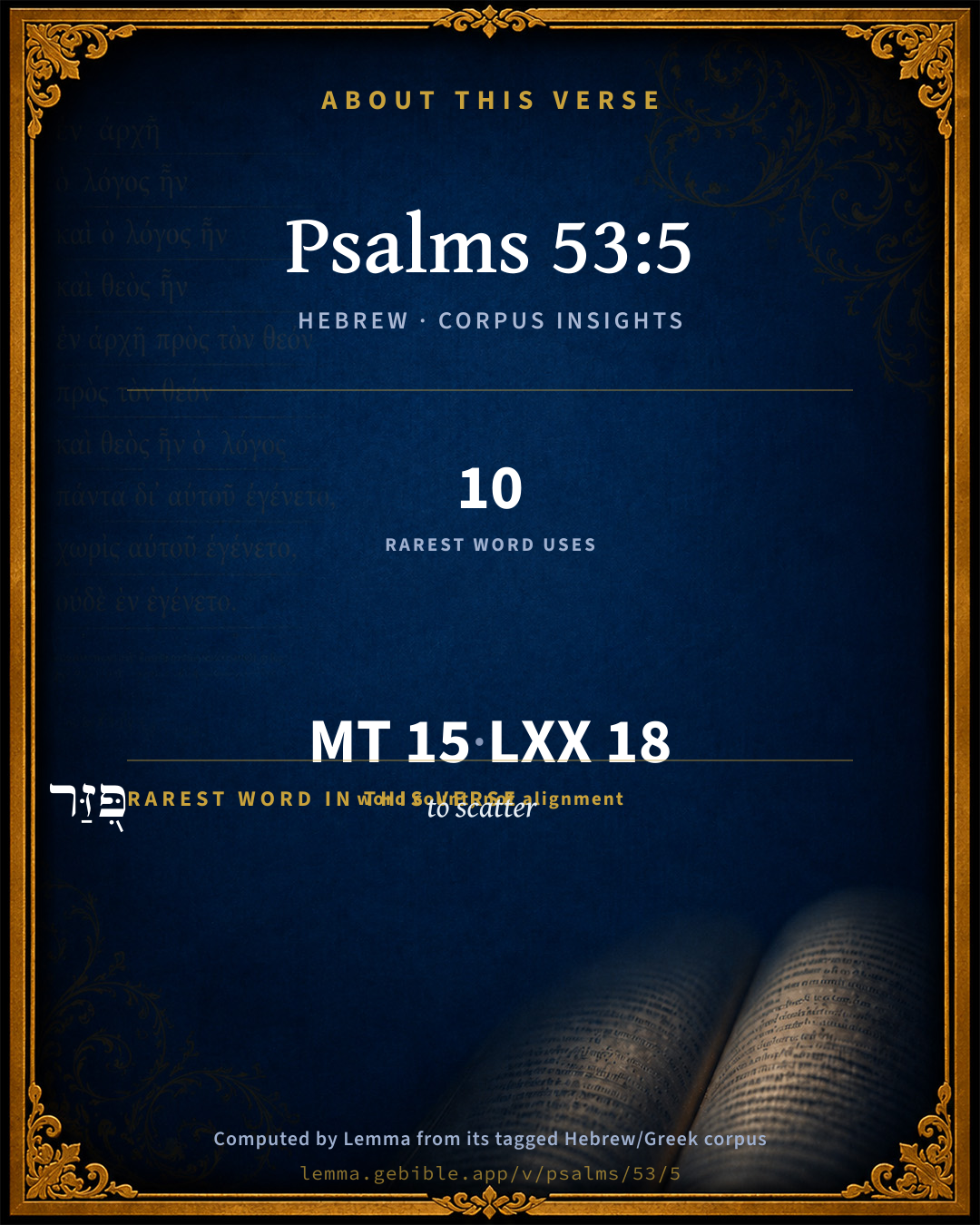
The rarest word here is פִּ֭זַּר to scatter H6340 — appearing just 10 times in the whole Hebrew Bible.

Shared distinctive vocabulary

פִּ֭זַּר to scatter H6340 occurs in 10 verses of the Hebrew Bible. Also found in:

Grammatical profile

  • 6 verbs
  • 5 nouns
  • 2 conjunctions
  • 1 adverb
  • 1 particle

Verb forms

  • פָּֽחֲדוּ Qal · Perfect
  • הָ֪יָה֫ Qal · Perfect
  • פִּ֭זַּר Piel · Perfect
  • חֹנָ֑ךְ Qal · Participle Active
  • הֱ֝בִשֹׁ֗תָה Hiphil · Perfect
  • מְאָסָֽם Qal · Perfect

Repetition

Words recur within this verse — often emphatic in Hebrew:

  • פַחַד֮ terror H6343 ×2
  • אֱלֹהִ֗ים God H430 ×2
  • כִּֽי that H3588 ×2

Hebrew & Septuagint length

In English translation the verse runs 33 words from the Hebrew and 16 from the Septuagint (LXX English) — closely comparable.

A rough comparison of the two English renderings, which tokenize alike — not a word-level alignment.

Word counts can differ between the Hebrew and the Greek without any difference in meaning — e.g. the Hebrew direct-object marker אֵת has no separate Greek word, and Greek often adds the article ὁ.

In the original languages it is 15 Hebrew tokens and 18 Greek tokens — but the two are counted differently (Hebrew bundles its prefixes and suffixes into one token; the Greek is in lemma form), so that isn’t a like-for-like length.

Cross-references

21

Topical passages linked to Psalms 53:5 in the Treasury of Scripture Knowledge — connected by theme and wording, ordered by reader-vote popularity; previews shown in the World English Bible.

  • Proverbs 28:1 The wicked flee when no one pursues; But the righteous are as bold as a lion.
  • Leviticus 26:36 "'As for those of you who are left, I will send a faintness into their hearts in the lands of their enemies: and the sound of a driven leaf will put them to flight; and they shall flee, as one flees from the sword; and they will fall when no one pursues.
  • Psalms 141:7 "As when one plows and breaks up the earth, Our bones are scattered at the mouth of Sheol."
  • Jeremiah 6:30 Refuse silver shall men them, because Yahweh has rejected them.
  • Ezekiel 6:5 I will lay the dead bodies of the children of Israel before their idols; and I will scatter your bones round about your altars.
  • Leviticus 26:17 I will set my face against you, and you will be struck before your enemies. Those who hate you will rule over you; and you will flee when no one pursues you.
  • Psalms 83:16–17 Fill their faces with confusion, That they may seek your name, Yahweh.
  • 1 Samuel 14:15 There was a trembling in the camp, in the field, and among all the people; the garrison, and the spoilers, they also trembled; and the earth quaked: so there was an exceeding great trembling.
  • Jeremiah 8:1–2 At that time, says Yahweh, they shall bring out the bones of the kings of Judah, and the bones of his princes, and the bones of the priests, and the bones of the prophets, and the bones of the inhabitants of Jerusalem, out of their graves;
  • Deuteronomy 28:65–67 Among these nations shall you find no ease, and there shall be no rest for the sole of your foot: but Yahweh will give you there a trembling heart, and failing of eyes, and pining of soul;
  • 2 Kings 7:6–7 For the Lord had made the host of the Syrians to hear a noise of chariots, and a noise of horses, even the noise of a great host: and they said one to another, Behold, the king of Israel has hired against us the kings of the Hittites, and the kings of the Egyptians, to come on us.
  • Psalms 2:4 He who sits in the heavens will laugh. The Lord will have them in derision.
  • Psalms 14:5 There they were in great fear, For God is in the generation of the righteous.
  • Psalms 35:4 Let those who seek after my soul be disappointed and brought to dishonor. Let those who plot my ruin be turned back and confounded.
  • Psalms 35:26 Let them be disappointed and confounded together who rejoice at my calamity. Let them be clothed with shame and dishonor who magnify themselves against me.
  • Psalms 40:14 Let them be disappointed and confounded together who seek after my soul to destroy it. Let them be turned backward and brought to dishonor who delight in my hurt.
  • Psalms 73:20 As a dream when one wakes up, So, Lord, when you awake, you will despise their fantasies.
  • Ezekiel 37:1–11 The hand of Yahweh was on me, and he brought me out in the Spirit of Yahweh, and set me down in the midst of the valley; and it was full of bones.
  • Job 15:21 A sound of terrors is in his ears; In prosperity the destroyer shall come on him.
  • Lamentations 2:6 He has violently taken away his tent, as if it were of a garden; he has destroyed his place of assembly: Yahweh has caused solemn assembly and Sabbath to be forgotten in Zion, Has despised in the indignation of his anger the king and the priest.
  • Isaiah 37:22–38 this is the word which Yahweh has spoken concerning him: The virgin daughter of Zion has despised you and ridiculed you; the daughter of Jerusalem has shaken her head at you.

Cross-references courtesy of OpenBible.info (CC BY 4.0).

Hebrew and Greek witnesses Masoretic Hebrew ↔ Greek Septuagint

The same verse in the two great witnesses to the Old Testament, shown verse-for-verse.

You’re reading Greek Psalm 52 (Hebrew Psalm 53). The Septuagint counts the superscription, so verse numbers can differ from the Hebrew — chapter-level alignment, not verse-by-verse. Numbering follows Rahlfs.

These are two independent witnesses, not word-aligned to each other, and the Septuagint is shown in lemma (dictionary) form.

Hebrew Psalms 53:5 Masoretic · Westminster Leningrad Codex

שָׁ֤ם פָּֽחֲדוּ פַחַד֮ לֹא הָ֪יָה֫ פָ֥חַד כִּֽי אֱלֹהִ֗ים פִּ֭זַּר עַצְמ֣וֹת חֹנָ֑ךְ הֱ֝בִשֹׁ֗תָה כִּֽי אֱלֹהִ֥ים מְאָסָֽם

There they were in great fear, where no fear was, For God has scattered the bones of him who encamps against you. You have put them to shame, Because God has rejected them.

World English Bible · Public Domain

Greek LXX Greek Psalm 52:5 Septuagint · lemma form

οὐ γιγνώσκω πᾶς ὁ ἐργάζομαι ὁ ἀνομία ὁ ἐσθίω ὁ λαός ἐγώ βρῶσις ἄρτος ὁ θεός οὐ ἐπικαλέω

or God has scattered the bones of the men-pleasers; they were ashamed, for God despised them.

LXX2012 (modern English Septuagint) · Public Domain

On this verse, Ellicott's Commentary for English Readers discusses the Septuagint’s reading. Read the note in Commentary ↓

Hebrew: Westminster Leningrad Codex (CC BY 4.0). Greek: Septuagint (public domain); English from LXX2012 (modern English Septuagint) (Public Domain). How the Septuagint differs from the Hebrew →

Commentary

Notes on Psalms 53:5 from classic Christian and Jewish commentators (each source and its license shown beneath its notes). The classic Christian expositions comment on the surrounding passage and are grouped to its opening verse, so a note may address several verses; the Jewish commentaries on the Tanakh (Rashi and others) are per-verse, so they appear only where the commentator wrote on this verse.

Lemma curates 59 commentaries, every one of them public domain or Creative Commons licensed, each selected and text-cleaned for this edition rather than reprinted as found. About our sources →

Trapp's Complete Commentary

John Trapp

Psa 53:5 There were they in great fear, [where] no fear was: for God hath scattered the bones of him that encampeth [against] thee: thou hast put [them] to shame, because God hath despised them.

Ver. 5. There were they in great fear] Heb. They feared a fear. God they feared not, of men they were greatly feared, and yet here they feared a fear where no fear was, viz. without themselves, only facti sunt a corde suo fugitivi, they feared and fled before their own consciences, their own trembling heart, Deu 28:65; the sound of fear that is in their ears, Job 15:21; the sound of a leaf chaseth them, Lev 26:36; they flee where none pursueth, Pro 28:1. Naturalists tell us of a certain little bird, quae fertur metu ne in ipsam coelum ruat, imponere sibi semper dormienti alterum pedem, which for fear lest the sky should fall on her head, sleepeth still with one foot laid upon her head. The Gauls that dwelt near the Adriatic Sea, being asked by Alexander the Great what they most feared, answered, ne supra se coelum corruat, lest the sky should fall upon them. Galen writeth of a certain melancholic fellow, who hearing that Atlas supported heaven with his shoulders, was therefore sore afraid lest he should faint under the burden; and therefore carried his arm before him to save his head. Heraclides, out of Anacreon, telleth of one Artemon, a timorous man, who kept home as much as might be, having ever a couple of servants to hold a brazen buckler over his head, lest anything should fall upon him from above; and if he were at any time necessitated to go abroad, he was carried in a horse litter that touched the ground almost; and was thereupon called Periphoretus (Plut. in Pericle).

For God hath scattered the bones] i.e. The strength, the strong troops, saith the Chaldee; they want decent burial, as Jer 22:19, saith the Syriac.

Thou hast put them to shame] viz. The poor afflicted, Psa 14:5, because

God hath despised them] i.e. Subjected them to the contempt of the wicked.

John Trapp, A Commentary or Exposition upon All the Books of the Old and New Testament (1647–1656) — public domain. Text from a community e-Sword module.

The Biblical Illustrator

Joseph S. Exell

Psa_53:5

Then were they in great fear where no fear was.

Idle fears

Every one must have heard of borrowing trouble. It is generally done by persons who have little real trouble of their own. Now, this habit of making oneself uneasy about little or nothing, of groping among dark and painful subjects, which might have been avoided, is, in part, constitutional; it may rise from the physical habit, or from temporary physical causes: and in that case the preacher has nothing to say about it in his official relation to the self-tormentor. But there are many instances in which the thing is not constitutional, or at least only so in part; cases in which it is clearly ones own fault that he vexes himself in the fashion which we have described, and must be held responsible, in great measure, for his own discomfort. Let us limit ourselves, now, to one special topic under the general head, and think of the case of those who borrow trouble by permitting themselves to be the victims of their fears. Of such persons the number is, unfortunately, great, and as for the causes of their alarm and anxiety, their name is Legion. What deserves special attention is this: that in a large number of cases there is really no ground at all for the anxieties into which they fall; and that many have found, after giving themselves no end of distress, that they had been afraid where no fear was; that the distress was the result of their imagination; that the evils they dreaded never came to pass; that, while they were shivering and shaking, all was going forward welt. This is the special case to which your attention is called; the very case described by the psalmist; and it may be useful to consider wherein lies the sinfulness of this thing, and by what means the fault may be cured. I spoke of this habit as a sin. There is a great difference in the quality and degree of sins; some are graver than others, some are positive and some negative. This is a sin of thoughtlessness and carelessness; the sin of one who overlooks what he might have observed, and ought, by all means, to have heeded, When there is real danger, a certain kind of fear is in order: not to have it would be foolhardiness; but as to the habit of being always nervously apprehensive, and never passing a day without dreading-one knows not exactly what, or dreading what we have no sound reason for judging to be imminent; this certainly shows a culpable forgetfulness of certain truths which form the basis of a peaceful life. Such an exhibition of weakness is what Gods servants ought never to make: if they suffer in that fashion, they put themselves in the place of the unjust. From panic and foolish dismay, their faith, their love, their trust, should save them; and when it is not so, we infer that in faith, love, and trust they must be far below the mark. Let us proceed to point out a cure for the habit thus hastily analyzed. First, then, we say to the timid, Keep God in mind. What should you fear, if you know that He is overhead? And next turn your minds steadily away from dark views of things. As Charles Kingsley puts it, Never begin to look darkly at a subject, without checking yourself and saying, Is there net a bright side to this? Has not God promised the bright side to me? Is not my happiness in my own power? Do not I know that I am ruining my mind, and endangering the happiness of those dear to me by looking at the wrong side? There are two ways of looking at every occurrence--a bright and a dark side. Two modes of action--which is most worthy of a rational being, a Christian, and a friend? It is absurd as a rational being H torture oneself unnecessarily. It is inconsistent in a Christian to see Gods wrath, rather than His mercy, in everything. And, next, there is a remedy against unreal fears, which, with any intelligent man or woman, ought H have great force. It lies in considering how, in real trouble, real, positive, and terrible distress, God in His providence has brought good out of evil. Even real disasters end in blessing, and light comes gloriously out of darkness. What then of your fears? There may be no foundation for them whatever, and in that case you ought to be ashamed of them. But even grant the worst, and suppose that they may be realized: what then? Cannot the same power turn them to good? May clot what you dread become to you the very thing you need to complete your development? Either way, fear not. If your fears are vain, it is mere self-torment; if there be ground for them, trust the Lord in this thing, and you may yet rejoice that the evil did not fail to come. In conclusion: if any ask how to do what is necessary to render himself independent of idle fears, or how to learn to bear the real troubles of this world, our answer must be, that the way is--first, to pray; and, secondly, to practise. Ask for the grace that you need; ask it day by day; such prayers cannot be vain. And, again, practise, by forcing your mind off from morbid, gloomy thoughts, by denying it the luxury of sentimental revelry, by insisting that it shall think of Gods love and goodness, by telling it that it shall look out of the windows into the sunlight, and not inside into the gloom and shadow. And as life passes on, you will find comfort and courage in your soul, where timidity and distress used to be, and, with the ending of this world, there shall come a large experience such as many of us must have had in our own little lives. (Morgan Dix, D. D.)

Fear, without danger

I may say to every believer in Jesus, that his condition is very like that of the landsman on board ship when the sea was rather rough, and he said, Captain, we are in great danger, are we not? As an answer did not come, he said, Captain, dont you see great fear? Then the old seaman gruffly replied, Yes, I see plenty of fear, but not a bit of danger. It is often so with us; whoa the winds are out and the storms are raging there is plenty of fear, but there is no danger. We may be much tossed, but we are quite safe, for we have an anchor of the soul both sure and steadfast, which will not start. (C. H. Spurgeon.)

The Biblical Illustrator, edited by Joseph S. Exell (c. 1880s–1900s) — public domain. Text from a community e-Sword module.

Joseph Benson's Commentary

Psa 53:5. Where no fear was — Where there was no great or sufficient cause of fear. They who designed to secure themselves from all fear and danger, by their contempt of God, and by the persecution of good men, and by other wicked courses, were, by these means, filled with the terrors which they sought to avoid. For God hath scattered the bones, &c. —

Hath not only broken the bones, that is, their strength and force, which are often signified by bones; but also dispersed them hither and thither, so that there is no hope of a restoration. Of him that encampeth against thee — That is, against thy people, expressed Psa 53:4, or Israel, or Zion, as it is in the next verse. Many refer this to Sheba, who blew the trumpet of rebellion afresh, 2Sa 20:2, and who, being left at last to shift for himself, was shut up in the city of Abel, and there taken and beheaded; after which, it is thought, his body was exposed to the fowls of the air, or the wild beasts, insomuch that his bones were at last scattered. Thou hast put them to shame — Thou, O Zion, or Jerusalem, or thou church of God, for the great and strange disappointment of their hopes and confidence; because God hath despised them — Or rejected them. Therefore it is no wonder if they could not stand before thee.

Joseph Benson's Commentary on the Old and New Testaments (1811–1818) — public domain. Text from a community e-Sword module.

Keil & Delitzsch

C. F. Keil & F. Delitzsch

The last two lines of this tristich are in letters so similar to the two distichs of Psa 14:1-7, that they look like an attempt at the restoration of some faded manuscript. Nevertheless, such a close following of the sound of the letters of the original, and such a changing of the same by means of an interchange of letters, is also to be found elsewhere (more especially in Jeremiah, and e.g., also in the relation of the Second Epistle of Peter to Jude). And the two lines sound so complete in themselves and full of life, that this way of accounting for their origin takes too low an estimate of them. A later poet, perhaps belonging to the time of Jehoshaphat or Hezekiah, has here adapted the Davidic Psalm to some terrible catastrophe that has just taken place, and given a special character to the universal announcement of judgment. The addition of לא־היה פּחד (supply אשׁר = אשׁר שׁם, Psa 84:4) is meant to imply that fear of judgment had seized upon the enemies of the people of God, when no fear, i.e., no outward ground for fear, existed; it was therefore חרדּת אלהים (Sa1 14:15), a God-wrought panic. Such as the case with the host of the confederates in the days of Jehoshaphat (Ch2 20:22-24); such also with the army of Sennacherib before Jerusalem (Isa 37:36). כּי gives the proof in support of this fright from the working of the divine power. The words are addressed to the people of God: Elohim hath scattered the bones (so that unburied they lie like dirt upon the plain a prey to wild beasts, Psa 141:7; Eze 6:5) of thy besieger, i.e., of him who had encamped against thee. חנך .eeht tsniaga instead of חנך = חנה עליך.

(Note: So it has been explained by Menachem; whereas Dunash wrongly takes the ך of חנך as part of the root, overlooking the fact that with the suffix it ought rather to have been חנך instead of חנך. It is true that within the province of the verb âch does occur as a pausal masculine suffix instead of écha, with the preterite (Deu 6:17; Isa 30:19; Isa 55:5, and even out of pause in Jer 23:37), and with the infinitive (Deu 28:24; Eze 28:15), but only in the passage before us with the participle. Attached to the participle this masculine suffix closely approximates to the Aramaic; with proper substantives there are no examples of it found in Hebrew. Simson ha-Nakdan, in his חבור הקונים (a MS in Leipzig University Library, fol. 29b), correctly observes that forms like שׁמך, עמּך, are not biblical Hebrew, but Aramaic, and are only found in the language of the Talmud, formed by a mingling of the Hebrew and Aramaic.)

By the might of his God, who has overthrown them, the enemies of His people, Israel has put them to shame, i.e., brought to nought in a way most shameful to them, the project of those who were so sure of victory, who imagined they could devour Israel as easily and comfortably as bread. It is clear that in this connection even Psa 53:5 receives a reference to the foreign foes of Israel originally alien to the Psalm, so that consequently Mic 3:3 is no longer a parallel passage, but passages like Num 14:9, our bread are they (the inhabitants of Canaan); and Jer 30:16, all they that devour thee shall be devoured.

Keil & Delitzsch — Biblical Commentary on the Old Testament (1861–1891) — public domain (CC PDM 1.0). Text via the HelloAO Bible API. (Old Testament only.)

J. A. Alexander on Psalms

Joseph Addison Alexander

6. (Psa 53:5). There have they feared a fear, because God hath scattered the bones of thy besieger; thou hast put (them) to shame, because God hath rejected them. See above, on Psa 14:5-6. The design to strengthen the expression is particularly clear in this case, where two verses are compresed into one, and the other changes all enhance the emphasis. Thus, instead of a general assurance of divine protection, God is in the righteous generation, we have here a description of their enemies' destruction, in the most poetical and striking terms, God hath scattered the bones of thy besieger, literally thy encamper, him that encampeth against thee. So, too, instead of the complaint, that the wicked treat the faith of pious sufferers with contempt—the counsel of the sufferer ye will shame, because Jehovah is his refuge—we have here the tables turned upon the scoffers by the scorn both of God and man—thou host put to shame (the individuals included in the collective phrase thy besieger), because God has rejected them, an act implying both abhorrence and contempt. In this, which is by far the most considerable variation of the two editions, the existence of design is so apparent, that the supposition of an inadvertent or fortuitous corruption seems preposterous. So far are the two psalmsfrom being contradictory. or even inconsistent, that they might be sung together, by alternate or responsive choirs, with the happiest effect. Nothing can be more natural, therefore, than the supposition that David gave the psalm this new shape, to express the same essential feelings in a higher degree, and a more emphatic form.

Joseph Addison Alexander, The Psalms Translated and Explained (1850) — public domain. Text from a community e-Sword module.

Tyndale Open Study Notes

Tyndale Open Resources

53:5 scatter the bones: Israel’s enemies would suffer shameful defeat and lack the peaceful rest of a decent burial (cp. 141:7; 2 Kgs 9:10; Jer 8:1-2; Ezek 6:5).

Tyndale Open Study Notes — © Tyndale Open Resources, licensed CC BY-SA 4.0. Text via the HelloAO Bible API.

Geneva Bible (1599)

Geneva Bible translators

Be the enemy’s power never so great, nor the danger so fearful, yet God delivereth his in due time.

When they thought there was none occasion to fear, the sudden vengeance of God lighted upon them.

Geneva Bible (1599) marginal notes — public domain. Text via Bolls.life.

Jamieson, Fausset & Brown

Robert Jamieson, A. R. Fausset & David Brown

Instead of assurances of God's presence with the pious, and a complaint of the wicked, Psa 14:5-6 portrays the ruin of the latter, whose "bones" even "are scattered" (compare Psa 141:7), and who are put to shame as contemptuously rejected of God.

Next: Psalms Chapter 54

Jamieson, Fausset & Brown — Commentary Critical and Explanatory on the Whole Bible (1871) — public domain (CC PDM 1.0). Text via the HelloAO Bible API.

Adam Clarke's Commentary

Verse 5. For God hath scattered the bones of him that encampeth against thee: thou hast put them to shame, because God hath despised them.] The reader will see, on comparing this with the fifth and sixth verses of Ps 14:5-6, that the words above are mostly added here to what is said there; and appear to be levelled against the Babylonians, who sacked and ruined Jerusalem, and who were now sacked and ruined in their turn. The sixth verse of Ps 14:6, "Ye have shamed the counsel of the poor, because the Lord is his refuge," is added here by more than twenty of Kennicott's and De Rossi's MSS.

Adam Clarke's Commentary on the Bible (1810–1826) — public domain. Text from a community e-Sword/MySword module.

Ellicott's Commentary for English Readers

(5) Where no fear was.—This—the most interesting variation from Psalms 14—appears plainly to have been inserted to bring the Psalm into harmony with some circumstance belonging to the time for which it was adapted, but to which we have no clue. As to the choice among the various explanations that have been given of it, we must remark that the one which takes “fear” in a good sense (“Then were they in great fright where there was no fear of God”) is excluded by the fact that the same word is employed in both clauses; and, as elsewhere pâchad is used of a “cause of terror,” we may render, There were they in great fear, where there was no cause for fear.

Apparently, from the immediate context, this statement is made not of the enemies of Israel, but of Israel itself, and was so constantly applicable to a people supposed to be living under the immediate protection of God, and yet liable to sudden panics, that we need not try to recover the precise event referred to.

Of him that encampeth against thee.—Literally, of thy besiegers. The bones of the beleaguering host lie bleaching on the sand. But the text seems to have suffered. The LXX. and Vulg. have “the bones of them that please men,” and a comparison with Psa_14:5-6 shows such a similarity of letters, with difference of meaning, that both texts look like different attempts to restore some faded MS. Many attempts have been made to restore the original, but none eminently satisfactory.

A Bible Commentary for English Readers, edited by Charles John Ellicott (1878–1897) — public domain. Text from a community e-Sword module.

The Cambridge Bible for Schools and Colleges

gen. ed. J. J. S. Perowne

5. There points to some signal instance in which panic terror and overwhelming calamity overtook the ‘workers of iniquity’ who came to devour the people of God. They were seized with a supernaturally inspired terror, where there was no natural cause for panic. Cp. 1Sa_14:15; 2Ki_7:6; 2Ki_19:7; 2Ki_19:35.

for God hath scattered &c.] The bones of Israel’s enemies lie bleaching on the plain, where their bodies were left unburied (Eze_6:5). This cannot be an anticipation of some further defeat. It must rather be an allusion to some historic event; and it at once suggests the annihilation of Sennacherib’s great army. Probably the text was intentionally altered in this recension in order to introduce a reference to the most famous example in later times of the discomfiture of worldly arrogance venturing to measure its strength with Jehovah.

against thee] The people of God are addressed.

thou hast put them to shame] Cp. 2Ki_19:20 ff.

hath despised them] R.V. rejected them, as the word is often rendered elsewhere. But despised better expresses the contempt for the enemies of His people which is meant. Cp. Jdg_9:38; Isa_33:8. In their folly they said in their heart, ‘There is no God’ (cp. 2Ki_18:35); and this catastrophe which they are powerless to avert is His answer to their blasphemy. Cp. Psa_2:4-5. For the widely different reading of Psa_14:5-6 see notes there.

The Cambridge Bible for Schools and Colleges (gen. ed. J. J. S. Perowne; Cambridge University Press, 1878–1918) — public domain. Text from a community e-Sword module.

John Gill's Exposition

There were they in great, fear, where no fear was,.... Before; neither of God nor man, nor any dread of punishment, but the utmost security, Rev 18:7; also See Gill on Psa 14:5;

for God hath scattered the bones of him that encampeth against thee; either against Christ, or against his church and people; who set themselves against the person, office, and grace of Christ, and seek to distress and destroy his interest: "the bones of such God will scatter": that is, he will destroy antichrist and his armies, which are his strength, as the bones are the strength of the human body; and make such a carnage of them, that the fowls of the air shall eat their flesh, and their bones shall be scattered here and there; see Rev 19:17. So the Targum,

"for God scatters the strength of the armies of the wicked.''

Kimchi interprets it of the bones of the nations that shall encamp against Jerusalem, in the days of Gog; see Rev 20:8; and Aben Ezra observes, that "thee" respects either God or the Messiah;

thou hast put them to shame; this is either an address of the psalmist unto God, declaring what he had done; or rather of God the Father to his Son Christ Jesus; and so Kimchi and Ben Melech say this refers to the Messiah: and it may be expressive of the shame and confusion that antichrist and his followers will be thrown into, when they shall make war with the Lamb, and he shall overcome them, Rev 17:14;

because God hath despised them; or rejected them as reprobates; given them up to a reprobate mind; and being ungodly men, has before ordained them to this condemnation. The Targum is,

"for the Word of the Lord hath rejected them;''

as filthy, loathsome, and abominable, and cast them alive into the lake of fire, Rev 19:20.

John Gill's Exposition of the Whole Bible (1746–1763) — public domain (CC PDM 1.0). Text via the HelloAO Bible API.

Albert Barnes' Notes on the Bible

There were they in great fear ... - Margin, as in Hebrew, “they feared a fear.” For the general meaning of the verse, see the notes at Psa 14:5. There is, however, an important change introduced here - the most important in the psalm. The general sentiment of two verses Psa 14:5-6 in Psa 14:1-7 is here compressed into one, and yet with such an important change as to show that it was by design, and apparently to adapt it to some new circumstance. The solution of this would seem to be that the original form Psa 14:1-7 was suited to some occasion then present to the mind of the writer, and that some new event occurred to which the general sentiment in the psalm might be easily applied (or which would express that as well as could be done by an entirely new composition), but that, in order to adapt it to this new purpose, it would be proper to insert some expression more particularly referring to the event.

The principal of these additions is found in the verse before us. In Psa 14:5-6, the language is, “There were they in great fear, for God is in the generation of the righteous; ye have shamed the counsel of the poor, because the Lord is his refuge.” In the psalm before us, the language is, “There were they in great fear, where no fear was: for God hath scattered the bones of him that encampeth against thee: thou hast put them to shame, because God hath despised them.” “Where no fear was.” The reference here, as in Psa 14:5, is to the fear or consternation of the people of God on account of the designs and efforts of the wicked. They were apprehensive of being overthrown by the wicked. The design of the psalmist in both cases is to show that there was no occasion for that fear. In Psa 14:5, he shows it by saying that “God is in the congregation of the righteous.” In the psalm before us fie says expressly that there was no ground for that fear - “where no fear was,” - and he adds, as a reason, that God had “scattered the bones” of them “that encamped against” them. That is, though there seemed to be occasion for fear - though those enemies were formidable in numbers and in power - yet God was their friend, and he had now showed them that they had no real occasion for alarm by dispersing those foes.

For God hath scattered the bones of him that encampeth against thee - Of the besieger. This, as already intimated, would seem to have been introduced in order to adapt the psalm to the particular circumstances of the occasion when it was revised. From this clause, as well as others, it appears probable that the particular occasion contemplated in the revision of the psalm was an attack on Jerusalem, or a siege of the city - an attack which had been repelled, or a siege which the enemy had been compelled to raise. That is, they had been overthrown, and their bones had been scattered, unburied, on the ground. The whole language of Psa 14:1-7, thus modified, would be well suited to such an occurrence. The general description of atheism and wickedness in Psa 14:1-7 would be appropriate in reference to such an attempt on the city - for those who made the attack might well be represented as practically saying that there was no God; as being corrupt and abominable; as bent on iniquity; as polluted and defiled; and as attempting to eat up the people of God as they eat bread; and as those who did not call upon God. The verse before us would describe them as discomfited, and as being scattered in slaughtered heaps upon the earth.

Thou hast put them to shame - That is, they had been put to shame by being overthrown; by being unsuccessful in their attempt. The word “thou” here must be understood as referring to God.

Because God hath despised them - He has wholly disapproved their character, and he has “despised “their attempts; that is, he has shown that they were not formidable or to be feared. They were efforts which might be looked on with contempt, and he had evinced this by showing how easily they could be overthrown.

Albert Barnes' Notes on the Bible (1834–1885) — public domain. Text from a community e-Sword/MySword module.

Matthew Poole's English Annotations

Where no fear was, i.e. where there was no great nor sufficient cause of fear. See Lev 26:36; Deu 28:65; Job 15:21; Pro 28:1. They who designed to secure themselves from all fear and danger by their contempt of God, and by the persecution of good men, and by other wicked courses, were by those means filled with the terrors which they sought to avoid.

Hath scattered the bones; hath not only broken their bones, i.e. their strength and force, which is oft noted by the bones, as Psa 6:2; 31:10; 51:8, but also dispersed them hither and thither, so as there is no hopes of a reunion and restoration.

Against thee, i.e. against my people, expressed, Psa 53:4, or Israel, or Zion, as it is in the next verse.

Thou, O Zion, or Jerusalem, which they besiege,

hast put them to shame, for the great and strange disappointment of their hopes and confidence. It was a great reproach to them, for such numerous and mighty forces to be baffled and conquered by those whom they thought to swallow up at a morsel.

Despised them; or, rejected them; cursed them. Therefore it is no wonder if they could not stand before thee.

Matthew Poole's English Annotations on the Holy Bible (1683–1685) — public domain. Text from a community e-Sword/MySword module.

The Treasury of David

Charles H. Spurgeon

Ver. 5. There were they in great fear, where no fear was. David sees the end of the ungodly, and the ultimate triumph of the spiritual seed. The rebellious march in fury against the gracious, but suddenly they are seized with a causeless panic. The once fearless boasters tremble like the leaves of the aspen, frightened at their own shadows. In this sentence and this verse, this Psalm differs much from the fourteenth. It is evidently expressive of a higher state of realisation in the poet, he emphasises the truth by stronger expressions. Without cause the wicked are alarmed. He who denies God is at bottom a coward, and in his infidelity he is like the boy in the churchyard who "whistles to keep his courage up."

For God hath scattered the bones of him that encampeth against thee. When the wicked see the destruction of their fellows they may well quail. Mighty were the hosts which besieged Zion, but they were defeated, and their unburied carcasses proved the prowess of the God whose being they dared to deny.

Thou hast put them to shame, because God hath despised them. God's people may well look with derision upon their enemies since they are the objects of divine contempt. They scoff at us, but we may with far greater reason laugh them to scorn, because the Lord our God considers them as less than nothing and vanity.

Ver. 5. There were they in great fear, where no fear was. There is a fond and superstitious fear, when men are afraid of their shadows, as Pisander was afraid of meeting his own soul; and Antenor would never go forth of the doors, but either in a coach closed upon all sides, or with a target borne over his head, fearing, I guess, lest the sky should fall down upon it, according to that in the Psalm, They fear where no fear is. John King, 1559-1621.

Ver. 5. There were they in great fear, where no fear was. Behold how fearful a hell a wounded conscience is! For why is Cain afraid to be killed, seeing there is none living to perform it, but his father and mother, and perhaps some women children, which the Scripture nameth not? It is God's just judgment, that they that will not fear the Lord who is only to be feared, should stand in fear of them who are justly no cause of fear. He that lately feared not to kill his brother, is now made a terror to himself. Hereby also we may consider what is the repentance of the wicked; they see perhaps the fault together with the punishment, but they admit the fault and lament the punishment. Nicholas Gibbens, 1602.

Ver. 5.

I. What persecutors are to themselves-their own

tormentors, full even of groundless fears.

II. What they are to one another-though in concert

here, their bones are scattered hereafter.

III. What they are to those whom they persecute-made

ashamed before them.

IV. What they are to God-a contempt and derision. G. R.

Psalms 53:6*

Charles H. Spurgeon's The Treasury of David (1869–1885) — public domain. Psalms only. Text from a community e-Sword/MySword module.

Whedon's Commentary on the Bible

Daniel D. Whedon

5. There were they in great fear—The particle שׁם, (sham,) may refer to time as well as place; then they trembled with fear, etc.

Where no fear was—Where there was no ground of fear, no visible cause. This has been supposed to refer to a supernatural panic, such as God struck his enemies with at different times. Thus Hammond: “God struck them with a sudden consternation for which there was no visible cause, and so they fled.” Others suppose it may mean, as in the destruction of Sennacherib’s army, that “in the midst of their proud security, when they were free from all apprehension, they were smitten with terror.”—Perowne. So, also, Venema. It is a warning to the proud enemies of God and persecutors of Zion, that their destruction will come by the invisible agencies of God at a moment of fancied and fatal security. See Job_15:21; 1Th_5:3.

For God hath scattered the bones—The judgment is from God, sudden, wide, wasting, terrible. Their “bones” should be dismembered, and strewn upon the earth without burial, to bleach in the sun.

Thou hast put them to shame—This address is to the persecuted righteous. The enemies of the Church had already “encamped against” them. But the righteous shall “put them to shame, because God hath despised them.” Thus faith triumphs and the godly are delivered.

Daniel D. Whedon (gen. ed.), Commentary on the Old and New Testaments (1874–1909) — public domain. Text from a community e-Sword module.

John Wesley's Explanatory Notes

Scattered - Hath not only broken their bones, their strength, and force, but also dispersed them hither and thither, so as there is no hope of a restoration. Thee - Against my people. Thou - Thou oh Jerusalem, which they besiege.

John Wesley, Explanatory Notes Upon the Whole Bible (1754–1765) — public domain. Text via the GEBible commentary corpus.

Rashi

Rabbi Shlomo Yitzchaki (Rashi)

Did not Should not those who devour My people like a meal of bread, and who did not call upon the Lord, know that ultimately they will experience there a great fear at the end of days?

Rashi on the Tanakh — English translations: “The Judaica Press complete Tanach with Rashi, translated by A. J. Rosenberg” (CC BY 4.0); “Pentateuch with Rashi's commentary by M. Rosenbaum and A.M. Silbermann, 1929-1934” (public domain); “The Metsudah Tanach series, Lakewood, N.J” (CC BY 4.0); and “The Book of Joshua, Metsudah Publications, 1997” (CC BY 4.0). Text via Sefaria.

Lesson kit

Teaching starters — assembled from the data on this page, not authored interpretation. Every prompt links to the verse data it draws on. Edit before teaching.

Psalms, in the Wisdom, opens this verse with 15 words (12 distinct Hebrew lemmas). Its most distinctive word is pâzar (“to scatter”). A historical commentator’s framing appears above. Read the whole chapter for the surrounding context.

Discussion questions

  1. What does “to scatter” (pâzar) contribute to the verse as a whole?
  2. How does Esther 3:8, which shares the word «to scatter», read alongside this verse?
  3. What does the repetition of “terror” (2× in this one verse) do in this verse?
  4. The translations on this page render this verse differently — a whole-verse word diff, not a word-by-word alignment. What might account for the different wordings?
  5. «פָּֽחֲדוּ» is a Qal Perfect verb. How does that grammatical form shape the action described?
  6. Compare how Trapp's Complete Commentary and The Biblical Illustrator read this verse. Where do they agree or differ?

Things to notice

Reading settings

Reading text

Shown beneath each verse's original-language words.

Old Testament
Old Testament edition

Read the OT as the Masoretic Hebrew (MT) or the Greek Septuagint (LXX).

English shown for the Greek Septuagint (in the Hebrew ↔ Greek comparison).

Comparing translations? Open the Compare panel on any verse page to stack up to four side by side.