
Psalms 69:17

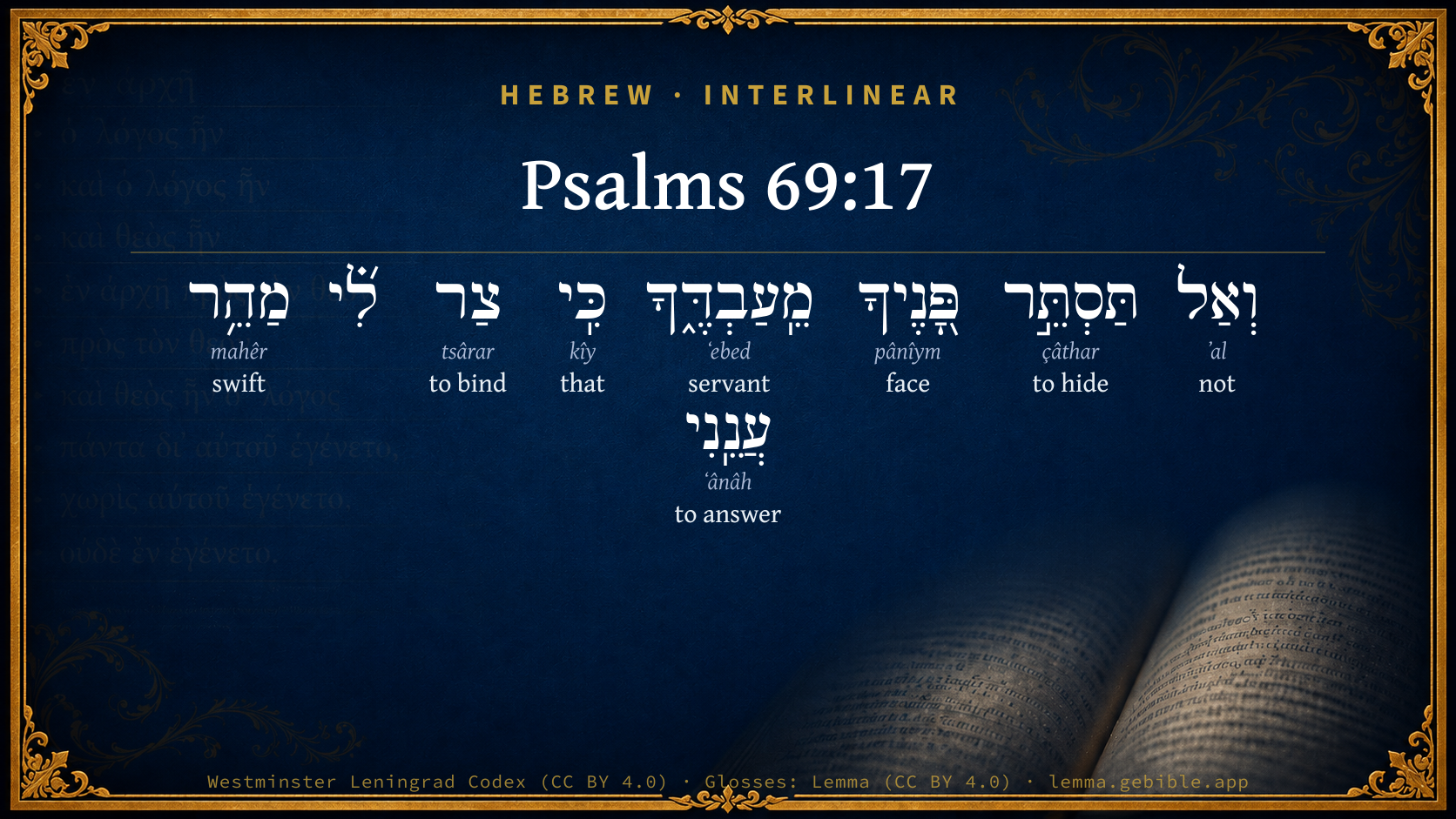
Hebrew (Westminster Leningrad Codex) Psalms 69:17 appears in the Hebrew Old Testament. The text above is from the Westminster Leningrad Codex. Each word links to its Strong’s number, a concise gloss, and parsing drawn from the Open Scriptures Hebrew Bible morphology. Click any word for its full Brown-Driver-Briggs (BDB) entry.
Download image
Cite this verse

Psalms 69:17 (World English Bible). Public Domain. Lemma interlinear Bible study tool, https://lemma.gebible.app/v/psalms/69/17.

Show BibTeX & RIS
BibTeX
RIS
English Translation
Don't hide your face from your servant, For I am in distress. Answer me speedily!
World English Bible · Public Domain
Download a study sheet

One document with this verse’s original text, its word-by-word gloss line, the meaning frame, cross-references with their text, attributed commentary, and full source and license credits — printable, and it pastes into notes with its structure intact.

This verse Autodidact and up

Study sheet (.html) Plain text (.txt)

A passage Seminary Student

Up to 50 verses in one chapter. A passage sheet keeps up to 6 commentary sources and 12 cross-references per verse, in the order this page ranks them, and says so on the sheet whenever that leaves anything out. Ask for a single verse and you get the Autodidact verse sheet above.

Everything on this page stays free to read, with no account — the sheet is a download of what is already on screen, not access to it.

Want to remove ads? Support Godless Engineer
Compare translations 3

The same verse in 3 English versions, stacked beneath the original-language interlinear above. Click any original word for its lexicon entry.

Each is an independent rendering of the whole verse — the interlinear is not word-aligned to these translations.

Highlighted words mark where these versions differ — a whole-verse word diff, not a word-by-word alignment.

  • World English Bible Public Domain
    Don't hide your face from your servant, For I am in distress. Answer me speedily!
  • King James Version Public Domain
    And hide not thy face from thy servant; for I am in trouble: hear me speedily.
  • unfoldingWord Literal Text CC BY-SA 4.0
    And may you not hide your face from your servant, for trouble to me; hurry, answer me.

unfoldingWord Literal Text — © unfoldingWord, licensed CC BY-SA 4.0. Word-aligned USFM3 via Door43 (git.door43.org/unfoldingWord/en_ult).

Versions to compare (up to 4)

3 of 4 selected

Show all 18 translations

Every available English version of this verse, each an independent rendering of the whole verse.

  • World English Bible Public Domain
    Don't hide your face from your servant, For I am in distress. Answer me speedily!
  • Berean Standard Bible Public Domain
    Hide not Your face from Your servant, for I am in distress. Answer me quickly!
  • Majority Standard Bible Public Domain
    Hide not Your face from Your servant, for I am in distress. Answer me quickly!
  • King James Version Public Domain
    And hide not thy face from thy servant; for I am in trouble: hear me speedily.
  • American Standard Version (1901) Public Domain
    And hide not thy face from thy servant; For I am in distress; answer me speedily.
  • Revised Version (1885) Public Domain
    And hide not thy face from thy servant; for I am in distress; answer me speedily.
  • Geneva Bible (1599) Public Domain
    And hide not thy face from thy seruant, for I am in trouble: make haste and heare me.
  • Douay-Rheims (1899) Public Domain
    Hear me, O Lord, for thy mercy is kind; look upon me according to the multitude of thy tender mercies.
  • Young's Literal Translation Public Domain
    And hide not Thy face from Thy servant, For I am in distress -- haste, answer me.
  • Literal Standard Version CC BY-SA 4.0
    And do not hide Your face from Your servant, || For I am in distress—hurry, answer me.
  • Unlocked Literal Bible CC BY-SA 4.0
    Do not hide your face from your servant, for I am in distress; answer me quickly.
  • unfoldingWord Literal Text CC BY-SA 4.0
    And may you not hide your face from your servant, for trouble to me; hurry, answer me.
  • Darby Bible Public Domain
    And hide not thy face from thy servant, for I am in trouble: answer me speedily.
  • World Messianic Bible Public Domain
    Don’t hide your face from your servant, for I am in distress. Answer me speedily!
  • Webster's Bible Public Domain
    \\69:16\\Hear me, O LORD; for thy loving-kindness is good: turn to me according to the multitude of thy tender mercies.
  • Free Bible Version CC BY-SA 4.0
    Don't turn away from me, your servant. Please answer me quickly because I'm in trouble.
  • Bible in Basic English Public Domain
    Let not your face be covered from your servant, for I am in trouble; quickly give me an answer.
  • JPS Tanakh (1917) Public Domain
    (69-18) And hide not Thy face from Thy servant; for I am in distress; answer me speedily.

Literal Standard Version (2020), Covenant Press — licensed CC BY-SA 4.0. Text via the HelloAO Bible API (eBible.org). Unlocked Literal Bible (unfoldingWord) — licensed CC BY-SA 4.0. Text via the HelloAO Bible API (eBible.org). unfoldingWord Literal Text — © unfoldingWord, licensed CC BY-SA 4.0. Word-aligned USFM3 via Door43 (git.door43.org/unfoldingWord/en_ult). Free Bible Version, Dr. Jonathan Gallagher — licensed CC BY-SA 4.0. Text via the HelloAO Bible API (eBible.org).

Word by word

More ways to search: Search by grammar → Find every occurrence → Compare this word →

Practice this passage: Drill this verse → Learn its vocabulary →

מַהֵ֥ר
mahêr
H4118
“swift”
Verb, Piel, Imperative, 2nd Person, Masculine, Singular
Part of Speech
Verb
Stem
Piel
Form
Imperative
Person
2nd Person
Gender
Masculine
Number
Singular
Full BDB Definition

Origin: from H4116

TWOT: 1152a , 1152b

hurrying, speedy, swift, hastening (adjective) - quickly, speedily (adverb)
  1. וְאַל ʼal H408 “and · not” Conjunction + Particle, Negative
  2. תַּסְתֵּ֣ר çâthar H5641 “to hide” Verb, Hiphil, Jussive, 2nd Person, Masculine, Singular
  3. פָּ֭נֶיךָ pânîym H6440 “face(s) · your” Noun, Common, Both, Plural, Construct + Suffix, Personal, 2nd Person, Masculine, Singular
  4. מֵֽעַבְדֶּ֑ךָ ʻebed H5650 “from · servant · your” Preposition + Noun, Common, Masculine, Singular, Construct + Suffix, Personal, 2nd Person, Masculine, Singular
  5. כִּֽי kîy H3588 “that” Conjunction
  6. צַר tsârar H6887 “to bind” Verb, Qal, Perfect, 3rd Person, Masculine, Singular
  7. עֲנֵֽנִי ʻânâh H6030 “answer · me” Verb, Qal, Imperative, 2nd Person, Masculine, Singular + Suffix, Personal, 1st Person, Common, Singular

About this verse

These counts appear in no published source. They are computed here, from the morphology-tagged text and Lemma’s own curated glosses. What Lemma adds →

9
words
8
distinct lemmas
Wisdom
section

Notable vocabulary

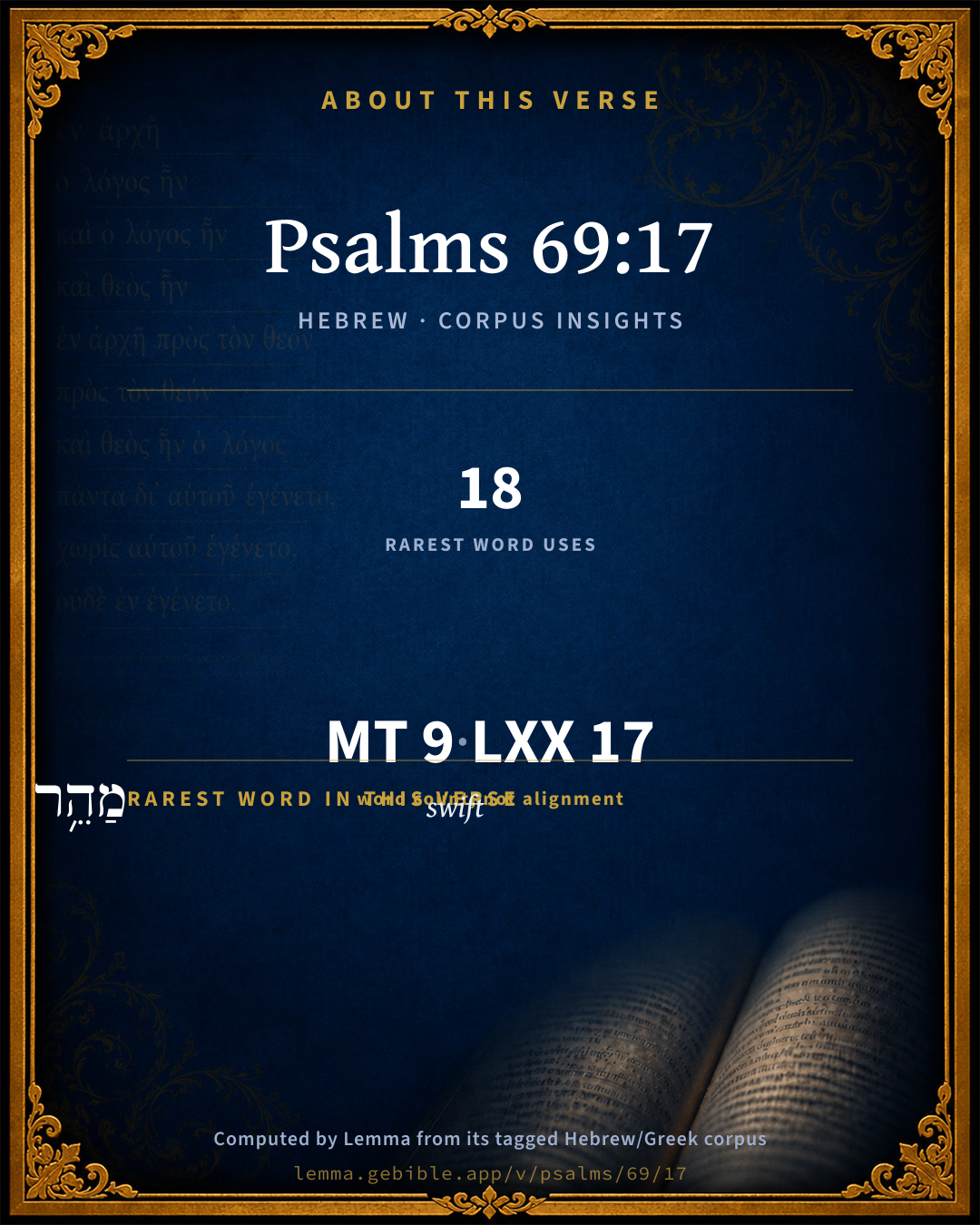
The rarest word here is מַהֵ֥ר swift H4118 — appearing just 18 times in the whole Hebrew Bible.

Shared distinctive vocabulary

מַהֵ֥ר swift H4118 occurs in 17 verses of the Hebrew Bible. Also found in:

Grammatical profile

  • 4 verbs
  • 2 nouns
  • 1 preposition
  • 1 conjunction
  • 1 particle

Verb forms

  • תַּסְתֵּ֣ר Hiphil · Jussive
  • צַר Qal · Perfect
  • מַהֵ֥ר Piel · Imperative
  • עֲנֵֽנִי Qal · Imperative

Hebrew & Septuagint length

In English translation the verse runs 15 words from the Hebrew and 16 from the Septuagint (LXX English) — closely comparable.

A rough comparison of the two English renderings, which tokenize alike — not a word-level alignment.

Word counts can differ between the Hebrew and the Greek without any difference in meaning — e.g. the Hebrew direct-object marker אֵת has no separate Greek word, and Greek often adds the article ὁ.

In the original languages it is 9 Hebrew tokens and 17 Greek tokens — but the two are counted differently (Hebrew bundles its prefixes and suffixes into one token; the Greek is in lemma form), so that isn’t a like-for-like length.

Cross-references

13

Topical passages linked to Psalms 69:17 in the Treasury of Scripture Knowledge — connected by theme and wording, ordered by reader-vote popularity; previews shown in the World English Bible.

  • Psalms 27:9 Don't hide your face from me. Don't put your servant away in anger. You have been my help. Don't abandon me, Neither forsake me, God of my salvation.
  • Psalms 102:2 Don't hide your face from me in the day of my distress. Turn your ear to me. Answer me quickly in the day when I call.
  • Matthew 27:46 About the ninth hour Jesus cried with a loud voice, saying, "Eli, Eli, lima sabachthani?" That is, "My God, my God, why have you forsaken me?"
  • Psalms 70:1 Hurry, God, to deliver me. Come quickly to help me, Yahweh.
  • Psalms 143:9 Deliver me, Yahweh, from my enemies. I flee to you to hide me.
  • Psalms 13:1 How long, Yahweh? Will you forget me forever? How long will you hide your face from me?
  • Psalms 44:24 Why do you hide your face, And forget our affliction and our oppression?
  • Psalms 66:14 which my lips promised, And my mouth spoke, when I was in distress.
  • Psalms 22:24 For he has not despised nor abhorred the affliction of the afflicted, Neither has he hidden his face from him; But when he cried to him, he heard.
  • Psalms 40:13 Be pleased, Yahweh, to deliver me. Hurry to help me, Yahweh.
  • Psalms 143:7 Hurry to answer me, Yahweh. My spirit fails. Don't hide your face from me, So that I don't become like those who go down into the pit.
  • Matthew 26:38 Then he said to them, "My soul is exceedingly sorrowful, even to death. Stay here, and watch with me."
  • Job 7:21 Why do you not pardon my disobedience, and take away my iniquity? For now shall I lie down in the dust. You will seek me diligently, but I shall not be."

Cross-references courtesy of OpenBible.info (CC BY 4.0).

Hebrew and Greek witnesses Masoretic Hebrew ↔ Greek Septuagint

The same verse in the two great witnesses to the Old Testament, shown verse-for-verse.

You’re reading Greek Psalm 68 (Hebrew Psalm 69). The Septuagint counts the superscription, so verse numbers can differ from the Hebrew — chapter-level alignment, not verse-by-verse. Numbering follows Rahlfs.

These are two independent witnesses, not word-aligned to each other, and the Septuagint is shown in lemma (dictionary) form.

Hebrew Psalms 69:17 Masoretic · Westminster Leningrad Codex

וְאַל תַּסְתֵּ֣ר פָּ֭נֶיךָ מֵֽעַבְדֶּ֑ךָ כִּֽי צַר לִ֝֗י מַהֵ֥ר עֲנֵֽנִי

Don't hide your face from your servant, For I am in distress. Answer me speedily!

World English Bible · Public Domain

Greek LXX Greek Psalm 68:17 Septuagint · lemma form

εἰςἀκούω ἐγώ κύριος ὅτι χρηστός ὁ ἔλεος σύ κατά ὁ πλῆθος ὁ οἰκτιρμός σύ ἐπιβλέπω ἐπί ἐγώ

And turn not away your face from your servant; for I am afflicted: hear me speedily.

LXX2012 (modern English Septuagint) · Public Domain

Hebrew: Westminster Leningrad Codex (CC BY 4.0). Greek: Septuagint (public domain); English from LXX2012 (modern English Septuagint) (Public Domain). How the Septuagint differs from the Hebrew →

Commentary

Notes on Psalms 69:17 from classic Christian and Jewish commentators (each source and its license shown beneath its notes). The classic Christian expositions comment on the surrounding passage and are grouped to its opening verse, so a note may address several verses; the Jewish commentaries on the Tanakh (Rashi and others) are per-verse, so they appear only where the commentator wrote on this verse.

Lemma curates 59 commentaries, every one of them public domain or Creative Commons licensed, each selected and text-cleaned for this edition rather than reprinted as found. About our sources →

Trapp's Complete Commentary

John Trapp

Psa 69:17 And hide not thy face from thy servant; for I am in trouble: hear me speedily.

Ver. 17. And hide not thy face from thy servant] Who am devoted to thy fear, and do, therefore, implore and expect thy favour.

For I am in trouble] And so a fit object of thy pity.

John Trapp, A Commentary or Exposition upon All the Books of the Old and New Testament (1647–1656) — public domain. Text from a community e-Sword module.

J. A. Alexander on Psalms

Joseph Addison Alexander

18. (Psa 69:17.) And hide not thy face from thy servant, for (there is) distress to me, I am distressed, make haste, answer me, i.e. grant me what I ask without delay,

Joseph Addison Alexander, The Psalms Translated and Explained (1850) — public domain. Text from a community e-Sword module.

Geneva Bible (1599)

Geneva Bible translators

Not that he feared that God would not hear him, but that care made him to think that God deferred long.

Geneva Bible (1599) marginal notes — public domain. Text via Bolls.life.

The Cambridge Bible for Schools and Colleges

gen. ed. J. J. S. Perowne

17. The Psalmist pleads his calling: surely God cannot continue to withhold His favour and help from one who is bound to His service and devoted to His cause. The plea would have special force if the Psalmist was a prophet like Jeremiah (Amo_3:7). Cp. Psa_27:9; Psa_31:16; Psa_44:24; &c.

for I am in trouble &c.] Because I am in a strait, answer me speedily.

The Cambridge Bible for Schools and Colleges (gen. ed. J. J. S. Perowne; Cambridge University Press, 1878–1918) — public domain. Text from a community e-Sword module.

John Gill's Exposition

And hide not thy face from thy servant,.... This is a character that is frequently given to Christ as Mediator; he is a servant of God's choosing, calling, and appointing; of his sending, bringing forth, and supporting; who is an obedient, diligent, righteous, and prudent one; who always reverenced and honoured him whose servant he was, Isa 42:1; now, when he was on the cross, suffering in the room and stead of his people, his Father hid his face from him; which he here deprecates, and desires he would not continue to do, seeing he was his servant, now doing his service, and about to finish it, even the great work of man's redemption; and for a reason following;

for I am in trouble; in straits and difficulties; pressed on every side, enclosed with the assembly of the wicked, who were mocking of him, and with the whole posse of devils, who were throwing their fiery darts at him; having the sins of his people and the curses of a righteous law on him, and the wrath of God in him; and what increased his trouble was, he was forsaken by him;

hear me speedily; or "make haste to hear" (e); and answer me; his case required haste; see Psa 22:19.

(e) "festina exaudire me", Vatablus.

John Gill's Exposition of the Whole Bible (1746–1763) — public domain (CC PDM 1.0). Text via the HelloAO Bible API.

Albert Barnes' Notes on the Bible

And hide not thy face from thy servant - See the notes at Psa 27:9.

For I am in trouble - In the midst of dangers and sorrows. Literally, “there is trouble upon me.”

Hear me speedily - Margin, as in Hebrew, “Make haste to hear me.” That is, Grant me without delay what I ask. The case is one of urgent necessity. I “must” have relief or I shall perish. It is not wrong to ask God to interpose at once in our behalf when we are in trouble, though it is our duty to be patient and resigned if his interposition is delayed, for he may have important ends to accomplish by our continuing to suffer. In our distress on account of sin also, it is right to plead with him to interpose “at once,” and to relieve us by forgiveness. In this respect we are not to be contented with delay; we are to cast ourselves upon his mercy, and to plead for immediate pardon, for as it is our only safety, so it is for the honor of God that we should be forgiven, and that we should not continue in a state of guilt. An afflicted child of God will be safe in the final issue, whether he is relieved at once, or whether he is suddenly cut off by death, or whether he continues to suffer for even many years; but an unpardoned sinner is “not” safe for a moment, and if he should be cut off, unforgiven, even when under the deepest conviction for sin, he would perish. Every consideration, therefore, makes it proper that he should plead for forgiveness at once, and ask that God would not “delay” to show him mercy.

Albert Barnes' Notes on the Bible (1834–1885) — public domain. Text from a community e-Sword/MySword module.

The Treasury of David

Charles H. Spurgeon

Ver. 17. And hide not thy face from thy servant. A good servant desires the light of his master's countenance; that servus servorum, who was also rex regium, could not bear to lose the presence of his God. The more he loved his Father, the more severely he felt the hiding of his face.

For I am in trouble. Stay thy rough wind in the day of thine east wind; do not add sorrow upon sorrow. If ever a man needs the comforting presence of God it is when he is in distress; and, being in distress, it is a reason to be pleaded with a merciful God why he should not desert us. We may pray that our flight be not in the winter, and that God will not add spiritual desertion to all our other tribulations.

Hear me speedily. The case was urgent, delay was dangerous, nay deadly. Our Lord was the perfection of patience, yet he cried urgently for speedy mercy; and therein he gives us liberty to do the same, so long as we add, "nevertheless, not as I will, but as thou wilt."

Ver. 17. Hide not thy face from thy servant; for I am in trouble. An upright servant, albeit he be troubled for God's cause, and do miss comfort from God; yet will he not change his Master, nor despair of his favour. David Dickson.

Ver. 17. Hide not thy face. The proper sense of the word rtm, gives the meaning to the phrase, veil not thy face from thy servant. In this there is a reference to a king, who, to prevent promiscuous approach to his chamber, spreads a veil before it, and admits to his presence only his minister of high confidence. So in Ps 31:21. The face of God is his majesty, and his gracious and favourable presence; the servant of God is his minister enjoying intimate access, and to veil the face from him is to prevent him coming into the presence of God; and, therefore, it belongs to the servant of God to be treated in a widely different manner. Hermann Venema.

Ver. 17. Thy servant. Hide not, he says, from thy servant; as if he should say, such as I am, I am thy servant. It belongs to the Master to take care of his servant, if in peril for his sake. In this same verse he says he is in a strait. In Ps 69:18 he declares that he is in jeopardy of his life. Musculus.

Ver. 17.

I. Prayer: Hide not thy face.

II. Person: Thy servant.

III. Plea: For I am in trouble.

IV. Pressure: Hear me speedily.

Psalms 69:18*

Charles H. Spurgeon's The Treasury of David (1869–1885) — public domain. Psalms only. Text from a community e-Sword/MySword module.

The Pulpit Commentary

And hide not thy face from thy servant. (comp. Psa_10:1 Psa_13:1 Psa_22:24 Psa_27:9, etc.) For I am in trouble; literally, for there is trouble to me. On the probable nature of the "trouble," see the introductory paragraph. Hear me speedily. (comp. Psa_22:19 Psa_31:2 Psa_38:22 Psa_70:1, etc.)

The Pulpit Commentary (1880–1919), ed. H.D.M. Spence-Jones & Joseph S. Exell — public domain. Text from a community e-Sword module.

Lesson kit

Teaching starters — assembled from the data on this page, not authored interpretation. Every prompt links to the verse data it draws on. Edit before teaching.

Psalms, in the Wisdom, opens this verse with 9 words (8 distinct Hebrew lemmas). Its most distinctive word is mahêr (“swift”). A historical commentator’s framing appears above. Read the whole chapter for the surrounding context.

Discussion questions

  1. How does “swift” (mahêr) shape what this verse is saying?
  2. How does Exodus 32:8, which shares the word «swift», read alongside this verse?
  3. The translations on this page render this verse differently — a whole-verse word diff, not a word-by-word alignment. What might account for the different wordings?
  4. «תַּסְתֵּ֣ר» is a Hiphil Jussive verb. How does that grammatical form shape the action described?
  5. Compare how Trapp's Complete Commentary and J. A. Alexander on Psalms read this verse. Where do they agree or differ?

Things to notice

Reading settings

Reading text

Shown beneath each verse's original-language words.

Old Testament
Old Testament edition

Read the OT as the Masoretic Hebrew (MT) or the Greek Septuagint (LXX).

English shown for the Greek Septuagint (in the Hebrew ↔ Greek comparison).

Comparing translations? Open the Compare panel on any verse page to stack up to four side by side.