Psalms 71:15

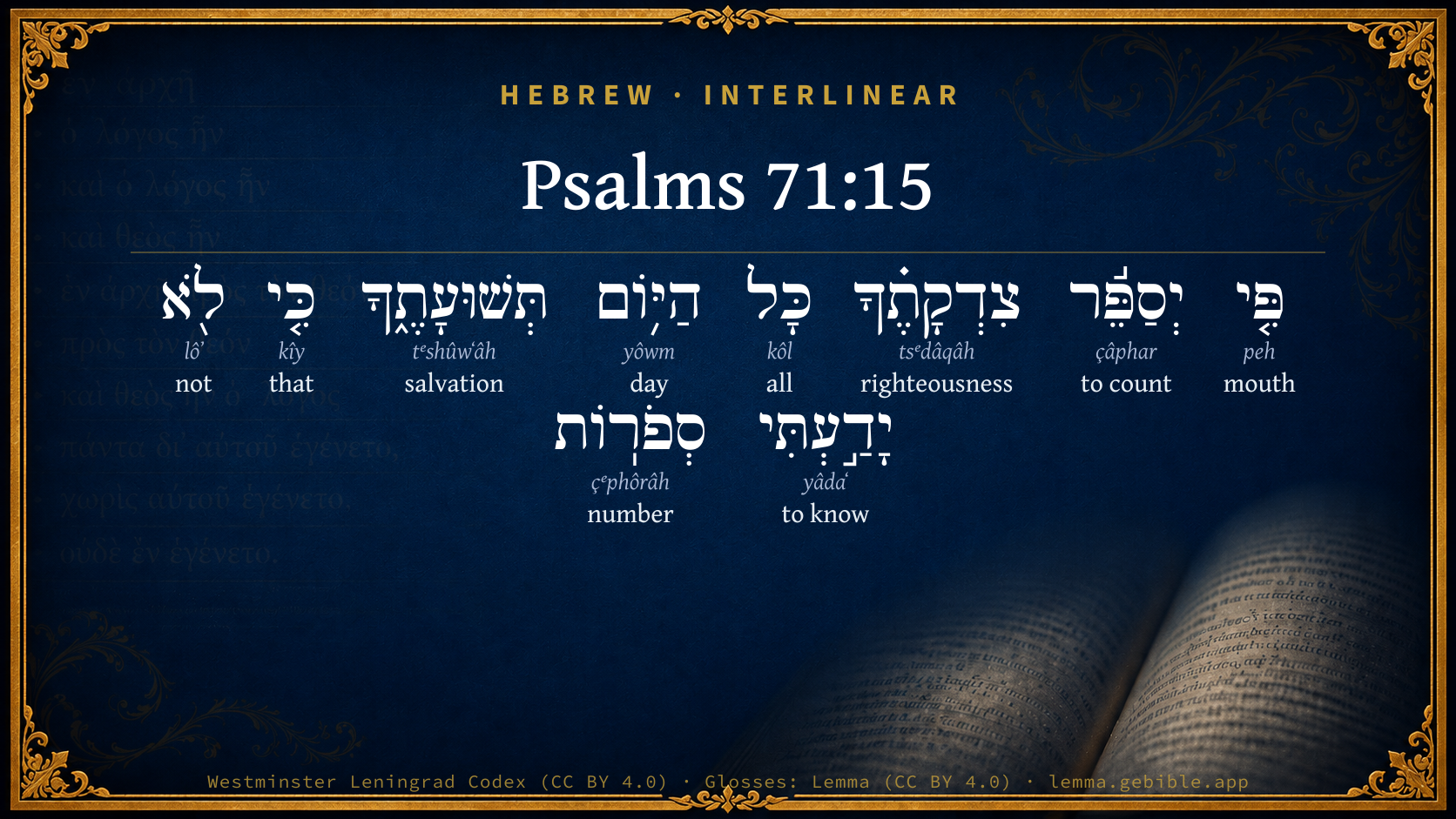
Hebrew (Westminster Leningrad Codex) Psalms 71:15 appears in the Hebrew Old Testament. The text above is from the Westminster Leningrad Codex. Each word links to its Strong’s number, a concise gloss, and parsing drawn from the Open Scriptures Hebrew Bible morphology. Click any word for its full Brown-Driver-Briggs (BDB) entry.
Download image
Cite this verse

Psalms 71:15 (World English Bible). Public Domain. Lemma interlinear Bible study tool, https://lemma.gebible.app/v/psalms/71/15.

Show BibTeX & RIS
BibTeX
RIS
English Translation
My mouth will tell about your righteousness, And of your salvation all day, Though I don't know its full measure.
World English Bible · Public Domain
Highlights
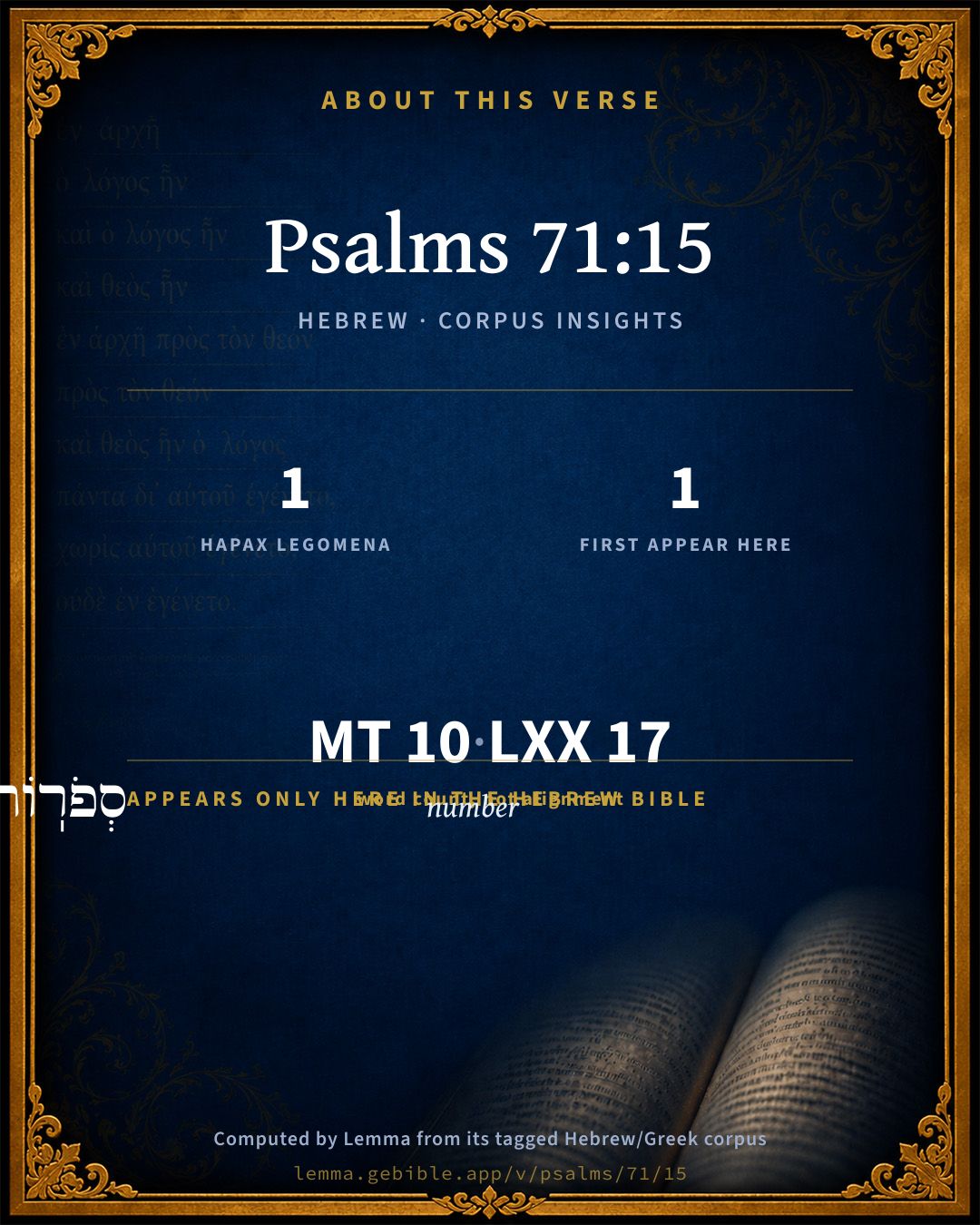
  • 1 hapax legomenon — only here in the Hebrew Bible
  • 1 first appearance in the Hebrew Bible
Full analysis ↓
Download a study sheet

One document with this verse’s original text, its word-by-word gloss line, the meaning frame, cross-references with their text, attributed commentary, and full source and license credits — printable, and it pastes into notes with its structure intact.

This verse Autodidact and up

Study sheet (.html) Plain text (.txt)

A passage Seminary Student

Up to 50 verses in one chapter. A passage sheet keeps up to 6 commentary sources and 12 cross-references per verse, in the order this page ranks them, and says so on the sheet whenever that leaves anything out. Ask for a single verse and you get the Autodidact verse sheet above.

Everything on this page stays free to read, with no account — the sheet is a download of what is already on screen, not access to it.

Want to remove ads? Support Godless Engineer
Compare translations 3

The same verse in 3 English versions, stacked beneath the original-language interlinear above. Click any original word for its lexicon entry.

Each is an independent rendering of the whole verse — the interlinear is not word-aligned to these translations.

Highlighted words mark where these versions differ — a whole-verse word diff, not a word-by-word alignment.

  • World English Bible Public Domain
    My mouth will tell about your righteousness, And of your salvation all day, Though I don't know its full measure.
  • King James Version Public Domain
    My mouth shall shew forth thy righteousness and thy salvation all the day; for I know not the numbers thereof.
  • unfoldingWord Literal Text CC BY-SA 4.0
    My mouth will recount your righteousness, all of the day, your salvation, for I do not know the numbers.

unfoldingWord Literal Text — © unfoldingWord, licensed CC BY-SA 4.0. Word-aligned USFM3 via Door43 (git.door43.org/unfoldingWord/en_ult).

Versions to compare (up to 4)

3 of 4 selected

Show all 18 translations

Every available English version of this verse, each an independent rendering of the whole verse.

  • World English Bible Public Domain
    My mouth will tell about your righteousness, And of your salvation all day, Though I don't know its full measure.
  • Berean Standard Bible Public Domain
    My mouth will declare Your righteousness and Your salvation all day long, though I cannot know their full measure.
  • Majority Standard Bible Public Domain
    My mouth will declare Your righteousness and Your salvation all day long, though I cannot know their full measure.
  • King James Version Public Domain
    My mouth shall shew forth thy righteousness and thy salvation all the day; for I know not the numbers thereof.
  • American Standard Version (1901) Public Domain
    My mouth shall tell of thy righteousness, `And' of thy salvation all the day; For I know not the numbers `thereof'.
  • Revised Version (1885) Public Domain
    My mouth shall tell of thy righteousness, and of thy salvation all the day; for I know not the numbers thereof.
  • Geneva Bible (1599) Public Domain
    My mouth shall daily rehearse thy righteousnesse, and thy saluation: for I knowe not the nomber.
  • Douay-Rheims (1899) Public Domain
    My mouth shall shew forth thy justice; thy salvation all the day long. Because I have not knows learning,
  • Young's Literal Translation Public Domain
    My mouth recounteth Thy righteousness, All the day Thy salvation, For I have not known the numbers.
  • Literal Standard Version CC BY-SA 4.0
    My mouth recounts Your righteousness, || All the day Your salvation, || For I have not known the numbers.
  • Unlocked Literal Bible CC BY-SA 4.0
    My mouth will tell about your righteousness and your salvation all the day, although I cannot understand it.
  • unfoldingWord Literal Text CC BY-SA 4.0
    My mouth will recount your righteousness, all of the day, your salvation, for I do not know the numbers.
  • Darby Bible Public Domain
    My mouth shall declare thy righteousness, [and] thy salvation all the day: for I know not the numbers [thereof].
  • World Messianic Bible Public Domain
    My mouth will tell about your righteousness, and of your salvation all day, though I don’t know its full measure.
  • Webster's Bible Public Domain
    My mouth shall show forth thy righteousness and thy salvation all the day; for I know not the numbers thereof.
  • Free Bible Version CC BY-SA 4.0
    I will talk about your goodness and your salvation every day, even though it's more than I can understand.
  • Bible in Basic English Public Domain
    My mouth will make clear your righteousness and your salvation all the day; for they are more than may be measured.
  • JPS Tanakh (1917) Public Domain
    My mouth shall tell of Thy righteousness, and of Thy salvation all the day; for I know not the numbers thereof.

Literal Standard Version (2020), Covenant Press — licensed CC BY-SA 4.0. Text via the HelloAO Bible API (eBible.org). Unlocked Literal Bible (unfoldingWord) — licensed CC BY-SA 4.0. Text via the HelloAO Bible API (eBible.org). unfoldingWord Literal Text — © unfoldingWord, licensed CC BY-SA 4.0. Word-aligned USFM3 via Door43 (git.door43.org/unfoldingWord/en_ult). Free Bible Version, Dr. Jonathan Gallagher — licensed CC BY-SA 4.0. Text via the HelloAO Bible API (eBible.org).

Word by word

More ways to search: Search by grammar → Find every occurrence → Compare this word →

Practice this passage: Drill this verse → Learn its vocabulary →

About this verse

These counts appear in no published source. They are computed here, from the morphology-tagged text and Lemma’s own curated glosses. What Lemma adds →

10
words
10
distinct lemmas
Wisdom
section

Notable vocabulary

1 hapax legomenon — a word that appears only here in the entire Hebrew Bible:

  • סְפֹרֽוֹת number H5615

First appearance in Scripture

This word makes its first canonical appearance in the Hebrew Bible here:

  • סְפֹרֽוֹת number H5615

Shared distinctive vocabulary

תְּשׁוּעָתֶ֑ךָ salvation H8668 occurs in 32 verses of the Hebrew Bible. Also found in:

Grammatical profile

  • 2 verbs
  • 6 nouns
  • 1 conjunction
  • 1 particle

Verb forms

  • יְסַפֵּ֬ר Piel · Imperfect
  • יָדַ֣עְתִּי Qal · Perfect

Hebrew & Septuagint length

In English translation the verse runs 20 words from the Hebrew and 23 from the Septuagint (LXX English) — closely comparable.

A rough comparison of the two English renderings, which tokenize alike — not a word-level alignment.

Word counts can differ between the Hebrew and the Greek without any difference in meaning — e.g. the Hebrew direct-object marker אֵת has no separate Greek word, and Greek often adds the article ὁ.

In the original languages it is 10 Hebrew tokens and 17 Greek tokens — but the two are counted differently (Hebrew bundles its prefixes and suffixes into one token; the Greek is in lemma form), so that isn’t a like-for-like length.

Cross-references

12

Topical passages linked to Psalms 71:15 in the Treasury of Scripture Knowledge — connected by theme and wording, ordered by reader-vote popularity; previews shown in the World English Bible.

  • Psalms 40:5 Many, Yahweh, my God, are the wonderful works which you have done, And your thoughts which are toward us. They can't be set in order to you; If I would declare and speak of them, they are more than can be numbered.
  • Psalms 35:28 My tongue shall talk about your righteousness and about your praise all day long.
  • Psalms 71:8 My mouth shall be filled with your praise, With your honor all the day.
  • Psalms 139:17–18 How precious to me are your thoughts, God! How vast is the sum of them!
  • Psalms 145:2 Every day I will praise you. I will extol your name forever and ever.
  • Psalms 145:5–14 Of the glorious majesty of your honor, Of your wondrous works, I will meditate.
  • Psalms 40:9–10 I have proclaimed glad news of righteousness in the great assembly. Behold, I will not seal my lips, Yahweh, you know.
  • Psalms 71:24 My tongue will also talk about your righteousness all day long, For they are disappointed, and they are confounded, who want to harm me.
  • Psalms 89:16 In your name they rejoice all day. In your righteousness, they are exalted.
  • Psalms 22:22–25 I will declare your name to my brothers. In the midst of the assembly, I will praise you.
  • Psalms 30:12 To the end that my heart may sing praise to you, and not be silent. Yahweh my God, I will give thanks to you forever!
  • Psalms 40:12 For innumerable evils have surrounded me. My iniquities have overtaken me, so that I am not able to look up. They are more than the hairs of my head. My heart has failed me.

Cross-references courtesy of OpenBible.info (CC BY 4.0).

Hebrew and Greek witnesses Masoretic Hebrew ↔ Greek Septuagint

The same verse in the two great witnesses to the Old Testament, shown verse-for-verse.

You’re reading Greek Psalm 70 (Hebrew Psalm 71). The Septuagint counts the superscription, so verse numbers can differ from the Hebrew — chapter-level alignment, not verse-by-verse. Numbering follows Rahlfs.

These are two independent witnesses, not word-aligned to each other, and the Septuagint is shown in lemma (dictionary) form.

Hebrew Psalms 71:15 Masoretic · Westminster Leningrad Codex

פִּ֤י יְסַפֵּ֬ר צִדְקָתֶ֗ךָ כָּל הַיּ֥וֹם תְּשׁוּעָתֶ֑ךָ כִּ֤י לֹ֖א יָדַ֣עְתִּי סְפֹרֽוֹת

My mouth will tell about your righteousness, And of your salvation all day, Though I don't know its full measure.

World English Bible · Public Domain

Greek LXX Greek Psalm 70:15 Septuagint · lemma form

ὁ στόμα ἐγώ ἐκἀγγέλλω ὁ δικαιοσύνη σύ ὅλος ὁ ἡμέρα ὁ σωτηρία σύ ὅτι οὐ γιγνώσκω γραμματεία

My mouth shall declare your righteousness openly, and your salvation all the day; for I am not acquainted with the affairs of men.

LXX2012 (modern English Septuagint) · Public Domain

Hebrew: Westminster Leningrad Codex (CC BY 4.0). Greek: Septuagint (public domain); English from LXX2012 (modern English Septuagint) (Public Domain). How the Septuagint differs from the Hebrew →

Commentary

Notes on Psalms 71:15 from classic Christian and Jewish commentators (each source and its license shown beneath its notes). The classic Christian expositions comment on the surrounding passage and are grouped to its opening verse, so a note may address several verses; the Jewish commentaries on the Tanakh (Rashi and others) are per-verse, so they appear only where the commentator wrote on this verse.

Lemma curates 59 commentaries, every one of them public domain or Creative Commons licensed, each selected and text-cleaned for this edition rather than reprinted as found. About our sources →

Trapp's Complete Commentary

John Trapp

Psa 71:15 My mouth shall shew forth thy righteousness [and] thy salvation all the day; for I know not the numbers [thereof].

Ver. 15. My mouth shall show forth thy righteousness and thy salvation] Lo, here, a sweet and comfortable conjunction of God’s righteousness and our salvation. See 2Th 1:6-7.

For I know not the numbers thereof] Or, though I know not, &c., by a modest correction, since they may be celebrated, but not enumerated.

Littora quot conchas, quot amaena rosaria flores,

Quotve soporiferum grana papaver habet:

Sylva feras quot alit, quot piscibus unda natatur,

Et tenerum pennis acra pulsar avis (Ovid.).

So many, and ten thousand times more, are God’s lovingkindnesses. The psalmist elsewhere venteth himself by an exclamation, Psa 31:19. {See Trapp on "Psa 31:19"}

John Trapp, A Commentary or Exposition upon All the Books of the Old and New Testament (1647–1656) — public domain. Text from a community e-Sword module.

The Biblical Illustrator

Joseph S. Exell

Psa_71:15

My mouth shall show forth Thy righteousness and Thy salvation all the day; for I know not the numbers thereof.

An inexhaustible subject

This psalmists words may well be a pattern for old men, who need fear no failure of buoyancy, nor any collapse of gladness, if they will fix their thoughts where this singer did his. Other subjects of thought and speech will pall and run dry; but he whose theme is Gods righteousness and the salvation that flows from it will never lack materials for animating meditation and grateful praise. I know not the numbers thereof. It is something to have fast hold of an inexhaustible subject. It will keep an old man young. (A. Maclaren, D. D.)

Witnessing of Gods grace and salvation

We may wrongly hide our religion so that it evaporates. Too many professing Christians put away their religion as careless housewives might do some precious perfume, Had when they go to take it out, they find nothing but a rotten cork, a faint odour and an empty flask. Take care of burying your religion so deep as dogs do bones, that you cannot find it again, or, if you do, discover when you open the coffin that it holds only a handful of dry dust. (A. Maclaren, D. D.)

The Biblical Illustrator, edited by Joseph S. Exell (c. 1880s–1900s) — public domain. Text from a community e-Sword module.

J. A. Alexander on Psalms

Joseph Addison Alexander

Psa 71:15. My mouth shall recount thy righteousness, all the day (long) thy salvation, for I know not numbers (to express them), I cannot number them, they are innumerable. The righteousnesss or rectitude of God, including his veracity or faithfulness, is here referred to as the cause of his salvation, the salvation of which he is the source and author.

Joseph Addison Alexander, The Psalms Translated and Explained (1850) — public domain. Text from a community e-Sword module.

Geneva Bible (1599)

Geneva Bible translators

Because thy benefits toward me are innumerable, I cannot but continually meditate and rehearse them.

Geneva Bible (1599) marginal notes — public domain. Text via Bolls.life.

Adam Clarke's Commentary

Verse 15. I know not the numbers] I must be continually in the spirit of gratitude, praise, and obedience, for thy blessings to me are innumerable.

Adam Clarke's Commentary on the Bible (1810–1826) — public domain. Text from a community e-Sword/MySword module.

John Calvin's Commentaries

15. My mouth shall recount thy righteousness Here he expresses more clearly what sacrifice of praise he resolved to present to God, promising to proclaim continually his righteousness and salvation. I have often before had occasion to observe, that the righteousness of God does not mean that property of his nature by which he renders to every man his own, but the faithfulness which he observes towards his own people, when he cherishes, defends, and delivers them. Hence the inestimable consolation which arises from learning that our salvation is so inseparably linked with the righteousness of God, as to have the same stability with this Divine attribute. The salvation of God, it is very evident, is taken in this place actively. The Psalmist connects this salvation with righteousness, as the effect with the cause; for his confident persuasion of obtaining salvation proceeded solely from reflecting that God is righteous, and that he cannot deny himself. As he had been saved so often, and in so many different ways, and so wonderfully, he engages to apply himself continually to the celebration of the grace of God. The particle כי, ki, which we have translated for, is by some rendered adversatively although, and explained in this way: Although the salvation of God is to me incomprehensible, and transcends my capacity, yet I will recount it. But the proper signification of the word is more suitable in this place, there being nothing which ought to be more effectual in kindling and exciting our hearts to sing the praises of God, than the innumerable benefits which he has bestowed upon us. Although our hearts may not be affected from having experienced only one or two of the Divine benefits; although they may remain cold and unmoved by a small number of them, yet our ingratitude is inexcusable, if we are not awakened from our torpor and indifference when an innumerable multitude of them are lavished upon us. Let us learn then not to taste of the goodness of God slightly, and, as it were, with loathing, but to apply all our faculties to it in all its amplitude, that it may ravish us with admiration. It is surprising that the authors of the Greek version ever thought of translating this clause, I have not known learning, an error unworthy of being noticed, were it not that some fanatics in former times, to flatter themselves in their ignorance, boasted that, after the example of David, all learning and liberal sciences should be despised; even as, in the present day, the Anabaptists have no other pretext for boasting of being spiritual persons, but that they are grossly ignorant of all science.

John Calvin's Commentaries (1540-1563) — public domain. Text from the Calvin Translation Society English edition (1840s-50s) via the Christian Classics Ethereal Library (ccel.org). Calvin's coverage is partial (roughly two-thirds of the Bible); uncommented books and verses are honest gaps, never fabricated. The 19th-century editor's footnotes and remarks are omitted so the notes are faithfully Calvin's own voice.

Ellicott's Commentary for English Readers

(15) Comp. Psa_40:5, which indicates the meaning here. Mere reminiscence must give place to actual calculation, which too must fail before the sense of Divine interference in his favour.

A Bible Commentary for English Readers, edited by Charles John Ellicott (1878–1897) — public domain. Text from a community e-Sword module.

The Cambridge Bible for Schools and Colleges

gen. ed. J. J. S. Perowne

15. My mouth shall tell of thy righteousness,

And of thy salvation all the day;

For I know not the tale thereof.

Salvation is coupled with righteousness, because the one is the outcome and visible manifestation of the other. Cp. Psa_71:2; Isa_45:21. There is a play in the Heb. on the words tell and tale. They are derived from the same root, which, like tell in old English, means both to count and to recount. God’s mercies are an inexhaustible theme. Cp. Psa_40:5; Psa_139:17-18.

The Cambridge Bible for Schools and Colleges (gen. ed. J. J. S. Perowne; Cambridge University Press, 1878–1918) — public domain. Text from a community e-Sword module.

John Gill's Exposition

My mouth shall show forth thy righteousness,.... Both his punitive justice in taking vengeance on his enemies, agreeably to the above imprecations; and his faithfulness in the performance of promises of good things unto him; as also his essential righteousness displayed and glorified in the redemption that is by Christ; and particularly the righteousness of Christ, accepted of God, and imputed by him; which the psalmist with his mouth declared his faith in, expressed his joy at, and set forth in a strong manner the glory and excellency of it, and determined to make mention of it, and of that only, as in Psa 71:16;

and thy salvation all the day; both temporal and eternal; the glory of both, and praise for the same;

for I know not the numbers thereof; of that righteousness and salvation, the numerous blessings which are contained in them; see Psa 40:5; or "though I know not the numbers of them" (c); though he could not fully declare the glories and excellencies of the righteousness and salvation of God, and the numerous mercies and rich grace included in them; yet he would attempt to set them forth in the best way he could, though in a feeble and imperfect manner.

(c) "quamvis", Junius & Tremellius, Piscator, Gejerus; So Ainsworth.

John Gill's Exposition of the Whole Bible (1746–1763) — public domain (CC PDM 1.0). Text via the HelloAO Bible API.

Albert Barnes' Notes on the Bible

My mouth shall show forth thy righteousness ... - See the notes at Psa 71:8. The word “righteousness” here refers to the righteous character of God, particularly as manifested in his behalf; the word “salvation” refers to what God had done to deliver him from his dangers.

For I know not the numbers thereof - That is, I cannot estimate the amount of thy favors; they are innumerable. See the notes at Psa 40:5.

Albert Barnes' Notes on the Bible (1834–1885) — public domain. Text from a community e-Sword/MySword module.

Matthew Poole's English Annotations

i.e. Of thy salvations and mercies vouchsafed to me, which being innumerable, oblige me the more to celebrate thy praises.

Matthew Poole's English Annotations on the Holy Bible (1683–1685) — public domain. Text from a community e-Sword/MySword module.

The Treasury of David

Charles H. Spurgeon

Ver. 15. My mouth shall shew forth thy righteousness and thy salvation all the day. We are to bear testimony as experience enables us, and not withhold from others that which we have tasted and handled. The faithfulness of God in saving us, in delivering us out of the hand of our enemies, and in fulfilling his promises, is to be everywhere proclaimed by those who have proved it in their own history. How gloriously conspicuous is righteousness in the divine plan of redemption! It should be the theme of constant discourse. The devil rages against the substitutionary sacrifice, and errorists of every form make this the main point of their attack; be it ours, therefore, to love the doctrine, and to spread its glad tidings on every side, and at all times. Mouths are never so usefully employed as in recounting the righteousness of God revealed in the salvation of believers in Jesus. The preacher who should be confined to this one theme would never need seek another: it is the medulla theologae, the very pith and marrow of revealed truth. Has our reader been silent upon this choice subject? Let us, then, press him to tell abroad what he enjoys within: he does not well who keeps such glad tidings to himself.

For I know not the numbers thereof. He knew the sweetness of it, the sureness, the glory, and the truth of it; but as to the full reckoning of its plenitude, variety, and sufficiency, he felt he could not reach to the height of the great argument. Lord, where I cannot count I will believe, and when a truth surpasses numeration I will take to admiration. When David spoke of his enemies, he said they were more in number than the hairs of his head; he had, therefore, some idea of their number, and found a figure suitable to set it out; but, in the case of the Lord's covenant mercies, he declares, "I know not the number, "and does not venture upon any sort of comparison. To creatures belong number and limit, to God and his grace there is neither. We may, therefore, continue to tell out his great salvation all day long, for the theme is utterly inexhaustible.

Ver. 15. The righteousness of God, here mentioned, includes not only the rectitude of his nature, and the equity of his proceedings, but likewise that everlasting righteousness which his Son hath brought in for our justification. God's righteousness and salvation are here joined together; and, therefore, let no man think to put them asunder, or expect salvation without righteousness. Mrs. Thomson.

Ver. 15. I know not the numbers. David began his arithmetic, in Ps 71:14, with addition: "I will yet praise thee more and more; "but he is fairly beaten in this first rule of sacred mathematics. His calculation fails him, the mere enumeration of the Lord's mercies overwhelms his mind; he owns his inadequacy. Reckon either by time, by place, or by value, and the salvation of God baffles all powers of estimation. C. H. S.

Ver. 15.

I. The determination avowed.

1. To recount the instances of the divine faithfulness in his deliverances.

2. To recount them publicly: My mouth, etc.

3. Constantly: All the day. II. The reason assigned: For I know not, etc. "Eternity's too short to utter all thy praise." Therefore I begin it now, and will continue it.

Psalms 71:16*

Charles H. Spurgeon's The Treasury of David (1869–1885) — public domain. Psalms only. Text from a community e-Sword/MySword module.

Whedon's Commentary on the Bible

Daniel D. Whedon

15. Thy righteousness and thy salvation—Two words literally translated and everywhere well defined. “God’s salvation stands to his righteousness in the relation of effect to cause. God has pledged himself to save those who put their trust in him, and as a righteous God he cannot deny himself.”—Perowne. Compare Heb_6:10. See note on Psa_71:19.

I know not the numbers—That is, the limits, or measures, (Furst,) of the righteousness and salvation just spoken of. But the Hebrew word, which occurs nowhere else, may be taken in the sense of enumerations, as in English version, and applied to God’s acts of righteousness and salvation; and in this sense corresponds with the declarations of Psa_40:5; Psa_139:17-18. In either sense, however, the doctrine is the same. These numberless and limitless mercies call for endless praises.

Daniel D. Whedon (gen. ed.), Commentary on the Old and New Testaments (1874–1909) — public domain. Text from a community e-Sword module.

The Pulpit Commentary

My mouth shall show forth thy righteousness and thy salvation all the day. Salvation is inseparable from righteousness. It is as being righteous himself that God accepts the righteous, and as faithful to his promises, which is a part of his righteousness, that he pardons penitents. For I know not the numbers thereof. (comp. Psa_40:5) God"s acts of pardoning mercy, by which he brings about the salvation of penitents, are innumerable.

The Pulpit Commentary (1880–1919), ed. H.D.M. Spence-Jones & Joseph S. Exell — public domain. Text from a community e-Sword module.

John Wesley's Explanatory Notes

The numbers - Of thy salvations and mercies vouchsafed to me.

John Wesley, Explanatory Notes Upon the Whole Bible (1754–1765) — public domain. Text via the GEBible commentary corpus.

Rashi

Rabbi Shlomo Yitzchaki (Rashi)

I do not know their number of the righteousness and the salvations that You have done for me.

Rashi on the Tanakh — English translations: “The Judaica Press complete Tanach with Rashi, translated by A. J. Rosenberg” (CC BY 4.0); “Pentateuch with Rashi's commentary by M. Rosenbaum and A.M. Silbermann, 1929-1934” (public domain); “The Metsudah Tanach series, Lakewood, N.J” (CC BY 4.0); and “The Book of Joshua, Metsudah Publications, 1997” (CC BY 4.0). Text via Sefaria.

Lesson kit

Teaching starters — assembled from the data on this page, not authored interpretation. Every prompt links to the verse data it draws on. Edit before teaching.

Psalms, in the Wisdom, opens this verse with 10 words (10 distinct Hebrew lemmas). Its most distinctive word is çᵉphôrâh (“number”). A historical commentator’s framing appears above. Read the whole chapter for the surrounding context.

Discussion questions

  1. What does “number” (çᵉphôrâh) contribute to the verse as a whole?
  2. This verse holds 1 word here found nowhere else in the Hebrew Bible. What might the rare word draw attention to?
  3. The word “number” first appears here in Scripture. What is being introduced at this debut?
  4. Judges 15:18 shares the word «salvation» with this verse. How do the two illuminate each other?
  5. These translations render this verse differently; the difference is in the English rendering, not the original. What questions does that raise?
  6. The verb «יְסַפֵּ֬ר» is Piel Imperfect. How does its form color the action?
  7. Reading how Trapp's Complete Commentary and The Biblical Illustrator read this verse, where do the two commentators agree and where do they part?

Things to notice

Reading settings

Reading text

Shown beneath each verse's original-language words.

Old Testament
Old Testament edition

Read the OT as the Masoretic Hebrew (MT) or the Greek Septuagint (LXX).

English shown for the Greek Septuagint (in the Hebrew ↔ Greek comparison).

Comparing translations? Open the Compare panel on any verse page to stack up to four side by side.