
Psalms 60:2

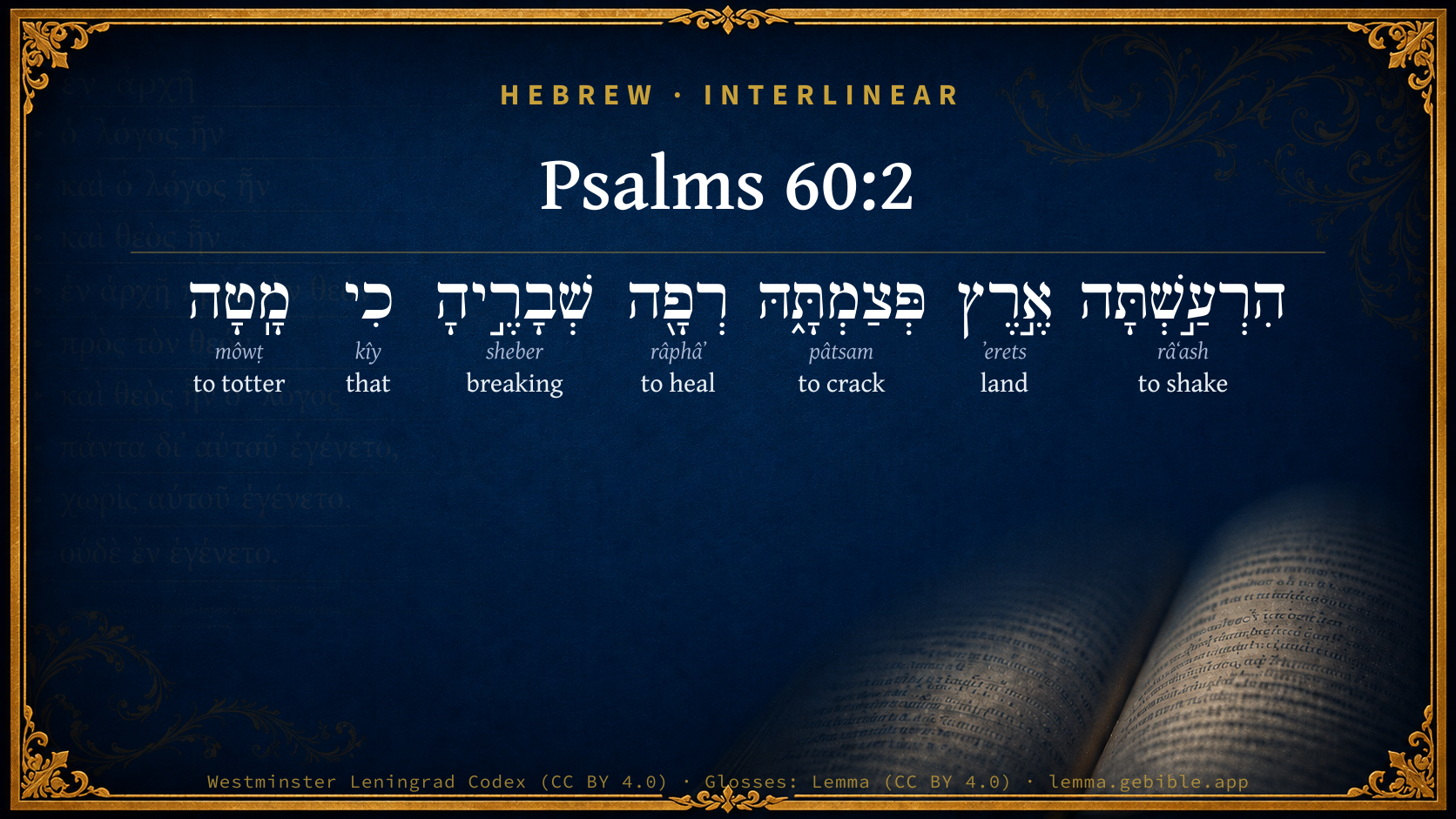
Hebrew (Westminster Leningrad Codex) Psalms 60:2 appears in the Hebrew Old Testament. The text above is from the Westminster Leningrad Codex. Each word links to its Strong’s number, a concise gloss, and parsing drawn from the Open Scriptures Hebrew Bible morphology. Click any word for its full Brown-Driver-Briggs (BDB) entry.
Download image
Cite this verse

Psalms 60:2 (World English Bible). Public Domain. Lemma interlinear Bible study tool, https://lemma.gebible.app/v/psalms/60/2.

Show BibTeX & RIS
BibTeX
RIS
English Translation
You have made the land tremble. You have torn it. Mend its fractures, For it quakes.
World English Bible · Public Domain
Highlights
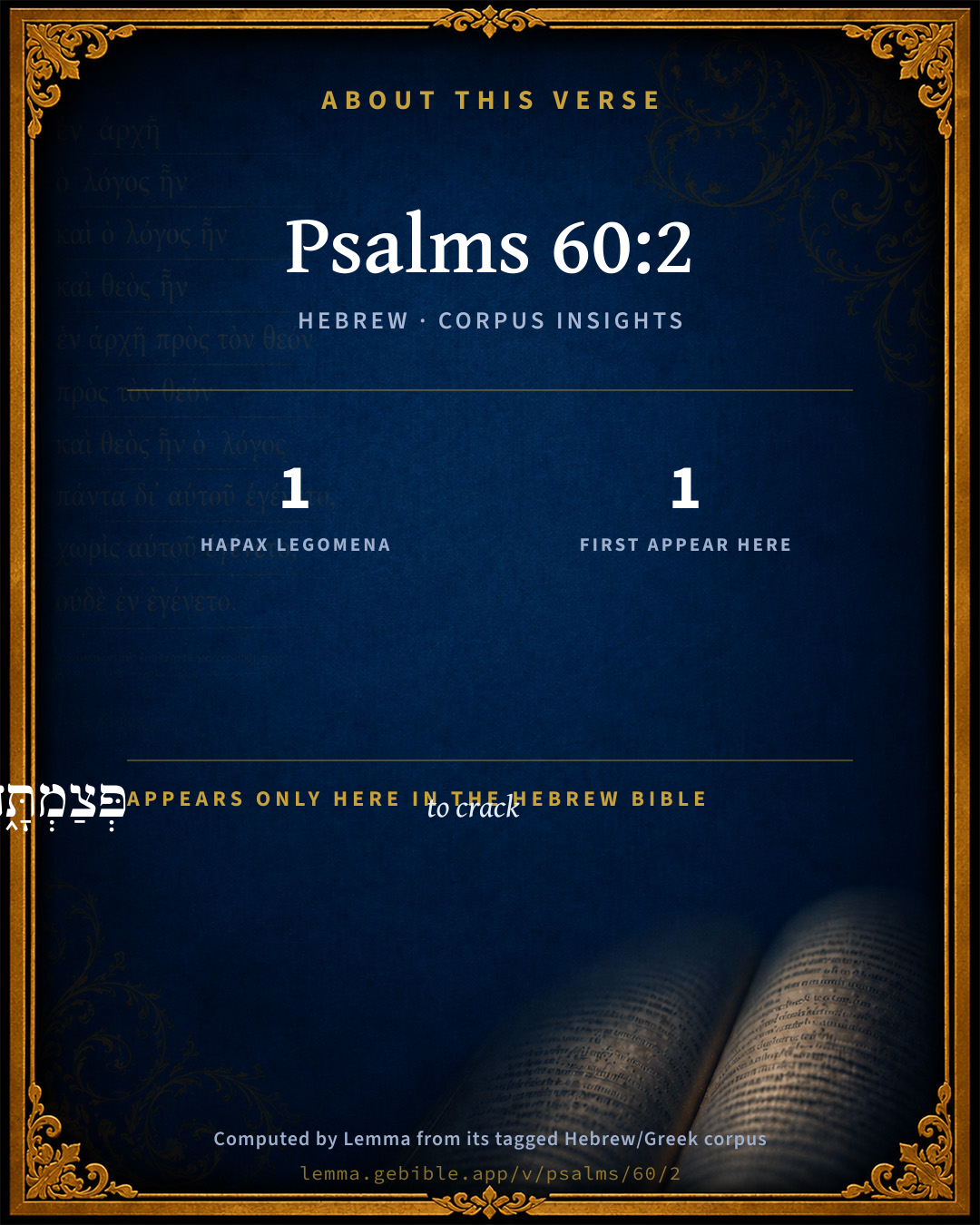
  • 1 hapax legomenon — only here in the Hebrew Bible
  • 1 first appearance in the Hebrew Bible
Full analysis ↓
Download a study sheet

One document with this verse’s original text, its word-by-word gloss line, the meaning frame, cross-references with their text, attributed commentary, and full source and license credits — printable, and it pastes into notes with its structure intact.

This verse Autodidact and up

Study sheet (.html) Plain text (.txt)

A passage Seminary Student

Up to 50 verses in one chapter. A passage sheet keeps up to 6 commentary sources and 12 cross-references per verse, in the order this page ranks them, and says so on the sheet whenever that leaves anything out. Ask for a single verse and you get the Autodidact verse sheet above.

Everything on this page stays free to read, with no account — the sheet is a download of what is already on screen, not access to it.

Want to remove ads? Support Godless Engineer
Compare translations 3

The same verse in 3 English versions, stacked beneath the original-language interlinear above. Click any original word for its lexicon entry.

Each is an independent rendering of the whole verse — the interlinear is not word-aligned to these translations.

Highlighted words mark where these versions differ — a whole-verse word diff, not a word-by-word alignment.

  • World English Bible Public Domain
    You have made the land tremble. You have torn it. Mend its fractures, For it quakes.
  • King James Version Public Domain
    Thou hast made the earth to tremble; thou hast broken it: heal the breaches thereof; for it shaketh.
  • unfoldingWord Literal Text CC BY-SA 4.0
    You have made the earth tremble; you have broken it. Heal its breaches, for it shakes.

unfoldingWord Literal Text — © unfoldingWord, licensed CC BY-SA 4.0. Word-aligned USFM3 via Door43 (git.door43.org/unfoldingWord/en_ult).

Versions to compare (up to 4)

3 of 4 selected

Show all 17 translations

Every available English version of this verse, each an independent rendering of the whole verse.

  • World English Bible Public Domain
    You have made the land tremble. You have torn it. Mend its fractures, For it quakes.
  • Berean Standard Bible Public Domain
    You have shaken the land and torn it open. Heal its fractures, for it is quaking.
  • Majority Standard Bible Public Domain
    You have shaken the land and torn it open. Heal its fractures, for it is quaking.
  • King James Version Public Domain
    Thou hast made the earth to tremble; thou hast broken it: heal the breaches thereof; for it shaketh.
  • American Standard Version (1901) Public Domain
    Thou hast made the land to tremble; thou hast rent it: Heal the breaches thereof; for it shaketh.
  • Revised Version (1885) Public Domain
    Thou hast made the land to tremble; thou hast rent it: heal the breaches thereof; for it shaketh.
  • Geneva Bible (1599) Public Domain
    Thou hast made the land to tremble, and hast made it to gape: heale the breaches thereof, for it is shaken.
  • Douay-Rheims (1899) Public Domain
    when he set fire to Mesopotamia of Syria and Sobal and Joab returned and slew of Edom, in the vale of the saltpits, twelve thousand men.
  • Young's Literal Translation Public Domain
    Thou hast caused the land to tremble, Thou hast broken it, Heal its breaches, for it hath moved.
  • Literal Standard Version CC BY-SA 4.0
    You have caused the land to tremble, || You have broken it, || Heal its breaches, for it has moved.
  • Unlocked Literal Bible CC BY-SA 4.0
    You have made the land tremble; you have torn it apart; heal its fissures, for it is shaking.
  • unfoldingWord Literal Text CC BY-SA 4.0
    You have made the earth tremble; you have broken it. Heal its breaches, for it shakes.
  • Darby Bible Public Domain
    Thou hast made the earth to tremble, thou hast rent it: heal the breaches thereof; for it shaketh.
  • World Messianic Bible Public Domain
    You have made the land tremble. You have torn it. Mend its fractures, for it quakes.
  • Free Bible Version CC BY-SA 4.0
    You have sent earthquakes on our land and split it apart. Now heal the cracks, for the land is still having tremors.
  • Bible in Basic English Public Domain
    By the power of your hand the earth is shaking and broken; make it strong again, for it is moved.
  • JPS Tanakh (1917) Public Domain
    (60-4) Thou hast made the land to shake, Thou hast cleft it; heal the breaches thereof; for it tottereth.

Literal Standard Version (2020), Covenant Press — licensed CC BY-SA 4.0. Text via the HelloAO Bible API (eBible.org). Unlocked Literal Bible (unfoldingWord) — licensed CC BY-SA 4.0. Text via the HelloAO Bible API (eBible.org). unfoldingWord Literal Text — © unfoldingWord, licensed CC BY-SA 4.0. Word-aligned USFM3 via Door43 (git.door43.org/unfoldingWord/en_ult). Free Bible Version, Dr. Jonathan Gallagher — licensed CC BY-SA 4.0. Text via the HelloAO Bible API (eBible.org).

Word by word

More ways to search: Search by grammar → Find every occurrence → Compare this word →

Practice this passage: Drill this verse → Learn its vocabulary →

About this verse

These counts appear in no published source. They are computed here, from the morphology-tagged text and Lemma’s own curated glosses. What Lemma adds →

7
words
7
distinct lemmas
Wisdom
section

Notable vocabulary

1 hapax legomenon — a word that appears only here in the entire Hebrew Bible:

  • פְּצַמְתָּ֑הּ to crack H6480

First appearance in Scripture

This word makes its first canonical appearance in the Hebrew Bible here:

  • פְּצַמְתָּ֑הּ to crack H6480

Shared distinctive vocabulary

הִרְעַ֣שְׁתָּה to shake H7493 occurs in 30 verses of the Hebrew Bible. Also found in:

Grammatical profile

  • 4 verbs
  • 2 nouns
  • 1 conjunction

Verb forms

  • הִרְעַ֣שְׁתָּה Hiphil · Perfect
  • פְּצַמְתָּ֑הּ Qal · Perfect
  • רְפָ֖ה Qal · Imperative
  • מָֽטָה Qal · Perfect

Hebrew & Septuagint length

In English translation the verse runs 16 words from the Hebrew and 16 from the Septuagint (LXX English) — the same length.

A rough comparison of the two English renderings, which tokenize alike — not a word-level alignment.

Word counts can differ between the Hebrew and the Greek without any difference in meaning — e.g. the Hebrew direct-object marker אֵת has no separate Greek word, and Greek often adds the article ὁ.

Cross-references

25

Topical passages linked to Psalms 60:2 in the Treasury of Scripture Knowledge — connected by theme and wording, ordered by reader-vote popularity; previews shown in the World English Bible.

  • 2 Chronicles 7:14 if my people, who are called by my name, shall humble themselves, and pray, and seek my face, and turn from their wicked ways; then will I hear from heaven, and will forgive their sin, and will heal their land.
  • Isaiah 30:26 Moreover the light of the moon shall be as the light of the sun, and the light of the sun shall be sevenfold, as the light of seven days, in the day that Yahweh binds up the hurt of his people, and heals the stroke of their wound.
  • Hosea 6:1 "Come, and let us return to Yahweh; For he has torn us to pieces, And he will heal us; He has injured us, And he will bind up our wounds.
  • Psalms 18:7 Then the earth shook and trembled. The foundations also of the mountains quaked and were shaken, Because he was angry.
  • Isaiah 5:25 Therefore Yahweh's anger burns against his people, And he has stretched out his hand against them, and has struck them. The mountains tremble, And their dead bodies are as refuse in the midst of the streets. For all this, his anger is not turned away, But his hand is still stretched out.
  • Jeremiah 4:24 I saw the mountains, and, behold, they trembled, and all the hills moved back and forth.
  • Jeremiah 10:10 But Yahweh is the true God; he is the living God, and an everlasting King: at his wrath the earth trembles, and the nations are not able to abide his indignation.
  • Jeremiah 48:38 On all the housetops of Moab and in the streets of it there is lamentation every where; for I have broken Moab like a vessel in which none delights, says Yahweh.
  • Ezekiel 34:16 I will seek that which was lost, and will bring back that which was driven away, and will bind up that which was broken, and will strengthen that which was sick: but the fat and the strong I will destroy; I will feed them in justice.
  • Job 9:6 Who shakes the earth out of its place; The pillars of it tremble;
  • Psalms 114:7 Tremble, you earth, at the presence of the Lord, At the presence of the God of Jacob,
  • Jeremiah 14:17 You shall say this word to them, Let my eyes run down with tears night and day, and let them not cease; for the virgin daughter of my people is broken with a great breach, with a very grievous wound.
  • Jeremiah 30:17 For I will restore health to you, and I will heal you of your wounds, says Yahweh; because they have called you an outcast, [saying], It is Zion, whom no man seeks after.
  • Amos 8:8 Won't the land tremble for this, And everyone mourn who dwells in it? Yes, it will rise up wholly like the River; And it will be stirred up and sink again, like the River of Egypt.
  • Habakkuk 3:10 The mountains saw you, and were afraid. The tempest of waters passed by. The deep roared and lifted up its hands on high.
  • Matthew 27:51 Behold, the veil of the temple was torn in two from the top to the bottom. The earth quaked and the rocks were split.
  • 2 Samuel 2:8–32 Now Abner the son of Ner, captain of Saul's host, had taken Ish-bosheth the son of Saul, and brought him over to Mahanaim;
  • 2 Samuel 3:11–14 He could not answer Abner another word, because he feared him.
  • Job 5:18 For he wounds, and binds up; He injures, and his hands make whole.
  • Psalms 89:40 You have broken down all his hedges. You have brought his strongholds to ruin.
  • Psalms 104:32 He looks at the earth, and it trembles. He touches the mountains, and they smoke.
  • Isaiah 7:8 For the head of Syria is Damascus, and the head of Damascus is Rezin; and within sixty-five years Ephraim shall be broken in pieces, so that it shall not be a people;
  • 2 Samuel 22:8 Then the earth shook and trembled, The foundations of heaven quaked Were shaken, because he was angry.
  • Lamentations 2:13 What shall I testify to you? what shall I liken to you, daughter of Jerusalem? What shall I compare to you, that I may comfort you, virgin daughter of Zion? For your breach is great like the sea: who can heal you?
  • Haggai 2:6–7 For this is what Yahweh of Hosts says: 'Yet once, it is a little while, and I will shake the heavens, the earth, the sea, and the dry land;

Cross-references courtesy of OpenBible.info (CC BY 4.0).

Hebrew and Greek witnesses Masoretic Hebrew ↔ Greek Septuagint

The same verse in the two great witnesses to the Old Testament, shown verse-for-verse.

You’re reading Greek Psalm 59 (Hebrew Psalm 60). The Septuagint counts the superscription, so verse numbers can differ from the Hebrew — chapter-level alignment, not verse-by-verse. Numbering follows Rahlfs.

These are two independent witnesses, not word-aligned to each other, and the Septuagint is shown in lemma (dictionary) form.

Hebrew Psalms 60:2 Masoretic · Westminster Leningrad Codex

הִרְעַ֣שְׁתָּה אֶ֣רֶץ פְּצַמְתָּ֑הּ רְפָ֖ה שְׁבָרֶ֣יהָ כִי מָֽטָה

You have made the land tremble. You have torn it. Mend its fractures, For it quakes.

World English Bible · Public Domain

Greek LXX Greek Psalm 59:2 Septuagint · lemma form

ὁπότε ἐμπυρίζω ὁ μεσοποταμία συρία καί ὁ συρία σωβα καί ἐπιστρέφω ιωαβ καί πατάσσω ὁ φάραγξ ὁ ἅλς δώδεκα χιλιάς

You have shaken the earth, and troubled it; heal its breaches, for it has been shaken.

LXX2012 (modern English Septuagint) · Public Domain

Hebrew: Westminster Leningrad Codex (CC BY 4.0). Greek: Septuagint (public domain); English from LXX2012 (modern English Septuagint) (Public Domain). How the Septuagint differs from the Hebrew →

Commentary

Notes on Psalms 60:2 from classic Christian and Jewish commentators (each source and its license shown beneath its notes). The classic Christian expositions comment on the surrounding passage and are grouped to its opening verse, so a note may address several verses; the Jewish commentaries on the Tanakh (Rashi and others) are per-verse, so they appear only where the commentator wrote on this verse.

Lemma curates 59 commentaries, every one of them public domain or Creative Commons licensed, each selected and text-cleaned for this edition rather than reprinted as found. About our sources →

Trapp's Complete Commentary

John Trapp

Psa 60:2 Thou hast made the earth to tremble; thou hast broken it: heal the breaches thereof; for it shaketh.

Ver. 2. Thou hast made the earth to tremble] By sundry fearful and dismal fractions and concussions in our state.

Thou hast broken it] In allusion to earthquakes.

Heal the breaches thereof] Remedy the disorders, and cure the diseases, like a good physician. The Greeks call a king αναξ αβ ακος, Medela from his healing office; God is Jehovah, the physician, the Sun of righteousness hath healing under his wings.

For it shaketh] Nutat ac mox ruitura videtur it will surely down if not timely shored up.

John Trapp, A Commentary or Exposition upon All the Books of the Old and New Testament (1647–1656) — public domain. Text from a community e-Sword module.

Joseph Benson's Commentary

Psa 60:2-3. Thou hast made the earth to tremble — A poetical expression, signifying great and dreadful changes among the people. Heal the breaches thereof — Reconcile all those differences which our civil wars have made among us. Thou hast showed thy people hard things — Thou hast made us feel what it is to offend thee, by inflicting grievous punishments upon us; thou hast made us drink the wine of astonishment — Thou hast fulfilled the words of thy servant Moses, Deu 28:34, for we have been like men bereft of the use of their reason by some intoxicating portion, and have madly destroyed one another.

Joseph Benson's Commentary on the Old and New Testaments (1811–1818) — public domain. Text from a community e-Sword module.

J. A. Alexander on Psalms

Joseph Addison Alexander

2. When, he conquered Aram, Naharaim and Aram Zobah, and Joab returned and smote Edom, in the Valley of Salt, twelve thousand men. The common version of the first verb (strove with) seems too weak, as a victory is clearly presupposed, and the idea of contention is conveyed by a cognate form of the same verb. The name Aram corresponds to Syria in its widest and vaguest sense, and is joined with other names to designate particular parts of that large country. It even includes Mesopotamia, which is a term of physical rather than political geography, and denotes the space between the Tigris and Euphrates, corresponding to Aram-Naharaim, or Syria of the Two Rivers, in the verse before us. The king of this country was tributary to the king of Aram Zobah, as appears from the account of David's second Aramean war (2Sa 10:16; 2Sa 10:19). It was after the return of the victorious army from this war, that Joab marched against Edom and achieved the victory here ascribed to him, as the leader of the army, but in 1Ch 18:12, to his brother Abishai, who probably commanded under him, as he did in a subsequent campaign (2Sa 10:10), and in 2Sa 8:13, to David himself as the sovereign whom they both represented. The Valley of Salt has been identified by modern travellers with a valley south of the Dead Sea, on the ancient confines of Israel and Edom. See Robinson's Palestine, vol. ii. p. 483. The number killed on this occasion is stated in 2Sa 8:13, and 1Ch 18:12, at eighteen thousand. But this diversity might easily arise from different modes of computation, and seems at least to shew that the writer of the verse before us did not blindly copy the historical books, while the smaller number which he gives evinces his exemption from all disposition to embellish or exaggerate.

4. (Psa 60:2). Thou hast made the earth quake, thou hast riven it; heal its breaches, far it moves. The idea of social disaster and calamity is here expressed by the figure of an earthquake and its natural effects, to which God is besought to put an end by the removal of the cause.

Joseph Addison Alexander, The Psalms Translated and Explained (1850) — public domain. Text from a community e-Sword module.

Geneva Bible (1599)

Geneva Bible translators

As cleft with an earthquake.

Geneva Bible (1599) marginal notes — public domain. Text via Bolls.life.

Ellicott's Commentary for English Readers

(2) Earth.—Rather, land; since, though the image is drawn from an earthquake, in which the solid ground trembles and buildings totter and fall (comp. Isa_30:13), the convulsion described is political, not physical.

A Bible Commentary for English Readers, edited by Charles John Ellicott (1878–1897) — public domain. Text from a community e-Sword module.

The Cambridge Bible for Schools and Colleges

gen. ed. J. J. S. Perowne

2. Thou hast made &c.] R.V. Thou hast made the land to tremble; thou hast rent it. The disaster is compared to an earthquake, which is often used as a symbol of great catastrophes and especially of divine judgement (Psa_18:7; Psa_46:3; Psa_46:6; Isa_24:18 ff). ‘The breaches’ may be the rents and rifts in the solid ground, or by a very natural transition, the state is further compared to the buildings shattered by the earthquake and threatening to fall (Psa_42:3; Isa_30:13; and for heal = repair, see Jer_19:11).

The Cambridge Bible for Schools and Colleges (gen. ed. J. J. S. Perowne; Cambridge University Press, 1878–1918) — public domain. Text from a community e-Sword module.

John Gill's Exposition

Thou hast made the earth to tremble; thou hast broken it,.... As is frequently done by an earthquake; which, whatever natural causes there may be of it, is always to be ascribed to God. The ancient Heathens (m) were of opinion that all earthquakes were of God. This respects not the whole earth, but the land of Israel only; and so the Targum,

"thou hast moved the land of Israel, thou hast shaken and rent it;''

and it does not design a natural earthquake in it, but a figurative one; a shaking and rending of their civil and church state; see Heb 12:26;

heal the breaches thereof; for it shaketh; which will be done in the latter day, when they shall return into their own land, and be restored as at the beginning, Isa 30:30.

(m) A. Gell. Noct. Attic. l. 2. c. 28.

John Gill's Exposition of the Whole Bible (1746–1763) — public domain (CC PDM 1.0). Text via the HelloAO Bible API.

Albert Barnes' Notes on the Bible

Thou hast made the earth to tremble - This refers, doubtless, to some calamity that might be compared with an earthquake - some disaster, discomfiture, or defeat that had shaken their hopes, as a city is shaken by an earthquake. Such comparisons are common in the Scriptures.

Thou hast broken it - As if it were broken up, or convulsed.

Heal the breaches thereof - That is, Appear for thy people, and repair their disasters, as if after an earthquake thou shouldst appear and fill up the rents which it had made. The prayer is that he would place things in their former condition of prosperity and success.

For it shaketh - It is convulsed or agitated. That is, there is still commotion. Things are unsettled and disturbed. The prayer is, that there might be stability or continued success.

Albert Barnes' Notes on the Bible (1834–1885) — public domain. Text from a community e-Sword/MySword module.

Matthew Poole's English Annotations

Made the earth to tremble; a poetical and hyperbolical expression, signifying great and dreadful changes among the people, as Hag 2:7, compared with Heb 12:26,27. See also 1Sa 14:15.

Heal the breaches thereof; reconcile all those differences which our civil wars have made among us.

Matthew Poole's English Annotations on the Holy Bible (1683–1685) — public domain. Text from a community e-Sword/MySword module.

The Treasury of David

Charles H. Spurgeon

Ver. 2. Thou hast made the earth to tremble. Things were as unsettled as though the solid earth had been made to quake; nothing was stable; the priests had been murdered by Saul, the worst men had been put in office, the military power had been broken by the Philistines, and the civil authority had grown despicable through insurrections and intestine contests.

Thou hast broken it. As the earth cracks, and opens itself in rifts during violent earthquakes, so was the kingdom rent with strife and calamity.

Heal the breaches thereof. As a house in time of earthquake is shaken, and the walls begin to crack, and gape with threatening fissures, so was it with the kingdom.

For it shaketh. It tottered to a fall; if not soon propped up and repaired it would come down in complete ruin. So far gone was Israel, that only God's interposition could preserve it from utter destruction. How often have we seen churches in this condition, and how suitable is the prayer before us, in which the extremity of the need is used as an argument for help. The like may be said of our personal religion, it is sometimes so tried, that like a house shaken by earthquake it is ready to come down with a crash, and none but the Lord himself can repair its breaches, and save us from utter destruction.

Ver. 2. Heal the breaches thereof; for it shaketh. They pray that this may be done with the utmost speed, because there was a danger in delay, for the kingdom was already pressed down with a heavy calamity, and on the brink of ruin, which is signified by the word hjm whose origin is in a very strong and tremulous inclination to one side, properly from the application of a lever, and is applied to those who are leaning so far to one side that they are just on the point of falling; figuratively, therefore, it expresses a most perilous condition, in which one is on the edge of destruction. Hermann Venema.

Ver. 2. Heal the breaches thereof. Even Israel is subject to breaches. So it was with the literal typical Israel, David's kingdom; so it may be with spiritual mystical Israel, the kingdom of Christ, the church of God upon earth. There are breaches from without, and breaches from within. I will invert the order. From without, by open persecution; from within, by intestine and homebred divisions. Of both these the church of God in all ages hath had sufficient experience. Look we upon the primitive times, during the infancy of the church, however the soundest and most entire church that ever was, yet how was it broken! Broken, as by foreign persecutions, so by homebred divisions. Both these ways was the church during the apostles' time broken, distressed by enemies from without who persecuted it. John Brinsley (1600-1665), in "The Healing of Israel's Breaches."

Ver. 2. It shaketh. That is, presaging nothing but ruin and downfall, unless it be speedily underpropped, and the breaches thereof made up and healed. Thus did David look upon Israel's disease, and hereupon it was that he was so deeply affected with it, so earnestly desiring the cure of it. The reference, as interpreters conceive, is to those homebred divisions, those civil wars betwixt the two houses of Saul and David, after the death of Saul: then did the "earth, "the land, that land of Israel (as the Chaldee explains it), quake and tremble, being broken, riven (as the word in the original signifieth): even as the earth sometimes by earthquakes is riven, and torn asunder with prodigious chasms, openings, or gapings: so was that kingdom divided in those civil commotions, the nobles and commons taking parts and siding, some with David, some with Ishbosheth. John Brinsley.

Ver. 2. The perturbation, the prayer, the plea. G. R.

Psalms 60:3*

Charles H. Spurgeon's The Treasury of David (1869–1885) — public domain. Psalms only. Text from a community e-Sword/MySword module.

Whedon's Commentary on the Bible

Daniel D. Whedon

2. Earth to tremble… broken… breaches… shaketh—Fearful words, descriptive of an earthquake, to which the army and nation, tottering, reeling, breaking, under the shock of disastrous war, are now compared.

Daniel D. Whedon (gen. ed.), Commentary on the Old and New Testaments (1874–1909) — public domain. Text from a community e-Sword module.

The Pulpit Commentary

Thou hast made the earth (rather, the land) to tremble. The blow struck convulsed the whole landi.e. the people in it. It is not really an earthquake, but a panic fear, that is intended. Thou hast broken it; or, rent it. The imagery of an earthquake is kept up. Heal the breaches thereof; for it shaketh. The panic fear still continued.

The Pulpit Commentary (1880–1919), ed. H.D.M. Spence-Jones & Joseph S. Exell — public domain. Text from a community e-Sword module.

John Wesley's Explanatory Notes

Tremble - A poetical expression, signifying great changes among the people.

John Wesley, Explanatory Notes Upon the Whole Bible (1754–1765) — public domain. Text via the GEBible commentary corpus.

unfoldingWord translationNotes

Door43 World Missions Community

Connecting Statement:

The psalmist continues speaking to God.

You have made the land tremble; you have torn it apart

The psalmist speaks of the disaster in his country as if it were an earthquake. (See: Metaphor)

heal its fissures

Making the people strong again is spoken of as repairing the fissures in the ground or walls. (See: Metaphor)

fissures

large cracks in the ground or walls

You have made your people see difficult things

Here "see" represents "experience" or "suffer." (See: Metonymy)

drink the wine of staggering

Being helpless is spoken of as staggering around, barely able to stand upright. The abstract noun "staggering" can be stated as a verb. AT: "the wine that makes us stagger" (See: Metaphor and Abstract Nouns)

translationWords

cure

people group

wine

unfoldingWord translationNotes — © Distant Shores Media and the Door43 World Missions Community, licensed CC BY-SA 4.0. Source: git.door43.org/Door43/en_tn.

Rashi

Rabbi Shlomo Yitzchaki (Rashi)

and Joab returned and smote of Edom, etc. [of] the eighteen thousand stated in Scripture (II Sam. 8:13, I Chron. 18:12), Abishai slew six thousand the first time, and Joab slew twelve thousand when he returned from battling Aram.

When he fought Heb. בהצותו, as (Num. 26:9): “when they quarreled (בהצותם) with the Lord,” that he fought with them because they aided the Ammonites.

Rashi on the Tanakh — English translations: “The Judaica Press complete Tanach with Rashi, translated by A. J. Rosenberg” (CC BY 4.0); “Pentateuch with Rashi's commentary by M. Rosenbaum and A.M. Silbermann, 1929-1934” (public domain); “The Metsudah Tanach series, Lakewood, N.J” (CC BY 4.0); and “The Book of Joshua, Metsudah Publications, 1997” (CC BY 4.0). Text via Sefaria.

Lesson kit

Teaching starters — assembled from the data on this page, not authored interpretation. Every prompt links to the verse data it draws on. Edit before teaching.

Psalms, in the Wisdom, opens this verse with 7 words (7 distinct Hebrew lemmas). Its most distinctive word is pâtsam (“to crack”). A historical commentator’s framing appears above. Read the whole chapter for the surrounding context.

Discussion questions

  1. How does “to crack” (pâtsam) shape what this verse is saying?
  2. This verse holds 1 word here found nowhere else in the Hebrew Bible. What might the rare word draw attention to?
  3. The word “to crack” first appears here in Scripture. What is being introduced at this debut?
  4. Judges 5:4 shares the word «to shake» with this verse. How do the two illuminate each other?
  5. These translations render this verse differently. What is at stake in choosing one wording over another?
  6. The verb «הִרְעַ֣שְׁתָּה» is Hiphil Perfect. How does its form color the action?
  7. Reading how Trapp's Complete Commentary and Joseph Benson's Commentary read this verse, where do the two commentators agree and where do they part?

Things to notice

  • 1 word in this verse appears nowhere else in the Hebrew Bible.
  • 1 word makes its first canonical appearance in Scripture here.
  • These translations choose different wording for 14 words in this verse.
  • 7 distinct Hebrew lemmas span 7 words in this verse.

Reading settings

Reading text

Shown beneath each verse's original-language words.

Old Testament
Old Testament edition

Read the OT as the Masoretic Hebrew (MT) or the Greek Septuagint (LXX).

English shown for the Greek Septuagint (in the Hebrew ↔ Greek comparison).

Comparing translations? Open the Compare panel on any verse page to stack up to four side by side.