Genesis 21:30

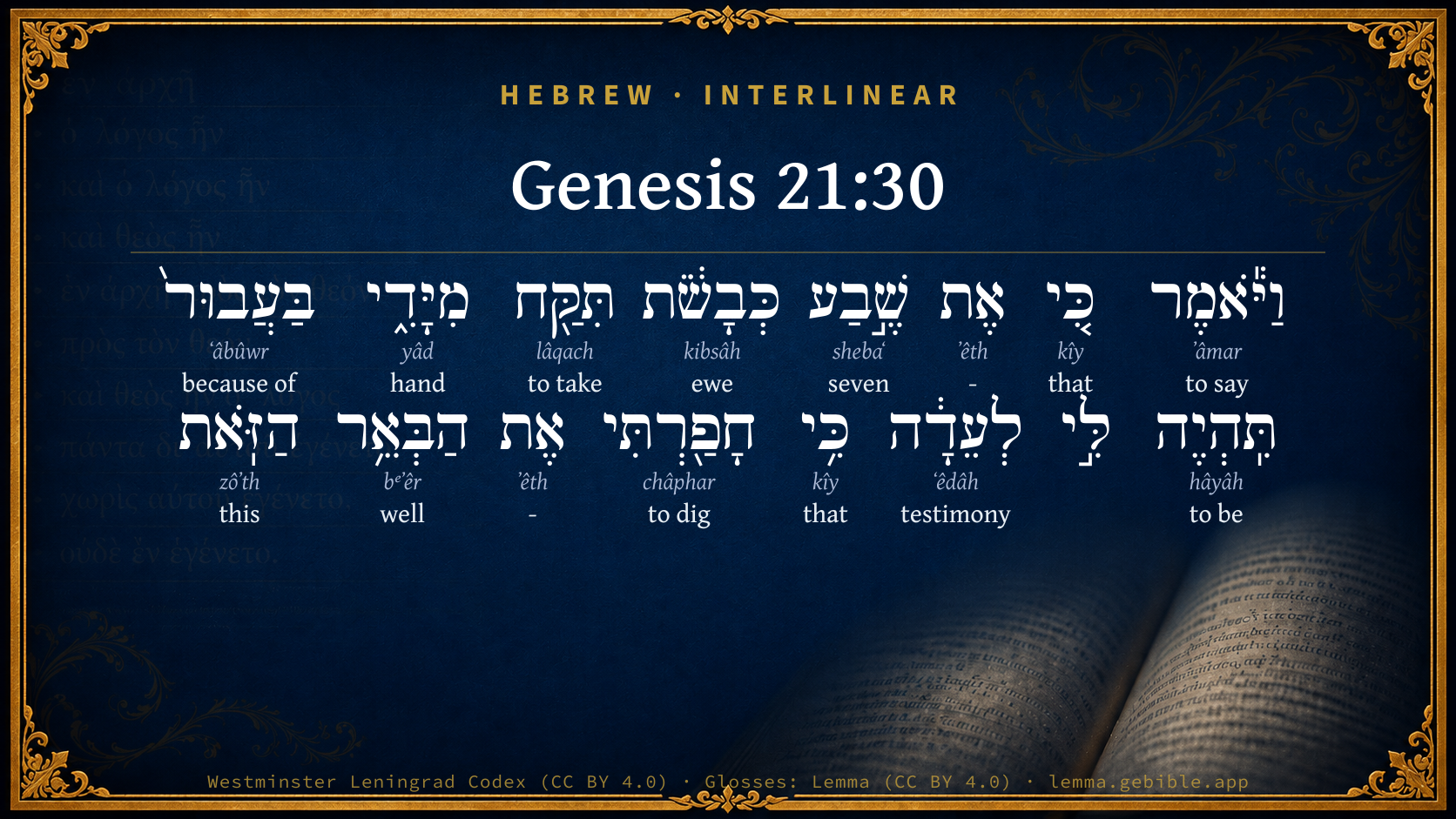
Hebrew (Westminster Leningrad Codex) Genesis 21:30 appears in the Hebrew Old Testament. The text above is from the Westminster Leningrad Codex. Each word links to its Strong’s number, a concise gloss, and parsing drawn from the Open Scriptures Hebrew Bible morphology. Click any word for its full Brown-Driver-Briggs (BDB) entry.
Download image
Cite this verse

Genesis 21:30 (World English Bible). Public Domain. Lemma interlinear Bible study tool, https://lemma.gebible.app/v/genesis/21/30.

Show BibTeX & RIS
BibTeX
RIS
English Translation
He said, "You shall take these seven ewe lambs from my hand, that it may be a witness to me, that I have dug this well."
World English Bible · Public Domain
Highlights
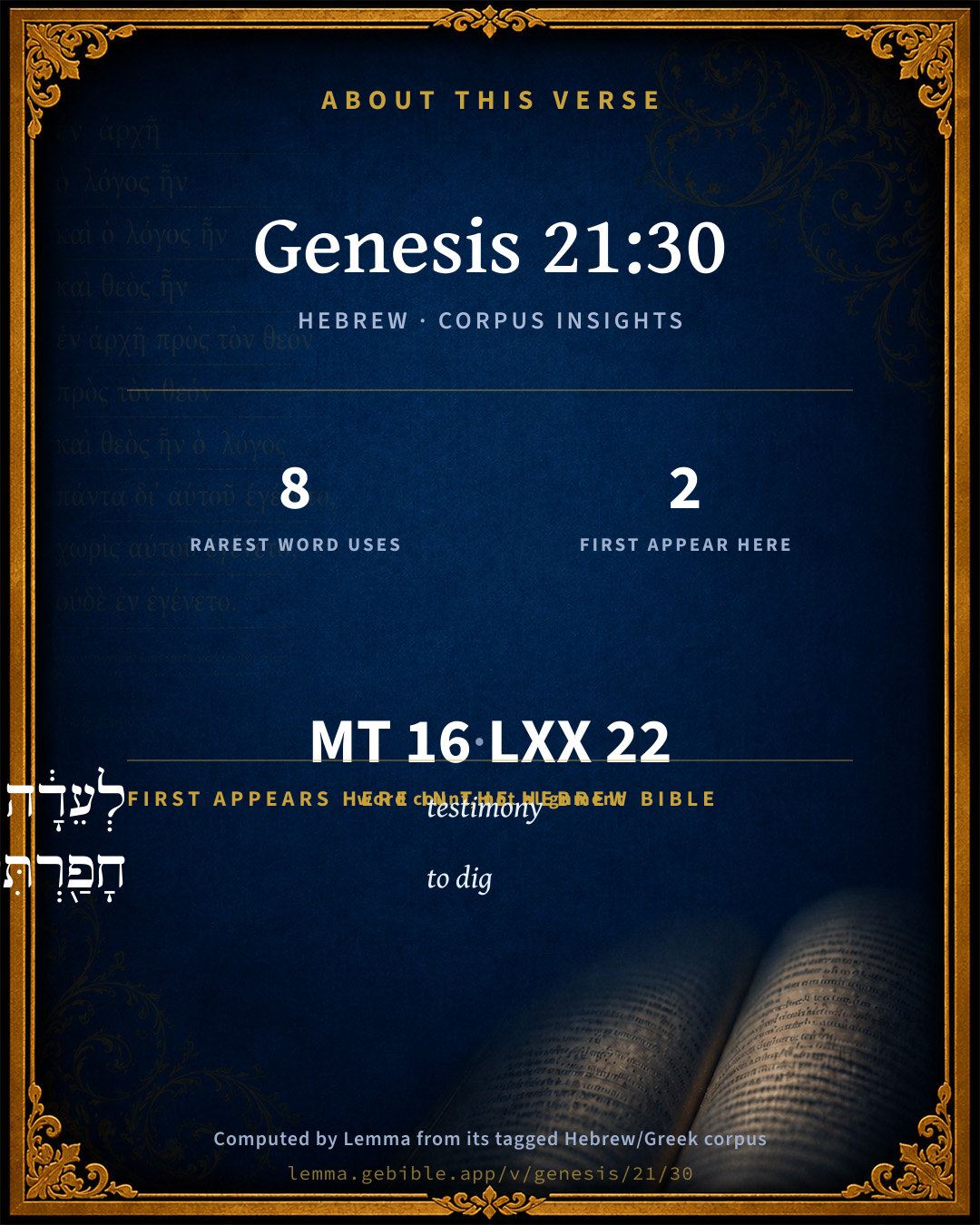
  • 2 first appearances in the Hebrew Bible
Full analysis ↓
Download a study sheet

One document with this verse’s original text, its word-by-word gloss line, the meaning frame, cross-references with their text, attributed commentary, and full source and license credits — printable, and it pastes into notes with its structure intact.

This verse Autodidact and up

Study sheet (.html) Plain text (.txt)

A passage Seminary Student

Up to 50 verses in one chapter. A passage sheet keeps up to 6 commentary sources and 12 cross-references per verse, in the order this page ranks them, and says so on the sheet whenever that leaves anything out. Ask for a single verse and you get the Autodidact verse sheet above.

Everything on this page stays free to read, with no account — the sheet is a download of what is already on screen, not access to it.

Want to remove ads? Support Godless Engineer
Compare translations 3

The same verse in 3 English versions, stacked beneath the original-language interlinear above. Click any original word for its lexicon entry.

Each is an independent rendering of the whole verse — the interlinear is not word-aligned to these translations.

Highlighted words mark where these versions differ — a whole-verse word diff, not a word-by-word alignment.

  • World English Bible Public Domain
    He said, "You shall take these seven ewe lambs from my hand, that it may be a witness to me, that I have dug this well."
  • King James Version Public Domain
    And he said, For these seven ewe lambs shalt thou take of my hand, that they may be a witness unto me, that I have digged this well.
  • unfoldingWord Literal Text CC BY-SA 4.0
    And he said, “Because you must take the seven ewe lambs from my hand, so that it can be a witness for me that I dug this well.”

unfoldingWord Literal Text — © unfoldingWord, licensed CC BY-SA 4.0. Word-aligned USFM3 via Door43 (git.door43.org/unfoldingWord/en_ult).

Versions to compare (up to 4)

3 of 4 selected

Show all 18 translations

Every available English version of this verse, each an independent rendering of the whole verse.

  • World English Bible Public Domain
    He said, "You shall take these seven ewe lambs from my hand, that it may be a witness to me, that I have dug this well."
  • Berean Standard Bible Public Domain
    He replied, “You are to accept the seven ewe lambs from my hand as my witness that I dug this well.”
  • Majority Standard Bible Public Domain
    He replied, “You are to accept the seven ewe lambs from my hand as my witness that I dug this well.”
  • King James Version Public Domain
    And he said, For these seven ewe lambs shalt thou take of my hand, that they may be a witness unto me, that I have digged this well.
  • American Standard Version (1901) Public Domain
    And he said, These seven ewe lambs shalt thou take of my hand, that it may be a witness unto me, that I have digged this well.
  • Revised Version (1885) Public Domain
    And he said, These seven ewe lambs shalt thou take of my hand, that it may be a witness unto me, that I have digged this well.
  • Geneva Bible (1599) Public Domain
    And he answered, Because thou shalt receiue of mine hand these seuen lambes, that it may be a witnes vnto me, that I haue digged this well.
  • Douay-Rheims (1899) Public Domain
    But he said: Thou shalt take seven ewe lambs at my hand: that they may be a testimony for me, that I dug this well.
  • Young's Literal Translation Public Domain
    And he saith, `For -- the seven lambs thou dost accept from my hand, so that it becometh a witness for me that I have digged this well;'
  • Literal Standard Version CC BY-SA 4.0
    And he says, “For—the seven lambs you accept from my hand, so that it becomes a witness for me that I have dug this well”;
  • Unlocked Literal Bible CC BY-SA 4.0
    He replied, “These seven female lambs you will receive from my hand, so that it may be a witness for me, that I dug this well.”
  • unfoldingWord Literal Text CC BY-SA 4.0
    And he said, “Because you must take the seven ewe lambs from my hand, so that it can be a witness for me that I dug this well.”
  • Darby Bible Public Domain
    And he said, That thou take the seven ewe-lambs of my hand, that they may be a witness to me that I have dug this well.
  • World Messianic Bible Public Domain
    He said, “You shall take these seven ewe lambs from my hand, that it may be a witness to me, that I have dug this well.”
  • Webster's Bible Public Domain
    And he said, For these seven ewe-lambs shalt thou take from my hand, that they may be a witness to me, that I have digged this well.
  • Free Bible Version CC BY-SA 4.0
    “I'm giving you these seven female lambs in return for your admission that I dug this well,” Abraham replied.
  • Bible in Basic English Public Domain
    And he said, Take these seven lambs from me as a witness that I have made this water-hole.
  • JPS Tanakh (1917) Public Domain
    And he said: 'Verily, these seven ewe-lambs shalt thou take of my hand, that it may be a witness unto me, that I have digged this well.'

Literal Standard Version (2020), Covenant Press — licensed CC BY-SA 4.0. Text via the HelloAO Bible API (eBible.org). Unlocked Literal Bible (unfoldingWord) — licensed CC BY-SA 4.0. Text via the HelloAO Bible API (eBible.org). unfoldingWord Literal Text — © unfoldingWord, licensed CC BY-SA 4.0. Word-aligned USFM3 via Door43 (git.door43.org/unfoldingWord/en_ult). Free Bible Version, Dr. Jonathan Gallagher — licensed CC BY-SA 4.0. Text via the HelloAO Bible API (eBible.org).

Word by word

More ways to search: Search by grammar → Find every occurrence → Compare this word →

Practice this passage: Drill this verse → Learn its vocabulary →

כְּבָשֹׂ֔ת
kibsâh
H3535
“ewes”
Noun, Common, Feminine, Plural, Absolute
Part of Speech
Noun
Type
Common
Gender
Feminine
Number
Plural
State
Absolute
Full BDB Definition

Origin: from H3532

TWOT: 950

ewe-lamb, lamb
  1. וַיֹּ֕אמֶר ʼâmar H559 “and · to say” Conjunction + Verb, Qal, Sequential Imperfect, 3rd Person, Masculine, Singular
  2. כִּ֚י kîy H3588 “that” Conjunction
  3. אֶת ʼêth H853 “-” Particle, Direct Object
  4. שֶׁ֣בַע shebaʻ H7651 “seven” Adjective, Cardinal number, Feminine, Singular, Absolute
  5. תִּקַּ֖ח lâqach H3947 “to take” Verb, Qal, Imperfect, 2nd Person, Masculine, Singular
  6. מִיָּדִ֑י yâd H3027 “from · hand · my” Preposition + Noun, Common, Both, Singular, Construct + Suffix, Personal, 1st Person, Common, Singular
  7. בַּעֲבוּר֙ ʻâbûwr H5668 “in/at · because of of” Preposition + Noun, Common, Masculine, Singular, Construct
  8. תִּֽהְיֶה hâyâh H1961 “to be” Verb, Qal, Imperfect, 3rd Person, Feminine, Singular
  9. לְעֵדָ֔ה ʻêdâh H5713 “to/for · testimony” Preposition + Noun, Common, Feminine, Singular, Absolute
  10. כִּ֥י kîy H3588 “that” Conjunction
  11. חָפַ֖רְתִּי châphar H2658 “to dig” Verb, Qal, Perfect, 1st Person, Common, Singular
  12. אֶת ʼêth H853 “-” Particle, Direct Object
  13. הַבְּאֵ֥ר bᵉʼêr H875 “the · well” Particle, Definite Article + Noun, Common, Feminine, Singular, Absolute
  14. הַזֹּֽאת zôʼth H2063 “the · this” Particle, Definite Article + Pronoun, Demonstrative, Feminine, Singular

About this verse

These counts appear in no published source. They are computed here, from the morphology-tagged text and Lemma’s own curated glosses. What Lemma adds →

16
words
13
distinct lemmas
Pentateuch
section

Notable vocabulary

The rarest word here is כְּבָשֹׂ֔ת ewe H3535 — appearing just 8 times in the whole Hebrew Bible.

First appearance in Scripture

These words make their first canonical appearance in the Hebrew Bible here:

  • לְעֵדָ֔ה testimony H5713
  • חָפַ֖רְתִּי to dig H2658

Shared distinctive vocabulary

כְּבָשֹׂ֔ת ewe H3535 occurs in 8 verses of the Hebrew Bible. Also found in:

Grammatical profile

  • 4 verbs
  • 5 nouns
  • 1 adjective
  • 1 pronoun
  • 1 preposition
  • 2 conjunctions
  • 2 particles

Verb forms

  • וַיֹּ֕אמֶר Qal · Sequential Imperfect
  • תִּקַּ֖ח Qal · Imperfect
  • תִּֽהְיֶה Qal · Imperfect
  • חָפַ֖רְתִּי Qal · Perfect

Repetition

A word recurs within this verse — often emphatic in Hebrew:

  • כִּ֚י that H3588 ×2

Hebrew & Septuagint length

In English translation the verse runs 26 words from the Hebrew and 25 from the Septuagint (LXX English) — closely comparable.

A rough comparison of the two English renderings, which tokenize alike — not a word-level alignment.

Word counts can differ between the Hebrew and the Greek without any difference in meaning — e.g. the Hebrew direct-object marker אֵת has no separate Greek word, and Greek often adds the article ὁ.

In the original languages it is 16 Hebrew tokens and 22 Greek tokens — but the two are counted differently (Hebrew bundles its prefixes and suffixes into one token; the Greek is in lemma form), so that isn’t a like-for-like length.

Cross-references

4

Topical passages linked to Genesis 21:30 in the Treasury of Scripture Knowledge — connected by theme and wording, ordered by reader-vote popularity; previews shown in the World English Bible.

  • Genesis 31:52 May this heap be a witness, and the pillar be a witness, that I will not pass over this heap to you, and that you will not pass over this heap and this pillar to me, for harm.
  • Genesis 31:44–48 Now come, let us make a covenant, you and I; and let it be for a witness between me and you."
  • Joshua 22:27–28 but it shall be a witness between us and you, and between our generations after us, that we may do the service of Yahweh before him with our burnt offerings, and with our sacrifices, and with our peace-offerings; that your children may not tell our children in time to come, You have no portion in Yahweh.
  • Joshua 24:27 Joshua said to all the people, Behold, this stone shall be a witness against us; for it has heard all the words of Yahweh which he spoke to us: it shall be therefore a witness against you, lest you deny your God.

Cross-references courtesy of OpenBible.info (CC BY 4.0).

Hebrew and Greek witnesses Masoretic Hebrew ↔ Greek Septuagint

The same verse in the two great witnesses to the Old Testament, shown verse-for-verse.

These are two independent witnesses, not word-aligned to each other, and the Septuagint is shown in lemma (dictionary) form.

Hebrew Genesis 21:30 Masoretic · Westminster Leningrad Codex

וַיֹּ֕אמֶר כִּ֚י אֶת שֶׁ֣בַע כְּבָשֹׂ֔ת תִּקַּ֖ח מִיָּדִ֑י בַּעֲבוּר֙ תִּֽהְיֶה לִּ֣י לְעֵדָ֔ה כִּ֥י חָפַ֖רְתִּי אֶת הַבְּאֵ֥ר הַזֹּֽאת

He said, "You shall take these seven ewe lambs from my hand, that it may be a witness to me, that I have dug this well."

World English Bible · Public Domain

Greek LXX Genesis 21:30 Septuagint · lemma form

καί εἶπον αβρααμ ὅτι ὁ ἑπτά ἀμνάς οὗτος λαμβάνω παρά ἐγώ ἵνα εἰμί ἐγώ εἰς μαρτύριον ὅτι ἐγώ ὀρύσσω ὁ φρέαρ οὗτος

And Abraam said, You shall receive the seven ewe-lambs of me, that they may be for me as a witness, that I dug this well.

LXX2012 (modern English Septuagint) · Public Domain

On this verse, John Gill's Exposition discusses the Septuagint’s reading. Read the note in Commentary ↓

Hebrew: Westminster Leningrad Codex (CC BY 4.0). Greek: Septuagint (public domain); English from LXX2012 (modern English Septuagint) (Public Domain). How the Septuagint differs from the Hebrew →

Targum (Aramaic paraphrase)

2

The Targum is the ancient Jewish Aramaic paraphrase of the Hebrew Scriptures — an interpretive translation, not the Hebrew text itself. Onkelos (literal) and Pseudo-Jonathan (expansive) render the Torah, and Jonathan the Prophets. Coverage is partial: where no permissively-licensed English translation exists for a verse, only the Aramaic is shown. This is verse-level text, not a word-by-word alignment to the Hebrew.

  1. Targum Onkelos Torah (Genesis–Deuteronomy)
    וַאֲמַר אֲרֵי יָת שְׁבַע חוּרְפַן תְּקַבֵּל מִן יְדִי בְּדִיל דִּתְהֵי לִי לְסַהֲדוּ אֲרֵי חֲפָרִית יָת בֵּירָא הָדָא

    (no public-domain English translation for this verse)

    Targum Onkelos — Aramaic: “Onkelos Genesis” (public domain); “Onkelos Exodus” (public domain); “Onkelos Leviticus” (public domain); “Onkelos Numbers” (public domain); “Onkelos Deuteronomy” (public domain). English: “Sefaria Community Translation” (CC0 1.0 (public-domain dedication)); “J.W. Etheridge. The Targums of Onkelos and Jonathan Ben Uzziel on the Pentateuch. London: Longmans, Green, 1862” (public domain). Text via Sefaria.

  2. Targum Pseudo-Jonathan Torah (Genesis–Deuteronomy)
    וַאֲמַר אֲרוּם יַת שְׁבַע חוּרְפַן תְּקַבֵּל מִן יְדִי מִן בִּגְלַל דְתֶהֱוֵי לִי לְסַהֲדוּ אֲרוּם חֲפָרִית יַת בֵּירָא הָדָא

    And he said, That thou mayest take the seven lambs from my hand, to be a testimony for me that I have digged this well.

    Targum Pseudo-Jonathan — Aramaic: “Targum Jonathan on Genesis” (public domain); “Targum Jonathan on Exodus” (public domain); “Targum Jonathan on Leviticus” (public domain); “Targum Jonathan on Numbers” (public domain); “Targum Jonathan on Deuteronomy” (public domain). English: “The Targum of Jonathan ben Uzziel, trans. J. W. Etheridge, London, 1862” (public domain). Text via Sefaria.

Commentary

Notes on Genesis 21:30 from classic Christian and Jewish commentators (each source and its license shown beneath its notes). The classic Christian expositions comment on the surrounding passage and are grouped to its opening verse, so a note may address several verses; the Jewish commentaries on the Tanakh (Rashi and others) are per-verse, so they appear only where the commentator wrote on this verse.

Lemma curates 59 commentaries, every one of them public domain or Creative Commons licensed, each selected and text-cleaned for this edition rather than reprinted as found. About our sources →

The Cambridge Bible for Schools and Colleges

gen. ed. J. J. S. Perowne

30. that it may be a witness] Abimelech’s question and Abraham’s answer are probably the technical terms of the usual transaction. The transfer of the seven lambs having taken place, it was a “witness” to the fact that Abraham was acknowledged by Abimelech to have digged the well. There is no mention of document or writing in the compact.

The Cambridge Bible for Schools and Colleges (gen. ed. J. J. S. Perowne; Cambridge University Press, 1878–1918) — public domain. Text from a community e-Sword module.

John Gill's Exposition

And Abraham planted a grove in Beersheba,.... The Jewish writers (w) are divided about the use of this grove, as Jarchi relates; one says it was for a paradise or orchard, to produce fruits out of it for travellers and for entertainment; another says it was for an inn to entertain strangers in; it rather was for a shade, to shelter from the sun in those sultry and hot countries; and perhaps for a religious use, and to be an oratory, as the following words seem to suggest: in the midst of it very likely Abraham built an altar, and sacrificed to the Lord; hence might come the superstitious use of groves among the Heathens; and, when they came to be abused to idolatrous purposes, they were forbidden by the law of Moses, which before were lawful. And, though the name of Abraham is not in the text, there is no doubt but he is designed, and was the planter of the grove, and which is expressed in the Septuagint version, as it is supplied by us. What sort of trees this grove consisted of cannot with certainty be said, very probably the oak. R. Jonah (x) thinks it may be the tree which in Arabic they call "ethel", and is a tree like that which is called tamarisk in general it signifies any tree, and especially large trees (y):

and called there on the name of the Lord, the everlasting God; who, is from everlasting to everlasting, or "the God of the world" (z), the Creator and upholder of it, and the preserver of all creatures in it; him Abraham invoked in this place, prayed unto him, and gave him thanks for all the mercies he had received from him.

(w) In T. Bab. Sotah, fol. 10. 1. (x) Apud Kimchi, Sepher Shorash. rad. (y) Vid. R. Sol. Urbin. Ohel Moed, fol. 72. 1. (z) "Dei seculi", Pagninus, Hontanus, Calvin; so Ainsworth.

John Gill's Exposition of the Whole Bible (1746–1763) — public domain (CC PDM 1.0). Text via the HelloAO Bible API.

Matthew Poole's English Annotations

That this care of Abraham’s was not superfluous may appear from Gen 26:15.

Matthew Poole's English Annotations on the Holy Bible (1683–1685) — public domain. Text from a community e-Sword/MySword module.

Whedon's Commentary on the Bible

Daniel D. Whedon

30. Seven ewe lambs shalt thou take of my hand — These seem to have been an additional present to bind the treaty at the well. The receiving of this gift would bind Abimelech by a most solemn stipulation. The Hebrew word for swear, in Gen_21:23-24, is the verbal form of the word for seven, and in its usual Niphal form (נשׁבע) means literally, to seven one’s self. This, perhaps, arose from the custom of confirming or sealing an oath by seven offerings or seven witnesses.

Daniel D. Whedon (gen. ed.), Commentary on the Old and New Testaments (1874–1909) — public domain. Text from a community e-Sword module.

Rashi

Rabbi Shlomo Yitzchaki (Rashi)

בעבור (supply the word זאת) — IN ORDER THAT this (where this, a feminine form in a neuter sense, as is usual in Hebrew, refers to the incident just recorded).

תהיה לי לעדה MAY BE UNTO ME AS A WITNESS The word עדה means witness in reference to a previous feminine form (in this case to זאת, this, which word Rashi supplied), just as (31:52) “And the pillar is a witness” (עדה the feminine form to correspond with the feminine noun מצבה, whereas the preceding words are עד הגל הזה “this heap is a witness” where עד is masc to agree with Gal.

כי חפרתי את הבאר THAT I HAVE DIGGED THIS WELL —Abimelech’s herdsmen quarrelled about it, saying, “We have dug it”. They arranged amongst themselves that the well should belong to him who would show himself at the well together with his sheep and at whose approach the waters would rise, and they rose at the approach of Abraham and his sheep (Genesis Rabbah 54:5).

Rashi on the Tanakh — English translations: “The Judaica Press complete Tanach with Rashi, translated by A. J. Rosenberg” (CC BY 4.0); “Pentateuch with Rashi's commentary by M. Rosenbaum and A.M. Silbermann, 1929-1934” (public domain); “The Metsudah Tanach series, Lakewood, N.J” (CC BY 4.0); and “The Book of Joshua, Metsudah Publications, 1997” (CC BY 4.0). Text via Sefaria.

Radak

Rabbi David Kimhi (Radak)

ויאמר...תהיה לי לעדה, “this gift that I am giving you shall serve as proof for me.”

Radak on the Tanakh — English translations: “Sefaria Community Translation” (CC0 1.0 (public-domain dedication)); “Eliyahu Munk, HaChut Hameshulash” (CC BY 4.0); “Rabbi Mike Feuer, Jerusalem Anthology” (CC BY 4.0); and “R. David Kimhi on the first book of Psalms, Translated by R.G. Finch, London, 1919” (public domain). Text via Sefaria.

Lesson kit

Teaching starters — assembled from the data on this page, not authored interpretation. Every prompt links to the verse data it draws on. Edit before teaching.

Genesis, in the Pentateuch, opens this verse with 16 words (13 distinct Hebrew lemmas). Its most distinctive word is kibsâh (“ewe”). A historical commentator’s framing appears above. Read the whole chapter for the surrounding context.

Discussion questions

  1. What does “ewe” (kibsâh) contribute to the verse as a whole?
  2. 2 words here appear for the first time in Scripture. What is being introduced at this debut?
  3. Genesis 21:28 shares the word «ewe» with this verse. How do the two illuminate each other?
  4. “that” occurs 2× in this one verse. What is the effect of the repetition?
  5. These translations render this verse differently; the difference is in the English rendering, not the original. What questions does that raise?
  6. The verb «וַיֹּ֕אמֶר» is Qal Sequential Imperfect. How does its form color the action?
  7. Reading how The Cambridge Bible for Schools and Colleges and John Gill's Exposition read this verse, where do the two commentators agree and where do they part?

Things to notice

Reading settings

Reading text

Shown beneath each verse's original-language words.

Old Testament
Old Testament edition

Read the OT as the Masoretic Hebrew (MT) or the Greek Septuagint (LXX).

English shown for the Greek Septuagint (in the Hebrew ↔ Greek comparison).

Comparing translations? Open the Compare panel on any verse page to stack up to four side by side.