

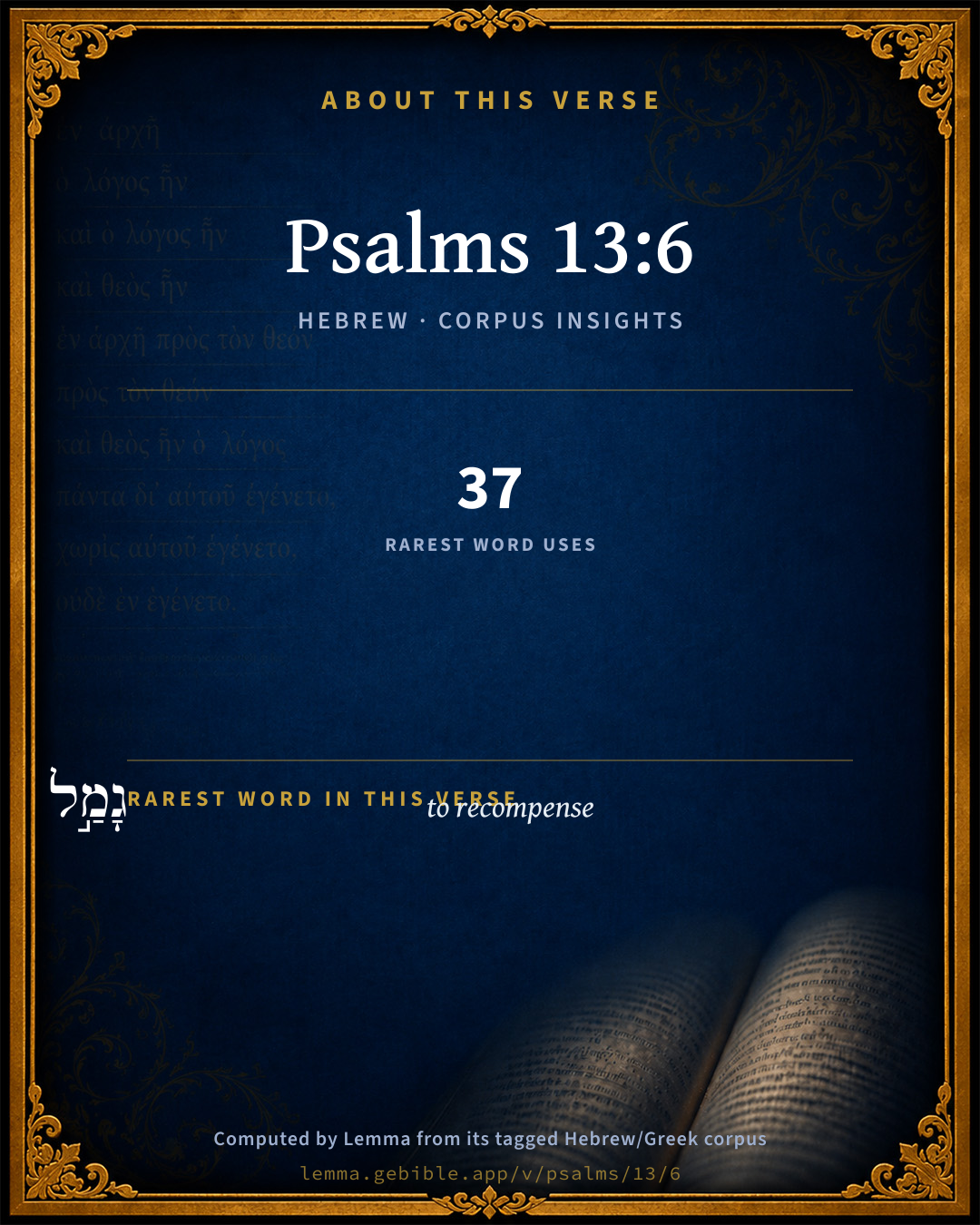
Psalms 13:6

Hebrew (Westminster Leningrad Codex) Psalms 13:6 appears in the Hebrew Old Testament. The text above is from the Westminster Leningrad Codex. Each word links to its Strong’s number, a concise gloss, and parsing drawn from the Open Scriptures Hebrew Bible morphology. Click any word for its full Brown-Driver-Briggs (BDB) entry.
Download image
Cite this verse

Psalms 13:6 (World English Bible). Public Domain. Lemma interlinear Bible study tool, https://lemma.gebible.app/v/psalms/13/6.

Show BibTeX & RIS
BibTeX
RIS
English Translation
I will sing to Yahweh, Because he has been good to me.
World English Bible · Public Domain
Download a study sheet

One document with this verse’s original text, its word-by-word gloss line, the meaning frame, cross-references with their text, attributed commentary, and full source and license credits — printable, and it pastes into notes with its structure intact.

This verse Autodidact and up

Study sheet (.html) Plain text (.txt)

A passage Seminary Student

Up to 50 verses in one chapter. A passage sheet keeps up to 6 commentary sources and 12 cross-references per verse, in the order this page ranks them, and says so on the sheet whenever that leaves anything out. Ask for a single verse and you get the Autodidact verse sheet above.

Everything on this page stays free to read, with no account — the sheet is a download of what is already on screen, not access to it.

Want to remove ads? Support Godless Engineer
Compare translations 3

The same verse in 3 English versions, stacked beneath the original-language interlinear above. Click any original word for its lexicon entry.

Each is an independent rendering of the whole verse — the interlinear is not word-aligned to these translations.

Highlighted words mark where these versions differ — a whole-verse word diff, not a word-by-word alignment.

  • World English Bible Public Domain
    I will sing to Yahweh, Because he has been good to me.
  • King James Version Public Domain
    I will sing unto the LORD, because he hath dealt bountifully with me.
  • unfoldingWord Literal Text CC BY-SA 4.0
    I will sing to Yahweh, because he has dealt bountifully with me.

unfoldingWord Literal Text — © unfoldingWord, licensed CC BY-SA 4.0. Word-aligned USFM3 via Door43 (git.door43.org/unfoldingWord/en_ult).

Versions to compare (up to 4)

3 of 4 selected

Show all 17 translations

Every available English version of this verse, each an independent rendering of the whole verse.

  • World English Bible Public Domain
    I will sing to Yahweh, Because he has been good to me.
  • Berean Standard Bible Public Domain
    I will sing to the LORD, for He has been good to me.
  • Majority Standard Bible Public Domain
    I will sing to the LORD, for He has been good to me.
  • King James Version Public Domain
    I will sing unto the LORD, because he hath dealt bountifully with me.
  • American Standard Version (1901) Public Domain
    I will sing unto Jehovah, Because he hath dealt bountifully with me. Psalm 14 For the Chief Musician. `A Psalm' of David.
  • Revised Version (1885) Public Domain
    I will sing unto the LORD, because he hath dealt bountifully with me.
  • Douay-Rheims (1899) Public Domain
    but I have trusted in thy mercy. My heart shall rejoice in thy salvation: I will sing to the Lord, who giveth me good things: yea I will sing to the name of the Lord the most high.
  • Young's Literal Translation Public Domain
    I do sing to Jehovah, For He hath conferred benefits upon me!
  • Literal Standard Version CC BY-SA 4.0
    I sing to YHWH, || For He has conferred benefits on me!
  • Unlocked Literal Bible CC BY-SA 4.0
    I will sing to Yahweh because he has treated me very generously.
  • unfoldingWord Literal Text CC BY-SA 4.0
    I will sing to Yahweh, because he has dealt bountifully with me.
  • Darby Bible Public Domain
    I will sing unto Jehovah, for he hath dealt bountifully with me.
  • World Messianic Bible Public Domain
    I will sing to the LORD, because he has been good to me.
  • Webster's Bible Public Domain
    I will sing to the LORD, because he hath dealt bountifully with me.
  • Free Bible Version CC BY-SA 4.0
    I will sing to the Lord because he has treated me with such generosity!
  • Bible in Basic English Public Domain
    I will make a song to the Lord, because he has given me my reward.
  • JPS Tanakh (1917) Public Domain
    (13-6) I will sing unto the LORD, because He hath dealt bountifully with me.

Literal Standard Version (2020), Covenant Press — licensed CC BY-SA 4.0. Text via the HelloAO Bible API (eBible.org). Unlocked Literal Bible (unfoldingWord) — licensed CC BY-SA 4.0. Text via the HelloAO Bible API (eBible.org). unfoldingWord Literal Text — © unfoldingWord, licensed CC BY-SA 4.0. Word-aligned USFM3 via Door43 (git.door43.org/unfoldingWord/en_ult). Free Bible Version, Dr. Jonathan Gallagher — licensed CC BY-SA 4.0. Text via the HelloAO Bible API (eBible.org).

Word by word

More ways to search: Search by grammar → Find every occurrence → Compare this word →

Practice this passage: Drill this verse → Learn its vocabulary →

גָמַ֣ל
gâmal
H1580
“to recompense”
Verb, Qal, Perfect, 3rd Person, Masculine, Singular
Part of Speech
Verb
Stem
Qal
Form
Perfect
Person
3rd Person
Gender
Masculine
Number
Singular
Full BDB Definition

Origin: a primitive root

TWOT: 360

to deal fully with, recompense - (Qal) - to deal out to, do to - to deal bountifully with - to recompense, repay, requite - (Qal) to wean a child - (Qal) to ripen, bear ripe (almonds)
  1. אָשִׁ֥ירָה shîyr H7891 “to sing” Verb, Qal, Cohortative, 1st Person, Common, Singular
  2. לַיהוָ֑ה Yᵉhôvâh H3068 “to/for · LORD” Preposition + Noun, Proper
  3. כִּ֖י kîy H3588 “that” Conjunction
  4. עָלָֽי ʻal H5921 “upon · me” Preposition + Suffix, Personal, 1st Person, Common, Singular

About this verse

These counts appear in no published source. They are computed here, from the morphology-tagged text and Lemma’s own curated glosses. What Lemma adds →

5
words
5
distinct lemmas
Wisdom
section

Shared distinctive vocabulary

גָמַ֣ל to recompense H1580 occurs in 32 verses of the Hebrew Bible. Also found in:

Grammatical profile

  • 2 verbs
  • 1 noun
  • 1 preposition
  • 1 conjunction

Verb forms

  • אָשִׁ֥ירָה Qal · Cohortative
  • גָמַ֣ל Qal · Perfect

Hebrew & Septuagint length

In English translation the verse runs 12 words from the Hebrew and 25 from the Septuagint (LXX English) — closely comparable.

A rough comparison of the two English renderings, which tokenize alike — not a word-level alignment.

Word counts can differ between the Hebrew and the Greek without any difference in meaning — e.g. the Hebrew direct-object marker אֵת has no separate Greek word, and Greek often adds the article ὁ.

Cross-references

3

Topical passages linked to Psalms 13:6 in the Treasury of Scripture Knowledge — connected by theme and wording, ordered by reader-vote popularity; previews shown in the World English Bible.

  • Psalms 116:7 Return to your rest, my soul, For Yahweh has dealt bountifully with you.
  • Psalms 21:13 Be exalted, Yahweh, in your strength, So we will sing and praise your power.
  • Psalms 119:7 I will give thanks to you with uprightness of heart, When I learn your righteous judgments.

Cross-references courtesy of OpenBible.info (CC BY 4.0).

Hebrew and Greek witnesses Masoretic Hebrew ↔ Greek Septuagint

The same verse in the two great witnesses to the Old Testament, shown verse-for-verse.

You’re reading Greek Psalm 12 (Hebrew Psalm 13). The Septuagint counts the superscription, so verse numbers can differ from the Hebrew — chapter-level alignment, not verse-by-verse. Numbering follows Rahlfs.

These are two independent witnesses, not word-aligned to each other, and the Septuagint is shown in lemma (dictionary) form.

Hebrew Psalms 13:6 Masoretic · Westminster Leningrad Codex

אָשִׁ֥ירָה לַיהוָ֑ה כִּ֖י גָמַ֣ל עָלָֽי

I will sing to Yahweh, Because he has been good to me.

World English Bible · Public Domain

Greek LXX Greek Psalm 12:6 Septuagint · lemma form

ἐγώ δέ ἐπί ὁ ἔλεος σύ ἐλπίζω ἀγαλλιάομαι ὁ καρδία ἐγώ ἐπί ὁ σωτήριον σύ ᾄδω ὁ κύριος ὁ εὐεργετέω ἐγώ καί ψάλλω ὁ ὄνομα κύριος ὁ ὕψιστος

I will sing to the Lord who has dealt bountifully with me, and I will sing psalms to the name of the Lord most high.

LXX2012 (modern English Septuagint) · Public Domain

Hebrew: Westminster Leningrad Codex (CC BY 4.0). Greek: Septuagint (public domain); English from LXX2012 (modern English Septuagint) (Public Domain). How the Septuagint differs from the Hebrew →

Commentary

Notes on Psalms 13:6 from classic Christian and Jewish commentators (each source and its license shown beneath its notes). The classic Christian expositions comment on the surrounding passage and are grouped to its opening verse, so a note may address several verses; the Jewish commentaries on the Tanakh (Rashi and others) are per-verse, so they appear only where the commentator wrote on this verse.

Lemma curates 59 commentaries, every one of them public domain or Creative Commons licensed, each selected and text-cleaned for this edition rather than reprinted as found. About our sources →

Trapp's Complete Commentary

John Trapp

Psa 13:6 I will sing unto the LORD, because he hath dealt bountifully with me.

Ver. 6. I will sing unto the Lord] How far different is the end of this psalm from the beginning! See the like Psa 6:1, {See Trapp on "Psa 6:1"}

Because he hath dealt bountifully with me] Qui retribuit mihi, so Popish merit-mongers read it, and would therehence collect something in favour of their absurd tenet. But their own Vulgate translation hath it bona tribuit, hath given me good things. And it is well observed (Ainsworth), that though the Hebrew word be sometimes taken for rewarding evil for good, Psa 7:5, or evil for evil, Psa 137:8, yet from God to his people it commonly signifieth a bountiful rewarding of good things instead of evil, which we rather do deserve. So Psa 116:7; Psa 119:17; Psa 142:7.

John Trapp, A Commentary or Exposition upon All the Books of the Old and New Testament (1647–1656) — public domain. Text from a community e-Sword module.

The Biblical Illustrator

Joseph S. Exell

Psa_13:6

I will sing unto the Lord.

The passing of morbid states of mind

Much spiritual darkness is no doubt caused by the minds sympathising with a morbid condition of the body, a condition not always known to the sufferer, and often not even suspected. Nevertheless, the morbid condition exists, and prevents the mind from rightly estimating the evidences of its conversion. No sooner, however, is the believers health restored than he finds himself in a new world of religious hope and feeling, and yet without a single new evidence of his being a child of God. His repentance is not more sincere, his faith more entire, nor his purpose to serve God more determined. His restoration to health alone has invested his evidences of conversion to God with pleasurable emotions. He has, of course, more enjoyment in his religion, but not an iota more of genuineness and safety in it than there was before. (David Caldwell, A. M.)

Joy in Gods ways with us

This Psalm, like many others, begins in sorrow, but ends in joy. In all Gods works there is a great likeness running throughout--a change from bad to good, from hope deferred to real enjoyment; as the proverb has it, No cross, no crown Thus it is that daylight succeeds the darkness of night, and disperses it. Health and strength follow so often after a bed of sickness, inward joy after a long period of outward sorrow. Our Lord Himself went not after joy; but first He suffered pain. And such is the lifes history of all Gods most chosen saints. How differently a man goes through the world who dwells upon the blessings he has received more than the sorrows and trials he may have undergone, who tries to see in all circumstances of his life Gods goodness towards himself, instead of repining continually in discontent at everything which crosses his will or his hopes. It is in this way that God so often draws the hearts of men to Himself, weans them from the love of this world, makes them to love Him supremely before all else, and thus sows the seed of eternal life in their hearts. We are all surrounded by a thousand blessings, of which we take little or no account. These words of the text contain a direct expression of our own individual blessings and mercies. It is the work of Gods Holy Spirit in us to shed abroad in our hearts the love of God. And when we love God we love all that belongs to God. Let this be one object of our daily life, to see more and more Gods love towards us. (W. J. Stracey, M. A.)

.

Psa_14:1-7

The Biblical Illustrator, edited by Joseph S. Exell (c. 1880s–1900s) — public domain. Text from a community e-Sword module.

Joseph Benson's Commentary

Psa 13:6. He hath dealt bountifully with me — Either, 1st, In giving me that support and assurance of his favour which I enjoy at the present; or 2d, In giving me gracious promises of the deliverance and help which I expect; it being a common thing for David and other prophets to speak of future deliverances as if they were really come, that so they might signify both the infallible certainty of the thing and their firm assurance thereof.

Joseph Benson's Commentary on the Old and New Testaments (1811–1818) — public domain. Text from a community e-Sword module.

Adam Clarke's Commentary

Verse 6. I will sing unto the Lord] That heart is turned to God's praise which has a clear sense of God's favour.

Because he hath dealt bountifully with me.] כי גמל עלי ki gamel alai, because he hath recompensed me. My sorrows were deep, long continued, and oppressive, but in thy favour is life. A moment of this spiritual joy is worth a year of sorrow! O, to what blessedness has this godly sorrow led! He has given me the oil of joy for the spirit of heaviness, and the garments of praise for mourning.

The old MS. Psalter, which I have so frequently mentioned and quoted, was written at least four hundred years ago, and written probably in Scotland, as it is in the Scottish dialect. That the writer was not merely a commentator, but a truly religious man, who was well acquainted with the travail of the soul, and that faith in the Lord Jesus Christ which brings peace to the troubled heart, is manifested from various portions of his comment. To prove this I shall, I think I may say, favour the reader with another extract from this Psalm on the words, "How long wilt thou forget me," c., Ps 13:1. I have only to observe that with this commentator a true penitent, one who is deeply in earnest for his salvation, is called a perfyte man i.e., one wholly given up to God.

How lang lord for getes thu me in the endyng? How lang o way turnes thou thi face fro me? The voice of haly men that covaytes and yernes the comyng of Iehu Crist, that thai might lyf with hym in ioy; and pleynaund tham of delaying. And sais, Lord how lang for getes thu me in the endyng? That I covayte to haf and hald. That es how lang delayes thu me fra the syght of Iehu Crist, that es ryght endyng of myn entent. And how lang turnes thu thi face fra me? that es, qwen wil thu gif me perfyte Knawing of the? This wordes may nane say sothly, bot a perfyte man or woman, that has gedyrd to gydir al the desyres of thair Saule, and with the nayle of luf fested tham in Iehu Crist. Sa tham thynk one hour of the day war our lang to dwel fra hym; for tham langes ay til hym; bot tha that lufs noght so, has no langyng that he come: for thair conscience sais thaim, that thai haf noght lufed hym als that suld have done.

The language of true Christian experience has been the same in all times and nations. "But he that loveth not knoweth not God; for God is love;" and to such this is strange language.

ANALYSIS OF THE THIRTEENTH PSALM

"This Psalm," says Bishop Nicolson, "is a fit prayer for a soul that is sensible of God's desertion."

It has three parts: -

I. A heavy and bitter complaint of God's absence, Ps 13:1-2.

II. An earnest petition for God's return, Ps 13:3. The reason, Ps 13:4.

III. A profession of faith and confidence, with joy in God, accompanied with thanksgiving, Ps 13:5-6.

I. He bitterly complains, and aggravates it.

1. That God had forgotten him: "Wilt thou forget me?"

2. That he hid his face from him: "Wilt thou hide thy face?"

3. That he was distracted with many cares, what way to take, and what counsel to follow, to recover God's favour: "I take counsel in my soul, having sorrow in my heart."

4. In the meantime, his enemy was exalted, triumphed and insulted over him.

5. And, lastly, he complains of the delay, which is quickened by the erotesis, (interrogation,) and anaphora, (beginning several sentences with the same words,) How long? How long? How long? What! for ever?

II. His petition, Ps 13:3. Of which there are three degrees opposed to the parts of his complaint, Ps 13:1-2.

1. Look upon me, or consider me. Thou hast hitherto seemed to turn away thy face; but once behold me, and give me a proof of thy love.

2. Hear me. Thou hast seemed to have forgotten; but now, I pray thee, remember me; and show that thou dost not neglect my prayer.

3. Lighten my eyes. I have been vexed in my soul, and agitated various counsels to recover thy favour; but do thou instruct me, and illuminate me, as to what course I shall take.

That his petition might be the sooner heard, he urges many arguments: -

1. From that relation that was between him and God: "O Lord my God, hear me!"

2. From a bitter event that was likely to follow, if God heard him not: "Lest I sleep the sleep of death."

3. From another afflictive consequence-the boasting and insult of his adversaries: "Lest my enemy say, I have prevailed against him; and those that trouble me rejoice when I am moved."

But although the answer was delayed, yet he does not despair-for,

III. In the conclusion, he professes faith, joy, and thankfulness: -

1. His faith: "I have trusted in thy mercy."

2. His joy: "My heart shall rejoice in thy salvation."

3. His thankfulness: "I will sing unto the Lord, because he hath dealt bountifully with me."

According to this scale, this Psalm can neither be read nor paraphrased without profit.

Adam Clarke's Commentary on the Bible (1810–1826) — public domain. Text from a community e-Sword/MySword module.

John Gill's Exposition

I will sing unto the Lord,.... In prayer faith is encouraged, through believing the heart is filled with joy; and this joy is expressed by the lips, in songs of praise to the Lord, ascribing the glory of salvation to him, and giving him thanks for every mercy and blessing of life;

because he hath dealt bountifully with me; both in a way of providence and grace, granting life and preserving it, and supporting with the comforts of it; blessing with spiritual blessings, and crowning with loving kindness and tender mercies; all which is generous and bountiful dealing, and affords a just occasion of praise and thanksgiving; see Psa 116:7.

Next: Psalms Chapter 14

John Gill's Exposition of the Whole Bible (1746–1763) — public domain (CC PDM 1.0). Text via the HelloAO Bible API.

Albert Barnes' Notes on the Bible

I will sing unto the Lord, because he hath dealt bountifully with me - The word which is here rendered “dealt bountifully” - גמל gâmal - means properly “to deal” with anyone; to “treat” anyone well or ill; and then, to requite, or recompense. When used absolutely, as it is here, it is commonly employed in a good sense, meaning to deal favorably, or kindly, toward anyone; to treat anyone with favor. It means here that God had shown him kindness or favor, and had thus laid the foundation for gratitude and praise. The psalm closes, therefore, with expressions of joy, thankfulness, triumph. Though it begins with depression and sadness, it ends with joy. This is often observable in the Psalms. In the commencement it often occurs that the mind is overwhelmed with sorrow, and there is earnest pleading with God. Light, under the influence of prayer, breaks in gradually upon the soul. The clouds disperse; the darkness disappears. New views of the goodness and mercy of God are imparted; an assurance of his favor is brought to the soul; confidence in his mercy springs up in the heart; and the psalm that began with sorrowful complaining ends with the language of praise and of joy. So, too, it is in our own experience. Afflicted, depressed, and sad, we go to God. Everything seems dark. We have no peace - no clear and cheerful views - no joy. As we wait upon God, new views of his character, his mercy, his love, break upon the mind. The clouds open. Light beams upon us. Our souls take hold of the promises of God, and we, who went to His throne sad and desponding, rise from our devotions filled with praise and joy, submissive to the trials which made us so sad, and rejoicing in the belief that all things will work together for our good.

Albert Barnes' Notes on the Bible (1834–1885) — public domain. Text from a community e-Sword/MySword module.

Matthew Poole's English Annotations

Either,

1. In giving me that support and assurance of his favour which for the present I enjoy. Or,

2. In giving me that mercy which he hath freely promised me; it being a common thing for David and other prophets to speak of future deliverances as if they were already come, that so they may signify both the infallible certainty of the thing, and their firm assurance thereof. But the words may be rendered, when he shall have

dealt bountifully with me. This verb properly signifies to requite, or reward, (as it may be taken here, for there is a reward of grace as well as of debt, Rom 4:4) but here it signifies a free and bountiful giving, as it doth also Psa 119:17; 142:7.

Matthew Poole's English Annotations on the Holy Bible (1683–1685) — public domain. Text from a community e-Sword/MySword module.

The Treasury of David

Charles H. Spurgeon

Ver. 6. The Psalm closes with a sentence which is a refutation of the charge of forgetfulness which David had uttered in the first verse,

He hath dealt bountifully with me. So shall it be with us if we wait awhile. The complaint which in our haste we utter shall be joyfully retracted, and we shall witness that the Lord hath dealt bountifully with us.

Ver. 6. I will sing unto the Lord, because he hath dealt bountifully with me. Faith keeps the soul from sinking under heavy trials, by bringing in former experiences of the power, mercy, and faithfulness of God to the afflicted soul. Hereby was the psalmist supported in distress. Oh, saith faith, remember what God hath done both for thy outward and inward man: he hath not only delivered thy body when in trouble, but he hath done great things for thy soul; he hath brought thee out of a state of black nature, entered into a covenant relation with thee, made his goodness pass before thee; he hath helped thee to pray, and many times hath heard thy prayers and thy tears. Hath he not formerly brought thee out of the horrible pit, and out of the miry clay, and put a new song in thy mouth, and made thee to resolve never to give way to such unbelieving thoughts and fears again? and how unbecoming is it for thee now to sink in trouble? John Willison, 1680-1750.

Ver. 6. I will sing unto the Lord. Mr. John Philpot having lain for some time in the bishop of London's coal house, the bishop sent for him, and amongst other questions, asked him why they were so merry in prison? singing (as the prophet speaks) Exultantes in rebus pessimis, rejoicing in your naughtiness, whereas you should rather lament and be sorry. Mr. Philpot answered, "My lord, the mirth which we make is but in singing certain Psalms, as we are commanded by Paul, to rejoice in the Lord, singing together hymns and Psalms, for we are in a dark, comfortless place, and therefore, we thus solace ourselves. I trust, therefore, your lordship will not be angry, seeing the apostle saith, If any be of an upright heart, let him sing Psalms; and we, to declare that we are of an upright mind to God, though we are in misery, yet refresh ourselves with such singing." After some other discourse, saith he, "I was carried back to my lord's coal house, where I, with my six fellow prisoners, do rouze together in the straw, as cheerfully (I thank God) as others do in their beds of down." And in a letter to a friend, he thus writes: "Commend me to Mr. Elsing and his wife, and thank them for providing me some ease in my prison; and tell them though my lord's coal house be very black, yet it is more to be desired of the faithful than the Queen's palace. The world wonders how we can be so merry under such extreme miseries; but our God is omnipotent, who turns misery into felicity. Believe me, there is no such joy in the world, as the people of God have under the cross of Christ: I speak by experience, and therefore believe me, and fear nothing that the world can do unto you, for when they imprison our bodies, they set our souls at liberty to converse with God; when they cast us down, they lift us up; when they kill us, then do they send us to everlasting life. What greater glory can there be than to be made conformable to our Head, Christ? And this is done by affliction. O good God, what am I, upon whom thou shouldest bestow so great a mercy? This is the day which the Lord hath made; let us rejoice and be glad in it. This is the way, though it be narrow, which is full of the peace of God, and leadeth to eternal bliss. Oh, how my heart leaps for joy that I am so near the apprehension thereof! God forgive me my unthankfulness, and unworthiness of so great glory. I have so much joy, that though I be in a place of darkness and mourning, yet I cannot lament; but both night and day am so full of joy as I never was so merry before; the Lord's name be praised for ever. Our enemies do fret, fume, and gnash their teeth at it. O pray instantly that this joy may never be taken from us; for it passeth all the delights in this world. This is the peace of God that passeth all understanding. This peace, the more his chosen be afflicted, the more they feel it, and therefore cannot faint neither for fire nor water." Samuel Clarke's "Mirror, "1671.

Ver. 6. I will sing unto the Lord. How far different is the end of this Psalm from the beginning! John Trapp.

Ver. 6. I will sing unto the Lord, etc. I never knew what it was for God to stand by me at all turns, and at every offer of Satan to afflict me, etc., as I have found him since I came in hither; for look how fears have presented themselves, so have supports and encouragements; yea, when I have started, even as it were at nothing else but my shadow, yet God, as being very tender to me, hath not suffered me to be molested, but would with one Scripture or another, strengthen me against all; insomuch that I have often said, Were it lawful, I could pray for greater trouble, for the greater comfort's sake. Ec 7:14 2Co 1:5. John Bunyan, 1628-1688.

Ver. 6. The bountiful giver and the hearty singer.

The whole Psalm would make a good subject, showing the stages from mourning to rejoicing, dwelling especially upon the turning point, prayer. There are two verses for each, mourning, praying, rejoicing. A. G. Brown.

Charles H. Spurgeon's The Treasury of David (1869–1885) — public domain. Psalms only. Text from a community e-Sword/MySword module.

Whedon's Commentary on the Bible

Daniel D. Whedon

6. I will sing—Faith rises to the point of victory, and joy ends the bitter outcry of Psa_13:1-2. Luther: “While Satan rages and roars about him, he meanwhile sings quietly his little psalm.”

Daniel D. Whedon (gen. ed.), Commentary on the Old and New Testaments (1874–1909) — public domain. Text from a community e-Sword module.

The Pulpit Commentary

I will sing unto the Lord. I will exchange my cry of despair, "How long?" (vers. 1, 2), for a joyful song of thanksgiving; because already I am cheered, I am revived he (i.e. the Lord) hath dealt bountifully with me. And this mental revival is an assurance of deliverance to come.

The Pulpit Commentary (1880–1919), ed. H.D.M. Spence-Jones & Joseph S. Exell — public domain. Text from a community e-Sword module.

John Wesley's Explanatory Notes

I will sing - It is a common thing for David and other prophets to speak of future deliverances as if they were already come, that so they may signify both the infallible certainty of the thing, and their firm assurance thereof.

John Wesley, Explanatory Notes Upon the Whole Bible (1754–1765) — public domain. Text via the GEBible commentary corpus.

Lesson kit

Teaching starters — assembled from the data on this page, not authored interpretation. Every prompt links to the verse data it draws on. Edit before teaching.

Psalms, in the Wisdom, opens this verse with 5 words (5 distinct Hebrew lemmas). Its most distinctive word is gâmal (“to recompense”). A historical commentator’s framing appears above. Read the whole chapter for the surrounding context.

Discussion questions

  1. How does “to recompense” (gâmal) shape what this verse is saying?
  2. Genesis 21:8 shares the word «to recompense» with this verse. How do the two illuminate each other?
  3. The translations on this page render this verse differently — a whole-verse word diff, not a word-by-word alignment. What might account for the different wordings?
  4. The verb «אָשִׁ֥ירָה» is Qal Cohortative. How does its form color the action?
  5. Reading how Trapp's Complete Commentary and The Biblical Illustrator read this verse, where do the two commentators agree and where do they part?

Things to notice

Reading settings

Reading text

Shown beneath each verse's original-language words.

Old Testament
Old Testament edition

Read the OT as the Masoretic Hebrew (MT) or the Greek Septuagint (LXX).

English shown for the Greek Septuagint (in the Hebrew ↔ Greek comparison).

Comparing translations? Open the Compare panel on any verse page to stack up to four side by side.