
Exodus 4:31

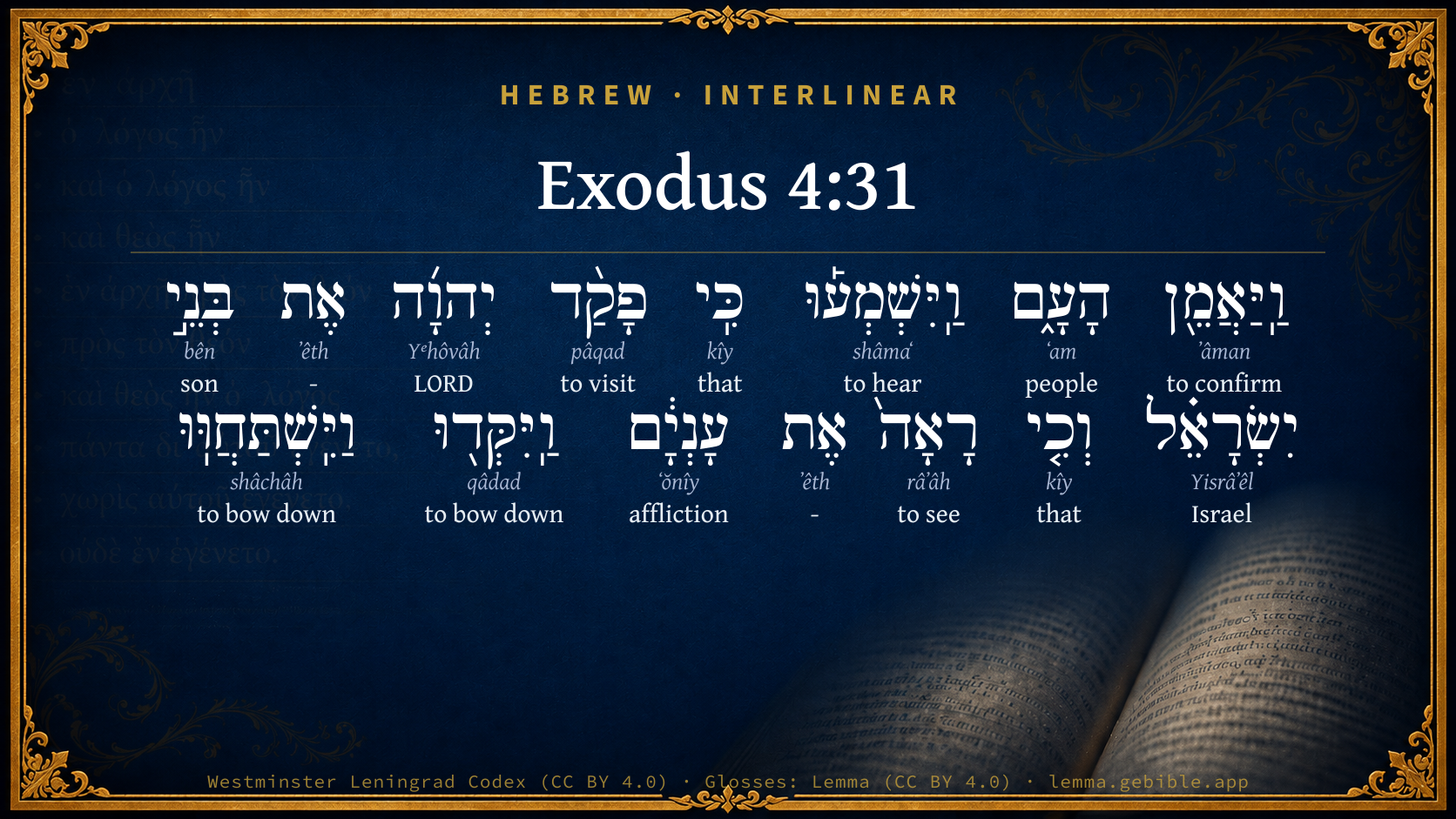
Hebrew (Westminster Leningrad Codex) Exodus 4:31 appears in the Hebrew Old Testament. The text above is from the Westminster Leningrad Codex. Each word links to its Strong’s number, a concise gloss, and parsing drawn from the Open Scriptures Hebrew Bible morphology. Click any word for its full Brown-Driver-Briggs (BDB) entry.
Download image
Cite this verse

Exodus 4:31 (World English Bible). Public Domain. Lemma interlinear Bible study tool, https://lemma.gebible.app/v/exodus/4/31.

Show BibTeX & RIS
BibTeX
RIS
English Translation
The people believed, and when they heard that Yahweh had visited the children of Israel, and that he had seen their affliction, then they bowed their heads and worshiped.
World English Bible · Public Domain
Download a study sheet

One document with this verse’s original text, its word-by-word gloss line, the meaning frame, cross-references with their text, attributed commentary, and full source and license credits — printable, and it pastes into notes with its structure intact.

This verse Autodidact and up

Study sheet (.html) Plain text (.txt)

A passage Seminary Student

Up to 50 verses in one chapter. A passage sheet keeps up to 6 commentary sources and 12 cross-references per verse, in the order this page ranks them, and says so on the sheet whenever that leaves anything out. Ask for a single verse and you get the Autodidact verse sheet above.

Everything on this page stays free to read, with no account — the sheet is a download of what is already on screen, not access to it.

Want to remove ads? Support Godless Engineer
Compare translations 3

The same verse in 3 English versions, stacked beneath the original-language interlinear above. Click any original word for its lexicon entry.

Each is an independent rendering of the whole verse — the interlinear is not word-aligned to these translations.

Highlighted words mark where these versions differ — a whole-verse word diff, not a word-by-word alignment.

  • World English Bible Public Domain
    The people believed, and when they heard that Yahweh had visited the children of Israel, and that he had seen their affliction, then they bowed their heads and worshiped.
  • King James Version Public Domain
    And the people believed: and when they heard that the LORD had visited the children of Israel, and that he had looked upon their affliction, then they bowed their heads and worshipped.
  • unfoldingWord Literal Text CC BY-SA 4.0
    and the people believed. And they heard that Yahweh had attended to the sons of Israel and that he had seen their affliction, and they bowed and prostrated themselves.

unfoldingWord Literal Text — © unfoldingWord, licensed CC BY-SA 4.0. Word-aligned USFM3 via Door43 (git.door43.org/unfoldingWord/en_ult).

Versions to compare (up to 4)

3 of 4 selected

Show all 18 translations

Every available English version of this verse, each an independent rendering of the whole verse.

  • World English Bible Public Domain
    The people believed, and when they heard that Yahweh had visited the children of Israel, and that he had seen their affliction, then they bowed their heads and worshiped.
  • Berean Standard Bible Public Domain
    and they believed. And when they heard that the LORD had attended to the Israelites and had seen their affliction, they bowed down and worshiped.
  • Majority Standard Bible Public Domain
    and they believed. And when they heard that the LORD had attended to the Israelites and had seen their affliction, they bowed down and worshiped.
  • King James Version Public Domain
    And the people believed: and when they heard that the LORD had visited the children of Israel, and that he had looked upon their affliction, then they bowed their heads and worshipped.
  • American Standard Version (1901) Public Domain
    And the people believed: and when they heard that Jehovah had visited the children of Israel, and that he had seen their affliction, then they bowed their heads and worshipped.
  • Revised Version (1885) Public Domain
    And the people believed: and when they heard that the LORD had visited the children of Israel, and that he had seen their affliction, then they bowed their heads and worshipped.
  • Geneva Bible (1599) Public Domain
    And the people beleeued, and when they heard that the Lord had visited the children of Israel, and had looked vpon their tribulation, they bowed downe, and worshipped.
  • Douay-Rheims (1899) Public Domain
    And the people believed. And they heard that the Lord had visited the children of Israel: and that he had looked upon their affliction: and falling down they adored.
  • Young's Literal Translation Public Domain
    and the people believe when they hear that Jehovah hath looked after the sons of Israel, and that He hath seen their affliction; and they bow and do obeisance.
  • Literal Standard Version CC BY-SA 4.0
    and the people believe when they hear that YHWH has looked after the sons of Israel, and that He has seen their affliction; and they bow and pay respect.
  • Unlocked Literal Bible CC BY-SA 4.0
    The people believed. When they heard that Yahweh had observed the Israelites and that he had seen their oppression, then they bowed their heads and worshiped him.
  • unfoldingWord Literal Text CC BY-SA 4.0
    and the people believed. And they heard that Yahweh had attended to the sons of Israel and that he had seen their affliction, and they bowed and prostrated themselves.
  • Darby Bible Public Domain
    And the people believed. And when they heard that Jehovah had visited the children of Israel, and that he had seen their affliction, then they bowed their heads and worshipped.
  • World Messianic Bible Public Domain
    The people believed, and when they heard that the LORD had visited the children of Israel, and that he had seen their affliction, then they bowed their heads and worshiped.
  • Webster's Bible Public Domain
    And the people believed: and when they heard that the LORD had visited the children of Israel, and that he had looked upon their affliction, then they bowed their heads, and worshiped.
  • Free Bible Version CC BY-SA 4.0
    The Israelites were convinced. When they heard that the Lord had come to them, and that he had been touched by their suffering, they bowed their heads and worshiped.
  • Bible in Basic English Public Domain
    And the people had faith in them; and hearing that the Lord had taken up the cause of the children of Israel and had seen their troubles, with bent heads they gave him worship.
  • JPS Tanakh (1917) Public Domain
    And the people believed; and when they heard that the LORD had remembered the children of Israel, and that He had seen their affliction, then they bowed their heads and worshipped.

Literal Standard Version (2020), Covenant Press — licensed CC BY-SA 4.0. Text via the HelloAO Bible API (eBible.org). Unlocked Literal Bible (unfoldingWord) — licensed CC BY-SA 4.0. Text via the HelloAO Bible API (eBible.org). unfoldingWord Literal Text — © unfoldingWord, licensed CC BY-SA 4.0. Word-aligned USFM3 via Door43 (git.door43.org/unfoldingWord/en_ult). Free Bible Version, Dr. Jonathan Gallagher — licensed CC BY-SA 4.0. Text via the HelloAO Bible API (eBible.org).

Word by word

More ways to search: Search by grammar → Find every occurrence → Compare this word →

Practice this passage: Drill this verse → Learn its vocabulary →

וַֽיִּקְּד֖וּ
qâdad
H6915
“and · to bow down”
Conjunction + Verb, Qal, Sequential Imperfect, 3rd Person, Masculine, Plural
Part of Speech
Conjunction + Verb
Stem
Qal
Form
Sequential Imperfect
Person
3rd Person
Gender
Masculine
Number
Plural
Full BDB Definition

Origin: a primitive root

TWOT: 1985

(Qal) to bow down
  1. וַֽיַּאֲמֵ֖ן ʼâman H539 “and · to confirm” Conjunction + Verb, Hiphil, Sequential Imperfect, 3rd Person, Masculine, Singular
  2. הָעָ֑ם ʻam H5971 “the · people” Particle, Definite Article + Noun, Common, Masculine, Singular, Absolute
  3. וַֽיִּשְׁמְע֡וּ shâmaʻ H8085 “and · to hear” Conjunction + Verb, Qal, Sequential Imperfect, 3rd Person, Masculine, Plural
  4. כִּֽי kîy H3588 “that” Conjunction
  5. פָקַ֨ד pâqad H6485 “to visit” Verb, Qal, Perfect, 3rd Person, Masculine, Singular
  6. יְהוָ֜ה Yᵉhôvâh H3068 “LORD” Noun, Proper
  7. אֶת ʼêth H853 “-” Particle, Direct Object
  8. בְּנֵ֣י bên H1121 “sons of” Noun, Common, Masculine, Plural, Construct
  9. יִשְׂרָאֵ֗ל Yisrâʼêl H3478 “Israel” Noun, Proper
  10. וְכִ֤י kîy H3588 “and · that” Conjunction + Conjunction
  11. רָאָה֙ râʼâh H7200 “to see” Verb, Qal, Perfect, 3rd Person, Masculine, Singular
  12. אֶת ʼêth H853 “-” Particle, Direct Object
  13. עָנְיָ֔ם ʻŏnîy H6040 “affliction · their” Noun, Common, Masculine, Singular, Construct + Suffix, Personal, 3rd Person, Masculine, Plural
  14. וַיִּֽשְׁתַּחֲוּֽוּ shâchâh H7812 “and · to bow down” Conjunction + Verb, Hishtaphel, Sequential Imperfect, 3rd Person, Masculine, Plural

About this verse

These counts appear in no published source. They are computed here, from the morphology-tagged text and Lemma’s own curated glosses. What Lemma adds →

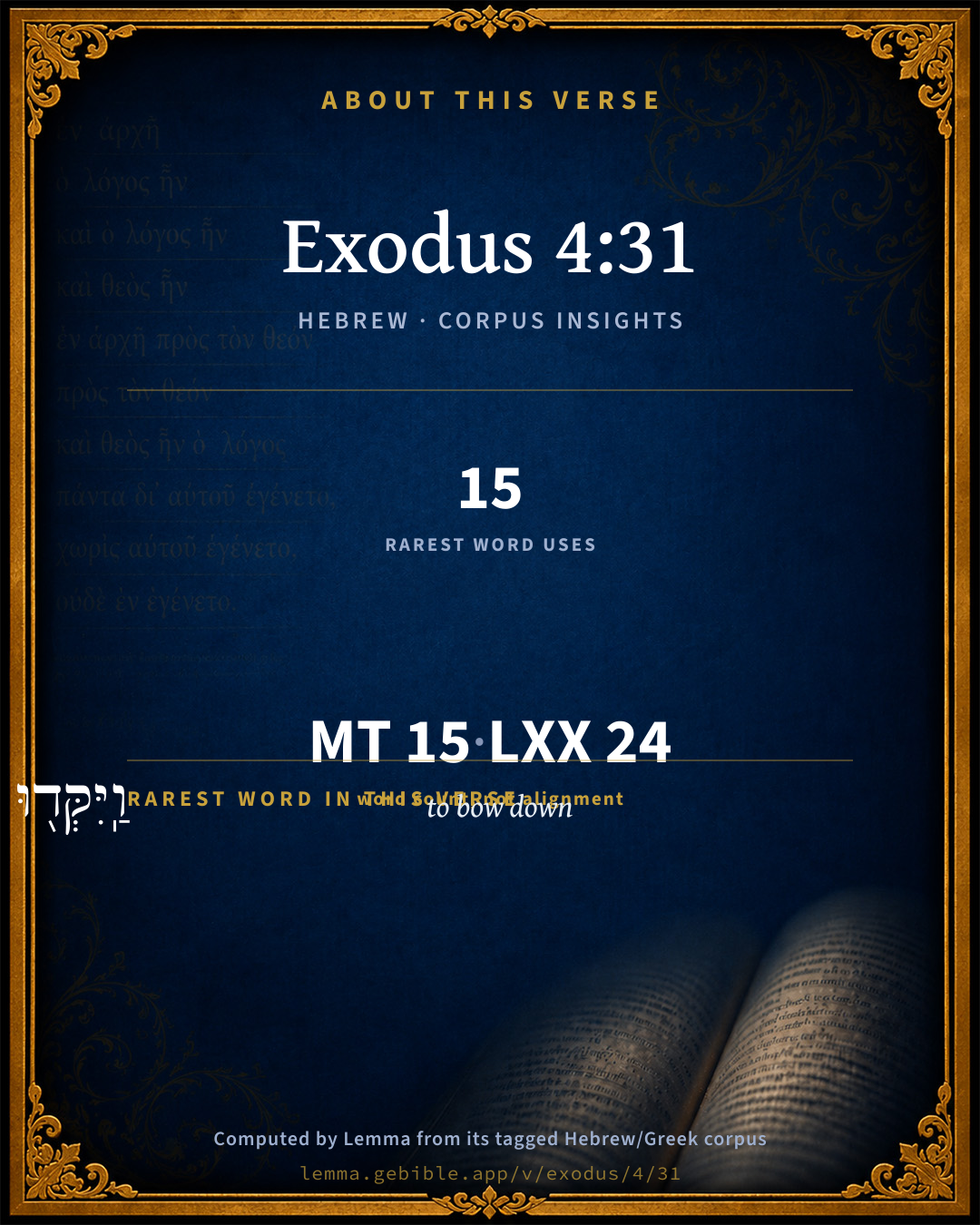
15
words
13
distinct lemmas
Pentateuch
section

Notable vocabulary

The rarest word here is וַֽיִּקְּד֖וּ to bow down H6915 — appearing just 15 times in the whole Hebrew Bible.

Shared distinctive vocabulary

וַֽיִּקְּד֖וּ to bow down H6915 occurs in 15 verses of the Hebrew Bible. Also found in:

Grammatical profile

  • 6 verbs
  • 5 nouns
  • 2 conjunctions
  • 2 particles

Verb forms

  • וַֽיַּאֲמֵ֖ן Hiphil · Sequential Imperfect
  • וַֽיִּשְׁמְע֡וּ Qal · Sequential Imperfect
  • פָקַ֨ד Qal · Perfect
  • רָאָה֙ Qal · Perfect
  • וַֽיִּקְּד֖וּ Qal · Sequential Imperfect
  • וַיִּֽשְׁתַּחֲוּֽוּ Hishtaphel · Sequential Imperfect

Repetition

A word recurs within this verse — often emphatic in Hebrew:

  • כִּֽי that H3588 ×2

Hebrew & Septuagint length

In English translation the verse runs 29 words from the Hebrew and 25 from the Septuagint (LXX English) — closely comparable.

A rough comparison of the two English renderings, which tokenize alike — not a word-level alignment.

Word counts can differ between the Hebrew and the Greek without any difference in meaning — e.g. the Hebrew direct-object marker אֵת has no separate Greek word, and Greek often adds the article ὁ.

In the original languages it is 15 Hebrew tokens and 24 Greek tokens — but the two are counted differently (Hebrew bundles its prefixes and suffixes into one token; the Greek is in lemma form), so that isn’t a like-for-like length.

Cross-references

13

Topical passages linked to Exodus 4:31 in the Treasury of Scripture Knowledge — connected by theme and wording, ordered by reader-vote popularity; previews shown in the World English Bible.

  • Exodus 3:18 They will listen to your voice, and you shall come, you and the elders of Israel, to the king of Egypt, and you shall tell him, 'Yahweh, the God of the Hebrews, has met with us. Now please let us go three days' journey into the wilderness, that we may sacrifice to Yahweh, our God.'
  • Exodus 2:25 God saw the children of Israel, and God was concerned about them.
  • Exodus 12:27 that you shall say, 'It is the sacrifice of Yahweh's Passover, who passed over the houses of the children of Israel in Egypt, when he struck the Egyptians, and spared our houses.'" The people bowed their heads and worshiped.
  • Psalms 106:12–13 Then they believed his words. They sang his praise.
  • Genesis 24:26 The man bowed his head, and worshiped Yahweh.
  • Exodus 3:7 Yahweh said, "I have surely seen the affliction of my people who are in Egypt, and have heard their cry because of their taskmasters, for I know their sorrows.
  • Exodus 3:16 Go, and gather the elders of Israel together, and tell them, 'Yahweh, the God of your fathers, the God of Abraham, of Isaac, and of Jacob, has appeared to me, saying, "I have surely visited you, and seen that which is done to you in Egypt;
  • Luke 8:13 Those on the rock are they who, when they hear, receive the word with joy; but these have no root, who believe for a while, then fall away in time of temptation.
  • Exodus 4:8–9 "It will happen, if they will neither believe you nor listen to the voice of the first sign, that they will believe the voice of the latter sign.
  • 1 Chronicles 29:20 David said to all the assembly, Now bless Yahweh your God. All the assembly blessed Yahweh, the God of their fathers, and bowed down their heads, and worshiped Yahweh, and the king.
  • Genesis 17:3 Abram fell on his face. God talked with him, saying,
  • 2 Chronicles 20:18 Jehoshaphat bowed his head with his face to the ground; and all Judah and the inhabitants of Jerusalem fell down before Yahweh, worshipping Yahweh.
  • Luke 1:68 "Blessed be the Lord, the God of Israel, For he has visited and worked redemption for his people;

Cross-references courtesy of OpenBible.info (CC BY 4.0).

Hebrew and Greek witnesses Masoretic Hebrew ↔ Greek Septuagint

The same verse in the two great witnesses to the Old Testament, shown verse-for-verse.

These are two independent witnesses, not word-aligned to each other, and the Septuagint is shown in lemma (dictionary) form.

Hebrew Exodus 4:31 Masoretic · Westminster Leningrad Codex

וַֽיַּאֲמֵ֖ן הָעָ֑ם וַֽיִּשְׁמְע֡וּ כִּֽי פָקַ֨ד יְהוָ֜ה אֶת בְּנֵ֣י יִשְׂרָאֵ֗ל וְכִ֤י רָאָה֙ אֶת עָנְיָ֔ם וַֽיִּקְּד֖וּ וַיִּֽשְׁתַּחֲוּֽוּ

The people believed, and when they heard that Yahweh had visited the children of Israel, and that he had seen their affliction, then they bowed their heads and worshiped.

World English Bible · Public Domain

Greek LXX Exodus 4:31 Septuagint · lemma form

καί πιστεύω ὁ λαός καί χαίρω ὅτι ἐπισκέπτω ὁ θεός ὁ υἱός ἰσραήλ καί ὅτι ὁράω αὐτός ὁ θλῖψις κύπτω δέ ὁ λαός προςκυνέω

and the people believed and rejoiced, because God visited the children of Israel, and because he saw their affliction: and the people bowed and worshipped.

LXX2012 (modern English Septuagint) · Public Domain

On this verse, The Cambridge Bible for Schools and Colleges discusses the Septuagint’s reading. Read the note in Commentary ↓

Hebrew: Westminster Leningrad Codex (CC BY 4.0). Greek: Septuagint (public domain); English from LXX2012 (modern English Septuagint) (Public Domain). How the Septuagint differs from the Hebrew →

Targum (Aramaic paraphrase)

2

The Targum is the ancient Jewish Aramaic paraphrase of the Hebrew Scriptures — an interpretive translation, not the Hebrew text itself. Onkelos (literal) and Pseudo-Jonathan (expansive) render the Torah, and Jonathan the Prophets. Coverage is partial: where no permissively-licensed English translation exists for a verse, only the Aramaic is shown. This is verse-level text, not a word-by-word alignment to the Hebrew.

  1. Targum Onkelos Torah (Genesis–Deuteronomy)
    וְהֵימִן עַמָא וּשְׁמָעוּ אֲרֵי דְכִיר יְיָ יָת בְּנֵי יִשְׂרָאֵל וַאֲרֵי גְלֵי קֳדָמוֹהִי יָת שִׁעְבּוּדְהוֹן וּכְרָעוּ וּסְגִידוּ:

    (no public-domain English translation for this verse)

    Targum Onkelos — Aramaic: “Onkelos Genesis” (public domain); “Onkelos Exodus” (public domain); “Onkelos Leviticus” (public domain); “Onkelos Numbers” (public domain); “Onkelos Deuteronomy” (public domain). English: “Sefaria Community Translation” (CC0 1.0 (public-domain dedication)); “J.W. Etheridge. The Targums of Onkelos and Jonathan Ben Uzziel on the Pentateuch. London: Longmans, Green, 1862” (public domain). Text via Sefaria.

  2. Targum Pseudo-Jonathan Torah (Genesis–Deuteronomy)
    וְהֵימִין עַמָא וּשְׁמָעוּ אֲרוּם דְכִיר יְיָ יַת בְּנֵי יִשְרָאֵל וַאֲרוּם גְלֵי קֳדָמוֹי שִׁעְבּוּדְהוֹן וּגְחָנַן וּסְגִידוּ

    And the people believed, and heard that the Lord had remembered the sons of Israel, and that their bondage was manifest before Him; and they bowed themselves and worshipped.

    Targum Pseudo-Jonathan — Aramaic: “Targum Jonathan on Genesis” (public domain); “Targum Jonathan on Exodus” (public domain); “Targum Jonathan on Leviticus” (public domain); “Targum Jonathan on Numbers” (public domain); “Targum Jonathan on Deuteronomy” (public domain). English: “The Targum of Jonathan ben Uzziel, trans. J. W. Etheridge, London, 1862” (public domain). Text via Sefaria.

Commentary

Notes on Exodus 4:31 from classic Christian and Jewish commentators (each source and its license shown beneath its notes). The classic Christian expositions comment on the surrounding passage and are grouped to its opening verse, so a note may address several verses; the Jewish commentaries on the Tanakh (Rashi and others) are per-verse, so they appear only where the commentator wrote on this verse.

Lemma curates 59 commentaries, every one of them public domain or Creative Commons licensed, each selected and text-cleaned for this edition rather than reprinted as found. About our sources →

Trapp's Complete Commentary

John Trapp

Exo 4:31 And the people believed: and when they heard that the LORD had visited the children of Israel, and that he had looked upon their affliction, then they bowed their heads and worshipped.

Ver. 31. They bowed their heads.] An ordinary gesture among the Jews then: as at this day, the reverence they show is in standing up, and the gesture of adoration in the bowing forward of their bodies: for, kneeling they use none, neither stir they their bonnets in their synagogues to any man, but remain still covered. {a}

{a} Spec. Europ.

John Trapp, A Commentary or Exposition upon All the Books of the Old and New Testament (1647–1656) — public domain. Text from a community e-Sword module.

The Biblical Illustrator

Joseph S. Exell

Exo_4:31

The people believed.

Lessons

1. The peoples faith should closely follow upon Gods word ministered, and by His works confirmed. A good connection.

2. Where God promiseth success to His ministers in the faith of others, there they shall believe (Exo_3:18).

3. All professed believers, receive not Gods word with the same faith.

4. Hearing is the usual sense of bringing in faith and the fruits of it.

5. Gods gracious visitation of His Church, and providential sight of its afflictions, is very good to be heard by them.

6. Such hearing of Gods visiting love and redeeming providence must affect Gods Israel.

7. Faith working by this sense stirs up souls to suitable returns unto God.

8. The humblest and sincerest worship in body and spirit is the most suitable return to God for His redemption. (G. Hughes, B. D.)

Human and Divine attitudes

I. The attitudes predicated of the people.

1. Their belief.

2. Their reverence.

3. Their devotion.

II. The attitudes predicated of God.

1. He saw the affliction of Israel.

2. Visited Israel. (J. S. Exell, M. A.)

Faith easy when in the line of desire

People are a great deal more apt to receive a message as from God when it is in the line of their own longings. The Israelites were quick to receive from God a promise of relief from Egyptian brick-making, readier to worship than when they wanted water or meat on the desert and failed to find it ready at hand for them. And they were very much like the rest of us in all this. How we should bow our heads and worship if the one inner longing of our hearts at this moment were granted to us, or even promised of God, all of a sudden! But how is it while God keeps back from us that which we long for, and we know that He is prompted to His course by both wisdom and love? Do we bow our heads and worship, all the same? Well, we bow our heads; but not always to worship. (H. C. Trumbull.)

Confidence in God

The Roman noblemen could give no greater proof of their confidence in their city and army, than when they bought the land on which their Carthaginian enemies were encamped around the city. And we can give no greater proof of our confidence in God, than by trusting Him in the land which our enemies, darkness and sickness and trouble, seem to possess, and acting as if He were their master, and mightier than they all. (W. Baxendale.)

The believing people

I. God always furnishes sufficient evidence to justify belief. Moses was a stranger to the people; Aaron doubtless well known. He had a welcome message--deliverance. Miracles in outward form: miracles typical in character: rod changed to a serpent and back, Moses changed from a shepherd to a ruler; cleansing of leprosy, the purifying of the human for Divine use.

II. Hearing precedes believing. God sent Aaron to speak. Ministers sent to preach.

III. The Israelites manifest their faith publicly. We must confess Christ in token of faith.

IV. God prepares the way for the reception of His truth. Aaron called to meet Moses. Gods Spirit precedes and accompanies the truth we utter.

V. Faith secures deliverance. By it the Israelites secured theirs. So must we by ours. It is unto us according to our faith. (Dr. Fowler.)

Bowed heads

1. Some heads are bowed with business cares. During the last four years many homes have been broken, and others sadly reduced, not so much through mens own folly, as from the long and serious depression in trade.

2. Some heads are bowed with sorrow over sinful children. That never-fading picture of the Prodigal Son, painted by a master hand, is often too truly representative of our own families. Young men, think of all the pain and anguish you cause for those dear parents by your lives of sin.

3. Some heads are bowed with bereavement. To many of us there have come dark days of sorrow and pain. Roses have withered in our domestic gardens; buds have been nipped before they had time to bloom; lights we loved have gone out. (Charles Leach.)

.

The Biblical Illustrator, edited by Joseph S. Exell (c. 1880s–1900s) — public domain. Text from a community e-Sword module.

Joseph Benson's Commentary

Exo 4:31. The people believed — That Moses was God’s messenger, sent for their deliverance, and bowed their heads, and worshipped Jehovah as the true God, and the God of their fathers, acknowledging his goodness, and testifying their gratitude for his thus graciously visiting them.

Joseph Benson's Commentary on the Old and New Testaments (1811–1818) — public domain. Text from a community e-Sword module.

Tyndale Open Study Notes

Tyndale Open Resources

4:31 the people of Israel were convinced: The initial response to the good news was one of faith and worship. Contrast the response of panic in 14:10-12, when they saw Pharaoh chasing them.

Tyndale Open Study Notes — © Tyndale Open Resources, licensed CC BY-SA 4.0. Text via the HelloAO Bible API.

Geneva Bible (1599)

Geneva Bible translators

So that Moses had now experience of God’s promise that he should have good success.

Geneva Bible (1599) marginal notes — public domain. Text via Bolls.life.

Adam Clarke's Commentary

Verse 31. The people believed] They credited the account given of the Divine appointment of Moses and Aaron to be their deliverers out of their bondage, the miracles wrought on the occasion confirming the testimony delivered by Aaron.

They bowed their heads and worshipped.] See a similar act mentioned, and in the same words, Ge 24:26. The bowing the head, c., here, may probably refer to the eastern custom of bowing the head down to the knees, then kneeling down and touching the earth with the forehead. This was a very painful posture and the most humble in which the body could possibly be placed. Those who pretend to worship God, either by prayer or thanksgiving, and keep themselves during the performance of those solemn acts in a state of perfect ease, either carelessly standing or stupidly sitting, surely cannot have a due sense of the majesty of God, and their own sinfulness and unworthiness. Let the feelings of the body put the soul in remembrance of its sin against God. Let a man put himself in such a position (kneeling for instance) as it is generally acknowledged a criminal should assume, when coming to his sovereign and judge to bewail his sins, and solicit forgiveness.

The Jewish custom, as we learn from Rabbi Maymon, was to bend the body so that every joint of the backbone became incurvated, and the head was bent towards the knees, so that the body resembled a bow and prostration implied laying the body flat upon the earth, the arms and legs extended to the uttermost, the mouth and forehead touching the ground. In Mt 8:2 the leper is said to worship our Lord, προσεκυνει αυτω. but in Lu 5:12 he is said to have fallen on his face, πεσων επι προσωπον. These two accounts show that he first kneeled down, probably putting his face down to his knees, and touching the earth with his forehead; and then prostrated himself, his legs and arms being both extended. See Clarke on Ge 17:3.

THE backwardness of Moses to receive and execute the commission to deliver the children of Israel, has something very instructive in it. He felt the importance of the charge, his own insufficiency, and the awful responsibility under which he should be laid if he received it. Who then can blame him for hesitating? If he miscarried (and how difficult in such a case not to miscarry!) he must account to a jealous God, whose justice required him to punish every delinquency. What should ministers of the Gospel feel on such subjects? Is not their charge more important and more awful than that of Moses? How few consider this! It is respectable, it is honourable, to be in the Gospel ministry, but who is sufficient to guide and feed the flock of God? If through the pastor's unfitness or neglect any soul should go astray, or perish through want of proper spiritual nourishment, or through not getting his portion in due season, in what a dreadful state is the pastor! That soul, says God, shall die in his iniquities, but his blood will I require at the watchman's hands! Were these things only considered by those who are candidates for the Gospel ministry, who could be found to undertake it? We should then indeed have the utmost occasion to pray the Lord of the harvest, εκβαλλειν, to THRUST OUT labourers into the harvest, as no one, duly considering those things would go, unless thrust out by God himself. O ye ministers of the sanctuary! tremble for your own souls, and the souls of those committed to your care, and go not into this work unless God go with you. Without his presence, unction, and approbation, ye can do nothing.

Adam Clarke's Commentary on the Bible (1810–1826) — public domain. Text from a community e-Sword/MySword module.

The Cambridge Bible for Schools and Colleges

gen. ed. J. J. S. Perowne

31. The people believe in Moses’ commission, as Jehovah had assured him that they would do (Exo_3:18 a, Exo_4:8-9); and bow the heads in reverence and gratitude when they hear that Jehovah has visited (Exo_3:16) His people.

and when, &c.] Heb. and they heard …, and they bowed. LXX. for and they heard (וישמעו) have and they rejoiced (וישמחו); no doubt rightly.

The Cambridge Bible for Schools and Colleges (gen. ed. J. J. S. Perowne; Cambridge University Press, 1878–1918) — public domain. Text from a community e-Sword module.

Matthew Poole's English Annotations

Had visited, i.e. taken cognizance of their cause and condition, and resolved to deliver them,

they bowed their heads and worshipped; acknowledging and adoring the kindness and faithfulness of God thereto.

Matthew Poole's English Annotations on the Holy Bible (1683–1685) — public domain. Text from a community e-Sword/MySword module.

The Pulpit Commentary

The people believed. This ready faith stands in strong contrast with the ordinary incredulous temper of the Israelitish people, who were "a faithless and stubborn generation a generation that "believed not in God, and trusted not in his salvation". (Psa_78:22) It would seem that under the pressure of affliction having, humanly speaking, no hope the stubborn spirit of the people had given way, and they were content to look to Jehovah and accept his promises, and believe in his messengers, notwithstanding their natural scepticism. No doubt the novelty of miracles helped to produce this state of feeling; and the fact that they were not called upon at present for any active exertion made acquiescence in what Moses put before them easier. When they heard that the Lord had visitedi.e. when the message contained in Exo_3:16 was delivered to them. And that he had looked upon their affliction. Compare, Exo_3:7. They bowed their heads. Rather "they bowed down" (Kalisch) or "inclined themselves." And worshipped. Some understand an act of respect and ho-mage done to Moses and Aaron, in token of their acceptance by the people as leaders; but, though the words employed are sometimes used in this sense, the context is opposed to their having this sense in this place. "When the people heard that the Lord had visited the children of Israel they bowed down and worshipped." Whom? Surely, the Lord.

Worship the proper outcome of thankfulness.

Israel, down-trodden, oppressed, crushed beneath an intolerable tyranny, no sooner hears the promise of deliverance, than it displays its gratitude by "bowing the head and worshipping." Many Christians talk of being thankful for God"s blessings vouchsafed to them, but never think of showing forth their thankfulness by any extra act of worship, or even any increased intensity in that portion of their ordinary worship which consists in thanksgiving. A sad sign this of modern lukewarmness, an indication that the "last times are drawing near, when "the love of many shall wax cold." Time was when each national success was at once celebrated by a "Te Deum," and when each blessing granted to an individual drew forth a special offering. The thankfulness that does not show itself in some such overt act must be a very poor thankfulness, a very weak and washed-out feeling.

The Pulpit Commentary (1880–1919), ed. H.D.M. Spence-Jones & Joseph S. Exell — public domain. Text from a community e-Sword module.

Lesson kit

Teaching starters — assembled from the data on this page, not authored interpretation. Every prompt links to the verse data it draws on. Edit before teaching.

Exodus, in the Pentateuch, opens this verse with 15 words (13 distinct Hebrew lemmas). Its most distinctive word is qâdad (“to bow down”). A historical commentator’s framing appears above. Read the whole chapter for the surrounding context.

Discussion questions

  1. How does “to bow down” (qâdad) shape what this verse is saying?
  2. Genesis 24:26 shares the word «to bow down» with this verse. How do the two illuminate each other?
  3. “that” occurs 2× in this one verse. What is the effect of the repetition?
  4. These translations render this verse differently. What is at stake in choosing one wording over another?
  5. The verb «וַֽיַּאֲמֵ֖ן» is Hiphil Sequential Imperfect. How does its form color the action?
  6. Reading how Trapp's Complete Commentary and The Biblical Illustrator read this verse, where do the two commentators agree and where do they part?

Things to notice

Reading settings

Reading text

Shown beneath each verse's original-language words.

Old Testament
Old Testament edition

Read the OT as the Masoretic Hebrew (MT) or the Greek Septuagint (LXX).

English shown for the Greek Septuagint (in the Hebrew ↔ Greek comparison).

Comparing translations? Open the Compare panel on any verse page to stack up to four side by side.