1 Chronicles 29:14

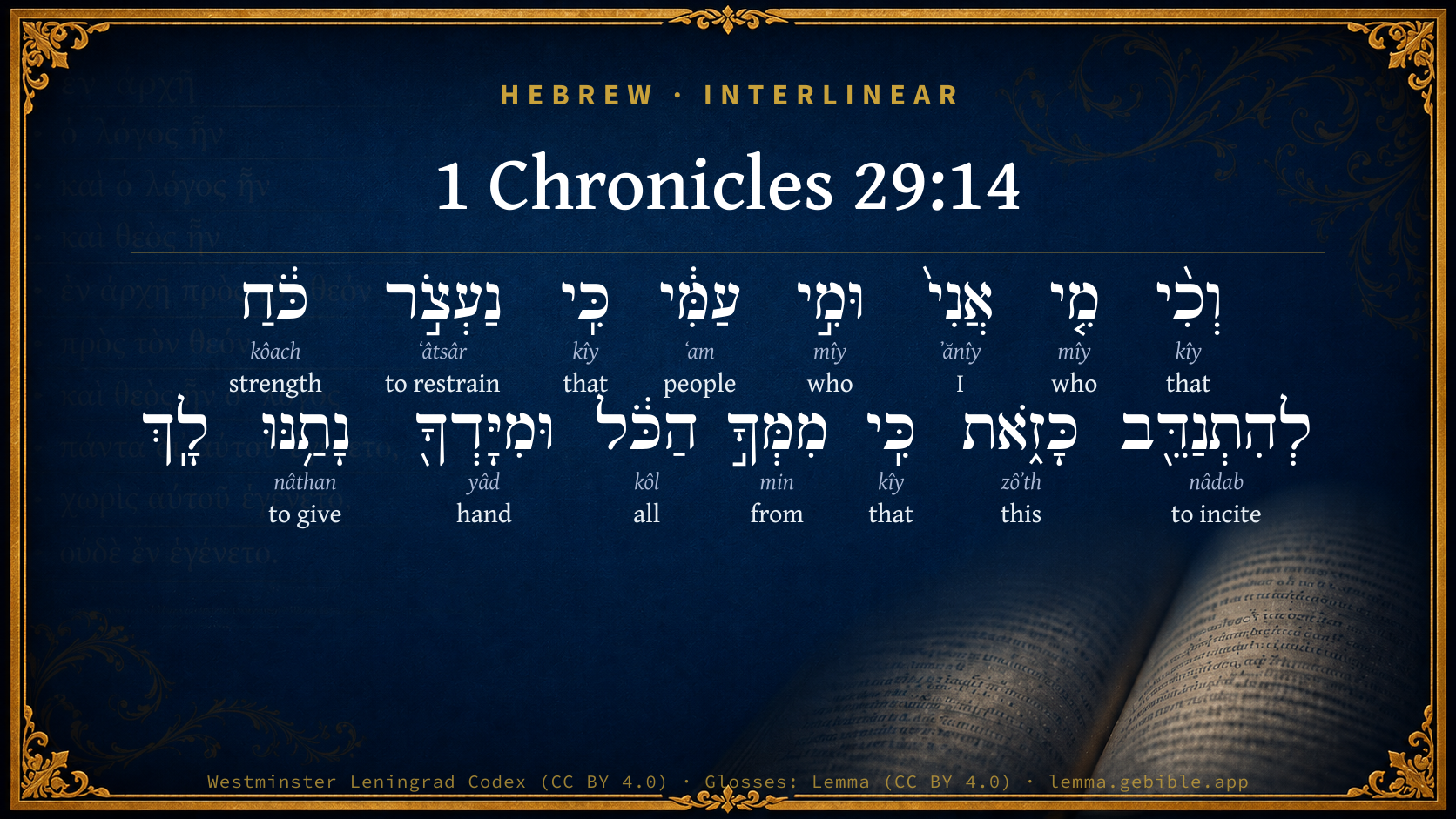
Hebrew (Westminster Leningrad Codex) 1 Chronicles 29:14 appears in the Hebrew Old Testament. The text above is from the Westminster Leningrad Codex. Each word links to its Strong’s number, a concise gloss, and parsing drawn from the Open Scriptures Hebrew Bible morphology. Click any word for its full Brown-Driver-Briggs (BDB) entry.
Download image
Cite this verse

1 Chronicles 29:14 (World English Bible). Public Domain. Lemma interlinear Bible study tool, https://lemma.gebible.app/v/1-chronicles/29/14.

Show BibTeX & RIS
BibTeX
RIS
English Translation
But who am I, and what is my people, that we should be able to offer so willingly as this? For all things come of you, and of your own have we given you.
World English Bible · Public Domain
Download a study sheet

One document with this verse’s original text, its word-by-word gloss line, the meaning frame, cross-references with their text, attributed commentary, and full source and license credits — printable, and it pastes into notes with its structure intact.

This verse Autodidact and up

Study sheet (.html) Plain text (.txt)

A passage Seminary Student

Up to 50 verses in one chapter. A passage sheet keeps up to 6 commentary sources and 12 cross-references per verse, in the order this page ranks them, and says so on the sheet whenever that leaves anything out. Ask for a single verse and you get the Autodidact verse sheet above.

Everything on this page stays free to read, with no account — the sheet is a download of what is already on screen, not access to it.

Want to remove ads? Support Godless Engineer
Compare translations 3

The same verse in 3 English versions, stacked beneath the original-language interlinear above. Click any original word for its lexicon entry.

Each is an independent rendering of the whole verse — the interlinear is not word-aligned to these translations.

Highlighted words mark where these versions differ — a whole-verse word diff, not a word-by-word alignment.

  • World English Bible Public Domain
    But who am I, and what is my people, that we should be able to offer so willingly as this? For all things come of you, and of your own have we given you.
  • King James Version Public Domain
    But who am I, and what is my people, that we should be able to offer so willingly after this sort? for all things come of thee, and of thine own have we given thee.
  • unfoldingWord Literal Text CC BY-SA 4.0
    And for who I, and who my people, that we should have the power to offer freely like this? For everything from you, and from your hand we have given to you.

unfoldingWord Literal Text — © unfoldingWord, licensed CC BY-SA 4.0. Word-aligned USFM3 via Door43 (git.door43.org/unfoldingWord/en_ult).

Versions to compare (up to 4)

3 of 4 selected

Show all 18 translations

Every available English version of this verse, each an independent rendering of the whole verse.

  • World English Bible Public Domain
    But who am I, and what is my people, that we should be able to offer so willingly as this? For all things come of you, and of your own have we given you.
  • Berean Standard Bible Public Domain
    But who am I, and who are my people, that we should be able to give as generously as this? For everything comes from You, and from Your own hand we have given to You.
  • Majority Standard Bible Public Domain
    But who am I, and who are my people, that we should be able to give as generously as this? For everything comes from You, and from Your own hand we have given to You.
  • King James Version Public Domain
    But who am I, and what is my people, that we should be able to offer so willingly after this sort? for all things come of thee, and of thine own have we given thee.
  • American Standard Version (1901) Public Domain
    But who am I, and what is my people, that we should be able to offer so willingly after this sort? for all things come of thee, and of thine own have we given thee.
  • Revised Version (1885) Public Domain
    But who am I, and what is my people, that we should be able to offer so willingly after this sort? for all things come of thee, and of thine own have we given thee.
  • Geneva Bible (1599) Public Domain
    But who am I, and what is my people, that we shoulde be able to offer willingly after this sort? for all things come of thee: and of thine owne hand we haue giuen thee.
  • Douay-Rheims (1899) Public Domain
    Who am I, and what is my people, that we should be able to promise thee all these things? all things are thine: and we have given thee what we received of thy hand.
  • Young's Literal Translation Public Domain
    yea, because, who `am' I, and who `are' my people, that we retain power to offer thus willingly? but of Thee `is' the whole, and out of Thy hand we have given to Thee;
  • Literal Standard Version CC BY-SA 4.0
    indeed, because who [am] I, and who [are] my people, that we retain power to offer thus willingly? But the whole [is] from You, and we have given to You out of Your [own] hand;
  • Unlocked Literal Bible CC BY-SA 4.0
    But who am I, and who are my people, that we should be able to offer so willingly these things? Indeed, all things come from you, and we have simply given back to you what is yours.
  • unfoldingWord Literal Text CC BY-SA 4.0
    And for who I, and who my people, that we should have the power to offer freely like this? For everything from you, and from your hand we have given to you.
  • Darby Bible Public Domain
    But who am I, and what is my people, that we should be able to offer willingly after this manner? for all is of thee, and of that which is from thy hand have we given thee.
  • World Messianic Bible Public Domain
    But who am I, and what is my people, that we should be able to offer so willingly as this? For all things come from you, and we have given you of your own.
  • Webster's Bible Public Domain
    But who am I, and what is my people, that we should be able to offer so willingly after this sort? for all things come from thee, and of thy own have we given thee.
  • Free Bible Version CC BY-SA 4.0
    But who am I, and who are my people, that we are able to give as willingly as this? For everything we have comes from you—we are only giving back what you have given us.
  • Bible in Basic English Public Domain
    But who am I and what is my people, that we have power to give so freely in this way? for all things come from you, and what we have given you is yours.
  • JPS Tanakh (1917) Public Domain
    But who am I, and what is my people, that we should be able to offer so willingly after this sort? for all things come of Thee, and of Thine own have we given Thee.

Literal Standard Version (2020), Covenant Press — licensed CC BY-SA 4.0. Text via the HelloAO Bible API (eBible.org). Unlocked Literal Bible (unfoldingWord) — licensed CC BY-SA 4.0. Text via the HelloAO Bible API (eBible.org). unfoldingWord Literal Text — © unfoldingWord, licensed CC BY-SA 4.0. Word-aligned USFM3 via Door43 (git.door43.org/unfoldingWord/en_ult). Free Bible Version, Dr. Jonathan Gallagher — licensed CC BY-SA 4.0. Text via the HelloAO Bible API (eBible.org).

Word by word

More ways to search: Search by grammar → Find every occurrence → Compare this word →

Practice this passage: Drill this verse → Learn its vocabulary →

לְהִתְנַדֵּ֖ב
nâdab
H5068
“to incite”
Preposition + Verb, Hithpael, Infinitive Construct
Part of Speech
Preposition + Verb
Stem
Hithpael
Form
Infinitive Construct
Full BDB Definition

Origin: a primitive root

TWOT: 1299

to incite, impel, make willing - (Qal) to incite, impel - (Hithpael) - to volunteer - to offer free-will offerings
  1. וְכִ֨י kîy H3588 “and · that” Conjunction + Conjunction
  2. מִ֤י mîy H4310 “who” Particle, Interrogative
  3. אֲנִי֙ ʼănîy H589 “I” Pronoun, Personal, 1st Person, Common, Singular
  4. וּמִ֣י mîy H4310 “and · who” Conjunction + Particle, Interrogative
  5. עַמִּ֔י ʻam H5971 “people · my” Noun, Common, Masculine, Singular, Construct + Suffix, Personal, 1st Person, Common, Singular
  6. כִּֽי kîy H3588 “that” Conjunction
  7. נַעְצֹ֣ר ʻâtsâr H6113 “to restrain” Verb, Qal, Imperfect, 1st Person, Common, Plural
  8. כֹּ֔חַ kôach H3581 “strength” Noun, Common, Masculine, Singular, Absolute
  9. כָּזֹ֑את zôʼth H2063 “like/as · this” Preposition + Pronoun, Demonstrative, Feminine, Singular
  10. כִּֽי kîy H3588 “that” Conjunction
  11. מִמְּךָ֣ min H4480 “from · you” Preposition + Suffix, Personal, 2nd Person, Masculine, Singular
  12. הַכֹּ֔ל kôl H3605 “the · all” Particle, Definite Article + Noun, Common, Masculine, Singular, Absolute
  13. וּמִיָּדְךָ֖ yâd H3027 “and · from · hand · your” Conjunction + Preposition + Noun, Common, Both, Singular, Construct + Suffix, Personal, 2nd Person, Masculine, Singular
  14. נָתַ֥נּוּ nâthan H5414 “to give” Verb, Qal, Perfect, 1st Person, Common, Plural

About this verse

These counts appear in no published source. They are computed here, from the morphology-tagged text and Lemma’s own curated glosses. What Lemma adds →

16
words
12
distinct lemmas
Historical
section

Notable vocabulary

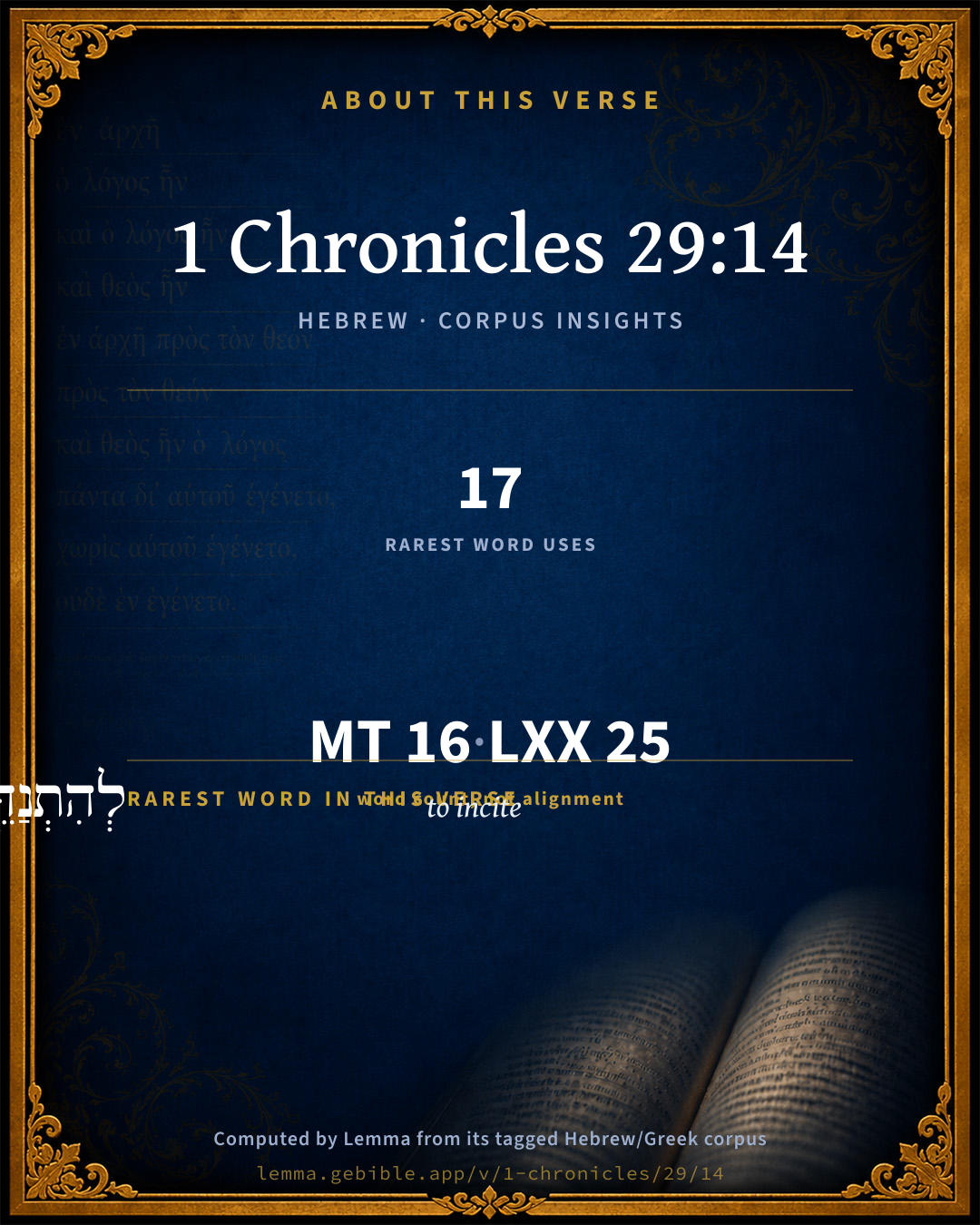
The rarest word here is לְהִתְנַדֵּ֖ב to incite H5068 — appearing just 17 times in the whole Hebrew Bible.

Shared distinctive vocabulary

לְהִתְנַדֵּ֖ב to incite H5068 occurs in 15 verses of the Hebrew Bible. Also found in:

Grammatical profile

  • 3 verbs
  • 4 nouns
  • 2 pronouns
  • 2 prepositions
  • 3 conjunctions
  • 2 particles

Verb forms

  • נַעְצֹ֣ר Qal · Imperfect
  • לְהִתְנַדֵּ֖ב Hithpael · Infinitive Construct
  • נָתַ֥נּוּ Qal · Perfect

Repetition

Words recur within this verse — often emphatic in Hebrew:

  • וְכִ֨י that H3588 ×3
  • מִ֤י who H4310 ×2

Hebrew & Septuagint length

In English translation the verse runs 34 words from the Hebrew and 35 from the Septuagint (LXX English) — closely comparable.

A rough comparison of the two English renderings, which tokenize alike — not a word-level alignment.

Word counts can differ between the Hebrew and the Greek without any difference in meaning — e.g. the Hebrew direct-object marker אֵת has no separate Greek word, and Greek often adds the article ὁ.

In the original languages it is 16 Hebrew tokens and 25 Greek tokens — but the two are counted differently (Hebrew bundles its prefixes and suffixes into one token; the Greek is in lemma form), so that isn’t a like-for-like length.

Cross-references

12

Topical passages linked to 1 Chronicles 29:14 in the Treasury of Scripture Knowledge — connected by theme and wording, ordered by reader-vote popularity; previews shown in the World English Bible.

  • James 1:17 Every good gift and every perfect gift is from above, coming down from the Father of lights, with whom can be no variation, nor turning shadow.
  • 2 Corinthians 3:5 not that we are sufficient of ourselves, to account anything as from ourselves; but our sufficiency is from God;
  • Romans 11:36 For of him, and through him, and to him, are all things. To him be the glory for ever! Amen.
  • 2 Corinthians 12:9–11 He has said to me, "My grace is sufficient for you, for my power is made perfect in weakness." Most gladly therefore I will rather glory in my weaknesses, that the power of Christ may rest on me.
  • Psalms 50:10–12 For every animal of the forest is mine, And the cattle on a thousand hills.
  • Psalms 115:1 Not to us, Yahweh, not to us, But to your name give glory, For your loving kindness, and for your truth's sake.
  • Genesis 32:10 I am not worthy of the least of all the loving kindnesses, and of all the truth, which you have shown to your servant; for with just my staff I passed over this Jordan; and now I have become two companies.
  • 1 Chronicles 29:9 Then the people rejoiced, because they offered willingly, because with a perfect heart they offered willingly to Yahweh: and David the king also rejoiced with great joy.
  • 1 Corinthians 15:9–10 For I am the least of the apostles, who is not worthy to be called an apostle, because I persecuted the assembly of God.
  • Philippians 2:13 For it is God who works in you both to will and to work, for his good pleasure.
  • Genesis 28:22 then this stone, which I have set up for a pillar, will be God's house. Of all that you will give me I will surely give the tenth to you."
  • 2 Samuel 7:18 Then David the king went in, and sat before Yahweh; and he said, Who am I, Lord Yahweh, and what is my house, that you have brought me thus far?

Cross-references courtesy of OpenBible.info (CC BY 4.0).

Hebrew and Greek witnesses Masoretic Hebrew ↔ Greek Septuagint

The same verse in the two great witnesses to the Old Testament, shown verse-for-verse.

These are two independent witnesses, not word-aligned to each other, and the Septuagint is shown in lemma (dictionary) form.

Hebrew 1 Chronicles 29:14 Masoretic · Westminster Leningrad Codex

וְכִ֨י מִ֤י אֲנִי֙ וּמִ֣י עַמִּ֔י כִּֽי נַעְצֹ֣ר כֹּ֔חַ לְהִתְנַדֵּ֖ב כָּזֹ֑את כִּֽי מִמְּךָ֣ הַכֹּ֔ל וּמִיָּדְךָ֖ נָתַ֥נּוּ לָֽךְ

But who am I, and what is my people, that we should be able to offer so willingly as this? For all things come of you, and of your own have we given you.

World English Bible · Public Domain

Greek LXX 1 Chronicles 29:14 Septuagint · lemma form

καί τίς εἰμί ἐγώ καί τίς ὁ λαός ἐγώ ὅτι ἰσχύω προθυμέομαι σύ κατά οὗτος ὅτι σός ὁ πᾶς καί ἐκ ὁ σός δίδωμι σύ

But who am I, and what is my people, that we have been able to be thus forward in offering to you? for all things are your, and of your own have we given you,

LXX2012 (modern English Septuagint) · Public Domain

Hebrew: Westminster Leningrad Codex (CC BY 4.0). Greek: Septuagint (public domain); English from LXX2012 (modern English Septuagint) (Public Domain). How the Septuagint differs from the Hebrew →

Commentary

Notes on 1 Chronicles 29:14 from classic Christian and Jewish commentators (each source and its license shown beneath its notes). The classic Christian expositions comment on the surrounding passage and are grouped to its opening verse, so a note may address several verses; the Jewish commentaries on the Tanakh (Rashi and others) are per-verse, so they appear only where the commentator wrote on this verse.

Lemma curates 59 commentaries, every one of them public domain or Creative Commons licensed, each selected and text-cleaned for this edition rather than reprinted as found. About our sources →

Trapp's Complete Commentary

John Trapp

1Ch 29:14 But who [am] I, and what [is] my people, that we should be able to offer so willingly after this sort? for all things [come] of thee, and of thine own have we given thee.

Ver. 14. But who am I, and what is my people?] This question showeth that David had a low mind in a lofty conversation, {a} which is a high commendation.

That we should be able to offer so willingly.] "It is God that worketh in us both to will and to do," {Php 2:13} and he can easily put into the hearts of his richer servants to relieve the poorer; yea, to hold it an honour, as here, that they may be so employed as almoners to the Most High.

And of thine own have we given thee.] Tα σα εκ των σων, as that good emperor wrote about his rich communion table in the temple of Sophia in Constantinople, dedicated to Jesus Christ; that is, Thine own things, and of thine own, do we thy servants Justinian and Theodora present unto thee, O thou Son and Word of God, who wast incarnated and crucified for us, beseeching thee graciously to accept the same, &c. {b} Bernard reporteth of Pope Eugenius, that meeting with a poor but honest bishop, he secretly gave him certain rich jewels wherewith he might present him. In like sort dealeth God by his poor servants, crowning his own graces in them, and accepting them for his own "comeliness," which himself hath "put upon them." {Eze 16:14}

{a} υφηλου βιου ταπεινον φρονημα.

{b} Cedren. Compend.

John Trapp, A Commentary or Exposition upon All the Books of the Old and New Testament (1647–1656) — public domain. Text from a community e-Sword module.

The Biblical Illustrator

Joseph S. Exell

1Ch_29:14

But who am I, and what is my people, that we should be able to offer so willingly?

The impossibility of creature-merit

No point in theology requires to be oftener stated, or more carefully established, than the impossibility that a creature should merit at the hands of the Creator. Each one of us, if he have ever probed his own heart, will confess himself prone to the persuasion, that the creature can lay the Creator under obligation. If one being merit of another, it must perform some action which it was not obliged to perform, and by which that other is advantaged. If either of these conditions fail, merit must vanish.

I. We are, in the first place, to speak on the stated fact that all things come of God.

II. The inference is--that we can give to God nothing which is not already His. If one creature give a thing to another, he ceases to have property in the gift, and cannot again claim it as his own. If a man make me a present he virtually cedes all title to the thing given; and if i were after;yards to restore him the whole, or a part, it would be of mine own that I gave him. But if I were reduced to utter poverty, with no means whatsoever of earning a livelihood, and if a generous individual came forward and gave me capital, and set me up in trade, and if, in mine after prosperity, I should bring my benefactor some offering expressive of gratitude, it is clear that I might, with the strictest truth say, Of thine own do I give thee. I should be indebted to my benefactor for what I was able to give; and, of course, that for which I stood indebted to him might be declared to be his. But even this comes far short of the Creator and the creature. This will show that there is no merit in the commonly-presumed instances of human desert.

1. Repentance.

2. Faith.

3. Works. (H. Melvill, B. D.)

God acknowledged

One of his gifts to his native town consisted of twenty-four beautiful and commodious almshouses, which were built and endowed by Sir Francis, as a testimony of his gratitude to Almighty God, and with a view of benefiting those of his fellow-townsmen who may be in need of assistance. Over the second-floor window of the central almshouse, along with the arms of Sir Francis, is the text, from 1Ch_29:14, Of Thine own have we given Thee. Each of the inmates receives from the endowment of the founder a weekly allowance sufficient to keep him from want. (Memoirs of Sir Francis Crossley.)

All belongs to God

There is no portion of time that is our time, and the rest Gods; there is no portion of money that is our money, and the rest Gods money. It is all His; He owns it all, gives it all, and He has simply trusted it to us for His service. A servant has two purses, the masters and his own; but we have only one. (A. Monod.)

Our obligations to God

A merchant in America, whom the Lord had greatly prospered, was a member of a Church where the congregation was mainly composed of very poor people, and therefore he had the privilege of contributing very largely to the upkeep of the Church, and toward the ministers salary. One of the members of the Church was travelling, and in conversation with a clergyman whom he met, he mentioned the case of Mr. D , and extolled his great liberality. The minister, without denying the praiseworthiness of the action, said, Now, you are a merchant? Yes. Well, I suppose you employ a clerk to serve your goods, and a schoolmaster to educate your children. Now, suppose the fees due to the schoolmaster had become due, and you give your clerk instructions to pay these, what would you think if that clerk were to receive great praise for having disbursed the money according to your instructions? I should think it very absurd. Well, do you not see that the case of your liberal-hearted friend and that hypothetical case of mine are almost analagous? God employs him as His steward or clerk to trade for Him; and out of the money which God has given him he is commanded to pay the schoolmaster of Gods children. The merchant is quite as much under obligation to trade for God as is the preacher to preach for God. We should remember that all things should be done to the glory of God. (J. King.)

Christ, the author of blessings ministered through His servants

Florence Nightingale, having gone like an angel of mercy among the hospitals in the Crimea, until her name was enshrined in every soldiers heart, asked to be excused from having her picture taken, as thousands begged, that she might drop out and be forgotten, and that Christ alone might be remembered as the author of the blessings her hands had ministered. That is the true Christian spirit. (J. R. Miller, D. D.)

No room for God

It is said of Hadrian VI. that, having built a stately college at Louvain, he set this inscription on the front in golden letters: Trajectum plantavie, Lovanium rigavit, sed Caesar dedit incrementum (Utrecht planted me, Louvain watered me, but Caesar gave the increase). A passenger, reproving his folly, underwrote: Hic Deus nihil fecit (Here was no room for God to do anything.) (Patens.)

The building of the temple

I call your attention--

I. To the hallowed work in which we are engaged; to build the temple, the Church of God, the house of prayer for all the people.

1. The temple was to be a house for the holy name of God.

2. The temple was the place of authorised and accepted sacrifice.

3. The temple was the place of united worship and of united blessing.

4. It was the place of actual communion between God and man.

II. The sentiments of deep abasement with which the circumstance of being permitted to take a part in it impressed the mind of David. The honour of being employed in a work of God ought to be deeply abasing to man. Who am I, and what is my people? These questions suggest three views.

1. What are we with reference to our former selves? We are, at best, but pardoned criminals; and have a long and sad retrospect of ingratitude and disobedience.

2. What are we in reference to our associates in this work?

3. What are we in reference to our actual contributions to this work?

III. To a consideration calculated powerfully to quicken our exertions in every department of the work of God, which may by His mercy be assigned to us. We are strangers before Thee, etc. This reminds us--

1. That what we do we must do quickly.

2. That what we do for others we must do quickly.

3. That short and uncertain as life is, within its narrow space works of infinite importance may nevertheless be done. Apply this--

(1) To your own personal conduct.

(2) To the great work of building the temple of God in distant lands.

IV. In all works undertaken for God, we are taught by the text to be mindful of the principle from which they flow. In the uprightness of my heart I have willingly offered all these things. To be upright in a moral sense signifies to be conformable to the will or law of God. That law, with reference to, the exercises of religious charity, has various parts, and taken together, they constitute uprightness. There is--

1. The law of sincere intention.

2. The law of grateful return.

3. The law of faithfulness.

4. The law of liberality.

5. The law of cheerful distribution.

6. The law of perseverance.

V. The joyous and benevolent feelings of the aged monarch when he saw the people assembled so willingly to offer in so blessed a work. It is a joyful night.

1. As a declaration of faith.

2. As a declaration of lofty and truly Christian benevolence.

3. As it opens the gate of the most splendid and delightful hopes. (R. Watson.)

Christian liberality in Gods cause

I. Liberality in the cause of God is worthy of all men.

1. Our infinite obligations demand it.

(1) How royally He gives to us

(a) The protecting care of His providence;

(b) the blessings of life.

(2) The earth and all things in it are His. How He opens His hand and satisfies the wants of every living thing!

(3) The gifts of His grace.

(a) The unspeakable gift of His Son;

(b) the promise of eternal glory.

2. Liberality in His cause is only the return to Him of part of that which He has given to us (1Ch_29:12).

(1) His gifts are trusts.

(2) We are stewards, not absolute owners.

(3) We are to occupy till He comes.

3. To withhold from Him is to lose His blessing on what we retain. To give to Him ever brings richer gifts, if only in the spiritual graces it calls forth.

4. Liberality in the cause of God is urged by our interest in the best welfare of our fellow-men.

II. Liberality is not only a duty, but a privilege.

1. It is a grateful recognition of being so blessed as to be able to give.

2. The willingness to, give is a ground of thankfulness.

III. The liberality of David and his people a lesson.

IV. Reflections.

1. We should cherish liberality for God, for the good it does our own souls. The gratitude, love, zeal, of which it is the expression, and which it directly fosters.

2. For the good it does our fellow-men.

3. We should measure our gifts by what we retain.

(1) How much do we give to God in comparison with what we give to ourselves?

(2) Have we ever made any real sacrifice for Him? Matthew and the other apostles have. Have we only given of our superfluity? (Cunninghan Geikie, D. D.)

God the bestower of all good gifts

I. The ability and the disposition to give to God come alike from Himself.

II. We ought to be more profoundly thankful for the possession of the disposition than of the ability to give.

III. The ability and the disposition to give are never more nobly employed than in erecting temples for the worship of God. (H. Stowell, A. M.)

A voluntary gift under the law

I. The nature of the gift. I do not dwell on the extent. I refer rather to its essential nature. It was a gift distinctly for the public good. What is called public spirit is surely one of the divinest things extant among men. God keeps alive this will to serve and sacrifice for the public as the great antidote to the innate selfishness of mankind. Public spirit rises in importance and dignity as man rises in intelligence, and is able to take wise counsel about the welfare of his fellows. If he is able to take heavenly counsel, to know what God is seeking for man and to supply it, there you have in the highest form the servant of his generation according to the will of God. This glory is theirs who take counsel and work for the religious culture sad elevation of men. They are the men who key the arch of progress and make it firm and sure.

II. The source of Davids and the peoples joy.

1. Living under the constraint of love is the most joyful exercise of the human powers. Mans selfishness is not native. It is the dents poison in his blood. Divine charity expels it. The sculls conscious of health again, sad breaks out into praise.

2. The joy man takes in the accomplishment of a noble public object is the purest and loftiest of all human joys.

3. I suppose a vision passed before Davids sight of what that work would be to man, and would do for man, through ages.

4. Concord in good works realises perhaps more than anything in our experience the angelic benediction, Peace on earth and goodwill to men.

III. The reason of the praise.

1. It is Gods inspiration. Of Thine own, of the strength and joy which Thine own hand has inspired, have we given Thee.

2. Praise and bless the Lord who inspires this spirit, for it commands an abounding blessing. (Baldwin Brown, B. A.)

The Biblical Illustrator, edited by Joseph S. Exell (c. 1880s–1900s) — public domain. Text from a community e-Sword module.

Geneva Bible (1599)

Geneva Bible translators

We gave thee nothing of our own, but that which we have received of thee: for whether the gifts be corporal or spiritual, we receive them all of God, and therefore must give him the glory.

Geneva Bible (1599) marginal notes — public domain. Text via Bolls.life.

Adam Clarke's Commentary

Verse 14. Of thine own have we given thee.] "For from thy presence all good comes, and of the blessings of thy hands have we given thee."-Targum.

Adam Clarke's Commentary on the Bible (1810–1826) — public domain. Text from a community e-Sword/MySword module.

Ellicott's Commentary for English Readers

(14) But who am I?—And, indeed, who am I? (answering to the Greek καὶ γάρ).

That we should be able.—That we should hold in: i.e., keep strength (‘âçar kôah), a phrase confined to six passages in the Chronicles and three in Daniel (Dan_11:6; Dan_10:8; Dan_10:16).

All things come of thee.—For from thee is the whole (scil.) of our wealth and power. (Comp. 1Ch_29:16.)

And of thine own.—And out of thine own hand.

A Bible Commentary for English Readers, edited by Charles John Ellicott (1878–1897) — public domain. Text from a community e-Sword module.

The Cambridge Bible for Schools and Colleges

gen. ed. J. J. S. Perowne

14. be able] Lit. retain strength. David praises God for the great success of the efforts of so transitory a creature as man.

of thine own] Lit. out of thine hand.

The Cambridge Bible for Schools and Colleges (gen. ed. J. J. S. Perowne; Cambridge University Press, 1878–1918) — public domain. Text from a community e-Sword module.

John Gill's Exposition

For we are strangers before thee, and sojourners, as were all our fathers,.... For though they were in possession of the land of Canaan, yet they held it not in their own right, but as the Lord's:

who said, the land is mine, Lev 25:23, they were but tenants in it, and were not to abide long here; they belonged to another city and country; the consideration of which might tend to set them loose to worldly things, and the more easily to part with them for the service of God, and the honour of his name:

our days on the earth are as a shadow; man's life is expressed by days, not months and years, being so short; and by days on earth, in distinction from the days of heaven, or eternity; and these said to be as a shadow, of a short continuance, empty, mutable, and uncertain, dark and obscure, quickly gone, like the shadow of the sun; and not only like that, or of a mountain, tree or wall; but, as the Targum, of a bird that is flying, which passes away at once:

and there is none abiding; not long, much less always, being but sojourners as before; so Cato in Cicero (p) is represented as saying,"I depart out of this life as from an inn, and not an house; for nature has given us an inn to sojourn, not a place to dwell in:''or "there is no hope or expectation" (q); of living long, of recalling time, and of avoiding death.

(p) De Senectute, c. 23. (q) "non est expectatio sive spes", Pagninus, Montanus, Vatablus, Michaelis.

John Gill's Exposition of the Whole Bible (1746–1763) — public domain (CC PDM 1.0). Text via the HelloAO Bible API.

Haydock's Catholic Bible Commentary

Promise. Hebrew, "to offer so willingly in this manner?" (Haydock) --- He is astonished at the rich display of gifts: but acknowledged that all was originally sent by God. In the same sentiments, we say in the mass, "We offer unto thee of thy own presents and gifts;" or, as the Greek expresses it, Greek: ta sa apo ton son. (Calmet)

George Leo Haydock (1774–1849), Haydock's Catholic Family Bible and Commentary, 1859 edition — public domain. Excludes Psalms (Douay-Rheims chapter numbering differs from Protestant) and Deuterocanonical books (Catholic canon only).

Matthew Poole's English Annotations

That we should be able to offer so willingly, i.e. that thou shouldst give us both such riches out of which we should be able to make such an offering, and such a willing and free heart to offer them; both which are thy gifts, and the fruits of thy good grace and mercy to us.

Of thine own have we given thee; we return only what we have received, and therefore we do only pay a debt to thee, and do not hereby oblige thee, or deserve any thing from thee.

Matthew Poole's English Annotations on the Holy Bible (1683–1685) — public domain. Text from a community e-Sword/MySword module.

John Wesley's Explanatory Notes

To offer - That thou shouldest give us both riches to make such an offering, and a willing heart to offer them, both which are the gifts and the fruits of thy good grace and mercy to us. Of thine - We return only what we have received, and therefore only pay a debt to thee. The more we do for God, the more we are indebted to him; for the honour of being employed in his service, and for grace enabling us in any measure to serve him.

John Wesley, Explanatory Notes Upon the Whole Bible (1754–1765) — public domain. Text via the GEBible commentary corpus.

Keil & Delitzsch

C. F. Keil & F. Delitzsch

For we are strangers before thee, and sojourners, as were all our fathers,.... For though they were in possession of the land of Canaan, yet they held it not in their own right, but as the Lord's:

who said, the land is mine, Lev 25:23, they were but tenants in it, and were not to abide long here; they belonged to another city and country; the consideration of which might tend to set them loose to worldly things, and the more easily to part with them for the service of God, and the honour of his name:

our days on the earth are as a shadow; man's life is expressed by days, not months and years, being so short; and by days on earth, in distinction from the days of heaven, or eternity; and these said to be as a shadow, of a short continuance, empty, mutable, and uncertain, dark and obscure, quickly gone, like the shadow of the sun; and not only like that, or of a mountain, tree or wall; but, as the Targum, of a bird that is flying, which passes away at once:

and there is none abiding; not long, much less always, being but sojourners as before; so Cato in Cicero (p) is represented as saying,"I depart out of this life as from an inn, and not an house; for nature has given us an inn to sojourn, not a place to dwell in:''or "there is no hope or expectation" (q); of living long, of recalling time, and of avoiding death.

(p) De Senectute, c. 23. (q) "non est expectatio sive spes", Pagninus, Montanus, Vatablus, Michaelis.

Keil & Delitzsch — Biblical Commentary on the Old Testament (1861–1891) — public domain (CC PDM 1.0). Text via the HelloAO Bible API. (Old Testament only.)

unfoldingWord translationNotes

Door43 World Missions Community

General Information:

David continues his prayer of praise to Yahweh.

But who am I, and who are my people, that we should be able to offer so willingly these things?

David uses this rhetorical question to express that he and his people deserve no praise for giving anything to God. AT: "My people and I should definitely offer these things to you willingly!" (See: Rhetorical Question)

we are strangers and travelers before you

This speaks of people's lives being short as if they were travelers only here on earth for a short time. AT: "For our lives are short and we are like strangers and travelers who pass before you" (See: Metaphor)

Our days on the earth are like a shadow

This speaks of people's lives being short as if they were a shadow that is only visible for a short time. A person's lifetime is represented by his "days." AT: "Our time here on earth is like a shadow that disappears quickly" (See: Simile and Synecdoche)

translationWords

shadow

hope

unfoldingWord translationNotes — © Distant Shores Media and the Door43 World Missions Community, licensed CC BY-SA 4.0. Source: git.door43.org/Door43/en_tn.

Rashi

Rabbi Shlomo Yitzchaki (Rashi)

Now who am I and who are my people that we should gather up strength to donate that we exerted ourselves to donate so much with this donation, and it is not ours, but all is from You, and You imparted a little to us.

and from Your hand we have given it to You - Heb. נָתַנּוּ. And what You have given us from Your hand, we have given You part. The “nun” punctuated by the “dagesh” substituted for the second “nun” נָתַנְנוּ לְךָ.

Rashi on the Tanakh — English translations: “The Judaica Press complete Tanach with Rashi, translated by A. J. Rosenberg” (CC BY 4.0); “Pentateuch with Rashi's commentary by M. Rosenbaum and A.M. Silbermann, 1929-1934” (public domain); “The Metsudah Tanach series, Lakewood, N.J” (CC BY 4.0); and “The Book of Joshua, Metsudah Publications, 1997” (CC BY 4.0). Text via Sefaria.

Lesson kit

Teaching starters — assembled from the data on this page, not authored interpretation. Every prompt links to the verse data it draws on. Edit before teaching.

1 Chronicles, in the Historical, opens this verse with 16 words (12 distinct Hebrew lemmas). Its most distinctive word is nâdab (“to incite”). A historical commentator’s framing appears above. Read the whole chapter for the surrounding context.

Discussion questions

  1. The word nâdab carries the sense “to incite.” How does it shape the verse?
  2. How does Exodus 25:2, which shares the word «to incite», read alongside this verse?
  3. What does the repetition of “that” (3× in this one verse) do in this verse?
  4. The translations on this page render this verse differently — a whole-verse word diff, not a word-by-word alignment. What might account for the different wordings?
  5. «נַעְצֹ֣ר» is a Qal Imperfect verb. How does that grammatical form shape the action described?
  6. Compare how Trapp's Complete Commentary and The Biblical Illustrator read this verse. Where do they agree or differ?

Things to notice

Reading settings

Reading text

Shown beneath each verse's original-language words.

Old Testament
Old Testament edition

Read the OT as the Masoretic Hebrew (MT) or the Greek Septuagint (LXX).

English shown for the Greek Septuagint (in the Hebrew ↔ Greek comparison).

Comparing translations? Open the Compare panel on any verse page to stack up to four side by side.