
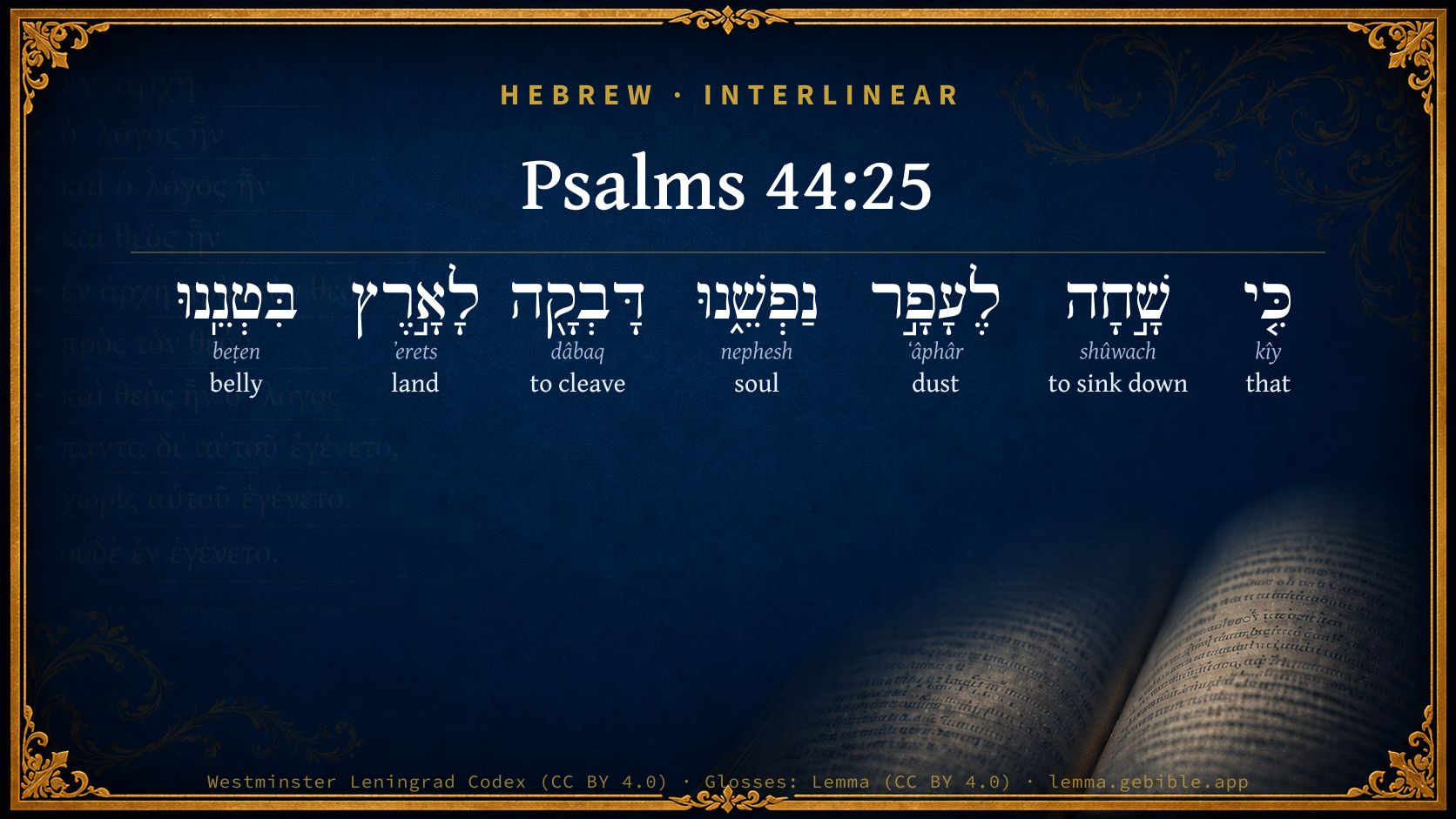
Psalms 44:25

Hebrew (Westminster Leningrad Codex) Psalms 44:25 appears in the Hebrew Old Testament. The text above is from the Westminster Leningrad Codex. Each word links to its Strong’s number, a concise gloss, and parsing drawn from the Open Scriptures Hebrew Bible morphology. Click any word for its full Brown-Driver-Briggs (BDB) entry.
Download image
Cite this verse

Psalms 44:25 (World English Bible). Public Domain. Lemma interlinear Bible study tool, https://lemma.gebible.app/v/psalms/44/25.

Show BibTeX & RIS
BibTeX
RIS
English Translation
For our soul is bowed down to the dust. Our body cleaves to the earth.
World English Bible · Public Domain
Highlights
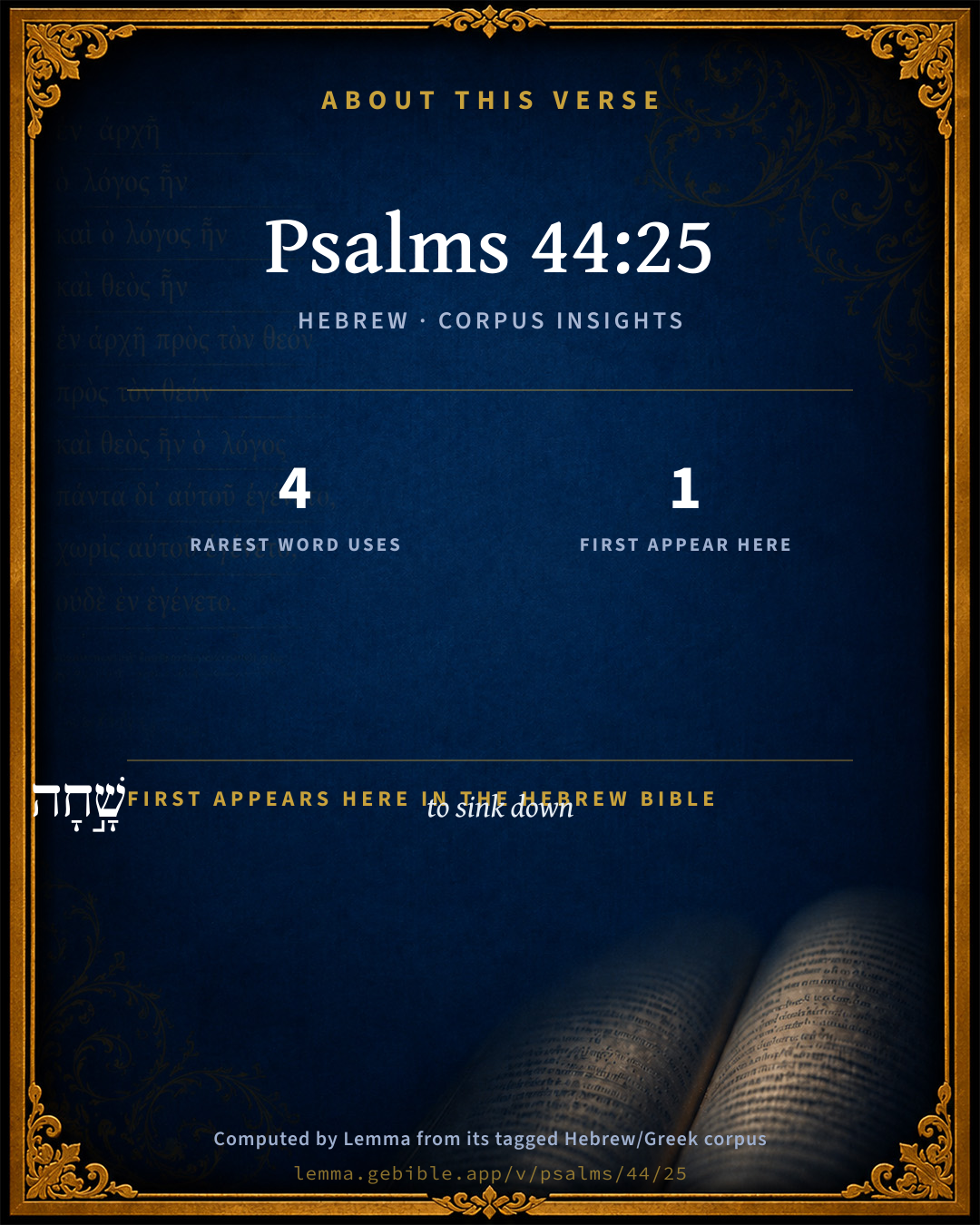
  • 1 first appearance in the Hebrew Bible
Full analysis ↓
Download a study sheet

One document with this verse’s original text, its word-by-word gloss line, the meaning frame, cross-references with their text, attributed commentary, and full source and license credits — printable, and it pastes into notes with its structure intact.

This verse Autodidact and up

Study sheet (.html) Plain text (.txt)

A passage Seminary Student

Up to 50 verses in one chapter. A passage sheet keeps up to 6 commentary sources and 12 cross-references per verse, in the order this page ranks them, and says so on the sheet whenever that leaves anything out. Ask for a single verse and you get the Autodidact verse sheet above.

Everything on this page stays free to read, with no account — the sheet is a download of what is already on screen, not access to it.

Want to remove ads? Support Godless Engineer
Compare translations 3

The same verse in 3 English versions, stacked beneath the original-language interlinear above. Click any original word for its lexicon entry.

Each is an independent rendering of the whole verse — the interlinear is not word-aligned to these translations.

Highlighted words mark where these versions differ — a whole-verse word diff, not a word-by-word alignment.

  • World English Bible Public Domain
    For our soul is bowed down to the dust. Our body cleaves to the earth.
  • King James Version Public Domain
    For our soul is bowed down to the dust: our belly cleaveth unto the earth.
  • unfoldingWord Literal Text CC BY-SA 4.0
    For our soul has sunk down into the dust, our belly clings to the earth.

unfoldingWord Literal Text — © unfoldingWord, licensed CC BY-SA 4.0. Word-aligned USFM3 via Door43 (git.door43.org/unfoldingWord/en_ult).

Versions to compare (up to 4)

3 of 4 selected

Show all 18 translations

Every available English version of this verse, each an independent rendering of the whole verse.

  • World English Bible Public Domain
    For our soul is bowed down to the dust. Our body cleaves to the earth.
  • Berean Standard Bible Public Domain
    For our soul has sunk to the dust; our bodies cling to the earth.
  • Majority Standard Bible Public Domain
    For our soul has sunk to the dust; our bodies cling to the earth.
  • King James Version Public Domain
    For our soul is bowed down to the dust: our belly cleaveth unto the earth.
  • American Standard Version (1901) Public Domain
    For our soul is bowed down to the dust: Our body cleaveth unto the earth.
  • Revised Version (1885) Public Domain
    For our soul is bowed down to the dust: our belly cleaveth unto the earth.
  • Geneva Bible (1599) Public Domain
    For our soule is beaten downe vnto the dust: our belly cleaueth vnto the ground.
  • Douay-Rheims (1899) Public Domain
    For our soul is humbled down to the dust: our belly cleaveth to the earth.
  • Young's Literal Translation Public Domain
    For bowed to the dust hath our soul, Cleaved to the earth hath our belly.
  • Literal Standard Version CC BY-SA 4.0
    For our soul has bowed to the dust, || Our belly has cleaved to the earth.
  • Unlocked Literal Bible CC BY-SA 4.0
    For we have melted away into the dust; our bodies cling to the earth.
  • unfoldingWord Literal Text CC BY-SA 4.0
    For our soul has sunk down into the dust, our belly clings to the earth.
  • Darby Bible Public Domain
    For our soul is bowed down to the dust; our belly cleaveth unto the earth.
  • World Messianic Bible Public Domain
    For our soul is bowed down to the dust. Our body clings to the earth.
  • Webster's Bible Public Domain
    \\44:24\\Why hidest thou thy face, and forgettest our affliction and our oppression?
  • Free Bible Version CC BY-SA 4.0
    We lie ruined in the dust, our bodies facedown in the dirt.
  • Bible in Basic English Public Domain
    For our souls are crushed down to the dust: our bodies are stretched out on the earth.
  • JPS Tanakh (1917) Public Domain
    (44-26) For our soul is bowed down to the dust; our belly cleaveth unto the earth.

Literal Standard Version (2020), Covenant Press — licensed CC BY-SA 4.0. Text via the HelloAO Bible API (eBible.org). Unlocked Literal Bible (unfoldingWord) — licensed CC BY-SA 4.0. Text via the HelloAO Bible API (eBible.org). unfoldingWord Literal Text — © unfoldingWord, licensed CC BY-SA 4.0. Word-aligned USFM3 via Door43 (git.door43.org/unfoldingWord/en_ult). Free Bible Version, Dr. Jonathan Gallagher — licensed CC BY-SA 4.0. Text via the HelloAO Bible API (eBible.org).

Word by word

More ways to search: Search by grammar → Find every occurrence → Compare this word →

Practice this passage: Drill this verse → Learn its vocabulary →

About this verse

These counts appear in no published source. They are computed here, from the morphology-tagged text and Lemma’s own curated glosses. What Lemma adds →

7
words
7
distinct lemmas
Wisdom
section

Notable vocabulary

The rarest word here is שָׁ֣חָה to sink down H7743 — appearing just 4 times in the whole Hebrew Bible.

First appearance in Scripture

This word makes its first canonical appearance in the Hebrew Bible here:

  • שָׁ֣חָה to sink down H7743

Shared distinctive vocabulary

שָׁ֣חָה to sink down H7743 occurs in 3 verses of the Hebrew Bible. Also found in:

Grammatical profile

  • 2 verbs
  • 4 nouns
  • 1 conjunction

Verb forms

  • שָׁ֣חָה Qal · Perfect
  • דָּבְקָ֖ה Qal · Perfect

Hebrew & Septuagint length

In English translation the verse runs 15 words from the Hebrew and 17 from the Septuagint (LXX English) — closely comparable.

A rough comparison of the two English renderings, which tokenize alike — not a word-level alignment.

Word counts can differ between the Hebrew and the Greek without any difference in meaning — e.g. the Hebrew direct-object marker אֵת has no separate Greek word, and Greek often adds the article ὁ.

Cross-references

4

Topical passages linked to Psalms 44:25 in the Treasury of Scripture Knowledge — connected by theme and wording, ordered by reader-vote popularity; previews shown in the World English Bible.

  • Psalms 119:25 My soul is laid low in the dust. Revive me according to your word!
  • Psalms 66:11–12 You brought us into prison. You laid a burden on our backs.
  • Isaiah 51:23 and I will put it into the hand of those who afflict you, who have said to your soul, Bow down, that we may go over; and you have laid your back as the ground, and as the street, to those who go over.
  • Lamentations 4:5 Those who did feed delicately are desolate in the streets: Those who were brought up in scarlet embrace dunghills.

Cross-references courtesy of OpenBible.info (CC BY 4.0).

Hebrew and Greek witnesses Masoretic Hebrew ↔ Greek Septuagint

The same verse in the two great witnesses to the Old Testament, shown verse-for-verse.

You’re reading Greek Psalm 43 (Hebrew Psalm 44). The Septuagint counts the superscription, so verse numbers can differ from the Hebrew — chapter-level alignment, not verse-by-verse. Numbering follows Rahlfs.

These are two independent witnesses, not word-aligned to each other, and the Septuagint is shown in lemma (dictionary) form.

Hebrew Psalms 44:25 Masoretic · Westminster Leningrad Codex

כִּ֤י שָׁ֣חָה לֶעָפָ֣ר נַפְשֵׁ֑נוּ דָּבְקָ֖ה לָאָ֣רֶץ בִּטְנֵֽנוּ

For our soul is bowed down to the dust. Our body cleaves to the earth.

World English Bible · Public Domain

Greek LXX Greek Psalm 43:25 Septuagint · lemma form

ἵνα τίς ὁ πρόσωπον σύ ἀποστρέφω ἐπιλανθάνω ὁ πτωχεία ἐγώ καί ὁ θλῖψις ἐγώ

For our soul has been brought down to the dust; our belly has cleaved to the earth.

LXX2012 (modern English Septuagint) · Public Domain

Hebrew: Westminster Leningrad Codex (CC BY 4.0). Greek: Septuagint (public domain); English from LXX2012 (modern English Septuagint) (Public Domain). How the Septuagint differs from the Hebrew →

Commentary

Notes on Psalms 44:25 from classic Christian and Jewish commentators (each source and its license shown beneath its notes). The classic Christian expositions comment on the surrounding passage and are grouped to its opening verse, so a note may address several verses; the Jewish commentaries on the Tanakh (Rashi and others) are per-verse, so they appear only where the commentator wrote on this verse.

Lemma curates 59 commentaries, every one of them public domain or Creative Commons licensed, each selected and text-cleaned for this edition rather than reprinted as found. About our sources →

Trapp's Complete Commentary

John Trapp

Psa 44:25 For our soul is bowed down to the dust: our belly cleaveth unto the earth.

Ver. 25. For our soul, &c.] Soul and belly (or body), both are oppressed, and lie suppliant at God’s feet; resolved there to live and die together.

John Trapp, A Commentary or Exposition upon All the Books of the Old and New Testament (1647–1656) — public domain. Text from a community e-Sword module.

J. A. Alexander on Psalms

Joseph Addison Alexander

26. (Psa 44:25). For bowed (or sunk) to the dust is our soul, fixed to the earth is our belly. Both Hebrew verbs are active, and literally mean, our soul has bowed down, our belly has adhered. Belly may either have the sense of body, as opposed to soul, as in Psa 31:10 (9), above, or be taken in its proper sense, in which case the whole clause is descriptive of the deepest degradation, a grovelling on the earth, without the capacity or wish to rise, a state like that of the lowest reptiles, or the one denounced upon the serpent in Gen 3:14. Whatever the image here presented may be, it is evidently meant to represent a state of deep depression and debasement.

Joseph Addison Alexander, The Psalms Translated and Explained (1850) — public domain. Text from a community e-Sword module.

Geneva Bible (1599)

Geneva Bible translators

There is no hope of recovery, except thou put to thine hand and raise us up.

Geneva Bible (1599) marginal notes — public domain. Text via Bolls.life.

Adam Clarke's Commentary

Verse 25. Our soul is bowed down] Our life is drawing near to the grave. If thou delay to help us, we shall become extinct.

Adam Clarke's Commentary on the Bible (1810–1826) — public domain. Text from a community e-Sword/MySword module.

John Calvin's Commentaries

25 For our soul is humbled to the dust The people of God again deplore the greatness of their calamities, and in order that God may be the more disposed to help them, they declare to him that they are afflicted in no ordinary manner. By the metaphors which they here employ, they mean not only that they are cast down, but also that they are crushed and laid upon the earth, so that they are not able to rise again. Some take the word soul for the body, so that there would be in this verse a repetition of the same sentiment; but I would rather take it for the part in which the life of man consists; as if they had said, We are cast down to the earth, and lie prostrate upon our belly, without any hope of getting up again. After this complaint they subjoin a prayer, (verse 26,) that God would arise for their help By the word redeem they mean not ordinary kind of help, for there was no other means of securing their preservation but by redeeming them. And yet there can be no doubt, that they were diligently employed in meditating upon the great redemption from which all the deliverances which God is daily effecting in our behalf, when he defends us from dangers by various means, flow as streams from their source. In a previous part of the psalm, they had boasted of the steadfastness of their faith; but to show us that, in using this language, they boasted not in their own merits, they do not claim here some recompense for what they had done and suffered for God. They are contented to ascribe their salvation to the unmerited goodness of God as the alone cause of it.

John Calvin's Commentaries (1540-1563) — public domain. Text from the Calvin Translation Society English edition (1840s-50s) via the Christian Classics Ethereal Library (ccel.org). Calvin's coverage is partial (roughly two-thirds of the Bible); uncommented books and verses are honest gaps, never fabricated. The 19th-century editor's footnotes and remarks are omitted so the notes are faithfully Calvin's own voice.

The Cambridge Bible for Schools and Colleges

gen. ed. J. J. S. Perowne

25. We lie utterly prostrate, crushed and helpless. Cp. Psa_119:25.

The Cambridge Bible for Schools and Colleges (gen. ed. J. J. S. Perowne; Cambridge University Press, 1878–1918) — public domain. Text from a community e-Sword module.

John Gill's Exposition

For our soul is bowed down to the dust,.... Which may signify great declension in spiritual things, much dejection of mind, and little exercise of grace, Psa 119:25; or a very low estate in temporals; subjection to their enemies; they setting their feet upon their necks, and obliging them to lick the dust of them: and even it may signify nearness to death itself; see Jos 10:24;

our belly cleaveth to the earth; as persons that lie prostrate, being conquered and suppliants.

John Gill's Exposition of the Whole Bible (1746–1763) — public domain (CC PDM 1.0). Text via the HelloAO Bible API.

Albert Barnes' Notes on the Bible

For our soul is bowed down to the dust - That is, We are overborne with calamity, so that we sink to the earth. The expression is one that denotes great affliction.

Our belly cleaveth unto the earth - We are like animals that are prone upon the earth, and that cannot rise. The allusion may be to reptiles that cannot stand erect. The figure is intended to denote great prostration and affliction.

Albert Barnes' Notes on the Bible (1834–1885) — public domain. Text from a community e-Sword/MySword module.

Matthew Poole's English Annotations

Our soul, i.e. either our lives or persons; or rather bodies, as it is explained in the next clause, and as the soul is oft taken by a synecdoche, as Num 11:6; Psa 16:10; 106:15, &c.

To the dust; either to the ground, where we lie prostrate at our enemies’ feet, or to the grave.

Our belly cleaveth unto the earth; we are not only thrown down to the earth, but we lie there like dead carcasses fixed to it, without any ability or hope of rising again.

Matthew Poole's English Annotations on the Holy Bible (1683–1685) — public domain. Text from a community e-Sword/MySword module.

The Treasury of David

Charles H. Spurgeon

Ver. 25. For our soul is bowed down to the dust. Our heart is low as low can be, as low as the dust beneath the soles of men's feet. When the heart sinks, the man is down indeed. Heart sorrow is the very heart of sorrow. Our belly cleaveth unto the earth. The man is prone upon the earth, and he is not only down, but fastened down on the earth and glued to it. It is misery, indeed, when the heart cannot escape from itself, is shut up in its own dejection, and bound with the cords of despondency. God's saints may be thus abject, they may be not only in the dust, but on the dunghill with Job and Lazarus, but their day cometh, and their tide will turn, and they shall have a brave summer after their bitter winter.

Ver. 25. For our soul is bowed down to the dust: our belly cleaveth unto the earth. We are as to body and soul, smitten and thrown down, glued as it were to the ground, so that we cannot raise ourselves up. E. W. Hengstenberg.

Ver. 25. For our soul is bowed down to the dust, etc. The speech is metaphorical, expressing the depth of their misery, or the greatness of their sorrow and humiliation. 1. The depth of their misery, with the allusion to the case of a man overcome in battle, or mortally wounded, and tumbling in the dust, or to a man dead and laid in the earth; as, "Thou hast brought me into the dust of death." Ps 22:15. Sure we are, the expression imports the extremity of distress and danger, either as a man dead or near death. 2. The greatness of their sorrow and humiliation; and so the allusion is taken from a man prostrate and grovelling on the ground, which was their posture of humbling themselves before the Lord, or when any great calamity befell them. As when Herod Agrippa died, they put on sackcloth and lay upon the earth weeping. Thomas Manton.

Ver. 25. The great need, the great prayer, the great plea.

Psalms 44:26*

Charles H. Spurgeon's The Treasury of David (1869–1885) — public domain. Psalms only. Text from a community e-Sword/MySword module.

The Pulpit Commentary

For our soul is bowed down to the dust; i.e. brought very low, humbled, as it were, to the earth, so weakened that it has no strength in it. Our belly cleaveth unto the earth. The body participates in the soul"s depression, and lies prostrate on the ground.

The Pulpit Commentary (1880–1919), ed. H.D.M. Spence-Jones & Joseph S. Exell — public domain. Text from a community e-Sword module.

John Wesley's Explanatory Notes

Our soul - Our persons. Our belly - We are not only thrown down to the earth, but we lie there like dead carcases.

John Wesley, Explanatory Notes Upon the Whole Bible (1754–1765) — public domain. Text via the GEBible commentary corpus.

unfoldingWord translationNotes

Door43 World Missions Community

For we have melted away into the dust; our bodies cling to the earth

These parallel phrases share similar meanings. The writer describes his people as lying on the ground in a posture of defeat and humiliation. (See: Parallelism)

For we have melted away into the dust

The writer speaks of their humiliation as if their bodies were objects, such as ice, that melt and soak into the dirt. (See: Metaphor)

our bodies cling to the earth

The writer speaks of their humiliation as if their their bodies were stuck to the ground and they could not raise themselves up. (See: Metaphor)

Rise up

This is a command to stand. This phrase refers to beginning to act on something. AT: "Take action" (See: Idiom)

for the sake of your covenant faithfulness

The abstract noun "faithfulness" can be translated as an adjective. AT: "to show that you are faithful to your covenant" (See: Abstract Nouns)

translationWords

body

earth

raise

redeem

covenant faithfulness

unfoldingWord translationNotes — © Distant Shores Media and the Door43 World Missions Community, licensed CC BY-SA 4.0. Source: git.door43.org/Door43/en_tn.

Lesson kit

Teaching starters — assembled from the data on this page, not authored interpretation. Every prompt links to the verse data it draws on. Edit before teaching.

Psalms, in the Wisdom, opens this verse with 7 words (7 distinct Hebrew lemmas). Its most distinctive word is shûwach (“to sink down”). A historical commentator’s framing appears above. Read the whole chapter for the surrounding context.

Discussion questions

  1. What does “to sink down” (shûwach) contribute to the verse as a whole?
  2. This is the first place “to sink down” appears in Scripture (first appears here). What does its debut here establish?
  3. How does Proverbs 2:18, which shares the word «to sink down», read alongside this verse?
  4. These translations render this verse differently. What is at stake in choosing one wording over another?
  5. «שָׁ֣חָה» is a Qal Perfect verb. How does that grammatical form shape the action described?
  6. Compare how Trapp's Complete Commentary and J. A. Alexander on Psalms read this verse. Where do they agree or differ?

Things to notice

  • 1 word makes its first canonical appearance in Scripture here.
  • These translations choose different wording for 9 words in this verse.
  • 7 distinct Hebrew lemmas span 7 words in this verse.

Reading settings

Reading text

Shown beneath each verse's original-language words.

Old Testament
Old Testament edition

Read the OT as the Masoretic Hebrew (MT) or the Greek Septuagint (LXX).

English shown for the Greek Septuagint (in the Hebrew ↔ Greek comparison).

Comparing translations? Open the Compare panel on any verse page to stack up to four side by side.